Clearly, performing the science and writing the journal articles isn’t getting the messages out that need to be gotten out, not on the continuing destruction of our environment, which leads to the continuing destruction of our climate, nor on health care, nor sex education, nor the destruction of public education in the name of “teacher accountability, nor evolution as the vastly superior and more accurate portrayal of life than creationism, nor the failure of supply-side economics, nor on a number of other issues.
Imagine for a moment that you are a wee little mousie, sitting on a tuft of grass nibbling on a seed. You think you feel a breath of a breeze from in back of you and you turn around to see this beautiful thing
Owls fly silently. Their feathers have evolved to move without rustles, to let the wind slip through them without making a whish. Owls demonstrate evolution at its mightiest, and nature, as the poets note, “red in tooth and claw.”
I’d like to know more about this film. Trained owl? Wild owl enticed by what kind of bait? Longer movie about eagle owls? I’m not familiar with them. So many little mysteries on the internet.
New Photron SA-2 High Definition High Speed Camera. Shot of ‘Checkers’ the eagle owl, 1000fps 1920×1080 resolution. Shot by SlowMo (www.slowmo.co.uk). See the owl and other birds of prey at www.turbarywoods.co.uk.
From Wikipedia
The Eurasian Eagle-owl (Bubo bubo) is a species of eagle owl resident in much of Europe and Asia. It is also one of the largest types of owls.
* * * * * *
The Eagle Owl is a large and powerful bird, smaller than the Golden Eagle but larger than the Snowy Owl. It is sometimes referred to as the world’s largest owl, but this is actually the Blakiston’s Fish Owl, which is slightly bigger on average.[2][3] The Eagle Owl has a wingspan of 138–200 cm (55–79 in) and measures 58–75 cm (23–30 in) long. Females weigh 1.75-4.5 kg (3.9-10 lbs) and males weigh 1.5-3.2 kg (3.3-7 lbs).[4][5][6] In comparison, the Barn Owl weighs about 500 grams (1.1 lbs).
Tip of the old scrub brush to Kathryn.
Spread the word; friends don't allow friends to repeat history.
One of my favorite examples of evolution and how we can see it in living things today: The laryngeal nerve of the giraffe, linking larynx to brain, a few inches away — but because of evolutionary developments, instead dropping from the brain all the way down the neck to the heart, and then back up to the larynx. In giraffes the nerve can be as much as 15 feet long, to make a connection a few inches away. Richard Dawkins explains:
All mammals have the nerve, and as a result of our fishy ancestry, in all mammals, the nerve goes down the neck, through a heart blood vessel loop, and back up. In fish, of course, the distance is shorter — fish have no necks.
Go see — unless you’re a creationist. If you’re a creationist you’ll see so much that you’ll begin to doubt your faith in creationism and anti-science, and then you’re likely to confuse that with doubt of God, and you can’t stand such a faith trial.
July 21, 2011, Austin — Far fewer people than usual signed up to testify on the electronic science book supplements the Texas State Board of Education is considering in lieu of new textbooks (no money for texts from the legislature, you recall).
So, in keeping with Chairman Barbara Cargill’s wishes, testimony concluded at 4:06 p.m. CDT, just six minutes later than scheduled.
Good deal. The air conditioning in the first floor hearing room still doesn’t work well.
Since 2003, the most visible difference in these hearings is the back wall. That’s where the electrical outlets are, and so those seats get taken up by publishers, lawyers, lobbyists, and a few bloggers.
When the board reconvenes at 4:30, the board will take up consideration of the supplemental materials. If they follow the testimony, there will be a quick vote to approve all of the supplements still standing.
But this may be where the fireworks get lighted.
Most witnesses asked the board to simply approve the supplemental material favored by staff at the Texas Education Agency and by the panels of teachers and experts the board appointed earlier. Those recommendations excluded the only pro-creationism materials by a small, first-time publishing company.
Andrew Ellington, the biology whiz from the University of Texas, gave another great presentation — limited to two minutes under the new rules. Most pro-evolution witnesses got no questions.
Josh Rosenau, the out-of-state champion for evolution (from the National Center for Science Education – NCSE, and Sciblogs blogger at Thoughts from Kansas) made the case for hard science. Walter Bradley, the champion for creationism, didn’t show up. He sent a substitute to read his testimony, in which he urged rejection of all the proposed materials because they don’t savage Darwin. He also gave thanks to God for the Texas SBOE.
Schafersman wrote, and you may wish to note:
My friends at Texas Freedom Network (TFN), Ryan Valentine and Dan Quinn, are also live blogging this meeting at TFN Insider. Josh Rosenau of the National Center for Science Education is also here live tweeting at at @JoshRosenau and @NCSE (using hashtag #txtxt). TFN informs me they are also live tweeting at #SBOE. Abby Rapoport of the Texas Observer will also be tweeting about this meeting using #SBOE.
______________
The Board reconvened promptly at 4:30. After a typical, SBOE-style confused discussion of the process, submissions for science supplements for grades 4, 5, 6 and 7 were quickly approved on a show-of-hands vote. The room has an electronic voting system which could offer quicker results. A show-of-hands is folksy and friendly, but leaves a poor record for tracking. Is this an intentional stab against transparency?
Discussion stalled at 8th grade materials. Question raised about whether striking a publisher’s materials requires just one objection or a majority vote (should be majority vote — the chair’s description sorta said that).
One publisher disputed two of 132 found errors — staff agreed with the publisher that there was no error. Chemistry. Chair Cargill announces that chemistry, physics and IPC curricula for high schools will be considered first — biology last. (Fireworks then?).
[Much of this discussion carries little significance. Among the errors officially tallied: “Judgment” is misspelled. Gail Lowe makes it clear that she has what she thinks are significant errors identified for one publisher, in the biology materials- Pearson,Technical Laboratory Systems, Chemistry I think. Fines can be levied for publishers who fail to correct errors.]
This discussion is so much inside baseball that the board takes a recess to figure it out.
It looks like — correct me if I’m wrong — the board is working to take potshots at some publisher’s biology stuff, and kill it.
Spread the word; friends don't allow friends to repeat history.
I am a little bit concerned in looking at some of these science online supplementary materials. I looked at one of the links and there was a picture of a — a graphic of a human fetus next to a gorilla fetus talking about how they only differ by one amino acid. Therefore, universal common decent. So that is of some concern. And I am not quite sure if we are going to have the votes to overturn that. We will work diligently to rectify and correct some of that. But remember we lost a conservative seat, so we’re down to six.
In this unguarded moment, Cargill drops the double-speak and is honest about her plan for the first meeting over which she will preside as chair — pressure publishers to censor scientific information from their materials and to insert bogus information questioning evolution. And she knows exactly what her task is: to get the extra votes necessary to accomplish this.
Stay tuned to TFN Insider on Thursday and Friday as we give you a front-row seat at the contentious hearing and board vote.
Live blogging the meeting starting at about 10:00 a.m today at TFN Insider at at Steve Schafersman’s blog, from the Texas Citizens for Science.
Oblivious to Mendel’s work and significance, and to much else in the world of knowledge, the Texas State Board of Education debates how to frustrate the teaching of evolution with hearings in Austin tomorrow, and a vote on supplementary materials to texts in biology on Friday, July 22.
Mendel would urge, pray for Texas and the children who will be saddled with the decision of the Texas SBOE.
Other fronts in the War on Education may have earned more attention here in the Bathtub, lately — and in state legislatures. Threats from the dilution and elimination of good, hard science courses continue to pose problems, especially from creationists and their shyer, camouflage troops from the Chapel of Intelligent Design.
We need to stay aware of the creationist/creationism threat. At its heart, creationism requires adherents to reject the facts of science, to reject the workings of science, and to reject the functions of debate about what is real, and what is not. It is to me a rather simple discussion of the quality of evidence.
Eugenie Scott and her colleagues from the National Center for Science Education provide a great update in what is going on, with a great video, and an informative and troubling explanation of the links between creationism and the “unbelievers” in climate change.
Be sure to watch the first ten minutes, to see the video update on the fight to keep good science education in schools, especially the teaching of evolution.
Spread the word; friends don't allow friends to repeat history.
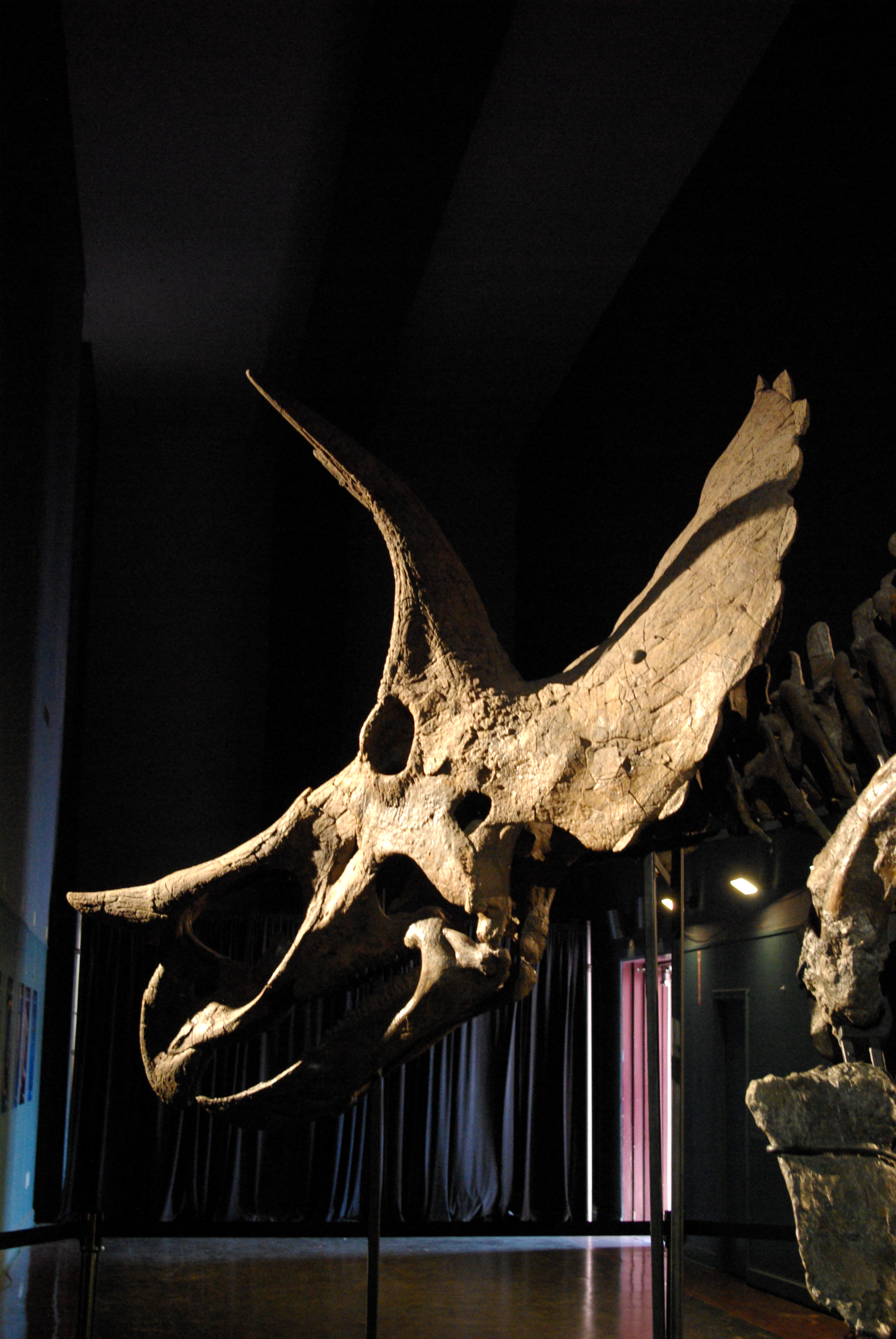
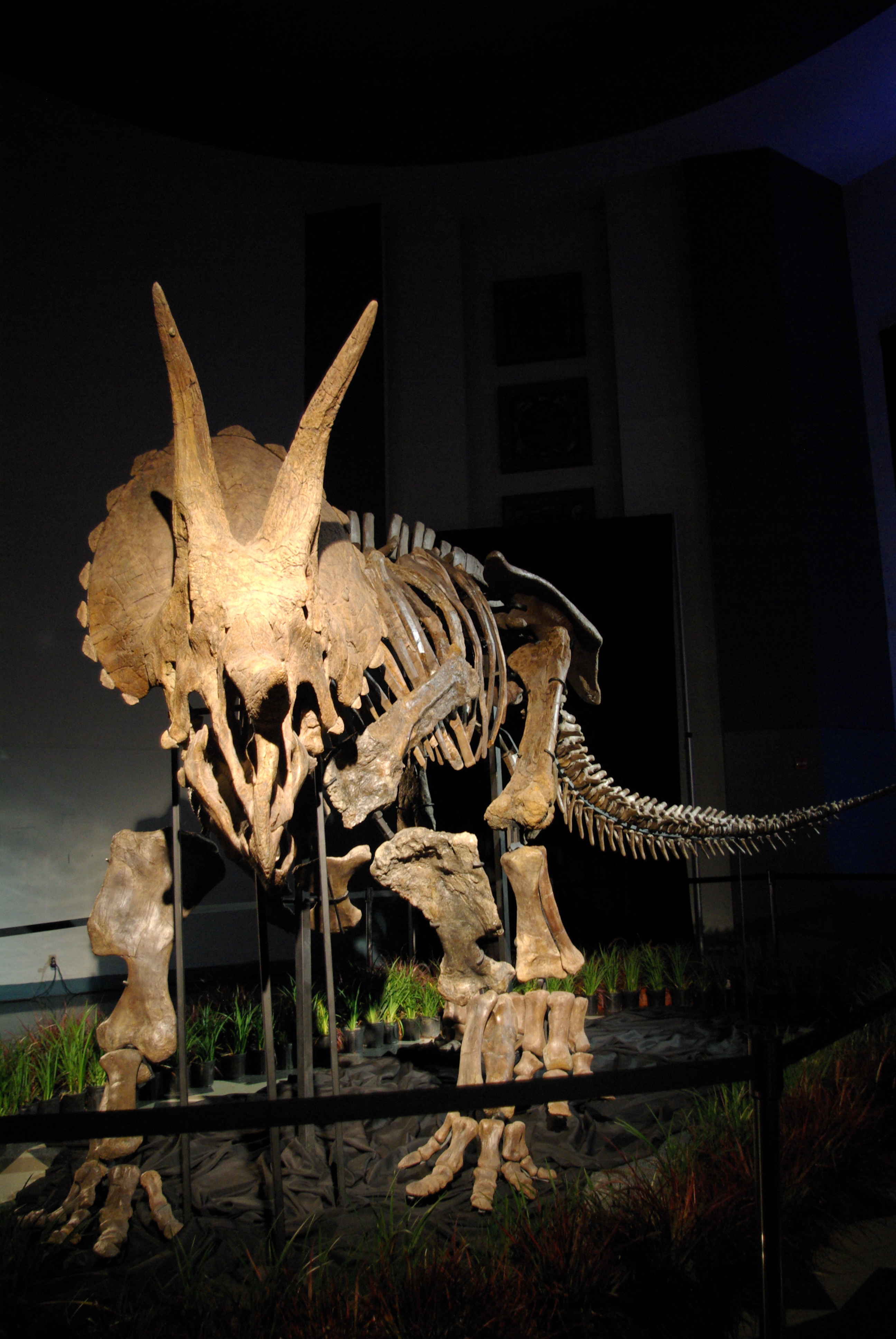
Triceratops welcomes bidders and gawkers to the Heritage Auction sale of fossils, gems, meteorites, and other national history ephemera. HA estimates this nearly-complete triceratops, mounted, to be worth about $700,000; less than 24 hours before the live auction, it has an online bid of $500,000 already.
Heritage Auctions set up a bug bunch of fossils, gems, meteorites, taxidermy, and art work from natural materials, for an auction on Sunday, June 12, 2011.
I can’t afford to bid, but they let me in to get photos. Nice people.
Heritage Auctions' June special, a triceratops - photo by Ed Darrell; use permitted with attribution
The triceratops greets visitors and bidders at the display site, the Tower Building at Dallas’s art deco gem, Fair Park. (If you look at the ceiling above the triceratops, you can see where restorers have stripped away several layers of paint to reveal the original ceiling paintings — original artwork, including murals, was painted over in the years following the dramatic debut of the buildings; restoration work proceeds slowly because of lack of funding.)
Triceratops horridus Cretaceous Hell Creek formation, Harding County, South Dakota
Triceratops has enjoyed much cultural publicity ever since its discovery. It is an iconic dinosaur that has appeared in movies ranging from black and white cinema to modern movies like “Jurassic Park.” It has also been in cartoons, such as the children’s classic “The Land before Time.” Triceratops is also the official state fossil of South Dakota and the official state dinosaur of Wyoming.
The present specimen was discovered in 2004 in two parts: First, the fossil hunters came upon pieces of dinosaur bone eroding down a gully. Following these bone fragments, they eventually came upon large bones that would indicate the presence of a large Ceratopsian dinosaur. While this large mass of bones was being excavated, other members of the team followed another bone trail which led them to an amazingly well preserved skull 750 feet away from the original discovery. Over the course of months, the specimens were carefully excavated in large blocks; each specimen was covered in plaster jackets and removed from the field to the lab. It was only during preparation that they discovered the dinosaur was a Triceratops, and it happened to be a Triceratops with an incredibly complete skull. The bones and skull were carefully removed from their field jackets and prepared using hand tools. Broken bones were professionally repaired and restored while a few missing elements were cast from other Triceratops skeletons. A custom made mount was created to support the bones and the skull; innovative bracket mounts were crafted for each bone so that no bones had to be damaged in order to mount them. The bones were mounted in osteologically correct position; making it comparable to and possibly surpassing the accuracy of older mounts in museum displays. Though it is impossible to say whether or not the skull is original to the specimen, being discovered 750 feet apart, it is certainly possible that the two elements are associated for a number of reasons: first, the size of the skull is consistent with the proportional size dimensions of the skeleton, and second, the surrounding matrix (host rock) was identical in composition.
The completed skeleton is enormous; measuring 19 feet long from head to tail, 11 feet across, and towering 12 feet tall. The skull itself measures 7 feet long with 3 ½ foot long horns; placing it near the top of the size range for Triceratops skulls. The leg bones stand 10 feet tall from toes to the top of the scapula; dwarfing many other Triceratops skeletons. Given that the skull represents about 30% of a dinosaur’s entire skeleton, the present specimen is about 75% original bone, with the right leg, pelvic region, several cervical vertebrae and a few tail vertebrae being cast reproductions.
Who owns the thing? Who put it together? Who is losing the specimen, should it go to a private collection (you got a living room that big?), and which museum really wants it?
But that’s just one of the specimens up for sale at this auction, and not necessarily the best. Also up for bid: A stegosaurus, and an allosaurus, posed as a “fighting pair.”
The "fighting pair," an allosaurus (left) and stegosaurus (right) posed in combat positions. Photo by Ed Darrell, use permitted with attribution.
Am I jaded? On the one hand you can’t look at these specimens without thinking they deserve to be seen by kids, and adults, and studied by paleontologists and biologist of all stripes — and so who has the right to sell these off? On the other hand, this is a Second Gilded Age, and the search for prize fossil specimens is often financed by the proceeds from these auctions. I enjoyed an hour’s browsing and photographing — a slide presentation on the wonders of America for some sleepy class next fall.
How many of these specimens will I get a chance to see again in the future?
Or, Dear Reader, how many of these will you ever get a chance to see?
HA will sell a lot more than just a few dinosaur fossils. This same sale includes the largest shark jawbone ever found, stuffed Kodiak and polar bears (from the same hunter), gems, art from petrified wood and fossilized fish, and a large selection of meteorites, including the only meteoroid ever confirmed to have struck and killed a living creature (a cow in Argentine; you can’t toss a stone without hitting a cow in Argentina, I hear).
Requires a large wall and high ceilings to display
I don’t plan to go bid; there’s about an hour remaining for online bidding tonight, but if you’re interested and you’ve got your income tax refund burning a hole in your pocket, you can also bid by telephone and hotlink on the internet (go to the Heritage Auction site for details). Frankly, I don’t think the sale will get the attention it deserves. I hope these spectacular specimens will land where they can get a great, admiring and studious audience.
Spread the word; friends don't allow friends to repeat history.
I don’t get the idea that Ham is sad about it, though, do you?
Destroying a child’s natural curiosity about science and the world around them damages them for life. In the U.S., we are fighting trends that show kids in 4th grade are as scientifically adept as the other best students in the world; by 8th grade their affinity for science has begun to fade, and by 12th grade, U.S. students rank far below many other industrialized nations in science achievement. Ken Ham’s story is one reason why that happens.
Isn’t crushing a child’s intelligence a form of child abuse?
December 27 is one of those days — many of us are off work, but it’s after Boxing Day, and it’s not yet on to New Year’s Eve or Day. We should have celebrated, maybe.
We should celebrate it as a day of portent: A good embarkation, and a good, safe end to a nation-encouraging trip to almost touch the Moon.
HMS Beagle, on a voyage of discovery
On December 27, 1831, Charles Darwin and H.M.S. Beagle set sail on an around-the-world voyage of discovery that would change all of science, and especially biology, forever.
December 27 1831
After a few delays, H.M.S. Beagle headed out from Plymouth with a crew of 73 under clear skies and a good wind. Darwin became sea-sick almost immediately.
Darwin never fully overcame his seasickness, but he fought it well enough to become the single greatest collector of specimens in history for the British Museum and British science, a distinction that won him election to science societies even before his return from the trip — and cemented his life in science, instead of in the church. Darwin’s discoveries would have revolutionized biology in any case. In analyzing what he had found, a few years later and with the aid of experts at the British Museum, Darwin realized he had disproved much of William Paley’s hypotheses about life and its diversity, and that another, more basic explanation was possible. This led to his discovery of evolution by natural and sexual selection.
Mini-sheet from the Royal Mail in 2009 honoring Darwin's discoveries in the Galapagos Islands
On December 27, 1968, Apollo 8 splashed down after a successful and heartening trip to orbit the Moon. The three crewmen, Commander Frank Borman, James A. Lovell, Jr., and William A. Anders, had orbited the Moon, a very important milestone in the methodological race to put humans on the Moon (which would be accomplished seven months later). 1968 was a terrible year for the U.S., with the North Korean capture of the U.S.S. Pueblo, assassinations of Rev. Martin Luther King, Jr., and Sen. Robert F. Kennedy during the presidential campaign, riots in dozens of American cities, nasty political conventions with riots at the Democratic Convention in Chicago, a contentious and bitter election making sore the nation’s divide over Vietnam policy, and other problems. On Christmas Eve, Borman, Lovell and Anders broadcast from orbit around the Moon, a triumphant and touching moment for the Apollo Program and Americans around the world. Their safe return on December 27 raised hopes for a better year in 1969.
In 1968, NASA engineers were scrambling to meet President Kennedy’s challenge to land a man on the moon by decade’s end. Because delays with the lunar module were threatening to slow the Apollo program, NASA chose to change mission plans and send the crew of Apollo 8 all the way to the moon without a lunar module.
Exactly 42 years ago, the three astronauts of Apollo 8 became the first humans to orbit another celestial object. As they came around the dark side for the third time, Frank Borman, the commander, finally turned their capsule around. And then they saw the Earth.
Borman: Oh my God! Look at that picture over there! Here’s the Earth coming up. Wow, is that pretty.
Anders: Hey, don’t take that, it’s not scheduled.
Borman: (laughing) You got a color film, Jim?
Anders: Hand me that roll of color quick, will you…
One of the resulting photos taken by Anders on a Hasselblad camera became one of the world’s most iconic images.
As Bill Anders recalls it:
I just happened to have one with color film in it and a long lens. All I did was to keep snapping… It’s not a very good photo as photos go, but it’s a special one. It was the first statement of our planet Earth and it was particularly impressive because it’s contrasted against this startling horizon… After all the training and studying we’d done as pilots and engineers to get to the moon safely and get back, [and] as human beings to explore moon orbit, what we really discovered was the planet Earth.
Yeah, we missed toasting it on time in 2010. Plan to raise a glass on December 27, 2011, to Good Trip Day for the human race. December 27 is a day we should remember, for these achievements.
Spread the word; friends don't allow friends to repeat history.
On November 24, 1859, Charles Darwin’s book was published, On the Origin of Species.
Title page, 1859 edition of Darwin's Origin of Species - image from the University of Sydney via Wikimedia image
How to celebrate? You could read a summary of Ernst Mayr’s shorthand version of Darwin’s theory, and understand it really for the first time (I hope not the first time, but there are a lot of people who really don’t understand what Darwin said — especially among critics of evolution):
Darwin’s theory of evolution is based on key facts and the inferences drawn from them, which biologist Ernst Mayr summarised as follows:[3]
Every species is fertile enough that if all offspring survived to reproduce the population would grow (fact).
Despite periodic fluctuations, populations remain roughly the same size (fact).
Resources such as food are limited and are relatively stable over time (fact).
A struggle for survival ensues (inference).
Individuals in a population vary significantly from one another (fact).
Individuals less suited to the environment are less likely to survive and less likely to reproduce; individuals more suited to the environment are more likely to survive and more likely to reproduce and leave their inheritable traits to future generations, which produces the process of natural selection (inference).
This slowly effected process results in populations changing to adapt to their environments, and ultimately, these variations accumulate over time to form new species (inference).
Charles Darwin's 1837 sketch, his first diagram of an evolutionary tree from his First Notebook on Transmutation of Species (1837) on view at the the Museum of Natural History in Manhattan. Interpretation of handwriting: "I think case must be that one generation should have as many living as now. To do this and to have as many species in same genus (as is) requires extinction . Thus between A + B the immense gap of relation. C + B the finest gradation. B+D rather greater distinction. Thus genera would be formed. Bearing relation" (next page begins) "to ancient types with several extinct forms." Wikimedia image
Spread the word; friends don't allow friends to repeat history.
A cat Kenny Darrell photographed in Crete -- notice each eye is a different color.
Darwin wondered about the genetic reasons behind white cats being blind deaf (though, of course, he didn’t call it “genetics” then). Evolution in action: White cats today usually can see hear.
Kenny found this cat in Crete, and got a good shot of its eyes, each of a different color — though of course, as soon as the focus was set, the cat leaned forward for a pet.
Kenny’s in China right now. I wonder if China has cats and dogs on the streets like Crete?
Or, until that account is unsuspended by the forces supporting Donald Trump: Follow @FillmoreWhite, the account of the Millard Fillmore White House Library
We've been soaking in the Bathtub for several months, long enough that some of the links we've used have gone to the Great Internet in the Sky.
If you find a dead link, please leave a comment to that post, and tell us what link has expired.
Thanks!
Retired teacher of law, economics, history, AP government, psychology and science. Former speechwriter, press guy and legislative aide in U.S. Senate. Former Department of Education. Former airline real estate, telecom towers, Big 6 (that old!) consultant. Lab and field research in air pollution control.
My blog, Millard Fillmore's Bathtub, is a continuing experiment to test how to use blogs to improve and speed up learning processes for students, perhaps by making some of the courses actually interesting. It is a blog for teachers, to see if we can use blogs. It is for people interested in social studies and social studies education, to see if we can learn to get it right. It's a blog for science fans, to promote good science and good science policy. It's a blog for people interested in good government and how to achieve it.
BS in Mass Communication, University of Utah
Graduate study in Rhetoric and Speech Communication, University of Arizona
JD from the National Law Center, George Washington University


 Posted by Ed Darrell









 Millard Fillmore's Bathtub