I get political e-mail, from Bill White on Texas social studies standards

April 29, 2010

Good information, oddly enough for a political note:

Dear Ed,

Click here to watch video
Watch my brief comments
and join the conversation.

We need your help to keep divisive politics out of Texas’ classrooms.

From now until May 14th, the State Board of Education is accepting public comments on its proposed curriculum changes.

The SBOE has proposed removing Thomas Jefferson from a part of the curriculum. They are also planning to exclude references to Hispanics who fought Santa Anna and died at the Alamo.

Watch the YouTube video with my brief comments by clicking here.

During the primaries, Texans voted against the most extreme and hyper-political SBOE candidates, sending a clear message about their approach of injecting politics into our classrooms.

Last month, I called on Rick Perry to ask his appointed chair of the SBOE to either send changes back to expert review teams or delay the vote until new board members are seated.

Perry’s response has been to say that he’s not going to “try to outsmart” the SBOE. He declined to show leadership, refusing to ask his appointed chair of SBOE to rein in the hyper-political curriculum amendment process.

Join the conversation and spread the word about this opportunity to be heard.

Our next governor should be a leader who ensures our schools prepare young Texans for college and their careers. I am committed to improving education and working for our future.

Thank you for taking the time to weigh in.

Sincerely,

Bill White

P.S. If you would like to send your comments directly to the SBOE, click here.


Colleague’s Fulbright-Hays trip to Senegal

April 26, 2010

One of my colleagues — an art teacher; you know, the adventurous type — heads off to Senegal this summer on a Fulbright-Hays program.

I’m sorta jealous, of course.  I need time to push our history course to championship level, though — I didn’t apply for anything this summer.

You can track Mr. Adkins’ trip and progress at a blog he’s set up, appropriately called Mr. Adkins’ Great Adventure in Senegal.

If you’re teaching world history, or art, or government, or environmental science, or geography, this might be a great blog to track.

Senegal is a very interesting place.  Note on the map how it completely surrounds its neighbor nation of The Gambia.

FAA map of Senegal

Senegal, map courtesy of the U.S. Federal Aviation Administration (FAA)

France held the nation as a colony once upon a time, from 1850 to independence of the Mali Federation in 1960 — one of the national languages is French, but regional languages are numerous, Wolof, Soninke, Seereer-Siin, Fula, Maninka, and Diola.  The Mali Federation was short-lived, and Senegal broke off in August of 1960.

If you listen to NPR, you’ve probably heard their reporter signing off in that distinct way she does, “Tthis is Ofeibea Quist-Arcton, for NPR, in Dah-KAHHH!”  (Not to be confused with Dacca, Pakistan).

According to the CIA Factbook (online version):

The French colonies of Senegal and the French Sudan were merged in 1959 and granted their independence as the Mali Federation in 1960. The union broke up after only a few months. Senegal joined with The Gambia to form the nominal confederation of Senegambia in 1982, but the envisaged integration of the two countries was never carried out, and the union was dissolved in 1989. The Movement of Democratic Forces in the Casamance (MFDC) has led a low-level separatist insurgency in southern Senegal since the 1980s, and several peace deals have failed to resolve the conflict. Nevertheless, Senegal remains one of the most stable democracies in Africa. Senegal was ruled by a Socialist Party for 40 years until current President Abdoulaye WADE was elected in 2000. He was reelected in February 2007, but has amended Senegal’s constitution over a dozen times to increase executive power and weaken the opposition, part of the President’s increasingly autocratic governing style. Senegal has a long history of participating in international peacekeeping and regional mediation.

The country is tropical, hot and humid.  Geographically, it is low, rolling plains.

Dakar is about as far west as one can go on the African continent.   (See the map inset — Senegal is in dark green).

Senegal has iron ores, and phosphorus (ancient bird droppings?).  It’s not a rich nation, but it’s better off than many developing countries.

Adkins is in for a great adventure, no?

Africa, showing Senegal - CIA Factbook

Africa, showing Senegal - CIA Factbook


I get e-mail: PFAW on Texas social studies follies (“please help!”)

April 23, 2010

Jeff Danziger cartoon, for the New York Times Syndicate, on Texas State Board of Education

Jeff Danziger cartoon, for the New York Times Syndicate, on Texas State Board of Education “changes” to Texas social studies texts.

People for the American Way have joined the fight for good education in Texas, pushing better social studies education standards.  The Texas State Board of Education will conduct final votes on social studies standards in May.

Grotesque slashes damaged social studies standards in the last round of amendments.  Conservatives will probably try to keep secret their proposed changes, offering a flurry of last-minute amendments carefully designed to gut serious education and make the standards work as indoctrination for young conservatives instead.

PFAW has good reason to fear.  Here’s their letter. from PFAW President Michael Keegan:

Dear People For Supporter,

Thomas Jefferson banned in Texas schools? Maybe… if the Right has its way. The fight is still on to keep absurd changes out of the Texas social studies textbook standards, with the final standards set to be adopted by the Texas State Board of Education (SBOE) on May 21.

Right-wing members of the SBOE are using the textbook standards in Texas to rewrite history in a way that could impact students across the U.S., tossing out facts in favor of propaganda like:

  • America is a Christian country, founded on “Biblical principles.”
  • Conservative icons from Ronald Reagan to Newt Gingrich, Phyllis Schlafly, the Moral Majority and even Sen. Joseph McCarthy are history’s “good guys,” but progressives and progressive values are at odds with what it means to be “American.”
  • Words like “democracy” (sounds like “Democrat!”) have nothing to do with America — we’re a Republic — In fact, “capitalism” has sort of a negative connotation to some, so they want that word to be universally replaced with “free market.”
  • Some of the major contributions of Thomas Jefferson — arguably America’s greatest thinker — are on the chopping block, as are the contributions of other important figures not favored by the zealots on the Texas State Board of Education, like Cesar Chavez and Thurgood Marshall. (Who’s next? Martin Luther King? FDR?)

Texas is just ground zero for what is clearly a national effort. We need to make sure that whatever standards are adopted in Texas, they do not affect the social studies textbooks used by students in other states.

Please sign our petition to the major textbook publishers urging them to keep Texas standards in Texas and not to publish national textbooks based on Texas’ standards.

The Texas State Board of Education traditionally has tremendous power in determining the content of textbooks not only for Texas students but for students across the U.S. Texas reviews and adapts textbook standards for the major subjects every six years, and because of the size of the state’s market, textbook publishers often print books consistent with the Texas standards. Last year, they attracted national ridicule for trying to inject creationism into science textbooks. This year, they’re voting on social studies standards.

The right-wing majority on the State Board wants indoctrinate Texas students into this new perverse revisionist history. PFAW is supporting our allies on the ground in Texas who are working to make sure students have the chance to learn history as it occurred, not how the Far Right wish it had happened. But we need to do all we can to make sure this is not exported to other states and school districts as well. Help us take extremism out of textbook decision making and let our children learn the truth in the classroom.

Sign our petition to major textbook publishers urging them to keep Texas standards from spreading and not to offer Texas-style textbooks nationally by default.

Thank you for your activism and for your continued support of PFAW.

— Michael B. Keegan, President

Pass the word, will you?

Add to FacebookAdd to NewsvineAdd to DiggAdd to Del.icio.usAdd to StumbleuponAdd to RedditAdd to BlinklistAdd to TwitterAdd to TechnoratiAdd to Furl


What if the old curmudgeon teaching economics married that cute, brainy geography teacher?

April 23, 2010

Or, was it the cute curmudgeon teaching econ and the old cartographer in geography?

I think I’ll add this to my TAKS review.  What other classroom uses can you find for it?

I found it at Cool InfoGraphics.

Seriously, geography and economics teachers, this is big stuff:

Follow the Money” is a video summarizing the results from the project by Northwestern University grad students Daniel Grady and Christian Thiemann.  Using data from the website Where’s George?, they have been able to track the movement of U.S. paper currency.  What can you learn from this?  That there are natural borders within the U.S. that don’t necessarily follow state borders, and it can also be used to predict the spread of disease because it maps movement of people within the U.S.

From Maria Popova on BrainPickings.org: This may sound like dry statistical uninterestingness, but the video visualization of the results is rather eye-opening, revealing how money — not state borders, not political maps, not ethnic clusters — is the real cartographer drawing our cultural geography.  The project was a winner at the 2009 Visualization Challenge sponsored by the National Science Foundation and AAA.

Tip of the old scrub brush to VizWorld and Maitri’s VatulBlog


You’re not using this technology in your classroom?

April 12, 2010

Here’s another opportunity to put real, cutting edge technology in your classroom.  In fact, your kids could probably invent all sorts of new uses for it.

Have you even heard of this stuff?  Can you use it, live, with the equipment you’ve got?

Blaise Aguera y Arcas  of MicroSoft demonstrated augmented-reality maps using the power of Bing maps, Flickr, Worldwide Telescope, Video overlays and Photosynth, to an appreciative and wowed audience at TEDS:

My prediction:  One more advance in computer technology that classrooms will not see in a timely or useful manner.

But have you figured out how to use this stuff in your geography, history, economics or government classes?  Please tell us about it in comments. Give examples and links, please.


Education board shames Texas: Social studies follies, part A

March 31, 2010

John Sherffius, one of my favorite editorial cartoonists, laid out the problem in his cartoon of March 18:

John Sherffius, Boulder Daily Camera, March 18, 2010 - Texas social studies standards

John Sherffius, Boulder Daily Camera, March 18, 2010

You may purchase a copy of the cartoon — or the original — here.

SBOE isn’t exactly asking that the Bible be rewritten — or at least, not directly.  Suggesting we replace Thomas Jefferson as a founder with John Calvin in high school standards, is just as silly.

Tip of the old scrub brush to What Would Jack Do, “Lone Star Laughing Stock,” and Steven Schafersman.


While thieves and COP15 fiddled, the world’s burning continued . . .

March 18, 2010

A friend wrote me the other day wondering what I thought about the global warming hoax.  I told him I thought denialists and contrarians have acted shamefully claiming that warming is not occurring.

My friend wrote back puzzled.  He had meant, what did I think about the collapse of the false claims of warming?  He said he had understood that almost all the claims of warming were hoaxes cast by a cabal of conspiratorialist scientists who had gotten fat government contracts only on the condition that they claimed there is warming.

It’s actually been about two weeks since I got that message, but it’s a common thought around the world.  The thieves who stole e-mails from scientists did what Shakespeare termed worse: They stole the good names of scientists.  The thieves’ accomplices, especially in blogs but also in brazen journals of bias like The Australian and The Daily Mail, successfully transplanted a stick they claimed was the end of warming science, and they’ve managed to keep it spray-painted green to convince careless observers that it’s alive.

That tree won’t flower.  God’s earth doesn’t care about such falsehoods, but goes on cycling as Darwin noted.  In that cycling, warming continues faster than apace, burning our future and our children’s futures in bits noted only by careful scientists.

While Anthony Watts and other denialists gloated about heavy snows — we’re still cleaning up broken trees and destroyed groves and forests here in Dallas — fact is the North American west suffered from a snow drought.  You may have seen part of it if you watched the Olympics from Vancouver.  It was unseasonably warm, and until the second week there was a great shortage of natural snow for snow events.

We may forget about the ecological chains that weather actually push.  Over at Ralph Maughan’s Wildlife News I found a story about the annual count of elk in Wyoming/Montana/Idaho.  Ralph tracks all sorts of wildlife news, but especially news about wolves and wolf reintroductions.  Wolf packs prey on elk when they can.  The health of elk herds affects the health of wolf packs.

In January I heard there would be no elk count this year because the lack of snow made counting pretty much impossible. I’m glad the amount of snow increased because these numbers are important. Gaps in the data are harmful.

How much have you heard about snowfall shortages in the west, other than the Olympics?  The drought is pretty bad up there.  Much of the Mountain west, on both sides of the Rockies, gets water from the melting snows.  It doesn’t rain much in the spring and summer, but melting snows supply rivers throughout the year.  One reader commented at Maughan’s blog:

I have been in the back country of Montana, Idaho and Washington in the last 3 months and I can tell you, there is no snow to really speak of, the place I stay in Montana normally has about 5-6 feet of snow on the ground in January and when I returned around the first part of January, it had about a foot, Bozeman was very low snow as was Great Falls and Billings, Sandpoint has flowers blooming already, the Columbia River Gorge area up in the Mountains above the Gorge is greening up real well, no snow and Mount Hood has not had much snow either.

Right now, it looks very bleak for river levels this year, My wife was on the phone with her cousin in Florence, MT and Her Uncle in Lincoln, MT this week and they are saying the snow is just not there this year and expects that fishing this year will be very poor due to low water levels and higher river temps, one lives on the Blackfoot and the other on the Bitterroot..

Looks like unless we have a strong spring rain season, things could get dicey this year..

Anecdotal news, just one spot of rather amorphous data, right?

No.  It’s widespread.

Snow Drought in Interior Northwest - USA Today graphic

Snow Drought in Interior Northwest – USA Today graphic

Surely not all the droughts nor drought effects can be blamed on warming — but the rolling disasters of dead forests, especially from pine borers and pine bark beetles, across North America, can be fairly attributed to global warming.  Average winters would kill the insects — where average winters now are a rarity, forests that have stood at least since Columbus are dying out.  Many of the dying forests predate the coming of all humans to the Americas, 37,000 years ago or so.

Housing prices will rise.  Wildfires will increase.  Water emergencies will be declared, and restrictions on development in water-strapped counties and states will be enacted.

Humans can deny warming and human causation.  But even the Rockies cry out.

Who will listen?

US Drought Monitor, March 16, 2010

US Drought Monitor, March 16, 2010 – Click image for updated maps


Geography education vs. geography learning

January 29, 2010

Angst over the state of education never goes away:

Much more important is the way we seem to have turned away from the very idea of education that sustains a healthy, vibrant liberal democracy.  As I write this I am conscious of how unfashionable it sounds. However, there has been a steady erosion of the notion that education can and should fuel our individual ability to think critically about the world as we find it – which requires knowledge and understanding of how the world has come to be. We are swamped with a language of targets, skills and 21st century ‘learning to learn’, but have forgotten what it is that distinguishes learning (a word that now seems to carry huge weight and always deemed a good thing in itself, when clearly it is not) from education.  All worthwhile education is, in the end self-education, based on the student’s curiosity, their need to know and readiness to rise to the challenge of finding out. Indeed, offering challenge to young people is one way to motivate them – so different from today’s orthodoxy which says we should make learning accessible, bite-sized and achievable by all.

These guys write from England, however, and they write from the vantage point of teaching geography and having just published their book on how better to teach geography.

See their take on what geography teachers should be teaching about Haiti right now.


Social studies train wreck at Texas State Board of Education: Live! A Nation at Risk

January 13, 2010

Steve Schafersman will live blog the hearings on social studies standards before the Texas State Board of Education (SBOE) today, at Evo-Sphere.  Schafersman is president of Texas Citizens for Science, and a long-time activist for better education in Texas on all topics.

Rapid updates or live-blogging should be available at the blog of the Texas Freedom Network, TFN Insider.

It’s Item #6 on the SBOE agenda, with a title that tips off the trouble:

Item #6 — Public Hearing Regarding Proposed Revisions to 19 TAC Chapter 113, Texas Essential Knowledge and Skills for Social Studies, and Chapter 118, Texas Essential Knowledge and Skills for Economics with Emphasis on the Free Enterprise System and Its Benefits.

Schafersman e-mailed an introduction to the meeting:

Some say the Social Studies public testimony by the religious right, liberals, etc., then the SBOE debate, motions to amend, votes, etc. is a bigger circus than adopting the science standards. Judge for yourself. You can watch the entire circus, carnival, and sideshow on the webcast video at http://www.texasadm in.com/cgi- bin/tea.cgi

This is Texas democracy in action, when sullen and tight-lipped State Board members listen to public testifiers for 3 minutes each and profoundly ignore them since they already know what they are going to do. But I, at least, feel better after speaking so I don’t later feel responsible for the crappy amendments, changes, and policies that come out of this horrible Board because I did nothing. The proposed Social Studies standards written by the panels composed of teachers and professors are excellent (when have I heard this before), but the SBOE can’t wait to shamelessly impose their own Religious Right agenda on them.

You’ll recall that SBOE has at every possible turn disregarded the advice of famous and serious historians, respected free-market-advocating economists, geographers and educators on these standards.  Economists, for example, want Texas kids to learn about “capitalism,” since that’s what it’s called by economists and policy makers, and colleges.  SBOE thinks “capitalism” sounds too subversive, and wishes instead to require Texas kids to learn about “free enterprise” instead.

‘A rose by any other name’ you think, until you start thinking of how Texas kids do on standardized tests, college admission exams, and the punchline on the joke, about Texas kids being told not to study capitalism.  No siree, no capitalism in the fictional home of J. R. Ewing, never mind the real-life capitalists like T. Boone Pickens or H. Ross Perot (Jr. and Sr.).

In Dallas, the city prepares to name a street after Cesar Chavez, the great Hispanic union organizer and advocate for working Americans.  In Austin, SBOE works to strike all mentions of Chavez, because they dislike the politics of heroes of our ethnic minorities (soon to be a majority in Texas).  In Washington historians and policy-makers follow the legacy of Thurgood Marshall, the great civil rights attorney and first African-American to sit on the U.S. Supreme Court.  In Austin, SBOE thinks Marshall should be left out of history books.  Many of us suspect he’s anathema to the white right-wing in Austin:  A smart, successful and noble man of color.

Mel and Norma Gabler died years ago, but their history lingers in the halls of education policy in Austin.  It’s Shakespearean.

This is a massive battle.  David Barton worked for 30 years to gut history standards nationally to teach a history of America that never was, and as the official religionist appointee of the right-wing SBOE members, he stands on the brink of accomplishing much of the revisionism he’s advocated.  See the Texas Tribune story on the issue, “Hijacking History.”

Generally we shouldn’t negotiate with terrorists, Ronald Reagan said.  At the SBOE, we’ve put the terrorists in charge of history and economic curricula — if not the terrorist themselves, at least the terrorists’ camels’ noses.  Texas’s process has earned flashing red-light, claxon-sounding repeating of the words of Ronald Reagan’s Commission on Excellence in Education:  If a foreign nation did this to us, we’d consider it an act of war [excerpt below the fold].

Make no mistake about it.  SBOE’s goal is to roll back any of the reforms left from Reagan’s Commission’s work.  Our nation is more at risk from foreign competition than ever before.  SBOE plans to give away a bit more of our future to China, this week.

Our saving grace is the general incompetence of SBOE members to make significant reform in Texas’s wounded schools, reeling from unworkable and damaging requirements under the No Child Left Behind Act and a testing program that severely limits what can be taught in any social studies course other than those bastions of learning left in International Baccalaureate programs and Advanced Placement courses (estimates are that between 5% and 10% of Texas high school students can take one of those good courses).  Whatever silliness, craziness or lies SBOE orders to  be taught, it can’t be taught and tested well.  Inertia preventing change works to save America in this case.

In business, most CEOs at least appreciate the value of having good front-line employees who are the ones who really deliver the service or product and produce the profit of the enterprise (even if they don’t treat those employees so well as the employees deserve).  Education may be the last bastion of flogging the horse that should be pulling the cart instead.  In this case, having well-trained teachers in the classroom is the last hope for Texas, Texas parents and Texas students — and Texas’s economic future and future in liberty.  Teachers are the last defense of freedom in Texas.  Today SBOE will make another assault on the ramparts that protect the teachers in their work.

When will the French fleet arrive to lend aid?  Will it arrive at all?  And if it arrives, will Texas kids know better than to shoot at the ships?

Carol Haynes, who claims to have a doctorate in some discipline, told the board how to rewrite the standards to completely change the history of the civil rights movement in their last hearing on the topic.  According to Haynes, apparently, Dr. Martin Luther King, Jr., was opposed to civil rights and Barry Goldwater was in favor — the Board didn’t offer to correct her revisionism, but instead asked her to go beyond her three minutes in fawning acceptance. This appears to be SBOE’s approval of various Other Universe hypotheses offered by Star Trek, allowing any damned thing at all to be taught as history (except the right stuff).  Haynes is scheduled to testify again (#128), probably very late at night, but perhaps in time for the 10:00 p.m. Texas television news broadcasts.  Oy.

Excerpt from the Report of the Commission on Excellence in Education, A Nation at Risk, below the fold.

ae_summer2015mehta_opener-1100x736

Cover of A Nation at Risk: The Imperative for Educational Reform, the 1983 report that started the education reform mess. AFT graphic.

Stand up for your nation, it’s children and future; sound the alarm:

Add to FacebookAdd to NewsvineAdd to DiggAdd to Del.icio.usAdd to StumbleuponAdd to RedditAdd to BlinklistAdd to TwitterAdd to TechnoratiAdd to Furl


Read the rest of this entry »


Trouble at Texas Board of Education: Social studies

January 11, 2010

Here is a news rundown of stories on the Texas State Board of Education, who have been planning for a year now to mess up social studies standards for Texas public schools, this week.

Get on your horse and warn Texans:  The Idiots are coming to get your good schoolbooks:

Add to FacebookAdd to NewsvineAdd to DiggAdd to Del.icio.usAdd to StumbleuponAdd to RedditAdd to BlinklistAdd to TwitterAdd to TechnoratiAdd to Furl


Annals of Global Warming: Black soot and glaciers in Tibet

January 5, 2010

Another in a series on the history of global warming; this comes from the Earth Observatory at NASA (visit that site — the image is more stunning, larger):

tibet_geos5_2009269

Black Soot and the Survival of Tibetan Glaciers

Posted December 15, 2009
Black Soot and the Survival of Tibetan Glaciers

Color bar for Black Soot and the Survival of Tibetan Glaciers
download large image (677 KB, JPEG) acquired September 26, 2009
download large animation image (9 MB, M4V) acquired August 1, 2009 – November 9, 2009

On the Tibetan Plateau, temperatures are rising and glaciers are melting faster than climate scientists would expect based on global warming alone. A recent study of ice cores from five Tibetan glaciers by NASA and Chinese scientists confirmed the likely culprit: rapid increases in black soot concentrations since the 1990s, mostly from air pollution sources over Asia, especially the Indian subcontinent. Soot-darkened snow and glaciers absorb sunlight, which hastens melting, adding to the impact of global warming.

NASA climate scientists combine satellite and ground-based observations of soot and other particles in the air with weather and air chemistry models to study how the atmosphere moves pollution from one place to another. This image is from a computer simulation of the spread of black soot (“black carbon” to climate scientists) over the Tibetan Plateau from August through November 2009. It shows black carbon aerosol optical thickness on September 26, 2009. (Aerosol optical thickness is scale that describes how much pollution was in the air based on how much of the incoming sunlight the particles absorbed.) Places where the air was thick with soot are white, while lower concentrations are transparent purple.

The highest concentrations of black soot are in the right-hand side of the image, over the densely populated coastal plain of China. But high concentrations occur over India, as well, and the black soot spreads across the southern arc of the Tibetan Plateau, which is defined by the towering peaks of the Himalaya Mountains. (Note: Topography has been exaggerated to highlight features that influence air movement). The animation shows how the black carbon pollution from India often circulates at high concentrations for several days against the base of the Himalaya, periodically “sloshing” over the rim of the mountains and spilling northward over the plateau, before being carried away over the Bay of Bengal or the Arabian Sea.

Writing about the implications of the study for the Goddard Institute for Space Studies Website, NASA climate scientist and study co-author James Hansen said, “[C]ontinued, ‘business-as-usual’ emissions of greenhouse gases and black soot will result in the loss of most Himalayan glaciers this century, with devastating effects on fresh water supplies in dry seasons. The black soot arises especially from diesel engines, coal use without effective scrubbers, and biomass burning, including cook stoves. Reduction of black soot via cleaner energies would have other benefits for human health and agricultural productivity. However, survival of the glaciers also requires halting global warming, which depends upon stabilizing and reducing greenhouse gases, especially carbon dioxide.”

NASA image by Gregory Shirah, Goddard Scientific Visualization Studio, based on model simulations from the Goddard Earth Observing System Model, Version 5 (GEOS-5). Caption by Rebecca Lindsey.


Geography Awareness Week, November 15-21

November 6, 2009

Geography Awareness week is sneaking up — November 15-21.

Got your special lesson plans ready, teachers?


Alaska’s salmon go missing. Why?

August 21, 2009

It’s one of those environmental mysteries that would be fun and intrigueing, were it not so worrisome.

Alaska’s King Salmon disappeared from traditional river runs this year.  Again.

From Reuters:  A sockeye salmon scurries through shallow water in the Adams River while preparing to spawn near Chase, British Columbia northeast of Vancouver October 11, 2006.  REUTERS/Andy Clark

From Reuters: "A sockeye salmon scurries through shallow water in the Adams River while preparing to spawn near Chase, British Columbia northeast of Vancouver October 11, 2006. REUTERS/Andy Clark"

Reasons could be one of many, or several:  Changing ocean currents, pollock fishing accidental catches of salmon, plankton blooms, conditions on the rivers, competition from “ranched” salmon.

Consumers may see only the rise in price and a change in labeling in the supermarket.

Effects on employment and food supply in Alaska are huge, and crippling.

Canada fisheries are affected, too.

Climate change probably plays a role, in any scenario anyone poses:

“It’s quite the shocking drop,” said Stan Proboszcz, fisheries biologist at the Watershed Watch Salmon Society. “No one’s exactly sure what happened to these fish.”

Salmon are born in fresh water before migrating to oceans to feed. They return as adults to the same rivers to spawn.

Several theories have been put forward to try to explain the sockeye’s disappearance:

* Climate change may have reduced food supply for salmon in the ocean.

* The commercial fish farms that the young Fraser River salmon pass en route to the ocean may have infected them with sea lice, a marine parasite.

* The rising temperature of the river may have weakened the fish.

The Canadian government doesn’t know what’s killing the fish, but believes the sockeye are dying off in the ocean, not in fresh water, based on healthy out-migrations, said Jeff Grout, regional resource manager of salmon for the Department of Fisheries and Oceans.

In this case, even a small change in climate can have huge effects on ecosystems and specific populations of animals.  It’s one of those climate change issues that climate change skeptics and denialists prefer not to talk about at all.  If, as they allege, concern over climate change is entirely political, driven by bad information and false claims from over-active environmentalists, these problems should not exist at all.

But the problems do exist.  A fishery that had been stable for 50 years previously, the entire time it was tracked so carefully, suddenly becomes fishless.  Watch those rivers and fisheries.

Tip of the old scrub brush to Pamela Bumsted.

Help save the salmon; tell others:

Add to FacebookAdd to NewsvineAdd to DiggAdd to Del.icio.usAdd to StumbleuponAdd to RedditAdd to BlinklistAdd to TwitterAdd to TechnoratiAdd to Furl


Global cooling? That would be good news for the forests

August 12, 2009

Climate change denialists (sorry, Mr. Watts – denialism is what it is) frequently argue that since the peak heat year of 1998, the planet has been cooling, and may be in a long-term trend to a much cooler planet.

Has anyone told the beetles?

Has anyone told the pine bark beetles (Dendroctonus ponderosae) that are devastating North American forests?

Colorado conifers affected by pine bark beetles (brown trees are dead) - image from Chad Crawford,  Homebrewed Christianity

Colorado conifers affected by pine bark beetles (brown trees are dead) - image from Chad Crawford, Homebrewed Christianity

I was interested to find this photo and this post at Homebrewed Christianity, by Chad Crawford.

But my trips to the mountains are always simultaneously joyful and mournful. The story I want to tell is about seeing the effects up close of the North American pine beetle outbreak. It’s devastating the Rocky Mountain forests in the U.S. and Canada and growing exponentially each year. The epidemic is occurring because our winters have not been cold enough to stop the beetles from multiplying. Bark beetles are good for the ecosystem, but not in this amount. The fall colors in our evergreen forests are telling us that global warming is no longer something our kids will face; it’s happening now. And it will accelerate if our forests disappear.

Mr. Watts, it’s not me you have to convince.  There are several millions of beetles in Colorado who must be persuaded the climate is not warming — and they’ll be a tough sell, since a colder climate means death to their future generations.

A greater challenge for you, Mr. Watts:  Not one of those beetles reads your blog.  How will you reach them?

Crawford went to Colorado and saw Fr. Thomas Berry.  Maybe we should buy a ticket to Colorado for Watts.


India today, in photos

August 3, 2009

Geography teachers, get out your PowerPoints and Keynotes.

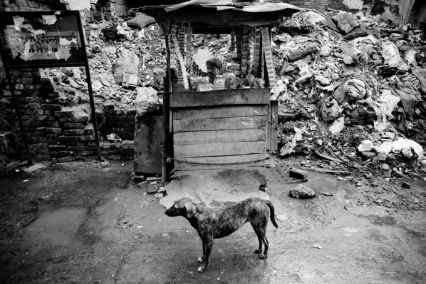
Photo of life in Delhi, India.  From a collection by Belgian photographer Frederik Buyckx, 2009

Photo of life in Delhi, India. From a collection by Belgian photographer Frederik Buyckx, 2009

Thought provoking, occasionally breath-taking photos from a 6:00 a.m. walkaround in Delhi, India; Belgian photographer Frederick Buyckx promises more photos from his recent trip to India and Pakistan, at his blog.

Please share:

Add to FacebookAdd to NewsvineAdd to DiggAdd to Del.icio.usAdd to StumbleuponAdd to RedditAdd to BlinklistAdd to TwitterAdd to TechnoratiAdd to Furl