Arctic Ocean gives up more methane than scientists predicted

March 4, 2010

Here’s another point of science that will give rational people concern, and which cannot in any way be explained as “no problem” by stolen e-mails:  Methane releases from the floor of the East Siberian Arctic are much larger than predicted.

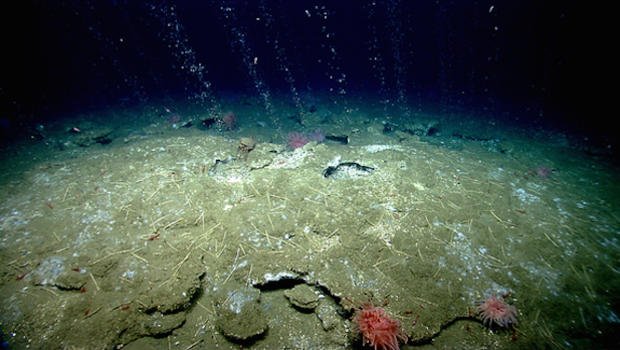
Methane hydrates releasing methane gas in bubbles in the ocean - i.treehugger image

Underwater methane gas plumes, Photo: NOAA Okeanos Explorer Program, 2013

Methane is a more powerful greenhouse gas than carbon dioxide.  Frozen forms of methane dot the bottoms of our oceans.  Warming of the oceans might be able to trigger an explosive thawing of the methane hydrates, as the frozen forms are known, seriously adding to our worldwide greenhouse gas problems.

Story here at Global ChangeScience article on which that post is based, here.

Cool SONAR pictures of methane bubbling up from the floor of the Arctic Ocean, but scary once you realize what they are, at this vintage post at Millard Fillmore’s Bathtub.

Is there any chance this research will merit a mention at the climate denialist blogs?


Shakiest states — geologically, that is

March 4, 2010

USGS map of states with the most quakes

Quake rankings of states

Which states shake the most?  Here are the top 20.

Surprised that Maine makes the list?

Much more from the US Geological Survey here, “Top Earthquake States.”


Annals of global warming: Glaciological map of Antarctica’s Palmer Land Area, 1947-2009

March 3, 2010

Are the ice fields of Antarctica increasing or decreasing?  How do we know?

U.S. Geological Survey released a study of the change in glaciation in Antarctica between 1947 and 2009.  Serious student of climate change will heed what the maps show — better bookmark the site.  The study and publication were done in a joint effort of USGS, the British Antarctic Survey, the Scott Polar Research Institute, and the Bundesamt für Kartographie und Geodäsie (same page, in English, here).

Coastal-Change and Glaciological Map of the Palmer Land Area, Antarctica: 1947—2009

By Jane G. Ferrigno,1 Alison J. Cook,2 Amy M. Mathie,3 Richard S. Williams, Jr.,4 Charles Swithinbank,5 Kevin M. Foley,1 Adrian J. Fox,2 Janet W. Thomson,6  and Jörn Sievers

Introduction

Cover of USGS publication, Coastal-Change and Glaciological Map of the Palmer Land Area, Antarctica: 1947—2009

Cover of USGS publication, Coastal-Change and Glaciological Map of the Palmer Land Area, Antarctica: 1947—2009

Reduction in the area and volume of the two polar ice sheets is intricately linked to changes in global climate, and the resulting rise in sea level could severely impact the densely populated coastal regions on Earth. Antarctica is Earth’s largest reservoir of glacial ice. Melting of the West Antarctic part alone of the Antarctic ice sheet would cause a sea-level rise of approximately 6 meters (m), and the potential sea-level rise after melting of the entire Antarctic ice sheet is estimated to be 65 m (Lythe and others, 2001) to 73 m (Williams and Hall, 1993). The mass balance (the net volumetric gain or loss) of the Antarctic ice sheet is highly complex, responding differently to different climatic and other conditions in each region (Vaughan, 2005). In a review paper, Rignot and Thomas (2002) concluded that the West Antarctic ice sheet is probably becoming thinner overall; although it is known to be thickening in the west, it is thinning in the north. The mass balance of the East Antarctic ice sheet is thought by Davis and others (2005) to be positive on the basis of the change in satellite-altimetry measurements made between 1992 and 2003.

Measurement of changes in area and mass balance of the Antarctic ice sheet was given a very high priority in recommendations by the Polar Research Board of the National Research Council (1986), in subsequent recommendations by the Scientific Committee on Antarctic Research (SCAR) (1989, 1993), and by the National Science Foundation’s (1990) Division of Polar Programs. On the basis of these recommendations, the U.S. Geological Survey (USGS) decided that the archive of early 1970s Landsat 1, 2, and 3 Multispectral Scanner (MSS) images of Antarctica and the subsequent repeat coverage made possible with Landsat and other satellite images provided an excellent means of documenting changes in the cryospheric coastline of Antarctica (Ferrigno and Gould, 1987). The availability of this information provided the impetus for carrying out a comprehensive analysis of the glaciological features of the coastal regions and changes in ice fronts of Antarctica (Swithinbank, 1988; Williams and Ferrigno, 1988). The project was later modified to include Landsat 4 and 5 MSS and Thematic Mapper (TM) images (and in some areas Landsat 7 Enhanced Thematic Mapper Plus (ETM+) images), RADARSAT images, aerial photography, and other data where available, to compare changes that occurred during a 20- to 25- or 30-year time interval (or longer where data were available, as in the Antarctic Peninsula). The results of the analysis are being used to produce a digital database and a series of USGS Geologic Investigations Series Maps (I-2600) (Williams and others, 1995; Swithinbank and others, 2003a,b, 2004; Ferrigno and others, 2002, 2005, 2006, 2007, 2008, and in press; and Williams and Ferrigno, 2005) (available online at http://www.glaciers.er.usgs.gov).

The paper version of this map is available for purchase from the USGS Store.

What’s the condition of glaciers in Antarctica?  Now you can look it up.

The pamphlet accompanying the maps says under “Discussion”:

The most noticeable and dramatic changes that can be seen on the Palmer Land area map are the retreat of George VI, Wilkins, Bach, and northern Stange Ice Shelves. The northern ice front of George VI Ice Shelf was at its farthest extent during our period of observation between 1966 and 1974. It retreated, losing 906 km2 between 1974 and 1992 and 87 km2 between 1992 and 1995. After 1995, it retreated an additional 1 km to more than 6 km by 2001. The southern George VI ice front retreated considerably from 1947 to the late 1960s. From the late 1960s to 1973, there was additional substantial retreat, the greatest during the period of measurements.  From 1973 to 2001, there was overall noticeable retreat.

Wilkins Ice Shelf had four ice fronts up till 2009; all retreated during the time period of our study, but Wilkins “a” and “b” have had the most dramatic change, including extensive calving in 2009 that eliminated ice front “b” and threatened the future of the ice shelf. During the period of observation, the Bach Ice Shelf front maintained a fairly consistent profile, and advanced or retreated at the same time along the entire ice front. The overall trend of Bach Ice Shelf is retreat. On the northern Stange Ice Shelf during the period of observation, the 1947, 1965–66, 1973, and 1986 ice fronts were more advanced, and the 1997 and 2001 ice fronts were more in retreat. However, the earlier data are less accurate geographically, and it is difficult to quantitatively analyze them. The later satellite images are more accurate, and it is possible to measure overall advance from 1986 to 1989, then retreat from 1989 to 1997 and from1997 to 2001; the net result was retreat.

The three coastal-change and glaciological maps of the Antarctic Peninsula (I–2600–A, –B, and –C) portray one of the most rapidly changing areas on Earth. The changes exhibited in the region are widely regarded as among the most profound and unambiguous examples of the effects of global warming yet seen on the planet.

Resources:


Free, detailed maps of Germany

March 3, 2010

Need maps of Germany for geography or world history?

Germany’s geodetic and cartography agency, Bundesamt für Kartographie und Geodäsie, in Frankfurt,  has three detailed maps available in .pdf form at it’s website.

These .pdfs are suitable for papers sizes roughtly 8.5 by 11 inches in the U.S. — but they probably would scale up nicely for poster-size maps, too.  The maps are in color, and in German.


Oklahoma earthquake

March 1, 2010

While attention was on Hawaii, wondering about the tsunami’s effects there, Oklahoma got hit with an earthquake of magnitude 4.1, a big one for such a flat, geologically inactive state (link goes to USGS site).

Epicenter of Oklahoma earthquake, February 27, 2010

Epicenter of Oklahoma earthquake, February 27, 2010

Most likely there is no connection between the Oklahoma quake and any other shaking on Earth in the past week or so.


Good news from Hawaii: No deaths, little damage

February 28, 2010

Hawaii missed a big tsunami.

That’s probably not entirely accurate, let’s rephrase:  Hawaii didn’t get a significant tsunami from the Chilean quake.  The Hawaiians didn’t miss it at all.  Hawaiians moved to higher ground.  They prepared for disaster.  Then the disaster didn’t occur.

That’s good news, especially since there remains disaster in Chile to worry about.

How long before some yahoo complains we shouldn’t trust USGS, nor NOAA?

Resources:


Tsunami warnings for Hawaii: How science really works

February 27, 2010

As I write this it’s more than five hours away.

Earthquake map from USGS, showing location of the Chile quake 2-27-2010

Earthquake map from USGS, showing location of the Chile quake 2-27-2010 - click on map to go to interactive version at USGS site

A horrible, devastating earthquake hit Chile last night, on the west coast of South America.  Scientists at the Pacific Tsunami Warning Center fear it may have triggered a tsunami that will hit Hawaii today (an AP story says at 5:19 p.m. Eastern; that’s 4:19 p.m. Central, and just after 11:00 a.m. in Honolulu, Hawaii, Hawaiian-Aleutian Standard Time (HAST).

HONOLULU (Reuters) – Hawaii prepared to start evacuations ahead of a tsunami generated by a massive earthquake in Chile, a civil defense official on the U.S. island said on Saturday.

It planned to sound civil defense sirens across the island state at 6 a.m. local time (11 a.m. EST) after the Pacific Tsunami Warning Center said a tsunami was generated that could cause damage along the coasts of all the Hawaiian islands,

“Get off the shore line. We are closing all the beaches and telling people to drive out of the area,” said John Cummings, Oahu Civil Defense spokesman.

Buses will patrol beaches and take people to parks in a voluntary process expected to last five hours.

More than an hour before sirens were due to sound lines of cars snaked for blocks from gas stations in Honolulu.

“Urgent action should be taken to protect lives and property,” the Warning Center said in a bulletin. “All shores are at risk no matter which direction they face.”

*  *  *  *  *  *  *  *

The warning follows a huge earthquake in Chile that killed at least 82 people and triggered tsunamis up and down the coast of the earthquake-prone country.

The center estimates the first tsunami, which is a series of several waves in succession, will hit Hawaii at 11:19 a.m. Hawaii time (4:19 p.m. EST) in the town of Hilo on the Big Island of Hawaii, with waves in Honolulu at 11:52 a.m.

Sardina said the Hawaiian islands could expect waves of six feet (two meters) in some places. Other estimates have been higher but he could not confirm those were likely.

Plate tectonics at work — the Pacific plate pushing underneath South America.  The epicenter was 22 miles deep.  We get a glimpse into how geologists and others work with a report from the Times of London:

Several big aftershocks later hit the south-central region, including ones measuring 6.9, 6.2 and 5.6.

The earthquake was caused by the floor of the Pacific being pushed below South American land mass.

This sudden jerking of the sea-floor displaced water and triggered a tsunami, which is now crossing the ocean at a speed of a jet plane.

The Pacific Tsunami Warning Center issued a warning for Chile and Peru, and a less-urgent tsunami watch for Ecuador, Colombia, Panama, Costa Rica and Antarctica.

A spokesman said: “Sea level readings indicate a tsunami was generated.

Will a potential disaster in human lives be averted?

Isn’t this exactly how science is supposed to work?  Will the anti-science yahoos ignore the warnings?

Woo notice: Our dogs were restless last night.  I had to get up twice to let them out just to bark with the rest of the dogs in the neighborhood, who all seemed to be going nuts at once.  Looking at the news stories, it was just a bit before the big quake hit Chile.  It doesn’t make sense to me that dogs so far away from the epicenter would be affected that way.

Resources:

Hawaii map and threat map from the Pacific Tsunami Warning Center - 2-27-2010

Hawaii map and threat map from the Pacific Tsunami Warning Center, February 27, 2010. Click on image for current information.


Annals of global warming: Talking reason; how does the Colorado flow?

February 14, 2010

From the introduction to Colorado River Basin Water Management: Evaluating and Adjusting to Hydroclimatic Variability, Water Science and Technology Board (WSTB), National Academies Press (2007):

The 20th century saw a trend of increasing mean temperatures across the Colorado River basin that has continued into the early 21st century. There is no evidence that this warming trend will dissipate in the coming decades; many different climate model projections point to a warmer future for the Colorado River region.

Modeling results show less consensus regarding future trends in precipitation. Several hydroclimatic studies project that significant decreases in runoff and streamflow will accompany increasing temperatures. Other studies, however, suggest increasing future flows, highlighting the uncertainty attached to future runoff and streamflow projections. Based on analysis of many recent climate model simulations, the preponderance of scientific evidence suggests that warmer future temperatures will reduce future Colorado River streamflow and water supplies. Reduced streamflow would also contribute to increasing severity, frequency, and duration of future droughts.


Another warming contrarian who can’t/won’t shoot straight

February 12, 2010

Joanne Nova is, I gather, a former television personality in Australia now blogging away against science and the study of climate change at JoNova.  Here’s how far off the track she is:  She’s been sucked in by Monckton,  as some great scientist and hero — he whose biggest achievements are to call scientists “bedwetters” and attack the reputations of famous dead women (what is it about Monckton and dead women?).

Her latest post is a hoot. She’s claiming that the case for global warming is coming apart.  She illustrates it with this PhotoShop™ masterpiece (note the “JoNova” in the lower lefthand corner, and note it well):

JoNova's PhotoShop of Glen Canyon Dam for an article on wildly inaccurate claims about climate change; original photo copyright by Wild Nature Images.

JoNova defaces photo of Glen Canyon Dam. Original photo copyright by Wild Nature Images.

Glen Canyon Dam poses problems for serious advocates of environnmental protection for many reasons, not the least being the death of Glen Canyon.  This dam represents one of the greatest losses of the environmental movement.  That’s not why Nova chose the photos, I’m sure — I’d be surprised if she could find Glen Canyon on a map, and I’m all but certain she’s clueless about the controversy about the dam (don’t even wonder whether she’s ever read Ed Abbey).

Regardless where one stands on the issues around Glen Canyon Dam, one cannot look at this photo without seeing the white stripe from the water behind the dam, running about 50 feet up the canyon walls.

Check out the original, copyrighted photo here, at WildNatureImages.com (and maybe buy a copy — it’s a great photo of the dam, Lake Powell and the area; no bluer sky anywhere).  I presume that, even with the huge “JoNova” on it, Nova will allow free duplication of her original work; but why didn’t she credit the guy who took the photo (Ron Niebrugge) and the people who put it on the internet for her (WildNatureImages.com)?  Update:  Nova is giving credit, now.

The original, without comment, is at once more beautiful, more awe-striking, and more accurate a portrayal of the effects of climate than Nova’s doctored version:

Glen Canyon Dam - photo by Ron Niebrugge, at WildNatureImages.com

Glen Canyon Dam, photo by Ron Niebrugge, at WildNatureImages.com. Displayed here with express written permission.

See, climate change is thought to be one of the culprits for that white line. Glen Canyon Dam is in straits right now, as is the Colorado River Compact that created the legal justification for constructing the dam, because precipitation in the mountains where the Colorado River is born has fallen dramatically in the past couple of decades — and Lake Powell has shrunk to a vestige of its former self, of its planned extent, of the extent hoped for in cooler times.

Lake Powell's drop, circa 2008, photo by Marco Ammannati via National Parks Traveler

Lake Powell's drop, circa 2008, photo by Marco Ammannati via National Parks Traveler. Caption from National Parks Traveler: "At Glen Canyon National Recreation Area, years of drought, possibly an indicator of climate change, have revealed Lake Powell's bathtub walls. Spring runoff, however, could soon make those bathtub walls vanish."

JoNova uses a photograph showing the harms of climate change, to claim that climate change does not occur.

Is this the stupidest anti-climate change statement ever made?

Offer your candidates for dumber or stupider claims below.  It’s time we started counting and cataloging.

More:


Wattsupgate: Denialists claim all knowledge is wrong

January 31, 2010

It really is that bad.  Climate science denialists now attack any information simply for not being what they want it to be.  Lysenko’s Ghost smiles broadly.

Anthony Watts is just the most prominent of the bloggers making hoax charges of error and worse in the fourth report from the Intergovernmental Panel on Climate Change (IPCC), because of a footnote that cites a rock climbing magazine.

Here’s the trouble for Watts:  There is no indication that the citation is in error in any way.  Watts’s move is more fitting of King George III’s campaign against Ben Franklin’s lightning rods, the prosecution of John Peter Zenger, the pre-World War II campaign against Einstein’s work because he was born a Jew, or the hoary old Red Channels campaign against Texas history told by John Henry Faulk.  It’s as bad as the Texas State Board of Education’s attack on Brown Bear, Brown Bear, What Do You See? Watts’ and others’ complaint is simply that Climbing magazine’s story on the worldwide retreat of glaciers suitable for climbing is not published in a juried science journal.

In other words, they indict the science, not because it’s wrong — they have no evidence to counter it — but because it’s too American Patriot correct Jewish left Texan mistakenly thought to be political well-known, too accessible, (small “d”) democratically-reported.

And of course, any comment that points that out at Watts’s blog goes into long-term “moderation,” keeping it from the light of day in the best tradition of the Crown’s defense of Gov. Cosby’s misadministration of New York (see “John Peter Zenger”).  Watts said in a quote that should have been attributed to the Daily Telegraph:

The IPCC’s remit is to provide an authoritative assessment of scientific evidence on climate change.

In its most recent report, it stated that observed reductions in mountain ice in the Andes, Alps and Africa was being caused by global warming, citing two papers as the source of the information.

However, it can be revealed that one of the sources quoted was a feature article published in a popular magazine for climbers which was based on anecdotal evidence from mountaineers about the changes they were witnessing on the mountainsides around them.

The other was a dissertation written by a geography student, studying for the equivalent of a master’s degree, at the University of Berne in Switzerland that quoted interviews with mountain guides in the Alps.

The revelations, uncovered by The Sunday Telegraph, have raised fresh questions about the quality of the information contained in the report, which was published in 2007.

It comes after officials for the panel were forced earlier this month to retract inaccurate claims in the IPCC’s report about the melting of Himalayan glaciers.

By those standards, Watts’s own readers should eschew his blog — it’s not peer reviewed science by any stretch, and Watts isn’t an established authority in climate science (he’s not even working for an advanced degree).  Consistency isn’t a virtue or concern among climate change denialists.  Watt’s entire modus operandi is much more anecdotal than the story in Climbing, which was written by a physicist/climber who studies climate change in the world’s mountains.

And did you notice?  They’re whining about research done by a scientist in pursuit of a degree, complaining about the second citation.  That’s the exaclty kind of research that they claim the magazine article is not.  Their complaint is, it appears, that a scientist in pursuit of education is not the right “kind” of person to do climate research. It’s the chilling sort of bigotry that we spent so much time in the 20th century fighting against.  In the 21st century, though, it appears one can still get away with demonizing knowledge, education and research, part of the campaign to indict “elitism,” the same sort of elitism aspired to by America’s founders.  Too much of the criticism against scientists involved in documenting global warming is the cheap bigotry the critics claim to find in science, falsely claimed in my view.

Topsy-turvy.

And the glaciers?  Yeah, the evidence tends to show they are in trouble.  Those Himalayan glaciers?  The IPCC report was accurate in everything except the speed at which the glaciers decline — they should be with us for another three centuries, not just 50 years, if we can reduce warming back to 1990s levels (oddly, denialists rarely deal with the facts of accelerating warming, preferring to point to a local snowstorm as a rebuttal of all knowledge about climate).

Oh, and the research?  The author of the story in Climbing magazine is Mark Bowen.  Dr. Bowen’s Ph.D. is in physics from MIT. He’s a climber, and he researches climate change on the world’s highest mountains.  His 2005 book, Thin Ice, focused tightly on what we can learn about climate from the world’s highest mountains.   Bowen is the expert Anthony Watts would like to be.

Cover of Mark Bowen's book defending climate science, "Censoring Science."

Cover of Mark Bowen’s book defending climate science, “Censoring Science.”

Bowen’s newest book:  Censoring Science:  Inside the political attack on James Hansen and the truth of global warming. Watts doesn’t want anyone to read that book.  It is easy to imagine Watt’s s attack is, he hopes, pre-emptive, against Bowen’s book.

I’ll wager Watts hasn’t read the article in Climbing, and didn’t know who Bowen was when he launched his attack, though.  The denials of bias coming out of the denialists’ camp will be interesting to watch.

Let the denialists roll out the rope far enough, they’ll inevitably hang themselves.

More:

Do something for freedom: Spread the news

Add to FacebookAdd to NewsvineAdd to DiggAdd to Del.icio.usAdd to StumbleuponAdd to RedditAdd to BlinklistAdd to TwitterAdd to TechnoratiAdd to Furl


Geography education vs. geography learning

January 29, 2010

Angst over the state of education never goes away:

Much more important is the way we seem to have turned away from the very idea of education that sustains a healthy, vibrant liberal democracy.  As I write this I am conscious of how unfashionable it sounds. However, there has been a steady erosion of the notion that education can and should fuel our individual ability to think critically about the world as we find it – which requires knowledge and understanding of how the world has come to be. We are swamped with a language of targets, skills and 21st century ‘learning to learn’, but have forgotten what it is that distinguishes learning (a word that now seems to carry huge weight and always deemed a good thing in itself, when clearly it is not) from education.  All worthwhile education is, in the end self-education, based on the student’s curiosity, their need to know and readiness to rise to the challenge of finding out. Indeed, offering challenge to young people is one way to motivate them – so different from today’s orthodoxy which says we should make learning accessible, bite-sized and achievable by all.

These guys write from England, however, and they write from the vantage point of teaching geography and having just published their book on how better to teach geography.

See their take on what geography teachers should be teaching about Haiti right now.


Yellowstone Earthquake Swarm of 2010 fizzling out?

January 27, 2010

Inside Yellowstone noted just three earthquakes in the Yellowstone swarm in a 24-hour period covering most of Saturday.

It wasn’t the End of the World as Old Faithful Knows It, after all.

The Yellowstone Volcano Observatory (YVO) suggests the swarm continues, however — but doesn’t suggest anyone should be too concerned about it.

As of January 26, 2010 9:00 AM MST there have been 1,360 located earthquakes in the recent Yellowstone National Park swarm. The swarm began January 17, 2010 around 1:00 PM MST about 10 miles (16 km) northwest of the Old Faithful area on the northwestern edge of Yellowstone Caldera. Swarms have occurred in this area several times over the past two decades.

There have been 11 events with a magnitude larger than 3, 101 events of magnitude 2 to 3, and 1248 events with a magnitude less than 2. The largest events so far have been a pair of earthquakes of magnitude 3.7 and 3.8 that occurred after 11 PM MST on January 20, 2010.

The first event of magnitude 3.7 occurred at 11:01 PM MST and was shortly followed by a magnitude 3.8 event at 11:16 PM. Both shocks were located around 9 miles to the southeast of West Yellowstone, MT and about 10 miles to the northwest of Old Faithful, WY. Both events were felt throughout the park and in surrounding communities in Wyoming, Montana, and Idaho.

See the University of Utah Seismograph Stations for the most recent earthquake data and press releases. The team is working 24/7 to analyze and communicate information about the swarm. Seismograph recordings from stations of the Yellowstone seismograph network can be viewed online at: http://quake.utah.edu/helicorder/yell_webi.htm.

You can get the information from the horse’s mouth (Dragon’s Mouth?) — some enterprising earth sciences, geography or general science teacher can probably work up a great assignment for students to deal with the data and make sense from them.

Ground deformations in the Yellowstone Caldera, from satellite photos - Geology.com imageGround deformations in the Yellowstone Caldera, from satellite photos - Geology.com image

Ground deformations in the Yellowstone Caldera, from satellite photos, in 2005 - Geology.com image (This isn't really directly related to the earthquake swarm, but it's a cool image.)

Update, March 12, 2011: This post has been mighty popular over the last week.  Can someone tell me, in comments, whether this post was linked to by another site?  Why the popularity all of a sudden — even before the Japan earthquake and tsunami?  Please do!


Yellowstone earthquake swarm, 2010

January 25, 2010

Stop me if you’ve heard this one:

Earthquake swarm hits the area of the Yellowstone Caldera, around Yellowstone Park; wackoes start predicting the End of the World As We Know It, at least for West Yellowstone, Montana, and Jackson Hole, Wyoming.  Unless they are Bobby Jindal, and they predict that the quakes didn’t even happen.

Oh, yeah — that was the series of earthquake swarms in late 2008 and early 2009, right?

Not exactly.  It’s happened again.

Yellowstone Volcano Observatory logo
YELLOWSTONE VOLCANO OBSERVATORY INFORMATION STATEMENT
Thursday, January 21, 2010 2:26 PM MST (Thursday, January 21, 2010 2126 UTC)

Yellowstone Volcano
44°25’48” N 110°40’12” W, Summit Elevation 9203 ft (2805 m)
Current Volcano Alert Level: NORMAL
Current Aviation Color Code: GREEN

The earthquake swarm on the northwest edge of Yellowstone Caldera that began on January 17, 2010 continues.

PRESS RELEASE FROM YVO PARTNER UNIVERSITY OF UTAH SEISMOGRAPH STATIONS

Released: January 21, 2010 2:00PM MST

This release is a continuation of information updates building upon our two previous press releases on the ongoing earthquake swarm on the west side of Yellowstone National Park. The University of Utah Seismograph Stations reports that a pair of earthquakes of magnitude 3.7 and 3.8 occurred in the evening of January 20, 2010 in Yellowstone National Park.

The first event of magnitude 3.7 occurred at 11:01 PM and was shortly followed by a magnitude 3.8 event at 11:16 PM. Both shocks were located around 9 miles to the southeast of West Yellowstone, MT and about 10 miles to the northwest of Old Faithful, WY. Both events were felt throughout the park and in surrounding communities in Wyoming, Montana, and Idaho.

These two earthquakes are part of an ongoing swarm in Yellowstone National Park that began January 17, 2010 (1:00 PM MST). The largest earthquake in the swarm as of 12 PM, January 21, 2010, was a magnitude 3.8. There have been 901 located earthquakes in the swarm of magnitude 0.5 to 3.8. This includes 8 events of magnitude larger than 3, with 68 events of magnitude 2 to 3, and 825 events of magnitude less than 2. There have been multiple personal reports of ground shaking from observations inside the Park and in surrounding areas for some of the larger events (for felt reports, please visit http://earthquake.usgs.gov/eqcenter/dyfi/). Earthquake swarms are relatively common in Yellowstone.

The swarm earthquakes are likely the result of slip on pre-existing faults rather than underground movement of magma. Currently there is no indication of premonitory volcanic or hydrothermal activity, but ongoing observations and analyses will continue to evaluate these different sources.

Seismic information on the earthquake can be viewed at the University of Utah Seismograph Stations: http://www.seis.utah.edu/.

Seismograph recordings from stations of the Yellowstone seismograph network can be viewed online at: http://quake.utah.edu/helicorder/yell_webi.htm.

Anyone who has felt earthquakes in the swarm are encouraged to fill out a form on the USGS Community Felt reports web site: http://earthquake.usgs.gov/eqcenter/dyfi/.

This press release was prepared by the Yellowstone Volcano Observatory partners of the U.S. Geological Survey, the University of Utah, and the National Park Service: http://volcanoes.usgs.gov/yvo/

The Yellowstone Volcano Observatory (YVO) is a partnership of the U.S. Geological Survey (USGS), Yellowstone National Park, and University of Utah to strengthen the long-term monitoring of volcanic and earthquake unrest in the Yellowstone National Park region. Yellowstone is the site of the largest and most diverse collection of natural thermal features in the world and the first National Park. YVO is one of the five USGS Volcano Observatories that monitor volcanoes within the United States for science and public safety.

CONTACT INFORMATION:
Peter Cervelli, Acting Scientist-in-Charge, USGS

pcervelli@usgs.gov (650) 329-5188


The Yellowstone Volcano Observatory (YVO) was created as a partnership among the U.S. Geological Survey (USGS), Yellowstone National Park, and University of Utah to strengthen the long-term monitoring of volcanic and earthquake unrest in the Yellowstone National Park region. Yellowstone is the site of the largest and most diverse collection of natural thermal features in the world and the first National Park. YVO is one of the five USGS Volcano Observatories that monitor volcanoes within the United States for science and public safety.

Here’s the map as of Sunday night, January 24, 9:10 p.m. MST (where the observatory is located); while this map may update here, you may want to click over to the observatory for more information (click on the map):

Yellowstone National Park Special Map, showing earthquakes in last week.

Yellowstone National Park Special Map, showing earthquakes in last week.

Eruptions has a short post on the swarmVolcanism, which covers volcanoes better than Sherwin-Williams covers the world, has a short post, probably appropriate to the newsworthiness.  Stoichiometry mentions them.  Not much to say yet, right?  Yellowstone Insider doesn’t seem too alarmed.

In mass media, The Billings (Montana) Gazette notes that these quakes are probably just shifting rocks, and not volcanic activity.  The headline in the Bozeman (Montana) Daily Chronicle captures the news:  “Earthquake Swarm Suggests Just Another Day in Yellowstone.”

Meanwhile, Scott Bowen at True/Slant sounds just a little alarmistRalph Maughan sets the right tone:  “No, it doesn’t mean the end is near.”  The tinfoil hat concessions probably won’t make nearly the money they did a year ago.

Outside of the Yellowstone and Intermountain areas, students will probably ask about 2012.  Tell them the Mayans didn’t know anything about Old Faithful.

Resources:

Shake a little news to the rest of the world:

Add to FacebookAdd to NewsvineAdd to DiggAdd to Del.icio.usAdd to StumbleuponAdd to RedditAdd to BlinklistAdd to TwitterAdd to TechnoratiAdd to Furl


Annals of Global Warming: Bering Strait, choke point and butterfly effect

January 17, 2010

From the National Science Foundation, we get more stuff that students in high school ought to learn, stuff which would give the conservatives on the Texas State Board of Education full-fledged conniptions, stuff that just doesn’t fit into Texas’s Teach-To-The-Test™ education standards.

Reading the press release brings home two points to me.  First, for the sake of Texas social studies standards, this story tells the physical effects of “choke points.”  The Bering Strait limited human migration to populate the America’s, meeting the definition of choke point favored by Texas Essential Knowledge and Skills (TEKS), and this story sheds light on that issue.  But it also points out that choke points affect more than just humans.  This was a key finding of the President’s Commission on Americans Outdoors that led to a recommendation that we create green corridors favorable for animal migration.  In the Bering Strait, it’s migration of ice and cold and warm water that get choked off — and that, too, affects human history.  Second, this may enlighten students to the butterfly effect noted in the science we call chaos, where a small physical perturbation in one area can have enormous consequences later, and far away, in the dynamic systems that keep our planet alive.  (Yeah, the Bering Strait is bigger than a butterfly.  I know.)

Press Release 10-003

Global Ice Age Climate Patterns Influenced by Bering Strait

Small geographic feature has large impacts on climate

Ice pouring through the Bering Strait, from the Arctic to Pacific Ocean - NASA photo via NSF

Ice is shown choking the Bering Strait in recent times; the ice moves from the strait south to the Bering Sea. Credit: NASA

January 10, 2010

In a vivid example of how a small geographic feature may have far-reaching impacts on climate, new research shows that water levels in the Bering Strait helped drive global climate patterns during ice age episodes dating back more than 100,000 years.

The international study, led by scientists at the National Center for Atmospheric Research (NCAR) in Boulder, Colo., found that the repeated opening and closing of the narrow strait due to fluctuating sea levels affected currents that transported heat and salinity in the Atlantic and Pacific Oceans.

As a result, summer temperatures in parts of North America and Greenland oscillated between comparatively warm and cold phases, causing ice sheets to alternate between expansion and retreat and affecting sea levels worldwide.

While the findings do not directly bear on current global warming, according to Steve Nelson, National Science Foundation (NSF) program director for NCAR, they highlight the complexity of Earth’s climate system and the fact that seemingly insignificant changes can lead to dramatic tipping points for climate patterns, especially in and around the Arctic.

“The global climate is sensitive to impacts that may seem minor,” says NCAR scientist Aixue Hu, the project’s lead scientist. “Even small processes, if they are in the right location, can amplify changes in climate around the world.”

The research results are published this week in the journal Nature Geoscience.

Funded by NSF and the U.S. Department of Energy, the scientists used the latest generation of supercomputers to study past climate at a level of detail that would have been impossible just a few years ago.

Hu and his colleagues set out to solve a key mystery of the last glacial period: Why, starting about 116,000 years ago, did northern ice sheets repeatedly advance and retreat for about the next 70,000 years? The enormous ice sheets held so much water that sea levels rose and dropped by as much as about 100 feet (30 meters) during these intervals.

In other cases, scientists have associated such major oscillations in climate with fluctuations in Earth’s orbit around the Sun. But in the time period the research team looked at, the orbital pattern did not correspond with the geologic movement of the ice sheets and associated sea level changes.

The researchers considered an alternative possibility: that changes in the Bering Strait, the main gateway in the Northern Hemisphere between the Atlantic and Pacific Oceans, might have affected ocean currents across much of the globe.

Although small–the strait is currently about 50 miles (80 kilometers) wide between Russia and the westernmost islands of Alaska–it allows water to circulate from the relatively fresh north Pacific to the saltier north Atlantic via the Arctic Ocean. This flow is instrumental to regulating the strength of a current known as the meridional overturning circulation, a key driver of heat from the tropics to the poles.

Using the NCAR-based Community Climate System Model, a powerful computer tool for studying worldwide climate, the researchers compared the responses of ice age climate to conditions in the Bering Strait.

They ran the model on new supercomputers at NCAR and the Department of Energy’s Oak Ridge National Laboratory, enabling them to focus on smaller-scale geographic features that, until recently, could not be captured in long-term simulations of global climate.

The simulations accounted for the changes in sea level, revealing a recurring pattern–each time playing out over several thousand years–in which the reopening and closing of the strait had a far-reaching impact on ocean currents and ice sheets.

As the climate cooled because of changes in Earth’s orbit, northern ice sheets expanded. This caused sea levels to drop worldwide, forming a land bridge from Asia to North America and nearly closing the Bering Strait.

With the flow of comparatively fresh water from the Pacific to the Atlantic choked off, the Atlantic grew more saline. The saltier and heavier water led to an intensification of the Atlantic’s meridional overturning circulation, a current of rising and sinking water that, like a conveyor belt, pumps warmer water northward from the tropics.

This circulation warmed Greenland and parts of North America by about 3 degrees Fahrenheit (1.5 degrees Celsius)–enough to reverse the advance of ice sheets in those regions and reduce their height by almost 400 feet (112 meters) every thousand years. Although the Pacific cooled by an equivalent amount, it did not have vast ice sheets that could be affected by the change in climate.

Over thousands of years, the Greenland and North American ice sheets melted enough to raise sea levels and reopen the Bering Strait.

The new inflow of fresher water from the Pacific weakened the meridional overturning circulation, allowing North America and Greenland to cool over time. The ice sheets resumed their advance, sea levels dropped, the Bering Strait again mostly closed, and the entire cycle was repeated.

The combination of the ocean circulation and the size of the ice sheets–which exerted a cooling effect by reflecting sunlight back into space–affected climate throughout the world.

The computer simulations showed that North America and Eurasia warmed significantly during the times when the Bering Strait was open, with the tropical and subtropical Indian and Pacific Oceans, as well as Antarctica, warming slightly.

The pattern was finally broken about 34,000 years ago, the point in Earth’s 95,000-year orbital cycle at which the planet was so far from the Sun at certain times of year that the ice sheets continued to grow even when the Bering Strait closed.

When the orbital cycle brought Earth closer to the Sun in the northern winter, the ice sheets retreated sufficiently about 10,000 years ago to reopen the strait. This helped lead to a relatively stable climate, nurturing the rise of civilization.

“This kind of study is critical for teasing out the nuances of our climate system,” says NCAR scientist Gerald Meehl, a co-author of the paper. “If we can improve our understanding of the forces that affected climate in the past, we can better anticipate how our climate may change in the future.”

In addition to NCAR, the study team included researchers from the National Center for Scientific Research (CNRS) in France, University of Colorado in Boulder, Catholic University of Louvain in Belgium, Australian National University and Harvard University.

-NSF-
Download the high-resolution JPG version of the image [of ice flowing through the Bering Strait, above]. (1.4 MB)

Bering Strait, NASA photo via National Science Foundation

The Bering Strait separates the U.S. and Russia by only 90 kilometers. Credit: NASA

Download the high-resolution JPG version of the image. (570 KB)

Currents move warm and cold water across the Arctic Ocean - UCAR map

Altered currents once produced ocean warming (right, dark red) that melted ice sheets. Credit: UCAR

Download the high-resolution JPG version of the image. (680 KB)

Media Contacts
Cheryl Dybas, NSF (703) 292-7734 cdybas@nsf.gov
David Hosansky, NCAR/UCAR (303) 497-8611 hosansky@ucar.edu

The National Science Foundation (NSF) is an independent federal agency that supports fundamental research and education across all fields of science and engineering. In fiscal year (FY) 2009, its budget is $9.5 billion, which includes $3.0 billion provided through the American Recovery and Reinvestment Act. NSF funds reach all 50 states through grants to over 1,900 universities and institutions. Each year, NSF receives about 44,400 competitive requests for funding, and makes over 11,500 new funding awards. NSF also awards over $400 million in professional and service contracts yearly.

Get News Updates by Email

Useful NSF Web Sites:
NSF Home Page: http://www.nsf.gov
NSF News: http://www.nsf.gov/news/
For the News Media: http://www.nsf.gov/news/newsroom.jsp
Science and Engineering Statistics: http://www.nsf.gov/statistics/
Awards Searches: http://www.nsf.gov/awardsearch/

Bookmark those sites, teachers.
More:


Annals of Global Warming: Research isn’t the road to riches

January 13, 2010

A popular theme among climate denialists claims that researchers are getting rich off of contracts to do research into global warming, and so they skew their data in order to make sure they can get future contracts.

This notion demonstrates an alarming lack of information about how research grants from government and other sources work.  Climate researchers aren’t buying big fancy homes and fast cars.  They aren’t getting rich off what little research money comes their way — that money goes into research.

Here’s one way to tell:  Canadian researchers into the changing conditions in the Arctic can’t get <i>to</i> the Arctic to do their work.  Were they getting rich off of grants, this would not happen.

Stories in Nature this week, and most of the stuff is available to the public, free:

J. England photo - Helicoptering research gear to researchers in the Canadian Arctic - Nature Magazine

J. ENGLANDGetting people and supplies into remote Arctic field sites requires expensive air support. - Nature photo

  • Canadian Arctic researchers left out in the cold

    The Arctic is one of the fastest-changing landscapes in the world: its glaciers, sea ice and animals are being radically affected by climate change, and the melting environment could in turn have huge impacts on rising temperatures. It is imperative that scientists continue to monitor these conditions. Yet Canadian scientists are finding it increasingly difficult to get out in the field to do their work, says John England in an Opinion piece. This is discussed further in an Editorial and with the author in the Nature Podcast, all free in Nature this week.

    Credit: J. England

Canada needs a polar policyJ. ENGLAND

Getting people and supplies into remote Arctic field sites requires expensive air support.