Texas earthquakes! No, really

November 2, 2008

[See report on January 6, 2014 series of earthquakes here.]

30 AM local time at epicenter - epicenter in Las Colinas, Irving, Texas.

Texas earthquake, 2.7 magnitude – Saturday, November 01, 2008 at 11:54:30 (UTC) – Coordinated Universal Time,  Saturday, November 01, 2008 at 06:54:30 AM local time at epicenter – epicenter in Las Colinas, Irving, Texas.

Some Texans hope for a Texas earthquake on Tuesday.  Four years ago Dallas County voters resisted the Red Tide, voting for a Democrat in every judicial race on the ballot where a Democrat was running, electing a Democrat for sheriff, and putting a Democrat in as District Attorney for the first time since Noah disembarked the boat on the mountain in Turkey.

Voters in Dallas County, Harris County (Houston), and Bexar County (San Antonio) seem prepared to do it again.

That would be a virtual earthquake.

Meanwhile, the Dallas area has had a series of real earthquakes over in the end of this week. The biggest was about 3.0 on the Richter Scales, barely detectable to most people.  But this is big stuff around here.  We sit on some of the most geologically stable land in North America.  Earthquakes are rare, and usually small.

We’ve had eight quakes in the past two days.  Despite their low magnitude, a few people are worried.  Students are interested, not least because they worry about a destructive quake.  For people who live in Tornado Alley, fears of earthquakes seem odd, at least to those of us who grew up in more earthquake-prone provinces.

Here’s the list from the U.S. Geological Survey (USGS):

Earthquake List for Map Centered at 33°N, 97°W


Update time = Sun Nov 2 4:00:04 UTC 2008

Here are the earthquakes in the Map Centered at 33°N, 97°W area (go see the map), most recent at the top.  (Some early events may be obscured by later ones.)  Click on the underlined portion of an earthquake record in the list below for more information.

MAG UTC DATE-TIME
y/m/d h:m:s
LAT
deg
LON
deg
DEPTH
km
LOCATION
MAP 2.7 2008/11/01 11:54:30 32.873 -96.968 5.0 3 km ( 2 mi) N of Irving, TX
MAP 2.5 2008/11/01 11:53:46 32.766 -97.035 5.0 6 km ( 4 mi) NNW of Grand Prairie, TX
MAP 2.9 2008/10/31 21:01:01 32.788 -97.028 5.0 8 km ( 5 mi) N of Grand Prairie, TX
MAP 2.9 2008/10/31 20:54:18 32.831 -97.028 5.0 6 km ( 4 mi) WSW of Irving, TX
MAP 2.9 2008/10/31 07:58:23 32.832 -97.012 5.0 5 km ( 3 mi) WSW of Irving, TX
MAP 2.6 2008/10/31 05:33:45 32.871 -96.971 5.0 3 km ( 2 mi) N of Irving, TX
MAP 3.0 2008/10/31 05:01:54 32.836 -97.029 5.0 6 km ( 4 mi) WSW of Irving, TX
MAP 2.6 2008/10/31 04:25:52 32.800 -97.016 5.0 7 km ( 4 mi) SW of Irving, TX
Map of Irving, Texas, showing the epicenter of an earthquake November 1, 2008 - near the development known as Las Colinas

Map of Irving, Texas, showing the epicenter of an earthquake November 1, 2008 – near the development known as Las Colinas

Two fault lines run under the Dallas-Fort Worth area, the Mexia and Balcones faults — but both are said to be “inactive.”  Earthquakes in this area are about as common as Democrats in statewide offices.

Resources, news coverage:

Historically, Texas has not been a hotbed of earthquake activity, between 1973 and 2012.  Texas Seismicity Map from USGS.

Texas Seismicity, 1973-2012. USGS

Texas Seismicity, 1973-2012. USGS


Atomic history, nuclear future

October 19, 2008

We’re going to see more nuclear power plants in the U.S., it’s a safe bet.  Both presidential candidates support developing alternatives to oil and coal.  Nuclear power is one of the alternatives.

John McCain kept repeating his comfort words, that ‘storage of wastes is not a problem.’ There is not a lot of evidence to support his claims.  With turmoil in financial markets, however, the nuclear power issue has gotten very little serious attention or scrutiny.  From the push to get compensation for radiation victims of atomic weapons and development in the U.S., I learned that the issue is not really whether wastes and other materials can be safely used and wastes stored. The issues are entirely issues of will.

Advantage to Obama, I think.  He’s not claiming that the storage problems are all solved.  A clear recognition of reality is good to have in a president.

Son Kenny sent a link to a history site, Damn Interesting, and it tells the story of the Techa River in the old Soviet Union — a place condemned for generations by the nuclear excesses of the past.

To make the story briefer, in their rush to produce nuclear weapons, the Soviets did nothing to protect Russia from radioactive waste products until it was much too late.  Efforts to reduce radioactive emissions, by storing them in huge underwater containers, resulted in massive explosions that released more radiation than Chernobyl (What?  You hadn’t heard of that, either?).

It’s a reminder that safety and security with peaceful uses of nuclear power depend on humans doing their part, and thinking through the problems before they arise.

Can we deal with radioactive wastes?  We probably have the technology.  Do we have the will? Ask yourself:  How many years has the U.S. studied Yuccan Mountain to make a case to convince Nevadans to handle the waste?  How many more decades will it take?

How is our history of dealing with nuclear contamination issues?  Not good.

Last spring SMU’s history department sponsored a colloquium on a power generation in the southwest, specifically with regard to coal and uranium mining on the Navajo Reservation.   We’ve been there before.

One of the photos used in one of the lectures, by Colleen O’Neill of Utah State, showed two Navajo miners outside a uranium mine during a previous uranium boom.  Neither one had a lick of protective equipment.  Underground uranium mining exposes miners to heave concentrations of radon gas, and if a miner is unprotected by breathing filters at least, there is a nearly 100% chance the miner will get fatal lung cancers.

Of the 150 Navajo uranium miners who worked at the uranium mine in Shiprock, New Mexico until 1970, 133 died of lung cancer or various forms of fibrosis by 1980 ([Ali, 2003] ).

Our Senate hearings on radiation compensation, in the 1970s, produced dozens of pages of testimony that Atomic Energy Commission officials understood the dangers, but did nothing to protect Navajo miners (or other miners, either).  It is unlikely that anyone depicted in those photos is alive today.

AP Photo  (borrowed from ehponline.org)

"Mine memory - Navajo miners work the Kerr-McGee uranium mine, 7 May 1953. Today, uranium from unremediated abandoned mines contaminates nearby water supplies. image: AP Photo" (borrowed from ehponline.org) This photo is very close to the one used by Prof. O'Neill. It may have been taken at nearly the same time. If you know of any survivors from this photo, please advise.

At a refining facility on the Navajo Reservation, highly radioactive wastewater was stored behind an inadequate earthen dam.  The dam broke, and the wastes flowed through a town and into local rivers.  Contamination was extensive.

Attempts to collect for the injuries to Navajo miners and their families were thrown out of court in 1980, on the grounds that the injuries were covered under workers compensation rules (where injury compensation was also denied, generally).

Navajos organized to protest the power plant. One wonders whether they can win it.

Sen. McCain seems cock sure that radioactive wastes won’t kill thousands of Americans in the future as they have in the past.  The uranium mining and uranium tailings issues occurred in Arizona, the state McCain represents.  Does he know?

We regard ourselves in the U.S. as generally morally superior to “those godless communists.”  Can we demonstrate moral superiority with regard to development of peacetime nuclear power, taking rational steps to protect citizens and others, and rationally, quickly and fairly compensating anyone who is injured?

That hasn’t happened yet.

When [uranium] mining [on the Navajo Reservation] ceased in the late 1970’s, mining companies walked away from the mines without sealing the tunnel openings, filling the gaping pits, sometimes hundreds of feet deep, or removing the piles of radioactive uranium ore and mine waste. Over 1,000 of these unsealed tunnels, unsealed pits and radioactive waste piles still remain on the Navajo reservation today, with Navajo families living within a hundred feet of the mine sites. The Navajo graze their livestock here, and have used radioactive mine tailings to build their homes. Navajo children play in the mines, and uranium mine tailings have turned up in school playgrounds (103rd Congress, 1994 ).

Think of the story of Techa River as a warning.

Resources:


“See ya Red States,” and a paean to Texas

October 16, 2008

You’ve seen it before — the letter saying toodle-oo to the red states, as the blue states muster the courage to let them go.  Somebody passed it along, I forwarded it to a few people I thought hadn’t seen it.

A discussion broke out.  Part of the discussion centered on Texas’s second secession from the U.S., and how nasty things can be in Texas (“It’s not the heat and humidity; it’s the hate and stupidity”).

A couple of exchanges in, I started to wince.  God knows Texas has its problems.  I haven’t even started in on the latest three months of lunacy at the State Board of Education where Creationist-in-Chief Don McLeroy is loosening his belt to drop his pants (figuratively, of course) and moon every kid in Texas before he eviscerates science education.

But — you know? — Texas has a couple of things going for it, reasons to smile while you’re stuck here.

Below the fold, the “So long, Red States” letter — but before that, a modest defense of Texas, as I wrote back:

I do regret that [y’all have] had such a difficult and unhappy time in Texas.  Texas is far from my ideal place, especially for the weather and lack of mountains (I appear to be losing the retirement fight – I wanted Jackson Hole, Kathryn wants Kanab.  Red rock wins with the family.)

And Yellowstone is a part of my soul, especially after we (probably illegally) scattered my brother’s ashes there in the last great family reunion before this past summer.

But, you know, Texas has some fine points that shouldn’t get overlooked. Especially, it doesn’t deserve to get every redneck.

Here are some of the great things about Texas:

It’s been a rather miserable 21 years in Texas for us, for a lot of reasons.  There are good things and good people in Texas.  It ain’t all gloomy.

Wildflowers not only do blossom where they grow:  They must blossom there.

Which reminds me, there are a dozen other wildflowers better than bluebonnets, and we haven’t even started on the magnificent grasses like big bluestem, little bluestem and side-oats grama.

(More humor below the fold.)

Read the rest of this entry »


Dallas shows off dinosaurs on ice

October 7, 2008

Viewers of NOVA tonight get to see some of the pride of Dallas on display.  “Arctic Dinosaurs” documents the work of a paleontologist from the Dallas Museum of Nature and Science digging dinosaurs in or near the Arctic Circle.

NOVA takes viewers on an exciting Arctic trek as one team of paleontologists attempts a radical “dig” in northern Alaska, using explosives to bore a 60-foot tunnel into the permafrost in search of fossil bones. Both the scientists and the filmmakers face many challenges while on location, including plummeting temperatures and eroding cliffs prone to sudden collapse. Meanwhile, a second team of scientists works high atop a treacherous cliff to unearth a massive skull, all the while battling time, temperature, and voracious mosquitoes.

The hardy scientists shadowed in “Arctic Dinosaurs” persevere because they are driven by a compelling riddle: How did dinosaurs—long believed to be cold-blooded animals—endure the bleak polar environment and navigate in near-total darkness during the long winter months? Did they migrate over hundreds of miles of rough terrain like modern-day herds of caribou in search of food? Or did they enter a dormant state of hibernation, like bears? Could they have been warm-blooded, like birds and mammals? Top researchers from Texas, Australia, and the United Kingdom converge on the freezing tundra to unearth some startling new answers.

Tony Fiorillo, curator of earth sciences at the Dallas museum, is one of the scientists featured in the NOVA production.  The film highlights the museum’s efforts to push science work as well as displays for the public.

Previously, the museum had relied on Texas volunteers to help unearth and mount displays on prehistoric creatures from Texas, under the direction of Charles Finsley, a venerable Texas geologist.  One one hand, it’s good to see the level of science kicked up a notch or two.  On the other hand, it was great to have such a high level outlet for amateur and future, volunteer scientists at a major  museum.

In any case, the PBS program demonstrates that science goes on in Texas despite foolish creationist eruptions from the State Board of Education.  Every piece of accurate information helps eclipse the anti-science leanings of education officials.

Resources:

_______________________________

Update:  Wonderful program.  There’s a lot of good science, and a good deal of geography in the program.  Geography teachers may want to think about using this as supplement to anything dealing with Alaska, or the Arctic.


Finding our place in the world

October 2, 2008

The exhibit is gone, but the memory, and the on-line educational features still remain.

Spectacular digital map of Africa, showing current development.  Map copyright by Allan Sluis, courtesy of NAVTEQ and ESRI

Spectacular digital map of Africa, showing current development. Map copyright by Allan Sluis, courtesy of NAVTEQ and ESRI

Geography teachers should explore the on-line version of the Field Museum’s exhibit, “Maps:  Finding Our Place in the World.

This exhibit is by itself an argument for live internet links for students.  Take a few minutes to peruse some fo the interactive features, like the world map that leads to photos of the major exhibit pieces.

We need more material like this, freely available in classrooms.

Also, see especially:


Lookin’ good, for 4.28 billion years old

September 25, 2008

New candidate for “oldest rocks on Earth,” from Canada.  They come in perhaps as old as 4.28 billion years.

They’re older than John McCain!


Road trip!

September 19, 2008

A bit unexpectedly, I’m in the wilds of Wisconsin at the moment and on the road the next couple of days.  Posting is likely to be sparse.

But the American open road is, as always, very interesting.

For example, according to the billboards, somewhere in Wisconsin there is a restaurant named Brisco’s (after Brisco County, Texas?), which claims to feature cuisine (a French word) of a “southwestern” flavor.  What does that mean?

Their billboard features a Wyoming-style cowboy, a saguaro cactus (from 800 miles south of Wyoming) in front of Delicate Arch, the signature arch of Arches National Park, near Moab, Utah, (well out of cattle company and still at least 400 miles from saguaro country).  Only on a billboard in Wisconsin . . .


Frozen North economics: Where supply, demand and distribution are important problems

September 6, 2008

Especially you economics teachers, look at this very carefully:

Six cans of juice, at a store on Baffin Island - photo from Tales from the Arctic

Six cans of juice, at a store on Baffin Island - photo from Tales from the Arctic

How much do you pay for juice at your local market?

“The High Cost of Northern Living” at Arctic Economics points to Tales from the Arctic and “Believe me now?”

How much per ounce?

Kennie (at Tales from the Arctic) features a bunch of unbelievable prices.  Getting goods to towns in the far north of North America, in Canada and Alaska, is a major production.  Transportation and handling kick prices up a bit.

We’ll find out how alert Sarah Palin is when somebody asks her the price of a gallon of milk . . .

More seriously, economics teachers might find some object lessons in these photos, and a good presentation on supply and demand, and the costs of distribution.

Milk at $8.50 a gallon? Even in Canadian currency, that burns.

I wonder:  Do prices like these make economics any easier to teach to high school kids?  Does the urgency of high prices make the subject more relevant?

Tip of the frozen scrub brush to Arctic Economics, of course.


Rapping physics in the Bathtub

September 3, 2008

Now it’s gone big time, with NPR’s Morning Edition and Pharyngula on the bandwagon, remember you saw the Large Hadron Collider Rap second here at Millard Fillmore’s Bathtub.

You saw it first at Tommaso Dorigo’s A Quantum Diaries Survivor.

Geography teachers, have you figured out how to use this in your classrooms yet?

Related NPR stories:


Lost expedition? Where’s the photos of the “new” Peruvian waterfall?

August 28, 2008

You’d think someone like National Geographic Society would hustle down there to find it.

Whatever happened to the expedition that took off on the trek to photograph what was rumored to be a world-class waterfall newly discovered in Peru?  The cataract was rumored to be among the world’s tallest.

Perhaps a reader who reads Spanish might find some news in the South American newspapers.  Has anyone seen any news?


Yo! History and geography teachers: Free state maps!

August 23, 2008

In the summer of my 8th year, after my uncle, Roland Christian*, sent me his collection of “official” state maps from his latest cross-country drive, several of us kids tried to collect maps of all 50 states. Considering we were in Burley, Idaho, it’s amazing that we could accumulate 36 different states, just by our badgering local gasoline stations for the free ones. We got on our bicycles and visited the stations, one after the other.

Free educational materials: A memory from a distant past.

I haven’t seen a free map from a gas station in years, maybe two decades. My love of geography, my love of chasing odd city names, strange routes, great sights, and history, was spurred by that map collection, I’m sure.

Today, though oil companies have gotten out of the tourism and driving promotion business, state tourism offices, or state road departments typically issue free maps. How to find them all?

To the rescue comes Less Than a Shoestring, with a list of the places to ask in each state, to get a free road map of the state. These maps are great helps for students doing a “project” on a different state. For the history class on your own state, if your school offers such a course, I think such maps are indispensable.

We teach Texas state history and geography in 7th grade. When I taught that course, one of the best classroom aids I had was a collection of the official map of Texas — a year old, but I got a couple dozen copies from the state’s tourism promotion group. They were anxious to get rid of the old maps, and I was very happy to have them.

Here’s something curious: The site, Less Than a Shoestring,  doesn’t list a place to get a map from the District of Columbia — Washington, D.C. You’d think that a town that depends so much on tourism would have an office to promote tourism that would pass out maps to make tourists’ trips easier. Is this just an indication of the great dysfunction of the D.C. government, or did we miss finding the site? Let me know in comments.

Tip of the old scrub brush to the Business Blog @ Capital Active.

____________________________

* Uncle Roland was a minister for the 7th-Day Adventists, and he traveled to preach around the country. Stuck in a small Idaho town for my first nine years, I thought Roland was a great world traveler. He always stopped to spend a night when he was within a state or two — he was a minister trying to travel on a shoestring, after all — and with his wonderful, deep, preacher’s voice, he had wonderful stories to tell. I miss him still, more than two decades after his death. Which of your nieces and nephews can you influence as Roland did?

Read the rest of this entry »


Teddy Roosevelt at the Minnesota State Fair

August 21, 2008

It’s state fair time!

Which state fair has the most fried foods? Which state fair has the oddest fried foods? You can make nominations in comments.

State fairs drive local economies, sometimes, and occasionally a bit of history gets made there. Certainly they are places where culture and history are on display.

Minnesota’s State Fair is so good even Teddy Roosevelt visited — it’s been an almost annual event since 1859. I’ll bet Roosevelt had a good time, though I wonder if the Fair served him a bag of their famous mini-donuts — 388,000 bags of donuts served last year (do they rival corny dogs?).

Then Vice President Theodore Roosevelt tell Americans our foreign policy should be to

Then Vice President Theodore Roosevelt tell Americans our foreign policy should be to “speak softly, and carry a big stick!” September 3, 1901. President William McKinley was shot on September 6, and died just over a week later; Roosevelt was sworn in as president on September 14.

Check out Minnesota’s State Fair with this 21-question interactive quiz by Dave Braunger at the Minneapolis Star-Tribune — see how well you know or can guess Minnesota history, and compare it to your own state fair if you’re not in Minnesota.

Corny dog, called a Pronto Pup, at the Minnesota State Fair. Pronto Pups are wan copies of Fletcher's Corny Dogs, from the Texas State Fair. Image from Travel.Garden.Eat

Corny dog, called a Pronto Pup, at the Minnesota State Fair. Pronto Pups are wan copies of Fletcher’s Corny Dogs, from the Texas State Fair. Image from Travel.Garden.Eat


Spectacular waterfall discovered in Peru – adventurers off to document it

August 16, 2008

Gocta was unknown until a few years ago — to the outside world. Local Peruvians knew about it, but said little. Gocta turned out to be the third highest waterfall in the world

Lightning has struck Peru again: A week ago an expedition left paved-road civilization to document another very high waterfall, perhaps higher than Gocta, whose existence was only recently discovered, outside of local residents — who said nothing because they feared the reaction of the outside world, or they just didn’t think that anyone else would be particularly interested. The expedition includes “representatives of the sub-regional direction of Bagua Grande and Utcubamba, from Utcubamba’s National Institute of Culture, a topographer of the provincial municipality and a cameraman.”

Perus Gocta, the third-highest waterfall in the world - Alberto Pintado photo

Peru's Gocta, the third-highest waterfall in the world - Alberto Pintado photo

A local explorer, Obed Cabanillas Silva, who seems to be coordinating local efforts to make the cataract known, said there are “stone structures” on the path to the waterfall. Could there be undiscovered, uncharted ruins of former How does the rest of the world miss a waterfall higher than a 250-story building? Here’s a Google Earth challenge — how many other giant waterfalls are there in Peru, “undiscovered” by the rest of the world? Remember the recent discovery of an impact crater in Australia?

The expedition of “discovery” set off a week ago — can you beat them to the thing, on Google Earth, or with any other LandSat image? (The few pieces of data on the specific location I have are at the bottom of this post.)

Gocta itself came to light in 2005 when a German engineer working on a water project close by, persuaded the Peruvian government to survey the uncharted, unnamed waterfall. When the surveyors came back with a report the thing was 2,532 feet hight, the German, Stefan Ziemandorff, checked his National Geographic Guide, figured it was third largest in the world, and had the good sense to call a press conference to let everyone else know. (Ziemandorff first heard of the cataract in 2002.)

World Waterfall Database is more picky. They rank Gocta at #16 right now — something about free fall, flow amounts, other measures.

The discovery of Gocta produced documentation of other spectacular water features nearby, Catarata Yumbilla (870 m) and Cataratas la Chinata (580 m). One might wonder about what methodical search of the area might find.

Read the rest of this entry »


Disaster at Arches National Park

August 10, 2008

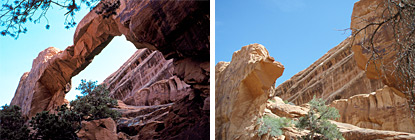
Wall Arch, 12th largest, one of the better-known and most-seen natural arches in Arches National Park, Utah, collapsed.

Wall Arch, before and after collapse - National Park Service photos

Wall Arch, before and after collapse – National Park Service photos

“Not being a geologist, I can’t get very technical but it just went kaboom,” [Arches NP] Chief Ranger Denny Ziemann said. “The middle of the arch just collapsed under its own weight. It just happens.”

Wall Arch, located along the popular Devils Garden Trail, was 71 feet tallwide and 33 1/2 feet widetall, ranking it 12th in size among the known arches inside the park. Lewis T. McKinney first reported and named Wall Arch in 1948.

No one reported observing the arch collapse and there were no visitor injuries, the National Park Service said.

Read the report from the Salt Lake Tribune.

Some tourist on Sunday, August 3, or Monday, August 4, got the last photograph of Wall Arch still standing. Was it you? Were you close? Give us a shout in the comments if so.

Other resources:

x

Other blogs and later reports: