Beautiful photograph; but where are the glaciers?

October 6, 2015

Stupendous photo of evening advancing on Glacier National Park.

The Wilderness Society Tweeted out this shot of Glacier National Park (I cannot read the photographer to whom credit belongs).

The Wilderness Society Tweeted out this shot of Glacier National Park (I cannot read the photographer to whom credit belongs). “Wow. Outstanding sky over @GlacierNPS.”

I know. It’s summer. But still I wonder, where are the glaciers? Where did they go?


Glories of Glacier N.P.

November 6, 2011

Seven-plus minutes of good reason to get your tail to Glacier National Park as soon as you can.

Produced and shot by Joshua Thompson, this is part of an award-winning film made to promote the park and get money for the research that the park hosts.

Grizzly Bears, Bighorn Sheep, spectacular sunsets and more…..

Part 3 of the recently shot Glacier DVD. This 20 min. film recently was nominated for best new nature documentary in the music category as well received an award for photography from the Wildlife Film Festival held in May of 2008. All funds for this project are being donated to the Glacier National Park Fund. For more info: http://www.glaciernationalparkfund.org/cart.php?page=glacier_national_park_fu…

I’ve been there only once.  A wise American would get there before turning 35, and return several times.


Is global warming/climate change a problem? Get the facts

March 15, 2011

Want solid information on climate change (global warming) and the problems it poses?

Several opportunities present themselves, from the National Academies of Science, America’s premiere science advisory group:

America’s Climate Choices Final Report in Review

The final report of the America’s Climate Choices suite of studies is in the final stages of peer review and will be released this Spring.  An official release date will be announced as soon as possible.  The report is authored by the Committee on America’s Climate Choices, which was responsible for providing overall direction, coordination, and integration of the America’s Climate Choices activities.

Related Activities at The National Academies

warming_world_cover
Warming World, a publication from the National Academies of Science

“Warming World: Impacts by Degree” Explains Findings of NRC Report

Emissions of carbon dioxide from the burning of fossil fuels have ushered in a new epoch, beginning to be called the Anthropocene, during which human activities will largely determine the evolution of Earth’s climate. That’s one of the main conclusions from Climate Stabilization Targets: Emissions, Concentrations, and Impacts over Decades to Millennia (NRC, 2011) an expert consensus report released last July and published this year.  Now a new 36-page booklet based on the report, “Warming World: Impacts by Degree” is available to help policymakers, students, and the general public better understand the report’s important conclusions.

The report concludes that, because carbon dioxide is so long-lived in the atmosphere, increases in this gas can effectively lock the Earth and many future generations in a range of impacts, some of which could be severe. Therefore, emission reduction choices made today matter in determining impacts that will be experienced not just over the next few decades, but also into the coming centuries and millennia.  Policy choices can be informed by recent advances in climate science that show the relationships among increasing carbon dioxide, global warming, related physical changes, and resulting impacts. The report identifies (and quantifies when possible) expected impacts per degree of warming, including those on streamflow, wildfires, crop productivity, the frequency of very hot summers, and sea-level rise and its associated risks and vulnerabilities.

Order free copies of the booklet at http://dels.nas.edu/materials/booklets/warming-world.


Report Sets Research Agenda to Study Earth’s Past Climate

Without a reduction in emissions, by the end of this century atmospheric carbon dioxide could reach levels that Earth has not experienced for more than 30 million years. Critical insights into how Earth’s atmosphere, oceans, and ecosystems would function in this high carbon dioxide environment are contained in the records of Earth’s geological past, concludes Understanding Earth’s Deep Past: Lessons for Our Climate Future, a National Research Council report from the Board on Earth Sciences that was released on March 1, 2011.

“Ancient rocks and sediments hold the only records of major, and at times rapid, transitions across climate states and offer the potential for a much better understanding of the long-term impact of climate change,” said Isabel Montañez, chair of the committee that wrote the report and a professor in the department of geology at the University of California, Davis. The research could also yield information on the tipping points for climate change–the threshold of greenhouse gas accumulation in the atmosphere at which abrupt climate change will occur.

The report sets out a research agenda for an improved understanding of Earth system processes during the transition to a warmer world. High-priority research initiatives include gaining a better understanding of the sensitivity of climate to increased atmospheric carbon dioxide, the amount of sea-level rise as the ice sheets melt, and the resilience of ecosystems to climate change.


Webinar on Transportation and Climate Change

On Thursday, March 24 from 2:00-3:00 p.m., the National Academies Transportation Research Board will host the first of a 2-part webinar series that looks the threats of climate change to transportation facilities and operations and at resources for adapting. The cost of the webinar is $109 (the webinars are free to employees of TRB sponsors). To sign up and/or to learn more, please visit http://www.trb.org/ElectronicSessions/Blurbs/164935.aspx.

Also, you can always check out the website for the Board on Atmospheric Sciences and Climate (BASC), a joint project of the National Academy of Sciences, National Academy of Engineering, Institute of Medicine, and National Research Council.


Moral math of climate change, on Speaking of Faith

August 5, 2010

Speaking of Faith is carried on many public radio stations nationally, perhaps on one in your area.  If, as I do, you live in an area where the program is not carried, you can pick up a podcast or .mp3 at the program’s website.  (Here’s a list of stations that carry the broadcast.)

Host Krista Tippett posts a weekly message on the scheduled program — this week, an interview with Bill McKibben, whose book, The End of Nature, was a popular introduction to climate change, when it was published in 1989 (!).

Yes, this program is about woo and how we deal with it in our daily lives.  This particular program looks at how even woo followers may find it to their advantage to pay attention to the science, and act to protect their families and communities as a result.  This is a moral side of climate change that too many people simply deny.

Ms. Tippett wrote:

This week on public radio’s conversation about religion, meaning, ethics, and ideas:

The Moral Math of Climate Change

Bill McKibben’s first book, The End of Nature, was the first popular book on climate change, and he is one of the most insightful figures of our time on ecology and life. We’ll explore his hopeful sense that what is good for the environment also nourishes human relationship. And we’ll seek his perspective on knowledge we can trust as we orient our minds and lives to changing realities of the natural world.

Krista Tippett, host of Speaking of Faith

History Tends to Surprise Us
It’s been striking how, across the past few years, the environment has found its way inside my guests’ reflections on every subject, as they say, under the sun. And we do need fresh vocabulary and expansive modes of reflection on this subject that, we’ve come to realize, is not just about ecology but the whole picture of human life and lifestyle.

Here are some pieces of vocabulary and perspective I’ve loved and used in recent years.

Starting with the basics, Cal DeWitt — a scientist, conservationist, and Evangelical Christian living in Wisconsin — pointed out to me that “environment” was coined after Geoffrey Chaucer used the term “environing.” This was a turning point in the modern Western imagination — the first time we linguistically defined ourselves as separate from the natural world, known up until then as the Creation. This helps explain why the language of “creation care” is so animating for many conservative Christians — as a return to a sacred insight that was lost. But from quantum physics to economics, too, we are discovering new existential meaning in terms like interconnectedness and interdependence.

Many people, but most recently the wonderful geophysicist Xavier le Pichon, have made the simple yet striking observation that climate change is the first truly global crisis in human history. In other words, just as we make newfound discoveries about old realities, they are put to the ultimate test. It is easy to be overwhelmed by the signs that we are not up to this test as a species. So it was helpful for me to have Matthieu Ricard, a biologist turned Buddhist monk, remind me that evolutionary change, which is what we need now in our behavior, always comes precisely at the moment where survival — not just betterment — is at stake.

Such ideas can make the task of integrating, or reintegrating, environmental and human realities sound far away and abstract. But it’s not.

The most redemptive and encouraging commonality of all the people I’ve encountered who have made a truly evolutionary leap is that they have come to love the very local, very particular places they inhabit. They were drawn into environmentalism by suddenly seeing beauty they had taken for granted; by practical concern for illness and health in neighborhood children; by imagining possibilities for the survival of indigenous flora and fauna, the creation of jobs, the sustainability of regional farms. The catchword of many of our most ingenious solutions to this most planetary of crises is “local” — local food, local economies. Ellen Davis and Wendell Berry illuminate this with poetic, biblical wisdom, each in their way reminding us that the health of our larger ecosystem is linked to knowing ourselves as creatures — “placed creatures.”

There is so much in my most recent conversation about all of this with Bill McKibben that will frame and deepen my sense of the nature and meaning of climate change moving forward. Among them is an exceedingly helpful four minutes, a brief history of climate change that we’re making available as a separate podcast. But what has stayed with me most of all, I think, is a stunning equation he is ready to make after two decades of immersion in the scientific, cultural, and economic meaning of our ecological present. He points out that cheap fossil fuels have allowed us to become more privatized, less in need of our neighbor, than ever in human history. And he says that in almost every instance, what is good for the environment is good for human community. The appeal of the farmers market is not just its environmental and economic value but the drama, the organic nature, of human contact.

I also gained a certain bracing historical perspective from my conversation with Bill McKibben. He and I were both born in 1960. He was waking up to the environment in years in which I was in divided Berlin, on the front lines of what felt like the great strategic and moral battle of that age. He published The End of Nature in 1989, the year the Berlin Wall fell. And as I learned from that book, the science of climate change had already begun to emerge at the height of the Cold War. In 1957, two scientists at the Scripps Institution described their findings that humanity initiated an unprecedented “geophysical experiment” that it might not survive.

So I’ve been chewing on this thought lately: If humanity is around to write history in a century or two, what was happening with the climate in 1989 may dwarf what we perceived as the great geopolitical dramas of that time. Living through the fall of the wall and the reunification of Europe emboldened my sense that there is always more to reality than we can see and more change possible than we can begin to imagine. I draw caution as well as hope from the fact that history tends to surprise us. And I draw caution as well as hope from the knowledge that humanity often surprises itself on the edge of survival.

The End of Nature by Bill McKibben I Recommend Reading:
The End of Nature
by Bill McKibben

This was the first book to introduce the notion and science of climate change to a non-scientific audience. It is passionately and beautifully written. And while Bill McKibben’s updated introduction in recent printings adds relevant new knowledge, it also highlights just how prescient and powerful the original book remains.

Add to FacebookAdd to NewsvineAdd to DiggAdd to Del.icio.usAdd to StumbleuponAdd to RedditAdd to BlinklistAdd to TwitterAdd to TechnoratiAdd to Furl


Debunking Monckton’s “no warming” hoax, Part 2

April 17, 2010

So, Maggie Thatcher, his boss, also rejected Christopher Monckton’s preposterous claims against the science of climate change?

Who knew?

It’s clear Christopher Monckton doesn’t know . . . much of value.

Sorta disappointed Peter Sinclair didn’t go after Monckton’s preposterous insults of Jackie Kennedy and Rachel Carson, but there’s only so much debunking one can do in a limited period of time, and so much of Monckton’s work requires debunking, even cries out for debunking.

Is there anything Monckton claims which is not hoax?


Annals of global warming: Glaciological map of Antarctica’s Palmer Land Area, 1947-2009

March 3, 2010

Are the ice fields of Antarctica increasing or decreasing?  How do we know?

U.S. Geological Survey released a study of the change in glaciation in Antarctica between 1947 and 2009.  Serious student of climate change will heed what the maps show — better bookmark the site.  The study and publication were done in a joint effort of USGS, the British Antarctic Survey, the Scott Polar Research Institute, and the Bundesamt für Kartographie und Geodäsie (same page, in English, here).

Coastal-Change and Glaciological Map of the Palmer Land Area, Antarctica: 1947—2009

By Jane G. Ferrigno,1 Alison J. Cook,2 Amy M. Mathie,3 Richard S. Williams, Jr.,4 Charles Swithinbank,5 Kevin M. Foley,1 Adrian J. Fox,2 Janet W. Thomson,6  and Jörn Sievers

Introduction

Cover of USGS publication, Coastal-Change and Glaciological Map of the Palmer Land Area, Antarctica: 1947—2009

Cover of USGS publication, Coastal-Change and Glaciological Map of the Palmer Land Area, Antarctica: 1947—2009

Reduction in the area and volume of the two polar ice sheets is intricately linked to changes in global climate, and the resulting rise in sea level could severely impact the densely populated coastal regions on Earth. Antarctica is Earth’s largest reservoir of glacial ice. Melting of the West Antarctic part alone of the Antarctic ice sheet would cause a sea-level rise of approximately 6 meters (m), and the potential sea-level rise after melting of the entire Antarctic ice sheet is estimated to be 65 m (Lythe and others, 2001) to 73 m (Williams and Hall, 1993). The mass balance (the net volumetric gain or loss) of the Antarctic ice sheet is highly complex, responding differently to different climatic and other conditions in each region (Vaughan, 2005). In a review paper, Rignot and Thomas (2002) concluded that the West Antarctic ice sheet is probably becoming thinner overall; although it is known to be thickening in the west, it is thinning in the north. The mass balance of the East Antarctic ice sheet is thought by Davis and others (2005) to be positive on the basis of the change in satellite-altimetry measurements made between 1992 and 2003.

Measurement of changes in area and mass balance of the Antarctic ice sheet was given a very high priority in recommendations by the Polar Research Board of the National Research Council (1986), in subsequent recommendations by the Scientific Committee on Antarctic Research (SCAR) (1989, 1993), and by the National Science Foundation’s (1990) Division of Polar Programs. On the basis of these recommendations, the U.S. Geological Survey (USGS) decided that the archive of early 1970s Landsat 1, 2, and 3 Multispectral Scanner (MSS) images of Antarctica and the subsequent repeat coverage made possible with Landsat and other satellite images provided an excellent means of documenting changes in the cryospheric coastline of Antarctica (Ferrigno and Gould, 1987). The availability of this information provided the impetus for carrying out a comprehensive analysis of the glaciological features of the coastal regions and changes in ice fronts of Antarctica (Swithinbank, 1988; Williams and Ferrigno, 1988). The project was later modified to include Landsat 4 and 5 MSS and Thematic Mapper (TM) images (and in some areas Landsat 7 Enhanced Thematic Mapper Plus (ETM+) images), RADARSAT images, aerial photography, and other data where available, to compare changes that occurred during a 20- to 25- or 30-year time interval (or longer where data were available, as in the Antarctic Peninsula). The results of the analysis are being used to produce a digital database and a series of USGS Geologic Investigations Series Maps (I-2600) (Williams and others, 1995; Swithinbank and others, 2003a,b, 2004; Ferrigno and others, 2002, 2005, 2006, 2007, 2008, and in press; and Williams and Ferrigno, 2005) (available online at http://www.glaciers.er.usgs.gov).

The paper version of this map is available for purchase from the USGS Store.

What’s the condition of glaciers in Antarctica?  Now you can look it up.

The pamphlet accompanying the maps says under “Discussion”:

The most noticeable and dramatic changes that can be seen on the Palmer Land area map are the retreat of George VI, Wilkins, Bach, and northern Stange Ice Shelves. The northern ice front of George VI Ice Shelf was at its farthest extent during our period of observation between 1966 and 1974. It retreated, losing 906 km2 between 1974 and 1992 and 87 km2 between 1992 and 1995. After 1995, it retreated an additional 1 km to more than 6 km by 2001. The southern George VI ice front retreated considerably from 1947 to the late 1960s. From the late 1960s to 1973, there was additional substantial retreat, the greatest during the period of measurements.  From 1973 to 2001, there was overall noticeable retreat.

Wilkins Ice Shelf had four ice fronts up till 2009; all retreated during the time period of our study, but Wilkins “a” and “b” have had the most dramatic change, including extensive calving in 2009 that eliminated ice front “b” and threatened the future of the ice shelf. During the period of observation, the Bach Ice Shelf front maintained a fairly consistent profile, and advanced or retreated at the same time along the entire ice front. The overall trend of Bach Ice Shelf is retreat. On the northern Stange Ice Shelf during the period of observation, the 1947, 1965–66, 1973, and 1986 ice fronts were more advanced, and the 1997 and 2001 ice fronts were more in retreat. However, the earlier data are less accurate geographically, and it is difficult to quantitatively analyze them. The later satellite images are more accurate, and it is possible to measure overall advance from 1986 to 1989, then retreat from 1989 to 1997 and from1997 to 2001; the net result was retreat.

The three coastal-change and glaciological maps of the Antarctic Peninsula (I–2600–A, –B, and –C) portray one of the most rapidly changing areas on Earth. The changes exhibited in the region are widely regarded as among the most profound and unambiguous examples of the effects of global warming yet seen on the planet.

Resources:


Annals of global warming: Columbia Glacier, Alaska (by James Balog)

February 20, 2010

Actual observations of the world show global warming.  Time-lapse photos of the destruction of the Columbia Glacier, in Alaska, by James Balog, should make any person start wondering how to control warming processes.

It’s a film documenting warming, a film that Joanne Nova and Anthony Watts hope you will never see.*

James Balog, at TEDS, explains the stuff in under 20 minutes:

From National Geographic’s site:

© 2008 James Balog/Extreme Ice Survey

This remarkable image sequence captures a series of massive calving events at Columbia Glacier near Valdez, Alaska. Composed of 436 frames taken between May and September of 2007, it shows the glacier rapidly retreating by about half a mile (1.6 kilometers), a volume loss of some 0.4 cubic miles (1.67 cubic kilometers) of ice or 400 billion gallons (1.5 trillion liters) of water.

The time-lapse was taken as part of the ongoing Extreme Ice Survey (EIS), an ambitious project to capture global warming-induced glacial retreat in the act. Beginning in December 2006, photographer James Balog and his colleagues set up 26 solar-powered cameras at glaciers in Greenland, Iceland, Alaska, the Alps, and the Rocky Mountains. Each unit will take a photograph every daylight hour until fall 2009.

In 2008, Balog’s team began to return to each of the camera sites to collect images. In the end, they will have more than 300,000 images to analyze and stitch together to produce more dramatic videos like this one.

This kind of multiyear effort, says Balog, is necessary to “radically alter public perception of the global warming issue.”

Don’t miss: Extreme Ice a NOVA/National Geographic Television special airing on PBS March 24, 2009 at 8:00 p.m.

Resources:

_____________

Am I too harsh?  Go over to those blogs and see if you can find the WordPress pingback listed in the comments to those posts, for this post’s link to them.  No?  Then they’ve gone in and deleted the message.  It’s automatic on WordPress, and it works wonderfully.  But if they have the readership they claim, and if they are so certain of their views, why do they fear Millard Fillmore’s Bathtub?


Wattsupgate: Denialists claim all knowledge is wrong

January 31, 2010

It really is that bad.  Climate science denialists now attack any information simply for not being what they want it to be.  Lysenko’s Ghost smiles broadly.

Anthony Watts is just the most prominent of the bloggers making hoax charges of error and worse in the fourth report from the Intergovernmental Panel on Climate Change (IPCC), because of a footnote that cites a rock climbing magazine.

Here’s the trouble for Watts:  There is no indication that the citation is in error in any way.  Watts’s move is more fitting of King George III’s campaign against Ben Franklin’s lightning rods, the prosecution of John Peter Zenger, the pre-World War II campaign against Einstein’s work because he was born a Jew, or the hoary old Red Channels campaign against Texas history told by John Henry Faulk.  It’s as bad as the Texas State Board of Education’s attack on Brown Bear, Brown Bear, What Do You See? Watts’ and others’ complaint is simply that Climbing magazine’s story on the worldwide retreat of glaciers suitable for climbing is not published in a juried science journal.

In other words, they indict the science, not because it’s wrong — they have no evidence to counter it — but because it’s too American Patriot correct Jewish left Texan mistakenly thought to be political well-known, too accessible, (small “d”) democratically-reported.

And of course, any comment that points that out at Watts’s blog goes into long-term “moderation,” keeping it from the light of day in the best tradition of the Crown’s defense of Gov. Cosby’s misadministration of New York (see “John Peter Zenger”).  Watts said in a quote that should have been attributed to the Daily Telegraph:

The IPCC’s remit is to provide an authoritative assessment of scientific evidence on climate change.

In its most recent report, it stated that observed reductions in mountain ice in the Andes, Alps and Africa was being caused by global warming, citing two papers as the source of the information.

However, it can be revealed that one of the sources quoted was a feature article published in a popular magazine for climbers which was based on anecdotal evidence from mountaineers about the changes they were witnessing on the mountainsides around them.

The other was a dissertation written by a geography student, studying for the equivalent of a master’s degree, at the University of Berne in Switzerland that quoted interviews with mountain guides in the Alps.

The revelations, uncovered by The Sunday Telegraph, have raised fresh questions about the quality of the information contained in the report, which was published in 2007.

It comes after officials for the panel were forced earlier this month to retract inaccurate claims in the IPCC’s report about the melting of Himalayan glaciers.

By those standards, Watts’s own readers should eschew his blog — it’s not peer reviewed science by any stretch, and Watts isn’t an established authority in climate science (he’s not even working for an advanced degree).  Consistency isn’t a virtue or concern among climate change denialists.  Watt’s entire modus operandi is much more anecdotal than the story in Climbing, which was written by a physicist/climber who studies climate change in the world’s mountains.

And did you notice?  They’re whining about research done by a scientist in pursuit of a degree, complaining about the second citation.  That’s the exaclty kind of research that they claim the magazine article is not.  Their complaint is, it appears, that a scientist in pursuit of education is not the right “kind” of person to do climate research. It’s the chilling sort of bigotry that we spent so much time in the 20th century fighting against.  In the 21st century, though, it appears one can still get away with demonizing knowledge, education and research, part of the campaign to indict “elitism,” the same sort of elitism aspired to by America’s founders.  Too much of the criticism against scientists involved in documenting global warming is the cheap bigotry the critics claim to find in science, falsely claimed in my view.

Topsy-turvy.

And the glaciers?  Yeah, the evidence tends to show they are in trouble.  Those Himalayan glaciers?  The IPCC report was accurate in everything except the speed at which the glaciers decline — they should be with us for another three centuries, not just 50 years, if we can reduce warming back to 1990s levels (oddly, denialists rarely deal with the facts of accelerating warming, preferring to point to a local snowstorm as a rebuttal of all knowledge about climate).

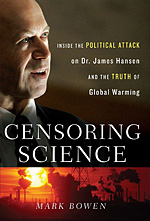
Oh, and the research?  The author of the story in Climbing magazine is Mark Bowen.  Dr. Bowen’s Ph.D. is in physics from MIT. He’s a climber, and he researches climate change on the world’s highest mountains.  His 2005 book, Thin Ice, focused tightly on what we can learn about climate from the world’s highest mountains.   Bowen is the expert Anthony Watts would like to be.

Cover of Mark Bowen's book defending climate science, "Censoring Science."

Cover of Mark Bowen’s book defending climate science, “Censoring Science.”

Bowen’s newest book:  Censoring Science:  Inside the political attack on James Hansen and the truth of global warming. Watts doesn’t want anyone to read that book.  It is easy to imagine Watt’s s attack is, he hopes, pre-emptive, against Bowen’s book.

I’ll wager Watts hasn’t read the article in Climbing, and didn’t know who Bowen was when he launched his attack, though.  The denials of bias coming out of the denialists’ camp will be interesting to watch.

Let the denialists roll out the rope far enough, they’ll inevitably hang themselves.

More:

Do something for freedom: Spread the news

Add to FacebookAdd to NewsvineAdd to DiggAdd to Del.icio.usAdd to StumbleuponAdd to RedditAdd to BlinklistAdd to TwitterAdd to TechnoratiAdd to Furl


Annals of Global Warming: Bering Strait, choke point and butterfly effect

January 17, 2010

From the National Science Foundation, we get more stuff that students in high school ought to learn, stuff which would give the conservatives on the Texas State Board of Education full-fledged conniptions, stuff that just doesn’t fit into Texas’s Teach-To-The-Test™ education standards.

Reading the press release brings home two points to me.  First, for the sake of Texas social studies standards, this story tells the physical effects of “choke points.”  The Bering Strait limited human migration to populate the America’s, meeting the definition of choke point favored by Texas Essential Knowledge and Skills (TEKS), and this story sheds light on that issue.  But it also points out that choke points affect more than just humans.  This was a key finding of the President’s Commission on Americans Outdoors that led to a recommendation that we create green corridors favorable for animal migration.  In the Bering Strait, it’s migration of ice and cold and warm water that get choked off — and that, too, affects human history.  Second, this may enlighten students to the butterfly effect noted in the science we call chaos, where a small physical perturbation in one area can have enormous consequences later, and far away, in the dynamic systems that keep our planet alive.  (Yeah, the Bering Strait is bigger than a butterfly.  I know.)

Press Release 10-003

Global Ice Age Climate Patterns Influenced by Bering Strait

Small geographic feature has large impacts on climate

Ice pouring through the Bering Strait, from the Arctic to Pacific Ocean - NASA photo via NSF

Ice is shown choking the Bering Strait in recent times; the ice moves from the strait south to the Bering Sea. Credit: NASA

January 10, 2010

In a vivid example of how a small geographic feature may have far-reaching impacts on climate, new research shows that water levels in the Bering Strait helped drive global climate patterns during ice age episodes dating back more than 100,000 years.

The international study, led by scientists at the National Center for Atmospheric Research (NCAR) in Boulder, Colo., found that the repeated opening and closing of the narrow strait due to fluctuating sea levels affected currents that transported heat and salinity in the Atlantic and Pacific Oceans.

As a result, summer temperatures in parts of North America and Greenland oscillated between comparatively warm and cold phases, causing ice sheets to alternate between expansion and retreat and affecting sea levels worldwide.

While the findings do not directly bear on current global warming, according to Steve Nelson, National Science Foundation (NSF) program director for NCAR, they highlight the complexity of Earth’s climate system and the fact that seemingly insignificant changes can lead to dramatic tipping points for climate patterns, especially in and around the Arctic.

“The global climate is sensitive to impacts that may seem minor,” says NCAR scientist Aixue Hu, the project’s lead scientist. “Even small processes, if they are in the right location, can amplify changes in climate around the world.”

The research results are published this week in the journal Nature Geoscience.

Funded by NSF and the U.S. Department of Energy, the scientists used the latest generation of supercomputers to study past climate at a level of detail that would have been impossible just a few years ago.

Hu and his colleagues set out to solve a key mystery of the last glacial period: Why, starting about 116,000 years ago, did northern ice sheets repeatedly advance and retreat for about the next 70,000 years? The enormous ice sheets held so much water that sea levels rose and dropped by as much as about 100 feet (30 meters) during these intervals.

In other cases, scientists have associated such major oscillations in climate with fluctuations in Earth’s orbit around the Sun. But in the time period the research team looked at, the orbital pattern did not correspond with the geologic movement of the ice sheets and associated sea level changes.

The researchers considered an alternative possibility: that changes in the Bering Strait, the main gateway in the Northern Hemisphere between the Atlantic and Pacific Oceans, might have affected ocean currents across much of the globe.

Although small–the strait is currently about 50 miles (80 kilometers) wide between Russia and the westernmost islands of Alaska–it allows water to circulate from the relatively fresh north Pacific to the saltier north Atlantic via the Arctic Ocean. This flow is instrumental to regulating the strength of a current known as the meridional overturning circulation, a key driver of heat from the tropics to the poles.

Using the NCAR-based Community Climate System Model, a powerful computer tool for studying worldwide climate, the researchers compared the responses of ice age climate to conditions in the Bering Strait.

They ran the model on new supercomputers at NCAR and the Department of Energy’s Oak Ridge National Laboratory, enabling them to focus on smaller-scale geographic features that, until recently, could not be captured in long-term simulations of global climate.

The simulations accounted for the changes in sea level, revealing a recurring pattern–each time playing out over several thousand years–in which the reopening and closing of the strait had a far-reaching impact on ocean currents and ice sheets.

As the climate cooled because of changes in Earth’s orbit, northern ice sheets expanded. This caused sea levels to drop worldwide, forming a land bridge from Asia to North America and nearly closing the Bering Strait.

With the flow of comparatively fresh water from the Pacific to the Atlantic choked off, the Atlantic grew more saline. The saltier and heavier water led to an intensification of the Atlantic’s meridional overturning circulation, a current of rising and sinking water that, like a conveyor belt, pumps warmer water northward from the tropics.

This circulation warmed Greenland and parts of North America by about 3 degrees Fahrenheit (1.5 degrees Celsius)–enough to reverse the advance of ice sheets in those regions and reduce their height by almost 400 feet (112 meters) every thousand years. Although the Pacific cooled by an equivalent amount, it did not have vast ice sheets that could be affected by the change in climate.

Over thousands of years, the Greenland and North American ice sheets melted enough to raise sea levels and reopen the Bering Strait.

The new inflow of fresher water from the Pacific weakened the meridional overturning circulation, allowing North America and Greenland to cool over time. The ice sheets resumed their advance, sea levels dropped, the Bering Strait again mostly closed, and the entire cycle was repeated.

The combination of the ocean circulation and the size of the ice sheets–which exerted a cooling effect by reflecting sunlight back into space–affected climate throughout the world.

The computer simulations showed that North America and Eurasia warmed significantly during the times when the Bering Strait was open, with the tropical and subtropical Indian and Pacific Oceans, as well as Antarctica, warming slightly.

The pattern was finally broken about 34,000 years ago, the point in Earth’s 95,000-year orbital cycle at which the planet was so far from the Sun at certain times of year that the ice sheets continued to grow even when the Bering Strait closed.

When the orbital cycle brought Earth closer to the Sun in the northern winter, the ice sheets retreated sufficiently about 10,000 years ago to reopen the strait. This helped lead to a relatively stable climate, nurturing the rise of civilization.

“This kind of study is critical for teasing out the nuances of our climate system,” says NCAR scientist Gerald Meehl, a co-author of the paper. “If we can improve our understanding of the forces that affected climate in the past, we can better anticipate how our climate may change in the future.”

In addition to NCAR, the study team included researchers from the National Center for Scientific Research (CNRS) in France, University of Colorado in Boulder, Catholic University of Louvain in Belgium, Australian National University and Harvard University.

-NSF-
Download the high-resolution JPG version of the image [of ice flowing through the Bering Strait, above]. (1.4 MB)

Bering Strait, NASA photo via National Science Foundation

The Bering Strait separates the U.S. and Russia by only 90 kilometers. Credit: NASA

Download the high-resolution JPG version of the image. (570 KB)

Currents move warm and cold water across the Arctic Ocean - UCAR map

Altered currents once produced ocean warming (right, dark red) that melted ice sheets. Credit: UCAR

Download the high-resolution JPG version of the image. (680 KB)

Media Contacts
Cheryl Dybas, NSF (703) 292-7734 cdybas@nsf.gov
David Hosansky, NCAR/UCAR (303) 497-8611 hosansky@ucar.edu

The National Science Foundation (NSF) is an independent federal agency that supports fundamental research and education across all fields of science and engineering. In fiscal year (FY) 2009, its budget is $9.5 billion, which includes $3.0 billion provided through the American Recovery and Reinvestment Act. NSF funds reach all 50 states through grants to over 1,900 universities and institutions. Each year, NSF receives about 44,400 competitive requests for funding, and makes over 11,500 new funding awards. NSF also awards over $400 million in professional and service contracts yearly.

Get News Updates by Email

Useful NSF Web Sites:
NSF Home Page: http://www.nsf.gov
NSF News: http://www.nsf.gov/news/
For the News Media: http://www.nsf.gov/news/newsroom.jsp
Science and Engineering Statistics: http://www.nsf.gov/statistics/
Awards Searches: http://www.nsf.gov/awardsearch/

Bookmark those sites, teachers.

More:


Annals of Global Warming: Black soot and glaciers in Tibet

January 5, 2010

Another in a series on the history of global warming; this comes from the Earth Observatory at NASA (visit that site — the image is more stunning, larger):

tibet_geos5_2009269

Black Soot and the Survival of Tibetan Glaciers

Posted December 15, 2009
Black Soot and the Survival of Tibetan Glaciers

Color bar for Black Soot and the Survival of Tibetan Glaciers
download large image (677 KB, JPEG) acquired September 26, 2009
download large animation image (9 MB, M4V) acquired August 1, 2009 – November 9, 2009

On the Tibetan Plateau, temperatures are rising and glaciers are melting faster than climate scientists would expect based on global warming alone. A recent study of ice cores from five Tibetan glaciers by NASA and Chinese scientists confirmed the likely culprit: rapid increases in black soot concentrations since the 1990s, mostly from air pollution sources over Asia, especially the Indian subcontinent. Soot-darkened snow and glaciers absorb sunlight, which hastens melting, adding to the impact of global warming.

NASA climate scientists combine satellite and ground-based observations of soot and other particles in the air with weather and air chemistry models to study how the atmosphere moves pollution from one place to another. This image is from a computer simulation of the spread of black soot (“black carbon” to climate scientists) over the Tibetan Plateau from August through November 2009. It shows black carbon aerosol optical thickness on September 26, 2009. (Aerosol optical thickness is scale that describes how much pollution was in the air based on how much of the incoming sunlight the particles absorbed.) Places where the air was thick with soot are white, while lower concentrations are transparent purple.

The highest concentrations of black soot are in the right-hand side of the image, over the densely populated coastal plain of China. But high concentrations occur over India, as well, and the black soot spreads across the southern arc of the Tibetan Plateau, which is defined by the towering peaks of the Himalaya Mountains. (Note: Topography has been exaggerated to highlight features that influence air movement). The animation shows how the black carbon pollution from India often circulates at high concentrations for several days against the base of the Himalaya, periodically “sloshing” over the rim of the mountains and spilling northward over the plateau, before being carried away over the Bay of Bengal or the Arabian Sea.

Writing about the implications of the study for the Goddard Institute for Space Studies Website, NASA climate scientist and study co-author James Hansen said, “[C]ontinued, ‘business-as-usual’ emissions of greenhouse gases and black soot will result in the loss of most Himalayan glaciers this century, with devastating effects on fresh water supplies in dry seasons. The black soot arises especially from diesel engines, coal use without effective scrubbers, and biomass burning, including cook stoves. Reduction of black soot via cleaner energies would have other benefits for human health and agricultural productivity. However, survival of the glaciers also requires halting global warming, which depends upon stabilizing and reducing greenhouse gases, especially carbon dioxide.”

NASA image by Gregory Shirah, Goddard Scientific Visualization Studio, based on model simulations from the Goddard Earth Observing System Model, Version 5 (GEOS-5). Caption by Rebecca Lindsey.