When things get tough, the patriotic listen to Barbara Jordan

August 2, 2007

Whose voice do you hear, really, when you read material that is supposed to be spoken by God? Morgan Freeman is a popular choice — he’s played God at least twice now, racing George Burns for the title of having played God most often in a movie. James Earl Jones?

Statue of Barbara Jordan at the Austin, Texas, Airport

Statue of Rep. Barbara Jordan at the Austin, Texas airport that bears her name. Photo by Meghan Lamberti, via Accenture.com

For substance as well as tone, I nominate Barbara Jordan’s as the voice you should hear.

I’m not alone. Bill Moyers famously said:

When Max Sherman called me to tell me that Barbara was dying and wanted me to speak at this service, I had been reading a story in that morning’s New York Times about the discovery of forty billion new galaxies deep in the inner sanctum of the universe. Forty billion new galaxies to go with the ten billion we already knew about. As I put the phone down, I thought: it will take an infinite cosmic vista to accommodate a soul this great. The universe has been getting ready for her.

Now, at last, she has an amplifying system equal to that voice. As we gather in her memory, I can imagine the cadences of her eloquence echoing at the speed of light past orbiting planets and pulsars, past black holes and white dwarfs and hundreds of millions of sun-like stars, until the whole cosmic spectrum stretching out to the far fringes of space towards the very origins of time resonates to her presence.

Virgotext carried a series of posts earlier in the year, commemorating what would have been Jordan’s 71st birthday on February 21. (Virgotext also pointed me to the Moyers quote, above.)

Now, when the nation seriously ponders impeachment of a president, for the third time in just over a generation, Ms. Jordan’s words have more salience, urgency, and wisdom. It’s a good time to revisit Barbara Jordan’s wisdom, in the series of posts at Virgotext.

“There is no president of the United States that can veto that decision.”

“My faith in the Constitution is whole.”

“We know the nature of Impeachment. We’ve been talking about it a while now.”

“Indignation so great as to overgrow party interests.”

And finally:

The rest of the hearing remarks are all here. It’s a longer clip than the others but honestly, there is not a good place to cut it.

This is Barbara Jordan on the killing floor.

This was a woman who understands history, who illustrates time and again that we are, with every action, with every syllable, cutting the past away from the present.

She never mentions Nixon by name. There is the Constitution. There is the office of the Presidency. But Richard Nixon the president has already ceased to exist. By the time she finishes speaking, he is history.

“A President is impeachable if he attempts to subvert the Constitution.”

Also see, and hear:

Virgotext’s collection of Barbara Jordan stories and quotes is an excellent source for students on Watergate, impeachment, great oratory, and Barbara Jordan herself. Bookmark that site.

Barbara Jordan, in a pensive moment, in a House Committee room

Rep. Barbara Jordan sitting calmly among tension, at a House Committee meeting (probably House Judiciary Committee in 1974).

Update 2019: Here is the full audio of Barbara Jordan’s speech. It is still salient, and if you listen to it you will understand better what is going on in Congress today.

Barbara Jordan, Statement on the Articles of Impeachment, at AmericanRhetori.com.


U.S. education: Old dogs, new tricks, no problem

July 31, 2007

David Parker notes this wonderful event.  It makes me hopeful for the nation, really.

David:  Did you ask the guy if your students can interview him?


Historians at work: The last known Brit who fought in the trenches of World War I

July 29, 2007

Richard van Emden is not a well known historian in the U.S., but perhaps he should be better known (he is also a television producer). This is exactly the sort of work that we need more historians doing:

Van Emden is interviewing Harry Patch of Somerset, England. Patch is 109 years old, and is the last known surviving soldier to have fought in the trenches in Belgium for the Allies in World War I.

Harry Patch and Richard van Emden, in BelgiumHarry Patch, foreground, and Richard van Emden visit the site of the World War I Battle of Passchendaele, near Flanders, Belgium.

250,000 British soldiers died in the battle.

The 109-year-old fought in the Battle of Passchendaele when he was aged 19.

He served with the Duke of Cornwall’s light infantry and was called up for service while working as an 18-year-old apprentice plumber in Bath.

During the fighting, Mr Patch was badly wounded and three of his best friends were killed when a shell exploded just yards from where he was standing.

He made the trip with historian Richard van Emden, who helped Mr Patch write down his memories.

Mr van Emden showed him the five miles they advanced over 99 days which claimed 3,000 British casualties every day.

He was also shown a recently discovered panoramic photograph of the fields taken in 1917.

“Too many died,” said Mr Patch. “War isn’t worth one life.”

Interviews with participants in history, with the eyewitnesses, provide a good training ground for future historians. The interviews generally provide great value, even when done by amateurs, such as high school students.

Teachers, how many veterans of how many wars live in your town? How many of them have been asked to tell about their experiences?


Who is this man?

July 25, 2007

President Abraham Lincoln meeting soldiers following the Battle of Antietam

And, are you ready to celebrate the bicentennial of his birth in your classroom?

  • Photo: P_________ _______ _______ meets soldiers from the Union forces, following the Battle of Antietam, in Maryland, October 3, 1862. With the man in the hat are, from left, Col. Alexander S. Webb, Chief of Staff, 5th Corps.; Gen. George B. McClellan; Scout Adams; Dr. Jonathan Letterman, Army Medical Director; an unidentified person; and standing behind Lincoln, Gen. Henry J. Hunt. Photo and caption from _______ _______ Bicentennial 2009.
  • Read the rest of this entry »

More Borlaug

July 22, 2007

I urged local newspapers to track down Norman Borlaug — oops!  Turns out he’s in my town.  The Dallas Morning News features a story on Norman Borlaug today.

Hey, P. Z. Myers — he’s out of the University of Minnesota system.  He says seeds professors and coaches plant today can yield big stuff, but later.

Norman Borlaug and Congressional Gold Medal  Photo by Lawrence Jenkins, special contributor to the Dallas Morning News.


Humanity’s hope for the future: A giant leap for mankind

July 21, 2007


Southwest Elementary in Burley, Idaho, existed in a world far, far away from the U.S. space program. We watched rocket launches on black and white television — the orbital launches were important enough my father let me stay home from school to watch, but when he dropped me off, I was in a tiny band of students who actually made it to school. Potato farmers and the merchants who supported them thought the space program was big, big stuff.

By John Glenn’s flight, a three-orbit extravaganza on February 20, 1962, a television would appear in the main vestibule of the school, or in the auditorium, and we’d all watch. There were very few spitballs. Later that year my family moved to Pleasant Grove, Utah.

Toward the end of the Gemini series, television news networks stopped providing constant coverage. The launch, the splashdown, a space walk or other mission highlight, but the nation didn’t hold its breath so much for every minute of every mission. Barry McGuire would sing about leaving the planet for four days in space (” . . . but when you return, it’s the same old place.”), then six days, but it was just newspaper headlines.

The Apollo 1 fire grabbed the nation’s attention again. Gus Grissom, one of the three who died, was one of the original space titans; death was always a possibility, but the U.S. program had been so lucky. Apollo’s start with tragedy put it back in the headlines.

The space program and its many successes made Americans hopeful, even in that dark decade when the Vietnam War showed the bloody possibilities of the Cold War. That darkest year of 1968 — see the box below — closed nicely with Apollo 8 orbiting the Moon, and the famous Christmas Eve telecast from the three astronauts, Frank Borman, Jim Lovell, and William A. Anders. The space program kept us hopeful.

By early 1969 many of us looked forward to the flight of Apollo 11 schedule for July — the space flight that promised to put people on the Moon for the first time in history, the realization of centuries-old dreams.

But, then I got my assignment for Scouting for the summer — out of nearly 50 nights under the stars, one of the days would include the day of the space walk. Not only was it difficult to get televisions into Maple Dell Scout Camp, a good signal would be virtually impossible. I went to bed knowing the next day I’d miss the chance of a lifetime, to watch the first moon landing and walk.

Just after midnight my sister Annette woke me up. NASA had decided to do the first walk on the Moon shortly after touchdown, at an ungodly hour. I’d be unrested to check Scouts in, but I’d have seen history.

And so it was that on July 20, 1969, Neil Armstrong became the first human to set foot on the Moon: “A small step for a man, a giant leap for mankind,” was what he meant to say in a transmission that was famously garbled (at least he didn’t say anything about jelly doughnuts).

P. Z. Myers says he remembers a lawnmower going somewhere. It must have been very bright in Seattle. (Thanks for the reminder, P.Z., and a tip of the old scrub brush to you.)

2009 will mark the 40th anniversary.

Texas Essential Knowledge and Skills (TEKS) lists 11 dates for U.S. history as the touchstones kids need to have: 1609, the founding of Jamestown; 1776, the Declaration of Independence; 1787, the Constitutional Convention; 1803, the Louisiana Purchase; 1861-1865, the American Civil War; 1877, the end of Reconstruction; 1898, the Spanish American War; 1914-1918, World War I; 1929, the Stock Market Crash and beginning of the Great Depression; 1941-1945, World War II; 1957, the launching of Sputnik by the Soviets. Most teachers add the end of the Cold War, 1981; I usually include Apollo 11 — I think that when space exploration is viewed from a century in the future, manned exploration will be counted greater milestone than orbiting a satellite; my only hesitance on making such a judgment is the utter rejection of such manned exploration after Apollo, which will be posed as a great mystery to future high school students, I think.)

* 1968, in roughly chronological order, produced a series of disasters that would depress the most hopeful of people, including: the Pueblo incident, the B-52 crash in Greenland, the Tet Offensive in Vietnam, the nerve gas leak at the Army’s facility at Dugway, Utah, that killed thousands of sheep, Lyndon Johnson’s pullout from the presidential race with gathering gloom about Vietnam, the Memphis garbage strike, the assassination of Martin Luther King, Jr., riots, the Black Panther shoot out in Oakland, the Columbia University student takeover, the French student strikes, the tornadoes in Iowa and Arkansas on May 15, the Catonsville 9 vandalism of the Selective Service office, the sinking of the submarine U.S.S. Scorpion with all hands, the shooting of Andy Warhol, the assassination of Robert F. Kennedy, the Buenos Aires soccer riot that killed 74 people, the Glenville shoot out in Cleveland, the cynicism of the Republicans and the nomination of Richard Nixon and Spiro Agnew, the Warsaw Pact invasion of Czechoslovakia crushing the “Prague Spring” democratic reforms, the Chicago Democratic Convention and the police riot, the brutal election campaign, the Tlatololco massacre of students in Mexico City, Black Power demonstrations by winning U.S. athletes at the Mexico City Olympics, coup d’etat in Panama. Whew!


Borlaug and the Green Revolution

July 18, 2007

Norman Borlaug, usually credited with starting the “Green Revolution,” which meant in its day the creation of new crop plants that were hardier in extreme weather conditions and resistant to fungal and insect pests, and often more nourishing than their predecessors, was decorated with the Congressional Gold Medal yesterday in Washington, D.C.

I did not realize he was still alive — he is 93 years old.

The Dallas Morning News reported:

Past Congressional Gold Medals had gone to the likes of George Washington, Thomas Edison, Martin Luther King Jr. and Mother Teresa.

Tuesday’s honoree, Texas A&M University professor Norman Borlaug, is credited with ushering in the “Green Revolution” in the 1960s and saving more than a billion lives by developing higher-yielding, disease-resistant varieties of wheat.

Borlaug’s brief remarks suggest it would be interesting to see a longer interview with him, especially about world food and nutrition issues, today.  Is he still living in College Station?  Are there any historians at Texas A&M or a local high school, or one of Texas’ newspapers, who can do the interview?

Dr. Borlaug urged scientists and public officials to continue his efforts to grow food rather than radical ideologies, especially in Africa. “Hunger, poverty and misery are very fertile soil for planting all kinds of ‘isms’ including terrorism,” he said.

Dr. Borlaug won the Nobel Peace Prize in 1963 and was awarded a Presidential Medal of Freedom in 1977.


Lady Bird Johnson, 94

July 12, 2007

Did I mention that we considered Lady Bird Johnson to be a family friend?

Ladybird Johnson among wildflowers

  • Ladybird Johnson in a field of Texas wildflowers, gaillardia and probably coriopsis, 2001; photo by Frank Wolfe, MacNeil/Lehrer Productions and KLRU-TV production, “Lady Bird”

We didn’t know her that well, really. But for the two years prior to our move to Texas, when I staffed the President’s Commission on Americans Outdoors, she was a solid presence. A passionate advocate of wildflowers, she was well aware of the possibilities that the commission might make recommendations regarding gardening and walking and hiking, and preserving natural beauty. She had already convered Tennessee Gov. Lamar Alexander to the cause — he issued an executive order that Tennessee should not cut down wildflowers along roadsides, saving the state a bunch of money on mowing and adding to the beauty of the state’s roads all at once. Alexander chaired the commission.

But she went to work on the vice chair, too — Gil Grosvenor, the president of the National Geographic Society. And she worked on the commission director, Victor Ashe, who had recently lost a U.S. Senate campaign to Al Gore and would go on to be mayor of Knoxville and chairman of the National Conference of Mayors. Lady Bird did not want to let any potential ally go unpersuaded. She had the phone numbers, and she made the calls, especially the late-in-the-day-catch-the-big-fish-without-a-secretary calls. Some of the people who go out of channels that way are very obnoxious. Lady Bird always produced smiles.

She persuaded them and the other commissioners to her cause, the commission staff, and probably anyone who ever bothered to read the reports of the commission or who attended any of the several public hearings where the joys and value of wildflowers was discussed.

And then we moved to Texas, and in the spring time we could see what Lady Bird’s passion was all about. It helped that Kathryn decided to chase her own passion for horticulture, and fell in with a great bunch of landscape designers and nursery people who emphasized Texas native plants. We joined the wildflower center Lady Bird set up in Austin, and actually met her on a couple of occasions. Kathryn and I both worked in the U.S. Senate, and we know stuffy people. Lady Bird was not stuffy, but always a woman of infinite charm and grace.

Most recently, when our son James earned his Eagle rank in Scouting, Lady Bird’s name was on the list of those public figures who would be gracious enough to drop a note of congratulations if asked. We know how to recognize the letters signed by machines, and we know how to recognize letters written by software that mimics handwriting. So it was a pleasant surprise to get a hand-addressed note from Austin, and see that the handwriting on the note matched the envelope. That’s the way a lady does it.

In Texas now, in the spring time there are bluebonnet watches, maps in newspapers showing a path to drive to see the best blooms, festivals, and trinkets galore. An entire industry of photographers revolves around getting families to sit among the flowers at the side of the road for a portrait. The flowers, other than the bluebonnets, show brilliantly to incoming airplanes. A flight from Houston or Austin to Dallas gives a passenger a floral sendoff and a floral welcome at the other end.

You can read the stories. Lady Bird was the financial manager of the Lyndon Johnson family fortune. She was also the peacemaker, the one who got LBJ calmed down from his frequent flights of passion, calm enough that he could be the best legislator our nation ever had, including James Madison, and a great legislative master even as president, as no president before or since.

Steel magnolias have nothing on Lady Bird Johnson, who understood the power of a blanket of flowers, the importance of roots and family, and how much grace can mean to those who get it.

Teachers in Texas should hit the newstands today and get the papers with the special features — the Dallas Morning News front page and front section are full of good stories. Teachers should get to the news websites and get the stories that will disappear in a week downloaded for later use. U.S. history teachers would do well to do the same, to get the information about the American environmental movement, and to pick up additional history on Lyndon Johnson, Vietnam, the successes of the civil rights movement, and the amazing decade of the 1960s.

America is better because of Lady Bird Johnson. She worked to be, and was, a family friend to the entire nation.

Here are sources you can check from contemporary news:

Dallas Morning News coverage


Former first lady dies at 94

LBJ trusted Lady Bird with his true self, warts and all

Lady Bird cultivated natural beauty from Western wilderness to inner cities

Journalist remembers her friend

Remembering Lady Bird

Editorial: She showed world grace, gentleness

Timeline: Her life and times

Services planned for Lady Bird Johnson

Statement from President George W. Bush

Statement from former President Bill Clinton and Sen. Hillary Clinton

Submit: Sign the online guestbook

Photos: The life of Lady Bird Johnson

Video:
Remembering Lady Bird Johnson (WFAA-TV)
Kay Bailey Hutchison on Lady Bird Johnson (WFAA-TV)
John Cornyn on Lady Bird Johnson (WFAA-TV)
Mrs. Johnson’s impact on Central Texas (KVUE-TV)
Lady Bird Johnson’s Legacy (KVUE-TV)
Family friend and spokesman Neal Spelce shares his memories of Mrs. Johnson (KVUE-TV)
Reaction from the LBJ Library and Museum staff (KVUE-TV)

Links
Lady Bird Johnson Final Tribute
Lady Bird Johnson Wildflower Center
Lady Bird Johnson biography
Lyndon Baines Johnson Library and Museum

Tip of the old scrub brush to O’Folks.


History Carnival catch up

July 11, 2007

How far behind am I on noting the Carnival of History?
History Carnival logo

Number 54 is at Historianess.

Number 53 is at American Presidents Blog.

History teachers, “off” for the summer, can use these assemblages for inspiration for lesson plans in world history, U.S. history, and state history courses, at a minimum. Serious readers will note deep themes suitable for summer consideration at the beach before we get back to the serious business of improving the world, in the fall, perhaps before Gen. Petraeus makes his report.

It’s summer. History is still serious.


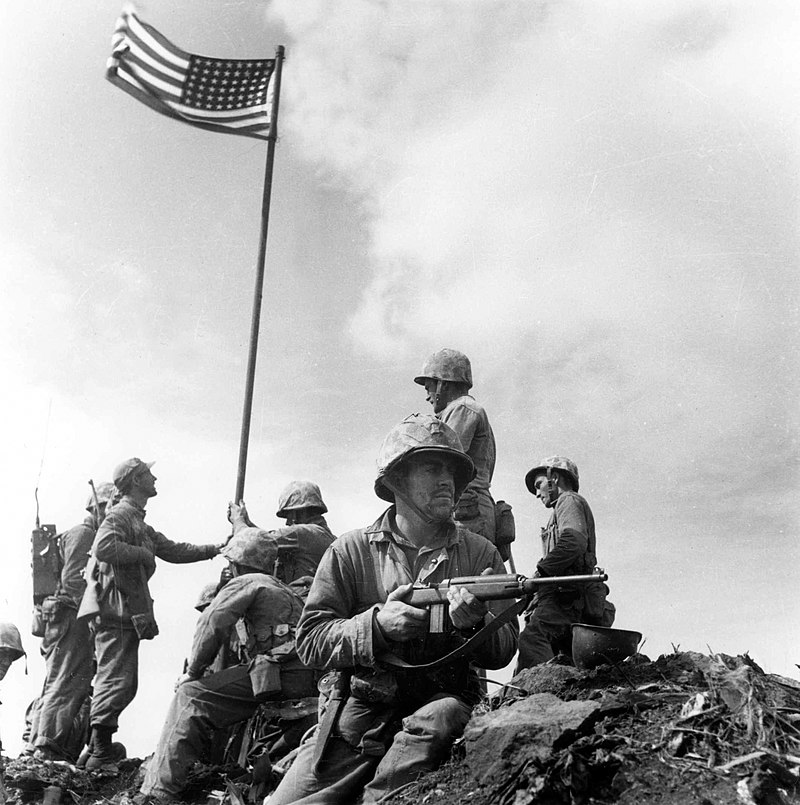
Charles Lindberg, first Iwo Jima flag raising

June 26, 2007

1st flag raising on Iwo Jima, photo by Sgt Lou Lowery, Leatherneck Magazine

First raising of the U.S. flag on Iwo Jima on February 23, 1945. Photo by Sgt. Lou Lowery, Leatherneck Magazine

This photo doesn’t look like the Joe Rosenthal photo that won the Pulitzer Prize, and then inspired the book and movie, Flags of Our Fathers?

It’s not the same photo. Different photographer. Different group of Marines.

This is the first flag raising on Mt. Suribachi, the highest point of the island that was known then as Iwo Jima. This shows the mean of Easy Company, including Charles Lindberg of Grand Forks, North Dakota, raising a flag they carried on a pipe they found. The photo was taken by Sgt. Lou Lowery of Leatherneck Magazine.

Charles Lindberg, one of the Marines in the photo, died this week. He was 86 years old.

In addition carrying a name made famous by that other guy, the pilot, few people believed him when he said his company raised the flag first on Iwo. He wasn’t in the Rosenthal photo. But Lindberg told the truth.

From his obituary on the Associated Press wire (in The Washington Post):

Three of the men in the first raising never saw their photos. They were among the more than 6,800 U.S. servicemen killed in the five-week battle for the island.

By Mr. Lindberg’s account, his commander ordered the first flag replaced and safeguarded because he worried someone would take it as a souvenir. Mr. Lindberg was back in combat when six men raised the second, larger flag about four hours later.

Rosenthal’s photo of the second flag-raising became one of the most enduring images of the war and the model for the U.S. Marine Corps memorial in Washington.

Rosenthal, who died last year, always denied accusations that he staged the photo, and he never claimed it depicted the first raising of a flag over the island.

Mr. Lindberg was shot through the arm March 1 and evacuated. After his discharge in 1946, Mr. Lindberg went home to Grand Forks, N.D. He moved to Richfield, Minn., in 1951 and became an electrician.

If you’re over 45, if you read James Brady’s Flags of Our Fathers, if you saw the Clint Eastwood movie version, or if you’re a fan of Johnny Cash’s Ballad of Ira Hayes, you know the stories of heroism and sorrow and tragedy that accompany Joe Rosenthal’s photo. As so often happens in history, there is a back story, a bit of a correction — and it has some of the same bittersweet flavors.

Lindberg was 24 years old when his company landed on Iwo Jima. That was 62 years ago. Those who were eyewitnesses are mostly gone. We need to seek out those few remaining, brave survivors, and let them tell what they remember, what they saw, how they felt and how they feel.  Of the twelve men who raised the two flags, Lindberg was the last survivor.  Three of the men from each group died in battle action after raising the flags.

Here’s to the memory of Charles Lindberg, a good American, a good soldier. Thank you, Mr. Lindberg.

Charles Lindberg in 1999, holding a copy of Sgt. Lou Lowery's photo of the first Iwo Jima flag raising Charles Lindberg holding the photo taken by Sgt. Lou Lowery of Leatherneck Magazine, of the first U.S. flag raising on Iwo Jima, by Easy Company. Lindberg is the soldier standing in back, on the right of the photo. Lowery’s photo was taken about four hours before the second flag raising, captured by Joe Rosenthal, which photo won the Pulitzer Prize. This photo of Lindberg, left, is from 1999, by Associated Press photographer Jackie Lorentz.

Lindberg’s citation for the Silver Star is below the fold.

Read the rest of this entry »


Rachel Carson’s friends chime in

June 19, 2007

Anti-environmental long-knives leave the impression that Rachel Carson knew little about science, and had a crabby disposition toward business and life in general.

Go read this: “Rachel Carson: I knew her when.

She was a poet and a scientist. You won’t learn anything about the controversy, really, other than the fact that Rachel Carson was a genuine woman, a very nice person. But it’s worth the read.

While you’re at Mort Reichek’s site, noodle around and see what else he’s got. He is a retired journalist with a lot to say. Pay attention. [New Jersey history and economics teachers: Do you realize what a resource you could have in this guy? Washington correspondent for Business Week? Hello!!???]

Update: Sadly, Mort passed on in 2011.  His blog remains up as a tribute to a great journalist and early blogger.


40 years of Loving — the changes we see

June 15, 2007

1968 propelled history in dramatic fashion, much of it tragic. History teachers might await the 40th anniversary stories of 1968’s events, knowing that the newspapers and television specials will provide much richer material than any textbook could hope for.

Was 1967 less momentous? Perhaps. But an anniversary this week only serves to highlight how the entire decade was a series of turning points for the United States. This week marks the 40th anniversary of the Supreme Court’s issuing the decision in Loving v. Virginia. The Lovings had been arrested, convicted and exiled from the state of Virginia for the crime of — brace yourself — getting married.

Richard and Mildred Loving, Bettman-Corbis Archive

Photo of Richard and Mildred Loving from Bettman-Corbis Archive.

You see, Virginia in those days prohibited marriage between a black person and a white person. So did 15 other states. In language that is quaint and archaic to all but Biblical literalist creationists, the trial judge said:

“Almighty God created the races white, black, yellow, malay and red, and he placed them on separate continents. And but for the interference with his arrangement there would be no cause for such marriages. The fact that he separated the races shows that he did not intend for the races to mix.”

The Lovings appealed their conviction. They appealed to the U.S. Supreme Court. And on June 12, 1967, the Supreme Court of the United States struck down laws that prohibit a person of one “race” from marrying a person of another. (I put “race” in quotes because, as we have since learned from DNA studies, there is just one race among us, the human race. Science verifies that the Supreme Court got it right, as did the Americans before them who wrote the laws upon which the Supreme Court’s decision was based.)

From 1958 to 1967 — nine years the case wended through the courts. Oral argument was had on April 10 — the decision coming down in just two months seems dramatically quick by today’s standards. This was one of the cases that angered so many Americans against the Court presided over by Chief Justice Earl Warren.

Ed Brayton at Dispatches from Culture Wars points to a statement from Mildred Loving on this anniversary. The statement is below the fold. Read the rest of this entry »


Applied history: Rescuing DaVinci

June 14, 2007

Ran into a website from a Dallas guy who is a practicing historian of a sort. A former oil man, he is involved in preserving and telling the story of the guys who rescued priceless works of art from the Nazis, the Monuments Men.

Monuments men, four survivors in D.C. to be honored

Robert Edsel’s blog is here; the site for his book, Rescuing DaVinci, is here.

Dallas-area world history and U.S. history teachers — have you called this guy to see if he’ll come visit your school?

  • Edsel’s caption for this photo: “Monuments Men Bernard Taper, James Reeds, Harry Ettlinger, and Horace Apgar being formally recognized for their efforts during World War II” [in Washington, D.C., on June 6, 2007]

Text of Mr. Edsel’s remarks below the fold.

Read the rest of this entry »


D-Day – fly your flag if you wish

June 6, 2007

Normandy landing, June 6, 1944, from an LST

D-Day landing taken by Chief Photographer’s Mate (CPHOM) Robert F. Sargent of the United States Coast Guard (USCG) Greatest Generation D-day landing

June 6, 2007, is the 63rd anniversary of D-Day, the massive invasion of Normandy by the U.S., Canada and Britain, Free France and Poland, to start the push toward final defeat of Germany in World War II (more formally known as the Battle of Normandy). Germany’s defeat would come ten months later.

The day is not formally listed by law as a day to fly the U.S. flag. Citizens may fly the flag on any day. Many veterans’ groups urge flying the flag today, especially in honor of the thousands who gave their lives in the invasion.

On the Allied side, 29,000 U.S. soldiers, 5,000 Canadian soldiers, 11,000 United Kingdom soldiers,  died between June 6 and August 25, 1944, the formal end of the battle.  France lost more than 12,000 civilians in the fight for freedom, too.

  • Photo: Assault landing One of the first waves at Omaha Beach as photographed by Robert F. Sargent. The U.S. Coast Guard caption identifies the unit as Company E, 16th Infantry, 1st Infantry Division.

Happy birthday, Carl!

May 23, 2007

Carl Linne, b. May 23, 1707

Today is the 300th birthday of Linnaeus, aka Carl Linnaeus, Carolus Linnaeus, Carl von Linné, Carl Linné, etc. etc. Oh, heck, just call him Carl. Happy birthday, Carl!

At Panda’s Thumb.