June 12, 1898 – U.S. flag rises over Guantanamo Bay

June 12, 2009

Hoisting the flag at Guantanamo, Cuba, June 12, 1898.  Image from the American Memory Collection at the Library of Congress

Hoisting the flag at Guantanamo, Cuba, June 12, 1898. Edward H. Hart, photographer. Image from the American Memory Collection at the Library of Congress

Oh, it’s important in retrospect, no?

On June 10, 1898, U.S. Marines landed at Guantánamo Bay. For the next month, American troops fought a land war in Cuba that resulted in the end of Spanish colonial rule in the Western Hemisphere. Cuban rebels had gained the sympathy of the American public while the explosion and sinking of the U.S.S. Maine, widely blamed on the Spanish despite the absence of conclusive evidence, further boosted American nationalistic fervor.

On June 12, the area was secured and the flag posted.

Read a lot more about this event, and get resources on the Spanish-American War, at the Library of Congress.


Typewriter of the moment: Theodore Roosevelt at Sagamore Hill

June 11, 2009

He held many jobs, cowboy, police commissioner, governor, military leader, president — but he regarded his profession as “writer.”

Theodore Roosevelt‘s typewriter, a Remington, from his house at Sagamore Hill, New York:

Theodore Roosevelts typewriter from his home at Sagamore Hill - Fish and Wildlife Service, National Digital Image Library

Theodore Roosevelt’s typewriter from his home at Sagamore Hill, New York – Fish and Wildlife Service photo, National Digital Image Library (public domain)

Remington typewriter used by Theodore Roosevelt at his home at Sagamore Hill, New York - US Fish and Wildlife Service, National Digital Library (public domain)

Update, March 16, 2012:  There are two versions of the same photo above, if we’re lucky.  The designator at the National Digital Library has changed at least twice, leaving this post high and dry.  There is another, slightly lower quality version of the photo above.  You’re not seeing double, you’re seeing operational redundancy.

Resources:

Please share this image and information:

Add to FacebookAdd to NewsvineAdd to DiggAdd to Del.icio.usAdd to StumbleuponAdd to RedditAdd to BlinklistAdd to TwitterAdd to TechnoratiAdd to Furl


Miller Field time in Milwaukee

June 11, 2009

What do you do with an afternoon in Milwaukee before the game?

You tour the Miller Brewing plant.  Free tours, off of State Street (where is Plank Road?).

The gift shop and start of the tour have a good timeline of Miller’s history, which now should be a simple case study in an business history text.  There’s a lot more corporate maneuverings that brewing in Miller’s history.  One guy on the tour seemed unhappy that Miller is South African-owned.

Gotta run.  Maybe a story about the fight at the game later — among the fans, not on the field  (Brewers lost).

Clock on State Street, Miller Valley, Milwaukee, Wisconsin

Clock on State Street, Miller Valley, Milwaukee, Wisconsin


The truth about Judge Sotomayor

June 11, 2009

Nina Totenberg of NPR wins great respect as a reporter on the Supreme Court for a reason:  She’s a great reporter.

Totenberg on Judge Sonia Sotomayor’s alleged race bias:

As a judge, Sotomayor has ruled in 100 cases that involve questions of racial discrimination of one sort or another. Tom Goldstein, Supreme Court advocate and founder of the leading Supreme Court blog, has read all of those decisions. He says that Sotomayor does not seem to put her thumb on the scale and has in fact, most of the time, ruled against those charging discrimination.

In only 1 of out 8 cases, he says, has she favored in some sense claims of discrimination.

“The fact that she so rarely upholds discrimination claims I think answers the idea that she is always angling for minorities,” he says.

Totenberg on Sotomayor’s statements about judge-made law and policy:

And if the New Haven case is a harbinger in one direction, there are other cases that point the other way too. Sotomayor, for example, dissented when her colleagues allowed the New York City Police Department to fire one of its officers for sending hate mail on his own time. While the hate mail was patently offensive, hateful and insulting, Sotomayor wrote, it did not interfere with the operations of the police department, and, she observed, under our Constitution, even a white bigot has the right to speak his mind.

In another case involving a black couple bumped from an American Airlines international flight, Sotomayor said their race discrimination claim was clearly trumped by an international treaty governing airline rules. It matters not, she said, that her ruling might mean airlines could discriminate on a wholesale basis and that there would be no legal recourse. The treaty’s language is clear and it is not for the courts to make policy, she said, adding that if policy is to be changed, Congress or federal agencies must do it.

White bigots ought to study more and flap less.


Can carbon dioxide be classed as a pollutant?

June 10, 2009

From Compound Interest

U.S. Department of State slide explaining the greenhouse effect, 1992. National Archives.

U.S. Department of State slide explaining the greenhouse effect, 1992. National Archives.

Sure.  Too much oxygen to a newborn baby can cause blindness; oxygen in that case is a pollutant.  Certainly, if an essential gas like oxygen can be classed as a pollutant, since too much carbon dioxide can be deadly as an acute poison, it’s fair to class it as a pollutant when it appears where it should not appear, or when it appears in concentrations too great to be safe for what we need it to do, or when it is destructive.

The tougher question is, can Congress do anything about it?

Arguments about whether carbon dioxide is a pollutant distract and detract from, and delay the critical arguments about how to act to mitigate harmful effects of climate change and how to prevent the most disastrous effects, if possible.

Barry Rabe teaches at the University of Michigan and studies policies of government on climate change, and the policy making of government on climate change.

Take a look at some of his work, under the title, “Can Congress Govern the Climate?”

Full report in pdf, here: “Can Congress Govern the Climate?” Or download 0423climatechange_rabe

Common atmospheric pollutants, from Compound Interest. CO2 is a pollutant

Common atmospheric pollutants, from Compound Interest. CO2 is a pollutant

See also:

Tip of the old scrub brush to U Town Blog.

Help cut through the fog of disinformation:


Add to FacebookAdd to NewsvineAdd to DiggAdd to Del.icio.usAdd to StumbleuponAdd to RedditAdd to BlinklistAdd to TwitterAdd to TechnoratiAdd to Furl


Crankery under the microscope: Denialism as pathology

June 10, 2009

You can see it in this little-noted blog.  Someone drops by to tell me I’m in error, that Rachel Carson really did plot with Pol Pot to murder millions, and then they also show up in the creationism threads defending the view that dinosaurs never existed, or in a tangentially-related note on climate change, perhaps arguing that ocean levels rising are either not a problem, or the product of Atlantis’s rising from the depths (and therefore no problem, since the denizens of that city had better science than we do and will be able to fix things, never mind their being dead for 5,000 years).  [That last description is mostly fictional – mostly.]

What is it that makes one person deny reality on so many different fronts?

Mark Hoofnagle hit the research journals, listing results at denialism blog, demonstrating that crankery can be studied.  This raises in my mind the interesting little question of whether such crankery is a pathology, and perhaps treatable or curable.

Our recent discussions of HIV/AIDS denial and in particular Seth Kalichman’s book “Denying AIDS” has got me thinking more about the psychology of those who are susceptible to pseudoscientific belief. It’s an interesting topic, and Kalichman studies it briefly in his book mentioning the “suspicious minds”:

At its very core, denialism is deeply embedded in a sense of mistrust. Most obviously, we see suspicion in denialist conspiracy theories. Most conspiracy theories grow out of suspicions about corruptions in government, industry, science, and medicine, all working together in some grand sinister plot. Psychologically, suspicion is the central feature of paranoid personality, and it is not overreaching to say that some denialists demonstrate this extreme. Suspicious thinking can be understood as a filter through which the world is interpreted, where attention is driven towards those ideas and isolated anecdotes that confirm one’s preconceived notions of wrong doing. Suspicious thinkers are predisposed to see themselves as special or to hold some special knowledge. Psychotherapist David Shpairo in his classic book Neurotic Styles describes the suspicious thinker. Just as wee see in denialism, suspiciousness is not easily penetrated by facts or evidence that counter individuals’ preconceived worldview. Just as Shapiro describes in the suspicious personality, the denialist selectively attends to information that bolsters his or her own beliefs. Denialists exhibit suspicious thinking when they manipulate objective reality to fit within their beliefs. It is true that all people are prone to fit the world into their sense of reality, but the suspicious person distorts reality and does so with an uncommon rigidity. The parallel between the suspicious personality style and denialism is really quite compelling.

Go read it at denialism.

Denialism may be a little greater problem than is generally acknowledged, in my opinion.  When it infects policy makers it causes legislative and executive crackups, like Oklahoma’s Sen. Tom Coburn, who held up the naming of the Rachel Carson Post Office for a year under the bizarre misconception that she played a role in spreading malaria (ditto for Utah Rep. Rob Bishop, who shared the view but was unable to stop the bill in the House), or like the Bush administration officials at the U.S. Agency for International Development who kept refusing to authorize spending for pesticides in Africa, claiming environmental groups would oppose them while the environmental groups were lobbying the agency to spend the money on those pesticides.

Former South Africa President Thabo Mbeki denied that HIV causes AIDS.  Mbeki’s refusal to act on the best science available may have led to as many as 350,000 deaths, some accounts say.  Ashley Montagu told the story of Adolf Hitler’s odd views of heritage being spread by blood transfusions — to avoid any possibility of his soldiers’ being turned Jewish by a blood transfusion, Hitler forbade the use of blood banks.  Tens of thousands of German soldiers died unnecessarily from lack of blood for transfusing during World War II.  Partisans and scientists still debate whether  and how much Ronald Reagan’s belief that AIDS was a syndrome caused by sin rather than a virus early in the AIDS crisis created a cascade of actions that still frustrates the development of a vaccination or cure.

Denialism in high school students is interesting, but most often a classroom problem.  When kids take great issue with the course material the class can get derailed.  Even when a teacher is able to keep the class on track, the denialist student may feel marginalized.  A colleague reported a student had informed that historians now concur that George Washington was African-American.  She could not be dissuaded from the view.  I had a student who insisted well into the second semester than Adolf Hitler was a great leader, smart and humanitarian, framed for war crimes of the British and Americans.  Unfortunately, I could not put him in contact with the earlier student who believed Hitler had been framed by the Soviet Union, and that the Americans and British were victims of the cruel hoax.

As the nominal head of public relations in the old (Pleistocene?) office of Sen. Orrin Hatch, my crew and I got the brunt of denialists and crazies.  We had one woman in Salt Lake City, “Mrs. B,” who regularly called the Salt Lake office to complain about Hatch’s actions and what she assumed his beliefs must be.  For a while she complained that, as someone born outside of Utah, he could never appreciate the views of the Latter-day Saints in Utah.  When at last we persuaded her that he was also a Mormon, she began complaining that he ignored Utah’s non-Mormon population.  Her ability to switch sides in an argument so as always to remain on the opposite side of Sen. Hatch got noticed.

Near the end of a summer session just before the recess the Senate had a lot of late-night meetings.  The news of these sessions did not always make the morning papers.  On one issue of some Utah import, Hatch had suggested he would probably vote one way, because of some issue of agency direction that had him concerned.  In the end the agency agreed to amendments that assuaged all of Hatch’s concerns and he was happy to support the bill (I forget what it was — the issue is absolutely irrelevant to the story).

I had caught a late-night flight to Salt Lake, and arrived at the SLC office early enough to catch our Utah problem solver Jack Martin explaining to Mrs. B that Hatch did indeed care about Utah . . .   Jack and I could carry on a conversation with only his occasional remarks to Mrs. B keeping her going, a scene out of a Cary Grant comedy, perhaps.  “Yes, Mrs. B . . .  No, Mrs. B  . . . I think I see your point.”  What he said was unimportant.  I could hear her rant on the telephone, while I was on the other side of the room.  I finally asked Jack what her issue was, and he explained it was the bill that Hatch had reveresed his position on.  She was complaining at great length about his original position.  I explained to Jack that an accommodation had been reached and that Hatch changed his vote in the final tally.

Jack smiled broadly as he handed me the phone.  “You tell her!”  It took a long time to get her to stop talking so I could explain who I was and that I had new information.  Finally she fell silent and I explained that she should be happy because Hatch had come around to her position.  There was a silence of a few more seconds, and she started in again:  “Hatch is an idiot!  Only a fool would vote that way.”  And she was off again on a rant against Hatch, eviscerating the views that she herself had held less than a  minute earlier.

The issue wasn’t important to her.  Hatch was wrong, whatever he did, even when he supported her views.

That’s denialism in full force, a raw, unmitigated power of nature.

Hoofnagle concludes at denialism:

So what do these studies mean for our understanding of cranks? Well, in addition to providing explanations for crank magnetism, and cognitive deficits we see daily in our comments from cranks, it suggests the possibility that crankery and denialism may be preventable by better explanation of statistics. Much of what we’re dealing with is likely the development of shoddy intellectual shortcuts, and teaching people to avoid these shortcuts might go a long way towards the development and fixation on absurd conspiracy theories or paranormal beliefs.

Wouldn’t you love to see that study replicated on readers of Watt’s Up With That?, Texas Darlin’ , Junk Science, or one of the antivaxxer blogs?

You may also want to read:


Fillmore wasn’t the only one with White House/bath tub troubles

June 9, 2009

Jim Butler alerted me to this little piece at I Can Has Cheezburger?  Notice the historical/mathematical error, explained below:

Yeah, it’s funny.  But Taft didn’t serve in all three branches of the federal government. He was never a member of Congress.  He served in the executive branch and the judicial branch, at least twice in each, but he never served in the legislative branch, in Congress.

Taft was collector of taxes for the IRS, Ohio state judge, Solicitor General of the U.S., judge on the Sixth Circuit Court of Appeals for the U.S., chairman of the commission to organize a government for the Philippines after the Spanish-American War, and then Governor-General of the Philippines, Secretary of War for Teddy Roosevelt, Acting Secretary of State, Governor of Cuba, Co-chairman of the National War Labor Board in World War I, and then Chief Justice of the U.S. Supreme Court, but never a member of either the House of Representatives or the Senate.

The LOLphoto is still funny.

Oh.  Kenny just found the same thing posted at Kitchen Pundit.   Still wrong.  Still funny.

What “bathtub trouble?” Well, yeah, we ought to explain that.  The story is that Taft was so large — 330 pounds plus as president — that he once got stuck in a White House bathtub, and consequently had a much larger tub installed there.  Is the story accurate?

Here’s a news story of Taft’s bathing troubles post-presidency, from the New York Times:

CAPE MAY, N.J., June 18 [1915]. — Ex-President Taft, who came here yesterday as the guest of the Pennsylvania Bankers’ Association, took a bath in his apartments in the Hotel Cape May. He failed properly to consider the size of the average seashore hotel bathtub, however, with the result that when he got into the tub the water overflowed and trickled down upon the heads of the guests in the dining room.

And the White House?  Here’s a photo of the specially-made Taft bathtub just before its installation at the White House, about 1911:

Four men show the size of President Tafts bathtub, 1911 - White House Museum.org photo

The National Archives and Records Administration has an exhibit right now at the Archives building on “BIG,” celebrating 75 years of NARA.  Included are orders for big tubs for Taft, and a replica of the giant tub installed at the White House (which was broken when it we removed in 1948 for renovation).

As evidence that William Howard Taft was the biggest man to serve as President of the United States, the exhibit presents the 1909 order for a bathtub and other items specially ordered to accommodate Taft’s 300-plus-pound frame. In January 1909, two months after being elected President (he was inaugurated on March 4, 1909), Taft boarded the USS North Carolina to set sail to inspect the Panama Canal construction zone. The ship was outfitted specially for him. The captain ordered the following items: “1 brass double bedstead of extra length; 1 superior spring mattress, extra strong; 1 bath tub, 5 feet 5 inches in length, over rolled rim and of extra width.” Later newspaper accounts (and a photograph) revealed that the bathtub was built on an even bigger scale—that it had “pondlike dimensions . . . [it] will hold four ordinary men and is the largest ever manufactured . . . the tub is 7 feet 1 inch long, 41 inches wide and weighs a ton.”

Soon after leaving the presidency, Taft lost 70 pounds, which he maintained throughout the remainder of his life. In 1921, Taft was appointed Chief Justice of the United States, becoming the only person to hold the highest office in both the executive and judicial branches.


June 9, 1902: Woodrow Wilson elected president . . .

June 9, 2009

107 years ago today  Woodrow Wilson was unanimously elected president, of Princeton University in New Jersey, on June 9, 1902.

Wilson’s history is remarkable.  He is not the only university president ever to have been elected president of the United States — Dwight Eisenhower and Charles James A. Garfield also served in that capacity (any others?) — but his election to the Princeton post marked an unusual rise in an essentially non-political career that would lead Wilson to the White House through the New Jersey governor’s mansion.

Wilson’s thinking, writing and thinking about how to make colleges and universities more democratic, and therefore more useful as fountains of leadership for the nation, propelled him forward.  This makes him unusually American in the way he worked for national service, and so was called to higher service.

All details courtesy the Library of Congress’s American Memory “Today in History” feature:

  • “On June 9, 1902, Woodrow Wilson was unanimously elected president of Princeton University, a position he held until he resigned in 1910 to run for governor of New Jersey. As university president, Wilson exhibited both the idealistic integrity and the occasional lack of political acumen that marked his tenure as the twenty-eighth president of the United States (1913-21).”
  • “Wilson served on the faculties of Bryn Mawr College and Wesleyan University before joining the Princeton faculty as professor of jurisprudence and political economy in 1890. A popular teacher and respected scholar, Wilson delivered an oration at Princeton’s sesquicentennial celebration (1896) entitled ‘Princeton in the Nation’s Service.’ In this famous speech, he outlined his vision of the university in a democratic nation, calling on institutions of higher learning ‘to illuminate duty by every lesson that can be drawn out of the past.'”
  • “Wilson began a fund-raising campaign to bolster the university corporation. The curriculum guidelines that he developed during his tenure as president of Princeton proved among the most important innovations in the field of higher education. He instituted the now common system of core requirements followed by two years of concentration in a selected area. When he attempted to curtail the influence of the elitist “social clubs,” however, Wilson met with resistance from trustees and potential donors. He believed that the system was smothering the intellectual and moral life of the undergraduates. Opposition from wealthy and powerful alumni further convinced Wilson of the undesirability of exclusiveness and moved him towards a more populist position in his politics.”
  • While attending a recent Lincoln celebration I asked myself if Lincoln would have been as serviceable to the people of this country had he been a college man, and I was obliged to say to myself that he would not. The process to which the college man is subjected does not render him serviceable to the country as a whole. It is for this reason that I have dedicated every power in me to a democratic regeneration.
    The American college must become saturated in the same sympathies as the common people. The colleges of this country must be reconstructed from the top to the bottom. The American people will tolerate nothing that savors of exclusiveness.
    Woodrow Wilson, president of Princeton University, “Address to Alumni,” April 16, 1910.
Woodrow Wilson, circa 1913 (in the Oval Office?) - Library of Congress image

Woodrow Wilson, circa 1913 (in the Oval Office?) - Library of Congress image


Fixing education at the top

June 9, 2009

No, Harold Levy doesn’t get it all right.  He’s a former chancellor of schools in New York City, so even if he did manage to get most what he says right, there would be enough people on the other side of some issue to say he did not, that if I compliment him too effusively, someone will say I’m wrong.

Among the greater products of the United States of America — and Canada, let’s face it — is the grand array of nearly 4,000 colleges and universities that set the pace for education in the world.  Our greatest export is education, the idea that education almost by itself can solve many great and vexing issues, the idea that education is a great democratic institution, and the education systems themselves, the methods of education used no matter how little backed by research.

Higher education makes up the better part of what we get right.

In an opposite-editorial page piece in the New York Times today Levy proposes some significant but eminently doable changes in how we work education in high schools and colleges.  Maybe surprising to some, he has good things to say about the University of Phoenix and their $278 million advertising campaign, about high-pressure tactics to reduce truants, and about the GI Bill.


New blog from the Texas Historical Commission

June 8, 2009

Texas Parlor notes that the Texas Historical Commission has gotten into the blog business, with a blog called See the Sites.

New logo and slogan for the Texas Historical Commission

New logo and slogan for the Texas Historical Commission

A lot of photos from the sites the Historical Commission operates, news of special events, and links to the Commission’s sites’ websites.  As yet there are not any substantive historical analyses.

The new blog accompanies a redesign of the Texas Historical Commission’s website, and the creation of a new logo for the agency, with a new slogan.

The new website makes navigation a good bit easier, to get to information about cemeteries, or the LaSalle Projects, Texas’s remarkable collection of county courthouses, Civil War monuments, or any of a number of other categories.

Historians begin to make the internet a real tool for education and learning, and the practice of history recording.

Tip of the old scrub brush to Will’s Texas Parlor, a site every Texas history teacher should have bookmarked, and should visit often.


Bathtub reading on a warm June Sunday

June 7, 2009

I thought everybody does serious reading in the bathtub, no?

The Boneyard at Davis-Monthan Air Force Base near Tucson, Arizona; the Pima Air & Space Museum now offers bus tours of the 309th Maintenance and Regeneration Groups collection of scrapped and very historic airplanes

The Boneyard at Davis-Monthan Air Force Base near Tucson, Arizona; the Pima Air & Space Museum now offers bus tours of the 309th Maintenance and Regeneration Group's collection of scrapped and very historic airplanes

Can’t soak all day.


D-Day, remembered by the men who fought there

June 7, 2009

Before we move past remembrances of D-Day, let’s take a moment to think about and memorialize the soldiers who fought there, so many of whom died there.

From the National Guards feature, This Day in National Guard History:  Circular written by General Dwight D. Eisenhower explaining the importance of the Normandy invasion on winning the war. These were distributed to every member of the attacking force the night prior to the D-Day landings. Sergeant J. Robert Bob Slaughter, a Guard member of Virginias Company D, 116th Infantry, passed his copy around among the members of Company D to get their signatures (front and back) as they waited to load aboard the landing craft that would take them to Omaha Beach. By nightfall of June 6, about half of these men were dead or wounded. Courtesy John R. Slaughter

From the National Guard's feature, This Day in National Guard History: "Circular written by General Dwight D. Eisenhower explaining the importance of the Normandy invasion on winning the war. These were distributed to every member of the attacking force the night prior to the D-Day landings. Sergeant J. Robert "Bob" Slaughter, a Guard member of Virginia's Company D, 116th Infantry, passed his copy around among the members of Company D to get their signatures (front and back) as they waited to load aboard the landing craft that would take them to Omaha Beach. By nightfall of June 6, about half of these men were dead or wounded. Courtesy John R. Slaughter"

National Guard’s “Today in History” explains the story for June 6, 1944:

Normandy, France — The Allied invasion of France, commonly known as “D-Day” begins as Guardsmen from the 29th Infantry Division (DC, MD, VA) storm onto what will forever after be known as “bloody Omaha” Beach. The lead element, Virginia’s 116th Infantry, suffers nearly 80% casualties but gains the foothold needed for the invasion to succeed. The 116’s artillery support, the 111th Field Artillery Battalion, also from Virginia, loses all 12 of its guns in high surf trying to get on the beach. Its men take up arms from the dead and fight as infantrymen. Engineer support came from the District of Columbia’s 121st Engineer Battalion. Despite high loses too, its men succeed in blowing holes in several obstacles clearing paths for the men to get inland off the beach. In the early afternoon, Maryland’s 115th Infantry lands behind the 116th and moves through its shattered remnants to start the movement in off the beach. Supporting the invasion was the largest air fleet known to history. Among the units flying missions were the Guards’ 107th (MI) and 109th (MN) Tactical Reconnaissance Squadrons The Normandy campaign lasted until the end of July with four Guard infantry divisions; the 28th (PA), 29th, 30th (NC, SC, TN) and the 35th (KS, MO, NE) taking part along with dozens of non-divisional units all earning the “Normandy” streamer.

Be sure to read the other posts in this series about Eisenhower’s Order of the Day:D-Day, 65 years ago today,” and “Quote of the moment:  Eisenhower, duty and accountability.


D-Day: 65 years ago today

June 6, 2009

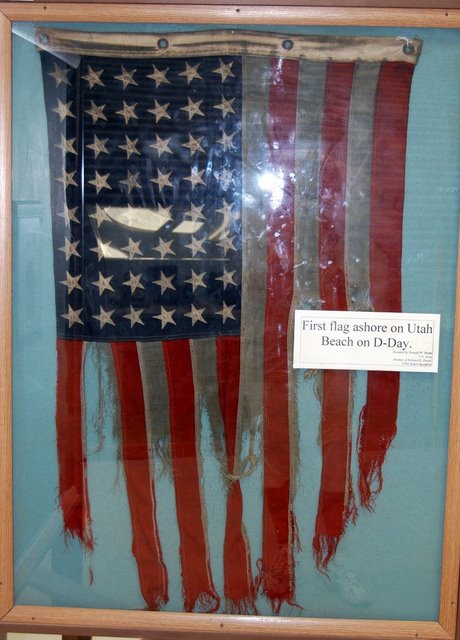
First Flag on Utah Beach, June 6, 1944

First U.S. flag on Utah Beach, Normandy, D-Day, June 6, 1944; Pima Air Museum, Tucson, Arizona

This mostly an encore post.  A reader sent an e-mail with a question:  Does U.S. law suggest the flying of the U.S. flag on the anniversary of D-Day?

Today is the 65th anniversary of the Invasion of Normandy in World War II, a date generally called D-DayNo, you don’t have to fly your flag. This is not one of the days designated by Congress for flag-flying.

But you may, and probably, you should fly your flag.  If you have any D-Day veterans in your town, they will be grateful, as will their spouses, children, widows and survivors. A 22-year-old soldier on the beach in 1944 would be 87 today, if alive.  These men and their memories of history fade increasingly fast.  Put your flag up.  You may be surprised at the reaction.

If you do run into a D-Day veteran, ask him about it.  Keep a record of what he says.

First Wave at Omaha:  The Ordeal of the Blue and the Gray by Ken Riley:  Behind them was a great invasion armada and the powerful sinews of war. But in the first wave of assault troops of the 29th (Blue and Gray) Infantry Division, it was four rifle companies landing on a hostile shore at H-hour, D-Day -- 6:30 a.m., on June 6, 1944. The long-awaited liberation of France was underway. After long months in England, National Guardsmen from Virginia, Maryland and the District of Columbia found themselves in the vanguard of the Allied attack. In those early hours on the fire-swept beach the 116th Infantry Combat Team, the old Stonewall Brigade of Virginia, clawed its way through Les Moulins draw toward its objective, Vierville-sur-Mer. It was during the movement from Les Moulins that the battered but gallant 2d Battalion broke loose from the beach, clambered over the embankment, and a small party, led by the battalion commander, fought its way to a farmhouse which became its first Command post in France. The 116th suffered more than 800 casualties this day -- a day which will long be remembered as the beginning of the Allies Great Crusade to rekindle the lamp of liberty and freedom on the continent of Europe.  Image from National Guard Heritage series, from which the caption was borrowed.

"First Wave at Omaha: The Ordeal of the Blue and the Gray" by Ken Riley: Behind them was a great invasion armada and the powerful sinews of war. But in the first wave of assault troops of the 29th (Blue and Gray) Infantry Division, it was four rifle companies landing on a hostile shore at H-hour, D-Day -- 6:30 a.m., on June 6, 1944. The long-awaited liberation of France was underway. After long months in England, National Guardsmen from Virginia, Maryland and the District of Columbia found themselves in the vanguard of the Allied attack. In those early hours on the fire-swept beach the 116th Infantry Combat Team, the old Stonewall Brigade of Virginia, clawed its way through Les Moulins draw toward its objective, Vierville-sur-Mer. It was during the movement from Les Moulins that the battered but gallant 2d Battalion broke loose from the beach, clambered over the embankment, and a small party, led by the battalion commander, fought its way to a farmhouse which became its first Command post in France. The 116th suffered more than 800 casualties this day -- a day which will long be remembered as the beginning of the Allies' "Great Crusade" to rekindle the lamp of liberty and freedom on the continent of Europe. Image from National Guard Heritage series, from which the caption was borrowed.


Quote of the moment: Eisenhower on D-Day (encore post)

June 5, 2009

Eisenhower talks to troops of invasion force, June 5 -- before D-Day[Encore post from 2007.]

Soldiers, Sailors, and Airmen of the Allied Expeditionary Force: You are about to embark upon the Great Crusade, toward which we have striven these many months. The eyes of the world are upon you.

Order of the Day, 6 June, 1944 (some sources list this as issued 2 June)


4 Stone Hearth 68 + remote central = good convergence

June 5, 2009

4 Stone Hearth’s 68th incarnation rises at remote central, among my favorite archaeology/anthropology/ancient history blogs.

Tim has done an outstanding job of shaking good stuff out of the internet tree:  Did cooking make humans smartKris Hirst on the human transition to agriculture (every history teacher needs this one);  The new discovery of a Miocene era ape, in Europe; and returning to a topic I spend so many years listening to at the Senate Labor Comittee, is tobacco worse than cocaine?

That’s just scratching the surface.  Go see.