“A Sense of Wonder” won praise at film festivals over the past few months, and now has premiered in a 100-city tour designed to get some attention for a near-documentary film, during National Women’s History Month.
Actress Kaiulani Lee painted her one-woman show on Rachel Carson on the big screen. The movie tells the story of Rachel Carson and the tremendous growth of environmental consciousness and activism following her 1962 book Silent Spring. Karen Montgomery produced, Christopher Monger directed, cinematography was done by Haskell Wexler (two-time Oscar winner, for Who’s Afraid of Virginia Woolf?, and Bound for Glory).
(A screening is planned in Dallas on March 31 for the Environmental Protection Agency (EPA) — but it’s a private screening. Only four other screenings in Texas have been scheduled.)
To find a screening near you, go to the “Sense of Wonder” interactive website, and click on “Screenings.” From there, either click on the list of sites, listed by date, at “100-city tour,” or click on the interactive map to find a site near you. You may also sign up to sponsor a screening.
If I had influence with the good fairy who is supposed to preside over the christening of all children I should ask that her gift to each child in the world be a sense of wonderso indestructible that it would last throughout life, as an unfailing antidote against the boredom and disenchantments of later years, the sterile preoccupation with things that are artificial, the alienation from the sources of our strength.
“In 2008, there were 20 scouts across the county who had gotten all 121 merit badges. I’m adding my name to that list,” Wes says.
But Weaver’s accomplishments don’t end with badges. The teen also earned his Eagle Scout award by building a 112-foot bridge over a creek bed in Lake Murray State Park. It was no easy task with the rugged terrain
“Just digging the holes I was thinking I’m never going to be done. All my weekends are going to be spent out here digging holes,” Wes says.
“It was scheduled to take between two to three months. It ended up taking a year and 6 months,” says Wes’s father, Rusty Weaver.
Rusty helped his son plan out the bridge and construct it, along with the rest of Troop 112. Now all kinds of area bicyclists, hikers and outdoor enthusiasts can enjoy the state park a little more. [video available here]
Keeping with an interesting if perplexing tradition, bugling was the last merit badge he earned. Weaver had aimed for 121 since he first became a Boy Scout, and his Scoutmaster, David Mannas challenged the troop to earn their Eagle rank and then go beyond the 44 merit badges Manass had earned.
Many of Weaver’s merit badges were earned in the traditional fashion, at the many summer and winter camps he attended over the years. Weaver’s father, Rusty Weaver, became the Scoutmaster of Troop 112 and is a Climbing Director for Arbuckle Area Council. “My dad would be at camp two to four weeks a summer so I stayed at camp and took all the merit badge classes I could. Before I knew it, I had 80 merit badges.”
He attends Plainview High School concurrently with Oklahoma School of Science and Mathematics, Regional Center and looks forward to finalizing his college plans.
Weaver was recognized for his rare achievement at the Arbuckle Area Council Annual Recognition Banquet, Feb. 28 at Camp Simpson in Bromide. His parents are Trish and Rusty Weaver, Ardmore.
My father lived through the Great Depression. That was what we noted whenever he cheered when somebody got a job with the Post Office. “It’s a steady job,” he’d say. “The Post Office doesn’t lay people off. They have good health care, and a pension.”
Elena Kagan took the oath of office to be the nation’s top lawyer, the Solicitor General, last Friday. The Associated Press is running a story (here from the Sacramento Bee) on whether this is a tryout for the Supreme Court itself, “Obama could make top high court lawyer a justice.” (Isn’t that a tortured headline?)
Three justices may want to retire soon: Justice John Paul Stevens is 88 years old. Justice Ruth Bader Ginsburg is 76, and back on the court in record time after surgery for pancreatic cancer. Justice David Souter is third oldest, at 69.
So, this AP story could be a good article for use in government classes. Consider these questions:
Is Solicitor General a stepping stone to the Supreme Court’s bench?
What is the role of the Solicitor General?
How important is Supreme Court experience, or experience in other courtrooms, to success in arguing before the Supreme Court?
What are some of the top cases before the Supreme Court this term, and what are the potential and likely results of these appeals?
What is the role of the U.S. Senate in selection of federal judges, and especially in the selection of Supreme Court justices?
Kagan clerked for Justice Thurgood Marshall. What do law clerks do for justices? What does her clerking suggest for Kagan’s advocacy of Voting Rights Act issues, since she worked with Justice Thurgood Marshall?
David and Shannon Croft, as parents and next friends of their three minor children (collectively, the “Crofts”), bring suit against the governor of the state of Texas, Rick Perry (“Perry”), arguing that Texas Education Code § 25.082(d) is an unconstitutional establishment of religion. The district court granted summary judgment in favor of Perry, holding that § 25.082(d) had a secular legislative purpose and was not an establishment of religion. For the following reasons, we affirm.
* * * * * *
Conclusion
The Crofts have standing to challenge the 2003 Amendments. But the Amendments are constitutional and satisfy all three prongs of the Lemon analysis. There is no excessive entanglement, and the primary effect of the Amendments is not to advance religion. The most difficult prong—for this and for moment of silence statutes generally—is legislative purpose. But our review of legislative history is deferential, and such deference leads to an adequate secular purpose in this case. While we cannot allow a “sham” legislative purpose, we should generally defer to the stated legislative intent. Here, that intent was to promote patriotism and allow for a moment of quiet contemplation. These are valid secular purposes, and are not outweighed by limited legislative history showing that some legislators may have been motivated by religion. Because the 2003 Amendments survive the Lemon test, they are not an unconstitutional establishment of religion, and the judgment of the district court is AFFIRMED
Millard Fillmore’s life was shaped by the women he loved. His first wife, Abigail Powers, probably was the chief spur for his drive which took him to the presidency. In the White House, she stood for education and improvement of American culture — she founded the White House Library in 1851. A remarkable woman you should know more about.
From the National Guard Image Gallery: Fort Wagner, South Carolina, July 18, 1863; "The Old Flag Never Touched the Ground": The 54th Massachusetts Volunteer Infantry Regiment was recruited in the spring of 1863 by Governor John Andrew, who had secured the reluctant permission of the War Department to create a regiment of African-American soldiers. Like all Massachusetts Civil War soldiers, the 54th's men were enlisted in the Massachusetts Volunteer Militia. These Guardsmen would serve as a test case for many skeptical whites who believed that blacks could not be good soldiers. The battle that proved they could was fought on Morris Island, at the mouth of Charleston Harbor. Following three days of skirmishes and forced marches with little rest, and 24 hours with no food, the regimental commander, Colonel Robert Gould Shaw, requested the perilous honor of leading the attack of Fort Wagner, a sand and palmetto log bastion. As night fell, 600 men of the 54th advanced with bayonets fixed. Despite withering cannon and rifle fire, the men sustained their charge until they reached the top of the rampart. There, Colonel Shaw was mortally wounded. There, also, Sergeant William Carney, who had earlier taken up the National Colors when the color sergeant had been shot, planted the flag and fought off numerous attempts by the Confederates to capture it. Without support, and faced with superior numbers and firepower, the 54th was forced to pull back. Despite two severe wounds, Sergeant Carney carried the colors to the rear. When praised for his bravery, he modestly replied, "I only did my duty; the old flag never touched the ground." Carney was awarded the Medal of Honor for his actions, the first African-American to receive the award. The 54th Massachusetts suffered 270 casualties in the failed assault, but the greater message was not lost: some 180,000 African-American soldiers followed in the footsteps of these gallant Guardsmen, and proved that African-American soldiers could, indeed, fight heroically if given the opportunity.
This is one of a series of artworks describing the history of the National Guard. A sizable gallery of art covers the first muster of a militia in Salem, Massachusetts, in 1637, through rescue and recovery efforts after Hurricane Katrina in 2005. Along the way are highlights such as Lexington and Concord, Teddy Roosevelt’s New Mexico Rough Riders in Cuba, including Fort Wagner and the return of General Lafayette. With some caution on accuracy, these are good for classroom use (the Rough Riders picture shows a man on horseback, but I understand the Rough Riders’ horses had not yet arrived when they stormed up San Juan Hill; it took more than 30 years for Carney to get his medal, etc.).
Col. James Madison of the Virginia Militia, Citizen Soldier – National Guard image
James Madison was born on March 16, 1751 — date depending on which calendar you use.
Madison was one of our nation’s top two legislating presidents, on a par with Lyndon Johnson. The essential ally for the creation of America, he is known as the Father of the Constitution for his work to shepherd that compact into existence. A great ally of George Mason, Thomas Jefferson, George Washington, Alexander Hamilton, James Monroe, and sometimes nemesis of some of these men, Madison campaigned for freedom of religion, freedom of speech and freedom of the press his entire life.
Madison was delegate to the Virginia assembly, and wrote freedom of religion into the Virginia Bill of Rights. He wrote the Memorial and Remonstrance defending religious freedom and opposing re-establishment of religion in Virgina, led the assembly to pass instead Thomas Jefferson’s Virginia Statute for Religious Freedom, helped settle the dispute over fishing and navigation in the Chesapeake, between Virginia and Maryland. In league with George Washington, he convinced the Continental Congress to try to fix the Articles of Confederation with a convention in Philadelphia in 1787, then he hijacked the convention to write a new charter instead. He wrote most of the Federalist Papers, with Alexander Hamilton, after John Jay was attacked and beaten by a mob. He campaigned and won a seat in the First Congress, defeating the popular James Monroe who then became his fast friend. Madison proposed and was chief sponsor of the 12 amendments to the Constitution that we now know as the Bill of Rights — two of the amendments did not win approval in 1791, but one of those did win approval in 1992 — so Madison wrote the first ten and the twenty-seventh amendments to the Constitution.
George Washington, the "porthole portrait" by Rembrandt Peale
I have a tie from the Save the Children Foundation, a picture drawn by a young child that shows a teacher in a classroom, with portraits of Washington, Lincoln and Teddy Roosevelt on the classroom wall. Where have those portraits gone?
At Mount Vernon this past weekend, with more than 20 teachers at the seminar I attended, a significant majority of us remembered those portraits in our classrooms. Most of us don’t have such portraits today.
The Mount Vernon Ladies Association, the group that saved Mount Vernon and operates it today, has program to donate a large, canvas portrait of Washington to your school, the George Washington Portrait Program. Two thousand schools have already received the framed portraits, and the program to distribute them, free of charge, to schools, has been extended.
Portraits come with an educational kit — a U.S. flag, flown at General Washington’s home, lesson plans for elementary schools, and a CD-ROM with information for middle and high schools.
TO RICHARD HENRY LEE
Dear Dickey:
I thank you very much for the pretty picture book you
gave me. Sam asked me to show him the pictures and I
showed him all the pictures in it; and I read to him how
the lame elephant took care of the master’s little son. I
can read three or four pages sometimes without missing
a word. Ma says I may go to see you and stay all day
with you next week if it be not rainy. She says I may
ride my pony Hero if Uncle Sam will go with me and lead
Hero. I have a little piece of poetry about the picture
book you gave me, but I mustn’t tell you who wrote the
poetry.
G. W.’s compliments to R.H.L.,
And likes his book full well,
Henceforth will count him his friend,
And hopes many happy days he may spend.
Your good friend,
George Washington
Letter to a very young Richard Henry Lee, from a very young George Washington
It’s one of the earliest samples of George Washington’s writing we have. I don’t have a date for the letter, but it is likely to have been prior to 1743, when his father died. This letter was probably written before George was 11.
Can you imagine George Washington as a giggling little boy? He was. We have the letters to prove it. I like this letter simply because it offers a view of George Washington too rarely thought of or talked about.
That these two men were childhood friends is a delightful little historical nugget.
Grant Wood's famous 1939 painting illustrating Parson Weems telling the story of George Washington's honesty. "Parson Weems' Fable" hangs in the Amon Carter Museum in Fort Worth, Texas.
Maybe some of your troubling students will grow up good and honest, too. Do we know what would push our students to be such model citizens? Do we know what influenced Washington?
Adult influences in Washington’s early life were not so good as some might imagine. His father died when he was 11. At some point he became estranged from his mother, with her repeated accusations that all her children ignored her (to Washington’s great embarrassment). Washington’s other great adult male influence was his half-brother Lawrence. George was sent to live with his Lawrence, but Lawrence died in 1752, when George was turning 20. Also, Washington got little direction from him after he went to sea with the British.
By the time he was 20, Washington was a military commander in the Virginia militia, making adult decisions and living in an adult world. Where did his childhood go? What was it that enabled him to pick himself up and aspire to greatness so often, in so many different ways? What was it bent the twig of the childhood Washington, who grew into the great man the adult Washington became?
You can find this letter in William B. Allen’s George Washington, A Collection, 1998 Liberty Fund. Liberty Fund wishes to spread these works as far as possible, and so has made the book available on-line. It is loaded with materials great for DBQs in AP classes, and other readings that should inspire discussion by students and assignments from teachers that make students think.
He may not have chopped down a cherry tree, but Washington most certainly was a child. What will our students make of this letter?
Spread the word; friends don't allow friends to repeat history.
Since I am dense as a stone about some of the great issues this carnival involves, I’m hopeful there will be plenty of good, early entries . . .
The Four Stone Hearth is a blog carnival that specializes in anthropology in the widest (American) sense of that word. Here, anthropology is the study of humankind, throughout all times and places, focussing primarily on four lines of research:
archaeology
socio-cultural anthropology
bio-physical anthropology
linguistic anthropology
Each one of these subfields is a stone in our hearth.
Four Stone Hearth is published bi-weekly, Wednesdays in odd-number weeks. If you would like to host the carnival, please write to Martin Rundkvist.
If you would like to submit content to the next issue of the carnival, please write to the keeper of the blog in question [Millard Fillmore’s Bathtub] or to Martin. You are encouraged to submit other bloggers’ work as well as your own.
So, cook something up to bring to the next Four Stone Hearth. It’s pot luck, the more stuff you bring, the more to share. Please include a mention of Four Stone Hearth in your e-mail’s title. I get a lot of e-mail, and I hate to miss anything important.
In the interim, take a good look at FSH #62. Several posts drive directly at the work scientists do with wonderful details about how they do it. It’s a bit of a slog to follow me to this conclusion, but I was struck by the amount of work required, the careful ways these guys go about it, and the way the work itself rather exposes the paucity of grounding of pseudo sciences. Science is under attack here in Texas, so I’m a little sensitive to that issue. Give it a look.
I love a good carnival!
Spread the word; friends don't allow friends to repeat history.
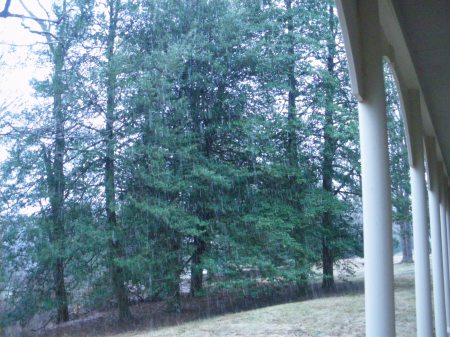
The photos don’t show the beauty, nor do they capture the wonderful quiet that accompanied it.
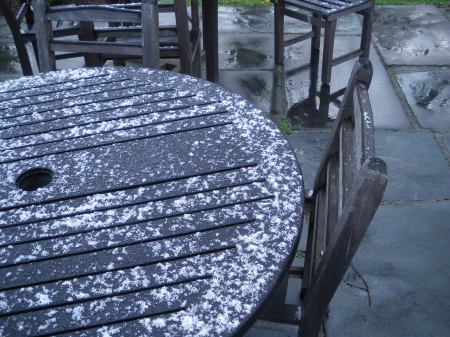
It snowed briefly and lightly at George Washington’s home at Mount Vernon Friday morning.
Snow at the Quarters, Mount Vernon, Virginia, March 13, 2009 - copyright Ed Darrell
Al fresco dining would have been cool, and wet.
Snow on tables, The Quarters, Mount Vernon, Virginia - copyright 2009 by Ed Darrell
Inside, a few minutes later, the conversation was hot. We opened with a session the night before, and post-dinner meeting with William B. Allen, the editor of a recent collection of George Washington’s papers. Allen is suave, with a perfectly-modulated baritone voice. He doesn’t just speak in properly punctuated, grammatically correct paragraphs. He speaks in chapters that summarize volumes.
Among other telling gems, Allen noted that Washington, who is often regarded as an intellectual inferior to Jefferson, Madison, Franklin, Hamilton and others, because he “wrote so little,” has had his collected published papers now pass the 100 volume mark. Reading the letters in full, as we did much of at this meeting, reveals Gen. Washington as little else can.
A quick snippet of learning from my stay at Mount Vernon:
How many places are named after Washington? How many schools?
At the relatively new museum here I found a display that notes how Americans have honored our First President by naming things after him:
26 mountains
740 schools
155 places (the exhibit said “155 cities and counties,” but the map also showed the State of Washington)
(All of this comes without the aid of a George Washington Legacy Project to inflate his importance and the love of Americans for his work!)
George Washington can still lay claim to his friend Richard Lee’s eulogy, as “first in the hearts of his countrymen.”
I found the display on place names on the way out of the Education Center — a place designed to help visiting teachers learn about resources available for classroom use.
Of course the group works to help teachers who can’t visit at the moment, too. To that end they’ve published online a series of lesson plans developed by the George Washington Teachers’ Institute, a summer residency program that provides professional development.
[This is an Encore Post, from August 2007 — just as it appeared then. See especially the links on textbook selection processes, and “cargo cult” science, at the bottom.]
NOVA had a couple of good programs on Richard Feynman that I wish I had — it had never occurred to me to look at YouTube to see what people might have uploaded.
By then, of course, Feynman was one of my heroes. His stories are useful in dozens of situations — his story of joining the samba bands in Rio testify to the joy of living, and the need for doing new things. Brazil was also the place he confronted the dangers of rote learning, when students could work equations perfectly for examples in the book — which they had memorized — but they couldn’t understand real world applications, such as describing how the sunlight coming off the ocean at Ipanema was so beautiful.
Feynman wrote about creationism, and about the dangers of voodoo science, in his now-famous essay on “Cargo cult science” — it’s so famous one has difficulty tracking down the facts to confirm the story.
Feynman’s stories of his wife, and her illness, and his love for her, were also great inspirations. Romance always gets me.
I failed to track him closely enough. During the run of the President’s Commission on Americans Outdoors, we had the misfortune of having scheduled a hearing in Orlando on January 30 (or maybe 29), 1986. We had hoped that the coincidental launch of the Space Shuttle Challenger on January 28 might boost our press response. Of course, the Challenger exploded. Our hearing went on as planned (we had a tough schedule to meet). The disaster affected our staff a lot, those who were in Florida, and the rest of us in Washington where many of us had been on the phone to Florida when the disaster occurred.
Feynman’s appointment to the commission studying the disaster was a brilliant move, I thought. Our schedule, unfortunately, kept me tied up on almost every day the Challenger commission met. So I never did walk the three blocks down the street to meet Feynman, thinking there would be other opportunities. He was already fatally ill. He died on February 15, 1988. I missed a chance of a lifetime.
We still have Feynman’s writings. We read the book aloud to our kids when they were younger. James, our youngest and a senior this year, read Surely You’re Joking again this summer, sort of a warmup to AP physics and his search for a college. [2009 Update: James is studying physics in the wilds of Wisconsin, finals week at Lawrence University next week — study hard, and good luck, James!]
BBC made portions of The Pleasure of Finding Things Out available for free online. These interviews include a short video of his explaining how a scientist can perceive the beauty of a flower at many different levels, beyond the artist’s view — a testament to science as a way of knowing AND appreciating life.
Or, until that account is unsuspended by the forces supporting Donald Trump: Follow @FillmoreWhite, the account of the Millard Fillmore White House Library
We've been soaking in the Bathtub for several months, long enough that some of the links we've used have gone to the Great Internet in the Sky.
If you find a dead link, please leave a comment to that post, and tell us what link has expired.
Thanks!
Retired teacher of law, economics, history, AP government, psychology and science. Former speechwriter, press guy and legislative aide in U.S. Senate. Former Department of Education. Former airline real estate, telecom towers, Big 6 (that old!) consultant. Lab and field research in air pollution control.
My blog, Millard Fillmore's Bathtub, is a continuing experiment to test how to use blogs to improve and speed up learning processes for students, perhaps by making some of the courses actually interesting. It is a blog for teachers, to see if we can use blogs. It is for people interested in social studies and social studies education, to see if we can learn to get it right. It's a blog for science fans, to promote good science and good science policy. It's a blog for people interested in good government and how to achieve it.
BS in Mass Communication, University of Utah
Graduate study in Rhetoric and Speech Communication, University of Arizona
JD from the National Law Center, George Washington University


 Posted by Ed Darrell






 Millard Fillmore's Bathtub