January 16, 2017: Religious Freedom Day in the USA

January 16, 2017

Interesting timing in 2017, falling on the Martin Luther King, Jr., holiday:  January 16 is Religious Freedom Day in the U.S.  Not a holiday (sadly), Religious Freedom Day commemorates the heritage of religious freedom in the U.S.

Thomas Jefferson statue in Charlottesville, Virginia, by Computer Guy. CC license.

January 16 is the anniversary of the adoption of the Virginia Statute of Religious Freedom in 1786.  Thomas Jefferson drafted the law in 1779, in his work to create a body of new laws suitable for a new republic based on freedom.  After the Treaty of Paris ended the American Revolutionary War in 1783, the 13 independent states in America continued in a difficult federation.  Patrick Henry in Virginia proposed in 1785 to roll back part of the Virginia Bill of Rights, and reestablish government paychecks to the clergy — partly to fund educated people in towns who could organize schools  in their non-preaching hours, but partly to reestablish the church in government.  Fellow legislator James Madison managed to delay consideration of the bill, urging such important matters needed time to develop public support.

Madison had other ideas.  He composed a petition eventually signed by thousands of Virginians, the Memorial and Remonstrance, defending religious freedom and stating the necessity of separating church and state to preserve religious freedom.  When the legislature reconvened in 1786, Henry had moved on to another term as governor; the legislature rejected Henry’s proposal and instead took up the bill Jefferson proposed earlier, and passed it.

The Virginia Statute for Religious Freedom remains in effect, unaltered, today.  It is generally regarded as the best statement on separation of state and church in law.  Within a year Madison was shepherding the construction of a new charter for the 13 American states that would become the Constitution; and in 1789, Madison proposed a much-refined religious freedom amendment to the U.S. Constitution, which was ratified as the First Amendment in 1791.

Every January 16, we honor the work of defenders of religious freedom, Thomas Jefferson, James Madison, the Virginia Assembly, and all who work today to keep religious freedom alive.

President Barack Obama issued a proclamation for Religious Freedom Day:

RELIGIOUS FREEDOM DAY, 2017

– – – – – – –

BY THE PRESIDENT OF THE UNITED STATES OF AMERICA

A PROCLAMATION

Believing that “Almighty God hath created the mind free,” Thomas Jefferson authored the Virginia Statute for Religious Freedom after our young Nation declared its independence. This idea of religious liberty later became a foundation for the First Amendment, which begins by stating that “Congress shall make no law respecting an establishment of religion, or prohibiting the free exercise thereof…” On Religious Freedom Day, we rededicate ourselves to defending these fundamental principles, pay tribute to the many ways women and men of different religious and non-religious backgrounds have shaped America’s narrative, and resolve to continue forging a future in which all people are able to practice their faiths freely or not practice at all.

Religious freedom is a principle based not on shared ancestry, culture, ethnicity, or faith but on a shared commitment to liberty — and it lies at the very heart of who we are as Americans. As a Nation, our strength comes from our diversity, and we must be unified in our commitment to protecting the freedoms of conscience and religious belief and the freedom to live our lives according to them. Religious freedom safeguards religion, allowing us to flourish as one of the most religious countries on Earth, but it also strengthens our Nation as a whole. Brave men and women of faith have challenged our conscience and brought us closer to our founding ideals, from the abolition of slavery to the expansion of civil rights and workers’ rights. And throughout our history, faith communities have helped uphold these values by joining in efforts to help those in need — rallying in the face of tragedy and providing care or shelter in times of disaster.

As they built this country, our Founders understood that religion helps strengthen our Nation when it is not an extension of the State. And because our Government does not sponsor a religion — nor pressure anyone to practice a particular faith or any faith at all — we have a culture that aims to ensure people of all backgrounds and beliefs can freely and proudly worship without fear or coercion. Yet in 2015, nearly 20 percent of hate crime victims in America were targeted because of religious bias. That is unacceptable — and as Americans, we have an obligation to do better.

If we are to defend religious freedom, we must remember that when any religious group is targeted, we all have a responsibility to speak up. At times when some try to divide us along religious lines, it is imperative that we recall the common humanity we share — and reject a politics that seeks to manipulate, prejudice, or bias, and that targets people because of religion. Part of being American means guarding against bigotry and speaking out on behalf of others, no matter their background or belief — whether they are wearing a hijab or a baseball cap, a yarmulke or a cowboy hat.

Today, we must also remember those outside the United States who are persecuted for their faith or beliefs, including those who have lost their lives in attacks on sacred places. Religious liberty is more than a cornerstone of American life — it is a universal and inalienable right — and as members of a global community, we must strive to ensure that all people can enjoy that right in peace and security. That is why my Administration has worked with coalitions around the globe to end discrimination against religious minorities, protect vulnerable communities, and promote religious freedom for all. We have also worked to ensure that those who are persecuted for their religious beliefs can find safety and a new home in the United States and elsewhere.

America has changed a great deal since Thomas Jefferson first drafted the Virginia Statute for Religious Freedom, but religious liberty is a right we must never stop striving to uphold. Today, let us work to protect that precious right and ensure all people are able to go about their day in safety and with dignity — without living in fear of violence or intimidation — in our time and for generations to come.

NOW, THEREFORE, I, BARACK OBAMA, President of the United States of America, by virtue of the authority vested in me by the Constitution and the laws of the United States, do hereby proclaim January 16, 2017, as Religious Freedom Day. I call on all Americans to commemorate this day with events and activities that teach us about this critical foundation of our Nation’s liberty, and that show us how we can protect it for future generations at home and around the world.

IN WITNESS WHEREOF, I have hereunto set my hand this thirteenth day of January, in the year of our Lord two thousand seventeen, and of the Independence of the United States of America the two hundred and forty-first.

BARACK OBAMA

More: 


Fly your flag today for the 2017 holiday honoring Rev. Martin Luther King, Jr.

January 16, 2017

As on every federal holiday, citizens and residents of the U.S. should fly their U.S. flags today, on the holiday marking the birth of the Rev. Dr. Martin Luther King, Jr.

Rev. King, and the U.S. flag

Rev. King, and the U.S. flag. (No information on place or time of photo; please feel free to lend light and facts.)

Fly the U.S. flag today for the holiday for the birthday of Martin Luther King, Jr.  The holiday is celebrated on the third Monday in January.

King’s actual birthday is January 15. You could have flown your flag then, too — many Americans fly flags all weekend.

Many Americans will celebrate with a day of service. Perhaps you will, too.

In 2017, days before the inauguration of a new president, remembering and honoring the life and struggles of Martin Luther King, Jr., and serving others in real and symbolic ways, is more important than ever.

More:

The Martin Luther King, Jr. Memorial in Washington, D.C. Credit: architecture.about.com, via Saporta Report

The Martin Luther King, Jr. Memorial in Washington, D.C. Credit: architecture.about.com, via Saporta Report

Save


January 9, 2017 – Connecticut flies U.S. flags for statehood

January 9, 2017

Carol Highsmith photo of Connecticut's Hall of Flags

Love this photo: Hall of Flags in the Connecticut State Capitol Building; photo by the great photo-historian Carol Highsmith, from the Library of Congress collection; the statue is Connecticut’s Civil War Governor, William A. Buckingham (1804-1875), honored for his personal contributions to the equipping of Connecticut’s men fighting in the Civil War.

Technically, states didn’t exist at all, yet.

But on January 9, 1788, Connecticut became the fifth of the 13 colonies to ratify the proposed Constitution for the United States of America, and by that action set the date we count as Connecticut’s entery into the union.

Within 12 months, four more colonies ratified the document, totaling nine ratifications required to put the Constitution into effect.  When the government of the new nation started functioning in 1789, Connecticut was counted as the fifth state.

Connecticut capitol building, Hartford

Capitol building for Connecticut in Hartford; this photo is from the rear of the building, so the U.S. flag is flying correctly on its own right. The building was completed in 1878. The dome is covered in gold. Image from Wikimedia Commons

To avoid political scheming by anti-federalist colony governors, especially Patrick Henry in Virginia, in September 1787 James Madison proposed that the draft constitution be ratified not by legislatures in the colonies, but instead by a specially-called convention of the people of the colony.  Connecticut’s convention met first on January 3, 1788. With six days of discussion and debate, the convention passed a resolution of ratification on January 9.

So by tradition, January 9 is Connecticut’s statehood anniversary.  According to U.S. law, the Flag Code and tradition, citizens and residents of a state fly their flags on statehood anniversaries.

Happy birthday Connecticut, 228 years old.

Next date to fly the U.S. flag is January 16, 2016, to honor the birth of the Rev. Dr. Martin Luther King, Jr. January 16 is the official holiday; January 19 is the actual birthday. You may fly your colors on both dates.

More:


Quote of the Trump administration? “What’s the Constitution between friends?”

January 8, 2017

Timothy J. Campbell, Congressman from New York; photo from Mathew Brady negative circa 1870; Library of Congress, Prints and Photographs Division, http://www.loc.gov/pictures/item/2005691716/

Timothy J. Campbell, Congressman from New York; photo from Mathew Brady negative circa 1870; Library of Congress, Prints and Photographs Division, http://www.loc.gov/pictures/item/2005691716/

What’s the Constitution between friends?

–Timothy J. Campbell (1840-1904), Attributed, circa 1885

A little more below the fold? Certainly. Read the rest of this entry »


Happy 217th birthday, Millard Fillmore! Mo Rocca’s profile, from our archives to yours

January 7, 2017

Millard Fillmore as a younger man? Several sites claim this is a painting of Fillmore, but as with much about our mysterious 13th president, it's difficult to confirm, partly because images of Fillmore really are rather rare.

Millard Fillmore as a younger man? Several sites claim this is a painting of Fillmore, but as with much about our mysterious 13th president, it’s difficult to confirm, partly because images of Fillmore really are rather rare.

Our 13th president, Millard Fillmore, was born January 7, 1800. He’s 217 years old today, though he’s been dead most of that time.

After commemorating Fillmore’s birthday each year for the past several years, I’m running out of ideas to write about him that seem novel, at least to me. [No doubt you’ve noted this is roughly the same post as last year.]  Several years I’ve called the University of Buffalo to try to get copies of the remarks officials make at Fillmore’s gravesite, but those remarks rarely come through — so we don’t get enlightenment from them.

Reality? Few people remember anything about Fillmore even after we feature it here. For Fillmore’s 217th, let’s review what little we really know about him, with some encore posts.

Raconteur Mo Rocca profiled Fillmore for CBS’s Sunday Morning, a while back. That may be as good a place as any to review the highlights of Fillmore’s life, and meaning and place in U.S. history.

Most historians give Fillmore bad marks as a president, despite his having opened Japan for trade, and despite his having procured a steady supply of bird poop for U.S. industry.

I get this eerie feeling Fillmore would fit right in today in the GOP presidential scraps, and would be a serious challenge to fellow New Yorker Donald Trump. Do you agree?

You may view Mo Rocca’s “profile” of President Millard Fillmore for CBS Sunday Morning, on YouTube:

“CBS Sunday Morning” correspondent Mo Rocca, far left, poses with Kathy Frost, curator of the Millard Fillmore Presidential Site, and Robert Lowell Goller, town historian and director of the Aurora Historical Society, during his recent visit to East Aurora. Photo by Robert Lowell Goller

East Aurora Advertiser caption: CBS Visits East Aurora “CBS Sunday Morning” correspondent Mo Rocca, far left, poses with Kathy Frost, curator of the Millard Fillmore Presidential Site, and Robert Lowell Goller, town historian and director of the Aurora Historical Society, during his recent visit to East Aurora. Photo by Robert Lowell Goller

CBS broadcast this piece on February 16, 2014.

 974

More:

Yes, this is mostly an encore post. Fighting ignorance requires patience.

Yes, this is mostly an encore post. Fighting ignorance requires patience. Overcoming Mencken’s hoax requires an army, too.

Save


Utah flies U.S. flags on January 4 for statehood: 121 years in 2017 – old enough to drink

January 4, 2017

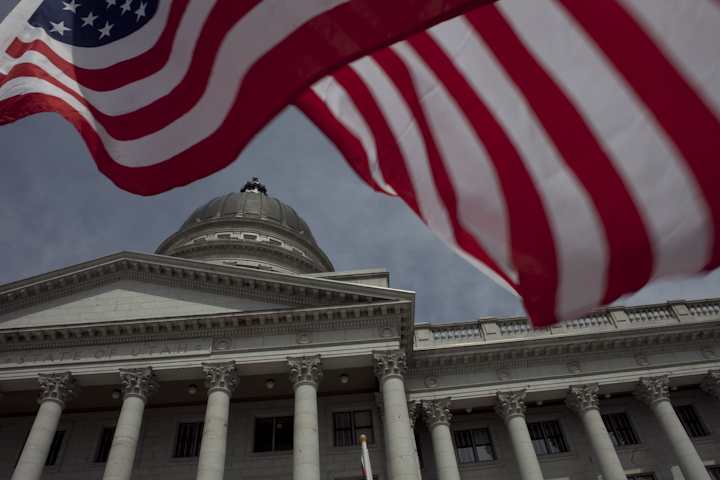
U.S. flag flying in front of the Utah State Capitol. Utah State Capitol image.

U.S. flag flying in front of the Utah State Capitol. Utah State Capitol image.

U.S. flags fly in Utah today in honor of Utah statehood. It’s also the day that new, elected state officers take their oaths and take their offices. Utah is 121 years in the union — as a state, it’s old enough to drink, though you may have difficulty finding a drink there among the teetotaling Mormons.

Utah joined the Union on January 4, 1896.  It had been a 49-year slog to statehood for Deseret, the Mormon settlement in the Desert.  The size had been pared down, so it would not be the biggest state, incorporating parts of what is now Nevada, Arizona, Oregon, Idaho, Colorado and New Mexico.  New capitals had been tried and cast aside (Fillmore, Utah).  Democratic Party rule was broken when LDS church authorities went door-to-door, calling every other family to the Republican Party, and party parity.  The Mormon Church abandoned polygamy, and adopted a state constitution that gave the vote to women.

Finally, Utah became the 45th state.

You may fly your U.S. flag today for Utah statehood, especially if you’re in Utah.

Happy birthday, Utah!  121 years old today.

Big dance in Fillmore to celebrate, Saturday:

Next federal flag-flying date: January 6, in honor of New Mexico’s statehood.

More:

One of my favorite Utah photos: U.S. flag at the south end of Mount Timpanogos; photo from Orem, Utah, by Bob Walker.

One of my favorite Utah photos: U.S. flag at the south end of Mount Timpanogos; photo from Orem, Utah, by Bob Walker.

Yes, this is mostly an encore post. Fighting ignorance requires patience.

Yes, this is mostly an encore post. Fighting ignorance requires patience.

Save

Save


58 years ago, January 3, 1959: Welcome, Alaska, and the 49-star flag

January 3, 2017

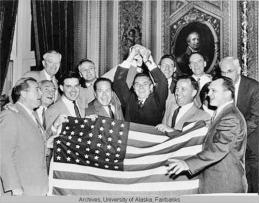
Alaska Territorial Gov. Bob Bartlett in center, with the 49-star flag (Bartlett was one of Alaska's first U.S. senators).

Alaska Territorial Gov. Bob Bartlett in center, with the 49-star flag (Bartlett was one of Alaska’s first U.S. senators).

The great service at the New York Times site, the Learning Network, notes the 1959 Dwight Eisenhower proclamation of Alaska as the 49th state, and the unveiling of the 49-star flag:

On Jan. 3, 1959, President Dwight Eisenhower signed a proclamation admitting Alaska to the Union as the 49th state. The New York Times noted that the signing included the unveiling of the new 49-star American flag.

The land that became Alaska came into U.S. possession in 1867, when William Seward, secretary of state under President Andrew Johnson, negotiated a deal to buy the 586,000-square-mile area from Russia for $7.2 million, less than 2 cents per acre. Seward’s decision was ridiculed in the American press, who saw no potential in the vast, inhospitable and sparsely populated area.

For decades after its purchase, Alaska was derided as “Seward’s folly” or “Seward’s icebox.” This opinion changed in 1896 with the discovery of gold in the neighboring Yukon Territory, which spurred tens of thousands of people to head to Alaska in search of gold. The gold rush also brought about a boom in mining, fishing and trapping.

Though the first statehood bill had been presented to Congress in 1916, there was little desire in either Alaska or Washington for Alaskan statehood until after World War II. During the war, the U.S. established multiple military bases to resist Japan’s attacks on Alaska’s Aleutian Islands and prevent a potential invasion of the mainland. The military activity, along with the completion of a major highway from Montana, led to a large population growth.

In 1946, Alaskans voted in favor of statehood in a referendum and Alaskan delegates began to lobby Congress for statehood. After years of debate, Congress voted in June 1958 to admit Alaska.

Eight months after Alaska’s admission, on Aug. 21, 1957 [should be 1959, no?], Hawaii became the 50th state. The 49-star remained in place until the following July 4, when it was replaced by the now-familiar 50-star flag.

49-star flags were produced only until August 1959, so there are few of them around.  I love this photo of the unveiling of the flag with President Eisenhower:

President Eisenhower and Quartermaster General MG Andrew T. McNamara, with 49-star flag - image from QM foundation

“Quartermaster General MG Andrew T. McNamara and President Eisenhower examine new 49 star flag” – image and caption from the Quartermaster Foundation. Photo by Bob Schutz, Associated Press (Who are the other two people?  The guy on the right looks to me a bit like is Pennsylvania’s Sen. Hugh Scott.)

It had been about 47 years since the previous state admission (Arizona); people became aware that no law set what the flag should look like.  President Eisenhower issued a directive.

How did the nation survive for 170 years without firm, decisive and conclusive orders on what the U.S. flag should look like?  Isn’t it a great story that we went so long without law setting the requirements?

Alaska's state flag design came from 13-year old Benny Benson.

Alaska’s state flag design came from 13-year old Benny Benson. Benny Benson holding the Alaska flag at the Jesse Lee Home, Seward, Alaska. ASL-P01-1921, Alaska State Library-Historical Collections.


Alaska’s state flag came from the imagination of a 13-year-old Aleut, Benny Benson, winning a contest to design the state’s flag.  Alaska’s flag stands out in any display of U.S. state flags.

Alaska's flag as it was approved by the state legislature, and still flies today. Image from the Ninilchik Natives Association, Inc (NNAI).

Alaska’s flag as it was approved by the state legislature, and still flies today. Image from the Ninilchik Natives Association, Inc (NNAI).


Yes, this is mostly an encore post. Fighting ignorance requires patience.

Yes, this is mostly an encore post. Fighting ignorance requires patience.

Save

Save

Save

Save

Save


Will you fly your U.S. flags in January 2017?

January 3, 2017

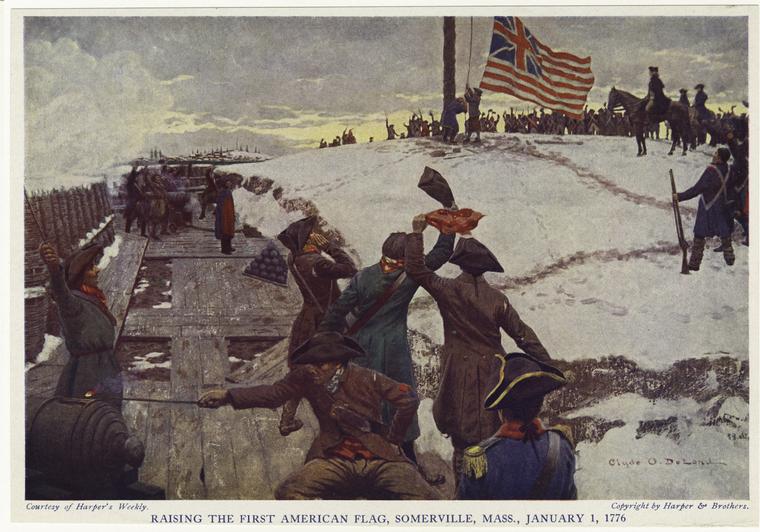
“Raising the first American flag, Somerville, Mass., January 1, 1776.” Harper’s Weekly painting by Clyde Osmer DeLand, 1897. From the digital collections of the New York Public Library

January is loaded with flag flying dates, when we add in statehood days, dates those states are invited to fly their U.S. flags.

In January 2017, the U.S. Flag Code urges citizens to fly flags on these dates, listed chronologically:

  • New Year’s Day, January 1, a federal holiday
  • January 2, Georgia Statehood Day
  • January 3, Alaska Statehood Day
  • January 4, Utah Statehood Day
  • January 6, New Mexico Statehood Day
  • January 9, Connecticut Statehood Day
  • Martin Luther King’s Birthday, a federal holiday on the third Monday of January; that date is January 16, in 2017; King’s actual birthday is January 15, and you may fly your flag then, too
  • Inauguration Day, January 20, the year after election years, as 2017 is
  • January 26, Michigan Statehood Day
  • January 29, Kansas Statehood Day

You may fly your flag any other day you wish, too; flags should not be flown after sundown unless they are specially lighted, or at one of the few places designated by Congress or Presidential Proclamation for 24-hour flag flying.  According to Wikipedia’s listing, those sites include:

  • Fort McHenry, Baltimore, Maryland (Presidential Proclamation No. 2795, July 2, 1948).
  • Flag House Square, Albemarle and Pratt Streets, Baltimore, Maryland (Public Law 83-319, approved March 26, 1954).
  • Marine Corps War Memorial (Iwo Jima Memorial), Arlington, Virginia (Presidential Proclamation No. 3418, June 12, 1961).
  • Lexington Battle Green, Lexington, Massachusetts (Public Law 89-335, approved November 8, 1965).
  • White House, Washington, D.C. (Presidential Proclamation No. 4000, September 4, 1970).
  • Washington Monument, Washington, D.C. (Presidential Proclamation No. 4064, July 6, 1971, effective July 4, 1971).
  • Any port of entry to the United States which is continuously open (Presidential Proclamation No. 413 1, May 5, 1972).
  • Grounds of the National Memorial Arch in Valley Forge State Park, Valley Forge, Pennsylvania (Public Law 94-53, approved July 4, 1975).
Flag House in 1936, 844 East Pratt & Albemarle Streets (Baltimore, Independent City, Maryland) (cropped). Image courtesy of the federal HABS—Historic American Buildings Survey of Maryland.

Flag House in 1936, where Mary Pickersgill sewed the garrison-sized, 15-star flag that flew over Fort McHenry at the Battle of Baltimore in 1814; one of the sites where the U.S. flag may be flown 24 hours. The house is at 844 East Pratt & Albemarle Streets (Baltimore, Independent City, Maryland). Cropped image courtesy of the federal HABS—Historic American Buildings Survey of Maryland.

Yes, this is mostly an encore post. Fighting ignorance requires patience.

Yes, this is mostly an encore post. Fighting ignorance requires patience.

Save


Scrooge’s 2016 Christmas gift to Donald Trump: His platform reduced to three words

December 30, 2016

Oh, why bother with this BEFORE Christmas? It’s more salient now, looking at the new year, and wondering what is the fate of man and men, in the new year.

Roberto Innocenti, Scrooge on a dark staircase

Ebenezer Scrooge, up a dark staircase; “Darkness was cheap, and Scrooge liked it.” Illustration by Roberto Innocenti, via Pinterest.

It’s a Quote of the Moment (an encore post for the season, with a bit of context thrown in later), Trump’s platform, and life, edited down to just three words, in green:

Darkness is cheap,
and Scrooge liked it.

– Charles Dickens, A Christmas Carol, Stave 1

Isn’t that the entire GOP platform in three words? “Darkness is cheap.”

I think of that line of Dickens’s often when  I read of the celebrations of calumny that pass as discourse in Republican politics these days. Although, with the 2008 renewing of Limbaugh’s contract, it may no longer be true that his particular brand of darkness is cheap. With the advent of Donald Trump’s insult politics, offending America’s allies and all American ethnic groups possible, with un-ironic calls to drop nuclear weapons, GOP politics is even darker than ever.

Cheap or not, darkness remains dark.

John Leach, Scrooge meets Ignorance and Want

Scrooge meets Ignorance and Want, the products of his stinginess (drawing by John Leech, 1809-1870)


Here is the sentence Dickens put before the quote, to add a little context; Scrooge was climbing a very large, very dark staircase.

Half-a-dozen gas-lamps out of the street wouldn’t have lighted the entry too well, so you may suppose that it was pretty dark with Scrooge’s dip.

Up Scrooge went, not caring a button for that. Darkness is cheap, and Scrooge liked it.

Speaking of darkness, a longer excerpt from a bit later in Dickens’s story, when the Ghost of Christmas Present ushers Scrooge to glimpse what is in the present, but what will be the future if Scrooge does not repent:

‘Forgive me if I am not justified in what I ask,’ said Scrooge, looking intently at the Spirit’s robe, ‘but I see something strange, and not belonging to yourself, protruding from your skirts. Is it a foot or a claw?’

‘It might be a claw, for the flesh there is upon it,’ was the Spirit’s sorrowful reply. ‘Look here.’

From the foldings of its robe, it brought two children; wretched, abject, frightful, hideous, miserable. They knelt down at its feet, and clung upon the outside of its garment.

‘Oh, Man! look here. Look, look, down here!’ exclaimed the Ghost.

They were a boy and girl. Yellow, meagre, ragged, scowling, wolfish; but prostrate, too, in their humility. Where graceful youth should have filled their features out, and touched them with its freshest tints, a stale and shrivelled hand, like that of age, had pinched, and twisted them, and pulled them into shreds. Where angels might have sat enthroned, devils lurked, and glared out menacing. No change, no degradation, no perversion of humanity, in any grade, through all the mysteries of wonderful creation, has monsters half so horrible and dread.

Scrooge started back, appalled. Having them shown to him in this way, he tried to say they were fine children, but the words choked themselves, rather than be parties to a lie of such enormous magnitude.

‘Spirit! are they yours?’ Scrooge could say no more.

‘They are Man’s,’ said the Spirit, looking down upon them. ‘And they cling to me, appealing from their fathers. This boy is Ignorance. This girl is Want. Beware them both, and all of their degree, but most of all beware this boy, for on his brow I see that written which is Doom, unless the writing be erased. Deny it!’ cried the Spirit, stretching out its hand towards the city. ‘Slander those who tell it ye! Admit it for your factious purposes, and make it worse. And bide the end!’

‘Have they no refuge or resource?’ cried Scrooge.

‘Are there no prisons?’ said the Spirit, turning on him for the last time with his own words. ‘Are there no workhouses?’ The bell struck twelve.

Scrooge looked about him for the Ghost, and saw it not. As the last stroke ceased to vibrate, he remembered the prediction of old Jacob Marley, and lifting up his eyes, beheld a solemn Phantom, draped and hooded, coming, like a mist along the ground, towards him.

A Christmas Carol, Stave 3

Think of 2014, 2015, and 2016, children abused in Central America and in the Middle East, fleeing as best they can, only to die, off the shores of Greece, on the southern deserts of the U.S., or be cast into incarceration after having achieved a nation whose very name promised them refuge, the United States. “Two children; wretched, abject, frightful, hideous, miserable,” Dickens described. Whose children? “Man’s.” Yours, and mine.

Christmas is a festival to celebrate light, what many Christians call “the light of the world?” If so, let us work to stamp out the darkness which the unrepentant Scrooge so dearly loved.

Darkness may be cheap, but it is not good.  Light a candle, and run into the darkness, spreading light. We need more light.

Hope you had a merry Christmas in 2016. Let us remember, as Tom and the late Ray Magliozzi always reminded us, the cheapskate pays more in the end, and usually along the way. Is Darkness cheap? Let us then eschew it as too costly for a moral nation, too costly for a moral people.

Is Donald Trump as smart as Ebenezer Scrooge? Is his heart as good as Scrooge’s heart?

More:

Yes, this is mostly an encore post. Fighting ignorance requires patience.

Yes, this is mostly an encore post. Fighting ignorance requires patience.

Save


December 30, 2016, Hubble Day! Look to the stars for our future

December 30, 2016

[Today is actually the day!  You may fly your flag if you choose.  This is the traditional Millard Fillmore’s Bathtub Hubble Day post.]

Lift a glass of champagne today in tribute to Edwin Hubble and his great discovery. Not sure what to call it — Hubble Day, Looking Up Day, Endless Possibilities Day — whatever, this is the anniversary of Edwin Hubble’s announcement that he had discovered the universe is much, much larger than anyone had imagined, containing far more stars than anyone had dared guess.

It’s a big universe out there.

Ultraviolet image of the Andromeda Galaxy. Wired caption: Photo: Edwin Hubble’s 1920s observations of Andromeda (whose ultraviolet spectrum is rendered here) expanded our notions of the size and nature of a universe that is itself expanding. Galaxy Evolution Explorer image courtesy NASA.

Ultraviolet image of the Andromeda Galaxy. Wired caption: “Photo: Edwin Hubble’s 1920s observations of Andromeda (whose ultraviolet spectrum is rendered here) expanded our notions of the size and nature of a universe that is itself expanding. Galaxy Evolution Explorer image courtesy NASA.”

So, today is a good day to celebrate the universe in all it’s glory – December 30.

On December 30, 1924, Edwin Hubble announced he’d discovered other galaxies in distant space. Though it may not have been so clear at the time, it meant that, as a galaxy, we are not alone in the universe (whether we are alone as intelligent life is a separate question). It also meant that the universe is much, much bigger than most people had dared to imagine.

92 years ago today.

I keep trying to get people to celebrate.

In 2008 for Hubble Day, Wired picked up on the story (with a gracious link to 2007’s post here at the Bathtub). Wired includes several links to even more information, a good source of information. See Wired’s 2009 post here.

Hubble was the guy who showed us the universe is not only bigger than we imagined, it’s probably much bigger and much more fantastic than we can imagine. (See J. B. S. Haldane’s “queerer” quote.) Hubble is the guy who opened our imaginations to the vastness of all creation.

Hubble’s work would have been impossible without the earlier work of one of the great, unsung women of science, Henrietta Leavitt, as Wired explained:

He trained the powerful new 100-inch telescope at Mount Wilson in Southern California on spiral nebulae. These fuzzy patches of light in the sky were generally thought to be clouds of gas or dust within our galaxy, which was presumed to include everything in the universe except the Magellanic Clouds. Some nebulae seemed to contain a few stars, but nothing like the multitudes of the Milky Way.

Hubble not only found a number of stars in Andromeda, he found Cepheid variable stars. These stars vary from bright to dim, and a very smart Harvard computationist named Henrietta Leavitt had discovered in 1912 that you could measure distance with them. Given the brightness of the star and its period — the length of time it takes to go from bright to dim and back again — you could determine how far away it is.

Hubble used Leavitt’s formula to calculate that Andromeda was approximately 860,000 light years away. That’s more than eight times the distance to the farthest stars in the Milky Way. This conclusively proved that the nebulae are separate star systems and that our galaxy is not the universe.

How does one celebrate Hubble Day? Here are some suggestions:

  • Easier than Christmas cards: Send a thank-you note to your junior high school science teacher, or whoever it was who inspired your interest in science. Mrs. Hedburg, Mrs. Andrews, Elizabeth K. Driggs, Herbert Gilbert, Mr. Willis, and Stephen McNeal, thank you.
  • Rearrange your Christmas/Hanukkah/KWANZAA lights in the shape of the Andromeda Galaxy — or in the shape of any of the great photos from the Hubble Telescope (Andromeda Galaxy pictured above; Hubble images here)

    A few of the images from the Hubble Telescope

    A few of the images from the Hubble Telescope

  • Go visit your local science museum; take your kids along – borrow somebody else’s kids if you have to (take them along, too); in Dallas, you can visit the Perot Museum of Nature and Science — it’s a doozy.
  • Spend two hours in your local library, just looking through the books on astronomy and the universe
  • Write a letter to your senators and congressman; tell them space exploration takes a minuscule portion of our federal budget, but it makes us dream big; tell them we need to dream big, and so they’d better make sure NASA is funded well.  While you’re at it, put in a plug for funding Big Bird and the rest of public broadcasting, too.  Science education in this nation more and more becomes the science shows on NPR and PBS, watched by kids who learned to read and think by watching Big Bird.
  • Anybody got a good recipe for a cocktail called “The Hubble?” “The Andromeda?” Put it in the comments, please.  “The Hubble” should have bubbles in it, don’t you think?  What was it the good monk said?  He was working to make great wine, but goofed somewhere, and charged the wine with another dose of yeast.  When he uncorked the very first bottle of what would come to be called champagne, Benedictine Monk Dom Pierre Perignon said “I am drinking stars!”  Except, he said it in French.  In any case, a Hubble cocktail should have bubbles, some of Perignon’s stars.

The encore post, from 2007:

December 30, 1924, Edwin Hubble announced the results of his observations of distant objects in space.

PBS

Edwin Hubble, long before the Surgeon General’s 1964 report on smoking made taboo photos of people smoking pipes.

In 1924, he announced the discovery of a Cepheid, or variable star, in the Andromeda Nebulae. Since the work of Henrietta Leavitt had made it possible to calculate the distance to Cepheids, he calculated that this Cepheid was much further away than anyone had thought and that therefore the nebulae was not a gaseous cloud inside our galaxy, like so many nebulae, but in fact, a galaxy of stars just like the Milky Way. Only much further away. Until now, people believed that the only thing existing outside the Milky Way were the Magellanic Clouds. The Universe was much bigger than had been previously presumed.

Later Hubble noted that the universe demonstrates a “red-shift phenomenon.” The universe is expanding. This led to the idea of an initial expansion event, and the theory eventually known as Big Bang.

Hubble’s life offered several surprises, and firsts:

  • Hubble was a tall, elegant, athletic, man who at age 30 had an undergraduate degree in astronomy and mathematics, a legal degree as a Rhodes scholar, followed by a PhD in astronomy. He was an attorney in Kentucky (joined its bar in 1913), and had served in WWI, rising to the rank of major. He was bored with law and decided to go back to his studies in astronomy.
  • In 1919 he began to work at Mt. Wilson Observatory in California, where he would work for the rest of his life. . . .
  • Hubble wanted to classify the galaxies according to their content, distance, shape, and brightness patterns, and in his observations he made another momentous discovery: By observing redshifts in the light wavelengths emitted by the galaxies, he saw that galaxies were moving away from each other at a rate constant to the distance between them (Hubble’s Law). The further away they were, the faster they receded. This led to the calculation of the point where the expansion began, and confirmation of the big bang theory. Hubble calculated it to be about 2 billion years ago, but more recent estimates have revised that to 20 billion years ago.
  • An active anti-fascist, Hubble wanted to joined the armed forces again during World War II, but was convinced he could contribute more as a scientist on the homefront. When the 200-inch telescope was completed on Mt. Palomar, Hubble was given the honor of first use. He died in 1953.

“Equipped with his five senses, man explores the universe around him and calls the adventure Science.”

That news on December 30, 1924, didn’t make the first page of the New York Times. The Times carried a small note on February 25, 1925, that Hubble won a $1,000 prize from the American Academy for the Advancement of Science.

(Does anyone have a suitable citation for that video? Where did it come from? Who produced it? Is there more somewhere?)

Happy Hubble Day! Look up!

Resources:

Hubble Space Telescope - NASA image

Hubble Space Telescope, working homage to Edwin Hubble – NASA image

Even More Resources:

Andromeda as we can see it today. Wikimedia image: The Andromeda Galaxy is a spiral galaxy approximately 2.5 million light-years away in the constellation Andromeda. The image also shows Messier Objects 32 and 110, as well as NGC 206 (a bright star cloud in the Andromeda Galaxy) and the star Nu Andromedae. This image was taken using a hydrogen-alpha filter.

Andromeda as we can see it today. Wikimedia image: The Andromeda Galaxy is a spiral galaxy approximately 2.5 million light-years away in the constellation Andromeda. The image also shows Messier Objects 32 and 110, as well as NGC 206 (a bright star cloud in the Andromeda Galaxy) and the star Nu Andromedae. This image was taken using a hydrogen-alpha filter.

Yes, this is mostly an encore post. Fighting ignorance requires patience.

Yes, this is mostly an encore post. Fighting ignorance requires patience.


Texans fly U.S. flags today in honor of Texas statehood

December 29, 2016

First class postage stamp showing U.S. and Texas flags together, issued for the Texas Statehood Centennial, in 1945. Yes, first class postage was three cents. Wikipedia image.

First class postage stamp showing U.S. and Texas flags together, issued for the Texas Statehood Centennial, in 1945. Yes, first class postage was three cents. Wikipedia image.

Congress approved Texas’s petition to join the union on December 29, 1845. Texas joined the United States of America 171 years ago today.

KWTX Channel 10 News described the process in 1845:

On December 29, 1845—171 years ago today—the U.S. Congress voted to annex Texas, eight years after statehood was first proposed. In June 1845 the Texas Congress voted in favor of annexation and on July 4, 1845, a convention of elected delegates followed suit. A popular vote in October ratified the document, which the U.S. Congress accepted on December 29, 1845, making Texas the 28th state. Texas President Anson Jones handed over control of the new state government to Gov. James Pinckney Henderson on February 19, 1846.

Engraving of Texas President Anson Jones lowering the flag of the Republic of Texas, to be replaced with the flag of the United States, on December 29, 1845, after Congress accepted the annexation of Texas into the Union. Texas State Library image.

Engraving of Texas President Anson Jones lowering the flag of the Republic of Texas, to be replaced with the flag of the United States, on December 29, 1845, after Congress accepted the annexation of Texas into the Union. Texas State Library image.

More:


Iowa entered the union on December 28, 1846; fly your flags, Hawkeyes!

December 28, 2016

Iowans may fly their flags today in celebration of the anniversary of Iowa statehood.  Iowa’s admission to the Union came on December 28, 1846; Iowa was the 29th state admitted.

“Millions of acres. Iowa and Nebraska. Land for sale on 10 years credit by the Burlington & Missouri River R. R. Co. at 6 per ct interest and low prices.” Poster advertising land in Iowa, circa 1872, from the Burlington & Missouri River Railroad Co. – Library of Congress Printed Ephemera Collection; Portfolio 134, Folder 13; via Wikipedia

The Flag Code, 4 USC §6 (d), notes that the U.S. flag may be flown on “the birthdays of States (date of admission),” in addition to the other score of dates specifically written into law.

Stars and Stripes were impossible to miss at University of Iowa's Kinnick Stadium in November 2014. Photos by Tim Schoon.

Sometimes we excuse parts of the Flag Code if the display otherwise stirs great patriotism. Stars and Stripes were impossible to miss at University of Iowa’s Kinnick Stadium in November 2014. Photos by Tim Schoon.

More:

Yes, this is mostly an encore post. Fighting ignorance requires patience.

Yes, this is mostly an encore post. Fighting ignorance requires patience.

Save

Save


Merry Christmas, 2016! Fly your flag today

December 25, 2016

“A Gift to a Nation” by painter of western scenes Tom Browning; Santa Claus puts together a flag for a family to fly on Christmas.

Christmas Day, December 25, is one of the holidays designated in the U.S. Flag Code for U.S. residents to fly the flag.

No, you don’t take the flag down for mere inclement weather; fly it through rain and snow. Remember to dry your flag before putting it away.

More:

  • Next dates to fly the flag: December 28, for Iowa statehood; December 29, for Texas statehood; New Years Day
  • Look around for other Christmas and Santa Claus posts
Ron Cogswell captured a flag displayed at Reagan National Airport in Washington, D.C., in December 2015; Creative Commons license

Ron Cogswell captured a flag displayed at Reagan National Airport in Washington, D.C., in December 2015; Creative Commons license

Save

Save

Save


George Washington: No military junta, no king; an example we can all follow

December 23, 2016

This is a mostly encore post, emphasizing George Washington’s astounding ability to draw from history just exactly the right lesson, and then set the example that makes history.

Washington, though having never attended college, was an inveterate reader, and a sharp student of history.  Early he read the story of the great Roman, Cincinnatus, who made the Roman Republic great with his refusal to lust for power.  Cincinnatus twice was named Dictator, and both times resigned the commission rather than personally profit as others did — after saving Rome both times, of course.

In his own life, Washington also twice cast off the mantle of top leader, once when he resigned his commission as Commander in Chief of the Continental Army when so many assumed he would just keep on, and add the title of “King of America;” and the second time when, as president, he stepped aside and retired, leaving the leadership of the nation up to the Constitutional processes that had never before been tried successfully in any nation.

Washington’s resignation from the army command came on December 23, 1783 — such an important anniversary usually gets lost in preparations for Christmas, so I’ll post it a bit early.  In your holiday toasts, lift a glass to George Washington, who gave us civilian rule, an end to monarchy, and an example of responsible leadership making way for peaceful succession.

In 2007, I wrote:

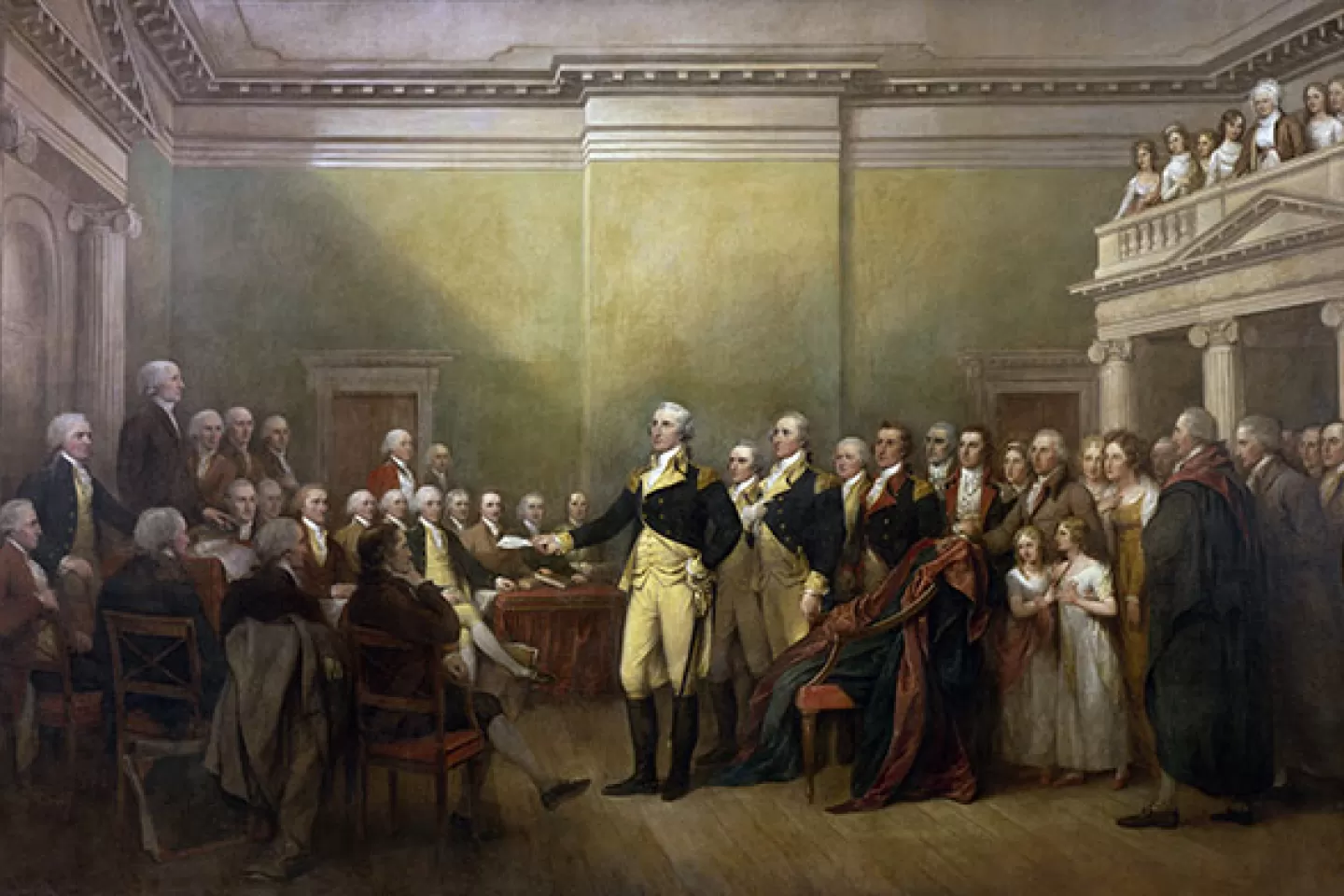
On December 23, 1783, Commander of the Continental Army, Gen. George Washington resigned his commission, to the Continental Congress sitting in Annapolis, Maryland. Washington modeled his actions on the life of Roman general and patriot Cincinnatus. (See especially this site, the Society of the Cincinnati)

John Trumbull painting of Washington resigning his commission

John Trumbull’s painting of Washington resigning his commission; one of eight great paintings hanging in the Rotunda of the U.S. Capitol

Washington had been thought to be in a position to take over the government and declare himself king, if he chose. Instead, at some cost to himself he personally put down a rebellion of the officers of the army who proposed a coup d’etat against the Continental Congress, angered that they had not been paid. Washington quietly asked that the men act honorably and not sully the great victory they had won against Britain. Then Washington reviewed the army, wrapped up affairs, journeyed to Annapolis to resign, and returned to his farm and holdings at Mount Vernon, Virginia.

Because Washington could have turned into a tyrant, it is reported that King George III of England, upon hearing the news of Washington’s resignation, refused to believe it. If the report were true, George is reported to have said, Washington was the greatest man who ever lived.

Washington’s resignation set precedent: Civilian government controlled the military; Americans served, then went back to their private lives and private business; Americans would act nobly, sometimes when least expected.

From the Library of Congress American Memory site, “Today in History”:

George Washington resigned his commission as commander-in-chief of the Continental Army on December 23, 1783, in the senate chamber of the Maryland State House in Annapolis, where the Continental Congress was then meeting.

Although the British had recognized American independence with the signing of the Treaty of Paris on September 3, British troops did not evacuate New York until December 4. After the last British ships left the harbor, Washington bid an emotional farewell to his officers and set out for Annapolis. On the journey south he was met with throngs of well-wishers paying him tribute for his role in the nation’s military victory over Great Britain.

Washington left Annapolis at dawn on December 24 and set out for Mount Vernon, his plantation on the Potomac River in Virginia. He arrived home before nightfall on Christmas Eve, a private citizen for the first time in almost nine years.

The Maryland State Capitol in Annapolis.

The Maryland State Capitol in Annapolis.

Maryland State House, Annapolis, Maryland
William Henry Jackson, photographer, circa 1892.
Touring Turn-of-the-Century America, 1880-1920

When Washington visited The Maryland State House in 1783, the structure was incomplete and suffered from a leaking roof. By 1786, when representatives from Maryland and Virginia meeting at the State House rallied support for the movement to remedy defects in the Articles of Confederation, construction of a new dome had begun. Today, the building begun in 1772 is the oldest state house still in legislative use.

Located at the mouth of the Severn River on the Chesapeake Bay, Annapolis was settled in 1649 by Puritans who moved there from Virginia. The town was known in the seventeenth century as Town of Proctor’s, Town at the Severn, and Anne Arundel Town before it was named for Queen Anne in 1695. It is home to the U.S. Naval Academy and to St. John’s College, founded in 1696.

This is an encore post.

Yes, this is an encore post. Defeating ignorance takes patience and perseverance.

Save


Flags in New Jersey flying for statehood, December 18

December 18, 2016

New Jersey's Capitol in Trenton, by Vagabond Voyage. Many complain it's difficult to get a good, nice looking photo of this building due to development around it. This photo is alleged to be one of the better photos possible.
New Jersey’s Capitol in Trenton, by Vagabond Voyage. Many complain it’s difficult to get a good, nice looking photo of this building due to development around it. This photo is alleged to be one of the better photos possible.

December 18 is New Jersey Statehood Day.

U.S. Flag Code encourages residents of each state to fly the U.S. flag on their state’s anniversary of statehood. New Jersey won consideration as the Third State, on December 18, 1787, by being the third colony to ratify the U.S. Constitution. Technically the U.S. did not come into existence until six more states ratified, but among the first 13 states, statehood dates are calculated traditionally as the day the colony ratified.

Does anyone in New Jersey celebrate it?

New Jersey's state flag. Just try to find photos of the U.S. flag and New Jersey flag flying together.
New Jersey’s state flag. Just try to find photos of the U.S. flag and New Jersey flag flying together.
New Jersey's Capitol Building and surroundings in Trenton, from across the Delaware River. U.S. flag can be seen flying at the Capitol. Wikipedia image.
New Jersey’s Capitol Building and surroundings in Trenton, from across the Delaware River. U.S. flag can be seen flying at the Capitol. Wikipedia image.

More:

  • Next Fly Your Flag dates: December 28 in Iowa, for Iowa statehood; December 29 in Texas, for Texas statehood.

Save