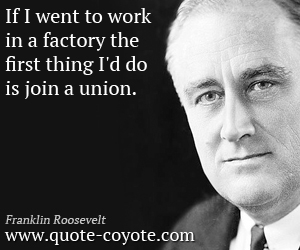
August 16 quote of the moment: FDR, ‘I’d join a union’

August 16, 2016

One wag, who didn’t want to discuss things after all, referred me to President Franklin Roosevelt’s message to the National Federal of Federal Employees (NFFE), of August 16, 1937 (from the American Presidency Project at the University of California – Santa Barbara (UCSB)).  The wag asked me to confess that FDR was anti-union, and that Wisconsin Gov. Scott “Ahab” Walker had acted in Roosevelt’s path in Walker’s assaults on the unions of policemen, firefighters and teachers in Wisconsin.

I demurred, and pointed out instead that Walker went after the unions despite their having NOT struck, that Walker refused to bargain in good faith, or bargain at all.  I pointed out that Walker had failed in his duty, in the view of FDR.

President Franklin Delano Roosevelt

President Franklin Delano Roosevelt, in 1936 (Checking to see whether, when and where FDR said that; Robert Reich says he did.)

It’s a good way to send wags packing on Twitter, I’ve learned.  They don’t like to read or think, and they certainly don’t want anyone pointing out that they may have misinterpreted something. Anything.

NFFE had invited Roosevelt to speak at their Twentieth Jubilee Convention; Roosevelt sent a letter declining the invitation. In declining, Roosevelt noted he opposed strikes by government employees.  No doubt there is more history there that deserves our attention.  We can get to it later.

Here’s the meat of FDR’s letter:

Particularly, I want to emphasize my conviction that militant tactics have no place in the functions of any organization of Government employees. Upon employees in the Federal service rests the obligation to serve the whole people, whose interests and welfare require orderliness and continuity in the conduct of Government activities. This obligation is paramount. Since their own services have to do with the functioning of the Government, a strike of public employees manifests nothing less than an intent on their part to prevent or obstruct the operations of Government until their demands are satisfied. Such action, looking toward the paralysis of Government by those who have sworn to support it, is unthinkable and intolerable. It is, therefore, with a feeling of gratification that I have noted in the constitution of the National Federation of Federal Employees the provision that “under no circumstances shall this Federation engage in or support strikes against the United States Government.”

What do you think Roosevelt would have made of the current and last “do nothing” GOP blocs in Congress?  (Or should we say “blocks?”)

Doesn’t this describe Republicans in Congress today?

” . . . intent on their part to prevent or obstruct the operations of government until their demands are satisfied. Such action, looking toward the paralysis of Government by those who have sworn to support it, is unthinkable and intolerable.”

Is it too much to ask Republicans in Congress to be at least as loyal to the U.S. as the unionized government employees who pledged not to shut down the government?

FDR was pro-union, for very good reasons. Patriots should be, too.

More:

Yes, this is mostly an encore post. Fighting ignorance requires patience.

Yes, this is mostly an encore post. Fighting ignorance requires patience.


300 Spartans, led by Leonidas died August 11, 480 B.C.

August 11, 2016

It’s a different Leonidas, but Michael Phelps yesterday tied a record for winning 12 solo events in Olympics previously held by a man called Leonidas of Rhodes. The record had stood, as best historians can tell, for 2,168 years.

That was August 10, 2016. On August 11, we remember Leonidas of Sparta, for events in war, not peace.

300 popped up on some movie channel back in 2008 as I was preparing to teach world history again.  I did not major in history, and my high school history instruction featured no AP courses (Pleasant Grove High, in Utah, didn’t offer such things then; I assume they do now, but I don’t know).

What I knew about Sparta and the stand of the 300 at Thermopylae came from my reading encyclopedias as a child, and culture.  Never had an occasion to write a speech about the events, though had I known the history better, I might have found some opportunity.  Sen. Orrin Hatch would have loved a compare and contrast speech between the stand of the Spartans and his work against the labor law reform bill in 1977 and 1978; more likely, we could have used the simple historical facts that the stand of the 300 at the same place today would be impossible due to poor soil conservation practices of the local farmers, which has created a plain broad enough for a Persian Army to march through with impunity, never fearing drowning in the sea that no longer exists there.  Thermopylae is a grand historical metaphor for a good orator.  The simple facts of history are important, too — Churchill knew Herodotus’s stories well, and considered them when planning military actions in the area in two world wars.

The movie came up from students in the previous year; it offered, perhaps, a hook for an introduction to world history, explaining why we bother to study it at all.

I got a time delay recording to watch it, which I did, mostly.  Interesting stylization.  Cartoonish characterizations, which one should expect from a movie intended as homage to the graphic novel that directly spawned it, more than an instruction about history.  We might doubt that the Persians had trained and armored rhinoceroses in their armament.  Dialogue — well, this is Hollywood.  It would have been in some dialect of Greek, and no Hollywood scriptwriter would have been able to reproduce it.

What about the battle itself.  World history courses in U.S. high schools should pay attention to this battle, I think.

A monument to Leonidas I - Inscription, Molon Lave, which roughly translates to Come and get it!

A monument to Leonidas I – Inscription, “Molon Lave,” which roughly translates to “Come and get it!”

Several sources dated the climax of the battle as August 11, 480 B.C. — 2,493 years ago. (The battle is said to have occurred during the Olympics that year, too.)

World history classes dig through that period of history in the first semester.  Teachers, it’s time to think about how we’re going to facilitate this history this year.  As always, some bright student will wave a hand in the air and ask, “Mr. Darrell!  How do they know what happened if no one survived, and nobody had their Sony videocorder?”

At least one other student in the course of the day will be surprised to discover the movie wasn’t a filmed-on-the-spot documentary.  But apart from that, how do we know the events well enough to pin it down to one day?  And, since the Greeks surely didn’t use the Gregorian calendar, since it wasn’t invented until the 18th century — how do we know the date?

The short answer is “Herodotus.”  The longer answer may resonate better:  This is one dramatic battle in a year-long fight for the history of the world.  The Greeks were understandably and justifiably proud that they had turned back Xerxes’s armies and navy (The Battle of Salamis, a bit after Thermopylae).  So, these events were preserved in poetry, in the chronicles, in song, in sculpture, and in every other medium available to the Greeks.  Your AP English students will probably tell you the movie reminds them of The IliadThere’s an entré for discussion.

Turning points in history:  Had Xerxes succeeded in avenging his father’s, Darius’s, defeats, and subjugated the Greeks, history would be much different.  The culture the Romans built on, the trading patterns from east to west and around the Mediterranean, the technologies, the myths, and the stories of the battles, would be different. (Remember, one of Darius’s defeats was at the Battle of Marathon, from which we get the modern marathon racing event, the traditional close of the modern Olympics.)

How do we know?  How do we know?

How do you handle that question?  (Tell us in comments, please.)

I like this battle for the way it ties together many of the loose threads that vex high school sophomores.  Is history exciting?  It can be, as the Frank Miller graphic novel and and the Zack Snyder movie demonstrate.  How important is accuracy in making the story exciting?  (Do the rhinoceroses improve the story of the courage of the Spartans, or merely offer a good graphical metaphor for the overwhelming forces of the Persians?)  What happens when one nation invades another — who has the advantage?  Is knowledge of geography important — in battle, for example?  The philosopher Santayana notes that those who do not remember history are “condemned” to repeat it.  Xerxes tried to apply the lessons of the history of his father’s failed invasion; was he successful?  Remember this point:  Napoleon failed in his invasion of Russia in 1812; Adolf Hitler assigned his generals to study Napoleon’s failure, for Germany’s invasion of Russia in 1941; so convinced were the Germans that they knew the lessons, they invade Russia on the anniversary of Napoleon’s invasion.  Did it go any better?  George Washington consciously patterned his life on the great Roman warrior and leader, Cincinnatus — especially in turning over rule once the task was done, as Washington did twice.  What if Washington had, instead, patterned his life after Leonidas?  How might the American Revolution have turned out, and how might the United States have developed, had Washington sacrificed himself as Leonidas did?

The story of the Battle of Thermopylea, the bravery and cunning tactics of Leonidas and the 300, the wars between Persia and the Greek City States, form a good foundation for a study of history at any point after.  It is the stuff of great history, and the stuff of great rhetoric.  It could be the stuff of great AP essays and good writing exercises in general.   Damn the Common Core State Standards*, and damn the misguided Texas critics of CSCOPE, this is a topic I wish more world history teachers would spend some good, profitable time on

Resources and commentary on Thermopylae, Leonidas, and the 300:

More:

Livius.org map of the area where the Battle of Thermopylae was fought

Livius.org map of the area where the Battle of Thermopylae was fought. Note that, in purple, the map shows where a plain now exists, which was an ocean the Spartans could use to squeeze the Persian Army, about 25 centuries ago. What a difference 25 centuries can make.

_____________

*  Common Core State Standards in social studies actually would support what I’m asking here, if only they weren’t filtered through state school boards who do not value scholarship, but instead wish history to be a checklist of faux-patriotic bullet points to regurgitate.  Here in Texas, we are not affected by Common Core — but we are affected by meddling in history standards by people whose agenda does not include making history exciting and good.  Common Core standards — technically — do not mention Thermopylae.  However, this is the sort of material, including the original texts of Herodotus, whose study the Common Core standards encourage, especially for analysis of the sort I think Thermopylae invites.  Texas TEKS allow mention of the battle, though the Battle of Thermopylae has been purged from the actual standards; Texas lesson plans frequently suggest “watching a film on the Battle of Thermopylae,” and “Answer questions on the battle; trade and grade.”  Teachers infuse those dull words with life — we hope.  Teachers’ actual practice in the classroom is the saving grace for this important history, in Texas; Texas world history teachers face their own Xerxes.  The Texas Lege recently removed the requirement that students study world history, instead giving them a choice of either world history or world geography.  And so the dumbing down of history by (probably well-meaning, but not well-thinking) legislators continues.

Yes, this is mostly an encore post. Fighting ignorance requires patience.

Yes, this is mostly an encore post. Fighting ignorance requires patience.

Save


When should you fly your U.S. flag in August 2016?

August 5, 2016

U.S. Olympic Women's Soccer team flying the national colors, in London, 2012 Olympics (I think)

U.S. Olympic Women’s Soccer team flying the national colors, in London, August 2012 Olympics (I think) Image via I Am That Girl

August in the U.S. is a lazy, often hot, summer month.  It’s a month for vacation, picnicking, local baseball games, camping, cookouts and beach vacations.  It’s not a big month for events to fly the U.S. flag.

Except, perhaps, in Olympics years, when the U.S. flag is often flown a lot, in distant locations.

Only one event calls for nation-wide flag-flying in August, National Aviation Day on August 19.  This event is not specified in the Flag Code, but in a separate provision in the same chapter U.S. Code.  Three states celebrate statehood, Colorado, Hawaii and Missouri.

Put these dates on your calendar to fly the flag in August:

  • August 1, Colorado statehood (1876, 38th state)
  • August 10, Missouri statehood (1821, 24th state)
  • August 19, National Aviation Day, 36 USC 1 § 118
  • August 21, Hawaii statehood (1959, 50th state)

If you want to fly your flag whenever a U.S. athlete gets a gold medal at the Olympics, that’s okay. Or any medal. Or all during the Olympics.

You may fly your U.S. flag any day. These are just the suggested days in law.

The American Flag, as it is known today, flies over Fort Stanwix National Monument. It is flown following the U.S. flag code regulations. At all times of the year it is a quite a site to see. National Park Service VIP Mike Hucko

US flag at site of a bitter siege in August, 1777; National Parks Service Caption: The American Flag, as it is known today, flies over [Fort Stanwix] National Monument. It is flown following the U.S. flag code regulations. At all times of the year it is a quite a site to see. National Park Service VIP Mike Hucko

More:

Yes, this is mostly an encore post. Fighting ignorance requires patience.

Yes, this is mostly an encore post. Fighting ignorance requires patience.


40 years since the Big Thompson River disaster; do not forget

August 1, 2016

With 1000-year flooding having killed two in Ellicott City, Maryland, over the weekend, we should be reminded that delugic rains may increase with global warming.

And we should remember the Big Thompson River flood of July 31, 1976, and its victims.http://www.startribune.com/heating-up-this-week-raging-case-of-weather-amnesia/388762331/

Via the Paul Douglas on Weather blog at the Minneapolis Star-Tribune (one of America’s great newspapers):

[Thunderhead that produced a slow-moving, and consquently more catastrophic deluge in the headwaters of the Big Thompson River, Colorado, on July 31, 1976.]

[Thunderhead that produced a slow-moving, and consquently more catastrophic deluge in the headwaters of the Big Thompson River, Colorado, on July 31, 1976.]

The Big Thompson Disaster: Reverberations of a Flash Flood, 40 Years Later. Dr. Jeff Masters has the post at WunderBlog: “What began as a celebratory Saturday in the mountains ended in tragedy 40 years ago this weekend, when a catastrophic flash flood ripped through the narrow Big Thompson Canyon of Colorado’s Front Range. A total of 144 people were killed on that Saturday evening, July 31, 1976–the eve of the 100th anniversary of Colorado’s statehood. On just about any summer weekend, the canyons northwest of Denver are packed with vacationers and day-trippers. With the state’s centennial falling on this particular weekend, the mood was especially festive, and the weather seemed no more threatening than on many other summer days. Forecasts through the day called for a 40% to 50% chance of showers and thunderstorms, but there was no particular concern about flood risk. Only a few hours later, critical gaps in weather data, communication, and public awareness had teamed up with a slow-moving deluge to create a true disaster–one that’s had a noteworthy influence on how we deal with flash floods today….”

Image credit: NOAA.

Hiking in the area recently, in a different canyon, I reflected on the tremendous changes in weather forecasting in the past 40 years. A lot of warnings about flash floods, and paths to climb up the canyon in emergencies. Plus, we had constant weather updates. Big Thompson was just one of several flood disasters in the 1970s, Masters notes. It’s worth reading his full post.

139 bodies were recovered from the flood, but many other bodies were never recovered. People died from injuries of being tossed about by the flood, and colliding with rocks and trees. Few died of drowning.

How do we prepare to survive and avoid such disasters in the future?

Save

Save


Colorado Statehood Day 2016 – Fly your flags

August 1, 2016

Colorado won proclamation as a state on August 1, 1876, the 38th state in the United States.

August 1 is Colorado Statehood day. U.S. Flag Code urges residents to fly the U.S. flag on the day their state entered the union — today, for Colorado. They call it Colorado Day now.

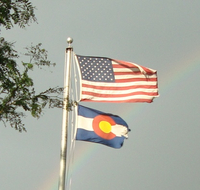
U.S. and Colorado flags flutter from the same flagpole. Denver Library image

U.S. and Colorado flags flutter from the same flagpole. Denver Library image

According to Colorado newspaperman and politician Jerry Koppel, Colorado’s path to statehood started in 1864, in an attempt to get another Republican state to boost Abraham Lincoln’s re-election chances.  Coloradans rejected the proposed constitution in a plebiscite, however, which pushed the effort into the next Lincoln administration — which, sadly, a month into Lincoln’s new term, became the Andrew Johnson administration.

High politics:  Colorado took a tortuous path to statehood.  While Colorado was not frustrated so often nor so long as it’s nextdoor neighbor, Utah, laws proposed to bring the state into the union were vetoed twice by President Andrew Johnson.  History from the Andrew Johnson National Historical Site in Greenville, Tennessee:

Colorado Statehood

First Veto:

1. There was such a small population in the area, Johnson felt Colorado would fare better as a territory without the added taxation of statehood.

2. Also due to the small population, Colorado would have only one representative to speak for the people in Congress. (New York, on the other hand, had thirty-one).

3. Johnson felt the citizens of Colorado were not prepared for, and not all wanted, statehood. Johnson wanted to hold a census or an election there first. This would ascertain the number of people in the area, as well as find out what their strongest desire was.

Second veto:

1. Johnson didn’t agree with the Edmunds Amendment which said that Nebraska and Colorado had to give equal suffrage to blacks and whites as a statehood condition. Johnson felt this was unconstitutional because Congress couldn’t regulate a state’s franchise, and the people had not been allowed to vote on it.

2. After holding a census, Johnson felt the population was still too small for statehood.

NOTE: In addition, Johnson did not feel right about adding new states to the Union when the Confederate States had not yet been readmitted to the Union and were still unrepresented.

Congress sustained the veto.

Jerome B. Chaffee. Library of Congress descrip...

Jerome B. Chaffee, one of Colorado’s first U.S. Senators, and the man who earlier pushed through Congress the law admitting Colorado into the Union. Library of Congress description: “Chaffee, Hon. J.B. of Colorado” (Photo credit: Wikipedia)

Colorado Republican and millionaire Jerome Chaffee, serving as the Colorado Territory delegate to Congress, managed to get a statehood bill passed in 1875, in the second term of President Ulysses S Grant; Grant signed the law.   Colorado drafted a state constitution that passed muster, Coloradans approved it, and President Grant declared Colorado the 38th state on August 1, 1876.  Chaffee was elected one of the first U.S. Senators from Colorado by the new state legislature.  In an odd footnote, President Grant’s son, Ulysses S Grant, Jr., married Chaffee’s daughter Fannie in 1881.

In 1875, Chaffee claimed 150,000 people lived in the state, but most historians think that figure was inflated; the 1880 census counted 194,000 people. Some historians doubt that count was accurate.

No doubt there are at least that many people in Colorado today.  Several counties in the northeast corner of the state got together in 2013 to explore the possibility of separating from Colorado to form their own state.  Does the political cauldron in Colorado ever cool? (Did those secessionists ever cool?)

Happy statehood day, to the Centennial State.

More:

An American flag hangs in front of a burning structure in the Black Forest, a thickly wooded rural region north of Colorado Springs, Colo. Authorities reported early Saturday that 473 houses had been incinerated. Air Force photo

One of the more dramatic images from Colorado in recent years, courtesy the U.S. Air Force. Captioned in the Las Vegas Review-Journal, June 15, 2013: “An American flag hangs in front of a burning structure in the Black Forest, a thickly wooded rural region north of Colorado Springs, Colo. Authorities reported early Saturday that 473 houses had been incinerated.” Wildfires plagued Colorado 2012-2015, a function of effects of a warming climate.

DoD photo by Master Sgt. Christopher DeWitt, U.S. Air Force

PRCA Rodeo in Steamboat Springs, Colorado; photo from SeaSweetie's Pages

PRCA Rodeo in Steamboat Springs, Colorado; photo from SeaSweetie’s Pages


Save

Save

Yes, this is mostly an encore post. Fighting ignorance requires patience.

Cluster of presidents’ birthdays in August

July 22, 2016

If presidents’ birthdays were spread out through the months evenly, we’d be approaching four births per month as we approach 48 presidents (Obama is 44th administration, of 43 presidents; Grover Cleveland served two non-consecutive terms, screwing up numbering for all time).

August has just more than its share of presidential births, five. In date order as we go through August:

  • Barack Obama, our 43rd President, was born August 7, 1961, in Honolulu, Hawaii
  • Herbert Hoover, 30th President, was born August 10, 1874, in West Branch, Iowa
  • Bill Clinton, 42nd President, was born August 19, 1946, in Hope, Arkansas
  • Benjamin Harrison, 22nd President, was born August 20, 1833, in North Bend, Ohio
  • Lyndon Baines Johnson, 34th President, was born August 27, 1908, in Stonewall, Texas

Obama will get cards and letters, and network news programs will probably make a light-hearted mention of his birthday. Are the other August presidents celebrated, even in their hometowns?

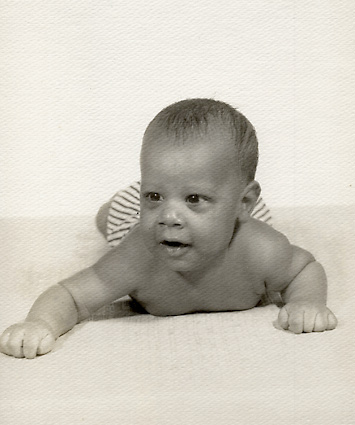
Barack Obama as an infant. Buzfeed

Barack Obama as an infant. Buzzfeed

Barack Obama, about age two, with his mother.

Barack Obama, about age two, with his mother. Parade Magazine image.

Herbert Hoover as an infant. Difficult to find photos of young Hoover. He was orphaned.

Herbert Hoover as an infant. Difficult to find photos of young Hoover. He was orphaned.

Bill Clinton, about age two. Parade Magazine image.

Bill Clinton, about age two. Parade Magazine image.


Lyndon Johnson's birthday is August 27. Even near his birth he looked like the cowboy-hatted president we remember. Image from Readers Digest

Lyndon Johnson’s birthday is August 27. Even near his birth he looked like the cowboy-hatted president we remember. Image from Readers Digest

Photos of Benjamin Harrison as an infant or young child appear to be exceedingly rare.

March and November also feature births of five presidents.

Save


July 21, 1861: First Battle of Bull Run shows war is no piece of cake, hints of hell to come

July 21, 2016

Only after the Civil War did Gen. William Tecumsah Sherman become famous for telling military academy graduates that “War is hell.”

In the summer of 1861, both Unionists and Confederates expected a short fight to settle what would come to be known as the American Civil War.  South Carolina fired on the Union Ft. Sumter in April.  But the first major action did not sully history until July.  Confederate forces and Union forces massed for a battle near Manassas, Virginia, at a little creek called Bull Run.

Spectators came out from Washington, D.C., bringing the family and picnic lunches, expecting a great drama to unfold — but they were surprised by the actual carnage.  What did they expect?

This battle gave rise to the famous, true story of farmer Wilmer McLean.  His house backed up on what would become the battlefield.  His summer kitchen took a cannonball.  Hoping to avoid further entanglement in the war, McLean moved his family and his farming farther south, to the unlikely-named town of Appomattox Courthouse.

There, in 1865, Gen. U.S. Grant’s entourage asked to borrow McLean’s parlor, for the surrender of Gen. Robert E. Lee.  McLean was able to say, with some high accuracy, that the war began in his back yard, and ended in his front room.

Details from the Library of Congress; teachers, you should have LOC sites bookmarked:

The First Battle of Bull Run

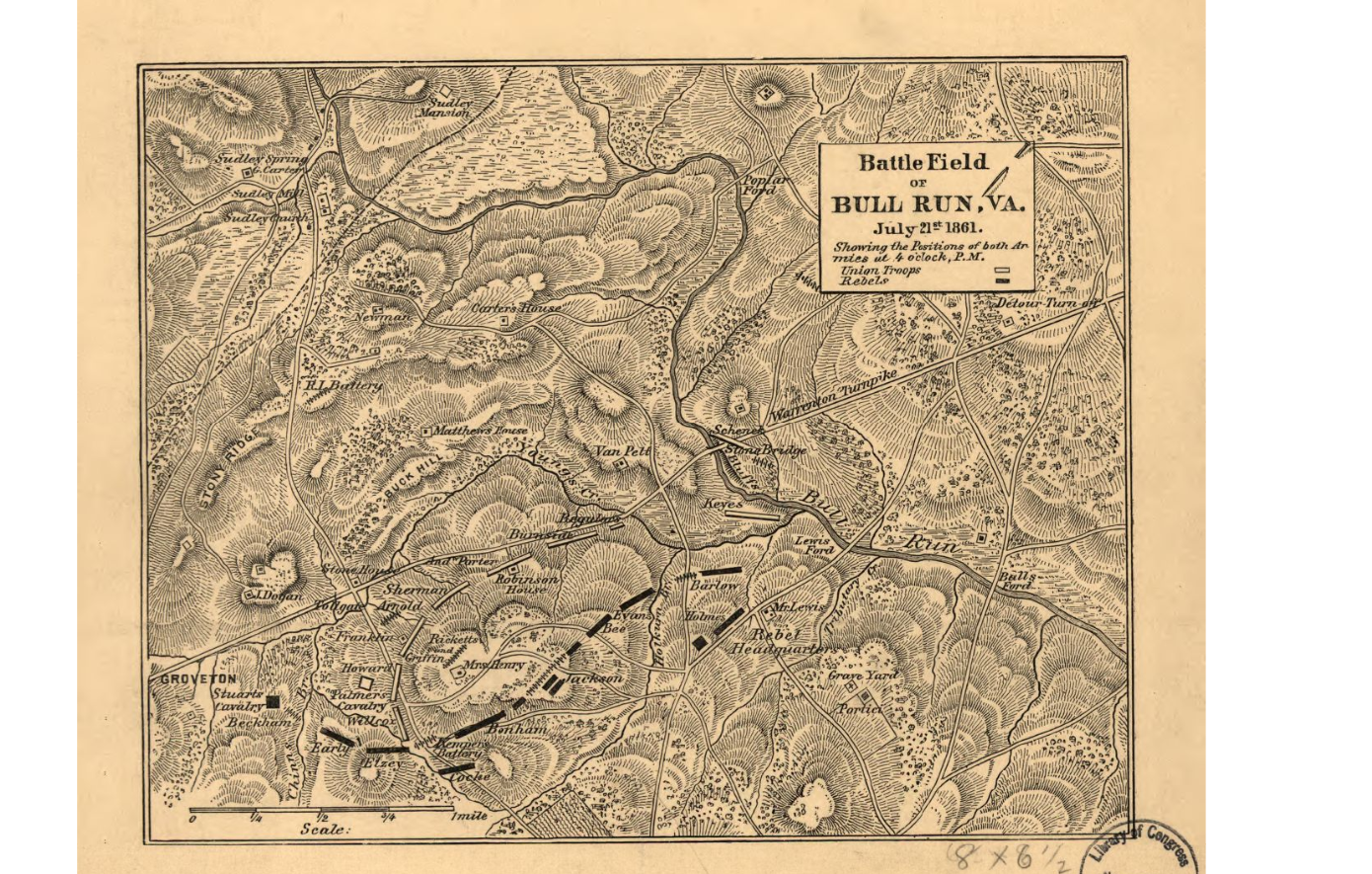
Bull Run, 1st battle of, map from LOC

Battle field of Bull Run, Va. July 21st 1861, Showing the positions of both armies at 4 o’clock, P.M.,
Map Collections: Military Battles and Campaigns

On July 21, 1861, a dry summer Sunday, Union and Confederate troops clashed outside Manassas, Virginia, in the first major engagement of the Civil War, the First Battle of Bull Run.

Union General Irvin McDowell hoped to march his men across a small stream called Bull Run in the vicinity of Manassas, Virginia, which was well-guarded by a force of Confederates under General P. G. T. Beauregard. McDowell needed to find a way across the stream and through the Southern line that stretched for over six miles along the banks of Bull Run.

McDowell launched a small diversionary attack at the Stone Bridge while marching the bulk of his force north around the Confederates’ left flank. The march was slow, but McDowell’s army crossed the stream near Sudley Church and began to march south behind the Confederate line. Some of Beauregard’s troops, recognizing that the attack at Stone Bridge was just a diversion, fell back just in time to meet McDowell’s oncoming force.

First Battle of Bull Run- Bull Run, Virginia

Bull Run, Va. Matthews' or the Stone House. Library of Congress image. George N. Barnard, photographer, March 1862. Selected Civil War Photographs

Bull Run, Va. Matthews’ or the Stone House. Library of Congress image. George N. Barnard, photographer, March 1862. Selected Civil War Photographs


Cub Run, Va. View with destroyed bridge. Library of Congress image.

Cub Run, Va. View with destroyed bridge. George N. Barnard, photographer, March 1862. Library of Congress image, Selected Civil War Photographs

These photographs of First Bull Run were not made at the time of the battle on July 21, 1861; the photographers had to wait until the Confederate Army evacuated Centreville and Manassas in March 1862. Their views of various landmarks of the previous summer are displayed here according to the direction of the Federal advance, a long-flanking movement along Sudley’s Ford.

When Beauregard learned of the attack, he sent reinforcements to aid the small group of Southerners, but they were unable to hold back the oncoming tide of Union troops. As more Union soldiers joined the fray, the Southerners were slowly pushed back past the Stone House and up Henry Hill.

The battle raged for several hours around the home of Mrs. Judith Henry on top of Henry Hill, with each side taking control of the hill more than once. Slowly, more and more Southern men poured onto the field to support the Confederate defense, and Beauregard’s men pushed the Northerners back.

At this point in the battle, Confederate General Barnard Bee attempted to rally his weary men by pointing to Brigadier General Thomas Jackson, who proudly stood his ground in the face of the Union assault. Bee cried, “There stands Jackson like a stone wall!” From that moment on, Thomas Jackson was known as “Stonewall” Jackson.

As the day wore on, the strength of McDowell’s troops was sapped by the continuous arrival of fresh Southern reinforcements. Eventually, the stubborn Confederates proved more than a match for McDowell’s men, and the Northerners began to retreat across Bull Run.

The Union pullout began as an orderly movement. However, when the bridge over Cub Run was destroyed, cutting off the major route of retreat, it degenerated into a rout. The narrow roads and fords, clogged by the many carts, wagons, and buggies full of people who had driven out from Washington, D.C., to see the spectacle, hampered the withdrawal of the Union Army. The Southerners tried to launch a pursuit, but were too tired and disorganized from the day’s fighting to be effective.

The morning of July 22 found most of the soldiers of the Union Army on their way back to Washington or already there. It was more than a year before the Northerners attempted once again to cross the small stream outside of Manassas named Bull Run.

Beauregard Bull Run Quick Step
J. A. Rosenberger, music,
1862.
Historic American Sheet Music, 1850-1920

Tourists in Virginia today enjoy the sights, probably-sunny days and air-conditioned restaurants. It may be difficult to remember why Sherman later told military cadets that “war is hell.”

Yes, this is mostly an encore post. Fighting ignorance requires patience.

Yes, this is mostly an encore post. Fighting ignorance requires patience.

Save

Save


Remembering when government gave humanity hope for the future: A giant leap for mankind on July 20, 1969

July 20, 2016

It’s a day to remember history.  Do you remember that day, the first time humans set foot on the Moon?

Southwest Elementary in Burley, Idaho, existed in a world far, far away from the U.S. space program. We watched rocket launches on black and white televisions — the orbital launches were important enough my father let me stay home from school to watch, but when he dropped me off at school, I was in a tiny band of students who actually made it to school. Potato farmers and the merchants who supported them thought the space program was big, big stuff, worth missing school.

By John Glenn’s flight, a three-orbit extravaganza on February 20, 1962, a television would appear in the main vestibule of the school, or in the auditorium, and we’d all watch. There were very few spitballs. Later that year my family moved to Pleasant Grove, Utah.

Earthrise from Apollo 11, before the Moon landing

Moonrise from Apollo 11 prior to Moon landing.

Toward the end of the Gemini series, television news networks stopped providing constant coverage. The launch, the splashdown, a space walk or other mission highlight, but the nation didn’t hold its breath so much for every minute of every mission. Barry McGuire would sing about leaving the planet for four days in space (” . . . but when you return, it’s the same old place.”), then six days, but it was just newspaper headlines.

The Apollo 1 fire grabbed the nation’s attention again. Gus Grissom, one of the three who died, was one of the original space titans; death was always a possibility, but the U.S. program had been so lucky. Apollo’s start with tragedy put it back in the headlines.

The space program and its many successes made Americans hopeful, even in that dark decade when the Vietnam War showed the bloody possibilities of the Cold War. That darkest year of 1968 — see the box below — closed nicely with Apollo 8 orbiting the Moon, and the famous Christmas Eve telecast from the three astronauts, Frank Borman, Jim Lovell, and William A. Anders. The space program kept us hopeful.

By early 1969 many of us looked forward to the flight of Apollo 11 schedule for July — the space flight that promised to put people on the Moon for the first time in history, the realization of centuries-old dreams.

But, then I got my assignment for Scouting for the summer — out of nearly 50 nights under the stars, one of the days would include the day of the space walk. Not only was it difficult to get televisions into Maple Dell Scout Camp, a good signal would be virtually impossible. I went to bed knowing the next day I’d miss the chance of a lifetime, to watch the first moon landing and walk.

Just after midnight my sister Annette woke me up. NASA had decided to do the first walk on the Moon shortly after touchdown, at an ungodly hour. I’d be unrested to check Scouts in, but I’d have seen history.

And so it was that on July 20, 1969, Neil Armstrong became the first human to set foot on the Moon: “A small step for a man, a giant leap for mankind,” was what he meant to say in a transmission that was famously garbled (at least he didn’t say anything about jelly doughnuts).

NASA provided a video compilation for the 40th anniversary of Apollo 11 in 2009:

P. Z. Myers says he remembers a lawnmower going somewhere. It must have been very bright in Seattle. (Thanks for the reminder, P.Z., and a tip of the old scrub brush to you.)

2016 marks the 47th anniversary.

Texas Essential Knowledge and Skills (TEKS) lists 11 dates for U.S. history as the touchstones kids need to have: 1609, the founding of Jamestown; 1776, the Declaration of Independence; 1787, the Constitutional Convention; 1803, the Louisiana Purchase; 1861-1865, the American Civil War; 1877, the end of Reconstruction; 1898, the Spanish American War; 1914-1918, World War I; 1929, the Stock Market Crash and beginning of the Great Depression; 1941-1945, World War II; 1957, the launching of Sputnik by the Soviets. Most teachers add the end of the Cold War, 1981; I usually include Apollo 11 — I think that when space exploration is viewed from a century in the future, manned exploration will be counted greater milestone than orbiting a satellite; my only hesitance on making such a judgment is the utter rejection of such manned exploration after Apollo, which will be posed as a great mystery to future high school students, I think.)

* Why 1968 was such a tough year, in roughly chronological order: 1968 produced a series of disasters that would depress the most hopeful of people, including: the Pueblo incident, the B-52 crash in Greenland, the Tet Offensive in Vietnam, the nerve gas leak at the Army’s facility at Dugway, Utah, that killed thousands of sheep, Lyndon Johnson’s pullout from the presidential race with gathering gloom about Vietnam, the Memphis garbage strike, the assassination of Martin Luther King, Jr., riots, the Black Panther shoot-out in Oakland, the Columbia University student takeover, the French student strikes, the tornadoes in Iowa and Arkansas on May 15, the Catonsville 9 vandalism of the Selective Service office, the sinking of the submarine U.S.S. Scorpion with all hands, the shooting of Andy Warhol, the assassination of Robert F. Kennedy, the Buenos Aires soccer riot that killed 74 people, the Glenville shoot-out in Cleveland, the cynicism of the Republicans and the nomination of Richard Nixon and Spiro Agnew, the Warsaw Pact invasion of Czechoslovakia crushing the “Prague Spring” democratic reforms, the Chicago Democratic Convention and the police riot, the brutal election campaign, the Tlatololco massacre of students in Mexico City, Black Power demonstrations by winning U.S. athletes at the Mexico City Olympics, coup d’etat in Panama. Whew!

More, from Millard Fillmore’s Bathtub:

And even more:

Yes, this is mostly an encore post. Fighting ignorance requires patience.

Yes, this is mostly an encore post. Fighting ignorance requires patience.


Trinity test, world’s first atomic bomb – July 16, 1945

July 17, 2016

Another good reason to follow the National Archives on Twitter, Tumblr and other media:  Great updates.

Like this one on the explosive arrival of the Atomic Age:

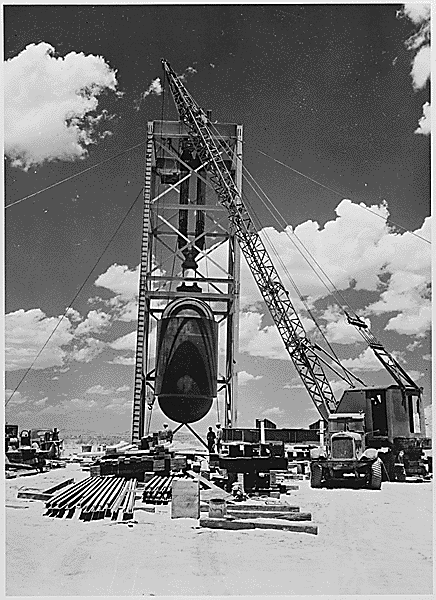
 Atomic Age Begins

"Trinity" atomic device being positioned at White Sands, New Mexico - National Archives

Trinity atomic device “Jumbo” being positioned at White Sands, New Mexico – National Archives

Atomic Age Begins

On July 16, 1945 the United States tested a nuclear device, code named “Trinity”, for the first time in White Sands Proving Ground, New Mexico.

Above: [“Jumbo” atomic device being positioned for “Trinity” test at Alamogordo, New Mexico.], 1945

Below: [“Trinity” explosion], 07/16/1945

Source: research.archives.gov

It’s astonishing to think anyone could hide the explosion today. Near the end of World War II, after Germany had surrendered to end the war in Europe, no one really knew just what at atomic explosion would look or sound like. The test occurred near dawn in a very desolate part of New Mexico’s southern desert, a then sparsely populated state. A few thousand may have seen the flash; a few hundred may have heard or felt the explosion. No one in government confirmed any report of a weapon.

English: Rare color photograph of the first nu...

Rare color photograph of the first nuclear test at Trinity site, July 16, 1945. Blurriness is in the original photograph (done when color photography was still fairly new). (Photo credit: Wikipedia)

This is based on an earlier post, and is mostly an encore post.

This is based on an earlier post, and is mostly an encore post.


July 15, 1848, economist Vilfredo Pareto born

July 15, 2016

Happy 80/20 Day!

Italian economist, engineer and political activist Vilfredo Pareto was born on July 15, 1848, in Paris, where his father had fled due to political difficulties.

Pareto should be more famous, for his explanation of the 80/20 rule, and for his contribution to making better things, the Pareto chart.  Many economic texts ignore his work almost completely.  Quality management texts ignore his life, too — generally mentioning the principles they borrow, but offering no explanation.

Vilifred Pareto, Wikipedia image

Vilfredo Pareto, Wikipedia image; why are there so few photographs of the man, who died in 1923?

His contributions, as accounted at Wikipedia:

A few economic rules are based on his work:

And now you, dear reader, having just skimmed the surface of the pool of information on Vilfredo Pareto, know more about the man than 99.99% of the rest of the people on the planet.  Welcome to the tip-top 0.01%.

A mystery I attribute to low readership: I’ve posted much of this information before. In several years, not once has anyone criticized these posts as supporting fascism, the most common mis-directed criticism of Pareto.

Resources:

Portrait drawing of Vilfredo Pareto, from one of the few photographs of the man available. Image at Alchetron. Artist?

Portrait drawing of Vilfredo Pareto, from one of the few photographs of the man available. Image at Alchetron, by Artigas at Deviant Art.


Bastille Day 2016; Liberté, égalité, fraternité!

July 14, 2016

Eiffel Tower in the French national colors, backlit by fireworks, on Bastille Day 2014. IBTimes photo

Eiffel Tower in the French national colors, backlit by fireworks, on Bastille Day 2014. IBTimes photo

Bastille Day, more properly called The 14th of July or National Day, celebrates the day in 1789 that Parisian peasants and non-nobles seized the iconic prison in an old fort known as the Bastille, an action that gave form to the French Revolution.

It is expected that those who love liberty will drink Champagne, listen to French music and toast good friends on Bastille Day. No, not sparkling wine from California or Spain or Australia — real, French Champagne.

Much more can be said about Bastille Day, including that it is generally overlooked in Texas high school history courses. We can put that off until later.

In the meantime, here’s a video from IBTimes of the 2014 fireworks display in Paris, said by many to be among the best ever. I’m off to find some Champagne.


Happy birthday, Gerald Ford, July 14, 1913

July 14, 2016

Today is the 103rd anniversary of President Gerald Ford‘s birth.

Happy birthday, Mr. President!

Gerald Ford, as an officer in the US Navy in 1945. Wikipedia image in the public domain.

Gerald Ford, as an officer in the US Navy in 1945. Ford left the Navy in 1946, and ran for Congress in 1948. Wikipedia image in the public domain.

More: 


Happy birthday John Quincy Adams, July 11, 1767

July 11, 2016

Today is the 249th anniversary of the birth of the sixth President of the United States (1825-1829), John Quincy Adams. Adams’s father was John Adams, who played key roles in the creation of the Declaration of Independence and establishment of the United States after adoption of the U.S. Constitution.

Quincy Adams is famous for returning to Congress as a member of the House of Representatives after his presidency, for his advocacy for freedom for slaves on a slave ship, and for being probably the first president ever to sit for a photographic portrait — though the sitting wasn’t until 1843, 14 years after he left the presidency.

John Quincy Adams, in Washington, D.C., 1843. According to the Metropolitan Museum of Art web site, this image is a copy of a lost daguerreotype of Adams taken by Philip Haas ca. 1843. Public Domain, https://commons.wikimedia.org/w/index.php?curid=522048

John Quincy Adams, in Washington, D.C., 1843. According to the Metropolitan Museum of Art web site, this image is a copy of a lost daguerreotype of Adams taken by Philip Haas ca. 1843. Some historians believe it may have been taken as late as 1847. Public Domain, https://commons.wikimedia.org/w/index.php?curid=522048


July 4, 2016: Fly your flag today! 240th anniversary of the public reading of the Declaration of Independence

July 3, 2016

It’s a day of tradition — oddly enough, since we are in reality a very new nation, and Lee’s resolution to declare independence from Britain came on July 2.

A soak in Millard Fillmore’s Bathtub is nothing if not a steeping in tradition.  Fly your flag today, to celebrate the independence of the American colonies of Britain.

Fourth of July: NPR has already read the Declaration of Independence (or will soon, if you’re up early), PBS is ready to broadcast the Capitol Fourth concert  (maybe a rebroadcast is available, if you’re off at your own town’s fireworks — check your local listings), your town has a parade somewhere this weekend, or a neighboring community does, and fireworks are everywhere.

At the White House, traditionally, new citizens are sworn in — often people who joined our armed forces and fought for our nation, before even getting the privileges of citizenship.  Fireworks on the Capital Mall will be grand, with the White House hosting a few thousand military people and their families from some of the best views.  Traditionally, five photographers, chosen by lottery, get to shoot photos of the fireworks from the windows of the Washington Monument; will that occur, with the Monument shut down from public view for repair from the earthquake?

There will be great fireworks also in Baltimore Harbor over Fort McHenry, the fort whose siege inspired Francis Scott Key to write the “Star-spangled Banner” from his boat in the harbor, in 1814. Firworks will frighten the bluebirds nesting at Yorktown National Battlefield.  I suspect there will be a grand display at Gettysburg, on the 150th anniversary of the end of that battle. July 4, 1863, also marked the end of the Siege of Vicksburg; tradition holds that Vicksburg did not celebrate the 4th of July for 83 years after that. I’ll wager there will be fireworks there tonight.  In Provo, Utah, the city poobahs will have done all they can to try to live up to their self-proclaimed reputation as having the biggest Independence Day celebration in the nation.  The celebration in Prescott, Arizona, is muted by the tragic deaths of 19 Hot Shot firefighters last week; will drought halt the fireworks, too?  There will be fireworks around the Golden Gate Bridge, in Anchorage, Alaska, reflecting on the waters of Pearl Harbor, and probably in Guam, American Samoa, and the Northern Marianas Islands.

Fireworks on the Fourth is a long tradition — a tradition that kept John Adams and Thomas Jefferson alive, until they both died on the 50th anniversary of the Declaration of Independence, in 1826, the sounds of the fireworks letting Adams know the celebration had begun (Adams erroneously celebrated that Jefferson, the Declaration’s author, still lived, unable to know Jefferson had passed just hours earlier).

Remember to put your flag up today.

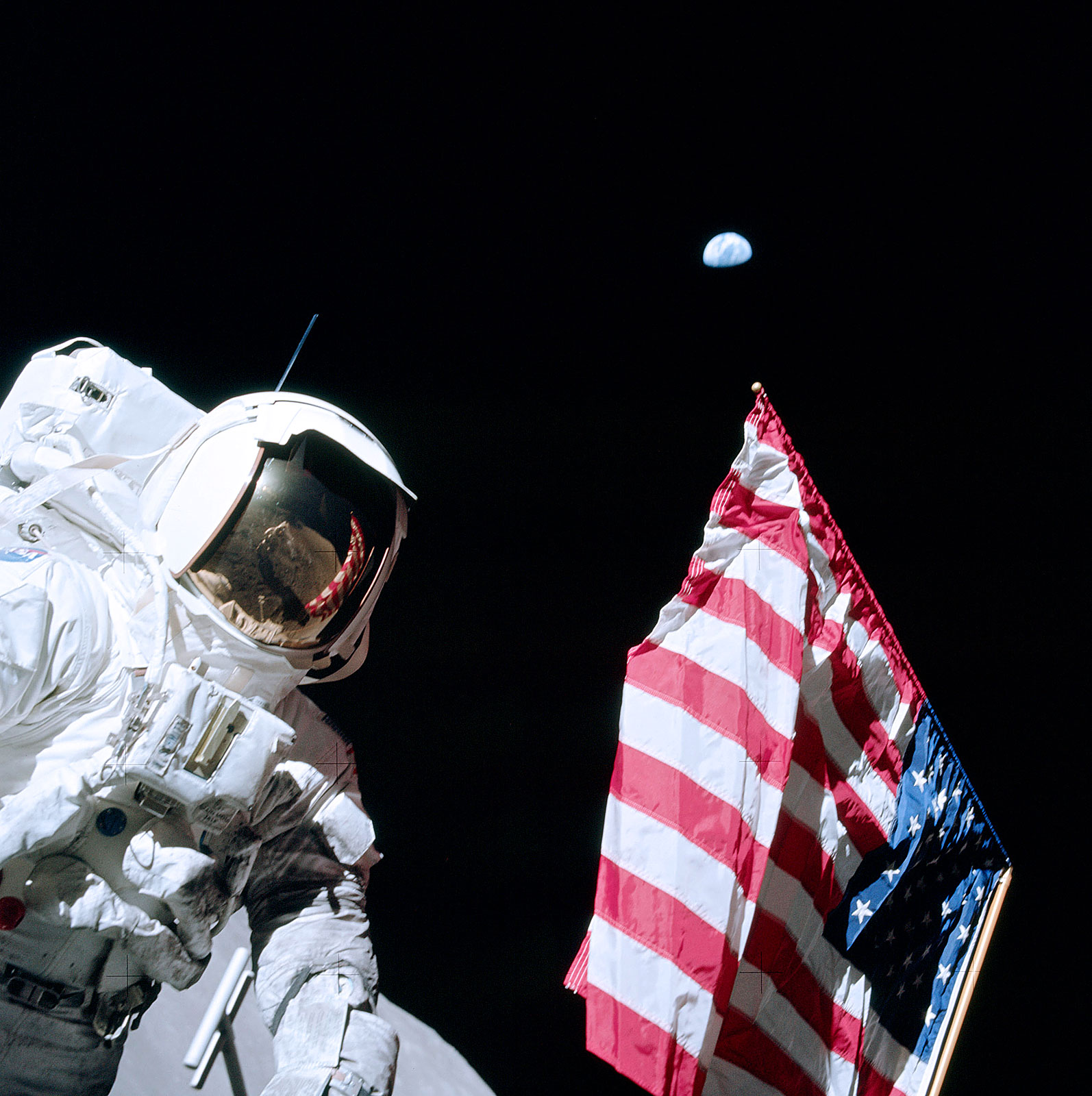
Astronaut Eugene Cernan and the U.S. Flag -- Apollo 17 on the Moon (NASA photo)

Last flag on the Moon: Astronaut Eugene Cernan and the U.S. Flag — Apollo 17 on the Moon (NASA photo)

If you’re not on the Moon, here are some tips on flag etiquette, how to appropriately fly our national standard.

Also:

Lunar Reconnaissance Orbiter photo of the Apollo 17 landing site.

Lunar Reconnaissance Orbiter photo of the Apollo 17 landing site. NASA caption: Apollo 17 Lunar Module Challenger descent stage comes into focus from the new lower 50 km mapping orbit, image width 102 meters. Credit: NASA/GSFC/Arizona State University

This is mostly an encore post, but I so love that photo of the flag with the Earth in the distance.

Happy birthday, Kathryn!

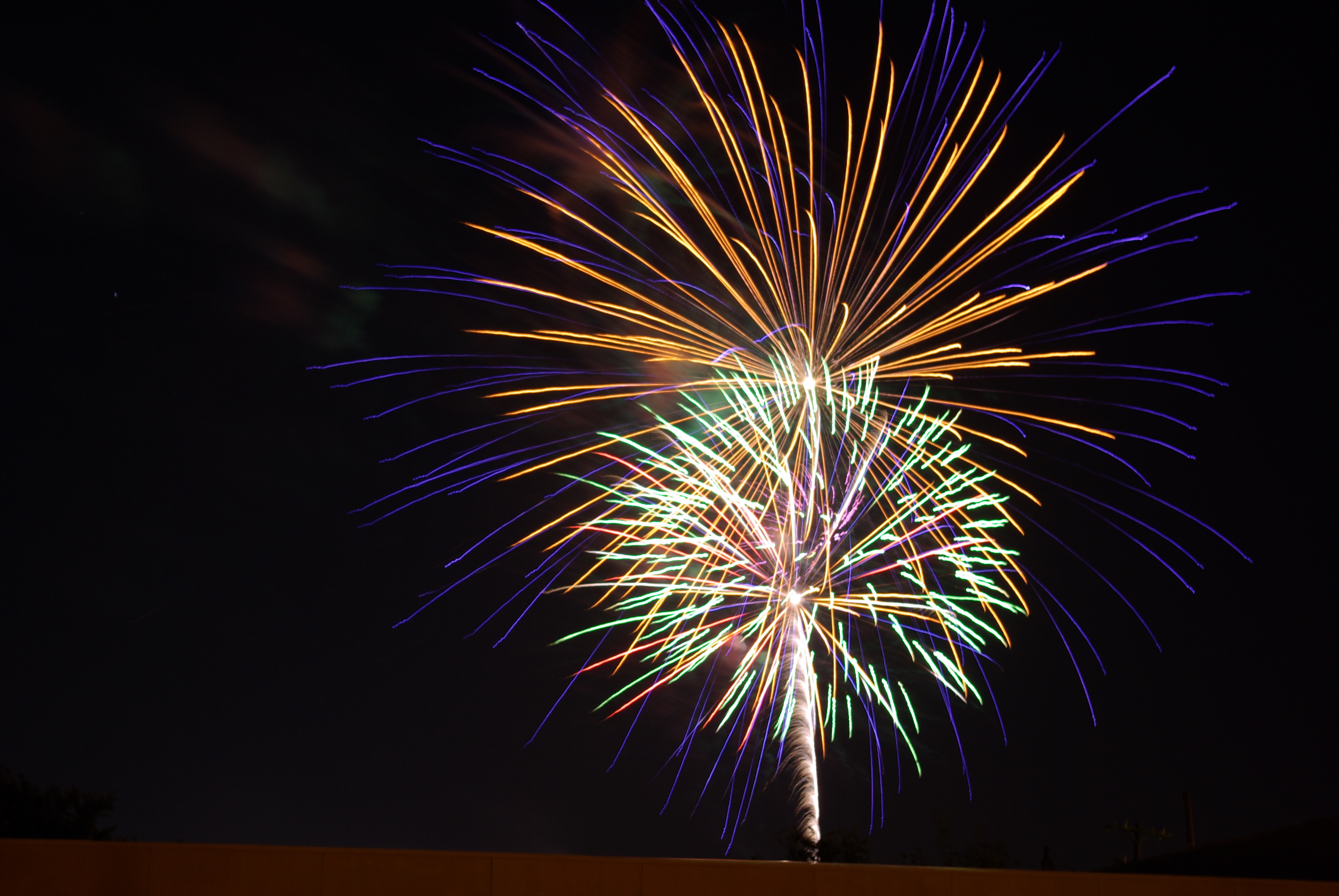
Fireworks in Duncanville, Texas, for July 4

Fireworks in Duncanville, Texas, for July 4 — Kathryn Knowles’s birthday. We’re always happy the town chimes in with the celebratory spirit.

Tip of the old scrub brush to Thomas Jefferson, Richard Henry Lee, John Adams, Benjamin Franklin, Roger Sherman, Robert Livingston, and the cast of thousands of patriots including George Washington.

Yes, this is mostly an encore post. Fighting ignorance requires patience.

Yes, this is mostly an encore post. Fighting ignorance requires patience.


July 3: Fly your flag for Idaho statehood

July 3, 2016

Especially if you have a 43-star flag, fly it today for Idaho statehood.

Idaho joined the union on July 3, 1890, the 43rd state. It was a time of a flurry of new states, however, and very few 43-star flags were made. Is there one in Idaho?

Regardless the number of stars, Idahoans fly their U.S. flags today in honor of Idaho statehood, July 3, 1890.

I found this history of 43-star flags at a site selling antiques and memorabilia — an interesting history which I crib completely here from Jeff R. Bridgman American Antiques.

Alas, this flag has sold.

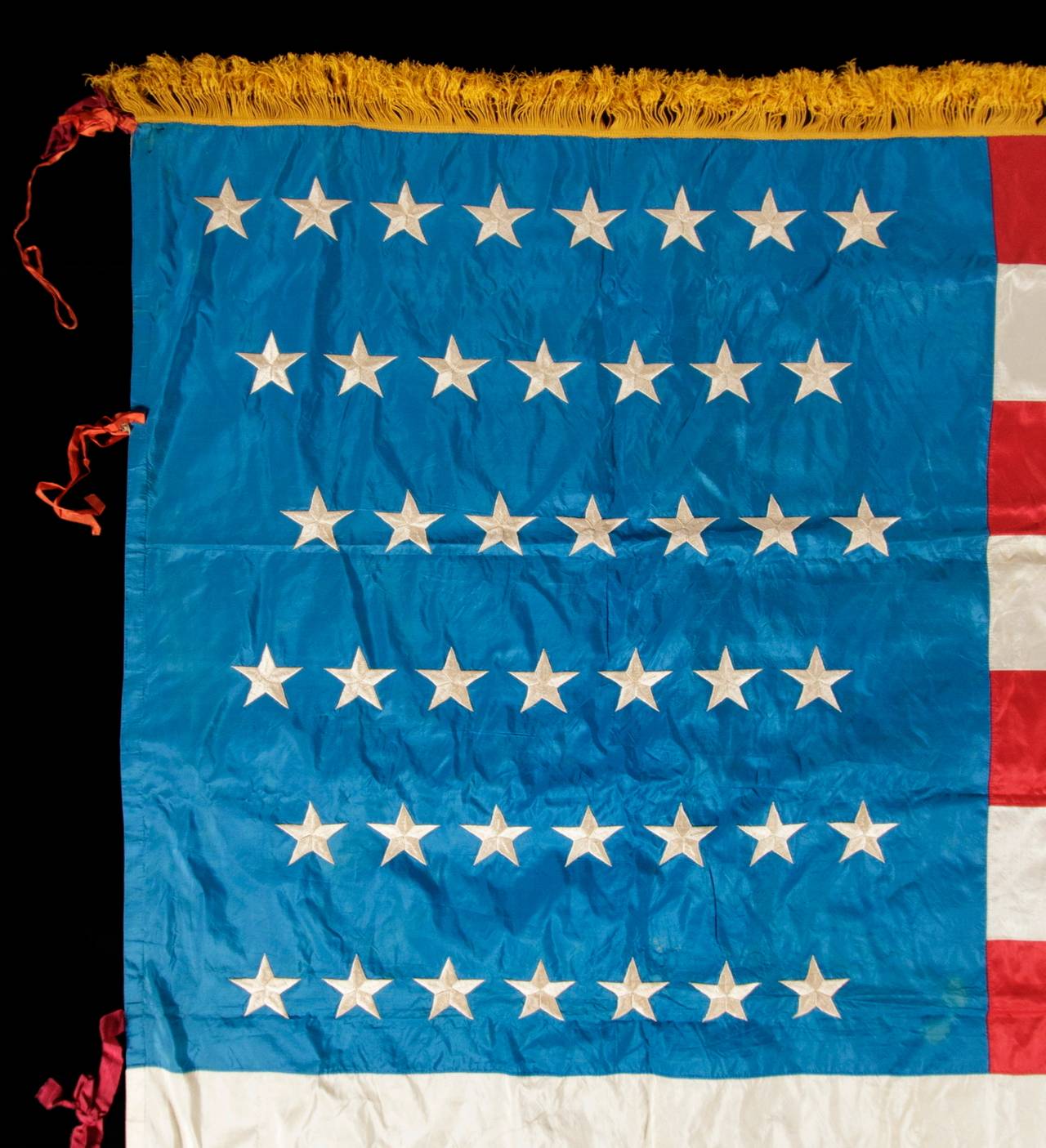
43 Star, Idaho Statehood, American Flag

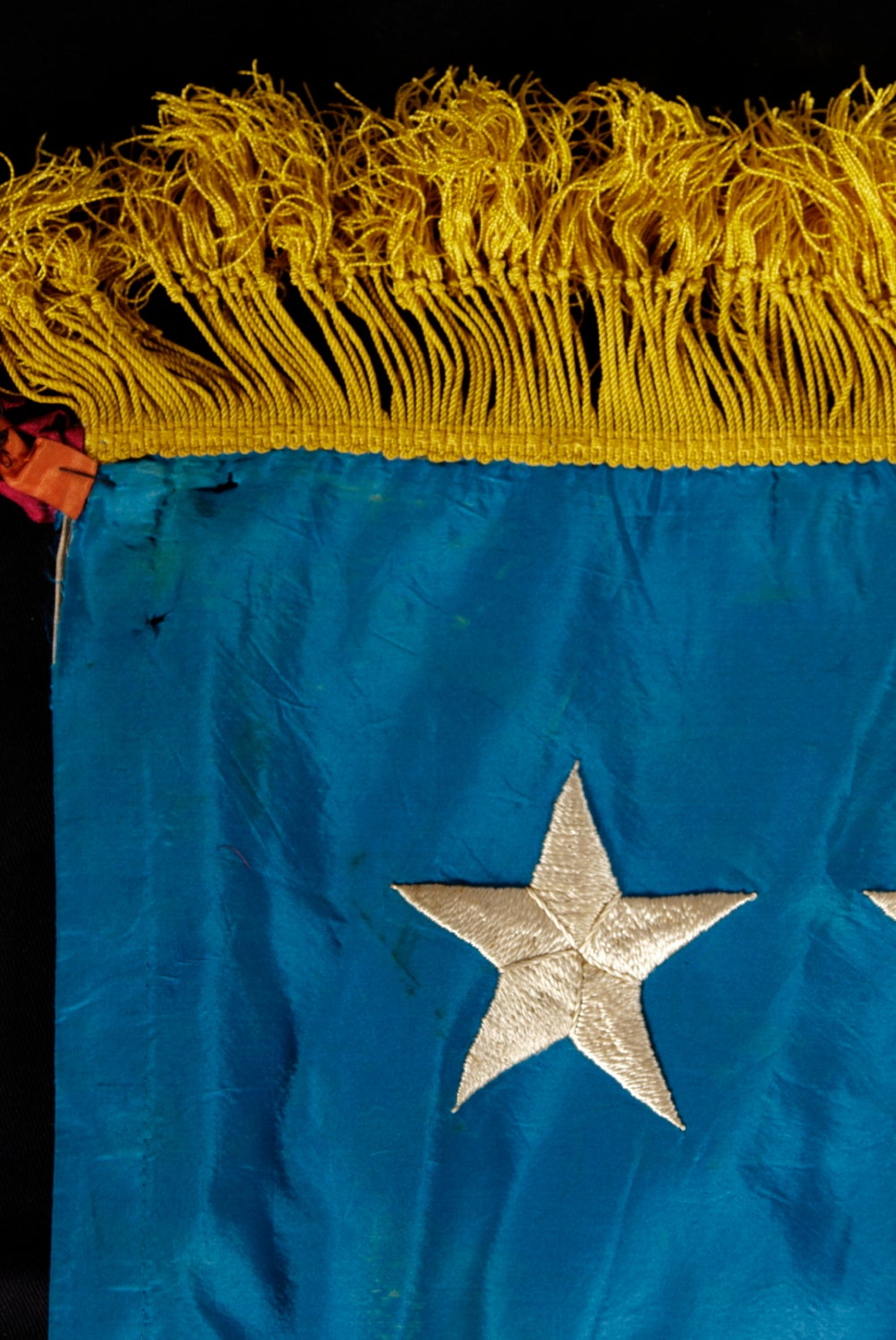
43 stars, Idaho statehood, one of the rarest star counts among surviving American flags of the 19th century; an exceptionally rare U.S. infantry battle flag, entirely hand-sewn, made for an African-American unit of civil war origin, circa 1889:

Numerous flags were produced with unofficial star counts during the second half of the 19th century, made by flag-maker’s anticipating the addition of more states. Interestingly enough, some flags were officially adopted by the United States Congress, but for all practical purposes never produced. Among these is the 43 star flag, which reflects the addition of Idaho. A tiny handful of flags with this star count are known, but they are among the most rare of all examples throughout American history. To understand why, one may turn back the clock to the 1876 and examine flag production from that year until the addition of the 44th state.

After the Flag Act of 1818, the official “flag year” began every July 4th. So on Independence Day, all states having been added to the Union over the previous year were officially given a star. Makers of flags, however, did not wait for July 4th and official star counts. Flag-making was a competitive industry and many manufacturers added stars before new states were actually added, wishing to create a reason for consumers to buy new flags and one-up each other in sales.

In 1876 the 37 star flag was official, but on August 1st we received our 38th state. Many flag-makers abandoned the 37 star flag when production began for the Centennial International Exposition, a six-month long World’s Fair held in Philadelphia as the first of its kind in America, which served as the nucleus for celebrations of our 100-year anniversary of independence from Britain. In that year 38 stars was a common choice, but other flag-makers actually skipped past 38 all-together, choosing to instead produce 39 star flags, anticipating the addition of the Dakota Territory as one state.

Seeing that Dakota wasn’t coming, production after 1876 seems to have reverted to the 38 star count. Then in 1889, thirteen years later, 39 star flags were once again manufactured with the anticipation of Dakota’s statehood. On November 2nd of that year, a surprise was lay in store for the makers of 39 star flags, when the Dakotas arrived as two different states, which forever rendered 39 star flags both inaccurate and unofficial. Just a few days later, on November 8th, Montana entered the Union as the 41st state, followed by Washington State as number 42 just three days hence on November 11th.

40 star flags were made in limited quantity, reflecting the Dakotas entry. This count is extremely scarce, but not exceptionally rare. Perhaps this is because some flag-makers anticipated the number correctly, and so some of the 40’s are anticipatory flags.

41 star flags, by contrast, are among the rarest that exist in 19th century America. This was a three-day flag and an increase ending in a count of 41 seems to not have been guessed.

In stark contrast, 42 star flags are common. These reflect the four new states that arrived in that week-and-a-half period between November 2nd and the 11th. For the next seven-eight months flag-makers seem to have favored this star count, producing many of them, probably with great enthusiasm for a reason to make new flags.

Just one day before the 42 star flag would have become official, on July 3rd, 1990, Idaho snuck in as the 43rd state, which rendered all of the 42 star flags forever unofficial. The 43 star flag became official on July 4th, but flag-makers basically skipped over the 43 star count entirely. This is because on July 10th, just seven days after Idaho gained statehood, Wyoming was admitted. Practically all flag-makers seem to have predicted this and 43 star flags, while official for one year, were overlooked in favor of those with a count of 44 to add Wyoming as well. For all practical purposes, 43 star flags were not made. Only a tiny handful survive, perhaps ten or so at the most. Of these, three are printed parade flags (a.k.a., “hand-wavers”), while the remainder are larger, pieced-and-sewn examples. I have been privileged to own approximately half of these. Among them, this is the most unusual.

In terms of form and function, this example is constructed as a U.S. Infantry battle flag. It is pieced and seamed entirely with hand-stitching, which is very unusual for the period. The sewing is especially fine and indicative of the very highest quality, as are the materials. The canton and stripes are made of silk. The hoist end was rolled over and bound and there are six silk ties sewn along the leading edge (more were formerly present). There is a knotted silk fringe, gold in color, along three sides, which is typical of infantry battle flags. The stars are embroidered in white silk floss, either by hand or machine, having been executed so well that the method is difficult to ascertain. Embroidered along the 5th red stripe, in the same white floss, are the words “Forest City Light Infantry.” followed by the date “1872”.

A company of African American soldiers by this name, with Civil War roots, existed in Savannah, Georgia. The earliest date I can presently reference for their existence is 1873 (one year before the date on the flag), when an officer of a black G.A.R. unit by this name deposited funds in Freeman’s Bank, which was established in 1866 to assist freed slaves in the unhealthy circumstances of the financially depressed South. Probably the men of this regiment were freed by Union Forces as Sherman’s March (Nov. – Dec. 1864) pressed through the state. Part of the general’s orders read: ” VII. Negroes who are able-bodied and can be of service to the several columns may be taken along, but each army commander will bear in mind that the question of supplies is a very important one and that his first duty is to see to them who bear arms….” Records concerning African American soldiers in this sort of circumstance are very hard to acquire, as few were kept. Names seldom appear on muster rolls. Whatever the case may be, however, Civil War-related material that concerns black soldiers is rare and interesting and flags are seldom ever encountered in the marketplace, whether war-period or post-war, like this example.

In summary, this is one of the rarest star counts that there is among antique American flags, on a rare and stunning U.S. infantry battle flag, with great colors and exquisite construction, accompanied by its original tassels, and with rare African American association.

Mounting: The flag has not yet been mounted. We employ professional staff with masters degrees in textile conservation and can attend to all of your mounting and framing needs.

Flag size (H x L): 78″ x 81.25″ (incl. fringe).