Wall Street Journal’s DDT-fueled war on science

May 12, 2010

I don’t subscribe to the Wall Street Journal — their discounts to educators are lousy.

So I missed this editorial when it ran on April 24, 2010 (page A12), “DDT and population control – malaria still kills one million every year.”

Nominally, that should be good news.  At the peak of DDT use in the early 1960s, malaria killed about 3 million people annually.  By the time we banned DDT use on cotton crops in the U.S., the death toll was still about 2 million people annually.  From the heyday of DDT, we’ve decreased malaria’s death toll, to less than half what it was.

Editorial writers at the Journal don’t let facts get in their way when they go off on a misdirected political jihad or crusade.  Gross error Number 1:  They mislead readers about the facts.

They are claiming that a million is too many (it is), but they claim that the total would be significantly less if only Americans would attack Africa with poison.  We have trouble enough with wars in Afghanistan and Iraq, it seems to me.  There is no indication that we could reduce malaria rates with a lot of extra poison.  Malaria is a parasite in human blood.  To defeat the disease we have to defeat the infections in humans.  Mosquitoes just spread the disease from one human to another.  DDT does not cure malaria in humans; it is one preventive device of limited effectiveness.

What are they on about?

The Journal’s editorial writers said:

Environmental activists this week marked the 40th anniversary of Earth Day, which happened to fall three days before World Malaria Day. Insofar as Earth Day politics have contributed to today’s malaria epidemic, the two events are related.

You could see this one coming.  The reactionaries at the editorial seek out opportunities to criticize environmentalists, whose cause they see as anti-business.   The Journal’s editorial page usually carries an op-ed piece by Hoover Institute maven Henry I. Miller about once a year (see here, for example), claiming we need DDT to fight West Nile virus.  We don’t, of course.  West Nile virus-carrying mosquitoes are best fought with other pesticides, when pesticides are used.  They need to be hit before adulthood, while they are still larva, in the water.  DDT is exactly wrong for such applications.  But Miller’s piece comes around almost every year, as soon as the first West Nile virus infections in humans are noted.

So, since they so soundly disregard science on that diatribe, why not here, too?  DDT offers a great target for Tea Baggers, Know-Nothings, and truth bashers.  Most of the history of DDT was written before the internet, so it’s easier to spread falsehoods without contradiction.

Disinformation.  Propaganda.  Shame on the Wall Street Journal.

Earth Day and World Malaria Day are related in this way:  Environmentalists warned us that doing the wrong stuff in the environment would make it harder to fight malaria, and they were right.  People who resist clean air and clean water legislation also resist legislation to stop poisoning our planet.  Those people rarely do anything to fight malaria, either.  Human comfort, human health, human survival, is not what they are concerned about.

Earth Day founder Gaylord Nelson, a U.S. Senator from Wisconsin, was a leading opponent of the insecticide DDT, which remains the cheapest and most effective way to combat malarial mosquitoes.

Gaylord Nelson, the father of Earth Day, was governor of Wisconsin when the University of Wisconsin did the first studies showing that songbirds and raptors in Wisconsin were being wiped out by DDT. We should expect him to be an opponent of indiscriminate use of the stuff.  His state was on the road to ruin, and long before the federal government acted against DDT, Wisconsin had laws and regulations to limit its use.  Wisconsin’s wild populations recovered a bit more quickly because Wisconsin had acted.

Gaylord Nelson at the Apostle Islands, Photograph by Frank Wallick, 1967.

Gaylord Nelson at the Apostle Islands, Photograph by Frank Wallick, 1967.

Nelson also knew that, in the U.S., malaria was conquered by 1939 (according to the Centers for Disease Control).  DDT came along in 1946, seven years later.  While DDT was used to control mosquitoes in the U.S., it was for no disease control reasons — that was why so many people opposed the rather pointless use of the stuff.  And I suspect Nelson was savvy enough to know that DDT has not been the cheapest means of controlling mosquitoes for several years.  One application of DDT in Africa costs about $12.00, for the professional who must apply it, and the testing to determine whether DDT will even work.  One application lasts about six months.  So, for a year’s protection, DDT costs about $24.00 per house, per year.

Bednets cost about $10.00, and last about five years.  That works out to $2.00 year.  For $24.00, you could provide a dozen different nets in a home, though most homes would use them only to protect children.

Moreover, recent test runs in Africa show DDT about 25% to 50% effective in reducing malaria incidence, while bednets are about 50% to 85% effective.  Nets are cheaper and more effective.

Doesn’t the Wall Street Journal have fact checkers?  Or do they just not care about the facts?

Rachel Carson’s 1962 book, “Silent Spring,” misleadingly linked pesticides to cancer and is generally credited with popularizing environmental awareness.

Wrong on three fronts.  Carson noted that the family of chemicals from which DDT comes might have links to cancer, but she did not make the claim that DDT is carcinogenic.  DDT was banned because it’s a long-term, deadly poison that destroys ecosystems.  Cancer in humans was not a part of the equation.

However, DDT is now known to be a weak human carcinogen.  Every cancer-fighting agency on Earth lists it as a “probable human carcinogen” (it is confirmed to cause cancer in other mammals).  Can’t the Wall Street Journal find the phone number of the American Cancer Society?

DDT earned its ban because of 20 years of research data by 1972, showing that DDT kills virtually everything it comes in contact with that is smaller than a large man, and it destroys ecosystems.  Talking about DDT’s carcinogenicity is a red herring.  Carson didn’t claim DDT was a significant cause of cancer, nor was DDT banned from agricultural use because anyone thought it was a significant cause of cancer.  Yes, DDT is a weak human carcinogen, contrary to the Journal’s implication; but no, that’s not why it was banned.

Carson’s book certainly ignited concerns about human activities affecting environment other than land development.  But “environmental awareness” is as old as our nation, at least.  A hundred years prior to Rachel Carson’s book, the U.S. set aside the world’s first National Park, Yellowstone.  60 years earlier, Teddy Roosevelt and Gifford Pinchot led the drive to conserve the nation’s forests.  The Soil Conservation Service, a New Deal program, worked to save soil on farms and unimproved areas, a good 30 years before Carson’s book.  Environmental awareness is an almost-congenital trait in Americans.  Rachel Carson sounded alarms about new reactive chemical combinations.  Americans were already alert to the need to save soil, water, air and wild spaces.

We banned DDT to save our crops and to save our wildlife.  Those are good reasons to keep the ban today.

But other leading greens of the period, including Nelson, biologist Paul Ehrlich and ecologist Garrett Hardin, were also animated by a belief that growth in human populations was harming the environment.

Nelson thought the U.S. needed to slow immigration (see more below).  Ehrlich feared a massive round of starvation, which was staved off only with the Green Revolution and billions of dollars of foreign aid money, the good luck of our having Norman Borlaug and the Rockefeller Foundation, and major economic change in nation’s like India and China.  Hardin pointed out that even the best intentioned people needed a structure to encourage them to conserve, else conservation would not take place.

They all recognized that while any human could minimize her impact on the natural world, no one person could ameliorate all the effects of billions of people.

“The same powerful forces which create the crisis of air pollution also are threatening our freshwater resources, our woods, our wildlife,” said Nelson. “These forces are the rapid increase in population, industrialization, urbanization and scientific technology.”

Notice, please, that Sen. Nelson did not suggest humans should do anything to cause or encourage massive human death (nor did the Journal do the courtesy of noting where they quoted him from).  He merely notes that air pollution and water pollution, and a lack of freshwater, are created by human populations, industry, urban sprawl and technology.  All of these things threaten human health.  Nelson is concerned that we not add to human illness and misery.  That’s not what the Journal’s editorial wants you to think, however.  It will suggest instead that Nelson urged more human suffering and death.

How craven must an editorial board be to accuse good people, falsely, of such sins?

In his book “The Population Bomb,” Mr. Ehrlich criticized DDT for being too effective in reducing death rates and thus contributing to “overpopulation.”

I doubt it.  I can’t find anything quite to that description in my copy of the book.  It’s a common internet legend (one level dumber than urban legend) — but shouldn’t the Wall Street Journal have higher standards than to use for documentation, “my cousin Clem heard a story about a person his aunt once knew?”

Hardin opposed spraying pesticides in the Third World because “every life saved this year in a poor country diminishes the quality of life for subsequent generations.”

Now the Journal is making things up.  In the essay from which the Journal quotes him, Hardin wrote about the dangers of uncontrolled immigration and population growth — almost sounding like an angry Arizona Tea Partier at times — but never did he get close to suggesting that we should not suppress malaria, for any reason.  (Wise readers may wish to see what Hardin actually said, where he really went awry if he did, and how his words resonate today, at his essay, “Living on a Lifeboat.”  Writers at the Journal should be ashamed of savaging the reputation of a guy who is so much in tune with what they usually write.  Notice Hardin does not mention DDT, use of pesticides in foreign nations, malaria, nor any other disease.  He rails at starvation, however.)  When the Wall Street Journal engages in fiction, shouldn’t they let us know?

For these activists, malaria was nature’s way of controlling population growth, and DDT got in the way.

Gee, in context, that’s all fiction. Never did Sen. Gaylord Nelson claim malaria was a good population control tactic, nor that we should stop using DDT to allow more people to die. Those are whole cloth lies. Never did Garrett Hardin say either of those things. Never did Paul Ehrlich say those things.

Cover of 2003 Science Magazine special on Garrett Hardin's essay

Cover of 2003 Science Magazine special on Garrett Hardin’s essay, “Tragedy of the Commons”

For anti-science activists, like the writers at the Wall Street Journal’s editorial page, falsehoods have become coin of the realm, and DDT is just one more sciency thing to try to use as whip against political opponents. The serious question is, why is the Wall Street Journal opposed to clean air and clean water?  Why are they trying to politicize things at all?

The writers at the Journal continue:

Today, malaria still claims about one million lives every year—mostly women and children in sub-Saharan Africa. There’s no evidence that spraying the chemical inside homes in the amounts needed to combat the disease harms humans, animals or the environment. Yet DDT remains severely underutilized in the fight against malaria because the intellectual descendants of Senator Nelson continue to hold sway at the World Health Organization and other United Nations agencies.

Full disclosure would be good here.  Malaria death rates are at the lowest point in history, at least since 1900.  Yes, too many die — but it’s not the fault of “not enough DDT.”  No nation that uses DDT has ever succeeded in eradicating malaria with pesticides alone.  Only those nations that assaulted malaria from the  human side, treating malaria in human victims, have been successful in eradicating the disease.  DDT use was essentially suspended in Africa by the World Health Organization in about 1965, because overuse of DDT in agriculture had bred mosquitoes that are resistant and immune to the stuff.  No amount of DDT spraying, anywhere, can reverse that.  Spraying DDT where mosquitoes are unaffected by it, is stupid.

Plus, studies indicate a correlation between DDT use, even in those small amounts, and premature deaths to children in the households sprayed.  DDT is not harmless.  DDT is not benign.

DDT has never been banned in Africa, and even under the 2001 Persistent Organic Pesticides Treaty (POPs) DDT has a special carve out to keep it available to fight malaria, despite its being a destroyer of worlds.  So implicit in the Journal’s screed here is that Africans are too stupid or lazy to use a substance that would save their children and themselves from malaria, though it’s available relatively cheaply.

Is DDT “underutilized?”  Again we should ask, why would anyone use DDT where it is not effective? Then we should ask, who would use DDT in fighting disease in Africa, and do they use it?  It turns out that DDT is not completely superfluous to all mosquito populations.  But testing is required to be sure DDT will work — were an organization to use ineffective pesticides, thousands could die, and the testing is therefore a preservation of human life.  And, because of past incidents in Africa, for example when DDT killed off the fish local populations depend on for their food, DDT use is extremely limited, to indoor applications only, and only by trained professionals who limit its spread.

WHO has been using DDT in Africa for indoor residual spraying (IRS) since the 1950s.  Use was slowed when DDT’s effectiveness was compromised.  In recent years WHO held a press conference on DDT to encourage locals who fear DDT poisoning to go along, and since 2005 DDT’s effectiveness appears to be dropping.  But DDT is available for use wherever it is needed to fight malaria in Africa.

Is the Wall Street Journal calling for mass poisoning of Africa?  What else could they be talking about?  Why would they call for such a thing?

The Journal claims WHO and other UN agencies are “under the sway” of Sen. Nelson, and that’s bad?  Let’s be clear:  Nelson didn’t oppose use of DDT in Africa to fight malaria.  UN’s WHO is the leading continent-wide advocate of proper use of DDT to fight malaria.  If the Journal claims that current, appropriate use of DDT is too little, what is the Journal advocating?

The good news is that the Obama Administration has continued the Bush policy of supporting DDT spraying in Zambia, Mozambique and other countries where the locals want it used. “Groups like the Pesticide Action Network have lobbied the U.S. Agency for International Development to stop spraying DDT, and Obama is ignoring them so far,” says Richard Tren of Africa Fighting Malaria, an advocacy group. “They’re prioritizing what makes sense from a science and public health point of view.”

Let’s be clear:  The Bush administration refused to allow U.S. money to be used to purchase DDT, or to use DDT, until about 2005.  Environmental Defense, the organization that first sued to stop DDT use in the U.S., argued for years that DDT should be allowed in the limited use WHO proposed, but Bush’s people stood firmly opposed, though never explaining why.  In any African nation where local people want DDT, it’s freely available with other money, of course.  So U.S. opposition, bizarre as it was, was not and is not a barrier to DDT use.

Most environmental groups favor beating malaria, and if a bit of DDT carefully controlled will help do the trick, so much the better.  While business lobbyists have falsely impugned environmentalists for years on this point, actual opposition to DDT use has come, in Uganda for example, from business groups.  Tobacco growers claim they fear some DDT will somehow get on tobacco leaves, and that will make the stuff unsaleable in the European Union.  Cotton growers fear any faint traces of DDT will ruin sales of organic cotton to the EU.  These business groups sued to stop DDT use against malaria in Uganda.

But environmental organizations, like ED, the Sierra Club, and others, have been fighting malaria for 40 years.

Which is more than we can say for Richard Tren.  Tren is one of two or three of the leading false propagandists for poisoning Africa in the world.  He tells false tales about Rachel Carson, false tales about DDT’s harms and effectiveness, and as best I can tell he has never lifted one finger or written one check to fight malaria himself, while taking tens of thousands of dollars to spread his false tales.

There are dozens of noble malaria fighters out there whose opinions we should seek — Socrates Litsios, the late Fred Soper, to mention two.  Why does the formerly august Wall Street Journal use Richard Tren as a source, when there are authoritative people handy to talk?

DDT helped to eradicate malaria in the U.S. and Europe after World War II, and the U.S. is right to take the lead in reforming public health insecticide policy and putting the lives of the world’s poor above green ideology.

Printed in The Wall Street Journal, page A12

According to the history of malaria at the CDC, malaria was essentially wiped out in the U.S. by 1939.  DDT was not available for use for another seven years.  Malaria was gone from northern Europe by World War II.  DDT was a tool in the final eradication of the disease in Italy and Greece.  But the main campaign against malaria was in curing the disease in humans, before the mosquito populations could rise up.

Among the nasty facts of science the Journal either does not know, or refuses to say, DDT can’t eradicate mosquitoes.  In anti-malaria campaigns, DDT is used to knock down the mosquito populations temporarily, so that the disease can be cured in humans.  Mosquito populations will quickly rise again, and in even greater numbers — but if there is no human reservoir of malaria parasites for mosquitoes to draw from, they cannot spread the disease.  Malaria parasites must spend part of their life cycle in humans, and part in mosquitoes.

Curing malaria in humans is the tough part.  It requires money to improve medical care, for accurate and speedy diagnoses, and for prompt and complete treatment of the disease in each patient.  Preventing malaria is aided greatly by better-built homes with screens on windows, the sort of stuff that requires people to have more than subsistence incomes.  So beating malaria generally requires economic development, too.

How much easier is it to bash environmentalists than to confront the real causes of malaria.  Bashing environmentalists won’t do anything to relieve human suffering nor eliminate the disease, so we can bash environmentalists again next World Malaria Day, and next Earth Day — all at no cost to us, safe in our Wall Street Journal offices in Manhattan, New York, U.S.A.  The Journal has fallen victim to bold purveyors of junk and voodoo science, and bogus and voodoo history.  Shame on the Journal.

Curing the disease in humans means the mosquitoes are mere nuisances, and no longer vectors of disease.  Killing the mosquitoes with poison means the disease will be back with a vengeance in a few weeks or months.  Curing humans is more difficult, and more costly — but it saves lives and can save Africa.  We cannot poison Africa to health.

It’s curious, though:  How did they get so poisoned by DDT, up in that office building?

More:

Help stop the poisoning of discussion:  Share this post:

Add to FacebookAdd to NewsvineAdd to DiggAdd to Del.icio.usAdd to StumbleuponAdd to RedditAdd to BlinklistAdd to TwitterAdd to TechnoratiAdd to Furl

Save


Dan Valentine – Homelessness

May 11, 2010

By Dan Valentine

Everywhere in America now you’ll see homeless pushing shopping carts filled with their last remaining possessions.

Yesterday I saw a disheveled-looking older gentleman, straggly-hair and all, right out of one’s worst nightmare, pushing a wheel barrel down a very busy highway here in Ensenada, two large black plastic bags filled with his remaining stuff.

Very, very sad.

He would push it, rest for a moment, then push it some more, going somewhere/nowhere with it.

Humans! We’re collectors.

When my friend and I sold our home in Texas, and I went off to Austin to start anew, we had a garage sale. Paintings, furniture, knickknacks, etc.

On a table in the driveway, we laid out trinkets. I had a large bag of refrigerator magnets from almost every place I’ve ever been. Vietnam, Scotland, New York, Philadelphia, South Dakota, Denver, St. Louis, New Orleans, Paris, Rome, Barcelona, Capri, Berlin, D.C., Geneva, Amsterdam, London, Glasgow, Cambodia, Hong Kong, Japan, Guam, Micronesia, Belize, Cuba (twice), Charleston, Seattle, Las Vegas, etc. One time my friend and I were in Kansas City. I had her drive me across the border to get an Arkansas magnet. It really irked her. To this day I hear about it.

Well, anyway, an older woman purchased them all for $5 and came by the next day to say how much pleasure she had had that night. She had laid them all out on her living room carpet and simply looked at them, and it gave her great joy.

Where is this going? When I left for Austin, I had to put all my personal effects in storage. Some 60 boxes.

(When we bought the house in Friendswood, the movers came with my stuff–it had been in storage in Salt Lake–and my friend didn’t talk to me for three days.

In Nashville and Austin, I was paying $64 a month for storage. When I became broke, my friend picked up the tab for a while. Ron, at the Music City Hostel in Nashville, picked up one month for me, tho’ he looked at me bewildered as if to say: Why are you hanging on to it? You’re old, broke, homeless, your life is over.

Anyway, when my friend bought a place, and I returned to Houston, we got my stuff out of storage.

Two weeks ago–two days before I was to leave again–she said her I had to do something with my boxes or her parents, who were moving in, would.

What to do? Get a grocery cart? A wheel barrow?

The boxes were filled with files. My dad’s letters to me when I was in Vietnam, my mom’s letters to me, photos, all my by-lines, hundreds of thousands of words I had written and had been honing for decades. Plays, songs, screenplays, musicals, my dad’s unfinished shorts stories, poems, etc. Everything I treasured. Every piece of writing I had been working on and polishing for years. I went through each file in each box the first day, thinking to my self, “Well, I can’t throw that away. I can’t throw that away. I can’t throw that away.”

Next day, with no time remaining, I had to toss it all. Three car trips to the dumpster down the road.

Earlier that week I had to sell all my books. One signed by Richard Nixon, a hundred or so first edition books of musical plays. One I had paid $65 for. At Half-Price Books, I got $85 for ‘em all. There’s not a big market for bound musical plays in Texas!

After tossing everything, my friend said: Don’t you feel like a gigantic weight has been lifted off your shoulders?” Noooooo! But she knows how I feel. As I kid, she moved a lot and she was forced to give up everything through the years as a result. She has a few cherished photos from her childhood, and that’s it!

I’m slowly getting over my grief of losing everything, tho’ in the middle of the night, I’ll wake up and go, “Oh, no! I threw that away? Oh, my god, I tossed that?”

People lose everything all the time. In fires, earthquakes, in wars. You move on. I guess.

I have a small travel bag. I have my laptop. Hopefully, some of the printed stuff I tossed is on my computer. I’m afraid to look.


Dan Valentine, May 10, 2010

May 11, 2010

By Dan Valentine

What an enjoyable time I had yesterday. I hadn’t written off the top of my head–without rewriting and rewriting, polishing and polishing (taking all the life out of it)–and pushed “submit” in years, if ever.

It was so gratifying I asked Ed if he’d permit me to write a daily (or sporadic) piece on his website, about my adventures; how someone like me, or anyone, can become homeless; how you lose a million bucks; about my dad and mom and sister and brother; my years with Sen. Hatch; working for the Tribune; my years in New York, my travels; the times; my two marriages; my beloved friend in Houston; my love for dogs, etc. I have just enough–well, not quite–social security coming to travel from town to town, hostel to hostel, state to state …

And he said go ahead.

So here goes. No polishing, no rewriting, no editor (this could be a mistake). So forgive the grammar and spelling and typos. I reread yesterday’s comment and found the word “message” typed instead of “massage”.

Where to start?

My dad was a genius. IQ-wise. During World War II, he served in the infantry. Got malaria storming Guadalcanal. Sent to Suva to recuperate. Become editor of the South Pacific News. Wrote for Armed Forces Radio. Became good friends with two fellow soldiers. Together, the three had dreams of conquering Hollywood. One’s name was Jack Paar. Yeah, that Jack Paar. The other was Hy Averback, who produced “F Troop” and directed “MASH.” After the war, they got together in Hollywood, but my dad’s dream was to be a newspaperman. His father was one. So he left Hollywood to become one. My dad was born in Saginaw, Mich., and the state of Michigan gave a free car to every returning veteran or something like that. My dad drove to Las Vegas, decided to see if he could double his money. Lost the car, hitchhiked to Salt Lake. Looked around. Decided he didn’t want to stay there. Got a job in Nebraska with UPI or AP. Can’t remember which.

Back to the IQ-story. He got in an argument with an officer over something, words were exchanged. My dad said he was a stupid son-of-a-bitch or something like that and could prove it, spotting him 10 points on an IQ test. And the officer wrote him up for it. He was found innocent when an officer upon hearing the story said, “There’s no law against an enlisted man thinking he’s smarter than an officer.”

Which reminds me of another story. As I said, my dad was editor of the South Pacific News, and one night he got a call from another officer to deliver a paper to him, hot off the press. My dad said, “I stopped delivering papers when I was ten,” and hung up.

A few minutes later, an admiral showed up and said, “Who said?”

It was Admiral Halsey.

My dad meekly said, “I did, sir.”

And Halsey supposedly said, “That was a damn good answer, son.”

My point being? How does someone like me, with more than a million bucks at one time, become homeless? The answer is: My dad was a genius. His first-born son ain’t!!!

Tho’ my dad has been wrong about some things. He used to say, “I’ve never been rich and I’ve never been poor. I’ve had the best of both worlds.”

Joe E. Lewis used to say, “I’ve been rich and I’ve been poor. Rich is better.”

My dad was wrong. Joe E. Lewis was right.

Tho’ I would not trade this experience for anything in the world.


Found thoughts: Dan Valentine, Jr.

May 11, 2010

Some months ago I wondered about a guy who wrote a column for the Salt Lake Tribune, before we were colleagues on the Senate staff of Sen. Orrin Hatch.  (How many incredible things in that sentence?)  I had lost touch with Dan Valentine, Jr.

Dan surfaced, and surfed the highways, surfaced again — and started writing a daily dispatch.

His words interest me.  I hope you’ll find them interesting, too.  I’m going to give each dispatch a post of its own, to highlight them so each can have a chance to get some of the readership it deserves.

Newspaper columns are high art, and high civics.  Newspapers are dying?  We still have need of good essays, short humor pieces, and the humanity that flows freely from the writings of learned and experienced souls.    Please give Dan’s work a read.

You can subscribe to this blog, too, and get Dan’s stuff by e-mail (along with other material from the blog).  Use the RSS button in the upper right hand  corner.


Constitutional drama, under our noses, off the radar

May 2, 2010

What about that impeachment trial, eh?  Planning to watch it?

Your best bet might be C-SPAN, but I wouldn’t wager the mortgage were I you.

Impeachment trial of President Andrew Johnson in the U.S. Senate, 1868; from Harper's Weekly, April 11, 1868 - public domain

Impeachment trial of President Andrew Johnson in the U.S. Senate, 1868; from Harper's Weekly, April 11, 1868 - public domain

Federal Judge Thomas Porteous of New Orleans got four articles of impeachment approved against him by the U.S. House of Representatives on March 10.  The first article got a nearly unanimous vote — who says the House is divided? — 412 to 0.  Three other articles got similar margins, 410-0, 416-0, and 423-0.

Unless you live in New Orleans or have a strange fascination for that great newspaper, The New Orleans Times-Picayune, you probably heard nothing about this great Constitutional drama. If you get the Times-Picayune, you’ve had good coverage of the issue so far.

Under its own special rules of impeachment, the Senate appointed a committee led by Sen. Claire McCaskill, D-Missouri, which will hold the actual trial and report results to the full Senate for action.  Sen. McCaskill said she expects the trial to begin in early August, and that the report to the full Senate could come as soon as September.

While news media and bloggers chase ghosts and hoaxes, real work continues in Washington, D.C.  You just don’t hear much about it.

You likely have not heard of Judge Proteous’s troubles, though they are long-standing, because the issue was a local, Louisiana and New Orleans affair.  Heaven knows New Orleans has had its share of other stories to knock off the front pages the ethical lapses of a sitting federal judge who was once a promising attorney.

Should you have heard?  How can we judge?  Should we not be concerned when a relatively important story is not only bumped to the back pages of newspapers, but bumped completely out of them, and off the radar of people who need to be informed about how well our government works?

My alert to this story came through a back-door route.  On the list-serv for AP Government, someone asked who presides at the impeachment trial of the Chief Justice — remember, the Constitution spells out that the Chief Justice is the presiding officer in the impeachment of the President or Vice President.  My memory is that the Senate rules on impeachments, and there is a committee that effectively presides, and that the impeachment of a Vice President or President merits special attention because the Vice President is the official, Constitutionally-mentioned presiding officer.  We can’t have the vice president presiding at the trial of himself or herself, nor of the president.  Looking up impeachment procedures, I stumbled across the pending impeachment of Judge Porteous.  I don’t think it has appeared in our local newspaper, The Dallas Morning News.

Other judges have been impeached.  Here in Texas, within the past three years, we had a federal judge impeached, Samuel Kent.  You’d think Texas media would be sensitive to such stories. (Kent resigned before the trial could begin.)

I perceive that media are ignoring several important areas of federal governing, not necessarily intentionally, but instead by being distracted by nonentity stories or stories that just don’t deserve the inflated coverage they get.  Among undercovered areas are the environment, energy research, higher education, foreign aid, management of public lands and justice, including indictments, trials and convictions.  A vast gray hole where should be the news of Judge Porteous’s pending impeachment is just one symptom.

Several news outlets carried stories:

More:


You should be reading Oh, For Goodness Sake

April 16, 2010

Seriously.

Especially if you’re a libertarian, anti-Obama, tea-partying American who thinks you’re living in a handbasket travelling faster than you can imagine to the place you claim to most fear.  Go read Oh, For Goodness Sake!

If you can’t read this stuff and smile, you need to spend more weekends teaching Cub Scouts how to post, retire and fold U.S. flags.

Especially you, Orly Taitz.

Or, you may be a simple, rational person.  Read it for the grins, kicks, and take-downs of tea-bagger, birther, and general nudnik error.


Typographical error, a gift to creationists

March 31, 2010

Here’s a post at Ecographica about a typographical error in the Arizona Daily Wildcat, the newspaper of the University of Arizona.

How long before some creationist seizes on it to claim Darwin’s theories are dead?  5 . . 4 . . 3 . . 2 . . .

If you find it, will you note it in comments, please?

(Notice how the only stuff creationists can make hay out of, is error?)

Background

Debates over the evolution of hominin bipedalism, a defining human characteristic, revolve around whether early bipeds walked more like humans, with energetically efficient extended hind limbs, or more like apes with flexed hind limbs. The 3.6 million year old hominin footprints at Laetoli, Tanzania represent the earliest direct evidence of hominin bipedalism. Determining the kinematics of Laetoli hominins will allow us to understand whether selection acted to decrease energy costs of bipedalism by 3.6 Ma.

Methodology/Principal Findings

Using an experimental design, we show that the Laetoli hominins walked with weight transfer most similar to the economical extended limb bipedalism of humans. Humans walked through a sand trackway using both extended limb bipedalism, and more flexed limb bipedalism. Footprint morphology from extended limb trials matches weight distribution patterns found in the Laetoli footprints.

Conclusions

These results provide us with the earliest direct evidence of kinematically human-like bipedalism currently known, and show that extended limb bipedalism evolved long before the appearance of the genus Homo. Since extended-limb bipedalism is more energetically economical than ape-like bipedalism, energy expenditure was likely an important selection pressure on hominin bipeds by 3.6 Ma.

Update:  Wall of Shame

Here are creationists claiming the findings rebut, refute or befuddle Darwin:


Science bloggers doing it wrong?

March 10, 2010

A new paper in the Journal of Science Communication offers a critique of the workings and effectiveness of science bloggers.

Happily for us, the paper is open access, freely available.

The article appears to be from some research for a Ph.D.:

Inna Kouper is a doctoral candidate in the School of Library and Information Science, Indiana University
Bloomington. Her current research interests lie broadly in the areas of language and information; the role
of science in society; and the evolution of information and communication technologies generally
described as social or participatory media (such as blogs, wikis, podcasts, etc.).

Several bloggers say the paper gets wrong what science bloggers do, and what they should do.

Perhaps — you can read the paper yourself and compare it with the criticism.

I do want to call your attention to a very good feature of the paper.  It analyzes postings on 11 of the top science blogs in the world.

1 Pure Pedantry scienceblogs.com/purepedantry
2 Synthesis http://www.synthesis.cc
3 MicrobiologyBytes http://www.microbiologybytes.com/blog
4 Wired Science http://www.wired.com/wiredscienc
5 BioEthics blog.bioethics.net
6 DrugMonkey scienceblogs.com/drugmonkey
7 Scientific Activist scienceblogs.com/scientificactivist
8 Pharyngula scienceblogs.com/pharyngula
9 Panda’s Thumb http://www.pandasthumb.org
10 ScienceBlog scienceblog.com
11 Cosmic Variance blogs.discovermagazine.com/cosmicvariance

How can you tell the paper’s serious?  The 11 blogs analyzed do not include any of the junk science blogs, like Uncommon Descent or Watt’s Up With That?

If you listen carefully, you can hear Bill Dembski and Anthony Watts stewing.


Okalahoma earthquakes: No swarm

March 6, 2010

Three earthquakes in a week do not make a swarm.  Interesting that the last post on an earthquake in Oklahoma drew earthquake conspiratorialists and “skeptics.”  Too many people distrust all science and sources of information these days.

Here’s the dirt on Oklahoma’s shaking in the last week, from the U.S. Geological Service site:

Earthquake List for Map Centered at 36°N, 97°W

Update time = Sat Mar 6 18:00:02 UTC 2010

Here are the earthquakes in the Map Centered at 36°N, 97°W area, most recent at the top.
(Some early events may be obscured by later ones.)
Click on the underlined portion of an earthquake record in the list below for more information.

MAG UTC DATE-TIME
y/m/d h:m:s
LAT
deg
LON
deg
DEPTH
km
LOCATION
MAP 3.1 2010/03/05 20:35:13 35.608 -96.783 5.0 3 km ( 2 mi) E of Sparks, OK
MAP 2.5 2010/03/03 04:35:17 35.549 -97.282 5.0 2 km ( 1 mi) SSE of Jones, OK
MAP 4.1 2010/02/27 22:22:27 35.557 -96.747 3.3 9 km ( 5 mi) SE of Sparks, OK

This isn’t unusual at all, of course. I think many people just don’t understand that earthquakes happen all the time, but they usually get crowded out of the newspaper because no one really cares.

For contrast, take a look at this animated map of a strip a little wider than Utah, covering from north of the Yellowstone Caldera to Arizona.  Run the animation.  Generally on any day there will have been at least two dozen earthquakes in the previous week, several magnitude 3, occasionally a magnitude 4 thrown in.

Almost none of those quakes make any news.

Maybe it’s the Earth, laughing.  We can hope.

Laugh, and the world laughs with you;
Weep, and you weep alone.
For the sad old earth must borrow it’s mirth,
But has trouble enough of its own.
Sing, and the hills will answer;
Sigh, it is lost on the air.
The echoes bound to a joyful sound,
But shrink from voicing care.

(Excerpted from “Solitude,” 1917, by Ella Wheeler Wilcox (1850-1919))


Reaction to the Millard Fillmore dollar

February 20, 2010

Millard Fillmore’s dollar got a bit of coverage — well, more than the dollar for Zachary Taylor, so far as I can tell.  It was not a big story.

The Wall Street Journal carried a page 1 feature. Some of the most fun coverage came out of local newspapers in Buffalo and Moravia, New York.

From the Berkshire-Hathaway-owned Buffalo News:

MORAVIA — When the U.S. Mint wanted to unveil a new $1 Millard Fillmore coin, it went to the 13th president’s birthplace to do the honors.

That’s this town of 4,000 in the Finger Lakes, where about a quarter of the population turned out Thursday to pay tribute to their favorite son.

But what about Buffalo, where he served as the University of Buffalo’s first chancellor and helped found a historical society and a hospital?

No problem. The same U.S. Mint official came to Buffalo to hold a second unveiling in Fillmore’s adopted hometown, where about three dozen people showed up at City Hall.

And in the Auburn, New York, Citizen, a story of a crowd much larger than anticipated:

MORAVIA – With close to 1,000 witnesses watching, a young Millard Fillmore impersonator and his equally sprite make-believe wife Abigail poured from a wooden bucket a stream of coins bearing the face of the 13th president and Moravia native.

The United States Mint Thursday released its 13th presidential dollar coin, honoring Millard Fillmore, at a ceremony in the Moravia Junior Senior School cafeteria, which was not large enough to accommodate the crowd of community members who had come to celebrate a president whose national legacy is not legendary, but whose roots are their roots.

“This is a grand, grand event,” Moravia Mayor Gary Mulvaney said, as he waited in a line that started at the cafeteria doors and wound through the school.

James P. McCoy’s photos of the unveiling and the large mockup of the dollar itself are good (you could steal them for a PowerPoint in your classroom), but I especially enjoyed the pictures in the Auburn paper, by Sam Tenney.  Two middle school students played Abigail and Millard Fillmore at the ceremony in Moravia.

Eleanor Younger, 10, and Colton Langtry, 12, portraying Abigail Powers Fillmore and Millard Fillmore, help Andy Brunhart, deputy director of the United States Mint, pour a bucket of $1 coins - Sam Tenney photo, Auburn, NY Citizen

Caption from the Auburn, New York, Citizen: "Eleanor Younger, 10, and Colton Langtry, 12, portraying Abigail Powers Fillmore and Millard Fillmore, help Andy Brunhart, deputy director of the United States Mint, pour a bucket of $1 coins bearing Fillmore's likeness during a ceremony celebrating the release of the coin Thursday morning at Moravia High School. The Fillmore coin is the 13th in a series honoring past presidents." Photo by Sam Tenney, Auburn, NY, Citizen

Uncharacteristically, the U.S. Mint offered some of the $1.00 coins to students for free — perhaps the only recorded time that the Mint has handed out money for free.

Looks like they had a good time.


How to report the news

February 2, 2010

This is the video version of the how-to-post-an-incendiary-blog-post piece I noted earlier.  The elder son of the Bathtubs brought it to our attention a couple of days ago:

And then, just as I was posting, I got a note about this post at Tome of the Unknown Blogger.

Yeah, this has already gone viral, and well it should.  Chris Clarke and Charlie Brooker have each captured the essence of knowledge and information passing in different realms.  Journalism schools should pay attention.


Wattsupgate: Denialists claim all knowledge is wrong

January 31, 2010

It really is that bad.  Climate science denialists now attack any information simply for not being what they want it to be.  Lysenko’s Ghost smiles broadly.

Anthony Watts is just the most prominent of the bloggers making hoax charges of error and worse in the fourth report from the Intergovernmental Panel on Climate Change (IPCC), because of a footnote that cites a rock climbing magazine.

Here’s the trouble for Watts:  There is no indication that the citation is in error in any way.  Watts’s move is more fitting of King George III’s campaign against Ben Franklin’s lightning rods, the prosecution of John Peter Zenger, the pre-World War II campaign against Einstein’s work because he was born a Jew, or the hoary old Red Channels campaign against Texas history told by John Henry Faulk.  It’s as bad as the Texas State Board of Education’s attack on Brown Bear, Brown Bear, What Do You See? Watts’ and others’ complaint is simply that Climbing magazine’s story on the worldwide retreat of glaciers suitable for climbing is not published in a juried science journal.

In other words, they indict the science, not because it’s wrong — they have no evidence to counter it — but because it’s too American Patriot correct Jewish left Texan mistakenly thought to be political well-known, too accessible, (small “d”) democratically-reported.

And of course, any comment that points that out at Watts’s blog goes into long-term “moderation,” keeping it from the light of day in the best tradition of the Crown’s defense of Gov. Cosby’s misadministration of New York (see “John Peter Zenger”).  Watts said in a quote that should have been attributed to the Daily Telegraph:

The IPCC’s remit is to provide an authoritative assessment of scientific evidence on climate change.

In its most recent report, it stated that observed reductions in mountain ice in the Andes, Alps and Africa was being caused by global warming, citing two papers as the source of the information.

However, it can be revealed that one of the sources quoted was a feature article published in a popular magazine for climbers which was based on anecdotal evidence from mountaineers about the changes they were witnessing on the mountainsides around them.

The other was a dissertation written by a geography student, studying for the equivalent of a master’s degree, at the University of Berne in Switzerland that quoted interviews with mountain guides in the Alps.

The revelations, uncovered by The Sunday Telegraph, have raised fresh questions about the quality of the information contained in the report, which was published in 2007.

It comes after officials for the panel were forced earlier this month to retract inaccurate claims in the IPCC’s report about the melting of Himalayan glaciers.

By those standards, Watts’s own readers should eschew his blog — it’s not peer reviewed science by any stretch, and Watts isn’t an established authority in climate science (he’s not even working for an advanced degree).  Consistency isn’t a virtue or concern among climate change denialists.  Watt’s entire modus operandi is much more anecdotal than the story in Climbing, which was written by a physicist/climber who studies climate change in the world’s mountains.

And did you notice?  They’re whining about research done by a scientist in pursuit of a degree, complaining about the second citation.  That’s the exaclty kind of research that they claim the magazine article is not.  Their complaint is, it appears, that a scientist in pursuit of education is not the right “kind” of person to do climate research. It’s the chilling sort of bigotry that we spent so much time in the 20th century fighting against.  In the 21st century, though, it appears one can still get away with demonizing knowledge, education and research, part of the campaign to indict “elitism,” the same sort of elitism aspired to by America’s founders.  Too much of the criticism against scientists involved in documenting global warming is the cheap bigotry the critics claim to find in science, falsely claimed in my view.

Topsy-turvy.

And the glaciers?  Yeah, the evidence tends to show they are in trouble.  Those Himalayan glaciers?  The IPCC report was accurate in everything except the speed at which the glaciers decline — they should be with us for another three centuries, not just 50 years, if we can reduce warming back to 1990s levels (oddly, denialists rarely deal with the facts of accelerating warming, preferring to point to a local snowstorm as a rebuttal of all knowledge about climate).

Oh, and the research?  The author of the story in Climbing magazine is Mark Bowen.  Dr. Bowen’s Ph.D. is in physics from MIT. He’s a climber, and he researches climate change on the world’s highest mountains.  His 2005 book, Thin Ice, focused tightly on what we can learn about climate from the world’s highest mountains.   Bowen is the expert Anthony Watts would like to be.

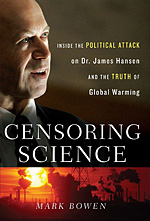
Cover of Mark Bowen's book defending climate science, "Censoring Science."

Cover of Mark Bowen’s book defending climate science, “Censoring Science.”

Bowen’s newest book:  Censoring Science:  Inside the political attack on James Hansen and the truth of global warming. Watts doesn’t want anyone to read that book.  It is easy to imagine Watt’s s attack is, he hopes, pre-emptive, against Bowen’s book.

I’ll wager Watts hasn’t read the article in Climbing, and didn’t know who Bowen was when he launched his attack, though.  The denials of bias coming out of the denialists’ camp will be interesting to watch.

Let the denialists roll out the rope far enough, they’ll inevitably hang themselves.

More:

Do something for freedom: Spread the news

Add to FacebookAdd to NewsvineAdd to DiggAdd to Del.icio.usAdd to StumbleuponAdd to RedditAdd to BlinklistAdd to TwitterAdd to TechnoratiAdd to Furl


Lou Dobbs is from Rupert, Idaho?

January 27, 2010

He should have spent more time with the spud farmers and sheep ranchers.  He should have spent more time with the Basques who herded the sheep.


DDT propaganda machine

January 23, 2010

Media Check carries edited excerpts from a book by Daniel Gutstein from last year, Not A Conspiracy Theory: How Business Propaganda Hijacks Democracy (Key Porter, 2009) by Donald Gutstein, Key Porter (2009).

In the excerpted chapter Gutstein details how nefarious interest groups conspired to ruin the reputation of Rachel Carson and environmental protection activists with false claims about DDT and environmentalist aims.

The problem with the coverage of the DDT issue and with the eco-imperialism charge is that they are based on falsehoods that the media did not investigate. Former CBC-TV National News anchor Knowlton Nash once said that “…our job in the media… is to… provide a searchlight probing for truth through the confusing, complicated, cascading avalanche of fact and fiction.” In this case, the media let their audiences down; fiction prevailed over fact.

Despite what the pro-DDT organizations alleged, DDT was not banned for use in mosquito control and could continue to be used in 25 countries in malarial regions. In these countries, limited amounts of DDT can be sprayed on the inside walls of houses to combat malaria-carrying mosquitoes. “The environmental community is collaborating with the World Health Organization to ensure that the phase-out of the remaining uses of DDT does not undermine the battle against malaria and the well-being of people living in malarial zones,” the United Nations Environmental Programme reported when the treaty came into force.

Has anyone read the book?  Has anyone seen it?  (So what if it’s aimed at Canada?)

More thoughts:  Years ago, when Jan Brunvand first achieved some fame cataloging urban myths, it occurred to me that his books should be required reading in the very first survey classes in journalism school.   Maybe they should be required reading in political science, rhetoric, and philosophy, too.

Gutstein’s book would be a good reader for a class on reporting, or investigative reporting, or science reporting, or political reporting.  I’m not sure where it would fit in to a science curriculum, but I wish more scientists came out of undergraduate years aware that they can get hammered by these hoax-selling, axe-grinding disinformation machines.  All those reports about how Rachel Carson is the “murderer of millions?”  They coarsen dialog, they misinform, disinform and malinform the public.  They do great disservice to citizenship and voters, and ultimately, to our democratic institutions.

It’s not enough to have a counter, good-information plan.  These people must be convinced to stop.

More:


Texas Tribune and Texas State Board of Education

January 5, 2010

Have you found Texas Tribune yet?  It’s a new, on-line newspaper, and generally it’s terrific.

See their collection of stories already about the State Board of Education. The collection can substitute for at least one cup of coffee to get your blood flowing in the morning.