Government and civics class manipulables

August 13, 2008

Be sure to check out the customer comments, too.

I was looking for lesson plan ideas for government class. With my background in airline and airport management, this one just jumped out at me.

If only it were just fantasy for kids.

If only it were just fantasy for kids.

It may be useful for customer service classes and corporate training, too.

Big, wet and bubbly tip of the old scrub brush to This One Goes to Eleven.


Baptism by fire, and the fire this time

August 8, 2008

New teachers, teachers taking on new subjects or major curriculum redesigns, and teachers trying to keep up may find this list useful: Baptism by Fire: 100 Essential Tips and Resources for Student Teachers.

It features an extensive list of ideas, suggestions, and useful on-line resources and ideas from the blog Smart Teaching.org.

I confess, I was unaware of Smart Teaching.org until Kelly Sonora contacted me from the organization.  What do you think, Dear Reader:  Useful stuff?


Real dope on human evolution

July 24, 2008

Subtitle this one, “DBQs in prehistory, paleontology, and anthropology.”

Younger son James complained yesterday about . . . well, about stuff he wasn’t taught. His questions to me were about what was available in the history textbooks on the great advances in science in the 20th century.

Very little is available, really. What had set him off was his summer reading where he’s been introduced, for the first time, to particle physics of the past 30 years. History texts may mention Einstein’s letter to FDR which started the Manhattan project. An outstanding history and science student in a U.S. high school can pass through the experience without ever learning what Einstein’s equation, E=mc², actually means, or how it pertains to his letter to Roosevelt, or when and how Einstein came up with it, how Einstein’s papers changed physics, how Einstein’s ideas were tested, how Einstein’s pacifism and Jewish heritage drove him to the U.S., and so on. Great advances in particle physics, or even in practical applications like CAT scans and PET scans, have fallen out of the books and out of the curriculum. 21st century medicine, but 20th century science texts and 19th century history texts. It’s the David-Bartonization of American education.

The stuff wasn’t covered in his AP physics or AP chemistry classes (what’s up with that?!), nor were most of the great discoveries even mentioned in any of the AP history courses.

No wonder the head of the Texas State Board of Education knows so little about science. Cue the country/western version of the story, “Been dumb as a stump so long it looks like genius to me.”** Plus, this makes it clear why the versions of curricula the SBOE head favors must be resisted.

Texas standards and national standards in history ask that students be familiar with American inventions and innovation. In reality that translates to Eli Whitney and the cotton engine, because it’s a key factor in the rise of plantation economics in the South prior to the Civil War; maybe some mention of water-powered looms; Edison and the light bulb; Ford and the assembly line; and maybe a mention of radio or television, usually with regard to the effects on culture. I know a teacher who has a great unit for Texas history on barbed wire and the Colt .45. World history mentions James Watt and the steam engine.* The Wright brothers and the airplane get a couple of sentences. Humans going to the Moon gets a few sentences, but not as much as Sputnik, because, well because Sputnik scared the bejeebers out of some of the people who yelled loudest at Texas and Florida textbook meetings, I imagine.

I’m not going to fix all of that, not right now. It’s a subject that deserves more time in the cooker, I think.

But I’m also working on plans for this next year. Pre-history human migrations, geological development of the planet — and last night I discovered a group hitting the Bathtub for information about humans and evolution. Sheesh! Another place where the history and science texts short the glorious science, where a student is more likely to be struck by lightning waiting for the bus than to get decent coverage of human evolution in the classroom. (Hey. Do you know a teacher who covers human evolution well in any subject? Put it in comments, below — I want to congratulate her, or him. I also want to steal the lesson plans.)

Here’s a quick fix, using some seminal documents that are perfectly classroom usable: Go to the Nature magazine website, and specifically look for the section, “focus on human origins.” If your administrators aren’t fully versed on No Child Left Behind, you can claim these as “research-based” (they are purely research-based; the law asks that our pedagogical methods be research-based, though, not the content, and that’s impossible; most of what we do in the classroom is tradition-based unsupported by any significant research, and federal laws and state regulations generally require the opposite of what the research says . . . don’t get me started). But I digress.

Nature is one of the premier science journals, a peer-reviewed or juried journal that is the prime place for key research findings to be published (along with Science, the other science journal giant). Most of their material is hidden away on the internet, held in proprietary sites available to scientists whose research institutions spring for expensive subscriptions (no, these journals are generally NOT available through the databases most high schools and non-research colleges purchase). Much of the best research of the last century is unavailable to high school teachers or students. This is true of chemistry, physics, biology and geology. The textbooks tend to obfuscate and cover the stuff up — or in the case of particle physics, ignore the field.

Several years ago Nature pulled about a dozen of the seminal papers in human evolution studies out of their vaults, making them available for free. These papers include some of the real classics:

Frankly, I wouldn’t expect to see these in a real DBQ in anything except, perhaps, human geography — but I can dream, can’t I? You can certainly create outstanding DBQ exercises with exerpts from these and a few other sources. Or you can simply use these complete papers in your classes. Except for a select few debate students at the upper echelons of competitiveness, real research papers fall out of the curriculum, and it’s a shame.

There is drama in these papers. Some of them shake the Earth, but in coolly scientific words. Ironically, the papers are not written so technically that they are beyond the ken of most high school readers. These papers are real history, real science, and our students deserve to read them.

Nature deserves our thanks for making these papers available. I wish other seminal papers were available, from Nature, and from other science and history research journals. Students would benefit from reading real history about the fall of the Berlin Wall, or the development of public health to fight tuberculosis. Students could mightily use to read about physics, biology, meteorology, geology, and other sciences upon which we rely to save the human race.

_____________________

* James Rowland of Woodlands High School in the Conroe Independent School District led a group of us teachers in an exercise last week at Texas Christian University in Fort Worth, asking the question about who invented the steam engine and when. With six different AP or advanced world history texts, we came up with eight different answers, including two different years given for Watt’s work.

** Yes, from Richard Fariña’s 1966 novel, Been Down So Long It Looks Like Up to Me (finished two days before his fatal motorcycle accident), and the song (pay no attention to the Lee Hazelwood-Nancy Sinatra song, but remember the Doors’s version is probably unsuitable for classroom use).

Resources:


Rock and Roll Hall of Fame lesson plans

July 16, 2008

Just found this source, courtesy of Woodlands High School’s James Rowland:  Rock and Roll Hall of Fame and Museum, Summer Teacher Institute lesson plans.

Seriously.  Consider these:

  • Lesson 2: Langston Hughes and the Blues
  • Lesson 4: The Vietnam War: A Popular Music Approach
  • Lesson 9: Woody Guthrie and The Grapes of Wrath
  • Lesson 27: I Went to the Crossroads: The Faust Theme in Music, Film and Literature
  • Lesson 30: Trouble for the United States in the Middle East: The Reagan-Bush Years

50 good P-12 education blogs

June 11, 2008

Scott McLeod at Dangerously Irrelevant has a list of 50 good and great blogs that focus on education, P-12.

1. Through some glitch in the screening process, Millard Fillmore’s Bathtub sneaked onto the list. The bubbles in the Bathtub seem deeper and warmer as we just think about it.  We’re flattered to be listed, even with an asterisk.

2. There are 49 very good blogs on that list, a few of which I’ve not heard of before, some of my old favorites, and all of them very interesting that I’ve checked out so far. Go check them out. They deserve the traffic. You deserve the information.

In fact, just to give them all a link boost, I’ll copy McLeod’s list below the fold.

School’s out for me, with just a little cleanup and an amazing training burden left for the summer. This last semester has been a doozy. I’ve not blogged nearly so much as I should have. There are a lot of issues left on the table. It’s nice to be on the list; I wish there were more comments. I find the feedback useful, fun, and instructive, like older son Kenny’s chastisement this morning subtly slipped into comments on the Mencken typewriter post.

Where should education bloggers be going, Dear Readers? Where should this blog be going?

McLeod’s list below the fold; comments are open for the whole summer.

Read the rest of this entry »


“Network of the Lincoln Bicentennial”

June 10, 2008

You’ve got to love C-SPAN. Commercial television networks spend billions purchasing rights to be the sole broadcaster of sporting events, the Superbowl, the World Series, the NBA championships, the NCAA basketball championships, the Olympics.

What’s a money poor, creativity- and content-rich public affairs cable channel to do? Well, gee, there’s the bicentennial of Abraham Lincoln’s birth coming up in February 2009 . . .:

Meet C-SPAN, “the network of the Lincoln Bicentennial.”

Note the site, set your video recorders (digital or not — just capture the stuff). C-SPAN plans monthly broadcasts on Lincoln and the times, plus special broadcasts on certain events — November 19, the 145th anniversary of the Gettysburg Address, for example.

Of particular value to students and teachers, C-SPAN offers a long menu of links to sites about Lincoln, and to original speeches and documents (DBQ material anyone?).


War with Mexico

House Divided

Lincoln-Douglas Debates

·1st Debate: Transcript | Video

·2nd Debate: Transcript | Video

·3rd Debate: Transcript | Video

·4th Debate: Transcript | Video

·5th Debate: Transcript | Video

·6th Debate: Transcript | Video

·7th Debate: Transcript | Video

Cooper Union Speech

Farewell Address

First Inaugural

Second Inaugural

Gettysburg Address

Last Address

Good on ’em. C-SPAN leads the way again.

Teachers, bookmark that site. Are you out for the summer? U.S. history teachers have a couple of months to mine those resources, watch the broadcasts, and watch and capture the archived videos, to prepare for bell-ringers, warm-ups, and lesson plans.

What will your classes do for the Lincoln Bicentennial? Will that collide with your plans for the Darwin bicentennial?


Phoenix has landed

May 25, 2008

Phoenix landed on Mars today at 4:38 p.m. Pacific Time. Confirmation of the landing took 15 minutes to get to Earth, radio signals traveling at the speed of light.

We have a robot scout on Mars again!

This is another of those teachable moments, an event to note in class that your students might tell their children and grandchildren about.

Artist's drawing of Phoenix, on Mars.Touchdown occurred exactly at the time programmed and predicted. Such accuracy might be interpreted as a good sign that NASA has anticipated problems, and a successful mission of discovery is in store.

The University of Arizona leads the discovery consortium on this mission (one of my alma maters). Educational activities and plans for teachers are listed at Arizona’s Phoenix Mission website.

NASA is the world’s biggest player in astrobiology, the science of figuring out how life could have begun, and where it might be. Astrobiology is one of the topics Texas’s State Board of Education threatened to remove from biology texts in 2003. That this mission has gotten this far is a sweet little bit of beneficial revenge on the anti-scientists who tried to gut the books then. Maybe it will pose a warning to them on the next go-round.

Teachers, strike a blow for science, knowledge and leadership in knowledge gathering: Teach your kids some astrobiology.

Resources:


“A house divided.” Lincoln, right?

May 12, 2008

You’re a good student of history. You know that when someone says, “a house divided,” they’re talking about Lincoln’s famous, troubling speech from June 1858. Right?

Look below the fold.

Read the rest of this entry »


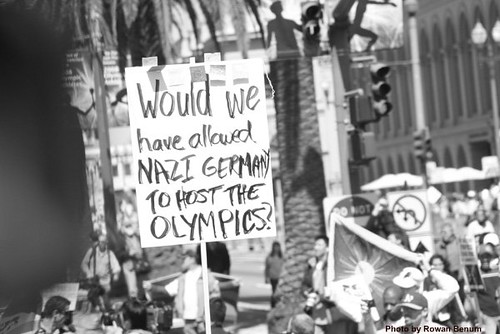
Olympic history FAIL!, or great PhotoShop

May 11, 2008

Ed Brayton found it.

Olympic torch relay protestor with really dumb sign

Do you think the sign maker was jesting? Or do you think the sign maker genuinely didn’t know? (See: 1936 Olympics in Berlin)

While we wait to see whether someone will confess to PhotoShopping this picture, we teachers might consider using this photo as a hook for a lesson on the differences between the rising totalitarian state of Nazi Germany in 1936, and the rising, increasingly economically free state of the People’s Democratic Republic of China today.

One more lesson plan for this year — it’s reusable next fall, with the added bonus then that by then you’ll have the headlines of the actual Olympics to add to the discussion.

Update: The photo is said to have been was taken by Rowan Benum at a California site (see Mr. Benum’s comment). Since it’s all the rage on conservative sites, where the history ignorance is condemned but the conservative bloggers can’t quite bring themselves to endorse the Communist Chinese, I strongly suspect wondered about a PhotoShop origin. The torch was run through San Francisco; there are few palms in San Francisco (Californians: Can you identify the location?).

Update 5-13-2008: The photographer kindly dropped by comments to note the authenticity of the photo. I agree, the Tibetan prayer flags suggest authenticity; would a hoaxer think of such details?

Discussion questions for the classroom:

Students should look at the photo, and read coverage of the torch relay, such as CNN’s story about the San Francisco relay where Mr. Benum took the photo. Students should have access to information about the International Olympic Committee and its organization, especially the tradition of Olympic Truce. The Charter of the Olympics is probably too long for practical classroom use, but Paragraph 2 can be copied for the students, or perhaps the full page of the “Fundamental Principles of Olympism”:

“Olympism is a philosophy of life, exalting and combining in a balanced whole the qualities of body, will and mind. Blending sport with culture and education, Olympism seeks to create a way of life based on the joy found in effort, the educational value of good example and respect for universal fundamental ethical principles.”
Olympic Charter, Fundamental principles, paragraph 2

There is a wealth of information for classroom use at the website of the IOC. If you’re particularly adventurous, or deep into this topic, check out the podcasts of Olympic history from amateur historian Eli Hunt.

Students should also have some information about Tibet, and the Dalai Lama and Tibet’s government in exile, about the history of Tibet and China’s actions since World War II. Students should have some history of the 1936 Olympics, and they should be familiar with the stories of Jesse Owens’ accomplishments there and his return to a segregated U.S. You may want to provide an article about the U.S. protest of the 1980 Olympics in Moscow, and the Soviet protest of the 1984 Olympics in Los Angeles, and other Cold War moments of Olympic tension.

  1. Since the International Olympics Committee (IOC) is an avowedly non-political international agency, is it fair or rational to protest the siting of an Olympics on political grounds?
  2. What do the protesters ask the IOC to do? What do the protesters ask others to do?
  3. Under international law, what are the rights and duties of the Peoples Republic of China (PRC)?
  4. Did the IOC ask anything of the government of the Peoples Republic of China of a political nature? Would such requests be fair, or rational?
  5. Other international organizations function in other nations where governments do not have good records on human rights, such as the Red Cross/Red Crescent, Scouting, UNICEF, and others (can you add to this list?). What considerations must such organizations give to local politics where human rights are at issue?
  6. Compare and contrast the issues surrounding the Beijing Olympics with issues surrounding the Myanmar relief efforts after Cyclone Nargis (2008).
  7. Look at other protests involving the Olympics, especially in 1980 and 1984. Did those protests achieve what the protesters had hoped? Does the success or failure of past protests augur well for current protests?
  8. The creator of the protest sign in the photograph appears to have not known about the 1936 Olympics, which were hosted in Berlin, then under the control of the Nazi government of Germany. The Olympics were sited in Berlin prior to the rise of the Nazi government. Does the protester’s ignorance of history affect the message of the sign? Does it reflect well on the cause the protester advocates?
  9. What other famous or notorious examples of ignorance of history can you find?
  10. Do you ever get embarrassed for the people captured in Jay Leno’s “Jaywalking” segments?
  11. Georges Santayana (1863-1952) famously said, “Those who cannot remember the past are condemned to repeat it.” Do you find that statement to be true? Does this affect the course of history? (Students may want to explore the history of invasions of Russia by Napoleon and Hitler, or the history of invasions of Afghanistan by Britain, the Soviet Union, and the U.S.)

Carnival Catch-up: Personal Finance

April 24, 2008

Behind on our carnivaling again . . . alas, not because we’ve been soaking in the tub, either.

Texas teachers, take note of the 149th Carnival of Personal Finance hosted by The Happy Rock. If you can’t find material there to bolster your personal finance curriculum, you need a lot more coffee.  Lots of posts on saving and investing and how to make it work on limited budgets, good stuff for the classroom.  Some are rather curious though — this one, from Squawkfox, suggests women should go around virtually naked in a sense, keeping no important documents or items in their purses.  Where should a lady carry her check book, seriously?

Tip of the old scrub brush to Don’t Mess with Taxes


Park your camel, the music’s begun

January 12, 2008

As long as we’re in Mali anyway, why not arrive a couple of days early for this other music festival? Michael Kessler writes about the Festival du Chameau in the Sydney Morning Herald, “The sound of the desert blues”:

A week ago, when the doctor was jabbing me with yellow fever, polio and hepatitis shots and supplying malaria tablets, I’d tried imagining what a camel festival would look like. The Festival du Chameau [in its third year in 2008] is the brainchild of Tinariwen, the international darlings of world music – a group of Touareg nomadic musicians, purveyors of the desert blues, whose political past combined with their hypnotic electric guitars make them local heroes in this, the Adrar des Iforas region of Mali.

Toronto Globe and Mail reporter Stephanie Nolen accompanied a group of Inuit musicians to Mali, documented in a blog for the newspaper, Trail to Timbuktu; from her reports, we know the festival is underway, music is on the dunes:

There’s no down-in-front with a camel, really.

The 8th Festival in the Desert began a couple of hours ago, with several thousand people sitting and standing in the cool, white sand at the edge of the oasis at Essekane. The sun set just as the event kicked off, silhouetting robed men, veiled women and camels on all the surrounding ridges. On the small, raised stage there were speeches by notables including the local governor and Mali’s Minister of Culture.

Then the music began, with the opening provided by Tamnana, a traditional ensemble of men and women from Essekane who drum, chant, clap and ululate. They’re a big hit with the locals, and it turns out that demonstrations of musical appreciation hereabouts take the form of camel tricks. When the spirit moves them, nomads on camelback suddenly charge down from the dunes to the front of the stage, where they coax their camels down to “walk” on their front knees a much-admired feat. Or they dismount and launch sudden sword fights with phantom opponents, before swinging back up and charging the camel back and forth in front of the stage a few times. It’s the Tuareg version of the mosh pit, and it’s magical to watch, but it does tend to blot out the action on the stage.

Inuit performers in the sand at Essakane Festival, Mali, 2008 - photo by Stephanie Nolen, Toronto Globe and Mail

Inuit performers from Canada, in the sands at the Essakane Festival, Mali, 2008; photo by Stephanie Nolen, Toronto Globe and Mail.

News still travels slowly out of Mali’s desert, though. Most of the news about the Mali Festival in the Desert comes in the form of festival veterans spreading the music, in other, far-flung venuues.

Influences of the Essakane Festival of the Desert reach Salina, Kansas, where the Salina Journal talks about the music of Toubab Crewe, a group of North Caronlians who have performed at the big Mali festival in the past.

Oregon feels it, too: MacArthur Foundation grant recipient Corey Harris, a veteran bluesman whose work was featured in the PBS series on the blues, especially his work in Mali with the late Ali Farka Toure, performs at the Rogue Valley Blues Festival in Ashland, Oregon, on January 18 (that’s the Southern Oregon Mail Tribune, not Mali Tribune).

Mali, and Africa, have much more than just these few festivals. Why should we concern ourselves with the Essakane festival at all? Africa. PopMatters carries a column by journalist Mark Reynolds, reviewing events and arts in Africa in 2007, with a look to 2008. It’s a survey of events and publications, but it’s a good backgrounder for a high school student in Africa concerns, an article that should suggest connections to be made in geography, history, government and economics courses.

Thanks to Ann at Peoples Geography for the correction — Sydney Morning Herald.


Festival au Desert Essakane! January 10-12, 2008

January 10, 2008

BBC’s internet services carried this slide and sound account of the 2007 Essakane festival in far off Mali; this is one music festival I would really like to attend. Snippets of songs crop up on NPR or PRI (especially The World), and on PBS, and in record stores with really savvy staff — or where Putumayo discs are on sale. Everything I have heard from these festivals is very, very good.

Robert Plant helped make it famous with his 2003 performance. But its fame is relative; it’s famous only among a select group of people — those who have heard the music.

[Alas, Vodpod died, and the video that I had captured via that service seems to appear nowhere else on the web.  If you should find the piece by Paula Dear which the BBC broadcast in 2007, please note it in comments.]

Vodpod videos no longer available. from news.bbc.co.uk posted with vodpod

.

The festival is set for January 10-12 in 2008. Who is playing? Where are news stories? Where are the CDs? Here’s the official website.

Geography teachers, think of the possibilities this festival offers for fun in the classroom! Adam Fisher wrote about it for the New York Times a couple of years ago:

My real aim is Essakane, an obscure desert oasis a half-day’s drive beyond Timbuktu, and the site of what’s billed as the “most remote music festival in the world.” It’s a three-day Afro-pop powwow held by the Tuareg, the traditionally nomadic “blue people” of the Sahara.

It’s a tribe often feared for the banditry of its rebels and respected for the fact that it has never really been conquered. Historically its great power came from its role in the trans-Saharan trade in gold, slaves and salt. Even now, Tuareg caravans make the 15-day journey south from the northern salt mines to Timbuktu on the Niger River. They rest their camels during the day and use the stars to navigate at night. The skin tint of the nomads comes from the indigo dye they use for their turbans and robes, which leaves a permanent stain.

What more exciting stuff do you have in your classroom on the Tuareg? Does it resonate better with your teenagers than this story would?

Read the rest of this entry »


Stanton Sharp history teaching symposium at SMU, February 9

January 8, 2008

Tired of odd speakers trying to tell you about how boys learn differently from girls because of the size of the Crockus in their brain?

How about serious material to beef up your teaching: Vietnam, the Russian Revolution, Mexicans in U.S. history, Native Americans in the 20th century, use of the internet in history classes — three sessions, each with three classes to choose from.

Poster for session on Russian Revolution, Stanton Sharp Symposium at SMU, 2008

The history department at Southern Methodist University in Dallas offers solid education in serious history issues for teachers in colleges and secondary schools. The Stanton Sharp Teaching Symposium on Saturday, February 9 offers great material in nine different areas. Several of these topics seem to be pulled from the Texas Education Agency’s list of subjects that students need to do better on, for the Texas Assessment of Knowledge and Skills (TAKS).

Invitation below the fold. The $15 fee includes lunch; you may earn up to 7 hours of Continuing Education Units (CEU) credits.

(I plan to be there, and if you’re really interested in the Crockus and its scholars, I happen to have a photo of the elusive Crosley Shelvador on my cell phone — he appeared to have used one of those spray-on tanning solutions, but is otherwise real, as the photos show.)

Read the rest of this entry »


Death penalty: Cruel and unusual punishment?

December 31, 2007

A note today from the Legal Information Institute (LII) at Cornell University’s Law Library notes that a big death penalty case is set for argument on Monday, January 7.

The issue in Baze v. Rees is whether lethal injection is cruel and unusual punishment, and therefore prohibited under the 8th Amendment to the Constitution. Plaintiffs Thomas Baze and Thomas K. Bowling argue that there is an impermissible chance of pain from the execution process.

Two lower courts ruled against the plaintiffs. In a rather surprise move, the Supreme Court granted a writ of certiorari on September 25 to hear the case, which some interpret as the Court’s willingness to review the cruel and unusual argument in the light of a majority of the states now refusing to use the death penalty, while others think it means the more conservative Roberts Court is willing to quash death penalty appeals with a ruling that injection is not cruel and unusual.

This highlights the 8th Amendment. Discussion of this topic may help students cement their knowledge of the amendment and Bill of Rights. News on this case generally highlights court procedures, procedures, legal and constitutional principles that students in government classes need to understand.

News on the arguments in this case should go into teacher scrapbooks for later classroom exercises. Teachers may want to note that the decision will come down before the Court adjourns in June, but it may come down before the end of the school year. Teachers may want to have students review information about the case and make predictions, which predictions can be checked with the decision issues.

Below the fold I copy LII’s introduction to the case in their Oral Argument Previews, with the links to the full discussion, which you may use in your classes.

LII operates off of contributions. I usually give $10 or so when I think of it — these resources are provided free. You should be using at least $10 worth of stuff in your classrooms — look for the donation link, and feel free to use it in the support of excellent legal library materials provided free of cost to teachers and students.

Read the rest of this entry »