For the birds, scientists at work

July 2, 2013

A scientist at work:

Amanda Holland with one of her research subjects, in South Carolina

Amanda Holland with one of her research subjects, in South Carolina

Kathryn’s cousin, Amanda Holland, moved from researching condors in California, to buzzards in Georgia and South Carolina (for the University of Georgia, I think).

Here she is with one of her research subjects.  Much lore is out there about handling carrion-eating birds for research — they vomit on you only if they like you, for example — but wholly apart from that, how great is this photo of a scientist at work?

I told her to copyright the photo (it is), and to hand on to the meme.  Can’t you see a character in Game of Thrones, or some other fantasy, who carries her own vultures to clean up after she devastates some other army in battle?

Eagles and falcons and owls are okay, but what other bird could conceal the results of the battle, so the warrior princess could move on in stealth?

Science field work looks like great stuff.  My experience is that it’s tiring, and sometimes lonely (though in very beautiful locations) — but the psychic rewards of actually increasing knowledge keep a lot of scientists going.  There’s not a lot of money in it.

Look at the friends you could make!


Birdbrains, in Canyonlands National Park

May 6, 2013

Bewick's Wrens nesting in skull of a bull, Canyonlands NP

From Canyonlands NP Facebook page: “View from the Maze: A pair of Bewick’s Wrens makes a nest in the brain cavity of an old bull’s skull. Where bovine ruminations once roamed a quick feathered flickering now prevails. If your skull ended up in a tree what species of bird would you like your brain cavity to host? (GC)”

Years ago in the Salt Lake Valley my sister Annette had a home on Wren Road.

One day she and a friend watched birds scurrying all over the property, plucking nesting materials.  “I wonder what kind of birds those are,” my sister said.

“Did you ever wonder why they named it ‘Wren Road?'” her friend replied.

If you want your bird watching friends to think you’re experienced at it, remember Bewick’s, as in “Bewick’s wren,”  is pronounced like the automobile, “Buick’s.”

More:


Grosbeak!

May 1, 2013

Our goldfinches left several weeks ago.  The cedar waxwings came through in at least three big waves, starting in February (and the last just over a week ago).  House finches moulted, and the breeding males have bright red heads. Migrating robins left us by the end of January, but a lot more residents stayed with us.

We have at least one, and maybe three cardinal families.  A black-capped chickadee family stuck around.  Haven’t seen a titmouse in a month, but I think they’re still in the neighborhood.  The black-chinned hummingbird family is back, and maybe a few other hummers.  The resident blue jays and white-winged doves duke it out every day.  Carolina wren stayed, and may have already fledged; but there are too many wrens for one family — is that a Bewick’s wren?

What’s THAT?

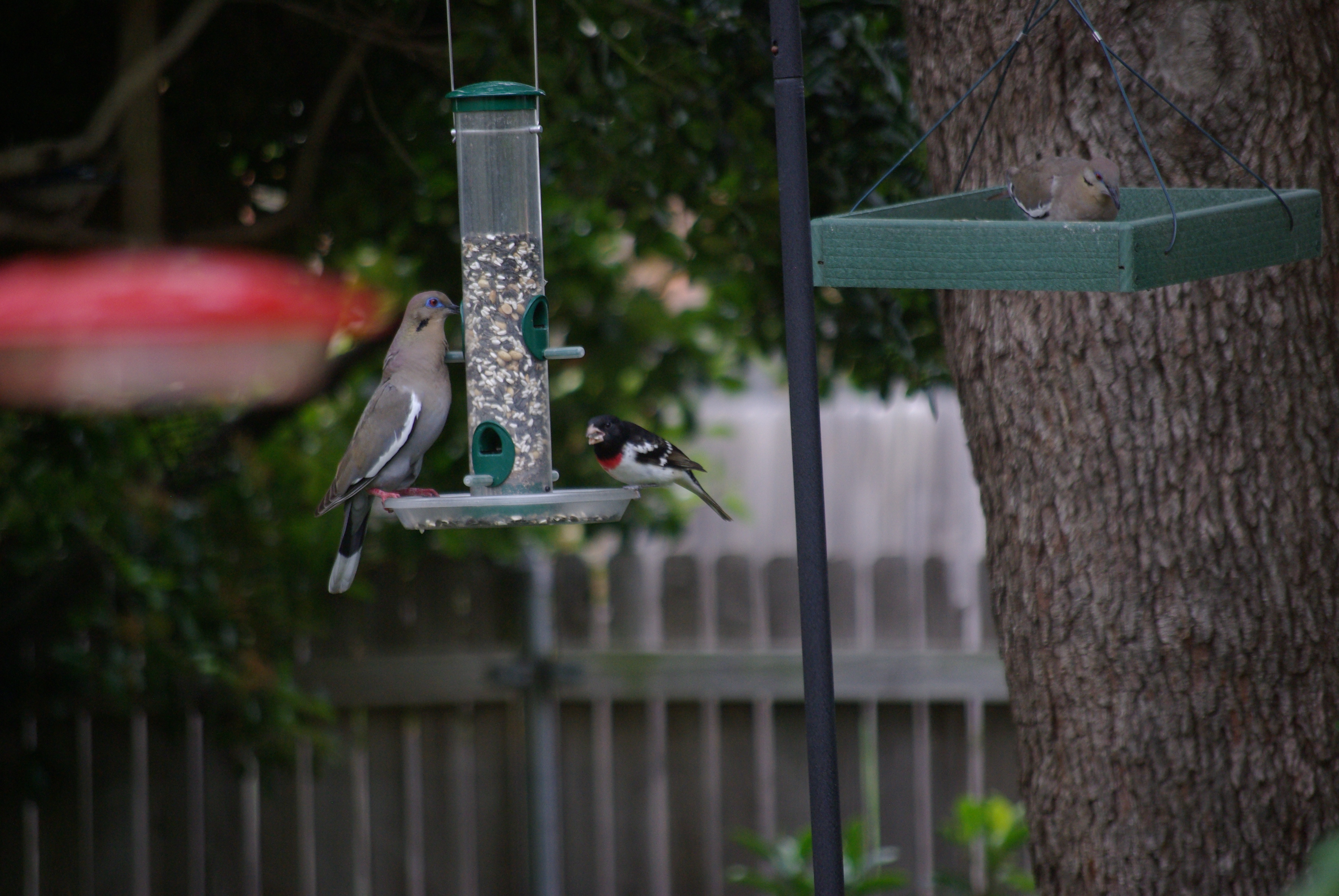
White winged dove and rose-breasted grosbeaki

White-winged dove, left, can’t scare away the rose-breasted grosbeak from the songbird feeder. Photo by Ed Darrell

IMGP4861

Look closer. Photo by Ed Darrell

It’s a rose-breasted grosbeak, Pheucticus ludovicianus.  It seems late for migrating birds, but only because so many migratory species migrate earlier these days.

Haunts of the rose-breasted grosbeak, from Cornell University's ornithological laboratory.

Haunts of the rose-breasted grosbeak, from Cornell University’s ornithological laboratory.

Would love to have a grosbeak family, but the Cornell ornithologists say this is fly-through territory.  Maybe that explains why it won’t scare by the white-winged dove, Zenaida asiatica.  Dallas is the western edge of the grosbeaks’ migratory path, but the eastern edge of the dove’s territory.  They probably don’t see much of each other.

We don’t even advertise clean restrooms.

More:


Backyard birds: Goldfinch at the feeder

March 12, 2013

No, he’s not particularly gold — but this is winter, and if he’s going to get his breeding plumage, it will come in a couple of weeks.

We’ve had Niger thistle seed feeders out for years; this year one goldfinch (Spinus tristis) finally started to visit.  We’ve had as many as four at a time — but they’re probably headed north soon.

Here’s a shot of our first guest, from a couple of weeks ago.

Goldfinch at the feeder

A goldfinch male, checking out the feeder before bringing in his buddies — we hope.

If you’re north of Dallas, and you see this guy at your feeder this summer, tell him “hello” from us.

The non-breeding plumage isn’t so flashy as the bright yellow of the breeding males.  Some of the finches settle in to a beautiful, smooth olive-drab livery for much of the winter.  Close up, they look like good pen-ink-drawings by a master artist.

More:


Backyard birds: A convention of white-winged doves

February 8, 2013

The white dove was a short-lived interlude; the white-winged doves seem to be with us constantly.

One family in 2011; two families in 2012 — and our yard isn’t that big.

A very early version of the birds who visited, befriended, and plagued Snoopy — this drawing, while faithful to Shultz’s work, was done by another artist.

Earlier this week I looked out, and it looked like the early “Peanuts” comic strip when Snoopy opened his dog house to a group of pigeon-like birds for their poker game.  The birds took advantage of Snoopy’s largesse, and nearly over-ran him.  (Woodstock was a product of that flock of birds, the last remaining vestige by Charles Shultz‘s death.)

At least they didn’t drink our beer and try to make off with the Picasso.

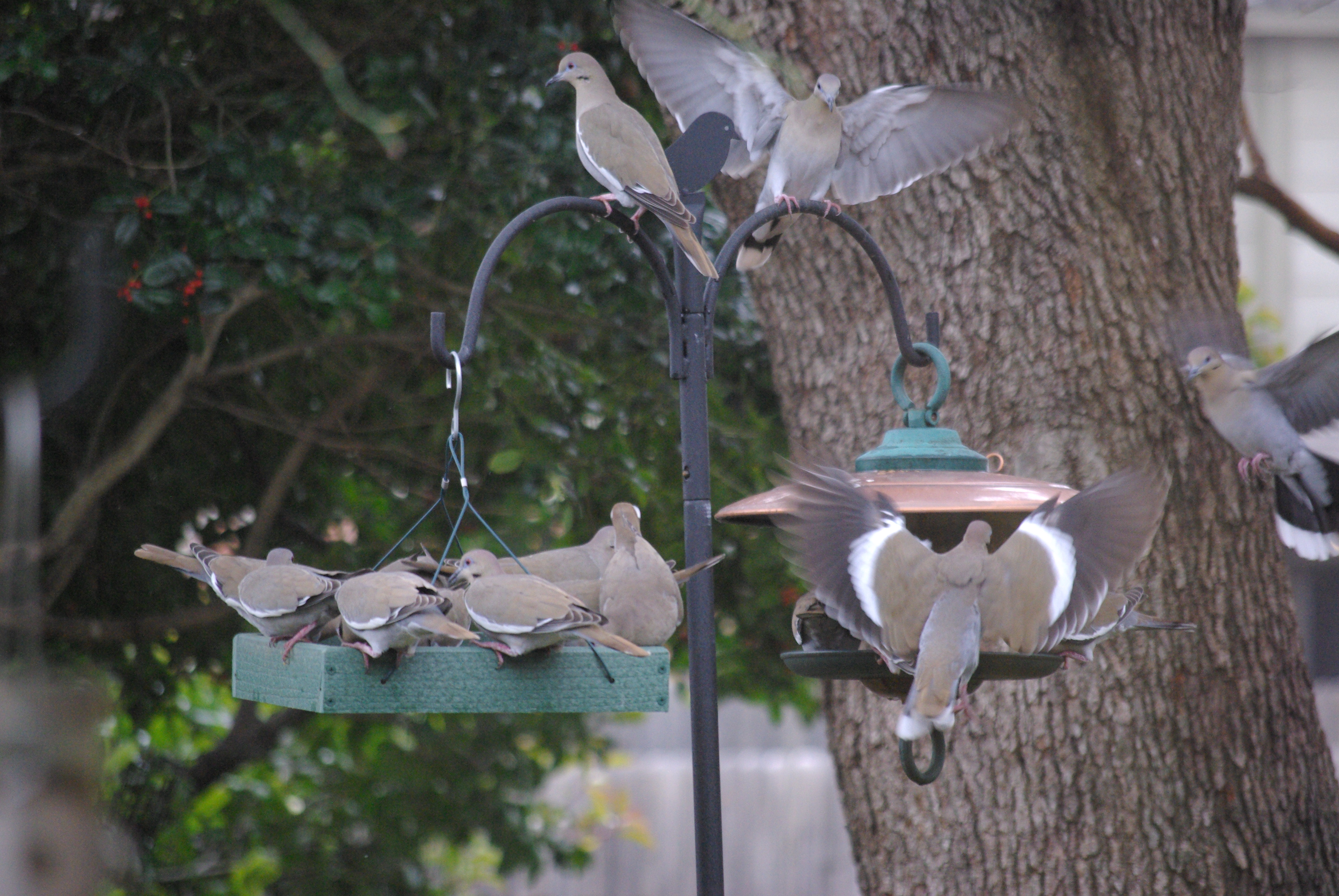
White-winged doves are really too big for any of our feeders -- but what are you going to tell a rampaging herd of them?  Photos by Ed Darrell - use encouraged with attribution.

White-winged doves are really too big for any of our feeders — but what are you going to tell a rampaging herd of them? Photos by Ed Darrell – use encouraged with attribution.

White-winged doves crowding at the bird feeders

Enough doves to frighten Alfred Hitchcock — Two of these birds is too many for either side of this feeding station. How many do you see here?

White winged doves jostle for position at the feeder.

Not enough room for all, and so they jostle and push each other off the feeders. See the display of the white stripe on the wings of one of our subjects here, from which the species gets its name.

Blue jays enforce the “too-long-or-too-many-at-the-feeder” rules here, but they can be distracted by peanuts put out by neighbors.  In any case, they were absent when we needed them.

We used to have mourning doves, but at some point in the last five years this bunch pushed them out.  We may be the only ones on the block who noticed.  (Yes, it’s “mourning” dove; Duncanville’s having misspelled it on “Morning Dove Lane” is their error.)

More:


Mystery white dove

February 3, 2013

It was last April.  Kathryn’s garden near the patio needed some work, and of course there are all the plants in pots, including the orange tree (which has since been joined by a pomegranate).

Birds visit often — we hang three or four birdfeeders.  Cardinals, house finches, the Carolina wren and her family, and a lot of white-winged doves commonly hang around.

Of a sudden a flutter of wings — and there he was:

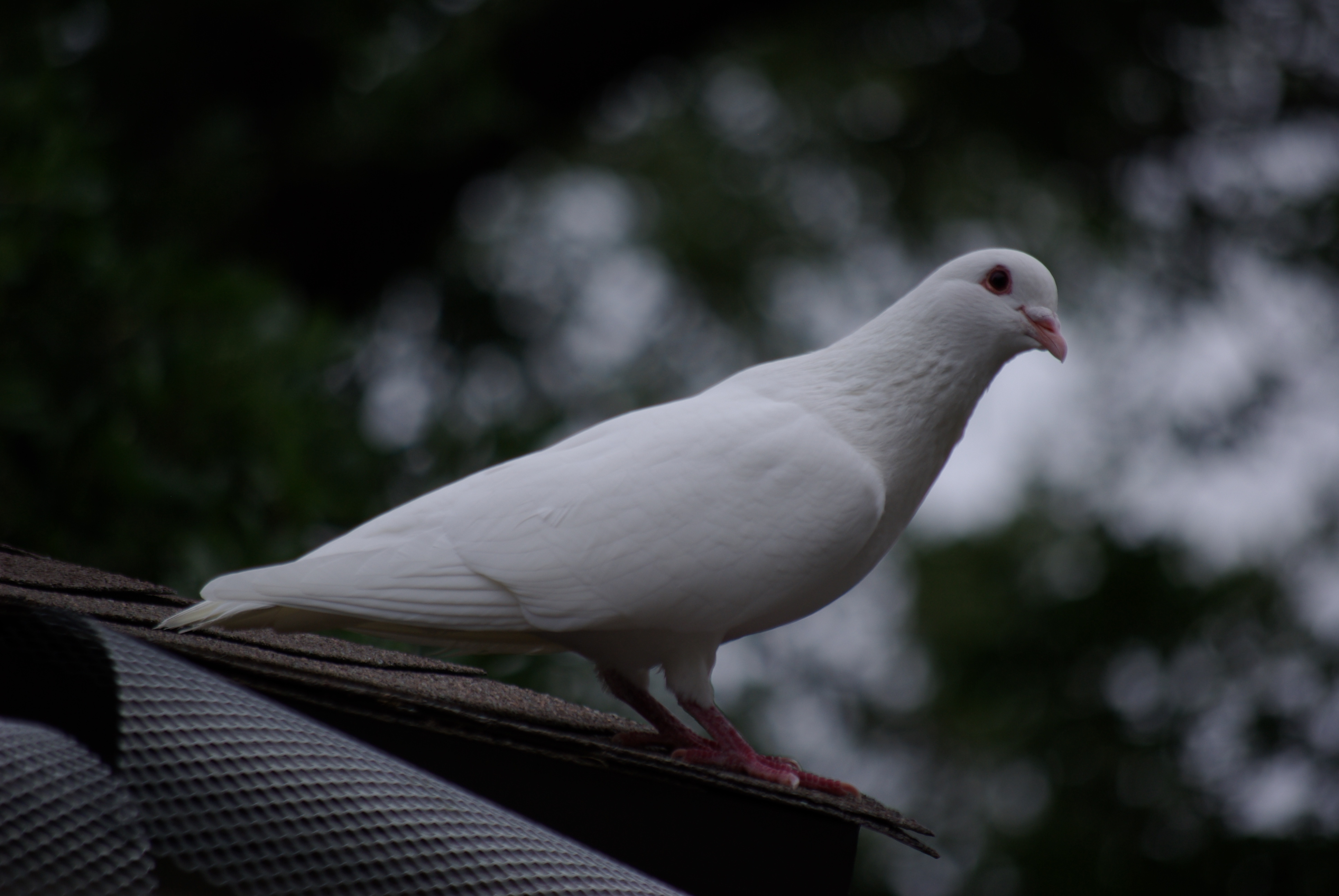
White dove

Where did this dove come from? For a few weeks in the spring, it haunted our yard.

We assumed it was male, but we have no way of knowing for sure.  At one point it seemed to make mating advances on some of the white-winged doves — but who knows.

The bird followed Kathryn around.  It ignored the feeders farther out in the yard, and concentrated on the feeders on the patio.  Then it would land on our patio table and watch.

Sometimes it splashed in the birdbaths.

White dove in the yard.

The bird appeared at ease around people. It would watch us work or play in the back yard.

Difficult to miss — the white was positively glowing.  When it flew in, it’s path suggested it came from a house up the alley a ways.  Was it a refugee from some cote, an escapee?  Or was it a trained bird just out for exercise?

A few times it arrived in the morning, and hung around for an hour or two.    Its usual pattern was to arrive in the early evening, grab a few seeds, do a lot of watching, and disappear.

With its color, we feared it would be a target for hawks.

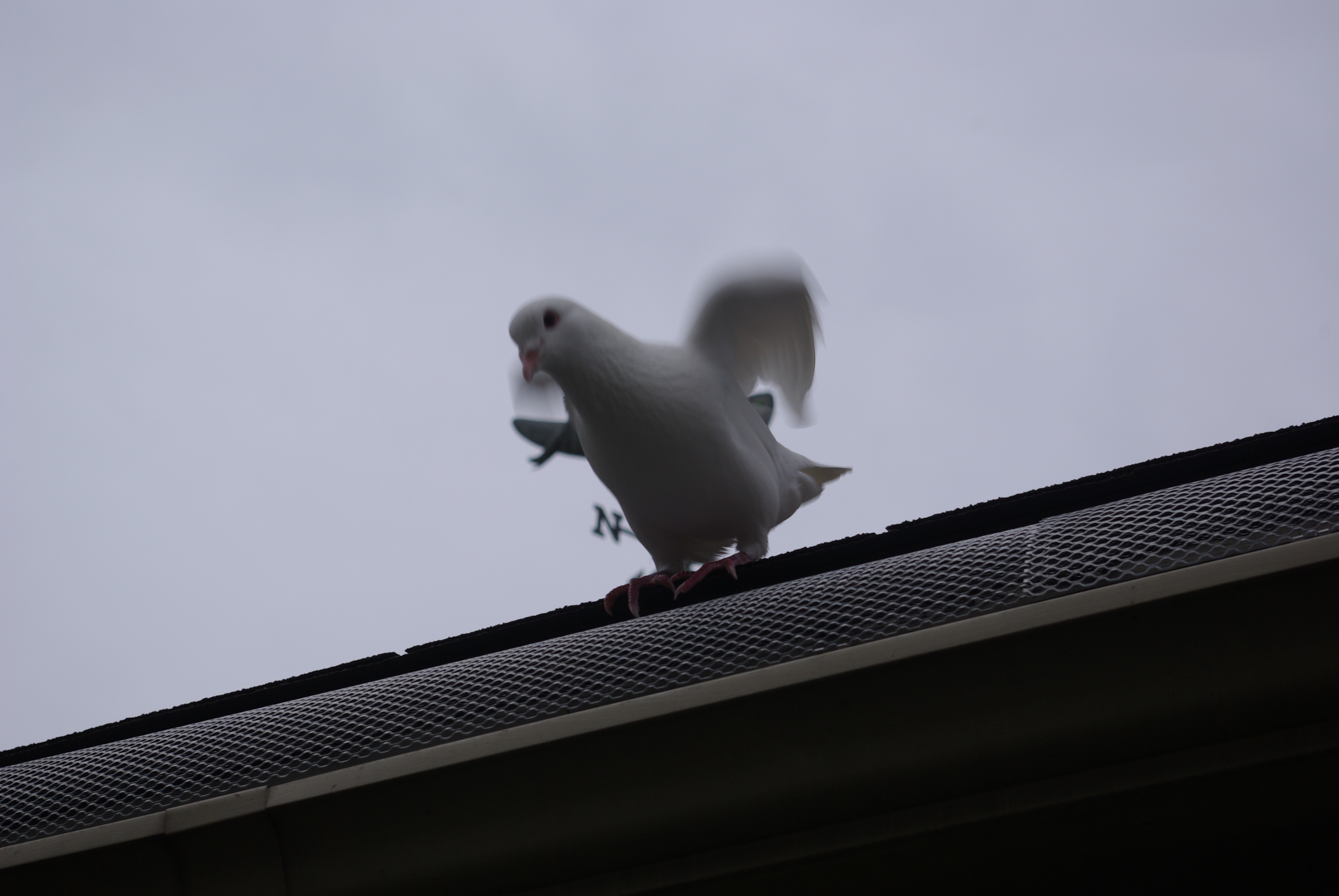
White dove ron the roof.

Where it flew to roost, we couldn’t determine.

One day it flew off, and didn’t return.

The mystery dove.  Where did it come from, was it tame?  Why was it here?  Where did it go?

More:


Eagles! We reduced DDT, and the eagles recovered

January 28, 2013

Love this photo, from the great folks at Yellowstone National Park:

Chris Daniel photo of a bald eagle in Yellowstone National Park, in the snow

From the Yellowstone NP Facebook site: An adult bald eagle perched along the Firehole River on New Year’s Day, near a trumpeter swan that it had either killed or was scavenging. Adult bald eagles usually remain in or near their nest territory throughout winter provided they have access to sufficient prey. Photo courtesy of Chris Daniel. (kd)

It’s a reminder of progress we’ve made in environmental protection.

While bald eagles may not have been the most endangered animal protected under the Endangered Species Act, or any other law, they became the most famous.  In the late 18th century Congress voted to designate the bald eagle as our national symbol.  At the time, the continent was still lousy with the creatures.  But from the arrival of Europeans after 1492, eagles had been hunted mercilessly.  By the early 20th century it was clear the animal was bound for extinction, like the great auk and other species (see here for technical information on the auk).

Ben Franklin complained the eagle was a dirty carrion eater, in a smart and funny polemic favoring the American turkey as the national bird.  Franklin couldn’t know how hunting and in-breeding would suck the nobility out of even wild turkeys over the next 200 years, until species protection laws and hunters pushed governments to invigorate stocks of wild turkeys again.  Compared to the eagle’s troubles, though, the turkey’s genetic torpor and limited habitat was almost nothing.

Americans tried to save the eagle.  After 1890, and during the run on great bird feathers that excited the fashion world and led to the senseless slaughter of millions of America’s most spectacular birds, we passed a federal law against hunting and shooting eagles for sport or no reason.  It was a toothless law, and the decline of eagle populations begun in the early 16th century continued unabated. Migratory bird treaties, providing more legal heft to bird protection, didn’t help the eagles either — not enough of them crossed borders, at least not that hunters and law enforcement could see.  The Bald Eagle Protection Act of 1940, kicking into action in 1941, provided teeth to eagle hunting restrictions, and hunters stopped shooting them so much.  Between 1940 and 1950, eagle populations stabilized, with a good bunch in Alaska, and a few nesting pairs spread from Oregon to Maine, Lake of the Woods to Florida Everglades.  There were so few eagles, and they were spread so far apart, that most Americans could not see one without major effort and travel.

Bird watchers noticed trouble in the 1950s.  Young eagles stopped showing up for the Audubon Christmas bird count, and at the Hawk Mountain migration counts.  Adults went through the motions, migrating, hunting, building nests, laying eggs for all anyone knew, and hatching young that had been seen, sometimes, to fledge — but then the young birds died.  Between leaving the nest, and returning to mate up and breed, the young birds simply disappeared.

Research showed deeper trouble.  On careful observation the birds were seen to be frustrated in hatching and raising chicks.  Sometimes the eggs wouldn’t hatch.  If they did hatch, the chicks died.  The few who lived to fly out, died soon after.

Rachel Carson called attention to the trouble in her 1962 claxon call on pesticide and chemical pollution, Silent Spring (50 years ago in 2012).

Doctor Science at Obsidian Wings wrote a paean to seeing bald eagles in the wild, with a brief and kind mention of this blog. You should go read it there.

Protecting birds?  The Steve Milloys, CEIs, AEIs, Heritage Foundations, CATO Institutes and other dens of smug cynicism and bad citizenship have it all wrong.  It’s not about power for environmentalists.  It’s nothing so cheap or mean.  Heck.  Often it’s not even about protecting the birds so much.

It’s about protecting our own dreams, and places we have to inspire those dreams.  Frederick Jackson Turner postulated that there is something mystical and magical in a frontier that helped form the American character and make us hard-working, smart, and noble.  He was right, of course.  Those frontiers are not simply frontiers of settlement in the wilderness anymore.  We have to work to find them, to declare Alaska the “Last Frontier,” or government reform and Cold War enterprise as the “New Frontier.”  But we still need frontiers.

Eagles still soar there.  Wherever eagles soar, in fact, we find those frontiers, those places to dream and inspire.  The Endangered Species Act isn’t about saving animals and plants.  It’s about saving our own souls.

More:


Occasional Tuesday tweet: Wren on the rose, Bewick’s or Carolina?

January 22, 2013

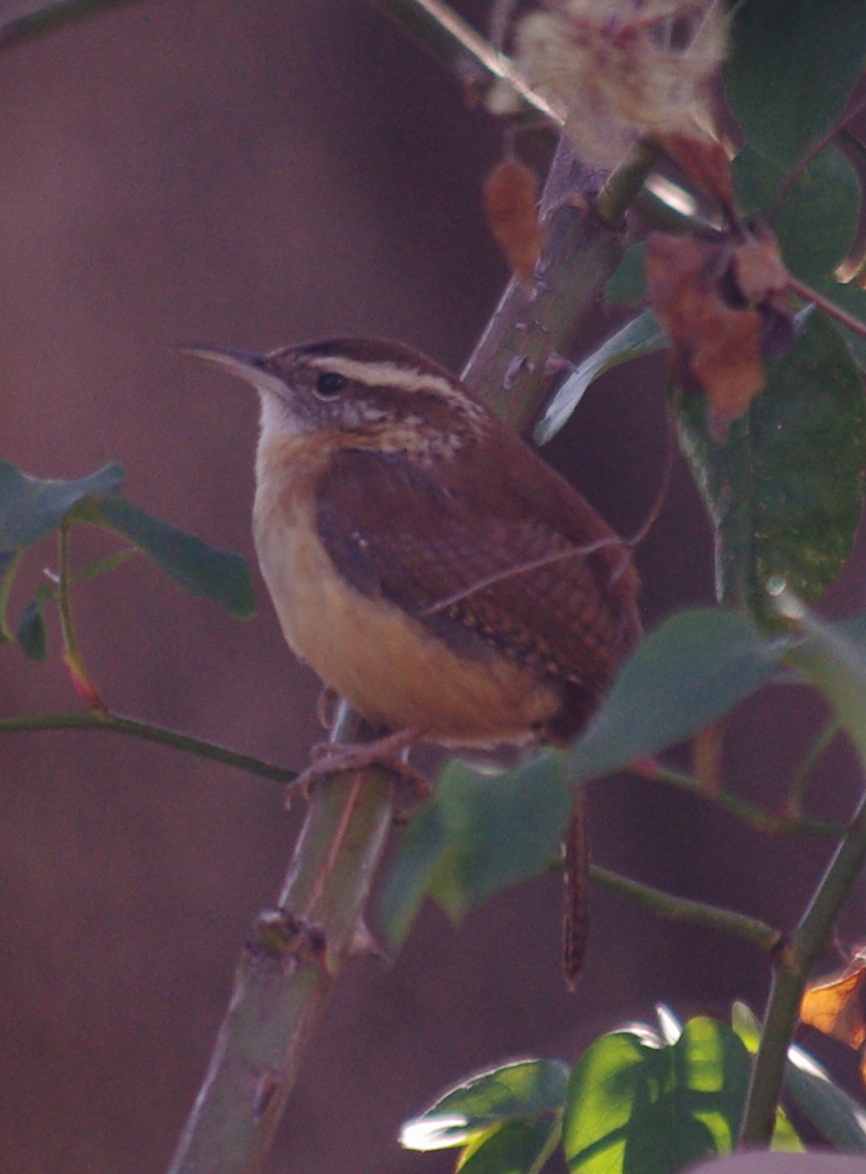
I’ve been calling these guys Bewick’s wrens (Thryomanes bewickii) for a couple of years, based on an identification I made a couple of years ago — but checking today to be sure, I’m thinking this is a Carolina wren (Thryothorus ludovicianus) instead.

In any case, a couple of days ago it paused for a few minutes in our backyard rose arbor, long enough I could try to get a good shot with just a 200mm telephoto, and with colors dulled by the window.

Carolina wren, perhaps, in Dalls

Wren in the rose arbor — ruddy color suggests it’s a Carolina wren, but I’ve been calling it a Bewick’s wren; pausing for its photo on Inauguration Day – Photo by Ed Darrell

Bewick’s wrens probably have more grey on their bellies; this one looks ruddy enough to be a Carolina wren.  (I just learned “Bewick’s” is pronounced like “Buicks.”)

Wrens stick around all winter now; they didn’t just over a decade ago.  This family has been with us for at least three years — two young this year successfully fledged.  By now it’s almost impossible to tell which are the young, which the parents.

Gulf fritillary on blue porterweed, Dallas, Texas - Ed Darrell photo

Gulf fritillary butterfly on blue porterweed — a few feet from the rose arbor where the wren posed, but months apart. Photo: Ed Darrell

On our patio we have a saga continuing with Gulf fritillary butterflies (Agraulis vanillae), their larva, and passion vine.  It seems our neighbors eradicated passion vine, so when the frits start moving north in the spring, they find our passion vines as the only ones in town.  The females go nuts laying eggs, and at some point we have a surplus of larva who denude the vines in a week.  Late hatching larva probably die off.

The butterfly books suggest that we cull the larva, but we don’t have the heart.  At some point in the spring the wrens wake up to the issue, and they cull the larva for us.  The vines recover, a new wave of frits hatch out, and the cycle begins again.  From June through September, the passion vine loses any leaves it puts out within 48 hours, usually.  But the wrens probably eat well.

The wrens seem never to perch where we can see them when they sing.  I suspect these little guys of having a much better voice than most wrens, but the great arpeggios I hear may be another bird, perhaps a warbler, that I just don’t know (good reason to go spend time at the local Dogwood Canyon Audubon Center, yes?).

More:


White-breasted nuthatch in action

July 21, 2012

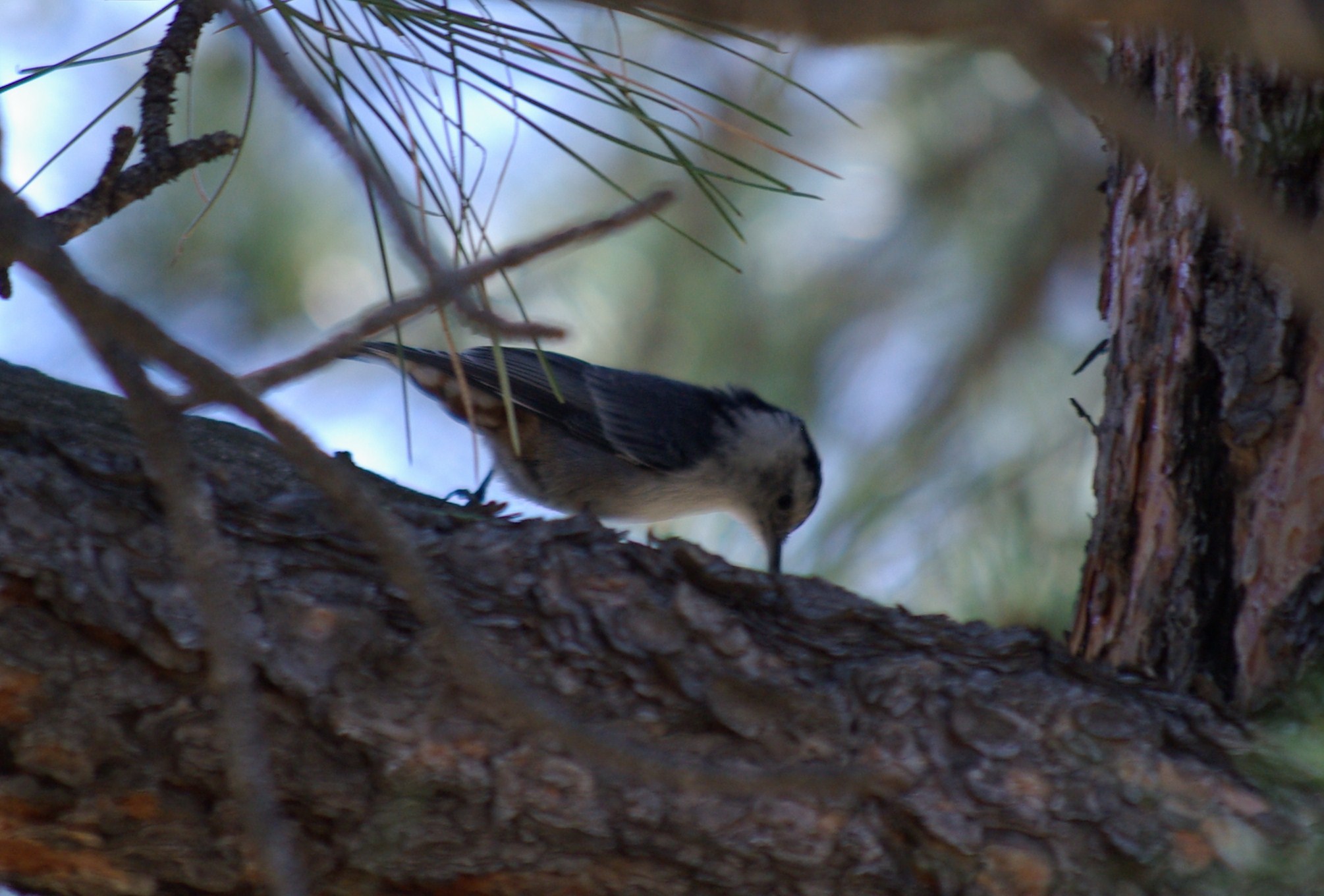
White-breasted nuthatch (Sitta carolinensis) (male?), cracking a nut on a pine limb, Peaceful Valley Scout Ranch, Colorado, July 2012:

White breasted nuthatch in action, Peaceful Valley Colorado, 2012 - photo by Ed Darrell - 061

White-breasted nuthatch (Sitta carolinensis)works over a seed, Colorado, 2012 – photo by Ed Darrell


Annals of Global Warming: Dramatic Links Found Between Climate Change, Elk, Plants, and Birds

March 14, 2012

Understanding the physics of the Earth’s atmosphere poses great problems — it is an astonishingly dynamic, fluid environment.  Understanding the relationships between species in ecosystems is no less complex, and no less vexing.

Wise followers of science recognize that when findings in biology, chemistry and physics, point the same direction, something powerful creates the convergence, and is not to be ignored.

So it is with these findings from the University of Montana and the U.S. Geological Survey, demonstrating clear links between climate change and the changing life patterns of large animals like elk, small animals like birds, and the plants the animals live in and consume.  This study is so complex that climate denialists haven’t figured out which part to deny, yet.  (This press release came out in January.)

From the USGS, with no adornment from the Bathtub, a press release on a letter in Nature Climate Change:

Dramatic Links Found Between Climate Change, Elk, Plants, and Birds

Released: 1/9/2012 11:30:00 AM

U.S. Department of the Interior, U.S. Geological Survey
Office of Communications and Publishing

In partnership with the University of Montana

Missoula, MT – Climate change in the form of reduced snowfall in mountains is causing powerful and cascading shifts in mountainous plant and bird communities through the increased ability of elk to stay at high elevations over winter and consume plants, according to a groundbreaking study in Nature Climate Change.

Red-faced warbler in Arizona, photo by Tom Martin, USGS

Red-faced warblers are one of the species affected by climate change in the form of reduced snowpack in the Arizona Mountains, according to a USGS Montana Cooperative Wildlife Research Unit study. Photo by Tom Martin, USGS, May 1998, in the Coconino National Forest

The U.S. Geological Survey and University of Montana study not only showed that the abundance of deciduous trees and their associated songbirds in mountainous Arizona have declined over the last 22 years as snowpack has declined, but it also experimentally demonstrated that declining snowfall indirectly affects plants and birds by enabling more winter browsing by elk. Increased winter browsing by elk results in trickle-down ecological effects such as lowering the quality of habitat for songbirds.

The authors, USGS Montana Cooperative Wildlife Research Unit scientist Thomas Martin and University of Montana scientist John Maron, mimicked the effects of more snow on limiting the ability of elk to browse on plants by excluding the animals from large, fenced areas. They compared bird and plant communities in these exclusion areas with nearby similar areas where elk had access, and found that, over the six years of the study, multi-decadal declines in plant and songbird populations were reversed in the areas where elk were prohibited from browsing.

Hermit thrushes in the Coconino National Forest, Arizona - 2005 photo by Tom Martin, USGS

Hermit thrushes are a songbird species that was strongly affected by plant community changes in mountains because of reduced snowpack and cascading ecological effects, according to a USGS Montana Cooperative Wildlife Research Unit study. 2005 photo by Tom Martin, USGS, in the Coconino National Forest

“This study illustrates that profound impacts of climate change on ecosystems arise over a time span of but two decades through unexplored feedbacks,” explained USGS director Marcia McNutt. “The significance lies in the fact that humans and our economy are at the end of the same chain of cascading consequences.”

The study demonstrates  a classic ecological cascade, added Martin. For example, he said, from an elk’s perspective, less snow means an increased ability to freely browse on woody plants in winter in areas where they would not be inclined to forage in previous times due to high snowpack. Increased overwinter browsing led to a decline in deciduous trees, which reduced the number of birds that chose the habitat and increased predation on nests of those birds that did choose the habitat.

Elk excluded, aspen growth increases - photo by Tom Martin, USGS, Coconino National Forest

When elk are excluded, aspen growth dramatically increases - Climate change in the form of reduced snowfall in mountains is causing powerful and cascading shifts in montane plant and bird communities through the increased ability of elk to stay at high elevations over winter and consume plants. Here, you can see an example of the difference in aspen growth inside versus outside a fence that excludes elk. Photo by Tom Martin, USGS, in Coconino National Forest

“This study demonstrates that the indirect effects of climate on plant communities may be just as important as the effects of climate-change-induced mismatches between migrating birds and food abundance because plants, including trees, provide the habitat birds need to survive,” Martin said.

The study, Climate impacts on bird and plant communities from altered animal-plant interactions, was published online on Jan. 8 in the journal Nature Climate Change.

Elk in winter at Camp Creek Feed Ground, Northwestern Wyoming - USGS photo

Elk in winter at Camp Creek Feed Ground, Northwestern Wyoming - USGS photo

More:


Say what? India only now figures out DDT kills birds?

January 17, 2012

Here’s a troubling thought:  What if India’s use of DDT now is just as destructive as the use of DDT in the U.S. in the 1950s and 1960s?

Why even mention it?  We’ve been reminded here that in the 21st century India is the world’s leading producer of DDT, and that the nation uses more DDT than the rest of the world combined.

Mon Town Baptist Church in the mist, Nagaland, India - Wikipedia image

Mon Town Baptist Church in the mist, Nagaland, India. The people of the state of Nagaland are mostly Christian, and local Baptist groups were among the most politically active groups who worked to put an end to fighting in the area in the early 1960s – Wikipedia image

From my perch in Dallas, Texas, it’s difficult to get a perspective on just how much DDT is used in the nation, and how much of the use is abusive, out of doors, or leading to environmental contamination.

One of the news feeds picked up on this opinion piece from Maneka Gandhi, blogging at the Nagaland PostNagaland is India’s most northeastern province.

Blyth’s Tragopan is the state bird of Nagaland, India's most northeastern province. A member of the pheasant clan, this beautiful bird is threatened by overhunting and DDT, even though it is chiefly a seed eater.

Blyth’s Tragopan is the state bird of Nagaland, India’s most northeastern province. A member of the pheasant clan, this beautiful bird is threatened by overhunting and DDT, even though it is chiefly a seed eater.

Among other troubling issues:  Ms. Gandhi talks about “with the disappearance of the vulture.”  Ecologists should sit up and take note of that; what cleans up the roadside carrion in Nagaland?

Killing birds due to human activity

[Maneka Gandhi]

16 Jan. 2012 11:51 PM IST

Last week I wrote about the strange and mysterious deaths of birds and fish that have taken place. But how many birds are killed every year due to human activity? I am not going to take into account the billion chickens that are killed at the rate of 1000 every minute, the turkeys, emus, ducks, quail that are slaughtered in the millions. I am talking about the birds you do not eat but kill anyway with deliberate malice or carelessness. Why are you ignorant of these? Because bird bodies are rarely found on the roads.

Night roaming scavengers finish them off very quickly. Here’s one estimate of numbers. A 2005 paper by Wallace Erickson, Gregory Johnson, and David Young (“A Summary and Comparison of Bird Mortality from Anthropogenic Causes with an Emphasis on Collisions”) estimates that 500 million-1 billion birds are killed each year in the U.S. alone from human-related causes.

This includes: Collisions with buildings – 550 million (58.2%) Collisions with power lines – 130 million (13.7%) Cats – 100 million (10.6%) Cars, trucks, etc. –80 million (8.5%) Pesticides – 67 million (7.1%) Communication towers – 4.5 million (0.5%) Wind turbines – 28.5 thousand (less than 0.01%) Airplanes –25 thousand (less than 0.01%) Other sources (oil spills, fishing by-catch, etc) – did not estimate I would put the same number in India.

Perhaps decrease the collision with buildings and increase the pesticide hit ones. While large mortality events make the news, the constant attrition, the constant killing has put one in six bird species worldwide in danger of extinction because of the factors listed above plus habitat loss, invasive species, and climate change. I was in Kolkata recently to start a campaign to save sparrows. It consisted of caps, drawings, speeches and the distribution of bird feeders.

I hope it will work but this much I learnt – very few of the children in the school had even seen a sparrow. How many kinds of birds have you seen? Most cities now just have crows and kites and a few parakeets. Looking at this list, can you see a number of ways that people – from municipalities to individuals can work to prevent at least some of these deaths.

Things like making windows and other structures more visible to birds, keeping cats indoors, and minimizing use of pesticides are all crucial to the survival of many species. The deaths are huge and quick but they are preventable if we just tweak our lifestyles. If I told you that you stood at the edge of a cliff and a little step forward would kill you but if you just sidestepped, you could reach safety, would you not?  Often the disappearance of a bird species alters entire human lifestyles, forcing them to change.

With the disappearance of the vulture most villages have had to think of what to do with cow/bullock dead bodies.

The carcass which would have been cleaned up in an hour by the vultures now becomes a threat to human life. No solutions have been found as yet. The Parsis will have to find another way to honour their dead as the towers of silence have no vultures so an entire religion has changed. China lost its sparrows (killed all of them) and then lost its grain because the insects proliferated. It finally had to import sparrows and start rebreeding them.

Today it is losing them again – as we are. Animal mortality is actually a far larger problem than these numbers might suggest. Just one example: in the U.S. there are some 70 million house cats. Each year they kill off hundreds of millions of native birds and more than a billion small mammals such as rabbits, chipmunks, and squirrels. The numbers are staggering. But they tend to go unnoticed, except by ecological researchers.

Most people consider what these cats (which are non-native, invasive pets) are doing to be “natural.” While animals are killed by weather fluctuations, lightning generated fires, the impacts of volcanism, earthquakes or other natural threats, all these hazards pale in comparison to what humans do to them. We have become by far the most significant factor in the deaths of individual animals, or entire species over the past several centuries.

There are many lethal artifacts of civilization. These range from agricultural toxins, to industrial pollution, to lawn care chemicals, to windows and glass buildings (which attract birds to collide with reflections), to predatory pets, to wires to loss of crucial habitats. So many birds have been killed by DDT alone – and it is still being used.

When the Americans finally noticed that their national bird, the Bald Eagle, was disappearing due to DDT, they banned it. We have lost all our birds of prey because DDT does a lot more than just kill insects. It impacts birds of prey to such a degree that it causes their eggs to weaken so that they can’t hatch.

Our consumption of fish is killing all the shore birds. With sonar fish finders and GPS technology, fish harvesters are decimating swordfish, tuna, and a host of other “food species” as our world population swells to 7 billion.

Make a New Year resolution that goes beyond not smoking, drinking and being nice to your mother/daughter in law. Start by making your house less toxic and by eating organic wheat/dal/rice. Plant as many fruit trees as you can so that birds have somewhere to nest. Choose a village and see if you can help them clean up their water body.

More, resources: 


Annals of DDT: No DDT produces benefits in Thunder Bay, Ontario

December 4, 2011

My news grabbers frequently take in articles about the recovery of some wild species in some far-flung place, a benefit of our having stopped the use of DDT in the area.

It occurs to me these stories should be filed away somewhere for future reference.

For example, here’s a letter to the editor of The Chronicle-Journal, in Thunder Bay, Ontario:

Let’s not reverse gains in falcon population

Saturday, December 3, 2011

I grew up in this town in the 1960s and ’70s never having seen nor heard a bald eagle or Peregrine falcon. I could only listen as my father (an MNR game warden) treated me to stories of the magnificent raptors previously living along the Nipigon River, Sibley and the Nor’Westers. I was 25 years old before I saw my first bald eagle and that was in Minnesota.

Decades of DDT use decimated the predator bird population to almost extinction in Ontario. The government eventually recognized the problem and corrected it by banning DDT in 1970. With the help of local groups, finally the birds are back.

In 1989, the Thunder Bay Field Naturalists, with support from the Ministry of Natural Resources, launched Project Peregrine “in an attempt to reintroduce this species to the Superior north shore . . . In 1993, successful nesting peregrines were recorded for the first time in the last quarter-century . . . due to an abundance of excellent habitat.”

A mere 20 years has gone by. Are we going to allow another crime against these species?

Allowing Horizon Wind to rape the escarpment for a few megawatts that we do not need now or in any foreseeable future is falling into a bully trap.
Parties have stated there will be no harm to the birds or to the escarpment. Au contraire. The blasting alone, not to mention the construction and roads, can be compared to demolishing the whole north core downtown and building a skyscraper no one intends to occupy.

Leave the birds and the escarpment alone. Go home, Horizon Wind.

Maggie Cummins
Thunder Bay


Amazing film – Flight of the eagle owl

October 8, 2011

Imagine for a moment that you are a wee little mousie, sitting on a tuft of grass nibbling on a seed. You think you feel a breath of a breeze from in back of you and you turn around to see this beautiful thing

Vodpod videos no longer available.

Amazing nature – The Eagle Owl, posted with vodpod

Beautiful, but terrible, too.

Owls fly silently. Their feathers have evolved to move without rustles, to let the wind slip through them without making a whish. Owls demonstrate evolution at its mightiest, and nature, as the poets note, “red in tooth and claw.”

Filmed at 1000 frames per second, according to Dogworks.com.  According to Vurtrunner at YouTube, filmed with a
Photron Full HD High Speed Camera SA2.

I’d like to know more about this film.  Trained owl?  Wild owl enticed by what kind of bait?  Longer movie about eagle owls?  I’m not familiar with them.  So many little mysteries on the internet.

_____________

Update:  From YouTube’s account of SloMoHighSpeed:

New Photron SA-2 High Definition High Speed Camera. Shot of ‘Checkers’ the eagle owl, 1000fps 1920×1080 resolution. Shot by SlowMo (www.slowmo.co.uk). See the owl and other birds of prey at www.turbarywoods.co.uk.

From Wikipedia

The Eurasian Eagle-owl (Bubo bubo) is a species of eagle owl resident in much of Europe and Asia. It is also one of the largest types of owls.

*   *   *   *   *   *

The Eagle Owl is a large and powerful bird, smaller than the Golden Eagle but larger than the Snowy Owl. It is sometimes referred to as the world’s largest owl, but this is actually the Blakiston’s Fish Owl, which is slightly bigger on average.[2][3] The Eagle Owl has a wingspan of 138–200 cm (55–79 in) and measures 58–75 cm (23–30 in) long. Females weigh 1.75-4.5 kg (3.9-10 lbs) and males weigh 1.5-3.2 kg (3.3-7 lbs).[4][5][6] In comparison, the Barn Owl weighs about 500 grams (1.1 lbs).

Tip of the old scrub brush to Kathryn.


Annals of DDT: Interior Dept compliments Rachel Carson’s research in Silent Spring

October 17, 2010

One of the most frequent hoax charges against Rachel Carson claims that she didn’t base Silent Spring on research.  Greater hoaxers claim that there is little or no evidence of harm to birds from DDT.

Rachel Carson's book stirs controversy, newspaper headlines

Rachel Carson’s book stirred controversy, as shown in newspaper headlines

These critics forget history, or they try to cover it up so you won’t know any better.  Carson provided more than 50 pages of citations to peer-reviewed research and communications with leading scientists in ornithology and chemistry about DDT and the damage it does.

Carson’s deep research won acknowledgment from the U.S. Department of the Interior, in this 1962 speech before the Audubon Society meeting in Corpus Christi, Texas, by the Special Assistant Assistant Secretary for Fish and Wildlife Robert M. Paul.

Paul told the birders that Interior was proud of the fact that so much of the research in the book relied on Interior’s research, from the U.S. Fish and Wildlife Service:

In addition, we are proud that so much of ‘Silent Spring“ is based on Fish and Wildlife Service research. And, with no modesty at all, we like to point out that Miss Carson is nobly carrying on a tradition that employees of the Department of the Interior, beginning with Walt Whitman nearly a century ago, have written some of the Nation’s most important books.

That’s quite the compliment to Carson, being compared even distantly to Walt Whitman.  It’s also a helluva brag for USFWS.

It’s also a 30-second response to the false charge that Carson’s work was not research based, or that research did not show DDT damage to wildlife.

Paul spoke to the Audubon Society about work to set up and operate the Federal Pest Control Board.

A .pdf of the speech can be found at the website for Interior, in a compilation of information from Interior about DDT between 1945 and 1998.  Full text below the fold.

Read the rest of this entry »


Monk parakeets in the locusts Chinese pistache

August 10, 2010

Terri Potts Smith showed up bright and early for work — was it in the spring? — and we talked in our first floor Dirksen Senate Office Building office about the grind we faced ahead with the hearing schedule for the Senate Labor Committee and subcommittees.  Suddenly she was transfixed by something out the window.

Having just recently learned that terrorists favored that particular corner for planting bombs under cars, I started a bit.  Terri explained, astonished, that a red bird flew into the tree out the window.

It was a cardinal (Cardinalis cardinalis), a common bird, but not one common to Utah, where both of us had grown up.

I think of that often these days, and am still constantly startled, to see green birds flit across the streets of Duncanville, Texas.

Monk parakeetsMyiopsitta monachus. Also known as the Quaker parrot.

Monk parakeets in the locusts, Duncanville, Texas, August 10, 2010 - photo by Ed Darrell, use with attribution encouraged

Monk parakeets profiled in the Chinese pistache, Duncanville, Texas, August 10, 2010 - photo by Ed Darrell; more than a dozen birds are hidden deeper in the tree.

Monk parakeets are invasive in Texas — it is thought the wild flocks developed from a few dozen escapees in the past three decades.  They favor nesting on tall electrical poles — the stadium lights of the high school and college football stadia host a lot, as do electrical transmission lines.  At Verizon Wireless we had at least one occasion when one of our cell tower climbers was attacked by one of the birds, apparently a mother just after the chicks had hatched.  Cell towers provide excellent habitat for the birds.

At the best sitings I’ve had, previously I lacked a camera.  Today I happened to have the small Pentax Optio V20.  20 to 30 of the birds roosted along an electrical wire.  They were happy to see me until I pulled out the camera.  (Pure conjecture:  They’re smart.  They’ve seen people with cameras before — and frequently, shortly after that some crew appears with a cherry-picker to destroy their nests.  Camera-shyness is a survival function for the birds.)

Cute little beggars.

Monk parakeets flocking -- collecting nesting materials?  Photo by Ed Darrell
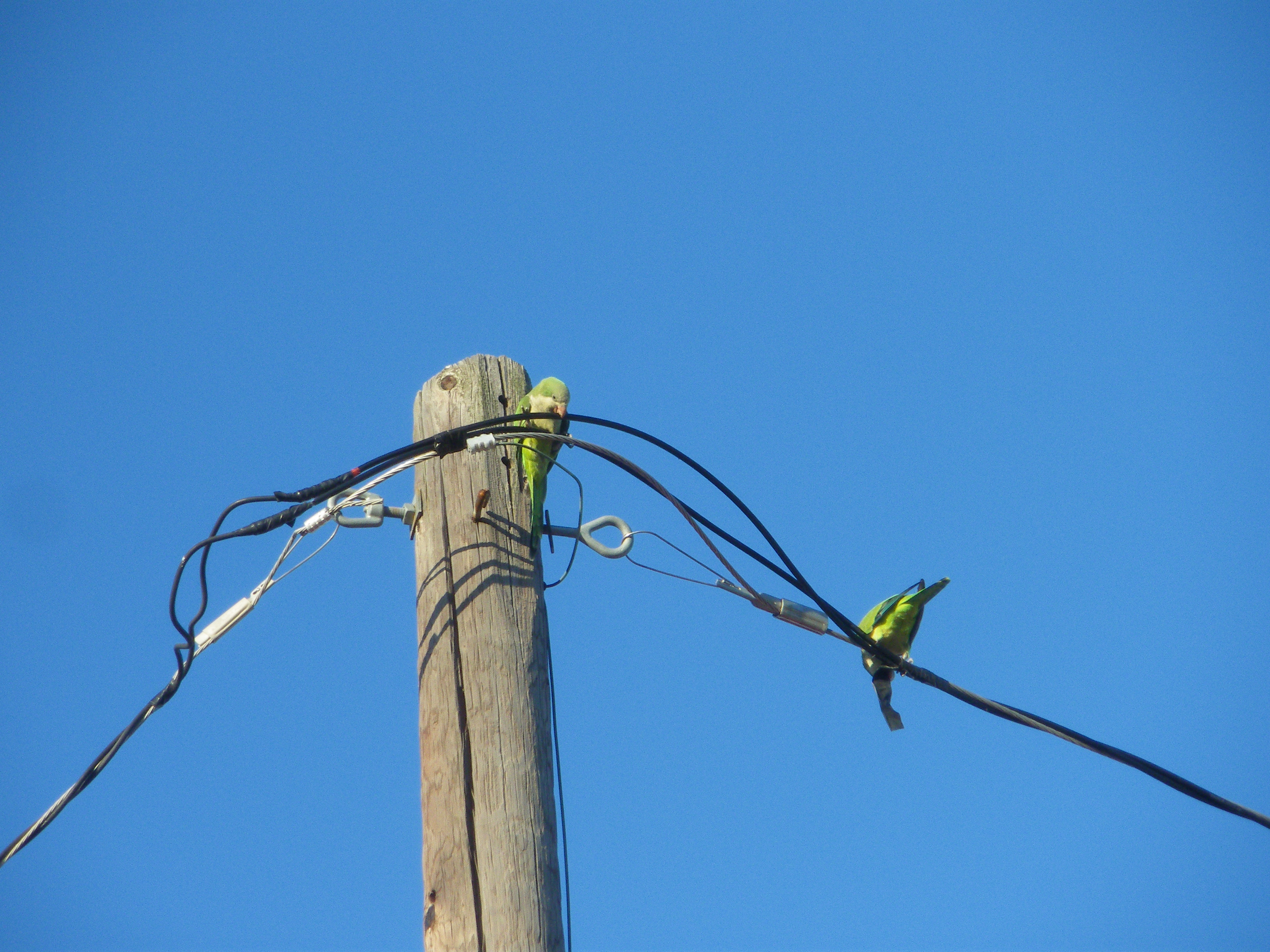
Monk parakeets flocking -- collecting nesting materials?

All I observed was social activity and some preening, except for the one bird flitting around with a stick in its bill.

And the two who were trying to pull tape off of electrical transmission wires.

Monk parakeets assaulting an electrical transmission line.  Photo by Ed Darrell
Monk parakeets working to get a charge out of life, picking at insulation on an electrical wire.

Troublemakers.

Truth be told, I’ll take the monk parakeets in greater profusion, if we can reduce the populations of starlings, grackles and cowbirds.

Is there any evidence of the parakeets preying on songbirds?

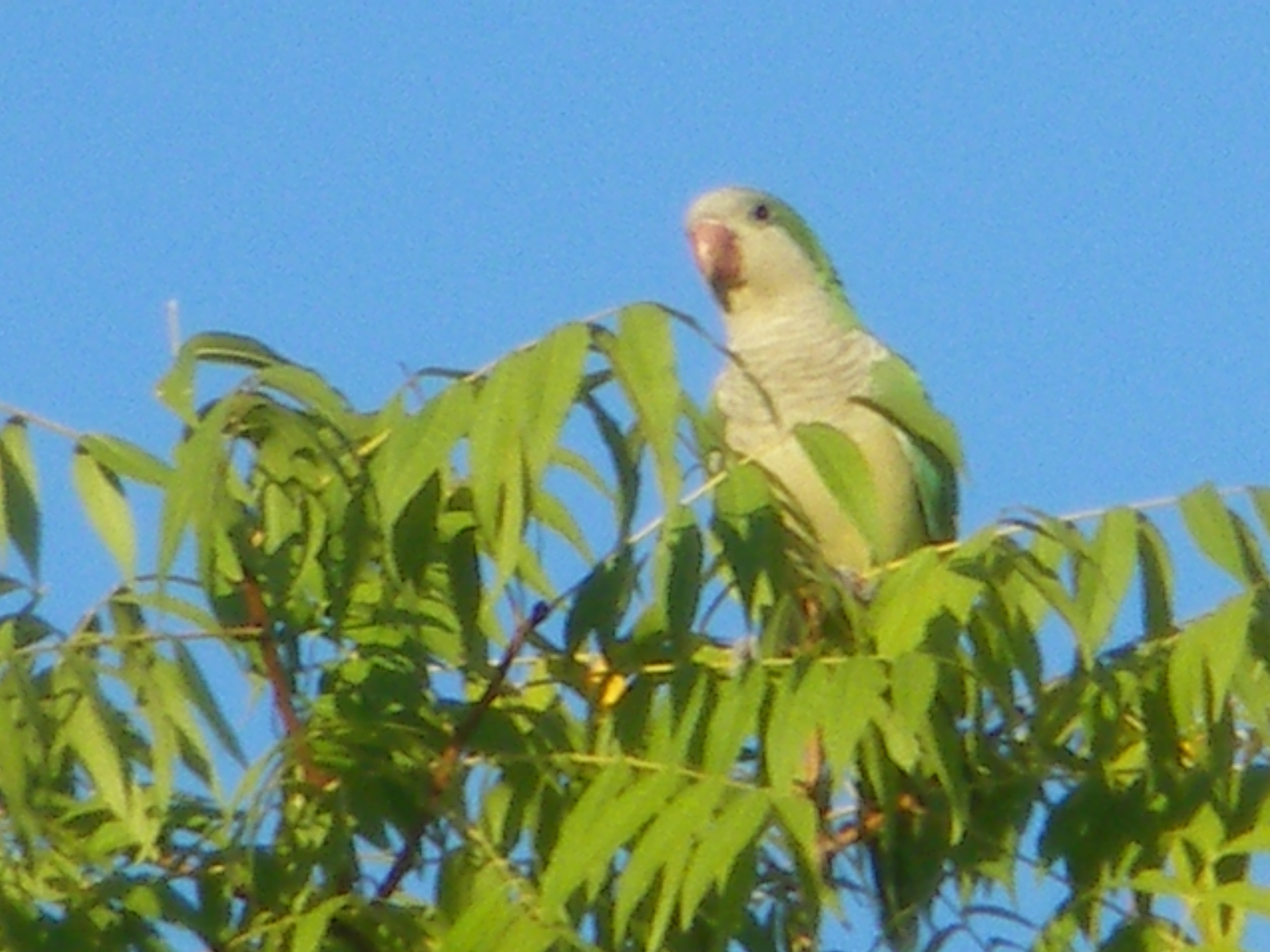
Monk parakeet in the <del>locust</del> Chinese pistache tree - photo by Ed Darrell - IMGP2237

Monk parakeet in the Chinese pistache tree. All photos by Ed Darrell, use with attribution encouraged.

[Update: Oops.  Looked like a locust tree on a quick look.  A longer look, I wasn’t so sure.  Kathryn confirmed that it’s really a Chinese pistache, Pistacia chinensis.]

Add to FacebookAdd to NewsvineAdd to DiggAdd to Del.icio.usAdd to StumbleuponAdd to RedditAdd to BlinklistAdd to TwitterAdd to TechnoratiAdd to Furl