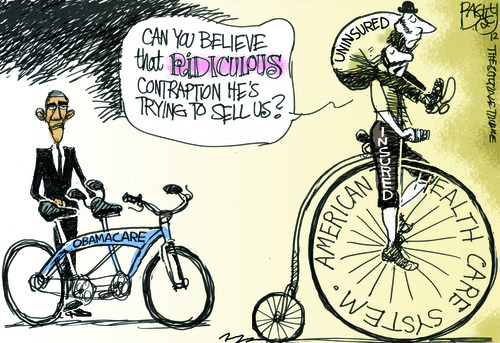
Salt Lake Tribune’s golden cartoonist, Pat Bagley, sums up so much of the difficulty we face in policy debates and discussions these days:
Especially “trickle-down” economics.
Maureen Dowd, in the New York Times (and other venues), “Cruel Conservatives Throw a Masquerade Ball”:
As I wandered the hall Tuesday night, past cowboy hats and cheeseheads, I ran into Christopher Shays, a delegate and former congressman. I asked the Connecticut moderate if he felt lonely at the conservative masquerade ball.
He laughed and then said wistfully, “Our biggest crime was trying to impeach the one president who was working with us.”
[All links added here.]
As is often the case, Ben Sargent makes vague things crystal clear, in this case, Romney’s economic program:
BushRomney-onomics. It worked so well in 2008, didn’t it?

Mike Peters in the Dayton Daily News, and King Features Syndicate, May 25, 2012. Did your local newspaper carry this cartoon? Why not? Call them and ask. More editorial cartoons, click the cartoon.
Peters’s editorial cartoons in the Dayton Daily News is one feature that distinguishes the newspaper, still, as one of America’s great daily papers. Here’s to the editors who keep doing it right.
Pat Bagley cartoon from the Salt Lake Tribune, May 2, 2012:
Wow.
More:
Generally the Pulitzer Prize committees look at specific works submitted by candidates. Bagley‘s day-in, day-out brilliance must make it difficult for editors to choose what to nominate, no?
This cartoon is just perfect, in so many ways:

Clifford Berryman drew some of the best and most famous political cartoons ever, for newspapers in Washington, D.C., over a career of more than 50 years. Berryman drew the cartoon of Teddy Roosevelt and the bear cub TR refused to shoot, that caused the story of TR and the bear to become famous, which led to the creation of the “Teddy bear” stuffed animal we all know today, for one example.
Our National Archives featured an exhibit of Berryman cartoons on running for office. The exhibit is long gone, but the materials from the exhibit live on, on line, waiting for students to study, and teachers to use for presentations, assignments, and tests.
Go check it out. Great resources. There’s a piece that describes some of the symbols and symbolism used in Berryman’s cartoons.
Some of the cartoons seem awfully prescient to today:

"Nearing the End of the Primaries," cartoon by Clifford Berryman published May 3, 1920. Caption from the Archives: "Today candidates usually secure their party’s nomination during the primary season, and the nominating convention merely provides the party’s official stamp of approval. In 1920, however, when the primary process was still new, it did not produce a clear winner for the Republican Party. As the Republican convention neared, there was no front-runner for the G.O.P. Presidential nomination. This cartoon shows the frazzled Republican elephant surrounded by conflicting newspaper headlines while the Democratic donkey makes pressing inquiries. Warren G. Harding was eventually chosen as the Republican nominee. U.S. Senate Collection Center for Legislative Archives"
Borrowed with express permission from Mr. Darrell’s Wayback Machine.
Mount Rushmore, that is:
John Sherffius, Boulder Camera, November 1, 2011
Is John Sherffius channeling Mount Rushmore? What do you think?
To understand political cartoons, one needs to understand the iconography used in them. Certainly Mount Rushmore and the four presidents it portrays is one of the more powerful icons in the United States, a Great Depression-era monumental sculpting project, the genius of Gutzon Borglum writ very, very large, and now a part of the National Park System, as a National Memorial in South Dakota, one of our smallest states in population, and one of the last frontier states in America.
I don’t have a favorite — there are too many good versions, in cartoons, in parody, as patriotic symbol, as a backdrop for Hitchcock movies, and as a representation of the heritage of Chicago blues, among others. What is your favorite use of the Mt. Rushmore icon, or your favorite photo of the carvings? Give us a link in comments, please.
Clay Bennett of the Chattanooga Times-Free Press took the top prize and $10,000 in the 2011 UNCA and the United Nations Society of Writers and Artists Ranan Lurie Political Cartoon awards.
Bennett earned honorable mentions before in this competition. His distinctive, almost simple style, and his sharp and incisive wit, make Bennett a great cartoonist, one of my favorites for a long time.
His 2011 Lurie Award winner depicted the breakdown in Palestinian/Israeli peace talks:

Clay Bennett's Lurie/UN Award winning cartoon, Chattanooga Times-Free Press; inspired by Escher, perhaps, it shows the difficulty in even getting started any talks on Mideast peace.
I especially like the ambidextrous feature: The cartoon works upside down, too.
Congratulations, Mr. Bennett, and all the winners in the 2011 Lurie/UN Cartoon Awards.
More:
What, exactly, are the requirements to be elected to the New Jersey Hall of Fame?
Thomas Nast is the great cartoonist whose pen launched crippling blows to the institutions of corrupt politicians including Tammany Hall’s Boss Tweed. Nast generally gets the credit for inventing the symbols of the two major national parties, the donkey for the Democratic Party (or jackass, as in the first cartoon), and the elephant for the Republican Party, the party Nast favored.
Santa Claus’s commonly-accepted image owes a lot to Nast, who drew Santa Claus supporting the Union efforts in the Civil War. Between 1855 and 1900, Nast supported the winning cause in at least seven presidential elections, illustrated the effects of America’s industrialization and rise as a world power, fought political corruption and campaigned for equal legal rights for immigrants and ex-slaves.

Thomas Nast’s tribute to the Emancipation Proclamation in Harper’s Weekly, 1863 – University of Michigan, Clements Library image; click image for a larger version
Lady Liberty? Columbia? An invention of Nast. Nast’s image of Columbia was more than minor inspiration to the French friends of America who created the Statute of Liberty. New Jersey is guarded, literally, with one of Nast’s creations.
Through it all, he clung to biases that, amplified by 1870s and 1880s politics, some people find less-than-acceptable today. When Catholics raised money from Europe to establish schools in America so Catholic children would not undergo Protestant indoctrination, Nast sided with the public schools (and, perhaps, with the Protestants). When immigrants, whose rights he defended, blindly turned the control of their votes over to corrupt political machines, he depicted those immigrants as louts, thugs and oafs. On the issue of temperance, he sided with those who wanted to restrict alcoholic beverages, in opposition to German and Irish brewers and distillers.
Through it all, his pen brilliantly and clearly stated his positions, in images. Nast’s work inspired Edgar Degas and Vincent van Gogh.
What should we make of the late-to-the-table complaints about Nast’s induction into the New Jersey Hall of Fame? Opponents say Nast lampooned Catholics. True. Nast lampooned anyone whose policies he opposed.
Zeno presents a very good case that the opposition is wrong-headed, and ironic, coming from the voluble-and-usually obnoxious Bill Donohue of the Catholic League for Religious and Civil Rights (a self-proclaimed name that many people find inaccurate), a guy who might well be a target of Nast had Nast and Donohue occupied the same place in time. (Though I quote Zeno at length here, go to his site to read the full piece.)
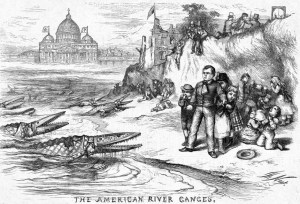
It was a theme to which the cartoonist returned whenever he wanted to inveigh against Romish influence (the Church was on record in opposition to the separation of church and state) or Irish immigration (Nast had decidedly nativist tendencies). Today we can look at Nast’s cartoons and see them as over the top. In high dudgeon, however, Bill Donohue cannot help but demonstrate once again his unerring instinct for avoiding le mot juste in favor of the words least apt:
[H]e demonized bishops by portraying them as crocodiles with miters for jaws; and he also depicted them as emerging from slime while prowling towards children.
Really, Bill? You had to go there? Silly man.
You just depicted Thomas Nast as a prophet.
Nast’s work provides us with a conundrum. On one hand he ardently and fervently supported the Union against the Confederacy, especially with regard to emancipation of slaves. On the other hand Nast ideologically opposed the Democratic Party — perhaps an easy thing to do in those days when the Democratic Party was on record supporting slavery — and portrayed anyone with Democratic links as a beast or thug.
Should Nast’s biases against Catholics and Irishmen who unthinkingly gave their poll power to Boss Tweed disqualify Nast from a spot in New Jersey’s Hall of Fame?
Here is a list of people elected to the New Jersey Hall of Fame over the past four years:
CLASS OF 2008
Buzz Aldrin
Clara Barton
Yogi Berra
Bill Bradley
Thomas Edison
Albert Einstein
Malcolm Forbes
Robert Wood Johnson II
Vince Lombardi
Toni Morrison
Norman Schwarzkopf
Frank Sinatra
Bruce Springsteen
Meryl Streep
Harriet TubmanCLASS OF 2009
Bud Abbott & Lou Costello
F. Scott Fitzgerald
Althea Gibson
Jon Bon Jovi
Jerry Lewis
Guglielmo Marconi
Shaquille O’Neal
Phil Rizzuto
Paul Robeson
Carl Sagan
Walt Whitman
William Carlos WilliamsUnsung Hero:
Captain Brian BrennanCLASS OF 2010
Count Basie
Judy Blume
Justice William Brennan
Danny DeVito
Larry Doby
Michael Graves
Carl Lewis
Jack Nicholson
Alice Paul
Les Paul
Phillip Roth
Susan Sarandon
Wally Schirra
Frankie Valli
President Woodrow WilsonUnsung Heroes:
Marc DiNardo & James D’heronCLASS OF 2011
John Basilone
Tony Bennett
Governor Brendan Byrne
Mary Higgins Clark
Admiral William Halsey
Franco Harris
Leon Hess
Queen Latifah
Bucky Pizzarelli
Martha Stewart
Joe Theismann
John Travolta
Bruce WillisUnsung Heroes:
9/11 Victims & First Responders
Generally a well-deserving group of heroes, don’t you think?
Careful students of history may blanche a bit at one name there, in consideration of the flap against Nast. Woodrow Wilson had his own biases — he resegregated the White House as president. He opposed civil rights for African Americans. He invited the racist, pro-Ku Klux Klan movie, “Birth of a Nation,” into the White House and praised it for its accuracy and advocacy.
Wilson led the nation into World War I (after promising he would not), and he campaigned unsuccessfully for a peace treaty that might have prevented World War II, had he been listened to. Wilson campaigned to create an international peace-keeping organization, the League of Nations, an agency doomed to failure because the U.S. Senate rejected Wilson’s every imprecation to ratify the treaty that ended the Great War and created the agency.
Can Bill Donohue actually make a case that the great cartoonist, Thomas Nast, does not belong in a pantheon that includes Frank Sinatra, Bruce Willis, John Travolta, and ex-con Martha Stewart? Is Nast not at least as deserving as Woodrow Wilson, on the same grounds?
Nominations for the class of 2012 include Aaron Burr, the vice president candidate whose overweening ambition nearly derailed the nation’s Constitution in 1800, the man who shot Alexander Hamilton fatally, and a man who plotted the overthrow of the government of the U.S.
Nast is nominated in the “General” category. The others nominated there are Alexander Calder, Alfred Stieglitz, Charles Addams, Doris Duke, Dorothy Parker, Dorothy Porter Wesley, Joyce Carol Oates, Milton Friedman, and Gov. Tom Kean.
Uh, Bill? Did you see Milton Friedman there? Yeah, he was a great economist and he made popular television and book explanations of economics (that Republicans eschew today, to the detriment of free markets and political freedom) — but should he be there considering his work for the Pinochet regime in Chile? I mean, Bill, can we be consistent? Chile is a chiefly Catholic nation, you know, and surely the murders of 10,000 Catholics should weigh in here, shouldn’t it?
(New Jersey’s ability to produce such a body of notables is, itself, notable. Probably each of those people deserves commemoration in the New Jersey Hall of Fame. Second place, two spots in the New Jersey Hall of Fame.)
Is this really what Catholics are reduced to, today — a pointless, silly campaign against commemorating a great cartoonist? May we assume Donohue and the Catholic Church oppose Nast across the board, in Nast’s campaigns against corruption, his work against slavery and support for the Union, and his support of the rights for immigrants?
Perhaps Donohue should review the situation, like Fagin.
And you, Dear Reader, should go vote for Thomas Nast’s inclusion, warts and all.
More:
Some of the cartoonists get it. Mother Earth will survive human extinction; it’s humans who will suffer if we don’t work to save ourselves.
Tim Eagan in Deep Cover, December 15, 2011:

Tim Eagan’s Deep Cover, on Durban Climate Conference, December 15, 2011; go to Eagan’s site for a larger view of the original
That’s right: Contrary to conservative and warming denialist blather, it is environmentalists who are the humanitarians in this unfortunate-to-have, unnecessary discussion.
Eagan is another recovering lawyer, ten points to his favor. Is there any publication that regularly features his work? I don’t know. There should be many.
Update: If you’re visiting the Bathtub for the first time, be sure not to miss the link at the top, to go to this cartoon.
Tip of the frozen-but-thawing scrub brush to Devona Wyant.

This Anderson cartoon from the Houston Chronicle in 2009 gets the facts right, but sadly, is still accurate
Remember the pathetic, disgusting attempt to derail the climate talks in Durban, just a few days ago? The “climate skeptics”™ dumped a bunch more private e-mails from the scientists who work on climate. (Stolen e-mails, here; be prepared to be bored, with no smoking guns, no cold guns, no guns at all.)
Unless one thinks the self-proclaimed skeptics are James Bond nemesis enough to actually hope for the end of the world (as opposed to just being monumentally, stupidly misled), their train still can’t get back on the tracks. Revealing that someone among them has stolen more e-mails than previously known, didn’t help. Here is a list of just how bad the derailment has been for the denialists:
One question we need to be asking is why the incidents around the stolen e-mails are known as “Climategate” in the circles of warming denialists. The thieves in this case came from the ranks of the so-called skeptics, and the release of the e-mails was done on the blogs of those who deny warming, or human causation, or human ability to mitigate at all. (Fox News got it bass ackwards, of course — wondering whether the government is somehow complicit in hiding information, while all the information is public and almost all of the private communication is public. At Fox, they don’t even get Homer Simpson doh! moments of understanding — that’s how bad it is in Denialville.)
So far no one’s listening to the bear on this one — follow the money, and bring the criminals to justice.
It’s really SkepticGate, with a more-than two-year coverup and continuing, and the recent release is SkepticGate II.
Denialists, and even those who question global warming on legitimate grounds, must be frustrated. Nothing they do stops the world from warming. As the massive wave of evidence demonstrating the Earth warms and humans share the blame turns to a tsunami, even policy makers (Ralph Hall excepted) look for solutions to warming problems. It’s so bad for the skeptics that even the old trick of stealing e-mails from the scientists, the trick that helped fog up the Copenhagen proceedings, did almost nothing to the Durban talks. While no treaty came out, none was expected — but the sudden action in the last couple of days of the conference to get action despite the continued interference by climate skeptics and their political allies, must have caught them off guard.
Now the cops are after them, too.
Happy Hanukkah, Merry Christmas, Cool KWAANZA, Ebullient Edwin Hubble Looking Up Day, Happy New Year!
Thomas Nast helped bring down the crooks at Tammany Hall with cartoons. Boss Tweed, the chief antagonist of Nast, crook and leader of the Tammany Gang, understood that Nast’s drawings could do him in better than just hard hitting reporting — the pictures were clear to people who couldn’t read.
But a cartoon has to get to an audience to have an effect.
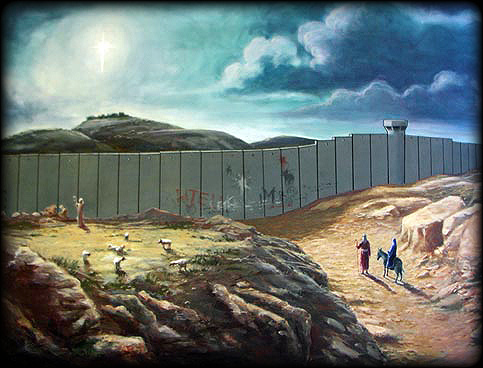
Here’s a cartoon below, a comment on the security wall being built in Israel, that got very little circulation in the west at Christmas time. Can you imagine the impact had this drawing run in newspapers in Europe, the U.S., and Canada?
It’s a mashup of a famous oil painting* related to the Christian Nativity, from a London-based artist who goes by the name Banksy. (Warning: Banksy pulls no punches; views shown are quite strong, often very funny, always provocative, generally safe for work unless you work for an authoritarian like Dick Cheney who wants no counter opinions.)

Banksy's modern nativity -- does he ever bother to copyright his stuff, or would he rather you broadcast it?
* At least I thought so in 2008. I can’t find the painting now. Anybody recognize a work underneath Banksy’s re-imagining? Let us know in comments, eh?
Tip of the old scrub brush to Peoples Geography.
More, in 2011: