Texas expects every Texas scientist to do her or his duty

March 9, 2009

Science needs your help, Texas scientists.

Last month science won a victory when members of the Texas State Board of Education (SBOE) agreed to strip creationist, anti-science language out of biology standards.

In the lightning round that followed the vote, however, some bad stuff was proposed.  The National Center for Science Education asks every Texas scientist to contact your representative on the SBOE to urge them to vote against the bad stuff at a meeting near the end of March.

Don’t take my word for it.  Below the fold, the full rundown of bad stuff, copied from NCSE’s website.

Details are available from Texas Citizens for Science.

New Texas Science Standards Will Be Debated and Voted Upon March 26-27 in Austin by the Texas State Board of Education — Public Testimony is March 25

Radical Religious-Right and Creationist members of the State Board of Education will attempt to keep the unscientific amendments in the Texas science standards that will damage science instruction and textbooks.

THE TEXAS SCIENCE STANDARDS SHOULD BE ADOPTED UNCHANGED!

The Texas Freedom Network has good information, too.

Also check out Greg Laden’s Blog.

Even Pharyngula’s in — Myers gets more comments from sneezing than the rest of us — but if he’s on it, you know it’s good science.

Read the rest of this entry »


Creationism, at the Bad Idea Blog

March 9, 2009

Bad himself has gone silent for a while.

But in a thread he started, originally on Ben Stein’s world tour of crackpottery, we’ve got a creationist minister who argues that evolution can’t be shown, is impossible, and that the science backs creationism.

Go give it a look.

I may post some of the stuff over here, eventually.  In the meantime, go discuss.  Maybe Bad can be convinced to come out of retirement.

Definitely related post:


Texas legislators get the message: Creationism hurts science and jobs

February 14, 2009

On Darwin’s birthday, two Texas legislators wrote about the stakes in the tussle between creationists on the one side, and educators, scientists and economic development on the other, in the Houston Chronicle.

Somebody gets it!  Will Gov. Rick Perry and SBOE Chairman Don McLeroy get the message?  McLeroy was reappointed as chairman a week ago — but the appointment must be approved by the State Senate.  Is a fight possible?

State Board of Education must be held accountable

By STATE SEN. RODNEY ELLIS and STATE REP. PATRICK M. ROSE
Copyright 2009 Houston Chronicle

[Can a newspaper copyright the words of public servants doing their jobs?]

Feb. 12, 2009, 12:14AM

As scientists and educators across Texas and the nation mark the 200th birthday of Charles Darwin with calls for a renewed commitment to science education, the State Board of Education continues to engage in narrow theological debate about the validity of evolution. If Texas schoolchildren are to succeed in the 21st Century economy, the SBOE must focus less on internal philosophical differences and more on improving science instruction.

Last month, the board once again got bogged down in a bitter dispute over this issue. Members tentatively approved new science curriculum standards that protect teaching of evolution in one area, while creationists succeeded in watering it down elsewhere. Sadly, it was just the latest battle in the “culture war” being fought by a board that decides what more than 4.7 million Texas children learn in their public schools.

Families should be the primary educators on matters of faith, not our public schools. Regardless of board members’ personal beliefs on creationism and evolution, science classrooms are not the place for resolving such disagreements about faith. Those classrooms should focus on science.

Despite one’s personal stance on evolution, its teaching is critical to the study of all the biological sciences.

Scientists from our state’s universities have expressed this to the board, and have warned that watering down science education would undermine biotechnology, medical and other industries that are crucial to our state’s future.

Last session, the Legislature committed to investing $3 billion over the next 10 years in making Texas the global leader in cancer research and finding cures. This historic investment is certain to bring economic and academic opportunities to our state.

Sadly, even as our state takes one step forward, the SBOE moves us two steps back by continuing to support a diminished standard for science education. Texas’ credibility and its investment in research and technology are placed at risk by these ongoing, unproductive debates.

This is a critical issue and a critical time. Study after study has demonstrated that states which do well in science education have the brightest long-term economic future. According to Gov. Rick Perry’s Select Commission on Higher Education and Global Competitiveness, despite improved scores in math and reading, Texas’ students continue to lag alarmingly behind other states in science proficiency.

The National Assessment of Education Progress revealed that only 23 percent of Texas 8th graders achieved proficiency in science, compared with 41 percent of students in the top-performing states — the states with which we compete for jobs.

Yet the board continues to undermine high-quality science instruction, allowing our students to slip further behind.

To ensure that the SBOE works as it should, we have filed legislation to place the board under periodic review by the Sunset Advisory Commission and hold them accountable for their performance, just as we do the Texas Education Agency and other state agencies.

The decisions of the SBOE not only impact millions of young lives on a daily basis, but impact the economic progress of our state as well.

For these reasons and many others, the public has a right to full disclosure and oversight.

The board has escaped such scrutiny for far too long. The disregard for educators, instructional experts and scientists can’t continue. It’s time to take a closer look at the operations and policies of the State Board of Education.

Our state, and especially our kids, deserve better.

Ellis represents the Houston area and parts of Fort Bend County; Rose represents Blanco, Caldwell and Hays counties.

Thank you, Houston Chronicle.

Resources:


Gov. Perry to Texas, biologists, educators, students, Hispanics, and parents: “Drop Dead”

February 7, 2009

That hissing sound you hear is hope leaking out of Texas scientists, educators and students.  Those trucks you hear are the moving trucks of science-based industries, leaving Texas for California (!), Massachusetts, Utah, New York, Florida and other states where science is taught well in public schools and assumed to be an educational priority.

In his year as chairman of the Texas State Board of Education, Don McLeroy has sown strife and discord among board members, professional staff, and educators across Texas.  He insulted Texas Hispanics and did his best to eliminate Hispanic heritage from Texas literature studies.  He repeatedly dismissed the advice of legally-required advisory committees of teachers and educators.  He insulted top scientists who offered advice on science education, and he ignored education experts in the development of curricula and standards for Texas public schools.  He promises a religious crusade to gut biology education in Texas.

On Friday, Texas Gov. Rick Perry reappointed McLeroy as chairman of SBOE, to a term that ends on February 1, 2011.

The Texas Senate must confirm.

Resources:


What’s going on in Texas?

February 4, 2009

In administrative hearings at the federal level, it’s a crime to knowingly present false testimony to an agency which might rely on that information to make a decision.

In Texas?  The law is not so clear — but Discovery Institute’s John West celebrates false information used by the State Board of Education in considering science standards.  (This is one reason, I suspect, why creationists are not more active at the federal level — their tactics are not only unethical, but also illegal.)

Sadly, shockingly but not surprisingly, the false information was presented by SBOE Chairman Don McLeroy in theform of nuggets from the creationist quote mines.

Keep watching that space — with the help of Jeremy Mohn’s blog, which has most of the story in a post from his co-blogger Cheryl Shepherd-Adams.

Tip of the old scrub brush to Tony Whitson and Texas Citizens for Science.


Darwinian medicine works; should we tell the children?

February 1, 2009

The indomitable  and always informative Coturnix at Blog Around the Clock pointed to this excerpt from an interview Richard Dawkins did with Randolph Nesse.  Randy Nesse is one of the most visible exponents of Darwinian medicine.  Nesse argues that much of modern medicine, especially the treatments and cures, is incomprehensible except in the light of evolution theory.

In short, Nesse is saying that the ability of physicians to diagnose and treat disease depends on accurate understandings and applications of evolution theory.

Does this sound familiar?  Sure — this is just a deeper understanding of the principles behind Austin biologist Steve Bratteng’s 13 Questions.

Creationists are working to be sure that Nesse’s points are kept from Texas high school students in science classes.  From this interview,  you can see why scientists ask the State Board of Education to ask Texas educators to teach science instead.  Actions of creationists are directed at preventing information such as this from getting to Texas students, to keep them in the dark.

Texas Citizens for Science, the Texas Freedom Network, and Teach Them Science.org are three organizations working to make sure Texas students get straight science that they need.

Resources:


Joe Lapp’s “flat earth” testimony to the Texas SBOE

January 23, 2009

[Another in a series of posts highlighting testimony supporting evolution offered to the Texas State Board of Education this week.]

Joe Lapp, Testimony to the Texas SBOE, January 21, 2009 - click picture for link to original image at Teach Them Science.com

Joe Lapp, Testimony to the Texas SBOE, January 21, 2009 - click picture for link to original image at Teach Them Science.com


Science wins: “Strengths and weaknesses” stripped from Texas science standards, 7-8

January 22, 2009

On a one-vote margin, the Texas State Board of Education stripped out of Texas science standards for public schools, creationist language that suggests there are weaknesses in evolution theory that make the theory sound like less than it is.

So far, that’s all the news I have, via the Quorum Report (January 22, 2009).  Tip of the old scrub brush to Annette Carlisle of Texas Citizens for Science.

Huge win for Texas Citizens for Science, the Texas Freedom Network, the National Center for Science Education, and the newly-formed Teach Them Science.org.  Huge win for Texas students, Texas high schools, Texas colleges and the Texas economy.

But of course, there’s still a chance to lose. Final More votes expected on the adoption of the standards, tomorrow; final vote in March.

Update – Not all news is good:  Among amendments adopted Thursday are amendments that call into question Big Bang in physics and common descent in biology.  Watch for update post.  Oy.

Resources:


Rev. Sharon Watkins’ sermon: Feed the good wolf

January 21, 2009

Update: In comments, Mary points to this site at the National Cathedral, for full video of the service. Thank you, Mary!

Full text here.

And here:

Harmonies of Liberty
Isaiah 58:6‐12, Mt 22:6‐40

Rev. Dr. Sharon E. Watkins
National Prayer Service; January 21, 2009

Mr. President and Mrs. Obama, Mr. Vice President and Dr. Biden, and your families, what an inaugural celebration you have hosted! Train ride, opening concert, service to neighbor, dancing till dawn . . .

And yesterday . . . With your inauguration, Mr. President, the flame of America’s promise burns just a little brighter for every child of this land!

There is still a lot of work to do, and today the nation turns its full attention to that work. As we do, it is good that we pause to take a deep spiritual breath. It is good that we center for a moment.

What you are entering now, Mr. President and Mr. Vice President, will tend to draw you away from your ethical center. But we, the nation that you serve, need you to hold the ground of your deepest values, of our deepest values.

Beyond this moment of high hopes, we need you to stay focused on our shared hopes, so that
we can continue to hope, too.

We will follow your lead.

There is a story attributed to Cherokee wisdom:
One evening a grandfather was teaching his young grandson about the internal battle that each person faces.
“There are two wolves struggling inside each of us,” the old man said.
“One wolf is vengefulness, anger, resentment, self‐pity, fear . . .
“The other wolf is compassion, faithfulness, hope, truth, love . . .”
The grandson sat, thinking, then asked: “Which wolf wins, Grandfather?”
His grandfather replied, “The one you feed.”

There are crises banging on the door right now, pawing at us, trying to draw us off our ethical center – crises that tempt us to feed the wolf of vengefulness and fear.

We need you, Mr. President, to hold your ground. We need you, leaders of this nation, to stay centered on the values that have guided us in the past; values that empowered to move us through the perils of earlier times and can guide us now into a future of renewed promise.

We need you to feed the good wolf within you, to listen to the better angels of your nature, and by your example encourage us to do the same.

This is not a new word for a pastor to bring at such a moment. In the later chapters of Isaiah, in the 500’s BCE, the prophet speaks to the people. Back in the capital city after long years of exile, their joy should be great, but things aren’t working out just right. Their homecoming is more complicated than expected. Not everyone is watching their parade or dancing all night at their arrival.

They turn to God, “What’s going on here? We pray and we fast, but you do not bless us. We’re confused.”

Through the prophet, God answers, what fast? You fast only to quarrel and fight and strike with the fist. . .

Is not this the fast that I choose: to loose the bonds of injustice . . . to share your bread with the hungry, and bring the homeless poor into your house . .? Then your light shall break forth like the dawn, and your healing shall spring up quickly . . .

At our time of new beginning, focused on renewing America’s promise –yet at a time of great crisis – which fast do we choose? Which “wolf” do we feed? What of America’s promise do we honor?

Recently Muslim scholars from around the world released a document, known as “A Common Word Between Us.” It proposes a common basis for building a world at peace. That common basis? Love of God and love of neighbor! What we just read in the Gospel of Matthew!
So how do we go about loving God? Well, according to Isaiah, summed up by Jesus, affirmed by a worldwide community of Muslim scholars and many others, it is by facing hard times with a generous spirit: by reaching out toward each other rather than turning our backs on each other. As Mahatma Gandhi once said, “people can be so poor that the only way they see God is in a piece of bread.”

In the days immediately before us, there will be much to draw us away from the grand work of loving God and the hard work of loving neighbor. In crisis times, a basic instinct seeks to take us over – a fight/flight instinct that leans us toward the fearful wolf, orients us toward the self‐interested fast . . .

In international hard times, our instinct is to fight – to pick up the sword, to seek out enemies, to build walls against the other – and why not? They just might be out to get us. We’ve got plenty of evidence to that effect. Someone has to keep watch and be ready to defend, and Mr. President – Tag!  You’re it!

But on the way to those tough decisions, which American promises will frame those decisions?  Will you continue to reason from your ethical center, from the bedrock values of our best shared hopes?  Which wolf will you feed?

In financial hard times, our instinct is flight – to hunker down, to turn inward, to hoard what little we can get our hands on, to be fearful of others who may take the resources we need. In hard financial times, which fast do we choose? The fast that placates our hunkered‐down soul – or the fast that reaches out to our sister and our brother?

In times, such as these, we the people need you, the leaders of this nation, to be guided by the counsel that Isaiah gave so long ago, to work for the common good, for the public happiness, the wellbeing of the nation and the world, knowing that our individual wellbeing depends upon a world in which liberty and justice prevail.

This is the biblical way. It is also the American way – to believe in something bigger than ourselves, to reach out to neighbor to build communities of possibility, of liberty and justice for all. This is the center we can find again whenever we are pulled at and pawed at by the vengeful wolf, when we are tempted by the self‐interested fast.

America’s true character, the source of our national wisdom and strength, is rooted in a generous and hopeful spirit.

“Give me your tired, your poor,
Your huddled masses yearning to breathe free, . . .
Send these, the homeless, tempest‐tost to me,1

Emma Lazarus’ poetry is spelled out further by Dr. Martin Luther King, Jr,: “As long as there is poverty in the world I can never be rich, even if I have a billion dollars. As long as diseases are rampant and millions of people in this world cannot expect to live more than twenty‐eight or thirty years, I can never be totally healthy . . . I can never be what I ought to be until you are what you ought to be. This is the way our world is made.”2

You yourself, Mr. President, have already added to this call, “If there’s a child on the south side of Chicago who can’t read, that matters to me, even if it’s not my child. . . . It’s that fundamental belief — I am my brother’s keeper, I am my sister’s keeper — that makes this country work.”

It is right that college classes on political oratory already study your words . You, as our president, will set the tone for us. You will help us as a nation choose again and again which wolf to feed, which fast to choose, to love God by loving our neighbor.

We will follow your lead – and we will walk with you. And sometimes we will swirl in front of you, pulling you along.
At times like these – hard times –we find out what we’re made of. Is that blazing torch of liberty just for me? Or do we seek the “harmonies of liberty”, many voices joined together, many hands offering to care for neighbors far and near?

Though tempted to withdraw the offer, surely Lady Liberty can still raise that golden torch of generosity to the world. Even in these financial hard times, these times of international challenge, the words of Katherine Lee Bates describe a nation with more than enough to share:   “Oh, beautiful for spacious skies, for amber waves of grain, for purple mountain majesties above the fruited plain . . .”

A land of abundance guided by a God of abundance, generosity, and hope – This is our heritage. This is America’s promise which we fulfill when we reach out to each other.

Even in these hard times, rich or poor, we can reach out to our neighbor, including our global neighbor, in generous hospitality, building together communities of possibility and of hope. Even in these tough times, we can feed the good wolf, listen to the better angels of our nature. We can choose the fast of God’s desiring.

Even now in these hard times let us
Lift every voice and sing Till earth and heaven ring,
. . . with the harmonies of Liberty;

Even now let us Sing a song full of hope. . .

Especially now, from the center of our deepest shared values, let us pray, still in the words of James Weldon Johnson:

Thou who has by Thy might
Led us into the light,
Keep us . . . in the path, we pray.
Lest our feet stray from the places, our God, where we met Thee,
Lest, our hearts drunk with the wine of the world, we forget Thee;
Shadowed beneath Thy hand,
May we forever stand.
True to our God,
True to our native land.3

_________________________________

1 Emma Lazarus
2 The Words of MLK, Jr., selected by Coretta Scott King, 21
3 James Weldon Johnson


Quote of the moment: Richard Halverson, chaplain of the U.S. Senate, religion in America becomes enterprise

January 20, 2009

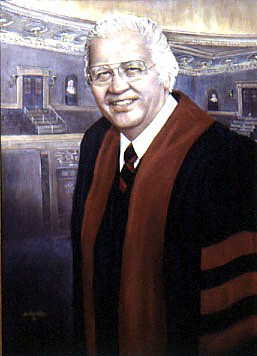
Rev. Richard C. Halverson, 1916-1995, Chaplain of the U.S. Senate; painting for the North Dakota Capitol by Ann Linton Hodge

Rev. Richard C. Halverson, 1916-1995, Chaplain of the U.S. Senate; painting for the North Dakota Capitol by Ann Linton Hodge

“In the beginning the church was a fellowship of men and women centering on the living Christ. Then the church moved to Greece, where it became a philosophy. Then it moved to Rome, where it became an institution. Next, it moved to Europe, where it became a culture. And, finally, it moved to America, where it became an enterprise.”

Richard Halverson, former Chaplain of the United States Senate

At least, P. M. Summer claims Halverson said it, and I trust himTip of the old scrub brush to P. M. Summer, at Una Perla, Por Favor.


Disciples minister to preach National Prayer Service

January 18, 2009

This will make P.  Z. Myers shake his head — apologies, P. Z. — but those of us in the “mainstream,” or “liberal leaning” sect of the Disciples of Christ are quite happy that our general minister, Sharon Watkins, will preach the sermon at the National Prayer Service on Wednesday.

We’re such a politically polyglot group that we can be described as mainstream, liberal, or conservative with some accuracy.  Three presidents have Disciples roots — James Garfield, who was a Disciples minister before becoming president of a Disciples college in Ohio; Lyndon Johnson, who was a life-long Disciple, and who built a chapel on his ranch; and Ronald Reagan, whose mother was a devout Disciple, and who attended one of several Disciples affiliated colleges, Eureka College in Eureka, Illinois.

Watkins is the first woman to preach at this service in the history of the nation.

The National Prayer Service is one of those events that underscores the separation of church and state.  At the first Washington inaugural, it was held the same day as the ceremony, but after the official ceremony.  The attendees concluded the swearing in and other official ceremonies, then adjourned to a church a few blocks away for a sermon, those who wished to.

This year the sermon will be held in the National Cathedral, a majestic building which is actually an Episcopalian venue (where Woodrow Wilson and Helen Keller are interred), miles from the federal area at the National Mall, and a day after the inauguration.

But watch:  There will be a band of religious radicals, fanatics, who will claim that the mere existence of this service somehow nullifies the First Amendment, and suggests that the government has a religious bias.  Do not believe them.  You know the history, and you know better.  Our government has great tolerance for religious displays, but no tolerance for religious bias, in our government.

I’ve wondered sometimes what would happen were the three Disciples presidents to meet.  If Reagan and Johnson ever met, I have not found the record of it.  I wonder whether Johnson, Reagan and Garfield could have found between them some subject of common interest for talk of substance.  It’s difficult to imagine Reagan and Johnson finding much common ground, one who revered FDR and the New Deal, and the other who campaigned against the New Deal almost from the day FDR died.  And yet they shared concepts of faith, and they may have found there common ground on which to stand, and talk.

I marvel at a sect that embraces, and celebrates, such diversity.  We think it makes for healthier theology, healthier congregations, and a healthier nation.

We can hope.

Below is the press release from Disciples News Service, with details about the service and how to view it or listen to it.  There is also a plea for clips from local papers — maybe some of you could do a good turn and clip any article that appears in your local paper, with the date and page, and mail it in.  It’s for the archives, you know — history.

Disciples News Service

FOR IMMEDIATE RELEASE

National Prayer Service Updates

January 17, 2009
Dear Disciples,
Earlier this week it was announced that Rev. Dr. Sharon Watkins will preach the sermon at the National Prayer Service in Washington, D.C. on Wednesday, Jan. 21. Her sermon will conclude Presidential Inauguration activities for our country’s forty-fourth President, Barack Obama. Dr. Watkins appreciates the outpouring of support, prayers and well wishes she has received from Disciples and ecumenical colleagues everywhere since the announcement.
“I am so grateful that Disciples have a role in this historic moment,” said Watkins. “I am depending on your prayers for God to use me to deliver an uplifting and appropriately challenging message to our new President, vice-President and all those who will attend the service.”
Watkins will be joined by a diverse group of religious leaders at the prayer service, which will take place at the National Cathedral, starting at 10 a.m. EST.
A press release listing those who will participate in the service was released yesterday afternoon and includes another Disciples pastor, Dr. Cynthia Hale, Senior Pastor of Ray of Hope Christian Church in Decatur, Ga. Hale will be among those reading scripture. To read the press release that announces participants at the service, please go to:
www.pic2009.org/pressroom/entry/presidential_inaugural_committee_
announces_participants_of_national_prayer_/

Many of you have asked about opportunities to view the program. Our office has just learned that the program will be webcast in two ways. One is through the National Cathedral website at: www.nationalcathedral.org. The other option is to go to the Presidential Inaugural Committee website at www.pic2009.org.
We’ve also had a number of phone calls regarding the availability of tickets for the prayer service. Unfortunately, we have not been able to secure tickets for the service.
Please note that DisciplesWorld Publisher and Editor Verity A. Jones will provide special coverage of many Inauguration activities, including the prayer service. Jones will blog from Jan. 18 to Jan. 21 at: disciplesworld.wordpress.com. She also will post news stories to the Disciples World home page and send short updates from the DisciplesWorld “twitter” account. To read more about ways DisciplesWorld will keep you informed, go to: www.disciplesworld.com/dynamic.html?wspID=501

Finally, Associate General Minister and Vice-President Todd Adams asks that Disciples send in hard copies of newspaper articles that have been covered in your community about Dr. Watkins and the prayer service, so that we might keep them in our official archives. Articles can be sent to: Dr. Todd Adams, Office of General Minister and President, P.O. Box 1986; Indianapolis, Ind. 46206-1986.
To read the Jan. 11 press release from the Presidential Inaugural Committee that announced Dr. Watkins selection for the prayer service and to learn updates about events taking place during the Inauguration, please visit www.disciples.org.
Please keep Sharon and the many other Disciples who will be attending the Inauguration, National Prayer Service and other events in your prayers.

Blessings,
Wanda Bryant Wills
Executive Director of Communication Ministries

Tip of the old scrub brush to Bill Longman, “Bill in the Ozarks,”  and the DoCDisc Listserv.

Other resources:


Scientists of a feather (& Big Bang resources)

January 15, 2009

Gamow and Myers.

From a report on Simon Singh’s presentation on Big Bang to the New York Academy of Sciences, reported by William Tucker:

There is much, much more to Singh’s chronicle. Did you know, for example, that helium was discovered in the sun before it was found on earth? Most terrestrial helium had long since drifted into space—hence the name, derived from “helios,” Greek for the sun. Then there is story of George Gamow’s first scientific experiment, when he took home the communion wafer in his cheek and put it under the microscope. He found no evidence of the Transubstantiation. “I think this was the experiment that made me a scientist,” he later wrote.

The report on Singh’s presentation is itself a good, concise history of Big Bang theory development, accompanied by this long list of top-notch, on-line resources about Big Bang.

Resources

Books:

The Structure of Scientific Revolutions, by Thomas S. Kuhn. 1996. University of Chicago Press.
Amazon | Barnes & Noble

Big Bang: The Origin of the Universe, by Simon Singh. 2005. Harper Collins, New York.
Amazon | Barnes & Noble

The Code Book, by Simon Singh. 2000. Anchor, New York.
Amazon | Barnes & Noble

Fermat’s Enigma, by Simon Singh. 1998. Anchor, New York.
Amazon | Barnes & Noble

Web Sites:

The Astronomy Cafe
Subtitled “The website for the astronomically disadvantaged,” Sten Odenwald’s site includes answers to many frequently asked questions about the universe and its origins and describes a number of books and articles he has written on the subject.

“Big Bang” on Wikipedia
An encyclopedic overview of the subject, including the history of the theory, problems it has faced, and questions remaining to be investigated. The essay includes extensive hyperlinks to other related topics.

Creation of a Cosmology: Big Bang Theory
A concise scientific explanation of the Big Bang theory.

Curious About Astronomy? Ask an Astronomer
This Web site for laypeople provides an archive of questions and answers about the Big Bang, and allows visitors to pose their own questions on the subject.

“A Day Without Yesterday”: Georges Lemaître & the Big Bang
Extensive biography of Georges Lemaître (1894-1966).

The First Three Minutes
Review of Steven Weinberg’s The First Three Minutes, a book about the very early development of the universe.

Sir Fred Hoyle
Extensive biography of astronomer, mathematician, and novelist Sir Fred Hoyle (1915-2001).

Great Debates in Astronomy
A series of debates held at the Smithsonian’s Museum of Natural History among leaders in the astronomical community. Features background information, educational material, and published proceedings for each debate.

The History Guide: Giordano Bruno
Links to resources about the life of philosopher and astronomer Giordano Bruno (1548-1600).

Hubble
Brief biography of Edwin Hubble.

Physics: Cosmology and Astronomy
A collection of links to popular information on the subject, from About.com.

Science & the Arts
A program organized by the City University of New York New Media Lab that bridges the two worlds. Expert speakers and performers—including recent participants like Laurie Anderson, Wallace Shawn, Michel Gondry, Brian Eno, and Todd Haynes, as well as Mighton and Greene—present examples of the interplay of science and the arts in dance, art, and theater. A calendar of upcoming events is available, as well as information about past offerings.

The Ten Big Questions: Big Bang Theory
This page ponders philosophical questions related to the Big Bang theory.

Theories Section—Big Bang
Concise article on the subject, written for educated non-astronomers, from Astronomy Today.

From the Academy:

What Caused the “Bang” of the Big Bang?, featuring Alan H. Guth, Massachusetts Institute of Technology. 2001. New York Academy of Sciences eBriefing.

A 50-50 Chance of Making It to the 22nd Century? Martin Rees Asks Scientists to Help Improve the Odds. 2003. New York Academy of Sciences eBriefing.

String Theory: A Conversation with Brian Greene. 2003. New York Academy of Sciences eBriefing, co-sponsored by NOVA.

Mirror, Mirror: Robin Kerrod and the Romance of Astronomy. Reported by William Tucker. Author: Robin Kerrod. 2004. New York Academy of Sciences Readers & Writers article.

Cosmic Questions
Annals of the New York Academy of Sciences
Volume 950, published Dec 2001
Edited by James B. Miller
description | full text

Faber, S. M. The Big Bang as Scientific Fact. 2001. Annals Online 950: 39-53 abstract | full text

Guth, A. H. Eternal Inflation. 2001. Annals Online 950: 66-82 abstract | full text

Russell, R. J. Did God Create Our Universe? Theological Reflections on the Big Bang, Inflation, and Quantum Cosmologies. 2001. Annals Online 950: 108-127 abstract | full text

George Gamow
Encyclopedia entry on the life of physicist George Gamow (1904-1968).

AstronomyLINKS
A small collection of annotated links on the big bang theory.

Also, see Simon Singh’s website.


I get e-mail from DDT cranks . . .

January 3, 2009

I noted the errors in a post at Reformed Musings.  Then I noodled around Mr. Mattes’s site,  and I dropped this note into his “about” thread, frustrated that I couldn’t just politely note the errors at his posts, where he’s disabled comments.

I said:

I wish you’d take comments on your posts. For example, you’ve got a couple of errors dealing with DDT in your post on climate change. It looks as though you’re hoping to sneak them past readers, rather than get the science right. I hope that’s not so.  By: Ed Darrell on December 31, 2008 at 7:41 pm

Mattes held that comment in moderation (afraid to let his other readers see it?), but responded in sort by diving deeper into wankery, with a post defending the more crackpot ideas of Michael Crichton, and straying much farther from the science in his claims about DDT and environmenta protection.  Heck, he even trotted out errors about Paul Ehrlich’s writing, apparently not content to be wrong about only DDT and global warming.

So, noting Mattes’s aggravation of his errors, I wrote again on his blog, a bit more sternly:

Shame on you. If you really think DDT is safe and that there was no science behind its “ban,” open comments, let us discuss.

But to compound your errors, and then to fail to approve comments from those who offer you correct information — well, reformation only goes so far, I guess.  By: Ed Darrell on January 2, 2009 at 11:56 am

Rather than open comments to discuss, and rather than respond to the post at the Bathtub, he sent me e-mail:

Shame on me? Excuse me, but I’m a bit amazed at your arrogance. You’ll offer correct information? Why, because others have a different opinion than you they have to be wrong? What are your technical qualifications and applicable experience, besides having a blog and a keyboard? Have you been to Africa? I have. Is racial eugenics your thing? Is that why third-world inhabitants are expendable to you?

Whatever you think you know, DDT is being successfully employed in Africa and elsewhere to save lives every day. No bad effects evident.  None. Their public health officials are literally begging for more. But then, their only agenda is survival. Selective and misleading reporting doesn’t interest them, only results.

Did Mattes miss many of the Tinfoil Hat Brigade’s concerns?

For the record, I don’t share Mattes’s fascination with eugenics as applied to race (and I’ll wager Mattes has no record fighting it); that tends to be a concern of the anti-science, historical revisionists (wrong about history, too).  I said nothing disparaging about third world peoples, and there are a dozen or more posts here to confirm my concerns about health in the third world, in contrast to only the junk science, “Let’s poison the hell out of Africa” attitude from Mattes.

In his second paragraph, he contradicts one of the main points of his first post. He says DDT is being used successfully in Africa — while his first post complained that environmentalists had successfully stopped it from being used.

That’s rather the mark of the true DDT sycophant, someone who suffers seriously from internet DDT poisoning:  The only reason they mention DDT is to find a cudgel to use against brave and smart women like Rachel Carson, or otherwise to criticize people who call for an end to pollution, or the preservation of water, air, trees or animals.  Unanchored by any fact or any need or desire to be accurate, they attack environmenalists, damn the inconsistency of the attacks.

Oy.

He’s followed up today with a new post that assaults science at every turn, claiming to follow science journals, but instead citing the chemical industry supporters like Richard Tren, opposing the Centers for Disease Control and World Health Organization.  While complaining about “eco-socialism,” he approvingly cites the experts of Lyndon Larouche, the late Dr. Gordon Edwards, in all of his errors and all of the political wankery of Larouche.

Mattes has gone back to the false claims that Edmund Sweeney exhonerated DDT, and that “evil” William Ruckelshaus banned DDT anyway — completely murdering Sweeney’s analysis and the law behind it, and completely avoiding the law, the court cases, and the history behind Ruckleshaus’s actions.

In his frantic, apoplectic dance to avoid discussing whether he might be in error, Mattes has dived so deeply into the depths of tinfoil hat sourcery (no, it’s spelled as I intended it) that in the end, he’s not jus twrong, he’s not even wrong.

If someone criticized any translation of the Bible as carelessly and wildly as Mattes criticizes science, he’d be out recruiting neighbors with pitchforks and torches to march.

Mattes claims he’s done with the issue.  We can only hope.  To continue in his current trend, he’d need to deny gravity (both Newton and Einstein), atomic theory, and Linneaus.  But I also suppose it means he’ll never check here to see the facts.  Just when we thought we were making progress . . .

The real story about DDT, a few of the posts at Millard Fillmore’s Bathtub:

The real story, elsewhere:

At Bug Girl’s Blog:

At Deltoid:

Also:


Who invented Santa Claus, and the Night Before Christmas?

December 24, 2008

An encore post from 2007

Thomas Nast invented Santa Claus? Clement C. Moore didn’t write the famous poem that starts out, “‘Twas the night before Christmas, and all through the house . . . ?”

The murky waters of history from Millard Fillmore’s Bathtub soak even our most cherished ideas and traditions.

But isn’t that part of the fun of history?

Santa Claus delivers to Union soldiers, "Santa Claus in Camp" - Thomas Nast, Harper's Weekly, Jan 3, 1863

Thomas Nast’s first published drawing featuring Santa Claus; for Harper’s Weekly, “A Journal of Civilization,” January 3, 1863 Nast portrayed the elf distributing packages to Union troops: “Santa Claus in camp.” Nast (1840-1904) was 23 when he drew this image.

Yes, Virginia (and California, too)! Thomas Nast created the image of Santa Claus most of us in the U.S. know today. Perhaps even more significant than his campaign against the graft of Boss Tweed, Nast’s popularization of a fat, jolly elf who delivers good things to people for Christmas makes one of the great stories in commercial illustration. Nast’s cartoons, mostly for the popular news publication Harper’s Weekly, created many of the conventions of modern political cartooning and modeled the way in which an illustrator could campaign for good, with his campaign against the graft of Tammany Hall and Tweed. But Nast’s popular vision of Santa Claus can be said to be the foundation for the modern mercantile flurry around Christmas.

Nast is probably ensconced in a cartoonists’ hall of fame. Perhaps he should be in a business or sales hall of fame, too.  [See also Bill Casselman’s page, “The Man Who Designed Santa Claus.]

Nast’s drawings probably drew some inspiration from the poem, “Account of a Visit from St. Nicholas,” traditionally attributed to Clement C. Moore, a New York City lawyer, published in 1822. The poem is among the earliest to describe the elf dressed in fur, and magically coming down a chimney to leave toys for children; the poem invented the reindeer-pulled sleigh.

Modern analysis suggests the poem was not the work of Moore, and many critics and historians now attribute it to Major Henry Livingston, Jr. (1748-1828) following sleuthing by Vassar College Prof. Don Foster in 2000. Fortunately for us, we do not need to be partisans in such a query to enjoy the poem (a complete copy of which is below the fold).

The Library of Congress still gives Moore the credit. When disputes arise over who wrote about the night before Christmas, is it any wonder more controversial topics produce bigger and louder disputes among historians?

Moore was not known for being a poet. The popular story is that he wrote it on the spur of the moment:

Moore is thought to have composed the tale, now popularly known as “The Night Before Christmas,” on December 24, 1822, while traveling home from Greenwich Village, where he had bought a turkey for his family’s Christmas dinner.

Inspired by the plump, bearded Dutchman who took him by sleigh on his errand through the snow-covered streets of New York City, Moore penned A Visit from St. Nicholas for the amusement of his six children, with whom he shared the poem that evening. His vision of St. Nicholas draws upon Dutch-American and Norwegian traditions of a magical, gift-giving figure who appears at Christmas time, as well as the German legend of a visitor who enters homes through chimneys.

Again from the Library of Congress, we get information that suggests that Moore was a minor celebrity from a well-known family with historical ties that would make a good “connections” exercise in a high school history class, perhaps (”the link from Aaron Burr’s treason to Santa Claus?”): (read more, below the fold)

Clement Moore was born in 1779 into a prominent New York family. His father, Benjamin Moore, president of Columbia University, in his role as Episcopal Bishop of New York participated in the inauguration of George Washington as the nation’s first president. The elder Moore also administered last rites to Alexander Hamilton after he was mortally wounded in a tragic duel with Aaron Burr.

A graduate of Columbia, Clement Moore was a scholar of Hebrew and a professor of Oriental and Greek literature at the General Theological Seminary in Manhattan. [See comment from Pam Bumsted below for more on Moore.] He is said to have been embarrassed by the light-hearted verse, which was made public without his knowledge in December 1823. Moore did not publish it under his name until 1844.

Tonight, American children will be tucked in under their blankets and quilts and read this beloved poem as a last “sugarplum” before slipping into dreamland. Before they drift off, treat them to a message from Santa, recorded by the Thomas Edison Company in 1922.

Santa Claus Hides in Your Phonograph
By Arthur A. Penn, Performed by Harry E. Humphrey.
Edison, 1922.
Coupling date: 6/20/1922. Cutout date: 10/31/1929.
Inventing Entertainment: The Motion Pictures and Sound Recordings of the Edison Companies

Listen to this recording (RealAudio Format)

Listen to this recording (wav Format, 8,471 Kb)

But Henry Livingston was no less noble or historic. He hailed from the Livingtons of the Hudson Valley (one of whose farms is now occupied by Camp Rising Sun of the Louis August Jonas Foundation, a place where I spent four amazing summers teaching swimming and lifesaving). Livingston’s biography at the University of Toronto site offers another path for a connections exercise (”What connects the Declaration of Independence, the American invasion of Canada, the famous poem about a visit from St. Nick, and George W. Bush?”):

Henry Livingston Jr. was born in Poughkeepsie, New York, on Oct. 13, 1748. The Livingston family was one of the important colonial and revolutionary families of New York. The Poughkeepsie branch, descended from Gilbert, the youngest son of Robert Livingston, 1st Lord of Livingston Manor, was not as well off as the more well-known branches, descended from sons Robert and Philip. Two other descendants of Gilbert Livingston, President George Walker Herbert Bush and his son, President-Elect George W. Bush, though, have done their share to bring attention to this line. Henry’s brother, Rev. John Henry Livingston, entered Yale at the age of 12, and was able to unite the Dutch and American branches of the Dutch Reformed Church. At the time of his death, Rev. Livingston was president of Rutgers University. Henry’s father and brother Gilbert were involved in New York politics, and Henry’s granduncle was New York’s first Lt. Governor. But the law was the natural home for many of Henry’s family. His brother-in-law, Judge Jonas Platt, was an unsuccessful candidate for governor, as was his daughter Elizabeth’s husband, U.S. Supreme Court Justice Smith Thompson. Henry’s grandson, Sidney Breese, was Chief Justice of the Illinois Supreme Court.

Known for his encyclopedic knowledge and his love of literature, Henry Livingston was a farmer, surveyor and Justice of the Peace, a judicial position dealing with financially limited criminal and civil cases. One of the first New Yorkers to enlist in the Revolutionary Army in 1775, Major Henry Livingston accompanied his cousin’s husband, General Montgomery, in his campaign up the Hudson River to invade Canada, leaving behind his new wife, Sarah Welles, and their week-old baby, on his Poughkeepsie property, Locust Grove. Baby Catherine was the subject of the first poem currently known by Major Livingston. Following this campaign, Livingston was involved in the War as a Commissioner of Sequestration, appropriating lands owned by British loyalists and selling them for the revolutionary cause. It was in the period following Sarah’s early death in 1783, that Major Livingston published most of his poems and prose, anonymously or under the pseudonym of R. Ten years after the death of Sarah, Henry married Jane Patterson, the daughter of a Dutchess County politician and sister of his next-door neighbor. Between both wives, Henry fathered twelve children. He published his good-natured, often occasional verse from 1787 in many journals, including Political Barometer, Poughkeepsie Journal, and New-York Magazine. His most famous poem, “Account of a Visit from St. Nicholas,” was until 2000 thought to have been the work of Clement Clarke Moore (1779-1863), who published it with his collected poems in 1844. Livingston died Feb. 29, 1828.

More on Henry Livingston and his authorship of the Christmas poem here.

Thomas Nast, Merry Old Santa Claus, Harper's Weekly, Jan 1, 1881


Our views of Santa Claus owe a great deal also to the Coca-Cola advertising campaign. Coca-Cola first noted Santa’s use of the drink in a 1922 campaign to suggest Coke was a year-round drink (100 years after the publication of Livingston’s poem). The company’s on-line archives gives details:

In 1930, artist Fred Mizen painted a department store Santa in a crowd drinking a bottle of Coke. The ad featured the world’s largest soda fountain, which was located in the department store of Famous Barr Co. in St. Louis, Mo. Mizen’s painting was used in print ads that Christmas season, appearing in The Saturday Evening Post in December 1930.

1936 Coca-Cola Santa cardboard store display

  • 1936 Coca-Cola Santa cardboard store display

Archie Lee, the D’Arcy Advertising Agency executive working with The Coca-Cola Company, wanted the next campaign to show a wholesome Santa as both realistic and symbolic. In 1931, The Coca-Cola Company commissioned Michigan-born illustrator Haddon Sundblom to develop advertising images using Santa Claus — showing Santa himself, not a man dressed as Santa, as Mizen’s work had portrayed him.
1942 original oil painting - 'They Remembered Me'

  • 1942 original oil painting – ‘They Remembered Me’

For inspiration, Sundblom turned to Clement Clark Moore’s 1822 poem “A Visit From St. Nicholas” (commonly called “‘Twas the Night Before Christmas”). Moore’s description of St. Nick led to an image of Santa that was warm, friendly, pleasantly plump and human. For the next 33 years, Sundblom painted portraits of Santa that helped to create the modern image of Santa — an interpretation that today lives on in the minds of people of all ages, all over the world.

Santa Claus is a controversial figure. Debates still rage among parents about the wisdom of allowing the elf into the family’s home, and under what conditions. Theologians worry that the celebration of Christmas is diluted by the imagery. Other faiths worry that the secular, cultural impact of Santa Claus damages their own faiths (few other faiths have such a popular figure, and even atheists generally give gifts and participate in Christmas rituals such as putting up a decorated tree).

For over 100 years, Santa Claus has been a popular part of commercial, cultural and religious life in America. Has any other icon endured so long, or so well?

Add to FacebookAdd to NewsvineAdd to DiggAdd to Del.icio.usAdd to StumbleuponAdd to RedditAdd to BlinklistAdd to TwitterAdd to TechnoratiAdd to Furl

________________________
Below:
From the University of Toronto Library’s Representative Poetry Online

Major Henry Livingston, Jr. (1748-1828)

Account of a Visit from St. Nicholas

1 ‘Twas the night before Christmas, when all thro’ the house,
2 Not a creature was stirring, not even a mouse;
3 The stockings were hung by the chimney with care,
4 In hopes that St. Nicholas soon would be there;
5 The children were nestled all snug in their beds,
6 While visions of sugar plums danc’d in their heads,
7 And Mama in her ‘kerchief, and I in my cap,
8 Had just settled our brains for a long winter’s nap –
9 When out on the lawn there arose such a clatter,
10 I sprang from the bed to see what was the matter.
11 Away to the window I flew like a flash,
12 Tore open the shutters, and threw up the sash.
13 The moon on the breast of the new fallen snow,
14 Gave the lustre of mid-day to objects below;
15 When, what to my wondering eyes should appear,
16 But a miniature sleigh, and eight tiny rein-deer,
17 With a little old driver, so lively and quick,
18 I knew in a moment it must be St. Nick.
19 More rapid than eagles his coursers they came,
20 And he whistled, and shouted, and call’d them by name:
21 “Now! Dasher, now! Dancer, now! Prancer, and Vixen,
22 “On! Comet, on! Cupid, on! Dunder and Blixem;
23 “To the top of the porch! to the top of the wall!
24 “Now dash away! dash away! dash away all!”
25 As dry leaves before the wild hurricane fly,
26 When they meet with an obstacle, mount to the sky;
27 So up to the house-top the coursers they flew,
28 With the sleigh full of Toys — and St. Nicholas too:
29 And then in a twinkling, I heard on the roof
30 The prancing and pawing of each little hoof.
31 As I drew in my head, and was turning around,
32 Down the chimney St. Nicholas came with a bound:
33 He was dress’d all in fur, from his head to his foot,
34 And his clothes were all tarnish’d with ashes and soot;
35 A bundle of toys was flung on his back,
36 And he look’d like a peddler just opening his pack:
37 His eyes — how they twinkled! his dimples how merry,
38 His cheeks were like roses, his nose like a cherry;
39 His droll little mouth was drawn up like a bow.
40 And the beard of his chin was as white as the snow;
41 The stump of a pipe he held tight in his teeth,
42 And the smoke it encircled his head like a wreath.
43 He had a broad face, and a little round belly
44 That shook when he laugh’d, like a bowl full of jelly:
45 He was chubby and plump, a right jolly old elf,
46 And I laugh’d when I saw him in spite of myself;
47 A wink of his eye and a twist of his head
48 Soon gave me to know I had nothing to dread.
49 He spoke not a word, but went straight to his work,
50 And fill’d all the stockings; then turn’d with a jerk,
51 And laying his finger aside of his nose
52 And giving a nod, up the chimney he rose.
53 He sprung to his sleigh, to his team gave a whistle,
54 And away they all flew, like the down of a thistle:
55 But I heard him exclaim, ere he drove out of sight –
56 Happy Christmas to all, and to all a good night.

Creationism vs. Christianity

December 20, 2008

Several weeks ago I responded to a lengthy thread at Unreasonable FaithThe original post was Garry Trudeau’s “Doonesbury” cartoon of the guy in a doctor’s office, just diagnosed with an infection.  The physician asks the guy if he’s a creationist, explaining that if he is, the doc will treat him with old antibiotics in honor of his belief that evolution of bacteria doesn’t occur. [Time passes: You may find the Doonesbury cartoon here, at Nature.com, in an article discussing issues with creationism.]

Point being, of course, that evolution occurs in the real world.  Creationists rarely exhibit the faith of their claims when their life, or just nagging pain, is on the line.  They’ll choose the evolution-based medical treatment almost every time.  There are no creationists in the cancer or infectious disease wards.

At one point I responded to a comment loaded with typical creationist error.  It was a long post.  It covered some ground that I’ve not written about on this blog.  And partly because it took some time to assemble, I’m reposting my comments here.  Of course, without the Trudeau cartoon, it won’t get nearly the comments here.

I’ll add links here when I get a chance, which I lacked the time to do earlier.  See my post, below the fold.

Read the rest of this entry »