July 21, 2011, Austin — Far fewer people than usual signed up to testify on the electronic science book supplements the Texas State Board of Education is considering in lieu of new textbooks (no money for texts from the legislature, you recall).
So, in keeping with Chairman Barbara Cargill’s wishes, testimony concluded at 4:06 p.m. CDT, just six minutes later than scheduled.
Good deal. The air conditioning in the first floor hearing room still doesn’t work well.
Since 2003, the most visible difference in these hearings is the back wall. That’s where the electrical outlets are, and so those seats get taken up by publishers, lawyers, lobbyists, and a few bloggers.
When the board reconvenes at 4:30, the board will take up consideration of the supplemental materials. If they follow the testimony, there will be a quick vote to approve all of the supplements still standing.
But this may be where the fireworks get lighted.
Most witnesses asked the board to simply approve the supplemental material favored by staff at the Texas Education Agency and by the panels of teachers and experts the board appointed earlier. Those recommendations excluded the only pro-creationism materials by a small, first-time publishing company.
Andrew Ellington, the biology whiz from the University of Texas, gave another great presentation — limited to two minutes under the new rules. Most pro-evolution witnesses got no questions.
Josh Rosenau, the out-of-state champion for evolution (from the National Center for Science Education – NCSE, and Sciblogs blogger at Thoughts from Kansas) made the case for hard science. Walter Bradley, the champion for creationism, didn’t show up. He sent a substitute to read his testimony, in which he urged rejection of all the proposed materials because they don’t savage Darwin. He also gave thanks to God for the Texas SBOE.
Schafersman wrote, and you may wish to note:
My friends at Texas Freedom Network (TFN), Ryan Valentine and Dan Quinn, are also live blogging this meeting at TFN Insider. Josh Rosenau of the National Center for Science Education is also here live tweeting at at @JoshRosenau and @NCSE (using hashtag #txtxt). TFN informs me they are also live tweeting at #SBOE. Abby Rapoport of the Texas Observer will also be tweeting about this meeting using #SBOE.
______________
The Board reconvened promptly at 4:30. After a typical, SBOE-style confused discussion of the process, submissions for science supplements for grades 4, 5, 6 and 7 were quickly approved on a show-of-hands vote. The room has an electronic voting system which could offer quicker results. A show-of-hands is folksy and friendly, but leaves a poor record for tracking. Is this an intentional stab against transparency?
Discussion stalled at 8th grade materials. Question raised about whether striking a publisher’s materials requires just one objection or a majority vote (should be majority vote — the chair’s description sorta said that).
One publisher disputed two of 132 found errors — staff agreed with the publisher that there was no error. Chemistry. Chair Cargill announces that chemistry, physics and IPC curricula for high schools will be considered first — biology last. (Fireworks then?).
[Much of this discussion carries little significance. Among the errors officially tallied: “Judgment” is misspelled. Gail Lowe makes it clear that she has what she thinks are significant errors identified for one publisher, in the biology materials- Pearson,Technical Laboratory Systems, Chemistry I think. Fines can be levied for publishers who fail to correct errors.]
This discussion is so much inside baseball that the board takes a recess to figure it out.
It looks like — correct me if I’m wrong — the board is working to take potshots at some publisher’s biology stuff, and kill it.
Spread the word; friends don't allow friends to repeat history.
I am a little bit concerned in looking at some of these science online supplementary materials. I looked at one of the links and there was a picture of a — a graphic of a human fetus next to a gorilla fetus talking about how they only differ by one amino acid. Therefore, universal common decent. So that is of some concern. And I am not quite sure if we are going to have the votes to overturn that. We will work diligently to rectify and correct some of that. But remember we lost a conservative seat, so we’re down to six.
In this unguarded moment, Cargill drops the double-speak and is honest about her plan for the first meeting over which she will preside as chair — pressure publishers to censor scientific information from their materials and to insert bogus information questioning evolution. And she knows exactly what her task is: to get the extra votes necessary to accomplish this.
Stay tuned to TFN Insider on Thursday and Friday as we give you a front-row seat at the contentious hearing and board vote.
Live blogging the meeting starting at about 10:00 a.m today at TFN Insider at at Steve Schafersman’s blog, from the Texas Citizens for Science.
Oblivious to Mendel’s work and significance, and to much else in the world of knowledge, the Texas State Board of Education debates how to frustrate the teaching of evolution with hearings in Austin tomorrow, and a vote on supplementary materials to texts in biology on Friday, July 22.
Mendel would urge, pray for Texas and the children who will be saddled with the decision of the Texas SBOE.
Then call your congressman, and him/her to act, now.
_____________
Note on Tom Toles from the Department of Earth Sciences, G-107 Environmental Geology, Indiana University-Purdue University at Indianapolis (IUPUI): “A political cartoon from the Washington Post on climate change. Tom Toles, a political cartoonist, often pens cartoons on environmental issues. His cartoons are often reprinted in other newspapers (Washington Post/Universal Press Syndicate).”
Spread the word; friends don't allow friends to repeat history.
If a global warming debate about certainty and cause only deepens doubt and defensiveness, what kind of debate would create support for action? We saw Hurricane Katrina as an opportunity to shift from the tired debate over cause and prevention to a new discussion about preparedness, thus reframing global warming from certainty to uncertainty and from limits on human activity to greater activity. Regardless of the cause, global warming is here and we need to prepare for it in the same way we prepare for any other imaginable natural disaster, not knowing exactly when or where it will strike. Global Warming Preparedness was created to test the possibility that action on global warming could be taken, not in spite of uncertainty, but because of it. (Breakthrough Institute, Plan for Global Warming Preparedness)
Part of “Green Revolution,” a series on science and environmental awareness from the National Science Foundation (NSF). This is a quick introduction to wind power, with some good video:
The military helicopter’s black shadow dances on an engorged Missouri River as the aircraft slowly loops the flood-encircled Fort Calhoun Nuclear Station — the same left-leaning turns the pilot navigated two days prior.
Warrant Officer Boe Searight, 32, with the Nebraska Air National Guard wants the infrared camera mounted under the chopper to record similar flood scenes for levee experts on the ground to compare.
He and his colleague Chief Warrant Officer 2 Eric Schriner also are looking for new signs of trouble for the flooded plant.
“Keep daily eyes on it and see if anything changes,” says Schriner, 31.
Far below, on mosquito-infested riverbanks, two-person crews with the Nebraska National Guard and Iowa National Guard patrol the Omaha and Council Bluffs levees in mud-caked boots.
Members of the Guard are the front-line levee watchers in an operation that clearly has high stakes: Levees protect about 40,000 people from homelessness in the neighboring river cities — as well as the region’s key airport.
The levee watchers are out there right now — three shifts a day, all week, searching for gopher holes, chasing away sightseers who could fall from the levees, and checking for signs of water seepage.
More than 130 men and women with the Nebraska Army and Air National Guard work each day for flood duty, along with 120 from the Iowa Army and Air National Guard.
The idea is to spot trouble early. Levees don’t always give notice before they rupture, but more often than not they do.
If trouble is spotted, steps can be taken to shore up or boost a weakened levee.
Good to know. Still no nuclear incident along the lines of the hoax report from the Pakistani outlet alleged to be based on a report from a Russian agency — which is also good news — but no cause for abatement of overall concern.
Sometimes safety preparations work. Kudos to the Air National Guards, to the Nuclear Regulatory Agency, and to the companies who own the power plants. May their work continue to pay off in no nuclear incidents.
The flooding situation in Nebraska has been the subject of bizarre conspiracy theories originating in Russia and Pakistan alleging that a meltdown has occurred at Ft. Calhoun and that the government is covering it up.
One U.S. web site, Business Insider, ran with the story as legitimate and set off a huge round of copy cat reports on the Internet.
Reports of a U.S. news blackout are also part of the conspiracy theory even though Nebraska papers such as the Omaha World-Herald and the New York Times have run major stories on measures by the two reactor sites to prevent the flood waters from reaching important infrastructure such as switch yards
Spread the word; friends don't allow friends to repeat history.
Last week, self proclaimed “geek,” Miss California, Alyssa Campanellamade beauty pageant history…by default. When the interviewer posed a Theory of Evolution question, she was one ofonly two delegates to use the scientific definition of the word “theory” in her response.
The honey-drenched, colloquial definition that the majority of her competitors clung to was, yes, diplomatic. Miss California, now Miss USA, however, did not aim to please or to appease the 60% of Americans that a 2009 Gallup Poll concluded do not believe in Evolution. Rather than aiming to please or appease an ignorant majority, The future Miss USA delivered a response that supported an empirical evidence based definition of specified phenomena: the scientific definition of the word, “theory.”
Brains is beauty, it seems to me. We should certainly run our schools as if intelligence and learning are great virtues in themselves.
Spread the word; friends don't allow friends to repeat history.
It took me a couple of tries to figure it out — last week when I told people Kathryn and I were off to Colorado Bend State Park to spend time on the river, several people commented about how much cooler it would be there.
What? West of Killeen about an hour, ten miles of dusty road outside of Bend, Texas (population 1,637), Colorado Bend is not cooler than Dallas. It was over 100° F every day we were there, stayed well above 90° most of the nights.
Kathryn studied wildflowers at a spring at the side of the Colorado River during a break from kayaking; this spring's flow was reduced, but still moist enough to create a near-oasis.
Our well-wishers were geographically confused. They thought we were headed to the Colorado River in Colorado, not the Colorado River in Texas, which is not the same river at all. I didn’t bother to check the temperatures in Colorado, but one might be assured that it was cooler along the Colorado River in Colorado than it was along the Colorado River in Texas.
It was a return trip. We stumbled into the park 16 years ago with the kids, for just an afternoon visit. The dipping pools in the canyon fed by Spicewood Springs captivated us. It took a while to get back, and then the kids were off doing their own thing.
So, just a quick weekend of hiking/camping/kayaking/soaking/stargazing/bird watching/botanical and geological study. Park officials closed the bat caves to human traffic in hope of keeping White Nose Syndrome from the bats; we didn’t bother to sign up for the crawling cave tour through another.
The author, still working to master that Go-Pro camera on the hat -- some spectacular shots, but I don't have the movie software to use it all; you know it's hot when SPF 75 sunscreen is not enough.
What did we see? Drought has a firm grip on Texas, especially in the Hill Country, especially outside of Dallas. The Colorado River is mostly spring fed; many of the springs are dry. No water significant water flowed through the park while we were there — kayak put-ins have been reduced to the downriver-most ramp, and the bottom of the boat launch ramp is three feet above water. Gorman Falls attracts visitors and scientists, but the springs feeding it are about spent this year — just a few trickles came over the cliff usually completely inundated with mineral-laden waters.
Drought produces odd things. The forest canopy around the park — and through most of the Hill Country we saw — is splattered with the gray wood of dead trees, many of which at least leafed out earlier this spring. The loss to forests is astonishing. Deer don’t breed well in droughts; deer around the campsites boldly challenge campers for access to grasses they’d ignore in other seasons. One ranger said he hadn’t seen more than about three fawns from this past spring, a 75% to 90% reduction in deer young (Eastern White Tail, the little guys). Raccoons are aggressively seeking food from humans, tearing into tents and challenging campers for food they can smell (lock your food in the car!). Colorado Bend is famous for songbirds, including the endangered Golden Cheeked Warbler, and the elusive, spectacular painted bunting. But the most commonly-sighted birds this year are turkey vultures, dining on the young that didn’t make it healthy into the summer and won’t survive until fall.
Warming denialists’ claims of “not so bad a drought” ring out as dangerous, wild delusion. (By actual measurement, Texas average rainfall the past nine months was 8.5 inches, the driest ever recorded in Texas, shattering the old record drought of 1917).
Great trip. Kathryn’s menu planning was spectacular. The old Coleman stove — a quarter century old, now, with fuel almost that old — performed like a champ even without the maintenance it needs (later this week). Other than the hot nights, it was stellar.
Stellar. Yeah. Stars were grand. It was New Moon, a happy accident. A topic for another post, later. Think, “Iridium.”
So posting was slow over the weekend. How far out in the Hill Country were we? Neither one of us could get a bar on our phones. We were so far out the Verizon Wireless guy was using smoke signals.
Thoreau was right, you know.
Spread the word; friends don't allow friends to repeat history.
Here’s a cool breeze: Pest Away Exterminators in New York explains, patiently, that DDT no longer works against bedbugs, and is otherwise ill-advised in most applications.
It was highly effective when it was first introduced.
It nearly wiped out bed bugs in America.
It is NO LONGER effective in treating bed bugs.
It is more dangerous than people realized.
In 1939, DDT (Dichloro-Diphenyl-Trichloroethane) was introduced as the “miracle pesticide.” It was effectively used in military and civilian arenas to control lice, malaria, mosquitoes and bed bugs. It nearly wiped out all bed bugs in an allegedly “safe” method, but by the 1960’s, bed bugs had built up a resistance and potential immunity to DDT.
In 1962, Rachel Carson wrote Silent Spring, which essentially demonized DDT and helped launch the environmental movement. By 1972, DDT was banned in the USA, but DDT is still used very effectively in other countries to control Malaria. Although there is a public outcry to bring DDT back, it’s very unlikely that it would have any meaningful effect on controlling bed bugs.
Jeff Eisenberg founded the company in 1991, after a career with a large accounting firm. It appears his training on the importance of accuracy in numbers, and honesty in facing tough situations, carried over to his new business. Good on him.
Spread the word; friends don't allow friends to repeat history.
Other fronts in the War on Education may have earned more attention here in the Bathtub, lately — and in state legislatures. Threats from the dilution and elimination of good, hard science courses continue to pose problems, especially from creationists and their shyer, camouflage troops from the Chapel of Intelligent Design.
We need to stay aware of the creationist/creationism threat. At its heart, creationism requires adherents to reject the facts of science, to reject the workings of science, and to reject the functions of debate about what is real, and what is not. It is to me a rather simple discussion of the quality of evidence.
Eugenie Scott and her colleagues from the National Center for Science Education provide a great update in what is going on, with a great video, and an informative and troubling explanation of the links between creationism and the “unbelievers” in climate change.
Be sure to watch the first ten minutes, to see the video update on the fight to keep good science education in schools, especially the teaching of evolution.
Spread the word; friends don't allow friends to repeat history.
Come on, you can figure out how this applies to those stories about Obama’s secret orders — or more accurately, the lack of those orders. From Neil deGrasse Tyson and the argument from ignorance, presented at St. Petersburg College, Florida, 2007:
Tip of the old scrub brush to Neil deGrasse Tyson, and his Tweet.
Spread the word; friends don't allow friends to repeat history.
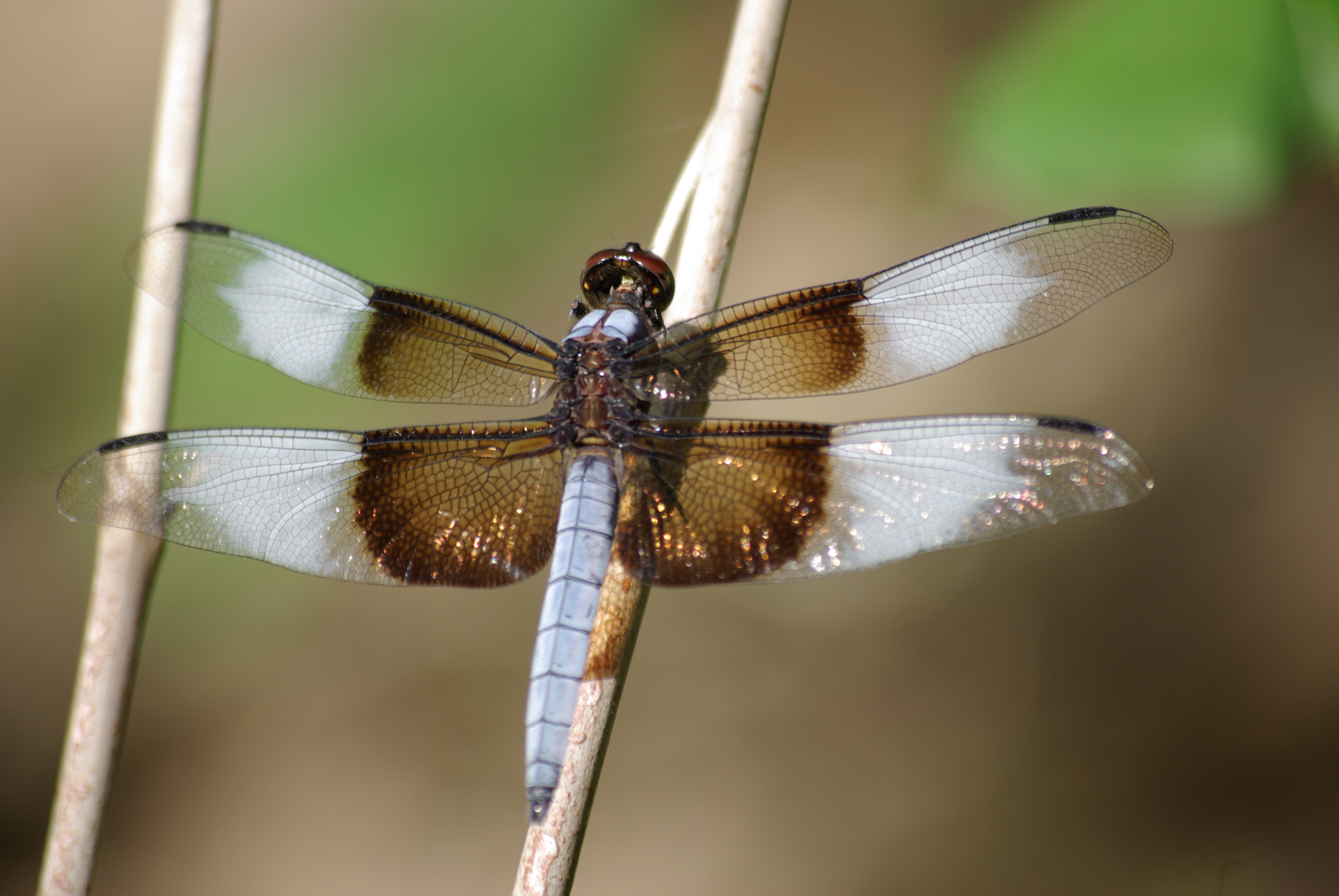
Lions Park in Duncanville, Texas, to be more precise. The dragon fly appears to me to be Neurothemis tullia, a Pied Paddy Skimmer, though I believe that is considered an Asian species. [But see note at the end of the post.]
Closely related? An exotic introduced to Texas? Here we had cotton fields, not rice paddies. The wings look like those of a Pied Paddy Skimmer, but most of the photos I’ve found show a black body, and this one is definitely gray. Hmmmm.
Dragon fly, Pied Paddy Skimmer, Neurothemis tullia - photo by Ed Darrell; copyright 2011, use permitted with attribution
Dragon flies look mean. As a very young child I was terrified of them, growing up on the banks of the Snake River in Idaho. My mother, a farm-raised girl, took me out for a walk among the diving, softly-humming aerobats, and explained they had no stingers, they ate other insects, and they seemed to like humans, if we’d watch them. As we watched, she held out her hand and a dragon fly landed, as if to say, “Hello! Listen to your mother. She knows us.”
Dragon fly takes a higher vantage point. Is this species exotic in Texas?
Up Payson Canyon, in Utah, at Scout Lake I passed many early morning hours, and many noon siestas, in the reeds watching the dragon flies. When we were in our canoes or rowboats they’d fly at us like rockets, appearing to think they were torpedo planes, then fly up, or right or left, at the last possible second, to avoid colliding with our craft. Through July they’d fly tandem, mating. This intrigued Scouts, and delighted them beyond measure when the nature merit badge counselor explained they were having sex. Red ones, blue ones, yellow, brown and black ones. Big ones, little ones.
Shortly after we moved to Texas, we discovered that a swarm of dragon flies probably meant a local colony of fire ants was casting off females, to mate and start a new mound of exotic, stinging terror. The dragon flies would catch and eat the queens-to-be. I had to use a broom to shoo off a neighbor with a can of insecticide, trying to kill the dragon flies in their work to keep us safe and happy. “But they look so mean,” she explained.
Judge no book by its cover (except Jaws); judge no insect by its eye apparel, or human eye appeal.
While a few (crabs?) argue that solar power will never make a significant contribution to our daily energy budgets in the U.S., others quietly slip the bonds of the grid and go solar. If solar works, it will work one house at a time.
From the Orange County Register, accessed June 2011 - click for larger image
Orange County, California, is the hotbed of conservative politics, and warming denialism such as it exists in California. In Orange County, solar power is a question of practicality, and one’s desire to save money on electricity. It’s in the Home and Garden section of the newspaper, not politics, not business.
Another gift from mainstream media that bloggers don’t equal, yet.
Is a Smart-Meter required for solar, today?
Spread the word; friends don't allow friends to repeat history.
Such sheets of fire, such bursts of horrid thunder, Such groans of roaring wind and rain, I never
Remember to have heard; man’s nature cannot carry
The affliction nor the fear … from Shakespeare’s Tragedy of King Lear
June 21, 2011: Record snowfall, killer tornadoes, devastating floods: There’s no doubt about it. Since Dec. 2010, the weather in the USA has been positively wild. But why?
Some recent news reports have attributed the phenomenon to an extreme “La Niña,” a band of cold water stretching across the Pacific Ocean with global repercussions for climate and weather. But NASA climatologist Bill Patzert names a different suspect: “La Nada.”
“La Niña was strong in December,” he says. “But back in January it pulled a disappearing act and left us with nothing – La Nada – to constrain the jet stream. Like an unruly teenager, the jet stream took advantage of the newfound freedom–and the results were disastrous.”
The blue and purple band in this satellite image of the Pacific Ocean traces the cool waters of the La Niña phenomenon in December 2010. (from Ocean Surface Topography Mission (OSTM)/Jason-2 satellite, Credit: NASA JPL)
La Niña and El Niño are opposite extremes of a great Pacific oscillation. Every 2 to 7 years, surface waters across the equatorial Pacific warm up (El Niño) and then they cool down again (La Niña). Each condition has its own distinct effects on weather.
The winter of 2010 began with La Niña conditions taking hold. A “normal” La Niña would have pushed the jet stream northward, pushing cold arctic air (one of the ingredients of severe weather) away from the lower US. But this La Niña petered out quickly, and no El Niño rose up to replace it. The jet stream was free to misbehave.
“By mid-January 2011, La Niña weakened rapidly and by mid-February it was ‘adios La Niña,’ allowing the jet stream to meander wildly around the US. Consequently the weather pattern became dominated by strong outbreaks of frigid polar air, producing blizzards across the West, Upper Midwest, and northeast US.”1
The situation lingered into spring — and things got ugly. Russell Schneider, Director of the NOAA-NWS Storm Prediction Center, explains:
“First, very strong winds out of the south carrying warm, moist air from the Gulf of Mexico met cold jet stream winds racing in from the west. Stacking these two air masses on top of each other created the degree of instability that fuels intense thunderstorms.”
Extreme contrasts in wind speeds and directions of the upper and lower atmosphere transformed ordinary thunderstorms into long-lived rotating supercells capable of producing violent tornadoes.2
This satellite image, taken in April 2011, reveals La Niña’s rapid exit from the equator near the US coast. The cool (false-color blue) water was gone by early spring. (from Ocean Surface Topography Mission (OSTM)/Jason-2 satellite, Credit: NASA JPL)
In Patzert’s words, “The jet stream — on steroids — acted as an atmospheric mix master, causing tornadoes to explode across Dixie and Tornado Alleys, and even into Massachusetts.”
All this because of a flaky La Niña?
“La Niña and El Niño affect the atmosphere’s energy balance because they determine the location of warm water in the Pacific, and that in turn determines where huge clusters of tropical thunderstorms form,” explains Schneider. “These storms are the main energy source from the tropics influencing the large scale pattern of the jet stream that flows through the US.”
In agreement with Patzert, he notes that the very strong and active jet stream across the lower US in April “may have been related to the weakening La Niña conditions observed over the tropical Pacific.”
And of course there’s this million dollar question: “Does any research point to climate change as a cause of this wild weather?”
“Global warming is certainly happening,” asserts Patzert, “but we can’t discount global warming or blame it for the 2011 tornado season. We just don’t know … Yet.”3
What will happen next? And please don’t say, “La Nada.”
(1) Other atmospheric factors also contributed to the inflow of frigid polar air, says Patzert. One of the most significant was a weakening in the whirlpool motion of the air around the North Pole. As a result of this weakening, more cold air flowed away from the pole and down toward the states. Climatologists call this an “arctic oscillation.”
(2) Imagine a paddle wheel oriented like a Ferris wheel and placed in winds that that are much stronger at the top than at the bottom. The wheel will spin in the direction of the strong winds above. This spring, these strong, turning winds led to ongoing rotation of the supercells themselves. So we ended up with intense rotation and updraft close to Earth’s surface — conditions ripe for strong tornadoes.
(3) On May 26, 2011, Patzert posted a comment about this topic on Andrew Revkin’s The New York Times’ DOT EARTH Blog, “Demography, Design, Atom Bombs and Tornado Deaths.” See comment 6 at this URL.
Looks to me as if the people at NASA are saying we should go slow, and not rush to blame our weather woes on climate change. Climate change “skeptics” should be so skeptical.
Spread the word; friends don't allow friends to repeat history.
Or, until that account is unsuspended by the forces supporting Donald Trump: Follow @FillmoreWhite, the account of the Millard Fillmore White House Library
We've been soaking in the Bathtub for several months, long enough that some of the links we've used have gone to the Great Internet in the Sky.
If you find a dead link, please leave a comment to that post, and tell us what link has expired.
Thanks!
Retired teacher of law, economics, history, AP government, psychology and science. Former speechwriter, press guy and legislative aide in U.S. Senate. Former Department of Education. Former airline real estate, telecom towers, Big 6 (that old!) consultant. Lab and field research in air pollution control.
My blog, Millard Fillmore's Bathtub, is a continuing experiment to test how to use blogs to improve and speed up learning processes for students, perhaps by making some of the courses actually interesting. It is a blog for teachers, to see if we can use blogs. It is for people interested in social studies and social studies education, to see if we can learn to get it right. It's a blog for science fans, to promote good science and good science policy. It's a blog for people interested in good government and how to achieve it.
BS in Mass Communication, University of Utah
Graduate study in Rhetoric and Speech Communication, University of Arizona
JD from the National Law Center, George Washington University


 Posted by Ed Darrell







 Millard Fillmore's Bathtub