No, Earth Day 2017 does not celebrate Lenin, who was anti-environmentalist – annual debunking of the annual Earth Day/Lenin hoax

April 22, 2017

This is mostly an encore post, repeated each year for April 22 and Earth Day — sad that it needs repeating; anti-environmentalists don’t appear to learn much, year to year.  (Yes, some of the links may be dated; if you find one not working, please let me know in comments.)

In 2017, we may need this post more, to put up with anti-science backlash to the March for Science.

You could write it off to pareidolia, once.

Like faces in clouds, some people claimed to see a link. The first Earth Day, on April 22, 1970, coincided with Lenin’s birthday. There was no link — Earth Day was scheduled for a spring Wednesday, when the greatest number of college students would be on campus.

Link to permanent Earth Day site, at EarthDay.org

Now, years later, with almost-annual repeats of the claim from the braying right wing, it’s just a cruel hoax.  It’s as much a hoax on the ill-informed of the right, as anyone else. Many of them believe it.

No, there’s no link between Earth Day and the birthday of V. I. Lenin:

One surefire way to tell an Earth Day post is done by an Earth Day denialist: They’ll note that the first Earth Day, on April 22, 1970, was an anniversary of the birth of Lenin.

Coincidentally, yes, Lenin was born on April 22, on the new style calendar; it was April 10 on the calendar when he was born — one might accurately note that Lenin’s mother always said he was born on April 10.

It’s a hoax. There is no meaning to the first Earth Day’s falling on Lenin’s birthday — Lenin was not prescient enough to plan his birthday to fall in the middle of Earth Week, a hundred years before Earth Week was even planned.

About.com explains why the idea of a link between Earth Day and Lenin is silly:

Does Earth Day Promote Communism?
Earth Day 1970 was initially conceived as a teach-in, modeled on the teach-ins used successfully by Vietnam War protesters to spread their message and generate support on U.S. college campuses. It is generally believed that April 22 was chosen for Earth Day because it was a Wednesday that fell between spring break and final exams—a day when a majority of college students would be able to participate.

U.S. Sen. Gaylord Nelson, the guy who dreamed up the nationwide teach-in that became Earth Day, once tried to put the whole “Earth Day as communist plot” idea into perspective.

“On any given day, a lot of both good and bad people were born,” Nelson said. “A person many consider the world’s first environmentalist, Saint Francis of Assisi, was born on April 22. So was Queen Isabella. More importantly, so was my Aunt Tillie.”

April 22 is also the birthday of J. Sterling Morton, the Nebraska newspaper editor who founded Arbor Day (a national holiday devoted to planting trees) on April 22, 1872, when Lenin was still in diapers. Maybe April 22 was chosen to honor Morton and nobody knew. Maybe environmentalists were trying to send a subliminal message to the national subconscious that would transform people into tree-planting zombies. One birthday “plot” seems just about as likely as the other. What’s the chance that one person in a thousand could tell you when either of these guys were born.

My guess is that only a few really wacko conservatives know that April 22 is Lenin’s birthday (was it ever celebrated in the Soviet Union?). No one else bothers to think about it, or say anything about it, nor especially, to celebrate it.

Certainly, the Soviet Union never celebrated Earth Day. Nor was Lenin any great friend of the environment.  He stood instead with the oil-drillers-without-clean-up, with the strip-miners-without-reclamation, with the dirty-smokestack guys.  You’d think someone with a bit of logic and a rudimentary knowledge of history could put that together.

Gaylord Nelson, Living Green image
Inventor of Earth Day teach-ins, former Wisconsin Governor and U.S. Senator Gaylord Nelson

The REAL founder of Earth Day, Wisconsin’s U.S. Sen. Gaylord Nelson, usually recognized as the founder and father of Earth Day, told how and why the organizers came to pick April 22:

Senator Nelson chose the date in order to maximize participation on college campuses for what he conceived as an “environmental teach-in.” He determined the week of April 19–25 was the best bet; it did not fall during exams or spring breaks, did not conflict with religious holidays such as Easter or Passover, and was late enough in spring to have decent weather. More students were likely to be in class, and there would be less competition with other mid-week events—so he chose Wednesday, April 22.

In his own words, Nelson spoke of what he was trying to do:

After President Kennedy’s [conservation] tour, I still hoped for some idea that would thrust the environment into the political mainstream. Six years would pass before the idea that became Earth Day occurred to me while on a conservation speaking tour out West in the summer of 1969. At the time, anti-Vietnam War demonstrations, called “teach-ins,” had spread to college campuses all across the nation. Suddenly, the idea occurred to me – why not organize a huge grassroots protest over what was happening to our environment?

I was satisfied that if we could tap into the environmental concerns of the general public and infuse the student anti-war energy into the environmental cause, we could generate a demonstration that would force this issue onto the political agenda. It was a big gamble, but worth a try.

At a conference in Seattle in September 1969, I announced that in the spring of 1970 there would be a nationwide grassroots demonstration on behalf of the environment and invited everyone to participate. The wire services carried the story from coast to coast. The response was electric. It took off like gangbusters. Telegrams, letters, and telephone inquiries poured in from all across the country. The American people finally had a forum to express its concern about what was happening to the land, rivers, lakes, and air – and they did so with spectacular exuberance. For the next four months, two members of my Senate staff, Linda Billings and John Heritage, managed Earth Day affairs out of my Senate office.

Five months before Earth Day, on Sunday, November 30, 1969, The New York Times carried a lengthy article by Gladwin Hill reporting on the astonishing proliferation of environmental events:

“Rising concern about the environmental crisis is sweeping the nation’s campuses with an intensity that may be on its way to eclipsing student discontent over the war in Vietnam…a national day of observance of environmental problems…is being planned for next spring…when a nationwide environmental ‘teach-in’…coordinated from the office of Senator Gaylord Nelson is planned….”

Nelson, a veteran of the U.S. armed services (Okinawa campaign), flag-waving ex-governor of Wisconsin (Sen. Joe McCarthy’s home state, but also the home of Aldo Leopold and birthplace of John Muir), was working to raise America’s consciousness and conscience about environmental issues.

Lenin on the environment? Think of the Aral Sea disaster, the horrible pollution from Soviet mines and mills, and the dreadful record of the Soviet Union on protecting any resource. Lenin believed in exploiting resources and leaving the spoils to rot in the sun, not conservation; in practice there was no environmental protection, but instead a war on nature, in the Soviet Union.

So, why are all these conservative denialists claiming, against history and politics, that Lenin’s birthday has anything to do with Earth Day?

Can you say “propaganda?” Can you say “political smear?”

2017 Resources and Good News:

2015 Resources and Good News:

2014 Resources and Good News:

2013 Resources and Good News:

Good information for 2012:

Good information from 2011:

Good information from 2010:

2014’s Wall of Shame:

2013 Wall of Shame:

Wall of Lenin’s Birthday Propaganda Shame from 2012:

Wall of Lenin’s Birthday Propaganda Shame from 2011:

Wall of Lenin’s Birthday Propaganda Shame from 2010:

Spread the word. Have you found someone spreading the hoax, claiming Earth Day honors Lenin instead? Give us the link in comments.

UAW’s March for Science banner
UAW's March for Science banner

Sa

Save


Malaria uptick in Botswana: No, more DDT can’t help

March 28, 2017

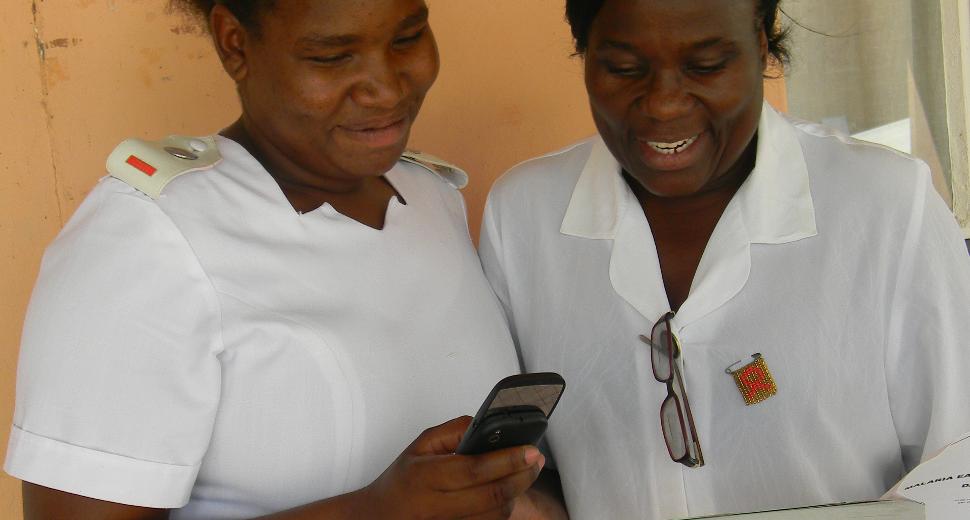
Health workers in Botswana use a cell phone to report malaria diagnoses and commencement of treatment, enabling real-time tracking of malaria outbreaks and rapid public health service responses. Photo from MalariaNoMore.

Interested, and interesting, to discover Botswana has a Facebook page where it appears is posted almost every press release or news item from the government.

I found it because some wag claimed on Twitter that Botswana faces a malaria crisis, and therefore DDT should be ‘brought back from the dead.’

Botswana did post about a malaria outbreak, but the nation appears to have good sense about how to fight malaria. The Tweeter missed that Botswana is already doing what a nation would use DDT for, Indoor Residual Spraying (IRS), and that phrase alone means Botswana’s malaria fighters are alert to any need for DDT should it arise, but also to the severe limitations on DDT use. DDT doesn’t work in about 95% of the nations on Earth.

Botswana is among the ten nations remaining on Earth who use DDT when and where they find a population of mosquitoes still susceptible to DDT. Almost all nations on Earth signed the Persistent Organic Pollutants Treaty (POPs, or Stockholm Agreement), which requires annual reporting of DDT use. But there are 11 other pesticides the World Health Organization (WHO) recommends for IRS. Botswana is unlikely to use DDT where it won’t work, which is most places.

Botswana is one of the DDT Ten in 2016, too. But this is down from 43 nations in 2001. DDT’s effectiveness and time as a tool to fight malaria is mostly gone, vanishing quickly.

Botswana has DDT if it can find a use for it; no more DDT is needed. A malaria outbreak in Botswana is no reason to remove the ban on DDT use on U.S. farms.

Here is the story/press release from Botswana’s government:

MALARIA CASES RISE IN OKAVANGO

North West District has been hard hit by a malaria epidemic with 670 recorded cases and five deaths since the beginning of the rainy season.

Head of the District Health Management Team, Dr Malebogo Pusoentsi revealed this at a press conference aimed at evaluating efforts made in the district to control the disease, recently.

A task force was in the district to assess and appreciate the situation as well as discuss what more could be done going forward.

Dr Pusoentsi said the highly affected region was Okavango which recorded over 90 per cent of the cases.

Highly affected areas include Shakawe, Xakao and Seronga in the Okavango District while in Ngami, Tsau and Mababe were the most affected.

Out of the affected people, it was reported that males were mostly affected as compared to females, and that more than 30 per cent of the affected were children. The most affected areas were said to be schools.

Dr Pusoentsi explained that malaria infection in humans was mainly transmitted through the sting of the female anopheles mosquito, adding that the disease in people could present clinically as either uncomplicated, complicated or asymptomatic, especially for people living in malaria endemic areas.

She stated that prevention of malaria remained a priority with strategies aimed at vector control. She said two strategies have been used to control mosquitoes in the area such as indoor residual spraying and the distribution of the long lasting insecticide treated nets. She added that 57 000 nets having been distributed across the country.

Regarding indoor spraying, Dr Pusoentsi revealed that for the transmission period of 2016/17, the district achieved an average of 69 per cent coverage as compared to the 85 per cent target.

Asked if the district was winning the battle, she said they were on the right track as health officials have doubled up efforts to tackle the epidemic.

She said social mobilisation was effective as the community and leadership were taught to make malaria a priority in their agenda, adding that if one member of a family was affected, chances were high that the rest of the family were also at risk.

Furthermore, Dr Pusoentsi explained that many opportunities still existed at community level to effectively control the spread of malaria, citing the cleaning of surroundings to minimise the breeding spaces for the mosquitoes.

Another strategy was to work collaboratively to ensure community knowledge and participation during the epidemic period. She urged the community to visit health facilities if they experience any symptoms of malaria so that they could be assisted on time.

She noted that common signs and symptoms include high temperature, headache and rigors, pallor and vomiting.

Dr Pusoentsi also noted that Botswana was among the countries which were aiming to eliminate malaria by 2018, adding that as part of the strategy, all efforts and investments had been put in place to control the spread.

Effective surveillance mechanism, she said had been put in place to monitor the disease burden and response efficiency at all times.

In addition, she pointed out that case management and drug supply had been strengthened to ensure quality management of cases of malaria to avoid deaths. (BOPA)

Save


Happy coincidence: Pi Day is Albert Einstein’s birthday

March 14, 2017

How many ways can we say happy birthday to a great scientist born on Pi Day?  So, an encore post.

E=mcc - logo from AIP

E=energy; m=mass; c=speed of light

Happy Einstein Day! to us.  Albert’s been dead since 1955 — sadly for us.  Our celebrations now are more for our own satisfaction and curiosity, and to honor the great man — he’s beyond caring.

Almost fitting that he was born on π Day, no? I mean, is there an E=mc² Day? He’s 138 years old today, and famous around the world for stuff that most people still don’t understand. 

Fittingly, perhaps, March 14 now is celebrated as Pi Day, in honor of that almost magical number, Pi, used to calculate the circumference of a circle. Pi is 3. 1415~, and so the American date 3/14 got tagged as Pi Day.

Albert Einstein was born on March 14, 1879, in Ulm, Germany, to Hermann and Pauline Einstein.

26 years later, three days after his birthday, he sent off the paper on the photo-electric effect; that paper would win him the Nobel Prize in Physics in 1921.

In that same year of 1905, he published three other papers, solving the mystery of Brownian motion, describing what became known as the Special Theory of Relativity and solving the mystery of why measurements of the light did not show any effects of motion as Maxwell had predicted, and a final paper that noted a particle emitting light energy loses mass. This final paper amused Einstein because it seemed so ludicrous in its logical extension that energy and matter are really the same stuff at some fundamental point, as expressed in the equation demonstrating an enormous amount of energy stored in atoms, E=mc².

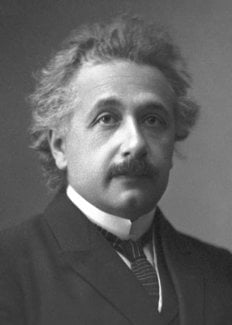
Albert Einstein as a younger man - Nobel Foundation image

Albert Einstein as a younger man – Nobel Foundation image

Any one of the papers would have been a career-capper for any physicist. Einstein dashed them all off in just a few months, forever changing the fields of physics. And, you noticed: Einstein did not win a Nobel for the Special Theory of Relativity, nor for E=mc². He won it for the photo-electric effect. Irony in history. Nobel committee members didn’t understand Einstein’s other work much better than the rest of us today.

117 years later, Einstein’s work affects us every day. Relativity theory at some level I don’t fully understand makes possible the use Global Positioning Systems (GPS), which revolutionized navigation and mundane things like land surveying and microwave dish placement.

Development of nuclear power both gives us hope for an energy-rich future, and gives us fear of nuclear war. Sometimes, even the hope of the energy rich future gives us fear, as we watch and hope nuclear engineers can control the piles in nuclear power plants damaged by earthquakes and tsunami in Japan.

English: Albert Einstein on a 1966 US stamp

Albert Einstein on a 1966 US stamp (Photo credit: Wikipedia)

If Albert Einstein was a genius at physics, he was more dedicated to pacifism. He resigned his German citizenship to avoid military conscription. His pacifism made the German Nazis nervous; Einstein fled Germany in the 1930s, eventually settling in the United States. In the U.S., he was persuaded by Leo Szilard to write to President Franklin Roosevelt to suggest the U.S. start a program to develop an atomic weapon, because Germany most certainly was doing exactly that. But while urging FDR to keep up with the Germans, Einstein refused to participate in the program himself, sticking to his pacifist views. Others could, and would, design and build atomic bombs. (Maybe it’s a virus among nuclear physicists — several of those working on the Manhattan Project were pacifists, and had great difficulty reconciling the idea that the weapon they worked on to beat Germany, was deployed on Japan, which did not have a nuclear weapons program.)

English: USSR stamp dedicated to Albert Einste...

Everybody wanted to claim, and honor Einstein; USSR issued this stamp dedicated to Albert Einstein Русский: Почтовая марка СССР, посвящённая Альберту Эйнштейну (Photo credit: HipStamp)

Einstein was a not-great father, and probably not a terribly faithful husband at first — though he did think to give his first wife, in the divorce settlement, a share of a Nobel Prize should he win it. Einstein was a good violinist, a competent sailor, an incompetent dresser, and a great character.

His sister suffered a paralyzing stroke. For many months Albert spent hours a day reading to her the newspapers and books of the day, convinced that though mute and appearing unconscious, she would benefit from hearing the words. He said he did not hold to orthodox religions, but could there be a greater show of faith in human spirit?

Einstein in 1950, five years before his death

Einstein in 1950, five years before his death

When people hear clever sayings, but forget to whom the bon mots should be attributed, Einstein is one of about five candidates to whom all sorts of things are attributed, though he never said them. (Others include Lincoln, Jefferson, Mark Twain and Will Rogers). Einstein is the only scientist in that group. So, for example, we can be quite sure Einstein never claimed that compound interest was the best idea of the 20th century. This phenomenon is symbolic of the high regard people have for the man, even though so few understand what his work was, or meant.

A most interesting man. A most important body of work. He deserves more study and regard than he gets, in history, diplomacy and science.

Does anyone know? What was Albert Einstein’s favorite pie?

More, Resources:


A pie for a Pi! A roundup of justice on π Day!

March 14, 2017

Let’s rerun this one. Again.  I like the photographs. I may go search for a good piece of pie.

Of course you remembered that today is pi Day, right?

Pi Day Pie from Slashfood.com

Happy π Day! Pi Day Pie – Slashfood.com

Oh, or maybe better, π Day.

We’ll start with the brief post from months ago, and then build on it with some activities and posts from around the WordPress-o-sphere.

The good people at PiDay.org suggest a few ways you can celebrate:

Make (and Eat) a Pie – These pie recipes for Pi Day from NPR’s McCallister look incredibly tasty. But, there’s no shame in putting a frozen store-bought pie in the oven, or picking up a pie from your local bakery. Any kind of pie is great on Pi Day! If you’re making your own, get inspired by these beautifully designed Pi Day Pies. Tell us on Facebook: What’s your favorite kind of pie for Pi Day?

Hope your π Day is complete as a circle, and well-rounded!

How are others celebrating?  A look around WordPress:

At SocialMediaPhobe, a musical interpretation of pi featuring the music of Michael Blake:

So Long Freedom:

pidaypieToday is March 14th, also known as “Pi Day” for us math geeks out there because March 14th (3/14) is the first 3 digits of π (3.14159…).  To celebrate “Pi Day” I highly recommend doing something mathematical while having some pie at 1:59 pm.  I recommend Yumology‘s S’mores Pie as it has 3 main ingredients (chocolate, marshmallow, and graham cracker) and about 0.14159 other ingredients like sugar, butter, and stuff.  If you are not a math geek, its okay…you can still eat pie and count things like how many stop signs you pass on your way back to work from lunch.  Or you could go to the library and take out a book on something fun like binary code.  As we like to say, “There are only 10 types of people in the world:  Those that understand binary and those that don’t.”  Seriously, binary is as easy as 01000001, 01000010, 01000011.

Miles Free at PMPA Speaking of Precision:Today 3-14 at 1:59 I will be celebrqting Pi Day. 3.14159 is the value of pi to 5 decimals...

So besides being  the cause of much techie “irrational” exuberance, Pi Day  is a great way to get some engagement with students.

Marymount High School has several activities, last year they had a design competition incorporating pi; the students then made and sold buttons of each design, proceeds going to the Red Cross.

Hmm- math subject matter, design, production, sales, accounting.

Sounds like what we do in manufacturing.
Maybe celebrating Pi Day is not so irrational as first thought.

Free said his pie is peach.

Steve Doyle at CraveDFW:

On March 12, 2009 your lawmakers  passed a non-binding resolution (HRES 224) recognizing March 14, 2009 as National Pi Day. It is one of the more legit holidays we discuss here, and it is actually an homage to geeks everywhere who see the date as a reason to celebrate due to its mathematical implications. We say any reason to celebrate anything is just fine by us.

Since we are predominately about food we will suggest a few places to actually enjoy a pie.

DSC06367

If you followed us at all this week you may have seen the pie at Bowl and Barrel pop up on our pages. This is the uber delicious Butterscotch Pie served as the solo dessert at the bowling alley and restaurant.  Go eat one of these.

He’s got more pi pie, if you click over there.

Gareth Branwyn at MakeZine offers more pie and a mnemonic:

How to Remember Pi to 15 Digits

Pi-Pie--69299

By way of sci-fi author and mathenaut Rudy Rucker’s Facebook wall comes this:

One way to remember the first few digits of pi is to count the letters in the words of this phrase:

“How I need a drink, alcoholic of course, after the heavy lectures involving quantum mechanics.”

[Image via FreakingNews]

Another song, on YouTube, at Awsomesauce:

b.love offers this clock image (is this clock for sale somewhere?):

A clock for pi day

TED Blog offers two videos:

Chirag Singh explains his “passion for pi.”

Daniel Tammet, “Different Ways of Knowing:

Geeks are really out in force today, flaunting pi for all they’ve got.

More:

Hey, students! Did any of your teachers do cool stuff for Pi Day? Tell us what, and who, in comments.

Pi Day? March 14? It's also the anniversary of Einstein's birth . . . Image from Legends102.7.com

Pi Day? March 14? It’s also the anniversary of Einstein’s birth . . . see a resemblance? Image from Legends102.7.com

Yes, this is mostly an encore post. Fighting ignorance requires patience.

Yes, this is mostly an encore post. Fighting ignorance requires patience.


Annals of Global Warming: Mexican plums blooming early in Dallas

February 17, 2017

Spring comes a few hours earlier every year as the planet warms; plants that used to blossom in March and April, now blossom in February. Mexican plum blossoms in Dallas, Texas, February 17, 2017. Photo by Ed Darrell, please share with attribution

Spring comes a few hours earlier every year as the planet warms; plants that used to blossom in March and April, now blossom in February. Mexican plum blossoms in Dallas, Texas, February 17, 2017. Photo by Ed Darrell, iPhone 6; please share with attribution.

Spring comes earlier every year in Dallas. Our Mexican plums used to blossom in March and April; for the past three years, we’ve had blossoms well before spring even comes. Last year we had a cold snap that took the young fruit out, after a premature blossoming.

It’s a sign of creeping global warming. Every year I marvel at Al Gore’s powers to convince our Mexican plum to blossom early, part of the “global warming conspiracy” so many fear.

That is, this is a symptom of global warming that cannot be faked, that is from observation, and not from models.

With flowers on fruit trees come hopes of a bountiful harvest. Dreading the underlying meaning of such an early blossom does not change our hopes, nor the birds’ hopes, for a good plum harvest.

More:

Save


February 15 is Shoulders of Giants Day

February 15, 2017

February 15th is Shoulders of Giants Day (unless you’re still on the Julian calendar).

Or should be. 

Famous quotations often get cited to the wrong famous person. ‘Somebody said something about standing on the shoulders of giants — who was it? Edison? Lincoln? Einstein? Jefferson?’  It may be possible someday to use Google or a similar service to track down the misquotes.

The inspiration, perhaps

Robert Burton, author of "Anatomy of Melancholy"

Robert Burton, melancholy scholar at Oxford

A dwarf standing on the shoulders of a giant may see farther than a giant himself.

Robert Burton (February 8, 1577-January 25, 1640), vicar of Oxford University, who wrote The Anatomy of Melancholy to ward off his own depressions

The famous quote

Sir Isaac Newton, by Sir Godfrey Keller, 1689

Sir Isaac Newton, by Sir Godfrey Keller, 1689

If I have seen further (than you and Descartes) it is by standing on the shoulders of Giants.

Sir Isaac Newton, letter to Robert Hooke, February 5, 1675, Julian/February 15, 1676, Gregorian

Newton consciously paid tribute to others who had plowed his science fields before, even if he came up with different crops, er, answers. All science is based on something that comes before it, and in the modern world science advances, oddly, by trying to disprove what scientists thought happened before.

But the sentiment applies equally well in business, in politics, in raising children. We are products of what we learn, and what we learn is a result of culture, which is a result of history. We all stand on the shoulders of those who came before us.

It’s our job to try to see farther, and not just look down, at how far up we are.

Someone will ask (since we so often discuss it), ‘can we fly our flags today?’

Of course you may fly your U.S. flag today. It’s not a day designated by law, but you may fly it in honor of Sir Isaac Newton’s letter if you wish. The U.S. flag code suggests times Americans may fly their flags, but does not require it, nor does law forbid flying the flag for other occasions, or just for every day.

Maybe better, climb to the top of the flag pole. What can you see, aided by a giant’s height?

Other references:

Inscription on the edge of Britain's 2-pound coin; in this photo, four coins are used, to show the entire inscription. Flickriver image

Inscription on the edge of Britain’s 2-pound coin; in this photo, four coins are used, to show the entire inscription. Flickriver image, 1875Brian

Yes, this is mostly an encore post. Fighting ignorance requires patience.

Yes, this is mostly an encore post. Fighting ignorance requires patience. But, nanos gigantum humeris insidentes.


Save

Save

Save

Save

Save


No, Rachel Carson didn’t cause an increase in malaria; bonus film to WGBH American Experience “Rachel Carson”

February 7, 2017

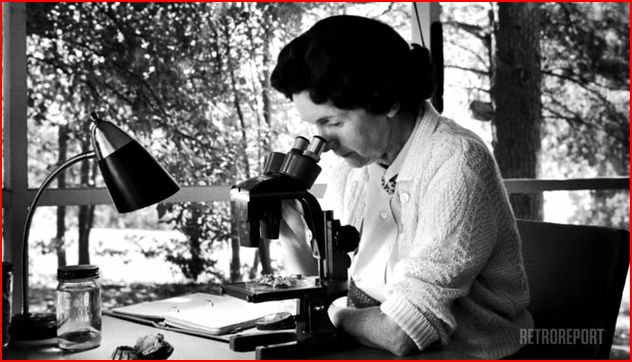
Rachel Carson at a microscope, American Experience/RetroReport image. Did Carson's work cause an increase in malaria? Is she to blame for continued malaria deaths? No, answers a short film bonus to "Rachel Carson," the 2017 PBS film.

Rachel Carson at a microscope, American Experience/RetroReport image. Did Carson’s work cause an increase in malaria? Is she to blame for continued malaria deaths? No, answers a short film bonus to “Rachel Carson,” the 2017 PBS film.

A straight up, historic look at the question of Rachel Carson’s fault in stopping malaria.

Anti-environmentalists and corporate hoaxsters argue that Rachel Carson should be blamed for an imaginary increase in malaria deaths, after the U.S. banned DDT use on crops.

In conjunction with WGBH’s American Experience film on Carson released early in 2017, this short film focusing on malaria as a continuing plague puts to rest the idea that Carson should be blamed at all.

Soaking in the bathtub, we find the film not strident enough in defense of Carson; but for those strident nuts who claim Carson a murderer, it may have some good effect. And of course, you, intelligent dear reader, will be persuaded more gently.

Where malaria is the question, DDT is not the answer. Where malaria still exists, it’s not Rachel Carson’s fault.

More:


December 30, 2016, Hubble Day! Look to the stars for our future

December 30, 2016

[Today is actually the day!  You may fly your flag if you choose.  This is the traditional Millard Fillmore’s Bathtub Hubble Day post.]

Lift a glass of champagne today in tribute to Edwin Hubble and his great discovery. Not sure what to call it — Hubble Day, Looking Up Day, Endless Possibilities Day — whatever, this is the anniversary of Edwin Hubble’s announcement that he had discovered the universe is much, much larger than anyone had imagined, containing far more stars than anyone had dared guess.

It’s a big universe out there.

Ultraviolet image of the Andromeda Galaxy. Wired caption: Photo: Edwin Hubble’s 1920s observations of Andromeda (whose ultraviolet spectrum is rendered here) expanded our notions of the size and nature of a universe that is itself expanding. Galaxy Evolution Explorer image courtesy NASA.

Ultraviolet image of the Andromeda Galaxy. Wired caption: “Photo: Edwin Hubble’s 1920s observations of Andromeda (whose ultraviolet spectrum is rendered here) expanded our notions of the size and nature of a universe that is itself expanding. Galaxy Evolution Explorer image courtesy NASA.”

So, today is a good day to celebrate the universe in all it’s glory – December 30.

On December 30, 1924, Edwin Hubble announced he’d discovered other galaxies in distant space. Though it may not have been so clear at the time, it meant that, as a galaxy, we are not alone in the universe (whether we are alone as intelligent life is a separate question). It also meant that the universe is much, much bigger than most people had dared to imagine.

92 years ago today.

I keep trying to get people to celebrate.

In 2008 for Hubble Day, Wired picked up on the story (with a gracious link to 2007’s post here at the Bathtub). Wired includes several links to even more information, a good source of information. See Wired’s 2009 post here.

Hubble was the guy who showed us the universe is not only bigger than we imagined, it’s probably much bigger and much more fantastic than we can imagine. (See J. B. S. Haldane’s “queerer” quote.) Hubble is the guy who opened our imaginations to the vastness of all creation.

Hubble’s work would have been impossible without the earlier work of one of the great, unsung women of science, Henrietta Leavitt, as Wired explained:

He trained the powerful new 100-inch telescope at Mount Wilson in Southern California on spiral nebulae. These fuzzy patches of light in the sky were generally thought to be clouds of gas or dust within our galaxy, which was presumed to include everything in the universe except the Magellanic Clouds. Some nebulae seemed to contain a few stars, but nothing like the multitudes of the Milky Way.

Hubble not only found a number of stars in Andromeda, he found Cepheid variable stars. These stars vary from bright to dim, and a very smart Harvard computationist named Henrietta Leavitt had discovered in 1912 that you could measure distance with them. Given the brightness of the star and its period — the length of time it takes to go from bright to dim and back again — you could determine how far away it is.

Hubble used Leavitt’s formula to calculate that Andromeda was approximately 860,000 light years away. That’s more than eight times the distance to the farthest stars in the Milky Way. This conclusively proved that the nebulae are separate star systems and that our galaxy is not the universe.

How does one celebrate Hubble Day? Here are some suggestions:

  • Easier than Christmas cards: Send a thank-you note to your junior high school science teacher, or whoever it was who inspired your interest in science. Mrs. Hedburg, Mrs. Andrews, Elizabeth K. Driggs, Herbert Gilbert, Mr. Willis, and Stephen McNeal, thank you.
  • Rearrange your Christmas/Hanukkah/KWANZAA lights in the shape of the Andromeda Galaxy — or in the shape of any of the great photos from the Hubble Telescope (Andromeda Galaxy pictured above; Hubble images here)

    A few of the images from the Hubble Telescope

    A few of the images from the Hubble Telescope

  • Go visit your local science museum; take your kids along – borrow somebody else’s kids if you have to (take them along, too); in Dallas, you can visit the Perot Museum of Nature and Science — it’s a doozy.
  • Spend two hours in your local library, just looking through the books on astronomy and the universe
  • Write a letter to your senators and congressman; tell them space exploration takes a minuscule portion of our federal budget, but it makes us dream big; tell them we need to dream big, and so they’d better make sure NASA is funded well.  While you’re at it, put in a plug for funding Big Bird and the rest of public broadcasting, too.  Science education in this nation more and more becomes the science shows on NPR and PBS, watched by kids who learned to read and think by watching Big Bird.

  • Anybody got a good recipe for a cocktail called “The Hubble?” “The Andromeda?” Put it in the comments, please.  “The Hubble” should have bubbles in it, don’t you think?  What was it the good monk said?  He was working to make great wine, but goofed somewhere, and charged the wine with another dose of yeast.  When he uncorked the very first bottle of what would come to be called champagne, Benedictine Monk Dom Pierre Perignon said “I am drinking stars!”  Except, he said it in French.  In any case, a Hubble cocktail should have bubbles, some of Perignon’s stars.

The encore post, from 2007:

December 30, 1924, Edwin Hubble announced the results of his observations of distant objects in space.

PBS

Edwin Hubble, long before the Surgeon General’s 1964 report on smoking made taboo photos of people smoking pipes.

In 1924, he announced the discovery of a Cepheid, or variable star, in the Andromeda Nebulae. Since the work of Henrietta Leavitt had made it possible to calculate the distance to Cepheids, he calculated that this Cepheid was much further away than anyone had thought and that therefore the nebulae was not a gaseous cloud inside our galaxy, like so many nebulae, but in fact, a galaxy of stars just like the Milky Way. Only much further away. Until now, people believed that the only thing existing outside the Milky Way were the Magellanic Clouds. The Universe was much bigger than had been previously presumed.

Later Hubble noted that the universe demonstrates a “red-shift phenomenon.” The universe is expanding. This led to the idea of an initial expansion event, and the theory eventually known as Big Bang.

Hubble’s life offered several surprises, and firsts:

  • Hubble was a tall, elegant, athletic, man who at age 30 had an undergraduate degree in astronomy and mathematics, a legal degree as a Rhodes scholar, followed by a PhD in astronomy. He was an attorney in Kentucky (joined its bar in 1913), and had served in WWI, rising to the rank of major. He was bored with law and decided to go back to his studies in astronomy.
  • In 1919 he began to work at Mt. Wilson Observatory in California, where he would work for the rest of his life. . . .
  • Hubble wanted to classify the galaxies according to their content, distance, shape, and brightness patterns, and in his observations he made another momentous discovery: By observing redshifts in the light wavelengths emitted by the galaxies, he saw that galaxies were moving away from each other at a rate constant to the distance between them (Hubble’s Law). The further away they were, the faster they receded. This led to the calculation of the point where the expansion began, and confirmation of the big bang theory. Hubble calculated it to be about 2 billion years ago, but more recent estimates have revised that to 20 billion years ago.
  • An active anti-fascist, Hubble wanted to joined the armed forces again during World War II, but was convinced he could contribute more as a scientist on the homefront. When the 200-inch telescope was completed on Mt. Palomar, Hubble was given the honor of first use. He died in 1953.

“Equipped with his five senses, man explores the universe around him and calls the adventure Science.”

That news on December 30, 1924, didn’t make the first page of the New York Times. The Times carried a small note on February 25, 1925, that Hubble won a $1,000 prize from the American Academy for the Advancement of Science.

(Does anyone have a suitable citation for that video? Where did it come from? Who produced it? Is there more somewhere?)

Happy Hubble Day! Look up!

Resources:

Hubble Space Telescope - NASA image

Hubble Space Telescope, working homage to Edwin Hubble – NASA image

Even More Resources:

Andromeda as we can see it today. Wikimedia image: The Andromeda Galaxy is a spiral galaxy approximately 2.5 million light-years away in the constellation Andromeda. The image also shows Messier Objects 32 and 110, as well as NGC 206 (a bright star cloud in the Andromeda Galaxy) and the star Nu Andromedae. This image was taken using a hydrogen-alpha filter.

Andromeda as we can see it today. Wikimedia image: The Andromeda Galaxy is a spiral galaxy approximately 2.5 million light-years away in the constellation Andromeda. The image also shows Messier Objects 32 and 110, as well as NGC 206 (a bright star cloud in the Andromeda Galaxy) and the star Nu Andromedae. This image was taken using a hydrogen-alpha filter.

Yes, this is mostly an encore post. Fighting ignorance requires patience.

Yes, this is mostly an encore post. Fighting ignorance requires patience.


Fact sheet for World Malaria Report 2016

December 16, 2016

A woman shows the mosquito net that protects her and her family from malaria transmission, in India. India remains the world's top DDT user, but is switching to nets in an effort to bring malaria rates down and set up malaria eradication before the end of DDT in 2020. WHO image.

A woman shows the mosquito net that protects her and her family from malaria transmission, in India. India remains the world’s top DDT user, but is switching to nets in an effort to bring malaria rates down and set up malaria eradication before the end of DDT in 2020. WHO image.

World Health Organization publishes an annual World Malaria Report, with the year appended to the title. It summarizes the state of the fight against malaria worldwide, recording progress and setbacks.

In the tally of progress we get a clear indication of what is needed to continue or increase that progress, with the ultimate goal of controlling malaria to the point it poses no great economic risk, or health risk, to any nation, or better that human malaria is eradicated.

World Malaria Report 2016 is 184 pages, shorter than some previous reports but packed with figures and history, some of which requires greater background to understand completely.

For example, the 2016 publication notes that about 412,000 people died from malaria in 2016. This is a shocking figure. Most of the news coverage of the report mentions this death toll in the first paragraph.

It’s too many deaths. But it’s a more than 50% reduction in deaths from 1990s rates, and it’s a more than 90% reduction from the annual death tolls that shocked the world to concerted action after World War II. Most estimates are that about 5 million people a year died from malaria through the 1950s, and into the 1960s.

WHO concentrates on the malaria fight, and plays down the political aspects to encourage international cooperation to help fight the disease. But there are political statements made, if one has the background to understand them. There remains controversy over the use of DDT, with many people yelling far and wide that if ‘bans on DDT were removed’ then malaria would quickly become an eradicated disease. This position ignores the facts, that there were still 5 million people dying each year during peak DDT use; that death tolls plunged after the U.S. banned DDT use on crops; that the U.S. ban covered only crop use, and that DDT use against disease has never been banned anywhere in the world; and that DDT use continued long after the U.S. banned DDT, around the world. DDT use never stopped.

Taken together, we would understand that the 90% reduction in malaria deaths from peak DDT use years, was accomplished mostly without DDT, and that therefore DDT is not a panacea.

World Malaria Report 2016 also tallies the slow demise of DDT. Mosquito resistance to pesticides, especially DDT, is a major problem in the fight against the disease. But more DDT can’t fix that problem now that every mosquito on Earth carries alleles that make them resistant and wholly immune to the stuff. DDT will probably never be a panacea, even were its manufacture not scheduled to stop very soon.

History, and a complete assessment of the science and current conditions in the frontlines of the malaria fight, can help us put these things in perspective.

So far, only the Los Angeles Times in the U.S. provided any in-depth reporting on World Malaria Report 2016. We hope other media will take up the challenge to inform. They will find WHO’s Fact Sheet useful.

With that warning in mind, it’s good to look at the broad outlines of the report, which WHO has packaged into a fact sheet for our convenience.

Fact Sheet: World Malaria Report 2016

13 December 2016

The World Malaria Report, published annually by WHO, tracks progress and trends in malaria control and elimination across the globe. It is developed by WHO in collaboration with ministries of health and a broad range of partners. The 2016 report draws on data from 91 countries and areas with ongoing malaria transmission.

Global progress and disease burden (2010–2015)

According to the report, there were 212 million new cases of malaria worldwide in 2015 (range 148–304 million). The WHO African Region accounted for most global cases of malaria (90%), followed by the South-East Asia Region (7%) and the Eastern Mediterranean Region (2%).

In 2015, there were an estimated 429 000 malaria deaths (range 235 000–639 000) worldwide. Most of these deaths occurred in the African Region (92%), followed by the South-East Asia Region (6%) and the Eastern Mediterranean Region (2%).

Between 2010 and 2015, malaria incidence rates (new malaria cases) fell by 21% globally and in the African Region. During this same period, malaria mortality rates fell by an estimated 29% globally and by 31% in the African Region.

Between 2010 and 2015, malaria incidence rates (new malaria cases) fell by 21% globally and in the African Region. During this same period, malaria mortality rates fell by an estimated 29% globally and by 31% in the African Region.

Other regions have achieved impressive reductions in their malaria burden. Since 2010, the malaria mortality rate declined by 58% in the Western Pacific Region, by 46% in the South-East Asia Region, by 37% in the Region of the Americas and by 6% in the Eastern Mediterranean Region. In 2015, the European Region was malaria-free: all 53 countries in the region reported at least 1 year of zero locally-acquired cases of malaria.

Children under 5 are particularly susceptible to malaria illness, infection and death. In 2015, malaria killed an estimated 303 000 under-fives globally, including 292 000 in the African Region. Between 2010 and 2015, the malaria mortality rate among children under 5 fell by an estimated 35%. Nevertheless, malaria remains a major killer of under-fives, claiming the life of 1 child every 2 minutes.

Trends in the scale-up of malaria interventions

Vector control is the main way to prevent and reduce malaria transmission. Two forms of vector control are effective in a wide range of circumstances: insecticide-treated mosquito nets (ITNs) and indoor residual spraying (IRS).

ITNs are the cornerstone of malaria prevention efforts, particularly in sub-Saharan Africa. Over the last 5 years, the use of treated nets in the region has increased significantly: in 2015, an estimated 53% of the population at risk slept under a treated net compared to 30% in 2010.

Indoor residual spraying of insecticides (IRS) is used by national malaria programmes in targeted areas. In 2015, 106 million people globally were protected by IRS, including 49 million people in Africa. The proportion of the population at risk of malaria protected by IRS declined from a peak of 5.7% globally in 2010 to 3.1% in 2015.

Diagnostics

WHO recommends diagnostic testing for all people with suspected malaria before treatment is administered. Rapid diagnostic testing (RDTs), introduced widely over the past decade, has made it easier to swiftly distinguish between malarial and non-malarial fevers, enabling timely and appropriate treatment.

New data presented in the report show that, in 2015, approximately half (51%) of children with a fever who sought care at a public health facility in 22 African countries received a malaria diagnostic test compared to 29% in 2010. Sales of RDTs reported by manufacturers rose from 88 million globally in 2010 to 320 million in 2013, but fell to 270 million in 2015.

Treatment

Artemisinin-based combination therapies (ACTs) are highly effective against P. falciparum, the most prevalent and lethal malaria parasite affecting humans. Globally, the number of ACT treatment courses procured from manufacturers increased from 187 million in 2010 to a peak of 393 million in 2013, but subsequently fell to 311 million in 2015.

Prevention in pregnancy

Malaria infection in pregnancy carries substantial risks for the mother, her fetus and the newborn child. In Africa, the proportion of women who receive intermittent preventive treatment in pregnancy (IPTp) for malaria has been increasing over time, but coverage levels remain below national targets.

IPTp is given to pregnant women at scheduled antenatal care visits after the first trimester. It can prevent maternal death, anaemia and low birth weight, a major cause of infant mortality. Between 2010 and 2015, there was a five-fold increase in the delivery of 3 or more doses of IPTp in 20 of the 36 countries that have adopted WHO’s IPTp policy – from 6% coverage in 2010 to 31% coverage in 2015.

Insecticide and drug resistance

In many countries, progress in malaria control is threatened by the rapid development and spread of antimalarial drug resistance. To date, parasite resistance to artemisinin – the core compound of the best available antimalarial medicines – has been detected in 5 countries of the Greater Mekong subregion.

Mosquito resistance to insecticides is another growing concern. Since 2010, 60 of the 73 countries that monitor insecticide resistance have reported mosquito resistance to at least 1 insecticide class used in nets and indoor spraying; of these, 50 reported resistance to 2 or more insecticide classes.

Progress towards global targets

To address remaining challenges, WHO has developed the Global Technical Strategy for Malaria 2016-2030 (GTS). The Strategy was adopted by the World Health Assembly in May 2015. It provides a technical framework for all endemic countries as they work towards malaria control and elimination.

This Strategy sets ambitious but attainable goals for 2030, with milestones along the way to track progress. The milestones for 2020 include:

  • Reducing malaria case incidence by at least 40%;
  • Reducing malaria mortality rates by at least 40%;
  • Eliminating malaria in at least 10 countries;
  • Preventing a resurgence of malaria in all countries that are malaria-free.

Progress towards the GTS country elimination milestone is on track: In 2015, 10 countries and areas reported fewer than 150 locally-acquired cases of malaria. A further 9 countries reported between 150 and 1000 cases.

However, progress towards other GTS targets must be accelerated. Less than half (40) of the 91 malaria-endemic countries are on track to meet the GTS milestone of a 40% reduction in malaria case incidence by 2020. Progress has been particularly slow in countries with a high malaria burden.

Forty-nine countries are on track to achieve the milestone of a 40% reduction in malaria mortality; this figure includes 10 countries that reported zero malaria deaths in 2015.

Funding trends

In 2015, malaria funding totalled US$ 2.9 billion, representing only 45% of the GTS funding milestone for 2020. Governments of malaria-endemic countries provided 32% of total funding. The United States of America and the United Kingdom are the largest international funders of malaria control and elimination programmes, contributing 35% and 16% of total funding, respectively. If the 2020 targets of the GTS are to be achieved, total funding must increase substantially.

More:

Save

Save


Good news, or great challenge? U.S. could help eliminate malaria

December 13, 2016

World Malaria Report 2016, published December 13, offers great hope in progress made against malaria in the past 16 years.

But it also notes a severe challenge: Funding to beat malaria works well, but funding pledges sometimes are not met, and progress against the disease slowed some in 2016.

In 2000, nearly a million people died from malaria worldwide. In 2015, the death toll had been cut to ~470,000, a 50% reduction in 15 years.

In 2016, ~429,000 people died from malaria. It’s 40,000 fewer people than the year before. Malaria fighters had hoped for more.

Most deaths occur in Africa, most deaths occur to children, and most deaths occur in areas where distribution of insecticide-impregnated bednets has not been complete. Distribution was slowed in 2016 by lack of funds at steps in the process, from manufacturing the nets (now done significantly in Africa) to distributing the nets, to educating people how to use them. Nets are more effective than pesticide spraying, with DDT or the other 11 approved pesticides, and considerably less expensive.

A child shows off the mosquito bednet that keeps him malaria-free. Image from Nothing But Nets.

A child shows off the mosquito bednet that keeps him malaria-free. Image from Nothing But Nets.

WHO’s press release on the Report laid out the problem, with hints at a solution.

Sustained and sufficient funding for malaria control is a serious challenge. Despite a steep increase in global investment for malaria between 2000 and 2010, funding has since flat-lined. In 2015, malaria funding totalled US$ 2.9 billion, representing only 45% of the funding milestone for 2020 (US$ 6.4 billion).

Governments of malaria-endemic countries provided about 31% of total malaria funding in 2015. The United States of America is the largest international malaria funder, accounting for about 35% of total funding in 2015, followed by the United Kingdom of Great Britain and Northern Ireland (16%).

U.S. funding was just over $1 billion. That may sound like a lot, but it’s not even a drop in the U.S. federal budget bucket.

With a doubling of the U.S. contribution to $2 billion, the U.S. could again lead the world in fighting malaria, and set a good example of American democracy in action.

In doing that, another 100,000 lives might be saved each year.

Then, U.S. would have high moral ground to urge other nations to contribute to fighting malaria, either directly through WHO or through non-governmental organizations whose work goes too-often unsung, such as Malaria No More, Nothing But ‘Nets, and the Clinton Foundation.

$10 buys a net and distribution, and a net protects a child from malaria better than spraying dangerous insecticides, for two to five years.

What are the odds the Trump administration could be recruited to beat malaria? Let’s increase those odds.


WHO’s World Malaria Report 2016 shows great progress, but funding slowdown hurts the fight against malaria

December 13, 2016

Promotional poster for the World Malaria Report 2016, from WHO

Promotional poster for the World Malaria Report 2016, from WHO; poster shows a woman and her child, protected from mosquitoes behind a bednet.

Incidence of malaria dropped to a new, all-time low in 2016, with reductions in total infections to 212 million, and a drop in malaria deaths to 429,000, worldwide. Malaria fighters had hoped the decreases would be greater.

Cover of World Malaria Report 2016, from the World Health Organization (WHO). The report has been published annually since at least 2008, tracking progress in the fight to control and eradicate malaria, one of the greatest scourge diseases in human history.

Cover of World Malaria Report 2016, from the World Health Organization (WHO). The report has been published annually since at least 2008, tracking progress in the fight to control and eradicate malaria, one of the greatest scourge diseases in human history.

This news comes from the World Health Organization’s (WHO) World Malaria Report 2016, released this morning in Geneva, Switzerland.

Of concern to readers here, the report lists ten nations still using DDT, the same number as 2015. Nine African nations and India still find some utility in DDT, though resistance to the long-used pesticide is found in almost all populations of almost all varieties of mosquito.

India remains the world’s heaviest user of DDT and the only place DDT is manufactured. The nine DDT-using African nations are Botswana, Democratic Republic of Congo, Gambia, Mozambique, Namibia, South Africa, Swaziland, Zambia, and Zimbabwe. Due to mosquito and other vector insect resistance to DDT, India will stop using DDT by 2020, and stop manufacturing at the same time.

Insecticide-impregnated bednets now are the chief tool used to prevent spread of new malaria infections. Nets have proven more effective than Indoor Residual Spraying (IRS), which has always been the chief use of DDT in the malaria fight. The report notes that mosquito resistance grows alarmingly to the preferred net pesticides, pyrethroids. Nets provide a physical barrier to mosquitoes, however, and work even when the insecticides wear off.

This years report is shorter than previous years, but still loaded with statistics and policy issues to be unpacked in the next few days.

WHO’s press release:


Malaria control improves for vulnerable in Africa, but global progress off-track

News release

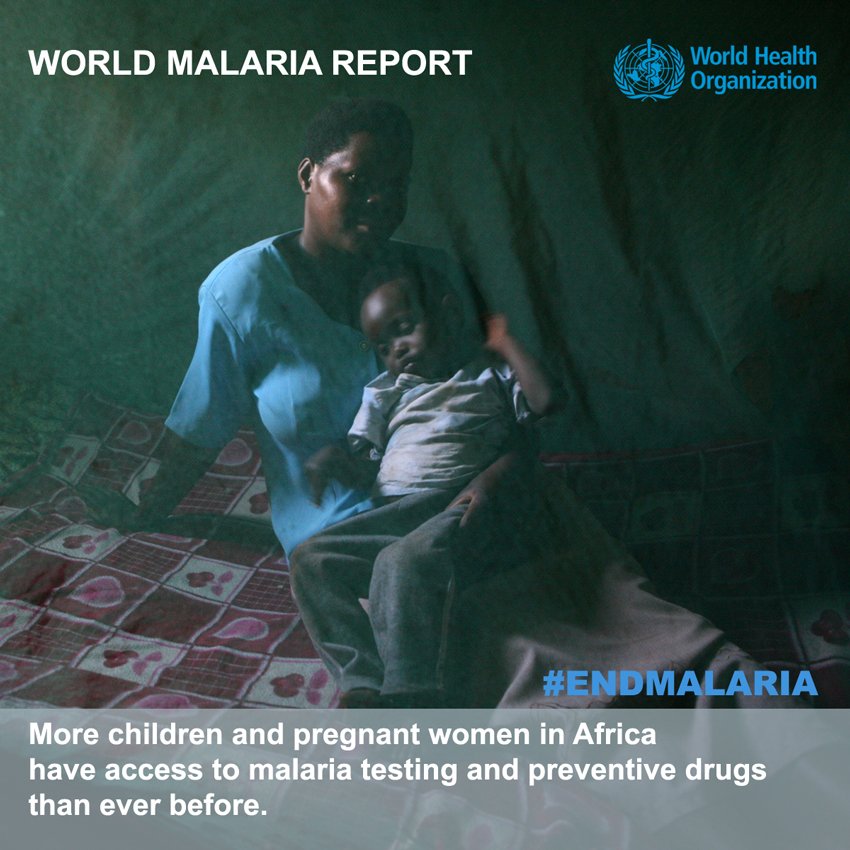
WHO’s World Malaria Report 2016 reveals that children and pregnant women in sub-Saharan Africa have greater access to effective malaria control. Across the region, a steep increase in diagnostic testing for children and preventive treatment for pregnant women has been reported over the last 5 years. Among all populations at risk of malaria, the use of insecticide-treated nets has expanded rapidly.

But in many countries in the region, substantial gaps in programme coverage remain. Funding shortfalls and fragile health systems are undermining overall progress, jeopardizing the attainment of global targets.

Scale-up in malaria control

Sub-Saharan Africa carries a disproportionately high share of the global malaria burden. In 2015, the region was home to 90% of malaria cases and 92% of malaria deaths. Children under five years of age are particularly vulnerable, accounting for an estimated 70% of all malaria deaths.

Diagnostic testing enables health providers to rapidly detect malaria and prescribe life-saving treatment. New findings presented in the report show that, in 2015, approximately half (51%) of children with a fever seeking care at a public health facility in 22 African countries received a diagnostic test for malaria, compared to 29% in 2010.

To protect women in areas of moderate and high malaria transmission in Africa, WHO recommends “intermittent preventive treatment in pregnancy” (IPTp) with sulfadoxine-pyrimethamine. The treatment, administered at each scheduled antenatal care visit after the first trimester, can prevent maternal and infant mortality, anaemia, and the other adverse effects of malaria in pregnancy.

According to available data, there was a five-fold increase in the percentage of women receiving the recommended 3 or more doses of this preventive treatment in 20 African countries. Coverage reached 31% in 2015, up from 6% in 2010.

Insecticide-treated nets are the cornerstone of malaria prevention efforts in Africa. The report found that more than half (53%) of the population at risk in sub-Saharan Africa slept under a treated net in 2015, compared to 30% in 2010.

Last month, WHO released the findings of a major 5-year evaluation in 5 countries. The study showed that people who slept under long-lasting insecticidal nets (LLINs) had significantly lower rates of malaria infection than those who did not use a net, even though mosquitoes showed resistance to pyrethroids (the only insecticide class used in LLINs) in all of these areas.

An unfinished agenda

Malaria remains an acute public health problem, particularly in sub-Saharan Africa. According to the report, there were 212 million new cases of malaria and 429 000 deaths worldwide in 2015.

There are still substantial gaps in the coverage of core malaria control tools. In 2015, an estimated 43% of the population in sub-Saharan Africa was not protected by treated nets or indoor spraying with insecticides, the primary methods of malaria vector control.

In many countries, health systems are under-resourced and poorly accessible to those most at risk of malaria. In 2015, a large proportion (36%) of children with a fever were not taken to a health facility for care in 23 African countries.

“We are definitely seeing progress,” notes Dr. Pedro Alonso, Director of the WHO Global Malaria Programme. “But the world is still struggling to achieve the high levels of programme coverage that are needed to beat this disease.”

Global targets

At the 2015 World Health Assembly, Member States adopted the Global Technical Strategy for Malaria 2016-2030. The Strategy set ambitious targets for 2030 with milestones every 5 years to track progress.

Eliminating malaria in at least 10 countries is a milestone for 2020. The report shows that prospects for reaching this target are bright: In 2015, 10 countries and territories reported fewer than 150 indigenous cases of malaria, and a further 9 countries reported between 150 and 1000 cases.

Countries that have achieved at least 3 consecutive years of zero indigenous cases of malaria are eligible to apply for the WHO certification of malaria elimination. In recent months, the WHO Director-General certified that Kyrgyzstan and Sri Lanka had eliminated malaria.

But progress towards other key targets must be accelerated. The Strategy calls for a 40% reduction in malaria case incidence by the year 2020, compared to a 2015 baseline. According to the report, less than half (40) of the 91 countries and territories with malaria are on track to achieve this milestone. Progress has been particularly slow in countries with a high malaria burden.

An urgent need for more funding

Sustained and sufficient funding for malaria control is a serious challenge. Despite a steep increase in global investment for malaria between 2000 and 2010, funding has since flat-lined. In 2015, malaria funding totalled US$ 2.9 billion, representing only 45% of the funding milestone for 2020 (US$ 6.4 billion).

Governments of malaria-endemic countries provided about 31% of total malaria funding in 2015. The United States of America is the largest international malaria funder, accounting for about 35% of total funding in 2015, followed by the United Kingdom of Great Britain and Northern Ireland (16%).

If global targets are to be met, funding from both domestic and international sources must increase substantially.

Note to editors

RTS,S/AS01 malaria vaccine

Last month, WHO announced that the world’s first malaria vaccine would be rolled out through pilot projects in 3 countries in sub-Saharan Africa. Vaccinations will begin 2018. The vaccine, known as RTS,S, acts against P. falciparum, the most deadly malaria parasite globally, and the most prevalent in Africa. Advanced clinical trials have shown RTS,S to provide partial protection against malaria in young children.

WHO multi-country evaluation on LLINs

On 16 November 2016, WHO released the findings of a 5-year evaluation conducted in 340 locations across 5 countries: Benin, Cameroon, India, Kenya and Sudan. The findings of this study reaffirm the WHO recommendation of universal LLIN coverage for all populations at risk of malaria.

Will major media cover this news? Will your local newspapers and broadcast outlets even make note?

Save


Annals of Global Warming: 2016 looks to be hottest year ever

November 19, 2016

Chart from Climate Central: The running average of global temperatures throughout 2016 compared to recent years. Each month shows the average of that month's temperature and each month before it

Chart from Climate Central: The running average of global temperatures throughout 2016 compared to recent years. Each month shows the average of that month’s temperature and each month before it

Earth is nearing the end of the the third record-breaking hot year in a row. 2014 was the hottest year ever, but was beaten by 2015. Now 2015’s heat takes second place to 2016’s heat.

2016’s record-breaking heat too fuel in part from an El Nino through the first nine months of the year; with a La Nina weather pattern developing now, there will be some cooling, but the cooling will not be enough to keep 2016 from being the warmest year ever recorded in human history.

Notes on this milestone can be found in several places; Climate Central’s explanation covers it succinctly.

The National Oceanic and Atmospheric Administration released its temperature data through the end of October on Thursday and found that for the year-to-date, the global average temperature is 1.75°F above the 20th century average of 57.4°F. That puts the year 0.18°F ahead of last year, the current hottest year titleholder, with just two months to go.

“It’s likely that we will end up as record warmest,” Jessica Blunden, a climate scientist with NOAA’s National Centers for Environmental Information, said during a press teleconference.

October itself tied as the third warmest in 136 years of record-keeping, coming in at 1.31°F (0.73°C) above the 20th century average of 57.1°F, according to NOAA. (NASA, which uses a different baseline and slightly different methods, put October in second place.)

September was the first month of the year to not be record warm (it came in second place), as temperatures began to cool slightly with the demise of El Niño and the move toward La Niña. It ended a streak of 16 consecutive record-setting months, itself a record.

Maybe more shocking, it’s been 115 years since we had a record cold year, according to Climate Central.

In fact, global temperatures have been above-average for 382 months in a row by NOAA’s reckoning, going all the way back to the Reagan administration. To find a record cold month requires going all the way back to February 1929. The last record-cold year was even further back, in 1911.

382 months. Anyone under the age of 31 has never experienced a single month of temperatures as low as the 20th century average, in their lifetime. A generation has been raised with global warming climate change as the norm. How will that affect voting patterns and public opinion to change government policies?

More:

Caption from Discover Magazine's ImaGeo blog: A map of temperature anomalies during October 2016 shows that the Arctic region was much warmer than the 1951-1980 mean. The United States and North Africa were also particularly warm. The largest area of cooler than average temperatures stretched across Russia. (Source: NASA GISS)

Caption from Discover Magazine’s ImaGeo blog: A map of temperature anomalies during October 2016 shows that the Arctic region was much warmer than the 1951-1980 mean. The United States and North Africa were also particularly warm. The largest area of cooler than average temperatures stretched across Russia. (Source: NASA GISS)


Global Warming is on the ballot; Bill Nye urges voting wisely

November 2, 2016

Bill Nye told Business Insider voters in 2016 can make a huge change, just voting for a president who will work on climate change.

Bill Nye told Business Insider voters in 2016 can make a huge change, just voting for a president who will work on climate change.

No secret that Bill Nye wants governments to act to slow and stop global warming.

Nothing if not hopeful, Nye explained to Mother Jones earlier that electing a president dedicated to making change could push Congress off the dime:

Electing a climate-friendly president is key, Nye says, because it could inject new life into Congress’ long-stagnant climate debate. “There are…many very reasonable people in Congress who are playing the hand they are dealt with these gerrymandered congressional districts,” he adds. “They have to please an extraordinary minority.” With the right leadership and timing, he says, the politicians just might take action.

A candidate rational about science and climate change is likely to be rational on other issues, too.

More:

Save

Save


Night shot, Kolob Reservoir Road (Zion National Park)

October 20, 2016

Cousin Amanda Holland sends snapshots from her science work.

“Evening drive along Kolob Reservoir Road, west end of Zion NP.” Photo by Amanda Holland; used with some permission, all rights reserved

Scientists in the field find beauty denied the casual visitor or even serious tourist — which is one of the great attractions of a science job, in the field.

Another view of why we love the American West, why we love the mountains, why we love the deserts.


Why we need war on the mosquito, the deadliest animal – Bill Gates

October 16, 2016

World's Deadliest Animals, Gates Foundation

World’s Deadliest Animals, Gates Foundation

One could quibble, and point out that it’s the malaria parasite that does the dirty work, more than the mosquito; but it’s only a quibble.

Short film from Bill Gates explaining why he helps wage war on the lowly mosquito. Use of science to find ways to defeat mosquito-borne disease transmission is especially important in the post-DDT world, since DDT resistance now aids every mosquito on Earth.

GatesNotes said:

There are about a dozen different diseases that are spread to humans by mosquito bites including dengue, yellow fever, Zika, chikungunya, and malaria. This little mosquito actually kills more humans than any other thing.

Learn more at: http://b-gat.es/2cUd9Ff