Ethnographer? It’s a person who makes a systematic study of a people and its culture, a subdivision of anthropology, sociology, history and geography all at once.
Milan Karanovic, trained as a priest, studied folk and cultural trends of Bosnians, roughly from 1900 to World War II.
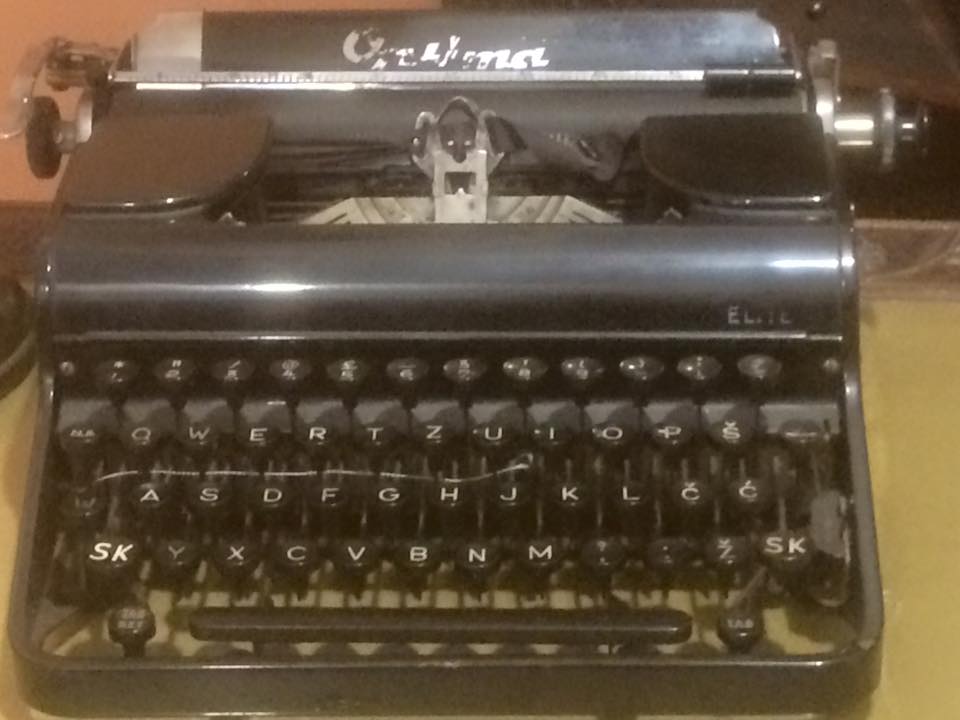
And this is his typewriter:
Typewriter of Bosnian ethnographer Milan Karanovic. Take careful note of special keys to accommodate Bosnian spellings. Typewriter on display in the National Museum of Bosnia and Herzegovina. Photo courtesy of Jonathan Halabi.
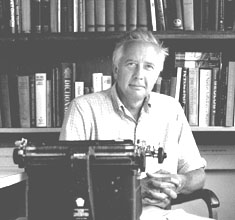
Photo of Milan Karanovich, National Museum of Bosnia and Herzegovina. “Zivot i rad” translates to “life and work.” Image by Jonathan Halabi.
Milan Karanovic was born in 1883 in Great Novljansko Rujiška. In his teens he moved to Sarajevo, graduated high school and attended seminary, graduating by 1909 and assuming duties as a parish priest (Orthodox?) in the Krajina region village of Rujnić. We know he published a study of the “village” of Sarajevo in 1907. On the wrong side of local authorities in World War I, he spent much of the war in prison. His publications resumed by 1925, and proliferated through 1937. He died in 1955.
Ten feet in altitude, 120 feet traveled, 12 seconds long. That was the first flight in a heavier-than-air machine achieved by Orville and Wilbur Wright of Dayton, Ohio, at Kittyhawk, North Carolina, on December 17, 1903.
Few witnesses observed the flight. Though the brothers Wright fully understood the potential of the machine they had created, even they waited before revealing to their supporters, and then the world, what they had accomplished.
Critics complain others achieved flight in a heavier-than-air machine before the Wrights. There are stories of flights in Texas, Connecticut, and France. If anyone achieved flight before the Wrights, the Wrights did a much better job of recording their achievement, and promoting it afterward. In the end, the Wrights left a legacy of flight research conducted in classic science, with careful records, a lot of experiments and observations, and publication of results.
On the morning of December 17, 1903, Wilbur and Orville Wright took turns piloting and monitoring their flying machine in Kill Devil Hills, North Carolina. Orville piloted the first flight that lasted just twelve seconds. On the fourth and final flight of the day, Wilbur traveled 852 feet, remaining airborne for 57 seconds. That morning the brothers became the first people to demonstrate sustained flight of a heavier-than-air machine under the complete control of the pilot.
No lost luggage, no coffee, no tea, no meal in a basket, either. No ATC (Air Traffic Control) delays. Neither brother endured a TSA screening.
Wikipedia caption: Polar explorer Apsley Cherry-Garrard in front of his typewriter in the Terra Nova hut at Cape Evans (Ross Island, Antarctica). August 30, 1911. British Antarctic Expedition 1910-13 (Ponting Collection)
Even in the Antarctic, scientists and explorers need to write their findings down. A typewriter was the state-of-the-art tool in 1911. Here we see Apsley Cherry-Garrard with his typewriter, on expedition.
Cherry-Garrard probably used that machine to write the notes, if not the actual text, for his account of the expedition, The Worst Journey in the World:
The Worst Journey in the World is a memoir of the 1910–1913 British Antarctic Expedition led by Robert Falcon Scott. It was written and published in 1922 by a member of the expedition, Apsley Cherry-Garrard, and has earned wide praise for its frank treatment of the difficulties of the expedition, the causes of its disastrous outcome, and the meaning (if any) of human suffering under extreme conditions.
NASA’s poster for National Aviation Day 2016. A young girl looks up at some of the experimental ideas for future aviation. NASA said: “It’s an exciting time for aviation, with potential NASA X-planes on the horizon and a lot of new technologies that are making airplanes much more Earth friendly. Use National Aviation Day to excite and inspire the young people you know about exploring aeronautics as a future career. Credits: NASA / Maria C. Werries”
August 19 is National Aviation Day. In federal law, the day is designated for flying the flag (36 USC 1 § 118).
August 19 is the anniversary of the birth of Orville Wright, usually credited with being on the team with his brother Wilbur who successfully built and flew the first heavier-than-air flying machine.
Celebrate? The White House issued no proclamation for 2016, but you may fly your flag anyway.
It’s a day to remember history. Do you remember that day, the first time humans set foot on the Moon?
Southwest Elementary in Burley, Idaho, existed in a world far, far away from the U.S. space program. We watched rocket launches on black and white televisions — the orbital launches were important enough my father let me stay home from school to watch, but when he dropped me off at school, I was in a tiny band of students who actually made it to school. Potato farmers and the merchants who supported them thought the space program was big, big stuff, worth missing school.
By John Glenn’s flight, a three-orbit extravaganza on February 20, 1962, a television would appear in the main vestibule of the school, or in the auditorium, and we’d all watch. There were very few spitballs. Later that year my family moved to Pleasant Grove, Utah.
Toward the end of the Gemini series, television news networks stopped providing constant coverage. The launch, the splashdown, a space walk or other mission highlight, but the nation didn’t hold its breath so much for every minute of every mission. Barry McGuire would sing about leaving the planet for four days in space (” . . . but when you return, it’s the same old place.”), then six days, but it was just newspaper headlines.
The Apollo 1 fire grabbed the nation’s attention again.Gus Grissom, one of the three who died, was one of the original space titans; death was always a possibility, but the U.S. program had been so lucky. Apollo’s start with tragedy put it back in the headlines.
The space program and its many successes made Americans hopeful, even in that dark decade when the Vietnam War showed the bloody possibilities of the Cold War. That darkest year of 1968 — see the box below — closed nicely with Apollo 8 orbiting the Moon, and the famous Christmas Eve telecast from the three astronauts, Frank Borman, Jim Lovell, and William A. Anders. The space program kept us hopeful.
By early 1969 many of us looked forward to the flight of Apollo 11 schedule for July — the space flight that promised to put people on the Moon for the first time in history, the realization of centuries-old dreams.
But, then I got my assignment for Scouting for the summer — out of nearly 50 nights under the stars, one of the days would include the day of the space walk. Not only was it difficult to get televisions into Maple Dell Scout Camp, a good signal would be virtually impossible. I went to bed knowing the next day I’d miss the chance of a lifetime, to watch the first moon landing and walk.
Just after midnight my sister Annette woke me up. NASA had decided to do the first walk on the Moon shortly after touchdown, at an ungodly hour. I’d be unrested to check Scouts in, but I’d have seen history.
Texas Essential Knowledge and Skills (TEKS) lists 11 dates for U.S. history as the touchstones kids need to have: 1609, the founding of Jamestown; 1776, the Declaration of Independence; 1787, the Constitutional Convention; 1803, the Louisiana Purchase; 1861-1865, the American Civil War; 1877, the end of Reconstruction; 1898, the Spanish American War; 1914-1918, World War I; 1929, the Stock Market Crash and beginning of the Great Depression; 1941-1945, World War II; 1957, the launching of Sputnik by the Soviets. Most teachers add the end of the Cold War, 1981; I usually include Apollo 11 — I think that when space exploration is viewed from a century in the future, manned exploration will be counted greater milestone than orbiting a satellite; my only hesitance on making such a judgment is the utter rejection of such manned exploration after Apollo, which will be posed as a great mystery to future high school students, I think.)
* Why 1968 was such a tough year, in roughly chronological order: 1968 produced a series of disasters that would depress the most hopeful of people, including: the Pueblo incident, the B-52 crash in Greenland, the Tet Offensive in Vietnam, the nerve gas leak at the Army’s facility at Dugway, Utah, that killed thousands of sheep, Lyndon Johnson’s pullout from the presidential race with gathering gloom about Vietnam, the Memphis garbage strike, the assassination of Martin Luther King, Jr., riots, the Black Panther shoot-out in Oakland, the Columbia University student takeover, the French student strikes, the tornadoes in Iowa and Arkansas on May 15, the Catonsville 9 vandalism of the Selective Service office, the sinking of the submarine U.S.S. Scorpion with all hands, the shooting of Andy Warhol, the assassination of Robert F. Kennedy, the Buenos Aires soccer riot that killed 74 people, the Glenville shoot-out in Cleveland, the cynicism of the Republicans and the nomination of Richard Nixon and Spiro Agnew, the Warsaw Pact invasion of Czechoslovakia crushing the “Prague Spring” democratic reforms, the Chicago Democratic Convention and the police riot, the brutal election campaign, the Tlatololco massacre of students in Mexico City, Black Power demonstrations by winning U.S. athletes at the Mexico City Olympics, coup d’etat in Panama. Whew!
From the U.S. National Archives Administration: Dated June 23, 1868, this is the printed patent drawing for a “Type-Writer” invented by Christopher L. Sholes, Carlos Glidden, and J. W. Soule. Drawing for a Typewriter, 06/23/1868 Drawing for a Typewriter, 06/23/1868 (ARC Identifier: 595503); Patented Case Files, 1836 – 1956; Records of the Patent and Trademark Office; Record Group 241; National Archives.
Links below can get us into position to commemorate the day adequately. Maybe celebrate with ribbons, without the wrapping paper and boxes? (Okay, maybe puns aren’t the way.)
Between Christmas and New Year’s Day, here at Millard Fillmore’s Bathtub we celebrate a variety of historically holy days. December 31, by tradition, is Bright Idea Day, the anniversary of the day Thomas Edison demonstrated for the public a working light bulb, in 1879.
100,000 people gather in Times Square, New York City (surely not the 1 million predicted by NBC!) tonight, and millions more around the world, in festivities for the new year made possible by the work of Thomas Alva Edison.
Here it is, the invention that stole sleep from our grasp, made clubbing possible, and launched 50,000 cartoons about ideas:
The light bulb Thomas Edison demonstrated on December 31, 1879, at Menlo Park, New Jersey – Wikimedia image (GFDL)
The light bulb. It’s an incandescent bulb.
It wasn’t the first bulb. Edison a few months earlier devised a bulb that worked with a platinum filament. Platinum was too expensive for mass production, though — and Edison wanted mass production. So, with the cadre of great assistants at his Menlo Park laboratories, he struggled to find a good, inexpensive filament that would provide adequate life for the bulb. By late December 1879 they had settled on carbon filament.
Edison invited investors and the public to see the bulb demonstrated, on December 31, 1879.
Thomas Edison in 1878, the year before he demonstrated a workable electric light bulb. CREDIT: Thomas Edison, head-and-shoulders portrait, facing left, 1880. Prints and Photographs Division, Library of Congress. Reproduction number LC-USZ62-98067
Edison’s successful bulb indicated changes in science, technology, invention, intellectual property and finance well beyond its use of electricity. For example:
Edison’s Menlo Park, New Jersey, offices and laboratory were financed with earlier successful inventions. It was a hive of inventive activity aimed to make practical inventions from advances in science. Edison was all about selling inventions and rights to manufacture devices. He always had an eye on the profit potential. His improvements on the telegraph would found his laboratory he thought, and he expected to sell the device to Western Union for $5,000 to $7,000. Instead of offering it to them at a price, however, he asked Western Union to bid on it. They bid $10,000, which Edison gratefully accepted, along with the lesson that he might do better letting the marketplace establish the price for his inventions. Other inventive labs followed Edison’s example, such as the famous Bell Labs, but few equalled his success, or had as much fun doing it. (Economics teachers: Need an example of the marketplace in action?)
Edison didn’t invent the light bulb — but his improvements on it made it commercial. “In addressing the question ‘Who invented the incandescent lamp?’ historians Robert Friedel and Paul Israel list 22 inventors of incandescent lamps prior to Joseph Wilson Swan and Thomas Edison. They conclude that Edison’s version was able to outstrip the others because of a combination of three factors: an effective incandescent material, a higher vacuum than others were able to achieve (by use of the Sprengel pump) and a high resistance lamp that made power distribution from a centralized source economically viable.”
Look around yourself this evening, and you can find a score of ways that Edison’s invention and its descendants affect your life. One of the more musing effects is in cartooning, however. Today a glowing lightbulb is universally accepted as a nonverbal symbol for ideas and inventions. (See Mark Parisi’s series of lightbulb cartoons, “Off the Mark.”)
Even with modern, electricity-saving bulbs, the cartoon shorthand hangs on, as in this Mitra Farmand cartoon.
Brilliant cartoon from Mitra Farmand, Fuffernutter (regrettably, we note this site is no longer there; but with some hope, we find a new site here)
Or see this wonderful animation, a video advertisement for United Airlines, by Joanna Quinn for Fallon — almost every frame has the symbolic lightbulb in it.
Electrification of America, and the consequent spread of electric lighting and electrical machines to make domestic and industrial life more productive, and the spread of great public works to enable these and other inventions to spread, were made possible by a people roughly united in advancing progress, what historians now call “the progressive agenda” and the great advances of the Progressive Era.
Could we get such agreement among workers, corporate bosses and many levels of government today? When we celebrate anniversaries, like the demonstration of the light bulb, we celebrate the united polity that made such things possible, too.
Thomas Edison’s electric lamp patent drawing and claim for the incandescent light bulb CREDIT: “New Jersey–The Wizard of Electricity–Thomas A. Edison’s System of Electric Illumination,” 1880. Prints and Photographs Division, Library of Congress. Reproduction Number LC-USZ62-97960.
It’s still solid, and most school administrators still miss the point. Teachers get sent to courses to “learn to do a PowerPoint,” but rarely can anyone leading those courses tell when to use a PowerPoint, or Keynote, and when a simple list on a chalkboard/whiteboard is more effective, or perhaps when having students copy a list would be more effective, or when students making a poem/song/poster of a point would be more effective.
An international law firm recently directed that it’s army of a couple thousand lawyers would, henceforth, use Prezi instead of PowerPoint. Nevermind that the lawyers hadn’t mastered PowerPoint and don’t have a clue what to do with Prezi: Some “managing co-partner” was taken in by the swoops of Prezi. More than four years ago I learned Prezi at a technology course for technologies my district later decided not to support (money, use, lack of internet connections, etc., etc. — I suspected a lack of planning and thinking about how technology could be used). In the course, I asked the instructor how to tell when to use Prezi instead of PowerPoint — and how to embed YouTube videos for classroom use of a Prezi. After working for too long, we decided we couldn’t figure out how to embed videos, and so PowerPoint might be more useful. Then the instructor confessed he didn’t know how to embed videos in PowerPoint, either.
Let alone, when does a video work better than other instructional methods? Long or short? Notes, quiz, or oral feedback?
Many Texas districts struggle to teach “keyboarding” to students who have difficulty printing notes, letter by letter, because they don’t know cursive writing (and therefore, cannot read their teachers’ comments on their written work).
Is “integrating technology” really the problem?
Anyway, here’s Mr. Ferriter’s list, a checklist to tell whether you’re getting close to actually using technology, or whether you’re just ringing the bells and tooting the whistles of machines on the desks.
Cheat Sheet: What do you want kids to do with technology? By Bill Ferriter The Tempered Radical blog.williamferriter.com @plugusin
_________________________________
What do you want kids to do with technology?
Wrong answers
Right answers
· Make Prezis
· Raise awareness
· Start blogs
· Start conversations
· Create Wordles
· Find answers
· Publish Animotos
· (Answers to
THEIR questions)
· Design flipcharts
· Join partners
· Post to EdModo
· Make a difference
· Use Whiteboard
· Take action
· Develop apps
· Drive change
Technology is a tool, NOT a learning outcome
_________________________________
“Technology is a tool, not a learning outcome,” Bill Ferriter says. He’s right, of course.
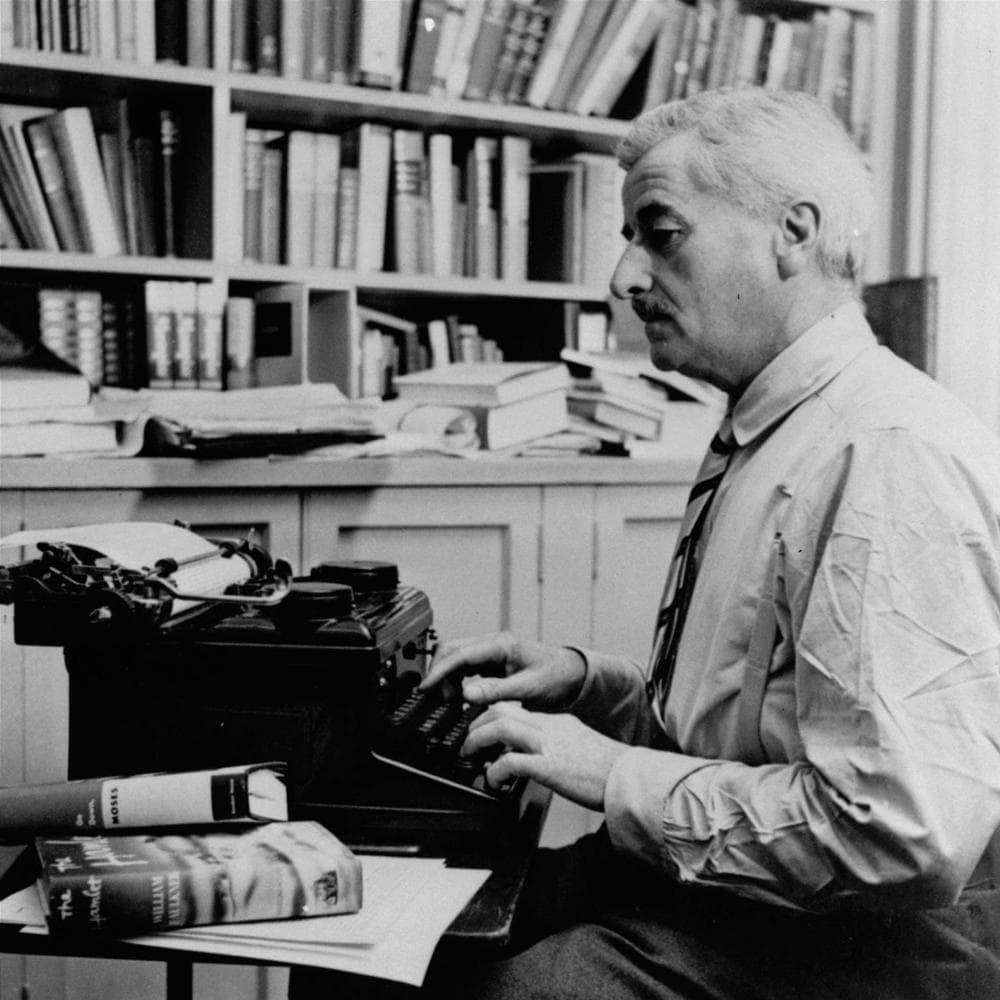
William Faulkner at his typewriter, August 12, 1954, at his home in Oxford, Mississippi. Associated Press photo, via ShelfLife
William Faulkner at his typewriter, August 12, 1954, at his home in Oxford, Mississippi. Associated Press photo.
The photo was probably posed; the two books to the left of the typewriter are Faulkner books. Faulkner may have written in a pressed shirt and tie, but I doubt it.
In a drawer in a file box in the U.S. Patent Office in Washington, D.C., is a study in black ink on white paper, lines that resemble those images most of us have of the first Wright Bros. flyer, usually dubbed “Kittyhawk” after the place it first took to the air.
Drawing 1 from patent granted to Orville Wright for a flying machine
The patent was issued on May 22, 1906, to Orville Wright, Patent No. 821393, for a “flying machine.”
It makes more sense if you turn the drawing on its side.
Between Christmas and New Year’s Day, here at Millard Fillmore’s Bathtub we celebrate a variety of historically holy days. December 31, by tradition, is Bright Idea Day, the anniversary of the day Thomas Edison demonstrated for the public a working light bulb, in 1879.
100,000 people gather in Times Square, New York City, tonight, and millions more around the world, in festivities for the new year made possible by the work of Thomas Alva Edison.
Here it is, the invention that stole sleep from our grasp, made clubbing possible, and launched 50,000 cartoons about ideas:
The light bulb Thomas Edison demonstrated on December 31, 1879, at Menlo Park, New Jersey – Wikimedia image (GFDL)
The light bulb. It’s an incandescent bulb.
It wasn’t the first bulb. Edison a few months earlier devised a bulb that worked with a platinum filament. Platinum was too expensive for mass production, though — and Edison wanted mass production. So, with the cadre of great assistants at his Menlo Park laboratories, he struggled to find a good, inexpensive filament that would provide adequate life for the bulb. By late December 1879 they had settled on carbon filament.
Edison invited investors and the public to see the bulb demonstrated, on December 31, 1879.
Thomas Edison in 1878, the year before he demonstrated a workable electric light bulb. CREDIT: Thomas Edison, head-and-shoulders portrait, facing left, 1880. Prints and Photographs Division, Library of Congress. Reproduction number LC-USZ62-98067
Edison’s successful bulb indicated changes in science, technology, invention, intellectual property and finance well beyond its use of electricity. For example:
Edison’s Menlo Park, New Jersey, offices and laboratory were financed with earlier successful inventions. It was a hive of inventive activity aimed to make practical inventions from advances in science. Edison was all about selling inventions and rights to manufacture devices. He always had an eye on the profit potential. His improvements on the telegraph would found his laboratory he thought, and he expected to sell the device to Western Union for $5,000 to $7,000. Instead of offering it to them at a price, however, he asked Western Union to bid on it. They bid $10,000, which Edison gratefully accepted, along with the lesson that he might do better letting the marketplace establish the price for his inventions. Other inventive labs followed Edison’s example, such as the famous Bell Labs, but few equalled his success, or had as much fun doing it. (Economics teachers: Need an example of the marketplace in action?)
Edison didn’t invent the light bulb — but his improvements on it made it commercial. “In addressing the question ‘Who invented the incandescent lamp?’ historians Robert Friedel and Paul Israel list 22 inventors of incandescent lamps prior to Joseph Wilson Swan and Thomas Edison. They conclude that Edison’s version was able to outstrip the others because of a combination of three factors: an effective incandescent material, a higher vacuum than others were able to achieve (by use of the Sprengel pump) and a high resistance lamp that made power distribution from a centralized source economically viable.”
Look around yourself this evening, and you can find a score of ways that Edison’s invention and its descendants affect your life. One of the more musing effects is in cartooning, however. Today a glowing lightbulb is universally accepted as a nonverbal symbol for ideas and inventions. (See Mark Parisi’s series of lightbulb cartoons, “Off the Mark.”)
Even with modern, electricity-saving bulbs, the cartoon shorthand hangs on, as in this Mitra Farmand cartoon.
Brilliant cartoon from Mitra Farmand, Fuffernutter
Or see this wonderful animation, a video advertisement for United Airlines, by Joanna Quinn for Fallon — almost every frame has the symbolic lightbulb in it.
Electrification of America, and the consequent spread of electric lighting and electrical machines to make domestic and industrial life more productive, and the spread of great public works to enable these and other inventions to spread, were made possible by a people roughly united in advancing progress, what historians now call “the progressive agenda” and the great advances of the Progressive Era.
Could we get such agreement among workers, corporate bosses and many levels of government today? When we celebrate anniversaries, like the demonstration of the light bulb, we celebrate the united polity that made such things possible, too.
Thomas Edison’s electric lamp patent drawing and claim for the incandescent light bulb CREDIT: “New Jersey–The Wizard of Electricity–Thomas A. Edison’s System of Electric Illumination,” 1880. Prints and Photographs Division, Library of Congress. Reproduction Number LC-USZ62-97960.
At IMDB: Billy Wilder and I.A.L. Diamond at work on the screenplay for Irma la Douce
Billy Wilder’s reputation as a great film director would not be possible, but for the typewriter. It is fate, perhaps, that we find several photographs of Mr. Wilder with various typewriters. In the photo above, he’s pictured working with I. A. L. Diamond, “Izzy.” The pair collaborated on at least 17 different screenplays.
This one is clearly a Royal; Hollywood Legacy’s Pinterest site: “BILLY WILDER and frequent screenwriter partner, I.A.L. DIAMOND. “Izzy” is seated at the typewriter, with Wilder standing, as usual. Wilder liked to “think on his feet” and was a notorious pacer. Wilder & Diamond wrote 17 films together, including: SOME LIKE IT HOT, THE APARTMENT, LOVE IN THE AFTERNOON, IRMA LA DOUCE”
Wilder’s scripts often featured writers and others who used typewriters. He had almost a fetish for featuring typewriters in his movies. How could we not like a guy who loved typewriters like that?
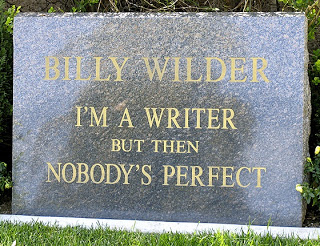
From the great Oz Typewriters site: “Wilder died in Beverly Hills on March 27, 2002. Here is what is on his tombstone
August 26 is the anniversary of the first television broadcast of professional baseball, in 1939; the future-legendary Red Barber called a doubleheader between his Brooklyn Dodgers and the Cincinnati Reds from Ebbets field.
Both games were carried on experimental television station W2XBS, which evolved into New York’s NBC affiliate Channel 2, WNBC. Two stationary cameras were used, in contrast to the several used in modern broadcasts — and it was in black and white. About 3,000 people are estimated to have watched.
The Reds won the opener, 5-2, but the Dodgers roared back in game 2, 6-1.
Ebbets field is gone. The Dodgers absconded to Los Angeles in the 1950s. Baseball games are in color.
Red Barber is gone, too. We have great play-by-play guys, and wonderful color commentators. There will never be another Red Barber though. Below is an old post noting Barber’s ways with typewriters.
The great Red Barber, when his hair was still red, working at his typewriter, with a volume of Roget’s Thesaurus close by.
Many of us knew Red chiefly through his weekly chats with Bob Edwards at NPR’s Morning Edition. The biographies say Red died in 1992. That was 19 years ago — it seems more recent than that. (Edwards left Morning Edition in 2004.)
It may be ironic to show Barber at his typewriter. He would be more accurately portrayed, perhaps, behind a microphone at a baseball park.
From 1939 through 1953 Barber served as the voice of the Brooklyn Dodgers. He was working for the New York Yankees when he retired in 1966. Barber had the distinction of broadcasting baseball’s first night game on May 24, 1935 in Cincinnati and the sport’s first televised contest on August 26, 1939 in Brooklyn.
During his 33-year career Barber became the recognized master of baseball play-by-play, impressing listeners as a down-to-earth man who not only informed but also entertained with folksy colloquialisms such as “in the catbird seat,” “pea patch,” and “rhubarb” which gave his broadcasts a distinctive flavor. (Radio Hall of Fame)
Or, until that account is unsuspended by the forces supporting Donald Trump: Follow @FillmoreWhite, the account of the Millard Fillmore White House Library
We've been soaking in the Bathtub for several months, long enough that some of the links we've used have gone to the Great Internet in the Sky.
If you find a dead link, please leave a comment to that post, and tell us what link has expired.
Thanks!
Retired teacher of law, economics, history, AP government, psychology and science. Former speechwriter, press guy and legislative aide in U.S. Senate. Former Department of Education. Former airline real estate, telecom towers, Big 6 (that old!) consultant. Lab and field research in air pollution control.
My blog, Millard Fillmore's Bathtub, is a continuing experiment to test how to use blogs to improve and speed up learning processes for students, perhaps by making some of the courses actually interesting. It is a blog for teachers, to see if we can use blogs. It is for people interested in social studies and social studies education, to see if we can learn to get it right. It's a blog for science fans, to promote good science and good science policy. It's a blog for people interested in good government and how to achieve it.
BS in Mass Communication, University of Utah
Graduate study in Rhetoric and Speech Communication, University of Arizona
JD from the National Law Center, George Washington University


 Posted by Ed Darrell












 Millard Fillmore's Bathtub