Teachers’ planning: On-line sources for everything

August 24, 2007

Digital History.

Maybe not absolutely everything. But you can mine this source, the veins are rich and deep.

This is a list of sources from Digital History, a site maintained by the University of Houston. I’ve mentioned it in the past, I think — I’ve used it a lot. For example, it has a list of history museums throughout the U.S., with websites and links. It lists the sites of history journals. It lists the sites of electronic history journals.

You’ve got your lesson plans mapped out, most of them done. You’ve got the data sheets for the students to fill out, you’ve got the first week’s bell ringers all prepared. The syllabi are all resting snug in their boxes, just waiting for students, those sly little foxes.

You’re ready.

Take a minute, take a deep breath; now, go browse the Digital History resources. See what other possibilities there are.


Got a manual typewriter you can donate?

August 19, 2007

Few of us use manual typewriters for business anymore. But there are a few people who use them.

From comments to a previous “typewriter of the moment” post:

It is so thrilling to see how the ‘little’ things such as our manual typewriter can connect people in far away places to real feelings! They are lucky kids indeed but how lucky are we that we get to be a part of it :) If you have a manual typewriter that you would like to see used and loved by “generation ?” feel free to send it to us. One just is not enough!
CSWS 9450 22nd Ave SW. Seattle. WA. 98106

With Love
Sarah Airhart
Founder of the Community School of West Seattle.

So, if you’ve got a working typewriter in your attic or basement, or in your office acting as a paperweight, now you know where to send it — I’ll wager Sarah will give you a receipt so you can deduct the value of the machine from your income taxes.

But even if there were no deduction, wouldn’t the interest of the kids be enough?

Kids at the Community School of West Seattle


Dreaming: Ideal set of classroom technology

August 19, 2007

What would your ideal classroom have in it, especially with regard to technology? Brian Smith wants you to tell him what you need, and what you want, and what you dream about — here, and here.

Pushing the corporation’s training into the 21st century, almost two decades ago for AMR Corp., the parent of American Airlines and SABRE (which has been split off subsequently), a group of us in the future-looking department benchmarked corporate and academic training and education. One of our trips took us to IBM’s training center in White Plains, New York — IBM then being considered rather the leader in corporate training and education (running neck and neck with Arthur Andersen; tempus fugit, o tempora, o mores).

IBM put us through a wringer designed to make us think hard. For one example, they asked us why we weren’t benchmarking our own pilot training, which they had benchmarked a few years earlier. Pilot training at airlines in the U.S. was the best in the world, one fellow noted: You hire people who already know how to do the job well, and you have the pick of the best; you train them in simulators and in an intense classroom situations; then when they go to the job, they have trained people behind them to make sure they do it all right; then you call them back every year to refresh with the latest technologies. (Most other training at airlines still is not up to the pilot training standards, which is good for safety as far as pilots are concerned; aircraft mainenance is close behind. One gets an appreciation for true concern about safety when studying that process. But I digress.)

Read the rest of this entry »


Typewriter of the moment: Scottish poet Edwin Morgan

August 17, 2007

A poet's typewriter; Scottish poet Edwin Morgan

From the Learning and Teaching Scotland site:

“Edwin Morgan has written hundreds of poems and translations on countless subjects and in a dizzying variety of forms and styles from Glasgow Sonnets to Science Fiction, opera libretto to Concrete poetry, live performance with jazz saxophonist Tommy Smith to the Instamatic poems.

“Edwin is widely acclaimed as Scotland’s greatest living poet. In 2004 the title of ‘Scots Makar’ was formally bestowed on Edwin effectively creating the first ‘Poet Laureate’ of Scotland.

“Literacy and Numeracy Scotland is developing a new Edwin Morgan resource for schools. The resource will feature video clips of Liz Lochhead and Edwin in conversation about his life, inspirations and poetry, as well as audio performances of 27 of Edwin’s poems with accompanying teaching ideas and interactives.”

See and hear Edwin Morgan’s poems here.

Photo from Learning and Teaching Scotland


Typewriter of the moment: Faulkner, again

August 15, 2007

The previous photo showed Faulkner himself using the machine.

It was a desktop machine. This color shot shows Faulkner’s portable typewriter, a different machine from the one in the publicity still from 1954.

William Faulkner's typewriter, displayed at his home in Oxford, Mississippi; photo by Gary Bridgman

Photographer Gary Bridgman provided a thorough history and explanation, at the Wikipedia Media site, which I quote completely and directly — bless him for the story:

The “Faulkner portable”: American novelist William Faulkner’s (1897-1962) Underwood Universal Portable typewriter, resting on a tiny desk his stepson helped him build. This space at Rowan Oak, the author’s home, was part of the back porch until Faulkner spent part of a Random House advance to enclose it in 1952, long after he had written his seminal Compson and Sartoris family novels. He insisted that this room not be called his “study.” According to biographer Joseph Blotner, “he did not study in it, so there was no sense in calling it that. It was the ‘office,’ the traditional name for the room in the plantation houses where the business was transacted.” As to the typewriter itself, Underwood introduced its Universal Portable in the mid-1930s among a full line of portables such as Champion, Noiseless Portable and Junior. Faulkner had a habit of buying used portables locally, wearing them out, then trading them in on more used portables. This Underwood was one of at least three typewriters in Faulkner’s possession at the time of his death (the University of Virginia has one, too). So, this is no more “the” typewriter any more than those square carpenter’s pencils next to it are “the” pencils. Had Faulkner lived a few more years, this machine would have met the same fate as the rest. Still, the room has a resonance. BOOK magazine was publishing an article of mine on “Yoknapatourism,” and thinking (mistakenly) that the editors hadn’t already selected a photographer, I returned to Oxford on a rainy October afternoon to make my own pictures for submission. The travel piece was eventually illustrated with sunny-day brochure shots, but I was happy to keep this one for myself. There was no direct lighting within the office, so I let the film take its time, soaking up faint incandescent glow from the library and main hallway, which neatly balanced the cloudy daylight. I used the camera’s timer so my hand wouldn’t jostle the tripod, and I even backed out of the room–in part to let the scarce light do its work and, I think, because I wanted Faulkner’s office truly vacant.

Trivia: the book next to the typewriter is the 1939 edition of Writer’s Market. Thanks to Bill Griffith, curator of Rowan Oak, for letting me past the Lucite wall and to Milly Moorhead West for lending me the tripod. – Gary Bridgman

Photo by Gary Bridgman, southsideartgallery.com.


Good Vibrations

August 15, 2007

August 15 is Leon Theremin’s birthday (b. 1896).

Leon Theramin and his instrument, the Theramin Without Leon Theremin, musical scores to horror movies would be nearly impossible, at least for everyone except Henry Mancini and John Williams.

His life would make a great movie. He invented the Theremin in the midst of World War I in Russia; after the war he toured Europe, and then the U.S. He played Carnegie Hall, he collaborated with Albert Einstein, and he married a young African-American ballerina, Lavinia Williams. In 1938 he was kidnapped by the Soviet KGB and forced to return to Russia, in the Union of Soviet Socialist Republics (USSR).

Sent to a work camp, he worked alongside Andrei Tupelov and a host of other famous Soviet scientists. Theremin was “rehabilitated” in 1956. He returned to invention, and invented bugging devices, including the famous microphone that was placed in the Great Seal of the United States in the U.S. Embassy in Moscow. The bug had no moving or active parts, and no power supply, but could transmit when hit with a microwave transmission. The bug spied on U.S. diplomats from 1945 until its accidental discovery in 1952.

Later Theremin turned to inventions of devices to open doors, and to burglar alarms. He trained his niece, Lydia Kavina, on the Theremin — she is considered a virtuoso at the instrument today. In 1991 he returned to the U.S., reunited with some of the artists he’d worked with 50 years earlier for several concerts. He died in Russia in 1993, at the age of 97.

And if you’ve ever heard the Beach Boys’ recording of “Good Vibrations,” you know what a Theremin sounds like.


Typewriter of the moment: Langston Hughes

August 11, 2007

Langston Hughes at his typewriter

Langston Hughes at his typewriter. Photo from the Kennedy Center.

Manuscript of Langston Hughes' poem,

Manuscsript of “Harlem,” with correction marks. From Kennedy Center website – Harlem Renaissance


Henry F. Phillips — when do we celebrate?

August 10, 2007

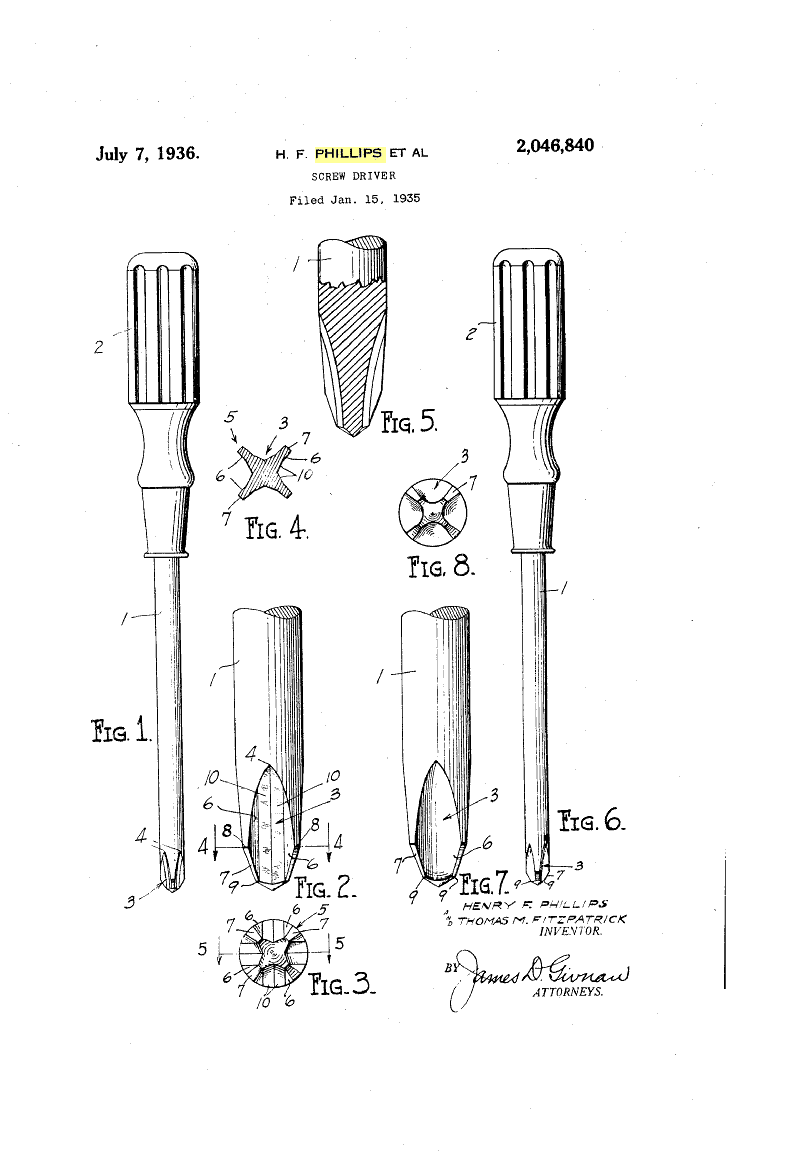
Herny Phillips' patent for the Phillips screw and screwdriver (Google Patents)

Patent drawings for the Phillips screw and screwdriver, 1936

Only Crook in Town was alerted to the work of Henry F. Phillips by an alert and helpful librarian (well — aren’t they all?). She worries –January 15 is Martin Luther King, Jr., Day, and July 7 is the middle of the summer — what day would be appropriate to celebrate the invention and patenting of the Phillips Screwdriver? (If image above does not display, click the thumbnail picture at the end of the post.)

Ah, history teachers, you noticed that the drawing comes from Google’s files of patent applications. And now you wonder: What other wonderful illustrations can we legally rip off to use in class? Wonderful question — what do you find?

The Phillips screwdriver came along in time for World War II and the mass assembly of aircraft, and aircraft instrument panels. The Phillips screw head helped aircraft assemblers keep from scratching the black metal of the rest of the panel while securing instruments into the forms.

Read the rest of this entry »


Typewriter of the moment: The Living Classroom

August 10, 2007

Typewriter donated by Anya to the Living Classroom, at the Community School of West Seattle, WashingtonSlight deviation from my usual practice of featuring the technological marvel of the writing machine of a well-known writer — these writers are not yet well known.

Someone brought in a vintage Smith-Corona typewriter to one of my favorite classrooms, at the Community School in West Seattle. Photographic evidence shows the machine is still in good working order (better than my Royal), and the students have already figured out how to make it work (see photo below).

My typing career began with my mother’s and father’s Royal, similar to the one I now own. It got me to ninth grade with no problems. I took typing classes on the classic, newsroom Underwoods, about the time that the IBM Selectric was making in-roads. In my senior year of high school I got an Underwood portable — brother Dwight was selling for Underwood-Olivetti. Later I got an old, junked Olivetti electric that was gray, would do line-and-a-half as well as double spacing, and which had a pitch somewhere between 10 and 12 pica. It was heavy and industrial, but the typeface was so readable that it was popular with my debater colleagues — we used to carry the machine with us to tournaments after I joined the college debate squad.

In my junior year at the University of Utah, on a Thomas J. Watson, Jr., Memorial scholarship from IBM, I purchased a Correcting Selectric II (no, IBM offered no discount). About 20 years later, tired of the massive repair bills and hoping word processors would forever banish it from our house, my wife donated that typewriter to the Salvation Army. I found another at a garage sale, and got it for $10.00. The mechanism on that one sprang out of the case about a year later, and we eventually donated it, too.

Perry W. Buffington found the Royal that graces my home office now, largely unused but full of sentiment. (I think Buff wanted me to write more.)

These kids in Washington — they don’t know the value of the tool they have. They can’t know.  Lucky kids.

Paper typed in the Living Classroom

Photo from the Living Classroom; work product from a student.


Toldja

August 8, 2007

Remember the earlier post on this?

Flight patters, from Aaron Koblin Design|Media Arts

Robert Krulwich at ABC thought it was neat, too — see this video, and you can see the artist who created the maps. Does this mean there will be more?


Structurally deficient bridges in your state? See this cool tool

August 7, 2007

How does your state rank in terms of “structurally deficient bridges?” You can get a per capita report and comparison at this site chock full of statistics comparing states: Statemaster.com.


Rank States Amount (top to bottom)
#1 Oklahoma: 21.331 per 10,000 people  
#2 Iowa: 17.965 per 10,000 people  
#3 Nebraska: 14.828 per 10,000 people  
#4 South Dakota: 13.493 per 10,000 people  
#5 North Dakota: 13.021 per 10,000 people  
#6 Mississippi: 12.67 per 10,000 people  
#7 Kansas: 12.038 per 10,000 people  
#8 Missouri: 9.094 per 10,000 people  
#9 Wyoming: 8.266 per 10,000 people  
#10 Vermont: 7.881 per 10,000 people  
#11 Montana: 6.231 per 10,000 people  
#12 West Virginia: 5.95 per 10,000 people  
#13 Alabama: 5.678 per 10,000 people  
#14 Louisiana: 4.908 per 10,000 people  
#15 Arkansas: 4.904 per 10,000 people  
#16 Pennsylvania: 4.404 per 10,000 people  
#17 Indiana: 3.366 per 10,000 people  
#18 Wisconsin: 3.183 per 10,000 people  
#19 South Carolina: 2.914 per 10,000 people  
#20 Kentucky: 2.815 per 10,000 people  
#21 New Hampshire: 2.802 per 10,000 people  
#22 Tennessee: 2.772 per 10,000 people  
#23 Maine: 2.762 per 10,000 people  
#24 North Carolina: 2.724 per 10,000 people  
#25 Ohio: 2.712 per 10,000 people  
#26 Minnesota: 2.283 per 10,000 people  
#27 Alaska: 2.17 per 10,000 people  
#28 Idaho: 2.148 per 10,000 people  
#29 New Mexico: 2.012 per 10,000 people  
#30 Illinois: 1.913 per 10,000 people  
#31 Michigan: 1.789 per 10,000 people  
#32 Rhode Island: 1.775 per 10,000 people  
#33 Oregon: 1.541 per 10,000 people  
#34 Virginia: 1.534 per 10,000 people  
#35 Georgia: 1.432 per 10,000 people  
#36 Hawaii: 1.216 per 10,000 people  
#37 Texas: 1.215 per 10,000 people  
#38 New York: 1.16 per 10,000 people  
#39 Utah: 1.093 per 10,000 people  
#40 New Jersey: 0.98 per 10,000 people  
#41 Massachusetts: 0.975 per 10,000 people  
#42 Connecticut: 0.966 per 10,000 people  
#43 Colorado: 0.855 per 10,000 people  
#44 California: 0.805 per 10,000 people  
#45 Maryland: 0.745 per 10,000 people  
#46 Washington: 0.693 per 10,000 people  
#47 Delaware: 0.498 per 10,000 people  
#48 District of Columbia: 0.345 per 10,000 people  
#49 Arizona: 0.286 per 10,000 people  
#50 Nevada: 0.257 per 10,000 people  
#51 Florida: 0.178 per 10,000 people  
  Weighted average: 4.3 per 10,000 people  

DEFINITION: Number of bridges which are structurally deficient. Per capita figures expressed per 10,000 population.

SOURCE: U.S. Department of Transportation, Federal Highway Administration, National Bridge Inventory: Deficient Bridges by State and Highway System, Washington, DC: 2004 via StateMaster

This site has oodles and oodles of great statistics, and a few tools to pull them out and compare. I have not even scratched the surface of utility for the site.

Welcome to StateMaster, a unique statistical database which allows you to research and compare a multitude of different data on US states. We have compiled information from various primary sources such as the US Census Bureau, the FBI, and the National Center for Educational Statistics. More than just a mere collection of various data, StateMaster goes beyond the numbers to provide you with visualization technology like pie charts, maps, graphs and scatterplots. We also have thousands of map and flag images, state profiles, and correlations.

We have stats on everything from toothless residents to percentage of carpoolers. Our database is increasing all the time, so be sure to check back with us regularly.

If you are interested in data on an international scale, be sure to check out NationMaster, our sister site and the world’s largest central database for comparing countries.

What other uses can you find?


Don’t trust what you read — on blogs, as well as in the news

August 6, 2007

The CEO of Fark suggests people turn off the newsfeeds for a while, and ignore the constant chatter of the internet.

Happy to be a Rock n’ Roller carries an excerpt of an interview with Drew Curtis:

Q: Which media patterns do you find most annoying, and which media patterns do you think are the most dangerous without being obviously so?

Equal time for nutjobs. It’s all funny when you talk about people not believing in moon landings, or who think an alien crash-landed in Texas in 1897, or who believe that there was once an ancient mediterranean civilization in Florida. It’s another thing entirely when people start to believe that denying the holocaust is a valid opinion.

Curtis wrote a book, It’s Not News, It’s Fark: How Mass Media Tries to Pass Off Crap As News .  It should be required reading for students doing research on the internet, I suspect. 

(I wonder what the original venue of that interview is — anybody know?)


Cool tool: Tag clouds of presidents’ thoughts

August 5, 2007

Only Crook pointed this out in a comment — and it’s neat enough to raise to a headline:

 . . . have you seen the U.S. Presidential Speeches Tag Cloud http://chir.ag/phernalia/preztags/ I happened upon a speech by Millard Fillmore, so naturally I thought of this blog. I can’t link you directly to the speech I looked at, which was his 1850 State of the Union Address, (you have to use the slider to get there) but these were the most common words in that speech according to the tag cloud:

appropriations california constitution negotiation pacific ports revenue territory treasury treaty war

Go try it out.   It’s a very interesting tool for the visual portrayal of information — visual portrayals that I don’t know how to copy for display here.

For example, notice the arrival of the word “California” in presidential speeches, circa 1848.  Note how the word grows over the next few years, but then disappears just prior to the Civil War — what might that suggest to students about events in California, compared to events in the rest of the U.S.?  Or, track the word “Constitution” from the earliest speeches/writings listed to the latest.  Or track the use of the word “Iraq” in President Bush’s speeches, between 2000 and 2007.

The tool is ahead of its time, a fun device now.  The key question is, how should we be using such information?

Chirag Mehta created the program. Browsing his site will give teachers good ideas about what can be done by a decent programmer.  Does any school have a programmer to make such things for the classroom?  And we’re supposed to be using technology?  (Mehta’s stuff may be as good as it looks — see this article about the tag cloud device, in the Wall Street Journal, no less.)


Quote of the moment: Andrew Carnegie, on competition

August 1, 2007

Carnegie Steel Works, Youngstown, Ohio, 1910

While the law [of competition] may be sometimes hard for the individual, it is best for the race, because it insures the survival of the fittest in every department. We accept and welcome, therefore, as conditions to which we must accommodate ourselves, great inequality of environment, the concentration of business, industrial and commercial, in the hands of a few, and the law of competition between these, as being not only beneficial, but essential for the future progress of the race.

Andrew Carnegie (1835-1919), “Wealth,” in the North American Review, June 1889.


Tracking hurricanes for classrooms

July 31, 2007

This image of Tropical Storm Chantal depicts wind speed in color and wind direction with small barbs. White barbs point to areas of heavy rain. The highest wind speeds, are shown in purple. The data were obtained by NASA’s QuikSCAT satellite on August 1, 2007, as it was just south of Newfoundland, Canada. NASA image

This image of Tropical Storm Chantal depicts wind speed in color and wind direction with small barbs. White barbs point to areas of heavy rain. The highest wind speeds, are shown in purple. The data were obtained by NASA’s QuikSCAT satellite on August 1, 2007, as it was just south of Newfoundland, Canada. NASA image

Here in North Texas, most of our classrooms see refugees from coastal storms from time to time — in fact, most schools still have refugees from Hurricane Katrina, or Hurricane Rita. Plus, sitting close to Tornado Alley, everyone understands that weather is no abstraction here. Weather is personal.

Maps of weather offer teachers a good way to make geography personal, too — or at least more relevant. Those little clouds swirling west from the coast of Africa today could be the hurricane that swamps the Texas coast in a couple of weeks.

An e-mail correspondent sent a link to the Weather Channel’s Hurricane Central, suggesting I might want to track storms for my personal safety (Tropical Storm Chantal is far off in the Atlantic, and racing away; no problems from that storm).

Why not have kids track storms in class? The map above, for example, should be a basic foundation for much of Texas history (the explorers and Spanish colonization, for example), for U.S. history (explorers and the slave trade, the Triangle Trade, the Battle of the Atlantic in World War II, and so on). Get students used to using maps to track important and interesting things, and map use will become second nature, as it should be. The Weather Channel and other sources create updates on that basic map several times a day.

What sorts of storms did the explorers face? The slave ships? How big was the storm that shipwrecked Esteban in Texas? What is one likely source of the massive forest blowdown that created the greater Caddo Lake?

Hurricane season runs through October. There should be a lot of grist for the learning mill just in the daily weather reports. You might also use the weather maps in the daily newspaper (most local newspapers will give you a classroom set for a week for under $20.00 under the Newspapers in Education (NIE) project) (NIE offers an interactive quiz on geography weekly, by the way).

Is there any kid who isn’t fascinated by the weather? That’s your hook. Maps are freely available from the Weather Channel site, and from dozens of others.

Caption from NASA: The third tropical depression of the Atlantic hurricane season formed around 11:00 p.m. EDT on Monday, July 30 west of Bermuda. Exactly 12 hours later on Tuesday, July 31, at 11:00 a.m. EDT, the storm strengthened into a tropical storm with sustained winds of 40 mph and higher gusts. At that time, the storm was named Tropical Storm Chantal. Chantal was located near latitude 40.2 north and longitude 62.7 west, about 330 miles (530 km) south of Halifax, Nova Scotia and is moving rapidly toward the northeast near 23 mph (37 km/hr). Chantal is not a threat to the United States.

Caption from NASA: The third tropical depression of the Atlantic hurricane season formed around 11:00 p.m. EDT on Monday, July 30 west of Bermuda. Exactly 12 hours later on Tuesday, July 31, at 11:00 a.m. EDT, the storm strengthened into a tropical storm with sustained winds of 40 mph and higher gusts. At that time, the storm was named Tropical Storm Chantal. Chantal was located near latitude 40.2 north and longitude 62.7 west, about 330 miles (530 km) south of Halifax, Nova Scotia and is moving rapidly toward the northeast near 23 mph (37 km/hr). Chantal is not a threat to the United States.

Save

Save

Save