The convention delegates actually gathered on March 1, 1836, a month after they were elected and sent to Washington, a growing town on the Brazos River less than 100 miles northwest of what now is Houston.
The convention within weeks would adopt a constitution amid a swift series of events. While they were meeting, Travis and his men were killed at the Alamo. And just over another month later, Gen. Sam Houston’s army would defeat the Mexicans in the famous Battle of San Jacinto.
Author Jim Bevill found the order issued on March 2, 1836, for the first copies of the Texas Declaration of Independence in a collection donated to the Southern Methodist University library. The order had long been missing from the state archives. Photo by Michael Paulsen, Houston Chronicle
Bevill was doing research for his upcoming book, The Paper Republic, a history of the Republic of Texas from the viewpoint of economics rather than the usual military perspective.
The new Texas government was desperately short of money. Investors in New Orleans refused to give the fledgling country a loan until Texas officially declared independence from Mexico.
The document Bevill found was an order sent to San Felipe to have printers make five handwritten copies and 1,000 printed copies of the declaration.
Hope you have a good Texas Independence Day. We have grades due.
Morning Edition,February 3, 2009 – Fifty years after his death at 22, rock ‘n’ roll founding father Buddy Holly is still cool. On Feb. 3, 1959, Buddy Holly, along with J.P. “The Big Bopper” Richardson and Ritchie Valens, died in a plane crash while touring the Midwest. Holly would have been 72 by now — and probably still rocking and rolling. Bob Dylan, The Rolling Stones, The Beatles and Elvis Costello have all paid tribute to Holly as a major influence.
But the music itself wasn’t his only contribution. Holly was among the first artists to use the studio as an instrument: He spent days crafting songs and experimenting with techniques that were still new in the recording business.
History is an odd business. Holly’s old hometown is Lubbock, Texas. Lubbock, itself in an odd, welcomed Prairie Renaissance, features a Rock and Roll Museum and a set of Buddy Holly glasses that would dwarf the Colossus at Rhodes. But his family is at odds with the city on the use of his name on local streets and promotional materials.
Sculpture of Buddy Holly's glasses, at the Buddy Holly Center, Lubbock - Roundamerica.com
163 years ago today: Rub your pet armadillo’s belly, slaughter the fatted longhorn, crank up the barbecue pit with the mesquite wood, put Willie Nelson and Bob Wills on the mp3 player, put the “Giant” DVD on the television, and raise your glass of Lone Star Beer (or Pearl, or Shiner Bock, or Llano Wine).
Texas was admitted to the union of the United States of America on December 29, 1845.
President Polk's Authorization to Affix the Great Seal to Texas Statehood - Texas Memorial Museum, University of Texas at Austin
The text reads:
I hereby authorize and direct the Secretary of State to affix the Seal of the United States to an authenticated copy of “an act to extend the laws of the United States over the State of Texas and for other purposes” approved Dec. 29, 1845 dated this day, and signed by me and for so doing this shall be his warrant.
James K. Polk
Washington, Dec. 29, 1845
Great Seal of the United States of America - State Archives Division, Texas State Library
Resources:
“Annexation – Celebrating 150 years of statehood,” at Humanities Interactive, Texas Council for the Humanities Resource Center (this page is difficult to find if you just go to the Humanities Interactive ste — bookmark it!)
Daughters of the Republic of Texas site, with this reminder: Texas Statehood Day [February 19, 1846] The legal entry of Texas into the Union was 29 December 1845, but the decade-old Republic of Texas did not formally transfer the authority to the new State of Texas until 19 February 1846.The Texans had until the end of the year in 1845 to accept the annexation as one of the states of the United States of America. They waited until 29 December 1845 to accept the terms, independent to the end. The formal transfer of authority from the Republic of Texas took place 19 February 1846 at the log capitol in Austin with President Anson Jones presiding. On this day we celebrate the end of the Republic of Texas.
Accuracy note:I linked to Robert Hilburn’s review of the book in the Los Angeles Times; he has another version of the story of Willie’s first wife, Martha, sewing him in the bedsheets when he came home drunk, then beating him with a broom. Hilburn’s review is worth reading just to get this story from another view.
Spread the word; friends don't allow friends to repeat history.
Missed this one. But contrary to what most of my journalism profs said, I think news is news so long as people don’t know it.
Walter Cronkite - undated photo via Mediabistro
Walter Cronkite turned 92 on election day, November 4.
Astounding. He’s still active in news, though heaven knows CBS doesn’t use him as they should (where was he on election night?).
I’ve been interested to see the prominence he gets, now, in history accounts of the Vietnam war. At the same time, it’s painful that we have students whose parents didn’t grow up with Cronkite on the air. They’re a generation removed from knowing what they missed.
My one brief Cronkite story: Late one afternoon I was preparing for a hearing at the Senate Labor Committee for the next morning, preparations that had been slowed by a fair deal of breaking news around Reagan’s Labor Secretary Raymond Donovan, whose potential links to crime organizations had been hidden from the committee during his nomination hearings (Donovan was acquitted of wrongdoing in a later trial). Chaos might be the best way to describe the events, especially in the news area. A lot of misinformation was passed around, about what were the position and concerns of Labor Committee Chairman, Sen. Orrin Hatch (my boss), what was the position of the White House, what was the evidence and what wasn’t the evidence on Donovan, etc.
I turned on the television to catch Cronkite’s broadcast. About five minutes in, the phone rang. It was Rita Braver, then a CBS producer, and she really gave me the third degree about some minor point on the Donovan story — a minor point, but one that had been reported incorrectly by others (I forget now what the issue was). I had known Braver, chiefly on the phone, for some time. I found her extremely careful with the facts, which was comfortable considering where she sat in CBS’s ranks; the stuff she worked on was on the evening news regularly. We talked for a few minutes, and then rather abruptly she yelled “Hang on!” and put me on hold. The newscast I was watching went to a commercial break, and as sometimes happened, the camera pulled away, and Cronkite on the air reached for the telephone on his desk. The commercial came on simultaneously with the voice on the phone: “This is Walter Cronkite. Mr. Darrell, I have a question about this report I’m holding. I think Rita has spoken with you about it.” We talked about the issue for just about a minute, he thanked me. As the show came out of the break, Cronkite read the news about Ray Donovan that day, with Hatch’s views. He got it right, of course.
Do most people realize how intensely most news operations work to get even the small stuff right?
It was really odd watching Cronkite reach for the phone, and then hear him on my phone.
Cronkite found time to go sailing on his birthday – recalling the old CBS joke that his boat was named “On Assignment.” Whenever Cronkite was away from the anchor desk, the substitutes explained he was “on assignment.”
You’ve seen it before — the letter saying toodle-oo to the red states, as the blue states muster the courage to let them go. Somebody passed it along, I forwarded it to a few people I thought hadn’t seen it.
A discussion broke out. Part of the discussion centered on Texas’s second secession from the U.S., and how nasty things can be in Texas (“It’s not the heat and humidity; it’s the hate and stupidity”).
A couple of exchanges in, I started to wince. God knows Texas has its problems. I haven’t even started in on the latest three months of lunacy at the State Board of Education where Creationist-in-Chief Don McLeroy is loosening his belt to drop his pants (figuratively, of course) and moon every kid in Texas before he eviscerates science education.
But — you know? — Texas has a couple of things going for it, reasons to smile while you’re stuck here.
Below the fold, the “So long, Red States” letter — but before that, a modest defense of Texas, as I wrote back:
I do regret that [y’all have] had such a difficult and unhappy time in Texas. Texas is far from my ideal place, especially for the weather and lack of mountains (I appear to be losing the retirement fight – I wanted Jackson Hole, Kathryn wants Kanab. Red rock wins with the family.)
And Yellowstone is a part of my soul, especially after we (probably illegally) scattered my brother’s ashes there in the last great family reunion before this past summer.
But, you know, Texas has some fine points that shouldn’t get overlooked. Especially, it doesn’t deserve to get every redneck.
Dallas Symphony, and Jaap Van Zweden (the premiere of “August 4, 1964” last month was fantastic; Van Zweden has a magic wand instead of a baton); and the Meyerson Symphony Center, which is a vastly superior hall in my mind to Carnegie, Avery Fisher, or anything at the Kennedy Center.
It’s the origin of Walter Cronkite, Bob Schieffer, Jim Lehrer, and lots of others
A dozen other things I’m forgetting for the moment
It’s been a rather miserable 21 years in Texas for us, for a lot of reasons. There are good things and good people in Texas. It ain’t all gloomy.
Wildflowers not only do blossom where they grow: They must blossom there.
Which reminds me, there are a dozen other wildflowers better than bluebonnets, and we haven’t even started on the magnificent grasses like big bluestem, little bluestem and side-oats grama.
Hidalgo himself was captured by the Spanish in 1811, and executed.
It’s a great story. It’s a good speech, what little we have of it (Hidalgo used no text, and we work from remembered versions).
Why isn’t there a good 10- to 15-minute video on the thing for classroom use? Get a good actor to do the speech, it could be a hit. Where is the video when we need it?
Statue of Father Hidalgo in Dolores, Mexico.
Update for 2008: Glimmerings of hope on the video front: Amateur videos on YouTube provide some of the sense of what goes on in modern celebrations.
And, see this re-enactment from Monterrey:
Spread the word; friends don't allow friends to repeat history.
Will Rogers, images from Will Rogers Museums, Oklahoma
After Mark Twain died, America found another great humorist, raconteur, story-teller, who tickled the nation’s funny-bone and pricked the collective social conscience at the same time. Will Rogers is most famous today for his sentiment that he never met a man he didn’t like. In 1935, he was at the height of his popularity, still performing as a lariat-twirling, Vaudeville comedian who communed with presidents, and kept his common sense. He wrote a daily newspaper column that was carried in 500 newspapers across America. Rogers was so popular that Texas and Oklahoma have dueled over who gets the bragging rights in claiming him as a native son.
Will Rogers ready to perform. Photo taken prior to 1900 - Wikimedia
Wiley Post was known as one of the best pilots in America. He gained fame by being the first pilot to fly solo around the world. Post was famous for his work developing new ways to fly at high altitudes. Post was born in Texas and moved to Oklahoma. He lost an eye in an oil-field accident in 1924, then used the settlement money to buy his first airplane. He befriended Will Rogers when flying Rogers to an appearance at a Rodeo, and the two kept up their friendship literally to death.
Post asked Rogers to come along on a tour of the great unknown land of Alaska, where Post was trying to map routes for mail planes to Russia. Ever adventurous, Rogers agreed — he could file his newspaper columns from Alaska by radio and telephone. On August 15, 1935, their airplane crashed near Point Barrow, Alaska, killing them both.
Wiley Post, first to fly solo around the world, in an early pressure suit for high-altitude flying - Wikimedia photo
Will Rogers was first an Indian, a cowboy then a national figure. He now is a legend.
Born in 1879 on a large ranch in the Cherokee Nation near what later would become Oologah, Oklahoma, Will Rogers was taught by a freed slave how to use a lasso as a tool to work Texas Longhorn cattle on the family ranch.
As he grew older, Will Rogers’ roping skills developed so special that he was listed in the Guinness Book of Records for throwing three lassos at once: One rope caught the running horse’s neck, the other would hoop around the rider and the third swooped up under the horse to loop all four legs.
Will Rogers’ unsurpassed lariat feats were recorded in the classic movie, “The Ropin’ Fool.”
His hard-earned skills won him jobs trick roping in wild west shows and on the vaudeville stages where, soon, he started telling small jokes.
Quickly, his wise cracks and folksy observations became more prized by audiences than his expert roping. He became recognized as being a very informed and smart philosopher–telling the truth in very simple words so that everyone could understand.
After the 10th grade, Will Rogers dropped out of school to become a cowboy in a cattle drive. He always regretted that he didn’t finish school, but he made sure that he never stopped learning–reading, thinking and talking to smart people. His hard work paid off.
Will Rogers was the star of Broadway and 71 movies of the 1920s and 1930s; a popular broadcaster; besides writing more than 4,000 syndicated newspaper columns and befriending Presidents, Senators and Kings.
During his lifetime, he traveled around the globe three times– meeting people, covering wars, talking about peace and learning everything possible.
He wrote six books. In fact he published more than two million words. He was the first big time radio commentator, was a guest at the White House and his opinions were sought by the leaders of the world.
Inside himself, Will Rogers remained a simple Oklahoma cowboy. “I never met a man I didn’t like,” was his credo of genuine love and respect for humanity and all people everywhere. He gave his own money to disaster victims and raised thousands for the Red Cross and Salvation Army.
For Wiley Post to achieve the altitude records he sought, he needed protection. (Pressurized aircraft cabins had not yet been developed.) Post’s solution was a suit that could be pressurized by his airplane engine’s supercharger.
First attempts at building a pressure suit failed since the suit became rigid and immobile when pressurized. Post discovered he couldn’t move inside the inflated suit, much less work airplane controls. A later version succeeded with the suit constructed already in a sitting position. This allowed Post to place his hands on the airplane controls and his feet on the rudder bars. Moving his arms and legs was difficult, but not impossible. To provide visibility, a viewing port was part of the rigid helmet placed over Post’s head. The port was small, but a larger one was unnecessary because Post had only one good eye!
Last photo of Will Rogers (in the hat) and Wiley Post, in Alaska in 1935 (from Century of Flight)
Tip of the old scrub brush to Alaska bush advocate Pamela Bumsted.
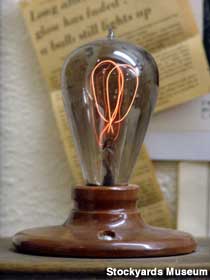
So, the second-oldest light bulb, the famous Ft. Worth, Texas, Palace Theater light bulb, first lighted up in 1908. For some odd reason the last post that mentioned the bulb keeps having difficulties. It took me four or five times before I realized that this year is the 100th anniversary year. As Robert Frost wondered more poetically, how many times did the apple have to hit Newton before he took the hint?
100 years old in September, 2008 -- the Palace Theater Light Bulb, Stokyards Museum, Fort Worth, Texas
Our famous old light bulb began burning in 1908 as a backstage light at the old Byers/Greenwald Opera House south of the Tarrant County Courthouse. It was never turned off. As the city grew and changed the old Opera House was rebuilt in 1919 into the more modern Palace Theater.All the work was done with the bulb illuminated. In 1977 the Palace Theater was replaced as Fort Worth continued to grow and eventually the Stockyards Museum was selected as its permanent home in retirement.
With any luck, we will be able to hold a super birthday celebration on September 21, 2008.
Mark your calendars: September 21, 2008. How many other lightbulbs do you know that have been burning for a century?
A photography studio in Fort Worth where Butch Cassidy and the Sundance Kid had their picture taken, with the Hole in the Wall Gang — made famous in George Roy Hill’s movie, “Butch Cassidy and the Sundance Kid” starring Paul Newman and Robert Redford (with the brilliant script by William Goldman)
World’s 2nd longest burning light bulb, Fort Worth, Texas, Stockyards Museum
The world’s second-longest burning light bulb, still going after more than a century, at the Stockyards Museum (take that you CFLs!)
Texas history teachers might want to note these sites — field trips! Extra credit! (The entire article is preserved below the fold, in the event of the folding of McClatchy Newspapers, or the paper’s deleting the story from their archives.)
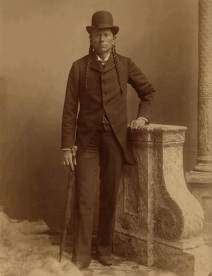
Photographs of Native Americans reside among the publicly and internet available materials of the National Archives. Images can be ordered in sets of slides, or as individual prints, though many are available in quality high enough for PowerPoint works and use on classroom materials. Many of the photos are 19th century.
Quanah Parker stands as one of the larger Native Americans in Texas history. This photo puts a face to a reputation in Texas history textbooks. Texas teachers may want to be certain to get a copy of the photo. His life story includes so many episodes that seem to come out of a Native American version of Idylls of the King that a fiction writer could not include them all, were they not real.
Quanah’s mother was part of the famous Parker family that helped settle West Texas in the 1830s. Cynthia Ann Parker was captured in 1836 when Comanches attacked Fort Parker, near present-day Groesbeck, Texas, in Limestone County. (See Fort Parker State Park.) Given a new name, Nadua (found one), she assimilated completely with the Nocona band of Comanches, and eventually married the Comanche warrior Noconie (also known as Peta Nocona). Quanah was their first child, born in 1852.
Nadua was captured by a Texas party led by Lawrence Sullivan “Sul” Ross in 1860, in the Battle of Pease River. Noconie, Quanah, and most of the Nocona men were off hunting at the time, and the fact of Nadua’s capture was not realized for some time. Nadua asked to return to the Comanches and her husband, but she was not allowed to do so. When her youngest daughter, who had been captured with her, died of an infection, Nadua stopped eating, and died a few weeks later.
Sul Ross was a character in his own right. At the time he participated in the raid that recaptured Cynthia Parker, he was a student at Baylor University (“What do I do on summer breaks? I fight Indians.”) At the outbreak of the Civil War, Ross enlisted in the Confederate Army as a private. Over 135 battles and skirmishes he rose to the rank of Brigadier General, the ninth youngest in the Confederate Army. A successful rancher and businessman back in Texas after the war, he won election as governor in 1887, served two very successful terms (he resolved the Jaybird-Woodpecker War in Fort Bend County, and had to call a special session of the legislature to deal with a budget surplus), refused to run for a third term, and was named president of Texas Agricultural and Mechanical College (Texas A&M) within a few days of stepping down as governor. Ross’s leadership of the college is legendary — students put pennies near a statue of Ross in a traditional plea to pass final exams, among many other traditions. After his death, Texas created Sul Ross State University, in Alpine, Texas, in his honor.
Quanah Parker’s father, Noconie, died a short time after his mother’s capture. He left the Nocona band, joined the Destanyuka band under Chief Wild Horse, but eventually founded his own band with warriors from other groups, the Quahadi (“antelope eaters”) (also known as Kwahadi). The Quahadi band grew to be one of the largest and most notorious, always with Quanah leading them. The Quahadis refused to sign the 1867 Medicine Lodge Treaties, and so avoided immediate internment to a reservation. However, dwindling food supplies and increasing opposition forced Quanah to retire to a reservation in 1875, in what is now southwestern Oklahoma. This was the last Comanche band to come to the reservation.
Quanah was appointed Chief of all the Comanches.
Through investments, Quanah became rich — probably the richest Native American of his time.
Quanah hunted with President Theodore Roosevelt.
Quanah Parker in later life, as a successful businessman. Wikipedia image, public domain
Rejecting monogamy and Christianity, Quanah founded the Native American Church movement, which regards the use of peyote as a sacrament. Quanah had been given peyote by a Ute medicine man while recovering from wounds he’d suffered in battle with U.S. troops. Among his famous teachings: The White Man goes into his church and talks about Jesus. The Indian goes into his Tipi and talks with Jesus.
Bill Neeley wrote of Quanah Parker: “Not only did Quanah pass within the span of a single lifetime from a Stone Age warrior to a statesman in the age of the Industrial Revolution, but he never lost a battle to the white man and he also accepted the challenge and responsibility of leading the whole Comanche tribe on the difficult road toward their new existence.”
Quanah Parker died on February 23, 1911. He is buried at Fort Sill Cemetery, Oklahoma, next to his mother and sister.
Quanah Parker’s epitaph reads:
Resting Here Until Day Breaks
And Shadows Fall and Darkness Disappears is
Quanah Parker Last Chief of the Comanches
Born 1852
Died Feb. 23, 1911
Not perfect — there is a brown spot on it; but beautiful, surpassingly rare, a creature of the serendipity of nature, it is a natural dogwood blossom in Dallas County, Texas:
What we came to see – the magical dogwood blossoms.
On April 5 Kathryn and I joined David Hurt and a jovial band of hikers for a trip into Dogwood Canyon in Cedar Hill, Texas. The physical formation of Cedar Hill upon which the city of the same name and several others stand, is one of the highest spots between the Mississippi River and the Rocky Mountains. It is an outcropping of chalk, a formation known as the Austin Chalk, that runs from Austin, north nearly to the Oklahoma border.
This rock formation creates a clear physical marker of the boundary between East and West. Dallas is east of the line, Fort Worth, Gateway to the Old West, is 30 miles farther west. On this outcropping is married the plains of the west with the oaks and forests of the east. Within a few miles of the line, the botanical landscape changes, cowboy prairie lands one way, forest lands the other.
On the chalk itself, the soil is thin and alkaline. The alkalinity is a function of the chemical composition of the chalk underneath it.
Dogwoods love the forests of East Texas with their acidic soils. Early spring produces fireworks-like bursts of white dogwood blossoms in the understory of East Texas forests. Dogwoods die out well east of Dallas as the soil changes acidity; driving from Dallas one can count on 30 to 60 miles before finding a dogwood.
Except in Dogwood Canyon. There, where entrepreneur David Hurt originally planned to build a family hideout and getaway, he found a stand of dogwoods defying botanists and the Department of Agriculture’s plant zone maps, blooming furiously in thin alkaline soil atop the Austin Chalk.
San Jacinto Day? April 21 is the anniversary of the Battle of San Jacinto, where Sam Houston and the Texian Army got the drop on Gen. Santa Anna and his much larger force, and in the course of a half-hour put the well-trained Mexican regulars on the run, and won Texas independence.
Unfortunately, it’s also a day most Texas students get smothered with reviews from their teachers for the Texas Assessment of Knowledge and Skills (TAKS), the state exam that had just ended last year on this date, and looms in the future this year. Instead of learning Texas history, Texas seventh graders spend this great day reviewing what educators are supposed to teach them. Nuts.
Those who cannot remember the past are condemned to repeat it.
George Santayana (The Life of Reason, vol. 1: Reason in Common Sense)
Last year a seventh grade kid approached me about a problem he had with the Texas history text. He pointed to a photograph of a Ku Klux Klansman, pointy-hood and all. It was a photo probably from the 1920s, in no way flattering to the Klansman, and it accompanied a couple of paragraphs explaining the resurrection of the Klan in that era. The book explained what some did to fight the Klan (not enough, but that’s a topic for another time).
“That’s racist, Mister!”
I asked him why he thought the photograph was racist.
“That’s a Klansman! They killed people!”
Yes, it’s a Klansman, and yes, Klansmen killed people unjustly. That’s part of history, a part of history we need to remember to prevent it from happening again. I explained that the photo did not endorse the Klan in any way, and that section of the book actually spoke against their actions.
“You’re a racist, Mister! That picture is racist and should be cut out!”
Our conversation had taken an inexplicable (to me) turn, away from the content of the photo or the book, into uncharted realms of inanity.
“Why don’t you take your complaint to the principal, and tell your parents about it,” I said. “I think this is a conversation you and I should have with your parents present.”
Of course, the student did nothing I asked. Within a week I had a handful of other students complaining about the picture. Some of those conversations were better, but not much. Students had a difficult time understanding how reading about racism was not practicing racism. Learning about the mistakes of the past in order to avoid them, was the same as making the mistakes, the students argued.
This occurred shortly after several parents in another Texas school district had complained about the use of The Adventures of Huckleberry Finn because it contains a slang term for “negro” now considered particularly offensive when used by whites. The complaining parents were black. Never mind that this great American novel’s point is that racism is wrong, slavery an abomination to a just God, and that Jim is much greater a man than those who held him captive in slavery.
I worry that too many people lack enough education in history to make rational decisions about what should be considered “good to read” and what should genuinely be kept out of curricula.
Case in point: A janitor and student at Indiana University-Purdue University at Indianapolis (IUPUI) was investigated for creating a “hostile work environment,” and one of his offenses appears to have been his reading of a history of a defeat of the Ku Klux Klan in South Bend, Indiana. It is unclear from details we have, but it appears complainants could not tell the difference between reading the history of a Klan defeat, and reading a book promoting the Klan.
Should we worry? I’d like your opinions, and experiences if you have any; details of the Indianapolis case below the fold.
Or, until that account is unsuspended by the forces supporting Donald Trump: Follow @FillmoreWhite, the account of the Millard Fillmore White House Library
We've been soaking in the Bathtub for several months, long enough that some of the links we've used have gone to the Great Internet in the Sky.
If you find a dead link, please leave a comment to that post, and tell us what link has expired.
Thanks!
Retired teacher of law, economics, history, AP government, psychology and science. Former speechwriter, press guy and legislative aide in U.S. Senate. Former Department of Education. Former airline real estate, telecom towers, Big 6 (that old!) consultant. Lab and field research in air pollution control.
My blog, Millard Fillmore's Bathtub, is a continuing experiment to test how to use blogs to improve and speed up learning processes for students, perhaps by making some of the courses actually interesting. It is a blog for teachers, to see if we can use blogs. It is for people interested in social studies and social studies education, to see if we can learn to get it right. It's a blog for science fans, to promote good science and good science policy. It's a blog for people interested in good government and how to achieve it.
BS in Mass Communication, University of Utah
Graduate study in Rhetoric and Speech Communication, University of Arizona
JD from the National Law Center, George Washington University


 Posted by Ed Darrell








 Millard Fillmore's Bathtub
