Return of the roadrunners

July 13, 2013

Our move to Texas in 1987 offered as one amenity, local roadrunners.

Camp Wisdom road was mostly two lanes then — it’s six, now.  Clark Road was two lanes.  It’s expanded to six, with a direct link to the freeway Spur 408.  Wheatland Road was two lanes.  You guessed it: Six now.

Not sure about baseball fields any more, but with roads, if you build ’em, people will come.  The empty prairie and cedar forests favored by golden-cheeked warblers, and favorable to lizard-eating roadrunners, gave way to bulldozers putting up apartment complexes, strip shopping centers (still mostly vacant), self-storage businesses, and more roads.  Roads bring automobiles, and autos provide collision courses for roadrunners.

In the summer, I used to see a roadrunner at least weekly at the intersection of Camp Wisdom and Clark; once watched one hunt down a very large Texas fence lizard and dash off with the lizard dangling from either side of its beak.  In the era before electronic cameras.

All that development takes the habitat of roadrunners, and that is the slow death of much wildlife.  Roadrunners dwindled down.  About 2009 we discussed how rare they were.  In 2011 Kathryn and I saw one lone roadrunner along Old Clark Road in Cedar Hill, precariously living in a 50-yard swath between two roads (which are slated to be widened), sharing a railroad track.  Nothing since.

Mama and chick roadrunners

Mama roadrunner gives me the eyeball from the safety of the cedar tree, while the chick grooms. Is it safe to go out into the sun?

Until two weeks ago.  Kathryn called me, excited that she’d seen a roadrunner crossing Mountain Creek Parkway, where Wheatland Road dead-ends into it.  It’s good roadrunner weather.  We were happy to know at least one survived.

Then, last Thursday I was driving along Old Clark Road.  I brought along the Pentax K10D because I was hopeful of catching the hawk family living a block off of Wheatland and Cedar Ridge Roads.  A roadrunner dashed across the road from a small ranchette into a “vacant” field of wild prairie grasses dotted with Ashe cedars.  My experience is they are reclusive, and don’t like to be watched.  I grabbed the camera and got a couple of shots of the bird, running under a tree and meeting up with another, smaller one — a chick!

I doubled back and u-turned, hoping they might at least dash.  The larger one danced on the edge of the shadow of the tree for a minute, then uncharacteristically strutted out, hunting something to eat.  She got something that looked like a lizard, or a fantastically large grasshopper, and a few other tidbits from the grass.  She strutted around, and headed back to the shade, and to the younger one.
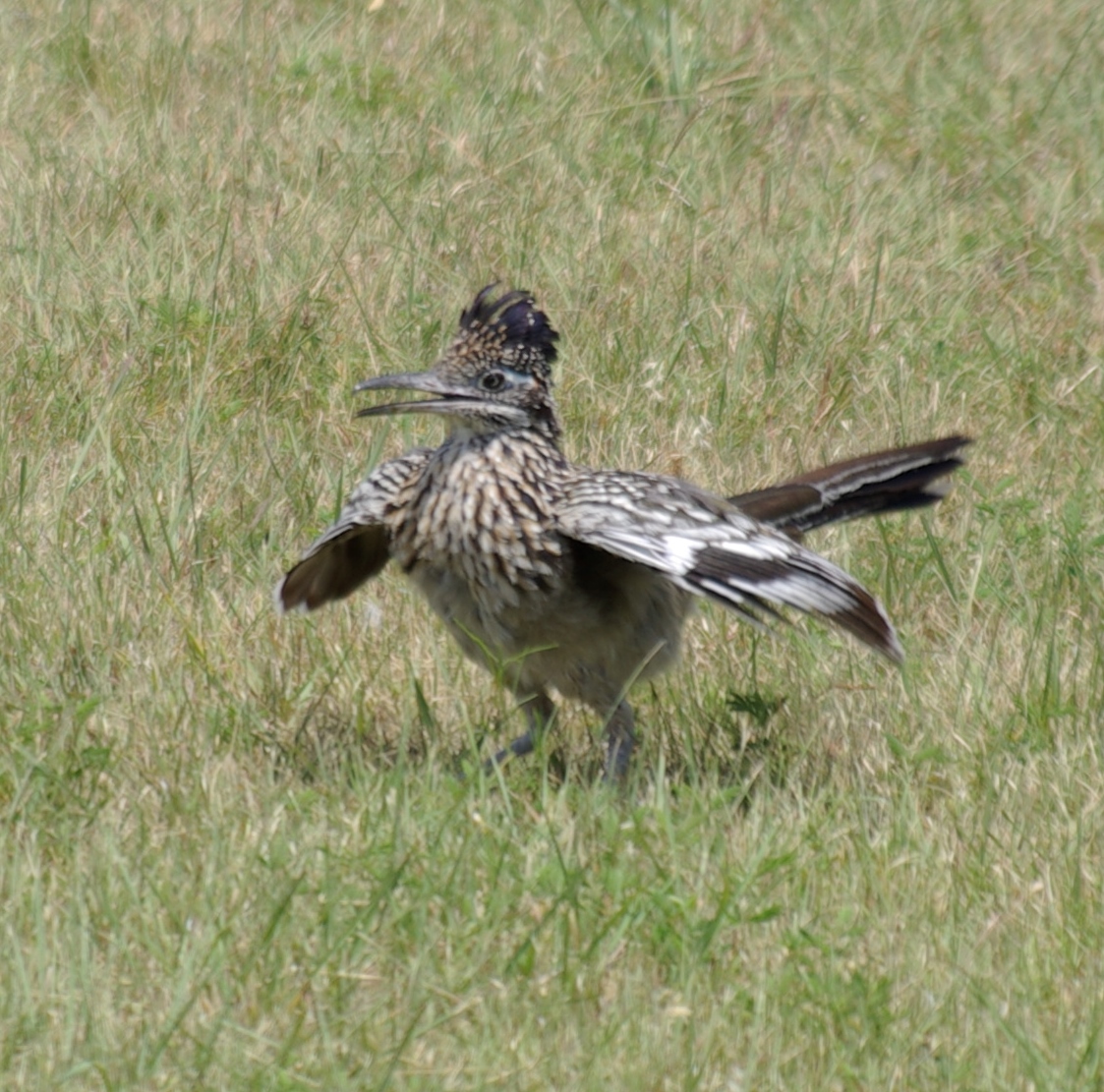
Mama Roadrunner flaps happily after ingesting a large something.

Mama Roadrunner flaps happily after ingesting a large something.

Roadrunners, the greater roadrunner, Geococcyx californianus (which means “Californian Earth-cuckoo,” a description of many politicians in the Golden State, perhaps).

I shot stills, with a 50-200 mm telephoto zoom, and I got a bunch of shots.  I strung them together in Windows Moviemaker.

Are the roadrunners doing okay?  Not really.  They’re not gone, but much of their old habitat disappeared from this hill, the highest point in Texas between the Louisiana border and the Rockies — swallowed by human development, homes, suburban shopping, and the roads that go with that development.

How are roadrunners doing in your area?  Got pictures?  (Cindy Knoke has a longer telephoto than I’ve got, and photos to prove it; go see.)

Greater Roadrunner running

Greater Roadrunner doing what roadrunners to, back to the shade of a cedar tree and her chick. It was 102 degrees F, after all.

More:


Texas State Capitol Rotunda — all quiet on the former front, for now

June 28, 2013

A vertical panorama — neat idea.

Joe Deshotel  - Panorama of empty rotunda at Texas Capitol - dome to floor. Posted on Twitter June 27, 2013

Joe Deshotel – Panorama of empty rotunda at Texas Capitol – dome to floor. Posted on Twitter June 27, 2013

This is the building that, just hours before, had been crowded by thousands of people hoping to get into the Texas Senate Chamber to see Sen. Wendy Davis’s filibuster.

Star on the dome of the Texas State Capitol; a similar star is five very long stories below, on the floor.

Star on the dome of the Texas State Capitol; a similar star is five very long stories below, on the floor. Image via Shapleigh.org, “Grover’s Tub.”

Look carefully, and you can see that the guides in the Capitol don’t lie — the star on the dome reflects the star on the floor (or vice versa).

Can you get a similar shot of the rotunda of your state capitol? Would you do it and send it in, or post it and give us the link?

Tip of the old scrub brush to Reeve Hamilton.


Amazon haiku to Sen. Wendy Davis’s pink Mizuno shoes

June 27, 2013

(Yes, you’re right — the shoes are red, not pink.)

Texas State Sen. Wendy Davis‘s filibuster so insinuated itself into our culture already that it is now a part of shoe reviews at Amazon.com:

Mizuno running shoes for sale at Amazon.com -- the same shoes Sen. Wendy Davis wore during her filibuster on June 25, 2012.

Mizuno running shoes for sale at Amazon.com — the same shoes Sen. Wendy Davis wore during her filibuster on June 25, 2012.

Customer Review


147 of 150 people found the following review helpful

5.0 out of 5 stars SHOES HAIKUS, June 27, 2013

By

mistersnoid “mistersnoid”

This review is from: Mizuno Women’s Wave Rider 16 Running Shoe (Apparel)

Wendy wore these, and
she wasn’t even running.
Here’s hopes she soon will!

Standing and talking,
one needs a lot of support.
You have all of ours.

More:

Mizuno's red running shoes, worn by Texas Sen. Wendy Davis.  Image from Outside the Beltway

Mizuno’s red running shoes, worn by Texas Sen. Wendy Davis. Image from Outside the Beltway


Dallas hearing on Texas redistricting tomorrow, June 6, 2013

June 5, 2013

I get e-mail from Sen. Wendy Davis:

Texas State Sen. Wendy Davis, D-Fort Worth. Dallas Observer image

Texas State Sen. Wendy Davis, D-Fort Worth. Dallas Observer image

I wrote to you last week about the Special Session that Governor Perry has called to address redistricting. As you know, state leaders have dropped their challenges to the Senate district map, meaning that the current makeup of Senate District 10 should remain unchanged for the remainder of the decade. This is wonderful news for our community. We’ve faced this redistricting battle for the past two years and have finally earned an important victory that continues to hold us together.

Unfortunately, Governor Perry is also insisting that the Legislature adopt the interim congressional and State House maps, which include features that a federal court ruled are in violation of the U.S. Voting Rights Act. The people of our district certainly know how important it is to have fairly drawn maps that allow voters to elect the leaders of their choice. All Texans deserve that.

You have a chance to speak out against the unfair congressional and State House maps.

I hope you will join us tomorrow for a public hearing with the House Select Committee on Redistricting. It’s vital that we make our voices heard. Let’s tell our state leaders to keep Senate District 10 intact and then to draw fair congressional and State House districts.

PUBLIC HEARING – House Select Committee on Redistricting
Thursday, June 6 – 2:00 PM – 1401 Pacific Avenue, Dallas
 

The Committee will hear testimony from any member of the public until 7:00 PM.
Once again, I understand that this is extremely short notice. I wish that there were more opportunities for the people of North Texas to have their say on this critical issue, but this may be the only chance that we get. If you are able, please come stand with us in the fight for fair maps.

Your friend, and proudly, your state senator,

Wendy
Wendy Davis

Will you be there?

English: Seal of State Senate of Texas. Españo...

Seal of State Senate of Texas. Wikipedia image. (Are those dots the Illuminati dots Gov. Perry insisted on?)

It’s a lousy place for inexpensive parking, so you may want to take the train — it runs within a couple of blocks of the hearing site.  But it’s a vital topic.

One wearies of the Texas GOP ramming their views down the gullet of citizens as if voters were just geese to be fattened for foie gras.

More:


Holding teachers accountable, in reality

June 5, 2013

Scott McLeod at Dangerously!Irrelevant put together a video, with computer voices to protect the innocent naive genuinely ignorant and proudly stupid.

Teachers who watch this may cry as they watch America’s future slip away into the Tide of Mediocrity™ we were warned about, which NCLB mistook for high water.  Turn it up so you can hear the full sound effects.  That’s the level of mediocrity rising as the “official” fiddles.

W. Edwards Deming researched and wrote a lot about organization managers who don’t really have a clue what is going on in their organizations, and who lack tools to measure employee work, because they lack an understanding of just what products are, what the resources are that are required to make the desirable product, and how to processes that make those products work, or could work better.

That’s education, today.

Should teachers be “held accountable?”  Depends.  Effective organizations understand that accountability is the flip-side of the coin of authority.  Anyone accountable must have the authority to change the things that affect product, for which that person is “held accountable.”  Texas schools lose up to 45 days a year to testing — that may drop as the TAKS test is phased out, but it won’t drop enough.  45 days is, effectively 25% of the school year.  If time-on-task is important to education as Checker Finn used to badger us at the Department of Education, then testing is sucking valuable resources from education, way above and beyond any benefits testing may offer.

Today, Texas Governor Rick Perry has proposed laws sitting on his desk that would greatly pare back unnecessary testing.  A coalition of businessmen (no women I can discern) with a deceptively-named organization urges Perry to veto the bills, because, they claim, rigor in education can only be demonstrated by a tsunami of tests.

What’s that, you ask?  Where is the person concerned about the student?  She’s the woman with the leaky classroom, who is being shown the door.

Why is it those with authority to change things for the better in Texas schools, and many other school systems throughout the U.S., are not being held accountable? If they won’t use their authority to make things better, why not give that authority to the teachers?

Check out McLeod’s blog — good comments on his video there.

More:

Fitzsimmons in the Arizona Daily Star

Fitzsimmons in the Arizona Daily Star


Texas, “Go fish!”

May 28, 2013

No, this isn’t a comment about the Texas Lege.  That I have to tell you that is comment enough.

Texas Parks and Wildlife notes:

Catching a fish is fun for kids, but many families have questions about how to get started. That’s why some state parks are offering free fishing classes. They’ll teach you the basics through fun, hands-on activities. Texas Parks and Wildlife has this report on a program called “Go Fish” as the June Outdoor Activity of the Month.

To find places to fish and events near you, visit texasstateparks.org/fishing

Doesn’t seem that long ago, but he’s grown, graduated from college and moved 2,000 miles away; heck, both of the boys graduated and moved away.  We started our romancing of Texas State Parks at Ink’s Lake State Park, in one of the hottest Augusts I ever would wish to see.  We got a new tent, big enough for a family and bigger than the pup tent Kathryn and I used on the Atlantic Beaches (never did get that hurricane smell out of it . . .).  I worried about older son Kenny.  Little patience for anything not electronic.

The rules were they could play handheld games until we got there, in the car, but not once we got down to camping.  When we got to Ink’s Lake it was 105º F.  Kenny decided he’d rather stay in the car with his games.  Eventually the batteries died.

It was a fun, but not necessarily easy first day.  We had Disney TrueLife Adventure watching a wasp and spider fighting.  We had deer wandering through the site, including one with a deformed mouth (we named her Celeste, but don’t ask me why).  Deer would do almost anything for a bite of cantaloupe.  Swimming, rocks to jump off of . . . Kenny was bordering on crabby.

I never took to fishing.  That’s Kathryn’s bailiwick.  She got poles for the kids.  The whole point of the trip was to get back to fishing for Kathryn.  Kenny complained about the hot son on the end of the pier, about the worms, about the lack of video games.  He complained about everything until he got that pole in his hand and dropped the hook in the water.  I wish we had it on video.  Instantly, he became a man of patience.

Caught his first little fish that day, too.   Bluegill, or crappie — I don’t remember.  The next few days brought quite a bit of adventure — small boat tour of Ink’s Lake, big tourist boat trip on nearby Lake Buchanan (” . . . this is Texas, Honey. It’s pronounced buck-CANnon. Don’t forget.”).  We froze in Longhorn Cavern.  We found magic, and five-foot catfish, at Hamilton Pool.  The catfish were larger than James, but he took great delight in watching them in the bottom of the supernaturally-clear pool.

English: Photo taken by Reid Sullivan during d...

Hamilton Pool, near the Pedernales River – photo by Reid Sullivan during drought conditions 1/2/2006, via Wikipedia

Both boys got great at camping, both had long periods with Boy Scouts after YMCA Guides (Kenny got Life; James got Eagle).  I think both of them got the fishing merit badge with help from the Mighty Fisher, Eddie Cline.  We have thousands of photos, lots of great memories, and for our family, it started with that trip to Ink’s Lake.

The good stuff all started with fishing.

More:


Dallas crime history: Deaths of Bonnie and Clyde, May 23, 1934

May 23, 2013

Bonnie Parker and Clyde Barrow, notorious bank-robbing outlaws from Oak Cliff, Texas, ran into a police ambush and were shot to death on May 23, 1934, in Bienville Parish, Louisiana.

Bonnie and Clyde in 1933 - Wikimedia

Bonnie and Clyde in 1933, about a year before their deaths – Wikimedia image

Though they wished to be buried together, her family protested. They are buried in separate cemeteries in Dallas. Bonnie is buried in the Crown Hill Cemetery off of Webb Chapel Road in Dallas (do not confuse with the Crown Hill Cemetery in Indianapolis). Clyde is buried in the Western Heights Cemetery off of Fort Worth Boulevard, in Oak Cliff (now a part of Dallas).

Borrowed originally with express permission from a Wayback Machine; expanded and edited here.

More:

Additional photo resources:

US Department of Justice, Division of Investig...

US Department of Justice, Division of Investigation identification order for Bonnie Parker and Clyde Barrow. Image via Wikipedia

Posse suffered deafness for hours after unleas...

“Posse members suffered deafness for hours after unleashing the thunderous fusillade” Wikipedia image

English: Photo of the grave of Clyde Barrow

The grave of Clyde Barrow – Wikipedia image

English: Photo of the grave of Bonnie Parker

The grave of Bonnie Parker – Wikipedia image

You should recall Faye Dunaway and Warren Beatty in their movie turn as Bonnie and Clyde.  But Serge Gainsborough and Brigitte Bardot, in French?  From 1968:


Out near Longview: Small district defense of CSCOPE and good lesson plans

May 10, 2013

The nasty kerfuffle over a Texas lesson-planning aide, a comprehensive program called CSCOPE, may have evaded your radar.

Heck, most people in Texas aren’t even aware of this money-wasting teapot tempest.

CSCOPE Parent Portal logo

CSCOPE Parent Portal logo for a Texas school district. Click to see one way Grand Prairie ISD gives parents access to what’s going on in classrooms.

But the state’s attorney general (campaigning for U.S. Senate, hoping to please the Tea Party Commissars) makes threatening gestures towards CSCOPE from time to time, our leading Black Shirt member of the State Senate pushes bills to gut the lesson planning tools, and Texas’s education overseeing ministry, the Texas Education Agency, is conducting a three-month “review” of CSCOPE to make sure it’s politically correct and properly condemning of Islam, Catholicism, Mormonism, Hinduism, agnosticism and atheism (if any can be found).  CSCOPE critics hope that the review will delay updating materials just long enough that school districts across the state will abandon it in favor of . . . um, well, kids can learn if they got books . . . er, um, well — “they shouldn’t be learning about Islam at all” (never mind the state standards that require that course unit).

Out of the east, near Longview, three brave school district officials from two school districts put up their hands to ask why the CSCOPE critics are standing naked.  It’s not much, but it’s about the toughest defense of CSCOPE put up by school officials — and of course, they risk investigation by the Attorney General Abbott merely by speaking out, according to CSCOPE critic harpies.

Dear Reader, you can learn a lot from this opposite-editorial page article in the Longview News-Journal (I’ve added links for your convenience):

CSCOPE and Carthage ISD

Posted: Friday, April 19, 2013 5:46 pm

It is sometimes mindboggling how some controversies begin. Certainly, the wildfire that has swept across Texas concerning the CSCOPE curriculum has our heads spinning. Misinformation has spread rampantly and the truth backed by factual information has been difficult to get out in front of the folks that are taking small excerpts and lessons out of context. In some cases, the CSCOPE curriculum has been attacked with reckless, unsubstantiated accusations.

The shame is that CSCOPE should be a success story of how 870 public school districts, average enrollment of 2000 students, working together with the twenty Education Service Centers (ESCs) created a 21st century curriculum based on the state mandated Texas Essential Knowledge and Skills (TEKS). Prior to selecting this curriculum for CISD, an extensive investigation was conducted to assure that it was a good fit for our district.

CSCOPE curriculum/lesson plans were created by master “Texas” teachers, not a textbook company, not a testing company, and not a private, for-profit vendor. Multiple resources, including digital resources, were integrated into the curriculum, with suggested lessons that proved to be extremely beneficial to less experienced teachers. The framework allowed districts and staff to integrate localized lessons within the scope and sequence of the system. Approximately 50% of the charter schools (i.e. KIPP Academy, UT Charter School, Bannockburn Christian Academy and the Texas School for the Deaf) also use CSCOPE. Private schools, such as Catholic Diocese of Austin, Wichita Christian, Hyde Park Baptist and Cornerstone Christian Academy use CSCOPE.

What is my point? CSCOPE and our ESCs have been accused of promoting non-Christian and unpatriotic values based on a couple of lessons that were taken out of context, the targeted lessons were based on state standards created and approved by the State Board of Education. Due to several districts refusing to purchase another “new” curriculum, the creators of this “new curriculum” began a mass media blitz misrepresenting two lessons that addressed the state required curriculum standards.

Districts are mandated to teach the major religions of the worlds and the beliefs of those religions. Districts are mandated to teach heroism and terrorism. CSCOPE curriculum units have designed lessons that explore these standards, allowing students to investigate, compare/contrast, and analyze perspectives based on cultural influences. Example, the Boston Tea Party was perceived as an act of heroism from an American’s point of view; however, patriots of England considered this an act of terrorism. Islam, one of the major religions of the world, believes their God is the only God. These are the two excerpts taken out of context of the instructional units that have resulted in mass social media messages from those wanting to sell “their curriculum”, accusing the writers of CSCOPE and the ESCs of treason and promoting the Islam religion! Recently, a superintendent received threatening emails because the district was using CSCOPE.

Carthage ISD was not one of the first districts to embrace the curriculum; however, the revised state standards and new state assessment system demanded a new curriculum. CSCOPE offers a well-designed curriculum framework that is vertically aligned to the state standards (NOT the Federal Core Standards as inaccurately reported), the state assessment system and 21st century life-long learning goals.

CSCOPE insures the appropriate skills are taught in specific grades using multiple resources. The instructional focus is college and career readiness at all levels. School districts have the flexibility of using the curriculum as a sole source or as an alignment framework – CSCOPE lessons/units optional. Skills such as spelling, cursive handwriting, and math facts are found aligned in CSCOPE. Teachers have the flexibility to adjust the amount of time spent practicing these skills.

CSCOPE is a learning curve for classroom instruction. It is not driven by one textbook or worksheets. It embraces multiple resources, integration of technology and higher order thinking skills.

Similar to purchased curriculum there are mistakes within the lessons, those are reported and corrected. An internal system exists where teachers are asked for input on any element of CSCOPE. It is a proprietary curriculum and shares the same protection as other vendors’ products one must purchase to access the content. Districts sign affidavits, comparable to those required by the state for STAAR testing, to protect the integrity of the system, not unlike copyright laws. The cost is based on the enrollment of the district.

Parents can view the content of a lesson at a parent meeting; however, giving parents free access to the lesson plans and tests would destroy the validity of the assessments and negatively impact the intent of the instructional lessons.

The attack against the supporters and users of CSCOPE may well become the first step toward the state assuming total control of all curriculum and lesson plans for all districts. A bill has been filed to begin this process. That would be another attack on local control by the state.

Article by:

Glenn Hambrick, Ed.D., Superintendent, Carthage ISD

Donna Porter, Ed.D., Asst. Superintendent, Carthage ISD

Mary Ann Whitaker, M.Ed., Superintendent, Hudson ISD

More: 

Longview is under the green star, map from Sperling's BestPlaces

Longview is under the green star, map from Sperling’s BestPlaces


Honk if you don’t get the joke

April 26, 2013

In Texas, Christian-themed bumper stickers outnumber all others by a huge number.

Some of the non-Christians have a better sense of humor, or at least a willingness to pun:

Ankh if you love Isis

“Ankh if you love Isis” bumper sticker in Texas. Photo by Ed Darrell

Of course, in order to get the homophone pun, and the joke, one needs to know a bit about world history and ancient Egyptian religions.  One faces the danger that people in the parking lot at the local Sam’s Club won’t know world history, won’t get the joke, and may take offense.

It’s a form of a test, to see who paid attention in world history and has a sense of humor, and who didn’t pay attention in world history.

I knew a librarian once, a good Christian woman, who hated those “Honk if you love Jesus” bumper stickers.  She said that she once sat on a crowded freeway and counted more than 25 of the things on cars that passed.  No one honked, however, and she feared that meant  people didn’t love Jesus.  Unintentional blasphemy by silence — only in Texas.

Honk if you don’t get the joke.  We’ll find a remedial world history class for you.

More:

Some Texans were unhappy to learn “Don’t Mess With Texas” was an anti-litter slogan; some Texans take their bumper stickers way too seriously. Texas Public Radio image


Remembering Lindheimer’s muhly grass from last year’s garden

April 23, 2013

It’s spring.  The grasses are sprouting.

Texas is a good place for grasses.

Lindheimer's muhly grass, in the afternoon sun

Lindheimer’s muhly grass, Dallas, Texas, January 2013. Photo by Ed Darrell; horticultural adventures by Kathryn Knowles

Spring sunlight is spectacular on the new flowers; winter sunlight, in the afternoon, shows a different kind of spectacular.

Lindheimer’s muhly grass, Muhlenbergia lindheimeri, shows beauty from soon after it sprouts until long after it’s gone dormant.  A garden is a year-around project, and joy.

History lives in those grasses, too.  You can find some at the Native Plant Society of Texas’s website, and its description of Lindheimer’s muhly.

This seems pretty dumb now, but many years ago when I first heard about so many grasses called “muley,” I was puzzled about that name. I’d heard of muley cattle such as polled Herefords, but not hornless grass! Needless to say, as soon as I looked up Lindheimer muhly, I could see it is in a genus named after a Mr. Muhlenberg.

Gotthilf Hunrich Ernst Muhlenberg lived from 1753 to 1815. He was born into a prominent Pennsylvania family, and his father and brothers were influential patriots during the Revolutionary War. Because of his family’s involvement in the Revolution, Muhlenberg was on the British hit list.

While he was hiding out in a rural area away from Philadelphia during the Revolution, Muhlenberg became interested in botany. Through his extensive collections, Muhlenberg made major contributions to botany, and many plants have been named in his honor. For example, among our local flora are several species of muhly grass (Muhlenbergia) and Chinquapin oak (Quercus muhlenbergii).

Lindheimer muhly was named in honor of Ferdinand Lindheimer, the “Father of Texas Botany.” Many other plants native to the Texas Hill Country also bear the name “Lindheimer” or “Lindheimer’s.” Most of these plants were first collected by Lindheimer, who settled on the banks of the Comal River in New Braunfels in 1845.

Another entry in the Blackland Prairie Almanac, perhaps.

More:


Texas no stranger to massive explosions and disasters

April 17, 2013

April 16 marked the 66th anniversary of the massive explosions of fertilizer on ships in the harbor of  Texas City, Texas — 576 people died in that 1947 disaster.

Last month marked the 76th anniversary of the massive natural gas explosion that destroyed the school in New London, Texas, killing about 300 people.

A few minutes ago, a disaster/rescue official in West, Texas, said he fears as many as 100 dead in the explosion of the fertilizer plant there, earlier this evening.  Another fertilizer tank may explode, and the town is being evacuated.

New London, Texas, school after the March 18, 1937, natural gas explosion that killed about 300 people.

New London, Texas, school after the March 18, 1937, natural gas explosion that killed about 300 people.

Texas City explosion, 1947

View of Texas City from Galveston, across the bay, after the explosion of the French ship SS Grandchamp, April 16, 1947. Photo from International Association of Fire Fighters Local 1259. 576 people died in that series of explosions.

The fertilizer tank that exploded contained several hundred times the amount of the same explosive used to destroy the Murrah Federal Building in Oklahoma City.

How can any town ever prepare for that?

More:


Historic images, encore: Quanah Parker, Last Chief of the Comanches

March 25, 2013

Glenn Frankel at the University of Texas wrote a book about the John Ford movie, “The Searchers.” It’s release, and stories about it, should remind us of the history of Quanah Parker, the last great, chief of the Comanches.  “The Searchers” was loosely based on a true story, the kidnapping of Cynthia Ann Parker, by Comanches, and her subsequent life with the tribe, and her recapture by white relatives.  She had married in the tribe — Quanah Parker was her son.

Back in June 2008 I posted this:

Quanah Parker, photo by Lanney

Quanah Parker, a Kwahadi Comanche chief; full-length, standing in front of tent.
Photographed by Lanney. Public Domain photo.
National Archives, “Pictures of Indians in the United States”

Photographs of Native Americans reside among the publicly and internet available materials of the National Archives. Images can be ordered in sets of slides, or as individual prints, though many are available in quality high enough for PowerPoint works and use on classroom materials. Many of the photos are 19th century.

Quanah Parker stands as one of the larger Native Americans in Texas history. This photo puts a face to a reputation in Texas history textbooks. Texas teachers may want to be certain to get a copy of the photo. His life story includes so many episodes that seem to come out of a Native American version of Idylls of the King that a fiction writer could not include them all, were they not real.

  • Quanah’s mother was part of the famous Parker family that helped settle West Texas in the 1830s. Cynthia Ann Parker was captured in 1836 when Comanches attacked Fort Parker, near present-day Groesbeck, Texas, in Limestone County. (See Fort Parker State Park.) Given a new name, Nadua (found one), she assimilated completely with the Nocona band of Comanches, and eventually married the Comanche warrior Noconie (also known as Peta Nocona). Quanah was their first child, born in 1852.
  • Nadua was captured by a Texas party led by Lawrence Sullivan “Sul” Ross in 1860, in the Battle of Pease River. Noconie, Quanah, and most of the Nocona men were off hunting at the time, and the fact of Nadua’s capture was not realized for some time. Nadua asked to return to the Comanches and her husband, but she was not allowed to do so. When her youngest daughter, who had been captured with her, died of an infection, Nadua stopped eating, and died a few weeks later.
  • Sul Ross was a character in his own right. At the time he participated in the raid that recaptured Cynthia Parker, he was a student at Baylor University (“What do I do on summer breaks? I fight Indians.”) At the outbreak of the Civil War, Ross enlisted in the Confederate Army as a private. Over 135 battles and skirmishes he rose to the rank of Brigadier General, the ninth youngest in the Confederate Army. A successful rancher and businessman back in Texas after the war, he won election as governor in 1887, served two very successful terms (he resolved the Jaybird-Woodpecker War in Fort Bend County, and had to call a special session of the legislature to deal with a budget surplus), refused to run for a third term, and was named president of Texas Agricultural and Mechanical College (Texas A&M) within a few days of stepping down as governor. Ross’s leadership of the college is legendary — students put pennies near a statue of Ross in a traditional plea to pass final exams, among many other traditions. After his death, Texas created Sul Ross State University, in Alpine, Texas, in his honor.
  • Quanah Parker’s father, Noconie, died a short time after his mother’s capture. He left the Nocona band, joined the Destanyuka band under Chief Wild Horse, but eventually founded his own band with warriors from other groups, the Quahadi (“antelope eaters”) (also known as Kwahadi). The Quahadi band grew to be one of the largest and most notorious, always with Quanah leading them. The Quahadis refused to sign the 1867 Medicine Lodge Treaties, and so avoided immediate internment to a reservation. However, dwindling food supplies and increasing opposition forced Quanah to retire to a reservation in 1875, in what is now southwestern Oklahoma. This was the last Comanche band to come to the reservation.
  • Quanah was appointed Chief of all the Comanches.
  • Through investments, Quanah became rich — probably the richest Native American of his time.
  • Quanah hunted with President Theodore Roosevelt.

    Quanah in European-American business attire.

    Quanah in European-American business attire. (Photo credit: Wikipedia)

  • Rejecting monogamy and Christianity, Quanah founded the Native American Church movement, which regards the use of peyote as a sacrament. Quanah had been given peyote by a Ute medicine man while recovering from wounds he’d suffered in battle with U.S. troops. Among his famous teachings: The White Man goes into his church and talks about Jesus. The Indian goes into his Tipi and talks with Jesus.
  • Photo at right: Quanah Parker in his later life, in his business attire. Photo thought to be in public domain.
  • Bill Neeley wrote of Quanah Parker: “Not only did Quanah pass within the span of a single lifetime from a Stone Age warrior to a statesman in the age of the Industrial Revolution, but he never lost a battle to the white man and he also accepted the challenge and responsibility of leading the whole Comanche tribe on the difficult road toward their new existence.”
  • Quanah Parker died on February 23, 1911. He is buried at Fort Sill Cemetery, Oklahoma, next to his mother and sister.

Quanah Parker’s epitaph reads:

Resting Here Until Day Breaks
And Shadows Fall and Darkness Disappears is
Quanah Parker Last Chief of the Comanches
Born 1852
Died Feb. 23, 1911

Other Resources:

Resources new in 2013:


Forgotten disasters in U.S. schools: The New London, Texas, gas explosion

March 18, 2013

Most high school history students don’t know about it.  Most high school history students in Texas don’t know about it.

New London School, New London, Texas, before the 1937 disaster.  Photo from the New London Museum

New London School, New London, Texas, before the 1937 disaster. Photo from the New London Museum

I wonder, sometimes, how many Texans remember at all.

I wonder, too, if there are lessons to be learned from the New London tragedy, while the nation debates what to do to prevent recurrences of school shootings.

The deadliest disaster ever to hit a public school in the U.S. struck on March 18, 1937, when a natural gas explosion destroyed the new school building at New London, Texas, killing about 300 people — 76 years ago today.

The remains of the London School after the exp...

The remains of the London School after the explosion of March 18, 1937. Wikipedia photo

Noise from the blast alerted the town, and many people in the oilfields for many miles.  Telephone and telegraph communication got word out.  Oil companies dismissed their employees, with their tools, to assist with rescue and recovery efforts.  Notably, 20-year-old Walter Cronkite came town to report the news for a wire service.

Investigation determined that a leak in a newly-installed tap into the waste gas pipe coming from nearby oil fields probably allowed natural gas to accumulate under the building.  A spark from a sander started a fire in gas-filled air, and that in turn exploded the cavern under the school.  School officials approved the tap to the waste gas line to save money.  Natural gas is odorless.  One result of the disaster was a Texas law requiring all utility natural gas to be odorized with ethyl mercaptan.

Though the Great Depression still gripped the nation, wealth flowed in New London from oil extraction from the nearby oil fields.  The  school district completed construction on a new building in 1939, just two years later — with a pink granite memorial cenotaph in front.

Today, disasters produce a wealth of litigation, tort suits trying to get money to make the injured whole, and to sting those at fault to change to prevent later disasters.  In 1937 official work cut off such lawsuits.

Three days after the explosion, inquiries were held to determine the cause of the disaster. The state of Texas and the Bureau of Mines sent experts to the scene. Hearings were conducted. From these investigations, researchers learned that until January 18, 1937, the school had received its gas from the United Gas Company. To save gas expenses of $300 a month, plumbers, with the knowledge and approval of the school board and superintendent, had tapped a residue gas line of Parade Gasoline Company. School officials saw nothing wrong because the use of “green” or “wet” gas was a frequent money-saving practice for homes, schools, and churches in the oilfield. The researchers concluded that gas had escaped from a faulty connection and accumulated beneath the building. Green gas has no smell; no one knew it was accumulating beneath the building, although on other days there had been evidence of leaking gas. No school officials were found liable.

These findings brought a hostile reaction from many parents. More than seventy lawsuits were filed for damages. Few cases came to trial, however, and those that did were dismissed by district judge Robert T. Brown for lack of evidence. Public pressure forced the resignation of the superintendent, who had lost a son in the explosion. The most important result of the disaster was the passage of a state odorization law, which required that distinctive malodorants be mixed in all gas for commercial and industrial use so that people could be warned by the smell. The thirty surviving seniors at New London finished their year in temporary buildings while a new school was built on nearly the same site. The builders focused primarily on safety and secondarily on their desire to inspire students to a higher education. A cenotaph of Texas pink granite, designed by Donald S. Nelson, architect, and Herring Coe, sculptor, was erected in front of the new school in 1939.  (Texas Handbook of History, Online, from the Texas State Historical Association)

Of about 500 students, more than 50% of them died.  Once the new school and memorial were built, and the law passed requiring utilities to odorize natural gas so leaks could be detected earlier, survivors and rescuers rather shut down telling the history.  A 1977 reunion of survivors was the first in 40 years.

New London School shortly after the March 18, 1937, explosion.  Photo from the New London Museum.

New London School shortly after the March 18, 1937, explosion. Photo from the New London Museum.

Because of that healing silence, the story slipped from the pages of most history books.

Trinity Mother Frances Hospital treated the victims; a 2012 film from the hospital offers one of the best short histories of the events available today.

New London, and the New London Museum, work to remember the dead and honor them.  Work continues on a film about the disaster, perhaps for release in 2013:

Now, more than 75 years later, the London Museum, across the highway from where the original school was destroyed, keeps alive the memory of much of a generation who died on that terrible day.

This video was produced by Michael Brown Productions of Arlington, TX as a prelude to a feature documentary on the explosion and its aftermath which is planned for
the spring of 2013.  . . .

www.newlondonschool.org/museum

What are the lessons of the New London Disaster?  We learned to remember safety, when dealing with natural gas.  A solution was found to alert people to the presence of otherwise-odorless, explosive gases, a solution now required by law throughout the U.S.  Natural gas explosions decreased in number, and in damages and deaths.  Wealthy schools districts, cutting corners, can create unintended, even disastrous and deadly consequences.  Quick rebuilding covers the wounds, but does not heal them.

Remembering history takes work; history not remembered through the work of witnesses, victims and survivors, is quickly forgotten — to the detriment of history, and to the pain of the witnesses, victims and survivors.

New, New London School and granite cenotaph memorial to the victims of the 1937 explosion

New, New London School and granite cenotaph memorial to the victims of the 1937 explosion. Photo from Texas Bob Travels.

More:

Houston’s KHOU-TV produced a short feature on the explosion in 2007:


Hog wild in Texas: Ranchers, guns, and science working against environmental disaster

February 25, 2013

Unusual?  No, this is really a typical marriage of agriculture, government agencies, science and hunters, working on problems of wildlife management, feral hogs in this case.

Notes from Texas Parks & Wildlife:

Feral hogs are running wild across Texas, at great cost to farmers, ranchers, and native wildlife. Hunters are helping, but science may prove critical to controlling the invasion on a broader scale. For more information on feral hogs and feral hog control, visit: http://www.tpwd.state.tx.us/huntwild/…

When it comes to feral hogs, every Texan turns environmentalist.

More:    

English: Sign for Texas Parks and Wildlife Dep...

Sign for Texas Parks and Wildlife Department headquarters – Wikipedia image


Anybody got photos of Texas’s Big Lake with, you know, water in it?

February 15, 2013

Contrary to popular rural and redneck legend, Caddo Lake is not Texas’s only natural* lake.  There’s also Big Lake, near the town of Big Lake.

Problem being, of course, that Big Lake’s water sources these days generally don’t flow.  So Big Lake is often dry.

Which produces a further problem for site like Millard Fillmore’s Bathtub:  If Big Lake is really a lake, why are there no photos of the lake with water in it?

A comment at AustinBassFishing.com got me thinking about this again, no photos of Big Lake as a Lake.  In the previous post here, we featured a photo of Big Lake Playa, sans water.  I searched the internet at the time and found no photos showing water in the lake.  My authority on Big Lake, Brad Wachsmann, swore that he had recently seen water in the thing (“recent” being “in the last decade or so”).

So, sorta good news:  A few photos of Big Lake, with water, plopped onto the internet since our last search.  Here are a couple from Panaramio:

Big Lake, Texas, with water in it.  Photo by doning

Water in Big Lake, near the city of Big Lake, Texas, laps at the State Highway 137 passing nearby. This photo comes from 2004, by doning.

Water in Big Lake, Texas, June 2005; photo by evansjohnc

Photo of water in Big Lake from June 2005. Photo by evansjohnc.  This photo appears to be about midway along the intersection of the lake with State Highway 137.

Big Lake, Texas, in dry phase, by cwoods

Big Lake in its dry phase, from looking north from the southern end of State Highway 137’s transection of the lake. Photo by cwoods.

Sign noting location of Big Lake, Texas, during dry phase. Photo by cwoods

Non-historic marker for Big Lake, also along State Highway 137, looking west. Photo by cwoods. Photo taken during Big Lake’s dry humor phase.

Now:  Can we track down the rumors of other natural lakes in TexasSabine Lake?  Green Lake?  Natural Dam Lake?

And, Dear Reader, can you find good photos of Big Lake with, you know, water in it?

_____________

* Is Caddo Lake a natural lake?  Originally, the lake seems to have been formed by an enormous blowdown of trees, probably during a hurricane, well over 400 years ago.  In that sense, it was a natural lake when European explorers first found it, and during all of Texas’s “six flags” historic periods.  Or, what is known as the Great Raft, a log jam, dammed up the Red River near the confluence of the Big Cypress Bayou, in about 1799.  By 1800, Caddo Lake was wet all year-round, and deep enough for shallow boat navigation.  In 1835, Capt. Henry Shreve blew up enough of the logjam that steamboat traffic could get past (the guy after whom Shreveport, Louisiana, is named).  After the Civil War, locals tried to expand boat traffic by completely removing the logjam.  Instead of making traffic easier, this removal led shrinking water levels in the lake, and it destroyed navigation farther up the Red River.  Several efforts to restore higher water levels achieved some success by about 1915.  When oil was discovered under the swamp, pressures came from oil companies to make drilling easier — travel in the mud was difficult.  After the invention of the Hughes drill bit (by Howard Hughes‘s father, the founder of Hughes Tool Co.) to allow drilling through water and mud into oil-bearing rock, a dam was built near where the logjam had been, to raise the level of what is known today as Caddo Lake.  What is seen today is a human-enhanced version of the Caddo Lake known by the Caddo Tribe.  This is all preface to the current Texas water wars.

More:
