I am a little bit concerned in looking at some of these science online supplementary materials. I looked at one of the links and there was a picture of a — a graphic of a human fetus next to a gorilla fetus talking about how they only differ by one amino acid. Therefore, universal common decent. So that is of some concern. And I am not quite sure if we are going to have the votes to overturn that. We will work diligently to rectify and correct some of that. But remember we lost a conservative seat, so we’re down to six.
In this unguarded moment, Cargill drops the double-speak and is honest about her plan for the first meeting over which she will preside as chair — pressure publishers to censor scientific information from their materials and to insert bogus information questioning evolution. And she knows exactly what her task is: to get the extra votes necessary to accomplish this.
Stay tuned to TFN Insider on Thursday and Friday as we give you a front-row seat at the contentious hearing and board vote.
Live blogging the meeting starting at about 10:00 a.m today at TFN Insider at at Steve Schafersman’s blog, from the Texas Citizens for Science.
It took me a couple of tries to figure it out — last week when I told people Kathryn and I were off to Colorado Bend State Park to spend time on the river, several people commented about how much cooler it would be there.
What? West of Killeen about an hour, ten miles of dusty road outside of Bend, Texas (population 1,637), Colorado Bend is not cooler than Dallas. It was over 100° F every day we were there, stayed well above 90° most of the nights.
Kathryn studied wildflowers at a spring at the side of the Colorado River during a break from kayaking; this spring's flow was reduced, but still moist enough to create a near-oasis.
Our well-wishers were geographically confused. They thought we were headed to the Colorado River in Colorado, not the Colorado River in Texas, which is not the same river at all. I didn’t bother to check the temperatures in Colorado, but one might be assured that it was cooler along the Colorado River in Colorado than it was along the Colorado River in Texas.
It was a return trip. We stumbled into the park 16 years ago with the kids, for just an afternoon visit. The dipping pools in the canyon fed by Spicewood Springs captivated us. It took a while to get back, and then the kids were off doing their own thing.
So, just a quick weekend of hiking/camping/kayaking/soaking/stargazing/bird watching/botanical and geological study. Park officials closed the bat caves to human traffic in hope of keeping White Nose Syndrome from the bats; we didn’t bother to sign up for the crawling cave tour through another.
The author, still working to master that Go-Pro camera on the hat -- some spectacular shots, but I don't have the movie software to use it all; you know it's hot when SPF 75 sunscreen is not enough.
What did we see? Drought has a firm grip on Texas, especially in the Hill Country, especially outside of Dallas. The Colorado River is mostly spring fed; many of the springs are dry. No water significant water flowed through the park while we were there — kayak put-ins have been reduced to the downriver-most ramp, and the bottom of the boat launch ramp is three feet above water. Gorman Falls attracts visitors and scientists, but the springs feeding it are about spent this year — just a few trickles came over the cliff usually completely inundated with mineral-laden waters.
Drought produces odd things. The forest canopy around the park — and through most of the Hill Country we saw — is splattered with the gray wood of dead trees, many of which at least leafed out earlier this spring. The loss to forests is astonishing. Deer don’t breed well in droughts; deer around the campsites boldly challenge campers for access to grasses they’d ignore in other seasons. One ranger said he hadn’t seen more than about three fawns from this past spring, a 75% to 90% reduction in deer young (Eastern White Tail, the little guys). Raccoons are aggressively seeking food from humans, tearing into tents and challenging campers for food they can smell (lock your food in the car!). Colorado Bend is famous for songbirds, including the endangered Golden Cheeked Warbler, and the elusive, spectacular painted bunting. But the most commonly-sighted birds this year are turkey vultures, dining on the young that didn’t make it healthy into the summer and won’t survive until fall.
Warming denialists’ claims of “not so bad a drought” ring out as dangerous, wild delusion. (By actual measurement, Texas average rainfall the past nine months was 8.5 inches, the driest ever recorded in Texas, shattering the old record drought of 1917).
Great trip. Kathryn’s menu planning was spectacular. The old Coleman stove — a quarter century old, now, with fuel almost that old — performed like a champ even without the maintenance it needs (later this week). Other than the hot nights, it was stellar.
Stellar. Yeah. Stars were grand. It was New Moon, a happy accident. A topic for another post, later. Think, “Iridium.”
So posting was slow over the weekend. How far out in the Hill Country were we? Neither one of us could get a bar on our phones. We were so far out the Verizon Wireless guy was using smoke signals.
Thoreau was right, you know.
Spread the word; friends don't allow friends to repeat history.
Lions Park in Duncanville, Texas, to be more precise. The dragon fly appears to me to be Neurothemis tullia, a Pied Paddy Skimmer, though I believe that is considered an Asian species. [But see note at the end of the post.]
Closely related? An exotic introduced to Texas? Here we had cotton fields, not rice paddies. The wings look like those of a Pied Paddy Skimmer, but most of the photos I’ve found show a black body, and this one is definitely gray. Hmmmm.
Dragon fly, Pied Paddy Skimmer, Neurothemis tullia - photo by Ed Darrell; copyright 2011, use permitted with attribution
Dragon flies look mean. As a very young child I was terrified of them, growing up on the banks of the Snake River in Idaho. My mother, a farm-raised girl, took me out for a walk among the diving, softly-humming aerobats, and explained they had no stingers, they ate other insects, and they seemed to like humans, if we’d watch them. As we watched, she held out her hand and a dragon fly landed, as if to say, “Hello! Listen to your mother. She knows us.”
Dragon fly takes a higher vantage point. Is this species exotic in Texas?
Up Payson Canyon, in Utah, at Scout Lake I passed many early morning hours, and many noon siestas, in the reeds watching the dragon flies. When we were in our canoes or rowboats they’d fly at us like rockets, appearing to think they were torpedo planes, then fly up, or right or left, at the last possible second, to avoid colliding with our craft. Through July they’d fly tandem, mating. This intrigued Scouts, and delighted them beyond measure when the nature merit badge counselor explained they were having sex. Red ones, blue ones, yellow, brown and black ones. Big ones, little ones.
Shortly after we moved to Texas, we discovered that a swarm of dragon flies probably meant a local colony of fire ants was casting off females, to mate and start a new mound of exotic, stinging terror. The dragon flies would catch and eat the queens-to-be. I had to use a broom to shoo off a neighbor with a can of insecticide, trying to kill the dragon flies in their work to keep us safe and happy. “But they look so mean,” she explained.
Judge no book by its cover (except Jaws); judge no insect by its eye apparel, or human eye appeal.
Five days on the road and we hoped to make it home Friday night.
"I've got the Presidential Seal / I'm up on the Presidential Podium. / My Mama loves me, she loves me . . ."* Playing around with the podium and teleprompter at the George H. W. Bush Presidential Library and Museum in College Station, Texas.
Air conditioning on the bus failed, and then the vacuum system failed and we lost the ability to close the door, and we started to lose brakes. Fortunately, we were within sight of Dallas when things really came to smash.
So our Teachers Tour of Presidential Libraries came to an interesting end last night. More good fortune — the bus stalled out in the parking lot of a gas station with a Dickey’s Barbecue attached. Ross Perot is right, at least about this: Dickey’s food is worth the stop.
Other stops along the way provided nutrition for our minds, and for our classroom preparation. Education experts at the 13 National Archives-related Presidential Libraries work together, and work separately, to create classroom friendly and classroom ready materials. Beyond the museums, we were looking for history to use in our classes. We got a lot of pointers to documents our students can use in class to learn history and how to write it.
This is the second year of this particular Teaching American History grant, from the U.S. Department of Education to the Dallas Independent School District. It’s important that you know that, because Republicans in Congress propose to cut this program out. This is one of the few programs I think has value way beyond the dollars spent on it. TAH may become just one more victim of the conservatives’ War on Education.
It was a rowdy group of teachers, of course, and we closed down every bookstore we found along the way. The bus driver hopes never again to hear a single verse of “99 Student Essays to Grade on the Desk.”
According to the catalogue from Heritage Auctions, this piece of glass was formed in what is now the Libyan Sahara 29 million years ago when a meteoroid struck the sand, creating massive heat that fused sand into glass. This light lemonade colored glass comes from only a small part of the Libyan sands. Tektite is collectible by itself. Some craftsman (unidentified and unplaced in time by Heritage Auctions) carved this piece into a cephalopod.
Taking an uncommonly large and clear specimen, the master lapidarist has carved the form of a malevolent-looking octopus, with superb rugose skin texture and a mass of curling tentacles. With a gorgeous translucence and lovely delicate green/yellow color, this exceptional sculpture measures 2¾ x 2 x 1¾ inches. Estimate: $2,800 – $3,200.
Compared to the giant articulated dinosaurs about 50 feet away from the display, one could easily overlook this little gem. Still, bidding online looked to be pretty active. Is P.Z. still in the British Isles? Is he bidding by internet? Is his Trophy Wife™ planning a Father’s Day surprise?
Tektites should pique your interest, Dear Reader. Glass formed only when interplanetary objects smash into the planet, providing clues to the makeup of our solar system and universe, dating back well before recorded time, found in only a few fields around the Earth. They are the perfect marriage-merger of geology, astronomy, geography, natural history, history and, in this case, art. They are popular among collectors. Who walks away with this one this afternoon?
Spread the word; friends don't allow friends to repeat history.
From my earlier post on the Texas Tribune interview with Michael Marder, in which he questioned the assumptions that monkeying with teacher discipline, accountability, pay, training, vacations, or anything else, can produce better results in educating students, especially students from impoverished backgrounds.
Marder is the director of the University of Texas’s program to encourage much better prepared teachers, UTeach.
Michael Marder’s numbers show that it’s not the teachers’ fault that so many students are not ready for college, and not learning the stuff we think they should know.
Texas Tribune said:
In the popular 2010 documentary Waiting for Superman, former DC schools chancellor Michelle Rhee said, “But even in the toughest of neighborhoods and circumstances, children excel when the right adults are doing the right things for them.”
After looking at the data, Marder has yet to be convinced that any teaching solution has been found that can overcome the detrimental effects of poverty on a large scale — and that we may be looking for solutions in the wrong place.
[Reeve] Hamilton’s interview of Marder takes up three YouTube segments — you should watch all three.
For the record, Michelle Rhee is probably right: In the toughest neighborhoods, children excel when the right adults do the right things for them. But the right adults usually are parents, and the right things include reading to the children from about 12 months on, and pushing them to love learning and love books. Teachers get the kids too late, generally, to bend those no-longer-twigs back to a proper inclination. The government interventions required to boost school performance must come outside the classroom. Michelle Rhee’s great failure — still — is in her tendency not to recognize that classroom performance of a student has its foundations and live roots in the homes and neighborhoods who send the children to school every day.
Spread the word; friends don't allow friends to repeat history.
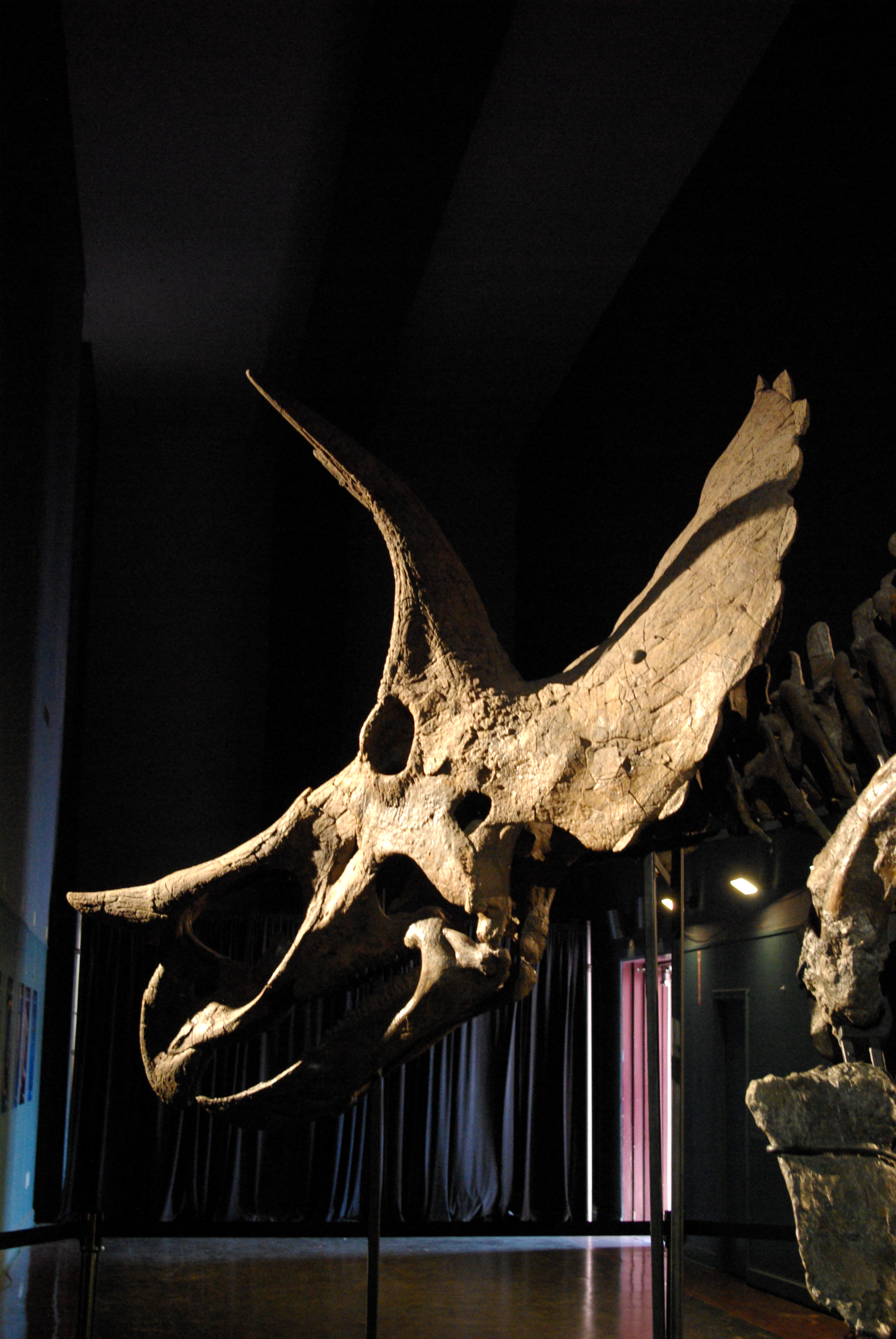
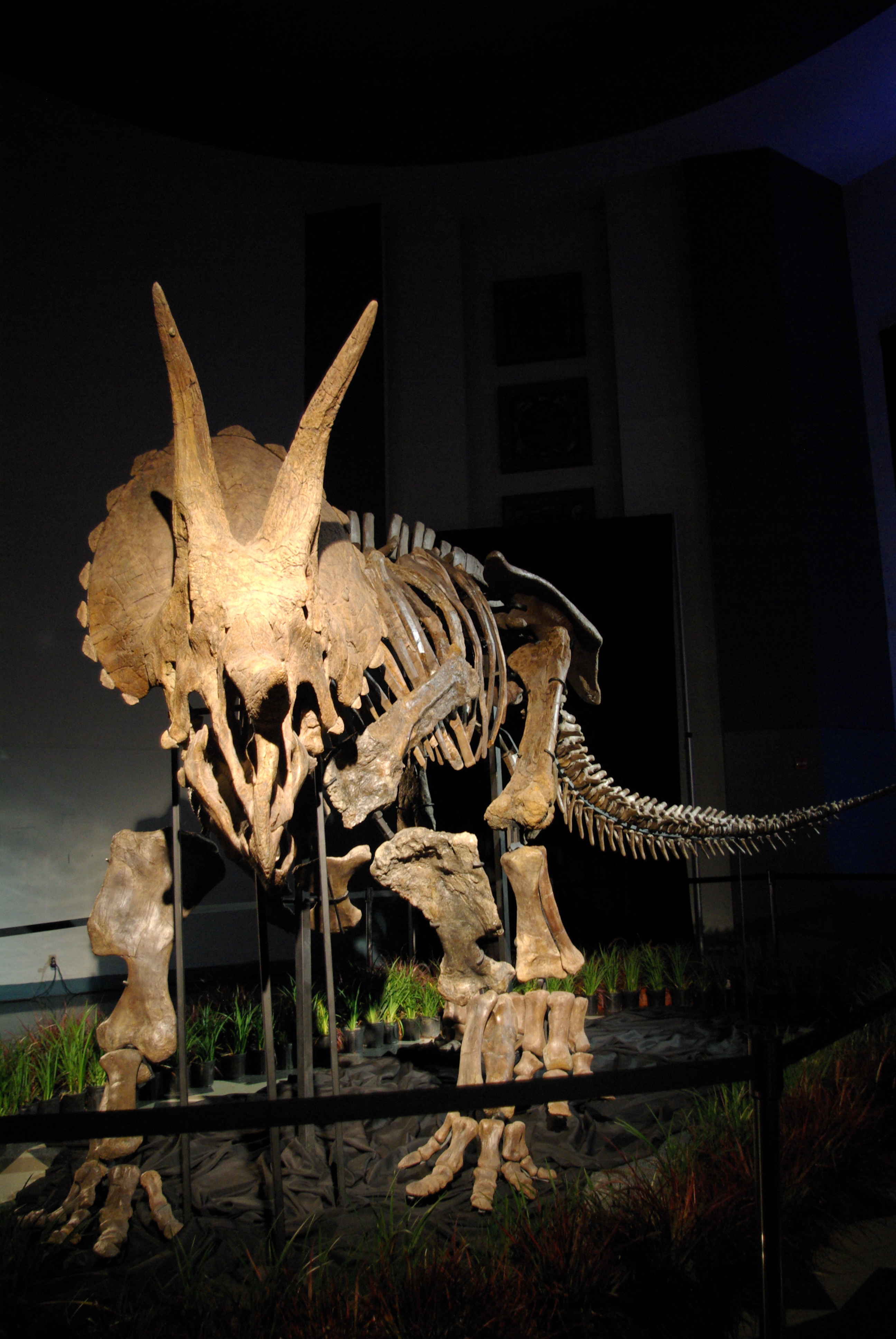
Triceratops welcomes bidders and gawkers to the Heritage Auction sale of fossils, gems, meteorites, and other national history ephemera. HA estimates this nearly-complete triceratops, mounted, to be worth about $700,000; less than 24 hours before the live auction, it has an online bid of $500,000 already.
Heritage Auctions set up a bug bunch of fossils, gems, meteorites, taxidermy, and art work from natural materials, for an auction on Sunday, June 12, 2011.
I can’t afford to bid, but they let me in to get photos. Nice people.
Heritage Auctions' June special, a triceratops - photo by Ed Darrell; use permitted with attribution
The triceratops greets visitors and bidders at the display site, the Tower Building at Dallas’s art deco gem, Fair Park. (If you look at the ceiling above the triceratops, you can see where restorers have stripped away several layers of paint to reveal the original ceiling paintings — original artwork, including murals, was painted over in the years following the dramatic debut of the buildings; restoration work proceeds slowly because of lack of funding.)
Triceratops horridus Cretaceous Hell Creek formation, Harding County, South Dakota
Triceratops has enjoyed much cultural publicity ever since its discovery. It is an iconic dinosaur that has appeared in movies ranging from black and white cinema to modern movies like “Jurassic Park.” It has also been in cartoons, such as the children’s classic “The Land before Time.” Triceratops is also the official state fossil of South Dakota and the official state dinosaur of Wyoming.
The present specimen was discovered in 2004 in two parts: First, the fossil hunters came upon pieces of dinosaur bone eroding down a gully. Following these bone fragments, they eventually came upon large bones that would indicate the presence of a large Ceratopsian dinosaur. While this large mass of bones was being excavated, other members of the team followed another bone trail which led them to an amazingly well preserved skull 750 feet away from the original discovery. Over the course of months, the specimens were carefully excavated in large blocks; each specimen was covered in plaster jackets and removed from the field to the lab. It was only during preparation that they discovered the dinosaur was a Triceratops, and it happened to be a Triceratops with an incredibly complete skull. The bones and skull were carefully removed from their field jackets and prepared using hand tools. Broken bones were professionally repaired and restored while a few missing elements were cast from other Triceratops skeletons. A custom made mount was created to support the bones and the skull; innovative bracket mounts were crafted for each bone so that no bones had to be damaged in order to mount them. The bones were mounted in osteologically correct position; making it comparable to and possibly surpassing the accuracy of older mounts in museum displays. Though it is impossible to say whether or not the skull is original to the specimen, being discovered 750 feet apart, it is certainly possible that the two elements are associated for a number of reasons: first, the size of the skull is consistent with the proportional size dimensions of the skeleton, and second, the surrounding matrix (host rock) was identical in composition.
The completed skeleton is enormous; measuring 19 feet long from head to tail, 11 feet across, and towering 12 feet tall. The skull itself measures 7 feet long with 3 ½ foot long horns; placing it near the top of the size range for Triceratops skulls. The leg bones stand 10 feet tall from toes to the top of the scapula; dwarfing many other Triceratops skeletons. Given that the skull represents about 30% of a dinosaur’s entire skeleton, the present specimen is about 75% original bone, with the right leg, pelvic region, several cervical vertebrae and a few tail vertebrae being cast reproductions.
Who owns the thing? Who put it together? Who is losing the specimen, should it go to a private collection (you got a living room that big?), and which museum really wants it?
But that’s just one of the specimens up for sale at this auction, and not necessarily the best. Also up for bid: A stegosaurus, and an allosaurus, posed as a “fighting pair.”
The "fighting pair," an allosaurus (left) and stegosaurus (right) posed in combat positions. Photo by Ed Darrell, use permitted with attribution.
Am I jaded? On the one hand you can’t look at these specimens without thinking they deserve to be seen by kids, and adults, and studied by paleontologists and biologist of all stripes — and so who has the right to sell these off? On the other hand, this is a Second Gilded Age, and the search for prize fossil specimens is often financed by the proceeds from these auctions. I enjoyed an hour’s browsing and photographing — a slide presentation on the wonders of America for some sleepy class next fall.
How many of these specimens will I get a chance to see again in the future?
Or, Dear Reader, how many of these will you ever get a chance to see?
HA will sell a lot more than just a few dinosaur fossils. This same sale includes the largest shark jawbone ever found, stuffed Kodiak and polar bears (from the same hunter), gems, art from petrified wood and fossilized fish, and a large selection of meteorites, including the only meteoroid ever confirmed to have struck and killed a living creature (a cow in Argentine; you can’t toss a stone without hitting a cow in Argentina, I hear).
Requires a large wall and high ceilings to display
I don’t plan to go bid; there’s about an hour remaining for online bidding tonight, but if you’re interested and you’ve got your income tax refund burning a hole in your pocket, you can also bid by telephone and hotlink on the internet (go to the Heritage Auction site for details). Frankly, I don’t think the sale will get the attention it deserves. I hope these spectacular specimens will land where they can get a great, admiring and studious audience.
Spread the word; friends don't allow friends to repeat history.
Dallas Independent School District’s (DISD) Superintendent Michael Hinojosa resigned about an hour ago to accept the job in Cobb County, Georgia. The board meets tonight, perhapsto appoint an interim superintendent.
Here’s the message sent out through the Dallas systems today, to teachers and administrators:
SUPERINTENDENT MICHAEL HINOJOSA RESIGNS FROM DALLAS ISD
Accepts Superintendent Position in Cobb County, Georgia
Superintendent of Schools Michael Hinojosa submitted his letter of resignation from the Dallas Independent School District today to accept a similar position in Cobb County, Georgia.
Dr. Hinojosa has served as the superintendent for the stateâs second-largest school district for six yearsâthe longest term since Linus Wright held the position in the 1980s. His last day with Dallas ISD will be Thursday, June 30, 2011.
“It has been an honor to serve as superintendent for the school district I attended as a child and where I started my teaching career,” said Hinojosa. “I am enormously proud of our shared accomplishmentsâthe biggest of which is that the number of students graduating from Dallas ISD schools is at its highest since 1983.”
This school year, Dallas ISD expects to graduate a total of 7,200 students, up from 5,800 four years ago. The number has steadily risen each of the last four years.
Under Dr. Hinojosaâs leadership, the school district implemented a systemwide curriculum that was developed by teachers. In addition, principals for schools that had vacancies during the last six years were selected through a collaborative process that allowed staff and the community to provide input.
A $1.37 billion bond program to build and improve school facilities that was approved by voters in 2002was implemented on schedule and under budget. Another $1.35 billion bond program that was approved by voters in 2008 will build 14 more schools, 13 additions, and provide renovations to more than 200 district facilities.
Dallas ISD also became known throughout the country for its leadership in arts education. The Wallace Foundation provided an $8 million grant for the district to partner with Big Thought and the City of Dallas to provide more arts opportunities for students both during and after school.
Under Dr. Hinojosa’s leadership, schools in the southern sector received a significant boost. Two early college high schools are now operating, an all-boys school will open this fall as will a New Tech High School, and three renovated/new schools will open in Wilmer-Hutchins signaling a rebirth of public education in that community.
Grants from the Michael and Susan Dell Foundation and Bill and Melinda Gates Foundation enabled the Dallas Independent School District to become a pioneer in the world of student data. The grants gave principals and teachers access to data dashboards, as well as established a Parent Portal for parents to monitor the progress of their students.
During his six-year tenure, Dr. Hinojosa responded to several crises, including the dissolution of neighboring Wilmer-Hutchins ISD and hurricanes Katrina and Rita, all of which caused an unexpected influx of additional students into Dallas ISD. The biggest crisis was a budget miscalculation that eventually forced the layoff of hundreds of staff during the 2008-09 school year.
Since then, the district has put in place a number of financial controls and rebuilt its fund balance to safer levels. The district now faces a significant cut in state funding because of a statewide budget shortfall.
“It certainly isn’t easy to be an urban school superintendent in todayâs environment, but I am proud of what this community has accomplished during the last six years,” said Hinojosa. “More students are graduating, more students are scoring at college-ready levels and our teachers and principals are better-trained. I hope whoever the board chooses as its next superintendent is provided the same opportunities to make improvements to continue the momentum on behalf of the students of this community. I am thankful to trustees, our staff and so many other leaders and stakeholders in Dallas who have been part of this experience.”
One of Dr. Hinojosaâs hallmarks was to make unannounced visits to the district’s 225 schools each Wednesday morning. He said the experiences kept him grounded on what was most important in the life of a large, urban school district.
“Every school has individuals who are devoted to helping our students succeed,” said Hinojosa. “I couldn’t help but be moved by the dedication of so many people, from custodians to food service workers, librarians to counselors, aides to front office staff and of course, principals and teachers. The Dallas Independent School District will continue to shine because of each of them. My address may soon be in Georgia, but a part of me will always be in Dallas. It has been a privilege.”
Dr. Hinojosa said he is moving to Georgia in part to be closer to his son whose wife is pregnant with their first child. He has two sons who have recently graduated from Hillcrest High School in Dallas who will be attending Ivy League colleges in the fall.
In Fort Worth, the board is expected to approve a separation agreement for Superintendent Melody Johnson, who is resigning to move to California to be closer to her aged mother. Most people expect a tough fight to find a capable person to head either district.
Spread the word; friends don't allow friends to repeat history.
Yeah, this video was first created for the April 2 teacher demonstrations in Austin; but the Texas Lege got filibustered at the last minute. Now the Lege is in special, emergency session.
They still plan to begin the dismantling of Texas public education. After the Brown vs. Board of Education decision, Texas did not follow the errors of Mississippi, Arkansas and Virginia, shutting down some or all of the state’s schools rather than education students of color. As a result, Texas students leapt ahead of their counterparts in those states.
But today, in 2011, the Texas Lege plans two years of budget cuts that will kill Texas education reform efforts and backtrack on 20 years of progress.
It may be like Canute speaking to the sea, the Texas Lege is that stone deaf (water deaf?) — but if Texas teachers don’t stand up for education and Texas kids, who is left to do it? Niemöller is dead. Who is left?
Spread the word; friends don't allow friends to repeat history.
Jake Sorenson at the Daily Utah Chronicle sent out a notice that Ernie Ford died last night. Cardiac issues. He was 70, after all — young by today’s standards, and not yet used up.
Ford was adjunct faculty and adviser to the Chronicle when I wrote there, and took classes from him. Ford and Roy Gibson were veterans of Utah journalism who could offer a couple of chapters of a textbook they never wrote on how to write well, and how to write good news stories — with just their markups, questions and corrections in the margins of the news story one had to meet deadline on.
Gibson died several years ago.
More than once I regretted that I had to send the copy, with Ford’s comments, off to “typesetting” in the backshop, knowing I’d never see it again. We didn’t have a photocopier to just make another copy.
Details to come, Jake said. We’re losing more than just old, established newspapers. We’re losing the men and women who made the news, news, and made the news readable, and understandable.
Ford made his reputation at KSL Television News and the Salt Lake Tribune. Here’s a 1989 story on his leaving KSL to move to a Dallas station. Sometime after that he moved on to run the Society of Professional Journalists, in Indiana. Details on Ford’s life and death to follow, but probably no film at 11:00.
When enough of the big trees fall, you can’t call it a forest any more, you know?
_______________
DePauw University put out a release on Ernie Ford:
Former Prof. Ernie Ford Passes Away at Age 70
Veteran reporter, editor and journalism professor Ernie Ford died June 1 in Greencastle, Indiana
June 2, 2011, Greencastle, Ind. — Ernest J. “Ernie” Ford Jr., a respected journalist and former member of the DePauw University faculty, passed away yesterday. He was 70 years old.
Ford was born on June 7, 1940, in Salt Lake City, and earned bachelor’s and master’s degrees in journalism from the University of Utah. After a lengthy career in print and broadcast journalism, Ford came to Greencastle in the spring of 1992 when he was named executive director of the Society for Professional Journalists (SPJ). The organization, which was founded by student journalists at DePauw University as Sigma Delta Chi (SDX) in 1909, is the nation’s most broad-based journalism organization. SPJ had its national headquarters in Greencastle in the 1990s.
“Ernie Ford was selected because of his strong management experience in broadcast and print journalism,” said Georgiana Vines, assistant managing editor of the Knoxville News Sentinel and chair of the search committee, when Ford’s appointment was announced.
Ford had served as SPJ’s national president during 1991-92 before taking a paid post with the organization. He became a member of SPJ’s national board of directors in 1984, when he was elected Region 9 director, and served as chair of the Ethics Committee, Publication Committee, and the Legal Defense Fund.
Photo, l-r: Ford and David Bohmer '69, director of the Pulliam Center for Contemporary Media Center and Media Fellows Program, with former The DePauw editors Eric Aasen '02 and Andrew Tangel '03 in October 2010
A regular lecturer to students in journalism classes and members of the DePauw Media Fellows program, Ford served as a part-time instructor in University Studies during the 2001-02 academic year. Ernie Ford and his wife, Linda, who survives, are also known to a generation of DePauw students as owners of the Fine Print Bookstore, which they operated on Greencastle’s square for 15 years.
He also served as an adjunct instructor at the University of Utah, Brigham Young University and Utah State University.
“Ernie was a great teacher who helped his students understand the media industry and journalism,” recalls Andrew Tangel, a 2003 DePauw graduate and former editor of The DePauw who now a reporter at New Jersey’s Bergen Record. “A former investigative reporter himself, he seemed to relish asking tough questions at public meetings on campus and in town. He passed along tips to student journalists and encouraged them to be aggressive, hard-nosed reporters.”
Before coming to Indiana, Ford’s journalism career which included stints as managing editor of KSL-TV in Salt Lake City, assistant news director of KDFW-TV in Dallas, assistant city editor of the Salt Lake Tribune, wire editor of the Idaho Post-Register in Idaho Falls, and general assignment reporter for the Deseret News in Salt Lake City. He collected numerous journalism awards, including a 1980 Sigma Delta Chi award for broadcast public service, regional Emmys, the Eudora Welty Award and the DuPont Award. A strong advocate for the First Amendment and the rights of journalists, Ford testified before Congress in support of the Freedom of Information Act and organized a a petition drive that led move the U.S. Supreme Court to permit still cameras in the courtroom.
In 2006, Ford was inducted into the Hall of Fame of the Daily Utah Chronicle, the University of Utah’s student newspaper, where he cuts his reporting teeth as an undergraduate and later served as faculty adviser.
Ford served on the boards of the Putnam County Humane Society, Great Lakes Booksellers Association, served of president of Main Street Greencastle, and was a longtime supporter of the Putnam County Playhouse.
A celebration of Ernie Ford’s life will be held at 2 p.m. Sunday at the Putnam County Playhouse, 715 South County Road 100 East, Greencastle.
Oddly, the great story on the Texas drought that showed up in the Dallas Morning News last week, does not show up on their website. Because this is a climate change-related issue, I think we should track it.
Generally, Texas school districts need to lock down their school year budgets by about the end of April.
Of course, that’s not possible this year. As of this morning, it looked as though the Texas Lege could not agree on school funding, and they will have to return for a special session to set education budgets in June or July.
Can you imagine being the budget officer for a Texas school district?
But, sorta good news in Dallas: Budget officers, making their best guesses on what will happen, created Budget 5.0 (the fifth iteration of this process — one is usually all a district gets, or needs).
Here’s the message from Downtown on the school’s internal communication system:
Budget Plan 5.0 presented to trustees
Budget Plan 5.0 was presented to trustees today during a budget workshop. The administration is optimistic that this particular scenario, which envisions a $90 million cut in state funding to the district, will be closest to the final budget presented to the board for approval in June.
Here are some of the highlights of Budget Plan 5.0:
No additional layoffs at the campus level will be necessary.
There will not be an additional loss in the number of teaching positions. The early resignation incentive offered earlier in the spring cut enough from the payroll to make any additional loss of positions unnecessary. It must be noted, however, that some reassignments will need to occur to level campuses depending upon staffing needs.
Full day pre-kindergarten for eligible Title I students, which has been a priority of the Board of Trustees, will be funded.
Certain teacher stipends will be eliminated.
Secondary schools will be staffed at a 27-1 class-size ratio, an increase over the current level of 25-1. While this is not ideal, it is preferable to earlier budget versions that included a 35-1 ratio.
Texas lawmakers remain gridlocked on the funding mechanism for schools yet have indicated an agreement in principle on the amount that will be available. The latest funding scenarios from the state give the district confidence to move forward with Budget Plan 5.0, with the possibility of some modifications, prior to its approval by the Board of Trustees in June.
Spread the word; friends don't allow friends to repeat history.
Texas schools continue to suffer under the oppression of the Republican state legislature (“the Lege”) and Gov. Rick Perry’s assault on education funding at all levels.
Last Thursday, May 19, some of the seams that hold Texas education together unraveled enough that problems spilled out for the public to see and wonder. In Dallas, school Superintendent Michael Hinojosa announced he plans to take the job open in the Cobb County, Georgia, school district. Hinojosa signed a three-year, more-money contract extension with Dallas Independent School District (ISD) earlier this year when he was passed over for the top job in Las Vegas, Nevada schools.
His announcement that he was leaving caught school board members flat footed, and not necessarily happy.
Hinojosa made a statement to teachers and others working in Dallas ISD:
Two weeks ago, I was contacted by the Cobb County School District in Georgia about the position of superintendent. This past Sunday, I met with their board and tonight I was named a sole finalist for the position. This process has moved very quickly, to say the least.
It is an honor to be considered and is yet another indicator that the achievements experienced in the Dallas Independent School District are being noticed by other school districts throughout the country. I did not seek the position in Cobb County, nor have I been looking to leave Dallas.
I am enormously proud of the accomplishments that have been achieved with our Board of Trustees during the past six years. The number of Dallas students passing statewide exams at both passing and college-ready levels has increased every year. The number of students graduating from our schools has increased during the last three years. The number of students taking and passing AP exams is going up every year. The number of schools considered exemplary by the state of Texas has increased each year.
This did not happen because of any one individual. It happened because of a shared commitment from the staff of the entire Dallas Independent School District. To be part of the progress that has been made has been something very special.
I am not certain how things will play out in Georgia during the next few weeks. Please know that, regardless of what happens, your work on behalf of the students of Dallas ISD continues to be deeply appreciated.
Thank you.
One might hope he’s up to date on the creationism-evolution controversy for the sake of his new job; evolution is not controversial in Dallas ISD. It’s been a tough year for most Texas school superintendents.
When schools are supposed to be planning for fall, most districts in Texas still don’t know how deep will be the cuts in funding from the state legislature. Consequently, schools do not know how many faculty they will have to lay off, and that makes planning for the coming year all but completely impossible. We should expect more than a few of them to be weary of these fights, and wearing out.
Raise your glass to the hard working people
Let’s drink to the uncounted heads
Let’s think of the wavering millions
Who need leaders but get gamblers instead
Spread the word; friends don't allow friends to repeat history.
We got the scores from the state yesterday, for the Texas Assessment of Knowledge and Skills (TAKS). Most of my students are juniors, so this is a big deal. If they pass these tests, in mathematics, science, English language arts and social studies.
Preliminary results gave me a 100% pass rate with 41% commended, out of 134 students whose scores counted (don’t ask about those formulae). Considering that our students’ poverty rate, as measured by school lunches, is well north of 85%, that’s good.
It doesn’t mean all these kids are ready for the Ivy League, though.
I know the preliminary results err somewhere. I can find two students in special education categories who did not muster the scores I had hoped, and to me, it looks like they may need to retake. Two failures wouldn’t be bad, either. I’ll let the state and our administrators fight that out.
So, I’ve done an okay job of teaching our kids bubble guessing. That’ what the TAKS test does, focus teaching on bubble guessing. Are we getting these kids ready for life and college? I have more doubts. The TAKS curriculum is limited, and shallow. Dallas District has two other tests, but again the curriculum tested is limited and shallow.
Each year I discover most students don’t remember what they studied of Paul Revere, and almost none know the famous Longfellow poem about him. They don’t know about Joyce Kilmer, either his poem or the sacrifice of his life.
Reading political cartoons proves difficult for many students, because they don’t understand the symbolism, sometimes of easy stuff like, “who does the Statue of Liberty represent?” or “why is that guy dressed in a star-spangled coat, striped pants and striped top hat?”
They don’t know about Route 66. They don’t know the National Parks. They don’t know Broadway, nor Stephen Foster. They are convinced Utah has some big river that led the Mormons to settle there, “on or near a waterway,” instead of the real reasons the Mormons settled there, for religious freedom in a desert.
Despite their remarkable test achievements, their teachers are all on the chopping block this year. The Texas Lege still quibbles over whether to lay off 10,000 or 100,000 teachers over the summer. We leave the academic year knowing only that the legislature as a collective hates teachers and teaching and schools, and they probably don’t like the students much, either, but they can’t say that because they want the students’ parents’ votes.
Jonathan at JD 2718 sent me a note a couple of weeks ago alerting me to a story in the online Texas Tribune, by Reeve Hamilton. Hamilton interviewed Dr. Michael Marder, a physicist at the University of Texas at Austin who in his spare times runs UT’s UTeach Program, which encourages the best students in science and math to consider teaching elementary and secondary classes. Marder has a strong case to make that it’s not the teacher’s fault when students in some schools do not measure up to the standards promulgated by the state tests, inadequate and inappropriate as those standards are.
(Personal note: Reeve Hamilton is a very good reporter who often does great work on otherwise mundane issues; he’s also the son of a woman I met in graduate school at the University of Arizona, the first woman who ever gave me a highly contingent proposal of marriage, which as you see we did not carry out — probably much to the benefit of all of us, with Reeve doing such great work, and all our kids being basically sane and sound. I smiled when Jonathan said such good things about Reeve’s work, and the subject of the story. Nice to hear unasked-for compliments about people you know and like.)
Marder knows numbers. Marder got the statistics on schools and their preparation of students for college, as well as we can get those numbers without an expensive and expansive study.
Michael Marder’s numbers show that it’s not the teachers’ fault that so many students are not ready for college, and not learning the stuff we think they should know.
Texas Tribune said:
In the popular 2010 documentary Waiting for Superman, former DC schools chancellor Michelle Rhee said, “But even in the toughest of neighborhoods and circumstances, children excel when the right adults are doing the right things for them.”
After looking at the data, Marder has yet to be convinced that any teaching solution has been found that can overcome the detrimental effects of poverty on a large scale — and that we may be looking for solutions in the wrong place.
Hamilton’s interview of Marder takes up three YouTube segments — you should watch all three.
Marder indicts those who blame teachers first, with the data. By implication, he also indicts the state legislatures who appear bent on continuing the daily flogging of teachers until teacher morale improves.
In Part I of the interview with Hamilton, Marder shows the statistics that demonstrate poverty of the student is a greater influence on student achievement than the teacher:
Spread the word; friends don't allow friends to repeat history.
Or, until that account is unsuspended by the forces supporting Donald Trump: Follow @FillmoreWhite, the account of the Millard Fillmore White House Library
We've been soaking in the Bathtub for several months, long enough that some of the links we've used have gone to the Great Internet in the Sky.
If you find a dead link, please leave a comment to that post, and tell us what link has expired.
Thanks!
Retired teacher of law, economics, history, AP government, psychology and science. Former speechwriter, press guy and legislative aide in U.S. Senate. Former Department of Education. Former airline real estate, telecom towers, Big 6 (that old!) consultant. Lab and field research in air pollution control.
My blog, Millard Fillmore's Bathtub, is a continuing experiment to test how to use blogs to improve and speed up learning processes for students, perhaps by making some of the courses actually interesting. It is a blog for teachers, to see if we can use blogs. It is for people interested in social studies and social studies education, to see if we can learn to get it right. It's a blog for science fans, to promote good science and good science policy. It's a blog for people interested in good government and how to achieve it.
BS in Mass Communication, University of Utah
Graduate study in Rhetoric and Speech Communication, University of Arizona
JD from the National Law Center, George Washington University


 Posted by Ed Darrell







 courtroom.



 Millard Fillmore's Bathtub