7 Billion: Are you typical? Year-long Nat Geo special reports

March 13, 2011

7 Billion: Are you typical?

Vodpod videos no longer available.

7 Billion: Are you typical? Year-long Nat Geo s…, posted with vodpod

I could see a bell-ringer in there somewhere.  Who do you think ought to see this thing?  What classes in public schools should see it, for what purpose?

I hope the year-long series lives up to the video.  I hope there are a lot more videos to go along with it.  As a piece of persuasive rhetoric, it does make a decent case for subscribing to National Geographic for a year.  How’s that for rhetorical criticism?


Latitude and Longitude in two minutes

March 3, 2011

Teachers, can you use a video that covers latitude and longitude in just over two minutes?

A good idea, generally, from Matt Rosenberg (a better idea without “autoplay”) — a few more videos at Ask.com Geography.

[Editor’s note:  I’ve put the video below the fold because I can’t find an easy way to turn off the autoplay command.  My apologies to anyone bothered by the problem.]

Read the rest of this entry »


Interesting parent/teacher conference coming in Wisconsin

February 24, 2011

What do you want to bet Wisconsin Gov. David “Ahab” Walker will skip the conference with his son’s teacher next time?

(From the Wisconsin Democratic Party)

The woman, Leah Gustafson,  is very brave.  This is the sort of thing that invites local retaliation by administrators, without even consulting with the governor’s office.  Let’s hope her district’s administrators have a clear understanding of the law, and will back her right to state her views.

Heck, let’s hope they agree with her views.  If they don’t, they should get out of the business.

Tip of the old scrub brush to Michael A. Ryder.


Sputnik – part of the series, “Cold War”

February 17, 2011

BBC’s 24-part series on the Cold War included an entire segment on Sputnik.  Kenneth Branagh narrated this episode.

Sarah Palin, you can start your education here.  On YouTube, it’s broken up into five parts, each less than 10 minutes long.

Cold War, Sputnik, Part 1

Sputnik, Part 2

Sputnik, Part 3

Sputnik, Part 4

Sputnik, Part 5


WWII veterans tell their stories – Central Florida WWII Museum

November 1, 2010

Part of the Veterans History Project, a museum in Florida interviews World War II veterans, and much of the material shows up on YouTube.

These interviews offer great resources for student projects, and are simply a grand way to capture history.

See this story about “Flying the Hump,” transporting war materiel over the Himalayas into China; it’s an interview with E. W. “Bill” Cutler, one of the fliers who survived:

This interview caught my attention for a personal reason.  My uncle, Bruce Davis, died flying the route.  His aircraft and remains were recovered more than 30 years later — someone stumbled on the wreckage accidentally.  When an aircraft went down for any reason (usually weather), the crews passed into a limbo that comprised a special hell for their families.  It was almost impossible that anyone would survive, as Cutler details.  But, with no wreckage and no remains, there were always questions.

Update: Brother Dwight informed me his father-in-law served at the last base before the airplanes went over the mountains.  We have more family Himalayan connections than I knew.

This interview has a mere 152 views as of this posting — pass it around, let’s bump the viewing total up, and get the story out.  At YouTube, the Central Florida WWII Museum has its own channel, listing several similar interviews.

I could see each student assigned to one interview, to tell the story of the interview to the class, to research the background of the theatre of war discussed, the battle, the incident, the armaments, the nations and people involved — to make a history narrative out of the interview, in other words.    What other uses do you see?

Here’s the rest of the story:  The museum has not yet been built.  This project, the video interviews, is a place-holder, a way to communicate while raising the money to build an edifice to honor the veterans more appropriately.  It’s a virtual museum — one your students may browse from the classroom.  How cool is that?


Sam O’Hare’s brilliant film, The Sand Pit

October 18, 2010

You can learn a lot just by observing.

Sam O’Hare’s observations, captured with his Nikon D-300, can teach you a lot.

Or, you can sit back an enjoy the images.  Spectacular stuff.

A day in the life of New York City, in miniature.

Winner: Prix Ars Electronica Award of Distinction 2010

Original Music: composed by Human (humanworldwide.com), co-written by Rosi Golan and Alex Wong.

Geography bell ringer?

Tip of the old scrub brush to Kenny in Beijing.


Annals of DDT: Remembering Rachel Carson

October 8, 2010

From America.gov, the real story of Rachel Carson, in less than two minutes:

More:


Powers of Ten day coming: 10/10/10

August 30, 2010

Press release from the office of the group that manages the estate and work of Charles and Ray Eames:

TENTH ANNUAL INTERNATIONAL POWERS OF TEN DAY

Santa Monica, California, August 27, 2010 /PRNewswire/ — The Eames Office announces with pleasure the Tenth Annual International Powers of Ten Day on October 10, 2010 (10/10/10). Powers of Ten Day promotes and encourages Powers of Ten Thinking, a form of rich, cross-disciplinary thought that approaches ideas from multiple interrelated perspectives, ranging from the infinitesimal to the cosmic—and the orders of magnitude in between.

Milky Way, by Charles and Ray Eames, from

The Milky Way Galaxy from the film, Powers of Ten, by Charles and Ray Eames. For use only in conjunction with press about Powers of Ten Day 2010. © 1977 Eames Office, LLC (eamesoffice.com) (caption provided)

Powers of Ten Day is inspired by the classic film Powers of Ten by designers Charles and Ray Eames. The film, a nine-minute visual journey of scale, takes the viewer from a picnic out to the edge of space and then back to a carbon atom in the hand of the man sleeping at the picnic. Every 10 seconds the view is from 10 times further away. In all, more than 40 Powers of Ten are visualized seamlessly. One of the most widely seen short films of all time—at the Smithsonian Air and Space Museum for decades and still widely used in schools around the world—Powers of Ten has influenced pop culture from The Simpsons to the rock band Coldplay, from Hummer commercials to the movie Men in Black. But Powers of Ten received perhaps the ultimate accolade in 1998 when the Library of Congress selected it, along with Easy Rider, Bride of Frankenstein, and Tootsie, for the National Film Registry—one of the 25 films of great cultural value chosen each year.

And the film’s importance only grows. Scale is not precisely just size, it is the relative size of things. As Eames Demetrios, director of the Eames Office, has said: “Scale is the new geography. So many of our challenges today are ultimately matters of scale. To be a good citizen of the world and have a chance to make it a better place, a person must have a real understanding of scale.”

Powers of Ten Day is for teachers, librarians, architects, designers, store owners, webmasters, business people, scientists, filmmakers, meditation gurus, parents, kids, and anyone wanting to extend the boundaries of their thinking. Participating can be as simple as watching the video (showing online throughout October [the tenth month] at www.powersof10.com), or putting together a screening of the film for friends or co-workers—at home, in a school, or at a library. Our goal is for as many people as possible to watch or share the film on that day. Some will be seeing it for the first time. Some will be revisiting a favorite classic. Everyone can be part of the conversation.

Powers of Ten Day can also be a lot more. Activities are happening worldwide throughout October. With the help of the DVD Scale is the New Geography as well as a Powers of Ten Box Kit, individuals (teachers in the broadest sense) can lead engaging workshops for kids and/or adults that let participants create their own scale journeys. Although those materials may be purchased at www.eamesoffice.com, as Eames Office Education Director Carla Hartman notes, “We’ve set aside some sets to be available at no charge for inquiring schools and teachers.” Those supplies are limited—and some are already being put to use. To inquire about availability of Powers of Ten supplies at no charge, email info@eamesoffice.com.

The Eames Office also encourages you to create and share your contributions. Over the years art has been created, music shared, global pilgrimages performed, and more. But most of all there has been hands-on learning. Events can be registered, and photographs, drawings, and writings uploaded. Sorted by power and by event, these will serve as inspiration and fodder for other events around the world—more than 1,000, possibly 10,000.

Anyone living in or visiting Southern California is welcome to visit the Powers of Ten Exhibition at the Eames Office in Santa Monica from now until the end of the year. There will be an event each day the exhibition is open during the month of October. Many more fun and thought-provoking activities will be available at www.powersof10.com by the end of the summer. The exhibit includes such things as a box that can hold 1 million pennies; as of mid-August, there were already 250,000! All the pennies collected will be given to TreePeople, an environmental nonprofit that unites the power of trees, people and technology to grow a sustainable future for Los Angeles.

Powers of Ten Thinking extends beyond this unique date of 10/10/10. As Demetrios says, “There is a little bit of the numerologist in all of us, so we love celebrating this date, but empowering people to explore and make connections between scales is a year-round goal of ours.” The Eames Office looks forward to tracking and inspiring another decade’s worth of Powers of Ten events. Towards that end, a map of the Earth on the website (and at the Office) will track events around our world.

The Eames Office is dedicated to communicating, preserving, and extending the work of Charles and Ray Eames. Additional information is available online at www.powersof10.com, as well as at www.eamesoffice.com and www.eamesfoundation.org.

The Powers of Ten Exhibition is open from 11 to 6, Wednesday through Saturday at the Eames Office, 850 Pico Boulevard, Santa Monica, CA 90405; 310/396-5991.

Powers of Ten Day is generously sponsored by IBM Corporation with additional support from Herman Miller Inc., Vitra, and Penfolds.

Your school should have one of the Eames versions of the film in the school library (they did more than one).  This is truly a classic, and it should be a good discussion starter for several different topics — map reading, map scaling, environmentalism, existentialism, transcendentalism, and more.

So what will you do for Powers of Ten Day?

Update:  A YouTube edition of the film, “Powers of Ten,” is now available. MFB post about the film, with embedded version and links, here.


Academy Award winner: “Logorama”

August 16, 2010

Delightfully creative.  Surely there is at least a bell ringer in here, just in identifying the different logos.  For economics and sociology classes, this is a study in branding, done in very interesting fashion.

Can you use it in class, even at 16 minutes?  The language may be too edgy for freshman and sophomores, yes?

A short description from the Vimeo post, by Marc Altshuler, who owns the company who created and recorded the music for the film:

This is a short film that was directed by the French animation collective H5, François Alaux, Hervé de Crécy + Ludovic Houplain. It was presented at the Cannes Film Festival 2009. It opened the 2010 Sundance Film Festival and won a 2010 academy award under the category of animated short.

In this film there are two pieces of licensed music, in the beginning and in the end. All the other music and sound design are original. The opening track (Dean Martin “Good Morning Life”) and closing track (The Ink Spots “I don’t want to send the world on fire”) songs are licensed pre-existing tracks. All original music and sound design is by, human (www.humanworldwide.com)

Brilliant little work even if you can’t use it in class.


More Billy Blob: Bumble BeEing and the Butterfly Effect

August 16, 2010

Also from Billy Blob (as the Space Probe cartoon posted here on August 15), “Bumble BeEing, Part 1:  The Butterfly Effect.”

How to categorize such a cartoon:  Philosophy?  Science of Chaos (from which we get the hypothetical “butterfly effect”)?

Education?  Religion?


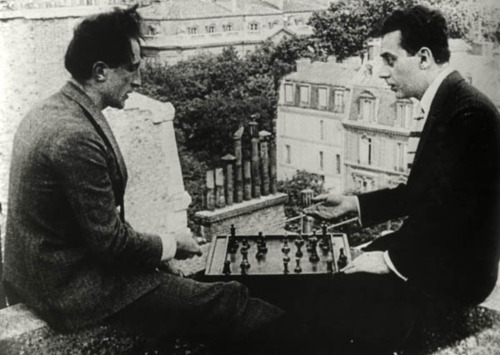
Chess games of the rich and famous: Duchamp vs. Man Ray

July 9, 2010

Marcel Duchamp and Man Ray play chess on a rooftop in Paris.

Duchamp again, this time on a rooftop in Paris, playing chess against Man Ray.

The photograph is later than 1915, when Duchamp moved to the U.S. to avoid World War I, and met Ray; it is probably after 1918.

The two even played chess in a movie:

Man Ray directed a number of influential avant-garde short films, known as Cinéma Pur, such as Le Retour à la Raison (2 mins, 1923); Emak-Bakia (16 mins, 1926); L’Étoile de Mer (15 mins, 1928); and Les Mystères du Château de Dé (20 mins, 1929). Man Ray also assisted Marcel Duchamp with his film Anemic Cinema (1926) and Fernand Léger with his film Ballet Mécanique (1924). Man Ray also appeared in René Clair‘s film Entr’acte (1924), in a brief scene playing chess with Duchamp.

The photo above is a still from that 1924 René Clair movie — it comes about 4:30 into the movie (the version shown here is half of the 20-minute movie, with a very modern, surrealist music score added; you can see the entire movie from Pathé, with a more contemporary score, here).

https://vimeo.com/488844088

Update, March 14, 2011:  See also this story from 2008 about Duchamp’s need to play chess, featuring of photo of Duchamp, Teeny Duchamp and the composer John Cage deeply engrossed in a game.  A good read about chess, and Duchamp.

Tip of the old scrub brush to ArtLex.com.


Typewriter of the moment: Jerry Lewis’s pantomime typewriter (with Leroy Anderson)

May 22, 2010

Ms. Fox’s class had a great time with this video — easy to see why, no?

From “Who’s Minding the Store,” a 1963 Paramount release.

I would have sworn I had a post on Leroy Anderson, but it’s not there to link to; you can check him out on PBS, though.  Another good topic to explore, an oversight to amend.

Jerry Lewis’s pantomime typewriter, always with the Leroy Anderson tune behind it, was one of his most famous comedic routines.  It was very popular in Europe, in both Germany and France.  It’s easy to translate.

Tip of the old scrub brush to Ms. Fox.


What if the old curmudgeon teaching economics married that cute, brainy geography teacher?

April 23, 2010

Or, was it the cute curmudgeon teaching econ and the old cartographer in geography?

I think I’ll add this to my TAKS review.  What other classroom uses can you find for it?

I found it at Cool InfoGraphics.

Seriously, geography and economics teachers, this is big stuff:

Follow the Money” is a video summarizing the results from the project by Northwestern University grad students Daniel Grady and Christian Thiemann.  Using data from the website Where’s George?, they have been able to track the movement of U.S. paper currency.  What can you learn from this?  That there are natural borders within the U.S. that don’t necessarily follow state borders, and it can also be used to predict the spread of disease because it maps movement of people within the U.S.

From Maria Popova on BrainPickings.org: This may sound like dry statistical uninterestingness, but the video visualization of the results is rather eye-opening, revealing how money — not state borders, not political maps, not ethnic clusters — is the real cartographer drawing our cultural geography.  The project was a winner at the 2009 Visualization Challenge sponsored by the National Science Foundation and AAA.

Tip of the old scrub brush to VizWorld and Maitri’s VatulBlog


Finch meets guitar

March 17, 2010

Totally safe for work (in that way), but you may want to turn down your sound, unless you work with a lot of Hendrix fans.

Hey, I’ve used weird things for picks, too.

Tip of the old scrub brush to Happy Jihad’s House of Pancakes.


Great animation: “The Chesnut Tree”

March 14, 2010

Wonderful film from 2007, by Hyun-min Lee.  I found it on PBS World this weekend, and then found a YouTube version.

Watch it with your young children.

[Youtube=http://www.youtube.com/watch?v=VsS4Tk-lrxo]