Annals of DDT: Interior Dept compliments Rachel Carson’s research in Silent Spring

October 17, 2010

One of the most frequent hoax charges against Rachel Carson claims that she didn’t base Silent Spring on research.  Greater hoaxers claim that there is little or no evidence of harm to birds from DDT.

Rachel Carson's book stirs controversy, newspaper headlines

Rachel Carson’s book stirred controversy, as shown in newspaper headlines

These critics forget history, or they try to cover it up so you won’t know any better.  Carson provided more than 50 pages of citations to peer-reviewed research and communications with leading scientists in ornithology and chemistry about DDT and the damage it does.

Carson’s deep research won acknowledgment from the U.S. Department of the Interior, in this 1962 speech before the Audubon Society meeting in Corpus Christi, Texas, by the Special Assistant Assistant Secretary for Fish and Wildlife Robert M. Paul.

Paul told the birders that Interior was proud of the fact that so much of the research in the book relied on Interior’s research, from the U.S. Fish and Wildlife Service:

In addition, we are proud that so much of ‘Silent Spring“ is based on Fish and Wildlife Service research. And, with no modesty at all, we like to point out that Miss Carson is nobly carrying on a tradition that employees of the Department of the Interior, beginning with Walt Whitman nearly a century ago, have written some of the Nation’s most important books.

That’s quite the compliment to Carson, being compared even distantly to Walt Whitman.  It’s also a helluva brag for USFWS.

It’s also a 30-second response to the false charge that Carson’s work was not research based, or that research did not show DDT damage to wildlife.

Paul spoke to the Audubon Society about work to set up and operate the Federal Pest Control Board.

A .pdf of the speech can be found at the website for Interior, in a compilation of information from Interior about DDT between 1945 and 1998.  Full text below the fold.

Read the rest of this entry »


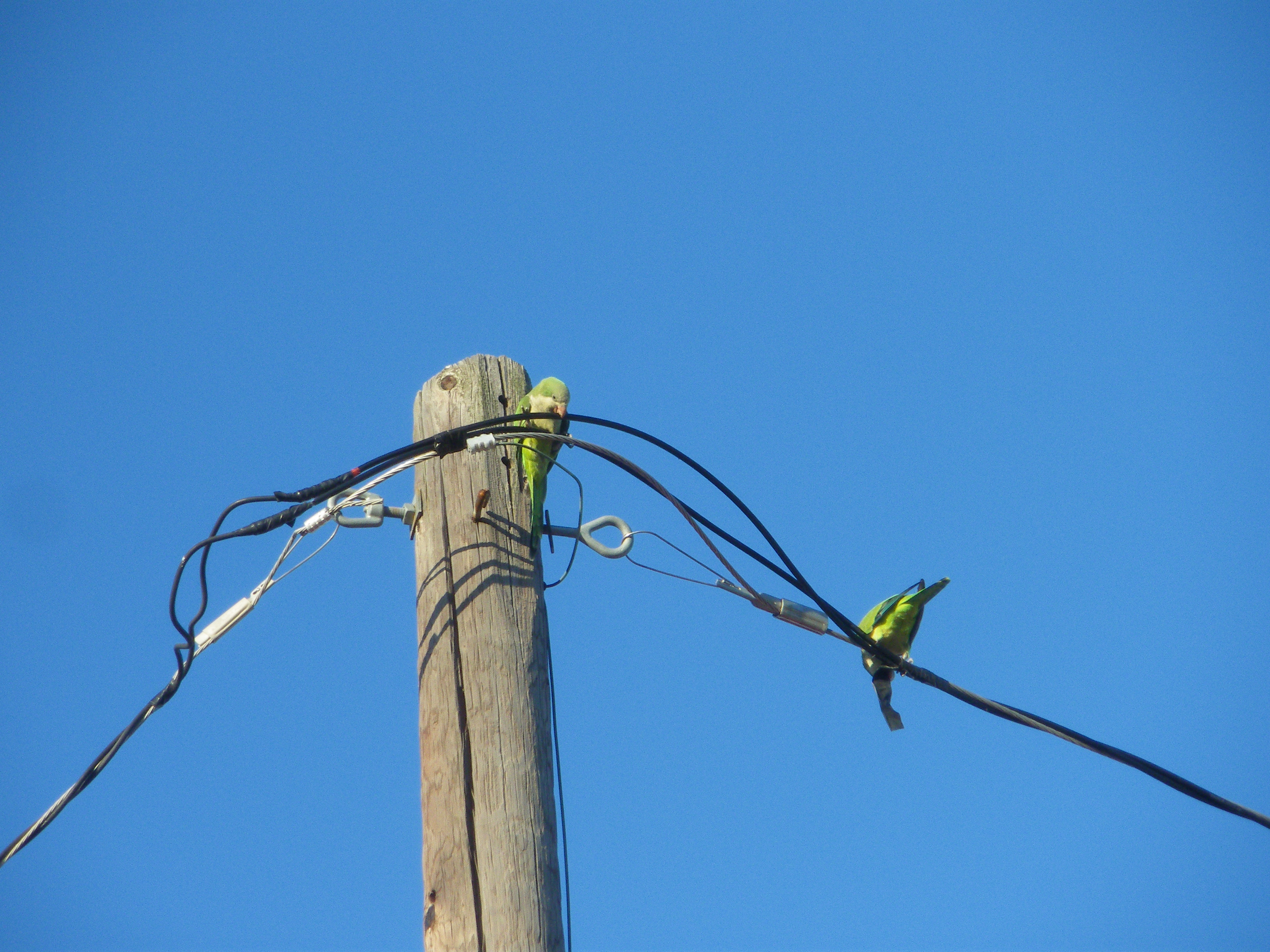
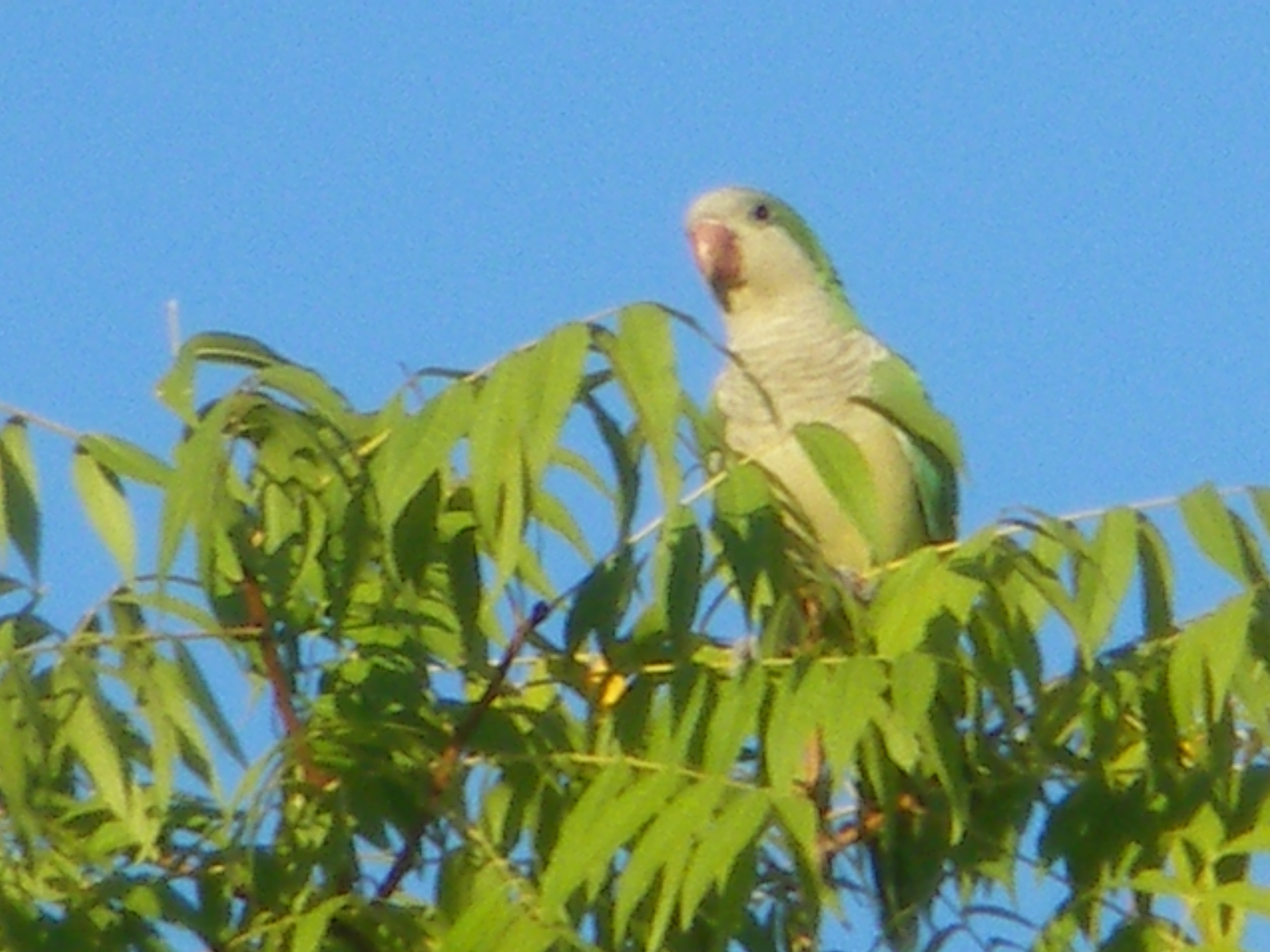
Monk parakeets in the locusts Chinese pistache

August 10, 2010

Terri Potts Smith showed up bright and early for work — was it in the spring? — and we talked in our first floor Dirksen Senate Office Building office about the grind we faced ahead with the hearing schedule for the Senate Labor Committee and subcommittees.  Suddenly she was transfixed by something out the window.

Having just recently learned that terrorists favored that particular corner for planting bombs under cars, I started a bit.  Terri explained, astonished, that a red bird flew into the tree out the window.

It was a cardinal (Cardinalis cardinalis), a common bird, but not one common to Utah, where both of us had grown up.

I think of that often these days, and am still constantly startled, to see green birds flit across the streets of Duncanville, Texas.

Monk parakeetsMyiopsitta monachus. Also known as the Quaker parrot.

Monk parakeets in the locusts, Duncanville, Texas, August 10, 2010 - photo by Ed Darrell, use with attribution encouraged

Monk parakeets profiled in the Chinese pistache, Duncanville, Texas, August 10, 2010 - photo by Ed Darrell; more than a dozen birds are hidden deeper in the tree.

Monk parakeets are invasive in Texas — it is thought the wild flocks developed from a few dozen escapees in the past three decades.  They favor nesting on tall electrical poles — the stadium lights of the high school and college football stadia host a lot, as do electrical transmission lines.  At Verizon Wireless we had at least one occasion when one of our cell tower climbers was attacked by one of the birds, apparently a mother just after the chicks had hatched.  Cell towers provide excellent habitat for the birds.

At the best sitings I’ve had, previously I lacked a camera.  Today I happened to have the small Pentax Optio V20.  20 to 30 of the birds roosted along an electrical wire.  They were happy to see me until I pulled out the camera.  (Pure conjecture:  They’re smart.  They’ve seen people with cameras before — and frequently, shortly after that some crew appears with a cherry-picker to destroy their nests.  Camera-shyness is a survival function for the birds.)

Cute little beggars.

Monk parakeets flocking -- collecting nesting materials?  Photo by Ed Darrell

Monk parakeets flocking -- collecting nesting materials?

All I observed was social activity and some preening, except for the one bird flitting around with a stick in its bill.

And the two who were trying to pull tape off of electrical transmission wires.

Monk parakeets assaulting an electrical transmission line.  Photo by Ed Darrell

Monk parakeets working to get a charge out of life, picking at insulation on an electrical wire.

Troublemakers.

Truth be told, I’ll take the monk parakeets in greater profusion, if we can reduce the populations of starlings, grackles and cowbirds.

Is there any evidence of the parakeets preying on songbirds?

Monk parakeet in the <del>locust</del> Chinese pistache tree - photo by Ed Darrell - IMGP2237

Monk parakeet in the Chinese pistache tree. All photos by Ed Darrell, use with attribution encouraged.

[Update: Oops.  Looked like a locust tree on a quick look.  A longer look, I wasn’t so sure.  Kathryn confirmed that it’s really a Chinese pistache, Pistacia chinensis.]

Add to FacebookAdd to NewsvineAdd to DiggAdd to Del.icio.usAdd to StumbleuponAdd to RedditAdd to BlinklistAdd to TwitterAdd to TechnoratiAdd to Furl


First cicada killer sighting of 2010

July 19, 2010

Cicada killer wasps appeared as early as July 7, in our yard.  This year we had a cold winter, with snows that appear to have stymied even the nasty, invasive Argentine fire ant.  But June was dry and hot.  July came with rains, and cicada killers don’t like wet soil to dig in.

For that matter, we don’t have many cicadas, either.

Plus, we had to tear down a planter box attached to the dining room window, since it hid termites too well.  No doubt that planter had young from the cicada killers in it.

Early yesterday evening, as we finished dinner, we watched the house finches (Carpodacus mexicanus) escorting their young to the bird feeders, the cardinal “babies” (Cardinalis cardinalis) breaking out of their baby feathering, we looked for the family of red-bellied woodpeckers (Melanerpes carolinus) — and there it was:  One lone cicada hawk zooming across the patio, yellow-and-black striped abdomen standing out among the other paper wasps (almost certainly Sphecius speciosa).

They’re back!

Earlier at Millard Fillmore’s Bathtub:

More:


The scientist’s work desk

July 8, 2010

This should be close to the top of “Best Places to Work.”

Condor flight pen observation booth - Amanda Holland photo, all rights reserved

Condor flight pen observation booth – Amanda Holland photo, all rights reserved

From my desk at the Senate Democratic Policy Committee I could look up to a crystal chandelier 10 feet across.  Out the west window was a view over the National Museum of Art, down the mall to the Washington Monument and Lincoln Memorial.  25 yards away, over specially-ordered Italian tile, was the gallery to the World’s Greatest Deliberative Body.  From my desk at the Senate Labor Committee I looked out on that grand Calder sculpture in the Hart Senate Office Building atrium.  A couple of my memorable offices.

The work spaces I miss?  That water tank in Shiprock, New Mexico, with the million-dollar view of the Shiprock; that trailer laboratory we parked in Huntington Canyon, Utah.   That old dock on the Sawkill in the Hudson Valley of New York, by the old snag where the pileated woodpeckers nested and raised their brood.

Cousin-in-law Amanda Holland took this photo of her work station, above.  This is a place where real science gets done.  Amanda wrote:

I get to sit here for hours at a time, recording condor behavior. It does not get old. These birds are AMAZING. You can see a couple condors perched on a snag in the back of the flight pen.

Real work, for real good.  That’s always the best place to work.


Snail zombies in our garden!

July 6, 2010

It became really apparent during the rains last week.

Snails crawl up the walls and plants around our patio, and appear to wait to die there.  We’ve moved them back down to the soil, and they climb up again.

Kathryn remarked at the army of snails on the garage wall, beneath a bird feeder . . . that was the clue.

I don’t think ours do that eye-stalk thing.  Worse for the parasites, most of the birds ignore the snails.

Tip of the old scrub brush to Kate at The Urban Primate.

MacDowell’s book kept me out of church for at least a decade.

In the later pages he talks about how many copies of the Bible there are, and he says that’s an indication of how accurate it is, and that it’s the truth.  That’s like saying any document I create becomes  more truthful the higher the number of Xerox copies I make.

I figured that was one of the stupidest claims ever made.  Maybe it was the crowd I was in with, but the more devout Christians (except for the Mormons, but that’s a different tale) swooned over the claim.  I thought that any belief system that was so devoid of logic, and which required adherents to abandon all reason, was foolish.

About five years ago I picked it up again when one of our youth ministers asked me about it, and I skimmed through it again looking for any cogent, careful and compelling argument.  Of course, this was long after law school and due diligence work in the law . . . I thought it more foolish than I had found it years before.

I summed it up this way for the youth minister:  If there were evidence, we wouldn’t need faith.  We call it a faith proudly, and we discuss the mysteries.  It’s a tragedy that MacDowell has been divorced from that sweet part of Christian discovery and leap of faith.  Were there evidence enough for a verdict, we’d not need faith, and it would be impossible to be anything other than an agnostic who has found the evidence.

Your mileage may differ, but if so, you need a tune-up.

Ed Darrell
Dallas


Lorrie Otto, environmental warrior

June 9, 2010

The Milwaukee Journal-Sentinel carries the news that Lorrie Otto has died.

When DDT spraying killed birds and bats in her yard, Lorrie Otto went to work to stop the destruction.  Otto won.  Someone should step up to take her place, in each of the things she did.

‘Nature Lady’ Otto helped lead DDT fight

Lorrie Otto leads Natural Landscape Tour in Milwaukee - Journal-Sentinel photo by Michael Sears

Caption from the Journal-Sentinel: Lorrie Otto (left) leads the "Natural Landscape Tour" along the banks of Lake Michigan in the 9700 block of N. Lake Drive. A video crew from NBC News photographed the event for a segment. Journal-Sentinel photo by Michael Sears

She began with natural yards, progressed to national causes

By Amy Rabideau Silvers of the Journal Sentinel

Posted: June 2, 2010

Lorrie Otto understood that it wasn’t nice to mess with Mother Nature.

And so the woman known as “the Nature Lady” planted her Bayside yard with native species and wildflowers – fighting for the right to keep her land natural and teaching others how to do the same. She rose to become an environmental warrior, a leader in the battle to ban DDT in Wisconsin and then nationally.

She shared her vision that average people could make a difference by eliminating the standard lawn for more ecological alternatives. The well-manicured lawn was not, she said, a healthy green space.

“They look like golf courses,” Otto once said, then corrected herself. “They look like cemeteries.”

Otto died of natural causes Saturday in Bellingham, Wash., where she moved in 2008 to be near her daughter. She was 90.

Otto served as a founder and leader with groups including Citizens Natural Resources Association of Wisconsin, the Riveredge Nature Center and Wild Ones. She became a nationally recognized naturalist and speaker, called “the godmother of natural landscaping.” Media credits include everything from Martha Stewart Living to “NBC Nightly News.”

“In recent years, a New Yorker article credited her and Rachel Carson for leading the movement,” said daughter Tricia Otto, referring to the author of the famous book “Silent Spring.”

Lorrie Otto, Milwaukee environmental activist, in 1999 - Milwaukee Sentinel-Journal photo

Milwaukee Journal-Sentinel photo: Lorrie Otto, shown in 1999, kept a lively prairie garden.

Otto was named to the Wisconsin Conservation Hall of Fame in 1999. The Schlitz Audubon Center’s annual natural yards tour is named in her honor.

“If suburbia were landscaped with meadows, prairies, thickets or forests, or combinations of these, then the water would sparkle, fish would be good to eat again, birds would sing and human spirits would soar,” Otto said.

She was born Mary Lorraine Stoeber, taking the name Lorrie after marriage. She grew up on a family dairy farm in Middleton and graduated from the University of Wisconsin in Madison.

During World War II, she saw an advertisement for the Women Airforce Service Pilots – what the ad called the “Cream of the Crop” – her daughter said.

“You had to be college-educated and have a pilot’s license,” Tricia said. “She went to the local airport and, with her own money, became a pilot.”

WASP pilots were civilians and the first women to fly American military planes. Just before she graduated, the war was coming to an end and the program quickly disbanded. She married her high school sweetheart, Owen Otto, and they settled in Bayside about 1952.

For Otto, the battles for natural landscaping and against DDT began in her own yard.

The former farm girl planted the family’s yard in a natural way, mostly to create “an enchanting place for my children to play.”

Soon Otto was confronting what she called “the lawn police” in Bayside. One day, a crew arrived and mowed part of her yard. She fought back, proving that her yard might look wild but that it did not contain weeds.

“She was so passionate,” Tricia said. “She would appear in court as an expert witness to defend someone whose yard was being persecuted.”

In the late 1950s, she learned of plans to develop the Fairy Chasm woodland area in her area. “She finally triumphed in 1969, when the Nature Conservancy purchased Fairy Chasm,” according to a copyrighted article by the National Wildlife Federation.

Those were also the days of routine DDT spraying, first to kill mosquitoes and then to kill the beetles destroying elm trees.

“Robins would go into convulsions. . . . I’d see the dead robins near the road,” she told The Milwaukee Journal in 1992. “Red bats would be dangling dead in the rosebushes.”

“She carried big bushel baskets of dead robins into village hall,” Tricia said. The official response ranged from indifferent to angry. “They said, ‘What do you want, lady, birds or trees?’ ”

Otto took the fight to the state level, finally deciding to sue. She contacted the Environmental Defense Fund, a fledgling out-of-state group that won a national reputation for action in Wisconsin. In 1970, Wisconsin banned the use of DDT. The federal ban was approved in 1972.

“She invited scientists from all over the country to her house, and they worked on the paper to present to Congress to get the ban on DDT,” said Dorothy Boyer, a friend and president of the Milwaukee North chapter of Wild Ones. “She had scientists sleeping in sleeping bags in her living room.”

Years later, she was still making new friends and encouraging others. One younger couple, Susannah and Lon Roesselet, began their own natural landscaping in Bayside a few years ago.

“One day the doorbell rang and this little white-haired woman was there, saying, ‘Hello, my name is Lorrie Otto,’ ” Susannah Roesselet said. “We knew about her. She stepped in and became our mentor. Our entire yard is now natural; she is everywhere. She’ll be missed, but she left her mark.”

When Otto finally had to leave her own home, she moved to Washington state to live with her daughter on a hundred acres of natural land.

“She was just having a ball,” Tricia said. “Living here, she said, you could believe the world was happy and whole.”

And Otto made plans for her own last plot of land, delighted to find a green burial cemetery and planting flowers on what would be her own grave. She will be buried without benefit of embalming or chemicals, returning to the earth she loved.

Otto is also survived by her sister, Betty Larson.

A Wisconsin gathering is being planned by friends.


Adventures in Condor land: Moonrise over Hopper Ranch

June 8, 2010

Moon over Hopper Ranch, by Amanda Holland

Moon over Hopper Ranch, by Amanda Holland

Kathryn’s cousin Amanda Holland writes from her great adventure helping to rescue the California Condor, with this photo of the Moon, behind clouds and haze, over the mountains, from Hopper Ranch.

Here’s where I feel the pangs of leaving biology behind for rhetoric, then politics and law.  Probably the best part of research in biology was the places one had to go.  The best adventures involve getting to and back from the places researchers must go to get data or samples.

And now, with electronic cameras and cards that will easily accommodate 1,000 photos, images are easy to capture.

Some of the images I wish I could get back:  Moonrise over Shiprock*; the rattlesnake who liked to hide in the equipment box at the New Mexico Agriculture Experiment Station; the field of asparagus at the Experiment Station, poking up through the desert for the first time (I wonder if they decided to grow asparagus); thunderstorms at Shiprock and over Kimberly, New Mexico; sunrise in Huntington Canyon, Utah; looking nearly into Nevada through crystal air after a summer thunderstorm near Seeley Mountain.  There are a lot more, really.

Adventures past: We remember them warmly.  Getting out in the wild, doing the hard, grunt work necessary to learn about endangered species, or save them, or just improve conservation practices, is close to godliness, and among the greatest pleasures life can offer.

More:

  • See this photo of Shiprock and Moon, probably by a photography named William Stone; this photo of Shiprock and storm, by Radeka, is good, too; at one time my job was to drive from Farmington, New Mexico, past the Shiprock everyday, to get air pollution samples.  The Shiprock rivals Mt. Timpanogos in my personal pantheon of great mountains I grew up with.

Red eared sliders

May 31, 2010

Red-eared sliders, turtles at Texas Discovery Gardens - photo by Ed Darrell

Red-eared sliders cluster together to catch the sun on a spring day at Texas Discovery Gardens at Fair Park in Dallas. Photo by Ed Darrell, 2010

Red-eared sliders (Trachemys scripta elegans), a common aquatic turtle in the southern U.S., caught sunning themselves at the Texas Discovery Gardens at Fair Park in Dallas.


Strange signs of wildlife

May 10, 2010

A good sign of wildlife recovery.  Photo by Amanda Holland, all rights reserved.

A good sign of wildlife recovery. Photo by Amanda Holland, all rights reserved.

A cousin-in-law spends a few months working on condor recovery in California.  We get photos from time to time.

This one isn’t particularly spectacular, but I love the irony, and the levels of meaning.


Friday Fox, and Go vote! Defenders of Wildlife photo contest

April 2, 2010

Friday Fox will not be a regular feature — but, Wow! isn’t that a great photo?

Unless you’re the mouse.

Ron Charest photo of a red fox in the Bombay Hook National Wildlife Refuge (Delaware) - Defenders of Wildlife

Ron Charest photo of a red fox in the Bombay Hook National Wildlife Refuge (Delaware) - Defenders of Wildlife

Defenders of Wildlife called for entries for the 2010 wildlife and wilderness photography contest.  They got more than 10,000 entries, and they’ve got the top 10.  They want you to vote for the best one.  The photo above is just one of the spectacular nominees.

I predict one of the photos featuring animals will win, but the wild lands photos are great, too.

You may vote for three.  Voting ends Sunday, April 4, 2010.

Go see.  Go vote


While thieves and COP15 fiddled, the world’s burning continued . . .

March 18, 2010

A friend wrote me the other day wondering what I thought about the global warming hoax.  I told him I thought denialists and contrarians have acted shamefully claiming that warming is not occurring.

My friend wrote back puzzled.  He had meant, what did I think about the collapse of the false claims of warming?  He said he had understood that almost all the claims of warming were hoaxes cast by a cabal of conspiratorialist scientists who had gotten fat government contracts only on the condition that they claimed there is warming.

It’s actually been about two weeks since I got that message, but it’s a common thought around the world.  The thieves who stole e-mails from scientists did what Shakespeare termed worse: They stole the good names of scientists.  The thieves’ accomplices, especially in blogs but also in brazen journals of bias like The Australian and The Daily Mail, successfully transplanted a stick they claimed was the end of warming science, and they’ve managed to keep it spray-painted green to convince careless observers that it’s alive.

That tree won’t flower.  God’s earth doesn’t care about such falsehoods, but goes on cycling as Darwin noted.  In that cycling, warming continues faster than apace, burning our future and our children’s futures in bits noted only by careful scientists.

While Anthony Watts and other denialists gloated about heavy snows — we’re still cleaning up broken trees and destroyed groves and forests here in Dallas — fact is the North American west suffered from a snow drought.  You may have seen part of it if you watched the Olympics from Vancouver.  It was unseasonably warm, and until the second week there was a great shortage of natural snow for snow events.

We may forget about the ecological chains that weather actually push.  Over at Ralph Maughan’s Wildlife News I found a story about the annual count of elk in Wyoming/Montana/Idaho.  Ralph tracks all sorts of wildlife news, but especially news about wolves and wolf reintroductions.  Wolf packs prey on elk when they can.  The health of elk herds affects the health of wolf packs.

In January I heard there would be no elk count this year because the lack of snow made counting pretty much impossible. I’m glad the amount of snow increased because these numbers are important. Gaps in the data are harmful.

How much have you heard about snowfall shortages in the west, other than the Olympics?  The drought is pretty bad up there.  Much of the Mountain west, on both sides of the Rockies, gets water from the melting snows.  It doesn’t rain much in the spring and summer, but melting snows supply rivers throughout the year.  One reader commented at Maughan’s blog:

I have been in the back country of Montana, Idaho and Washington in the last 3 months and I can tell you, there is no snow to really speak of, the place I stay in Montana normally has about 5-6 feet of snow on the ground in January and when I returned around the first part of January, it had about a foot, Bozeman was very low snow as was Great Falls and Billings, Sandpoint has flowers blooming already, the Columbia River Gorge area up in the Mountains above the Gorge is greening up real well, no snow and Mount Hood has not had much snow either.

Right now, it looks very bleak for river levels this year, My wife was on the phone with her cousin in Florence, MT and Her Uncle in Lincoln, MT this week and they are saying the snow is just not there this year and expects that fishing this year will be very poor due to low water levels and higher river temps, one lives on the Blackfoot and the other on the Bitterroot..

Looks like unless we have a strong spring rain season, things could get dicey this year..

Anecdotal news, just one spot of rather amorphous data, right?

No.  It’s widespread.

Snow Drought in Interior Northwest - USA Today graphic

Snow Drought in Interior Northwest – USA Today graphic

Surely not all the droughts nor drought effects can be blamed on warming — but the rolling disasters of dead forests, especially from pine borers and pine bark beetles, across North America, can be fairly attributed to global warming.  Average winters would kill the insects — where average winters now are a rarity, forests that have stood at least since Columbus are dying out.  Many of the dying forests predate the coming of all humans to the Americas, 37,000 years ago or so.

Housing prices will rise.  Wildfires will increase.  Water emergencies will be declared, and restrictions on development in water-strapped counties and states will be enacted.

Humans can deny warming and human causation.  But even the Rockies cry out.

Who will listen?

US Drought Monitor, March 16, 2010

US Drought Monitor, March 16, 2010 – Click image for updated maps


Sage grouse non-listing: USDA offers $16 million to protect the birds

March 17, 2010

Remember the sage grouse? People groused because the U.S. Department of Interior Fish and Wildlife Service determined most populations of western sage grouse are threatened enough to earn listing as an endangered species under the Endangered Species Act — but then refused to list the bird, because other plants and animals are even more threatened, and need attention sooner.  (I was one of those people complaining.)

It’s a new administration.  U.S. Department of Agriculture offered $16 million for projects to protect the bird’s habitat.  This ruling put increased pressure on state wildlife agencies, in an interesting if not unique twist of the issue of federalism, state vs. federal responsibility for wildlife and wild lands.  Wyoming wants $3 million right away, for projects mostly on private land.

In other words, the administration will sometimes find ways to do the right thing without doing the most difficult or controversial thing.  Ranchers and energy developers cheered by original decision are also happy about Ag’s proposed spending.  Environmentalists unhappy with the first ruling shouled be cheered by Ag’s action, too.  State agencies that worked hard to make the case for listing the bird may be cheered, also.

Sage grouse habitat threatened by deveolopment, in Nevada - Las Vega Sun graphic

Sage grouse habitat threatened by deveolopment, in Nevada - Las Vega Sun graphic

Readers of the Las Vegas Sun learned about the program last week — the Sun has covered the sage grouse as part of its coverage of alternative energy programs.  Much sage grouse habitat in Nevada overlaps wind energy and geothermal energy development zones.

Ranchers across the west are being offered millions of dollars in aid from the federal government to make their operations more environmentally sustainable and reduce their impact on the sage grouse the U.S. Department of Agriculture announced today.

“USDA will take bold steps to ensure the enhancement and preservation of sage grouse habitat and the sustainability of working ranches and farms in the western United States,” Agriculture Secretary Tom Vilsack said. “Our targeted approach will seek out projects that offer the highest potential for boosting sage-grouse populations and enhancing habitat quality.”

The Department of Agriculture’s Natural Resources Conservation Service will soon begin accepting applications for two federal programs aimed at reducing threats to the birds such as disease and invasive species and improving sage-grouse habitat. The agency will have up to $16 million at its disposal for the programs.

The Wilderness Habitat Incentive Program provides up to 75 percent cost-share assistance to create and improve fish and wildlife habitat on private and tribal land.

Sage grouse face a difficult future.  State wildlife management agencies face a tough future, too, in trying to save the birds.  The nation needs energy resources found, often, where the sage grouse need lands to meet, mate and raise their young.  It’s a difficult balancing act.

More information:


Voice of America on Rachel Carson

March 14, 2010

Broadcast from March 13, 2010; transcript and link to MP3 version of the broadcast, here.

A few minor errors, but overall a good history of Rachel Carson and DDT.


For sage grouse, not a nickel’s difference between Bush and Obama

March 9, 2010

Sage grouse don’t vote. If they did vote, they’d have a difficult time picking between Democrats and Republicans on their own life and death issues.

Of course, there aren’t enough sage grouse to make much of a difference on election day. That’s the problem.

Courting sage grouse - Gail Patricelli, UC-Davis

Courting sage grouse - Photo from Gail Patricelli, University of California - Davis

Last week the U.S. Department of the Interior released a decision on the fate of the sage grouse:  Near enough to extinction to merit protection under the Endangered Species Act, but too far down the list of endangered plants and animals to merit action on anything at the moment.

That means that the vanishing habitats of the little, magnificent bird, can be crushed by trucks making tracks across westerns prairies, deserts and mountains searching for oil.

Exxon-Mobil 1, Sage Grouse 0.  One might must hope that’s an early game score, and not the population counts.

Jim Tankersly explained the situation, more dispassionately, in The Los Angeles Times:

Reporting from Washington — The Interior Department declared Friday that an iconic Western bird deserves federal protection under the Endangered Species Act, but declined to offer that protection immediately — a split decision that will allow oil and gas drilling to continue across large swaths of the mountainous West.

The department issued a so-called “warranted but precluded” designation for the greater sage grouse, meaning that the bird merits protection but won’t receive it for now because other species are a higher priority.

My childhood was marked by rapidly plummeting bird populations all around us.  Stopping the use of DDT benefited some of them, the Endangered Species Act benefited others.  Conservation efforts of groups like Ducks Unlimited and the Audubon Society saved others, and helped all of them.  While I lived near a great river, a view of a heron, egret or crane is not what I recall from my childhood.  Our children know the birds well.

Land birds, like turkeys, are even more rare.  Turkeys, mostly in eastern forested areas, at least well out of the Mountain West, made dramatic recoveries with massive aid from state game commissions.  I recall one column from the Washington Post’s recently retired hunting and outdoors columnist, Angus Phillips, in which he confessed that with the aid of professional guides paid from the paper’s expense accounts, in more than 15 years of hunting he had heard, but never seen, a wild turkey. This was two weeks after we had come upon a flock just off the side of the Baltimore-Washington Parkway, the first I’d ever seen.

I remembered Phillips’ confession a few months later as I sat in the cold, at dawn, in a field at the Land Between the Lakes preserve of the Tennessee Valley Authority with other staff and members of the President’s Commission on Americans Outdoors, when a guide summoned seven magnificent, lustful wild turkey toms to race across a field toward the lustful hen sounds the guide made with a part of a birth control diaphragm as a calling device.

In my years tramping the west for fun, in the months camping with the Scouts, in the professional tramping with the Air Pollution Lab and the Senate and the Utah Wilderness Commission, and just for fun, I’ve never seen a sage grouse.

Whether my children get such an opportunity, and their children, is a decision for the moment left to private interests, especially private groups with a financial stake in trampling out the nestings where the youth of grouse are grown.

Exxon-Mobil, will you and your colleagues go easy on the grouse, please?

More:


Tracks on the beach, footprints in the sand

January 30, 2010

Maybe not the tracks you expected — pulse quickening, all the same:

Grizzly bear tracks, Sithylemenkat Lake, Kanuti National Wildlife Refuge, Alaska - photo by Steve Hillebrand USFWS, public domain

Grizzly bear tracks, Sithylemenkat Lake, Kanuti National Wildlife Refuge, Alaska - August 2006 photo by Steve Hillebrand USFWS, public domain