Think American Institute. “We’re Fighting to Prevent This.” Rochester, New York: Kelly Read, 1943. Prints and Photographs Division, Library of Congress
Both Republicans and Democrats might make a claim on this poster, today.
Propaganda for patriots, from World War II, from collections now held by the Library of Congress.
Eisenhower’s contingency statement, in case D-Day failed – image from the National Archives
This quote actually isn’t a quote. It was never said by the man who wrote it down to say it. It carries a powerful lesson because of what it is.
The Bathtub recently posted Gen. Dwight Eisenhower’s “order of the day” to the troops about to conduct the Allied invasion of Normandy — D-Day — to establish the toehold in Europe the Allies needed to march to Berlin, and to end World War II in Europe. As a charge to the troops, it was okay — Eisenhower-style words, not Churchill-style, but effective enough. One measure of its effectiveness was the success of the invasion, which established the toe-hold from which the assaults on the Third Reich were made.
Eisenhower wrote a second statement, a shorter one. This one was directed to the world. It assumed the assault had failed. In a few short sentences, Eisenhower commended the courage and commitment of the troops who, he wrote, had done all they could. The invasion was a chance, a good chance based on the best intelligence the Allies had, Eisenhower wrote. But it had failed.
The failure, Eisenhower wrote, was not the fault of the troops, but was entirely Eisenhower’s.
He didn’t blame the weather, though he could have. He didn’t blame fatigue of the troops, though they were tired, some simply from drilling, many from war. He didn’t blame the superior field position of the Germans, though the Germans clearly had the upper hand. He didn’t blame the almost-bizarre attempts to use technology that look almost clownish in retrospect — the gliders that carried troops behind the lines, sometimes too far, sometimes killing the pilots when the gliders’ cargo shifted on landing; the flotation devices that were supposed to float tanks to the beaches to provide cover for the troops (but which failed, drowning the tank crews and leaving the foot soldiers on their own); the bombing of the forts and pillboxes on the beaches, which failed because the bombers could not see their targets through the clouds.
There may have been a plan B, but in the event of failure, Eisenhower was prepared to establish who was accountable, whose head should roll if anyone’s should.
Eisenhower took full responsibility.
Our landings in the Cherbourg-Havre area have failed to gain a satisfactory foothold and I have withdrawn the troops. My decision to attack at this time and place was based upon the best information available. The troop, the air [force] and the navy did all that bravery and devotion to duty could do. If any blame or fault attaches to the attempt, it is mine alone.
Do you think anyone in the U.S. command would write such a thing today? I have several candidates. Who do you think is leader enough to shoulder the blame for such a massive, hypothetical debacle?
The message may also be viewed here. Yes, it’s incorrectly dated July 5 — should have been June 5.
Gen. Dwight D. Eisenhower talks with paratroopers of the U.S. 101st Airborne Division, June 5, 1944; photo credit unclear; from Ohio State University
Soldiers, Sailors, and Airmen of the Allied Expeditionary Force: You are about to embark upon the Great Crusade, toward which we have striven these many months. The eyes of the world are upon you.
In 1944, DDT seemed like a great idea. The U.S. Army made this film extolling the virtues of the stuff, “DDT: Weapon Against Disease.” It runs just over 14 and a half minutes, from the Army Signal Corps.
Though the film does not discuss the dangers of DDT in any appreciable way, it’s a valuable contribution to the historical canon, simply to show what DDT advocates hoped the substance could do, near the end of World War II.
Einstein’s famous formula. “E” is energy. “m” is mass of the particle or particles; “c” is the speed of light, or a fantastically large number. Energy equals the mass multiplied by the speed of light squared. Accidentally very accurate, the equation notes the idea that matter and energy are the same thing, and can be converted one to the other. (Image from PBS)
Happy Einstein Day (a day late)! Almost fitting that he was born on π Day, no? I mean, is there an E=mc² Day?
Albert Einstein was born on March 14, 1879, in Ulm, Germany, to Hermann and Pauline Einstein. 26 years later, three days after his birthday, he sent off the paper on the photo-electric effect; that paper would win him the Nobel Prize in Physics in another five years, in 1921. In that same year of 1905, he published three other papers, solving the mystery of Brownian motion, describing what became known as the Special Theory of Relativity and solving the mystery of why measurements of the light did not show any effects of motion as Maxwell had predicted, and a final paper that noted a particle emitting light energy loses mass. This final paper amused Einstein because it seemed so ludicrous in its logical extension that energy and matter are really the same stuff at some fundamental point, as expressed in the equation demonstrating an enormous amount of energy stored in atoms, E=mc².
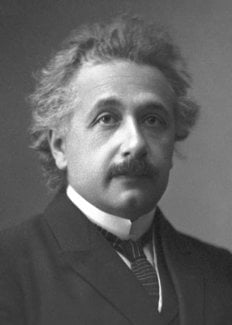
Einstein in 1921, the year he was awarded the Nobel Prize in Physics for the photoelectric effect.
Any one of the papers would have been a career-capper for any physicist. Einstein dashed them off in just a few months, forever changing the field of physics. And, you noticed: Einstein did not win a Nobel for the Special Theory of Relativity, nor for E=mc². He won it for the photo electric effect. Irony in history.
106 years later Einstein’s work affects us every day. Relativity theory at some level I don’t understand makes possible the use Global Positioning Systems (GPS), which revolutionized navigation and mundane things like land surveying and microwave dish placement. Development of nuclear power both gives us hope for an energy-rich future, and gives us fear of nuclear war. Sometimes, even the hope of the energy rich future gives us fear, as we watch and hope nuclear engineers can control the piles in nuclear power plants damaged by earthquakes and tsunami in Japan.
If Albert Einstein was a genius at physics, he was more dedicated to pacifism. He resigned his German citizenship to avoid military conscription. His pacifism made the German Nazis nervous; Einstein fled Germany in the 1930s, eventually settling in the United States. In the U.S., he was persuaded by Leo Szilard to write to President Franklin Roosevelt to suggest the U.S. start a program to develop an atomic weapon, because Germany most certainly was doing exactly that. But Einstein refused to participate in the program himself, sticking to his pacifist views. Others could, and would, design and build atomic bombs. (Maybe it’s a virus among nuclear physicists — several of those working on the Manhattan Project were pacifists, and had great difficulty reconciling the idea that the weapon they worked on to beat Germany, was deployed on Japan, which did not have a nuclear weapons program.)
Einstein was a not-great father, and probably not a terribly faithful husband at first — though he did think to give his first wife a share of a Nobel Prize should he win it in the divorce settlement. Einstein was a good violinist, a competent sailor, an incompetent dresser, and a great character. His sister suffered a paralyzing stroke. For many months Albert spent hours a day reading to her the newspapers and books of the day, convinced that mute and appearing unconscious, she would benefit from hearing the words. He said he did not hold to orthodox religions, but could there be a greater show of faith in human spirit?
Einstein in 1950, five years before his death.
When people hear clever sayings, but forget to whom the bon mots should be attributed, Einstein is one of about five candidates to whom all sorts of things are attributed, though he never said them. (Others include Lincoln, Jefferson, Mark Twain and Will Rogers). Einstein is the only scientist in that group. So, for example, we can be quite sure Einstein never claimed that compound interest was the best idea of the 20th century. This phenomenon is symbolic of the high regard people have for the man, even though so few understand what his work was, or meant.
A most interesting man. A most important body of work. He deserves more study and regard than he gets.
Growing up, I remember marveling at the stories about the bravery, courage, and patriotism demonstrated by the Tuskegee Airmen.
I was happy to see them gain renewed recognition through the recent film Red Tails. Their story of persevering through a pervasive culture of prejudice to become American heroes is one we should tell more often.
But as we celebrate Black History Month and honor the African-American heroes in our lives, we must remember that films celebrating the contributions of people of color remain few and far between. That’s why I’m asking you to sign onto a letter asking movie studios to bring more of these stories to the silver screen.
Sign our letter encouraging Hollywood to create more films like Red Tails, celebrating the contributions of African-Americans throughout our history:
The facts about the production of films showing African-American heritage, and the employment of African-Americans in Hollywood, are alarming.
In 2009, Screen Actors Guild President Ken Howard said, “the diverse and multicultural world we live in today is still not accurately reflected in the portrayals we see on the screen.” And last year, the Writers Guild of America released a study showing the minority share of employment in feature films had fallen to 5%, its lowest level in ten years.
We must reverse these trends. With your help, we can send a message to the Hollywood studios that the public wants to see more films on the contributions of diverse communities, written, directed, and produced by filmmakers from all walks of life.
Make no mistake — we have come a long way since the Tuskegee Airmen flew in the face of a society that thought them incapable of achieving the feats of bravery they regularly demonstrated. Now we must ensure their legacy will be passed on to future generations.
Join us in telling Hollywood we need more films celebrating African-American culture and contributions:
After you sign the letter, I hope you’ll go see Red Tails in the theaters this weekend. It’s a great way to continue celebrating Black History Month. And if you have already seen it, see it again!
Thank you,
Vic Bulluck
Executive Director
NAACP Hollywood Bureau
P.S. Join us on February 17th as we honor those who have achieved milestones in the fields of social justice and art. The 43rd Annual NAACP Image Awards will air live on NBC at 8:00 p.m. (7:00 p.m. central).
Have you seen “Red Tails” yet? What did you think?
(Oy. Have you heard the controversy in Dallas about taking classes to see it?)
“Mike is learning his lesson.” Still shot from the 1947 U.S. government film, “Don’t Be a Sucker,” intended to encourage Americans to be inclusive to avoid the divisions and disaster that afflicted Nazi Germany. Vox.com image
Financed and produced by the United States War Department, and shot at the Warners [Bros.] studio, although it was distributed through all of the major studios’ film exchanges and also by National Screen Services free to the theatre exhibitors: A young, healthy American Free Mason is taken in by the message of a soap-box orator who asserts that all good jobs in the United States are being taken by the so-called minorities, domestic and foreign. He falls into a conversation with a refugee professor who tells him of the pattern of events that brought Hitler to power in Germany and how Germany’s anti-democratic groups split the country into helpless minorities, each hating the other. The professor concludes by pointing out that America is composed of many minorities, but all are united as Americans. (Reissued in 1946 following the end of World War II.) (Written by Les Adams)
From the Department of Defense in 1943 and 1946, “Don’t Be a Sucker,” about 18 minutes:
Just trying to keep the history wires warm while we’re testing in the cold, a bit of olla podrida.
Today in history? For January 10:
From the National Archives: “This campaign medallion from the 1856 presidential election is a predecessor to the candidate bumper sticker. The small hole punched at the top would have allowed a person to sew the medallion to a jacket or coat, or string it on a chain. Pictured in the center of the medallion is former President Millard Fillmore. “
Fillmore was nominated by the American Party, also known as the “Know-Nothing” Party, as their Presidential candidate. The Know-Nothing party was staunchly anti-immigrant and Protestant, and feared the large number of German and Irish Catholics who were coming into the United States at the time.
This medallion is one of many campaign-related objects from the Truman Library. When it first opened in 1957, President Truman wanted the Library to become a general center for the study of the presidency, not just focused on him. As a result, the Library actively sought out presidential-related objects to collect. The Library will be featuring more campaign history throughout this 2012 election year.
Compared to many other Southern states, Florida saw little military action. Strategically important coastal cities, such as Jacksonville and Saint Augustine, switched hands between the North and South but the interior of the state remained under Confederate control. When Lee surrendered in 1865, Tallahassee was the only Southern capital east of the Mississippi that was still held by rebel forces.
"A woman prepares a sign promoting American Education Week by attaching it to the wall of the Education Department office." Photo by Ansel Adams, 1943, at Manzanar War Relocation Center - Library of Congress collections
Just an ironic blast from the past, an Ansel Adams photograph of an interned American citizen of Japanese descent, putting up a poster celebrating “American Education Week,” at the Manzanar War Relocation Center, California. Photo details:
Title: Education week sign / photograph by Ansel Adams.
Summary: A woman prepares a sign promoting American Education Week by attaching it to the wall of the Education Department office.
Reproduction Number: LC-DIG-ppprs-00417 (b&w digital file from original print) LC-DIG-ppprs-00158 (b&w digital file from original neg.) LC-A35-T01-6-M-6 (b&w film dup. neg.)
Rights Advisory: No known restrictions on publication.
Call Number: LOT 10479-7, no. 20 [P&P]
Repository: Library of Congress Prints and Photographs Division Washington, D.C. 20540 USA
Notes:
Title transcribed from Ansel Adams’ caption on verso of print.
Original neg. no.: LC-A35-6-M-6.
Gift; Ansel Adams; 1965-1968.
Forms part of: Manzanar War Relocation Center photographs.
Spread the word; friends don't allow friends to repeat history.
October 31 hosts several famous anniversaries. It is the anniversary of Nevada’s statehood (an October surprise by Lincoln for the 1864 campaign?). It is the anniversary of the cleaving of western, catholic Christianity, as the anniversary of Martin Luther’s tacking his 95 theses to the door of the church in Wittenburg, Germany in 1517, the formal start of the Reformation. Maybe the original Christian trick or treat.
U.S.S. Reuben James sinking, October 31, 1941 - National Archives photo
October 31 is also the anniversary of the sinking of the World War I era Clemson-class, four-stack destroyer, U.S.S. Reuben James, by a German U-boat. Woody Guthrie memorialized the sad event in the song, Reuben James, recorded by the Almanac Singers with PeteSeeger (see also here, and here), and later a hit for the Kingston Trio. The Reuben James was sunk on October 31, 1941 — over a month before the Japanese attack on Pearl Harbor. Details via Wikipedia (just to make you school librarians nervous):
This history figured into the 20088 presidential campaign in a small way: One of the internet hoax letters complaining about Barack Obama claimed that the U.S. entered World War II against Germany although the Germans had not fired a single round against the U.S. The 115 dead from the crew of 160 aboard the James testify to the inaccuracy of that claim, wholly apart from the treaty of mutual defense Germany and Japan were parties to, whichencouraged Germany to declare war upon any nation that went to war with Japan. After the U.S. declaration of war on Japan, Germany declared war on the U.S., creating a state of war with Germany.
This history also reminds us that many Americans were loathe to enter World War II at all. By October 1941, Japan had been occupying parts of China for ten years, and the Rape of Nanking was four years old. The Battle of the Atlantic was in full swing, and the Battle of Britain was a year in the past, after a year of almost-nightly bombardment of England by Germany. Despite these assaults on friends and allies of the U.S., and the losses of U.S. ships and merchant marines, the U.S. had remained officially neutral.
Many Americans on the left thought the sinking of the Reuben James to be the sort of wake-up call that would push Germany-favoring Americans to reconsider, and people undecided to side with Britain. The political use of the incident didn’t have much time to work. Five weeks later Japan attacked Pearl Harbor, and by the end of 1941, the U.S. was at war with the Axis Powers.
Letter to the U.S. Navy asking the fate of friends aboard the U.S.S. Reuben James, November, 1941
Telegram informing his family of the death of Gene Guy Evans, of Norfolk, Virginia, lost in the torpedoing of the U.S.S. Reuben James
The Kingston Trio sings, as the names of the dead scroll:
Reuben James was born in Delaware about 1776. During the Quasi-War with France, Boatswain’s Mate James participated in Constellation’s victories over the French ships L’Insurgente, 9 February 1799, and La Vengeance. During the Barbary Wars, he served aboard Enterprise and accompanied Stephen Decatur into the harbor at Tripoli on 16 February 1804, as Decatur and his men burned the captured American frigate Philadelphia to prevent Tripoli from using her in battle. In the ensuing skirmish, an American seaman positioned himself between Decatur and an enemy blade. This act of bravery was attributed to Reuben James and to Daniel Frazier. For the rest of the war, James continued to serve Decatur aboard Constitution and Congress. During the War of 1812, he served in United States, under Decatur, and in President. On 15 January 1815, however, President was defeated by the British and James was taken prisoner. After the war, he resumed service with Decatur, aboard Guerriere, and participated in the capture of the 46-gun Algerian flagship Mashouda on 17 June 1815. After peace was made with the Barbary states, James continued his service in the Navy until declining health brought about his retirement in January 1836. He died on 3 December 1838 at the U.S. Naval Hospital in Washington, D.C.
Reuben James (DD-245) was laid down 2 April 1919 by New York Shipbuilding Corp., Camden, N.J.; launched 4 October 1919; sponsored by Miss Helen Strauss; and commissioned 24 September 1920, Comdr. Gordon W. Haines in command.
Assigned to the Atlantic Fleet, Reuben James sailed from Newport, R.I., 30 November 1920 to Zelenika, Yugoslavia, arriving 18 December. During the spring and summer of 1921, she operated in the Adriatic and the Mediterranean out of Zelenika and Gruz, Yugoslavia, assisting refugees and participating in postwar investigations. In October 1921 at Le Havre, she joined Olympia (C-6) at ceremonies marking the return of the Unknown Soldier to the United States. At Danzig, Poland, from 29 October 1921 to 3 February 1922, she assisted the American Relief Administration in its efforts to relieve hunger and misery. After duty in the Mediterranean, she departed Gibraltar 17 July 1922.
Based then at New York, she patrolled the Nicaraguan coast to prevent the delivery of weapons to revolutionaries in early 1926. In the spring of 1929, she participated in fleet maneuvers that foreshadowed naval airpower. Reuben James decommissioned at Philadelphia on 20 January 1931.
Recommissioned 9 March 1932, she again operated in the Atlantic and the Caribbean. From September 1933 to January 1934 she patrolled Cuban waters during a period of revolution. Sailing for the Pacific from Norfolk 19 October 1934, she arrived at her new homeport of San Diego, Calif., 9 November. Following maneuvers that evaluated aircraft carriers, she returned to the Atlantic Fleet in January 1939. Upon the outbreak of war in Europe in September 1939, she joined the Neutrality Patrol, and guarded the Atlantic and Caribbean approaches to the American coast.
In March 1941, Reuben James joined the convoy escort force established to promote the safe arrival of war materials to Britain. This escort force guarded convoys as far as Iceland, where they became the responsibility of British escorts. Based at Hvalfjordur, Iceland, she sailed from Argentia, Newfoundland, 23 October 1941, with four other destroyers to escort eastbound convoy HX-156. While escorting that convoy, at about 0525, on 31 October 1941, Reuben James was torpedoed by German submarine U-562. Her magazine exploded, and she sank quickly. Of the crew, 44 survived, and 115 died. Reuben James was the first U.S. Navy ship sunk by hostile action in World War II.
25 September 2005
Spread the word; friends don't allow friends to repeat history.
(This is almost completely an encore post — one that should get more circulation. From four years ago, in 2007. I have not updated years or ages — sharpen your math skills, and do it as you go.)
Some people can’t let go of the past, and like the greedy chimpanzee who grasps the rice in the jar, and then is trapped when he cannot pull out his fist nor will he give up his prize to save his freedom, they trap themselves out of a good life.
Cover of 1996 album of songs, "Pete." Seeger, born May 3, 1919, is 88 years old now.
Probably more important in 2011 than before: Fly your flag for American labor today.
Poster from the Office of War Information, 1942
It’s Labor Day 2011 in the United States, a federal holiday, and one of those days Americans are urged to fly the U.S. flag.
The poster was issued by the Office of War Information in 1942, in full color. A black-and-white version at the Library of Congress provides a few details for the time:
Labor Day poster. Labor Day poster distributed to war plants and labor organizations. The original is twenty-eight and one-half inches by forty inches and is printed in full color. It was designed by the Office of War Information (OWI) from a photograph especially arranged by Anton Bruehl, well-known photographer. Copies may be obtained by writing the Distribution Section, Office of War Information [alas, you can’t get a copy from the Office of War Information in 2011]
Greg Williams produces more cartoons than newspapers can print (or do print) — he’s got a blog called WikiWorld as an outlet for some of them. At WikiWorld, he does a one-panel cartoon to accompany some article he found at Wikipedia. It’s much cooler than it sounds.
Would this make a good poster for a classroom? Greg Williams cartoon, Wikipedia information
In my studies of rhetoric at the University of Arizona, one class turned to a long discussion on Kilroy. Without the internet, we had to make do with memory, logic, argument, and a quick trip to the library to see what we could find quickly.
My thesis, which I still hold, is that the presence of Kilroy marks the existence of sanity in otherwise crazy world, and that the rise of Kilroy, or Kilroyism, in war, demonstrates the spirit necessary to win. Kilroy didn’t win the war singlehandedly, of course — but it was that spirit of Kilroy that turned the tide to victory for the Americans and allies so many times, in so many places.
Why isn’t Kilroy in the Texas Essential Knowledge and Skills (TEKS) list?
Or, until that account is unsuspended by the forces supporting Donald Trump: Follow @FillmoreWhite, the account of the Millard Fillmore White House Library
We've been soaking in the Bathtub for several months, long enough that some of the links we've used have gone to the Great Internet in the Sky.
If you find a dead link, please leave a comment to that post, and tell us what link has expired.
Thanks!
Retired teacher of law, economics, history, AP government, psychology and science. Former speechwriter, press guy and legislative aide in U.S. Senate. Former Department of Education. Former airline real estate, telecom towers, Big 6 (that old!) consultant. Lab and field research in air pollution control.
My blog, Millard Fillmore's Bathtub, is a continuing experiment to test how to use blogs to improve and speed up learning processes for students, perhaps by making some of the courses actually interesting. It is a blog for teachers, to see if we can use blogs. It is for people interested in social studies and social studies education, to see if we can learn to get it right. It's a blog for science fans, to promote good science and good science policy. It's a blog for people interested in good government and how to achieve it.
BS in Mass Communication, University of Utah
Graduate study in Rhetoric and Speech Communication, University of Arizona
JD from the National Law Center, George Washington University


 Posted by Ed Darrell









 Millard Fillmore's Bathtub