I haven’t seen a good Get Out the Vote campaign from a Scout Group in at least 40 years. From my perspective it appears Richard Nixon took the fire out of Scouts and Scout leaders to do a community wide, non-partisan drive to get out the vote.
Plus, in many of those years the Scouts pushed getting people to vote, while their parents and other voters probably suppressed voting from certain groups.
Still it’s great to see the history, that in 1928 voting was considered such an uncontroversial part of citizenship that it made the cover of Boys’ Life.
Boys’ Life Magazine, November, 1928. “Healthy moral values are the solution for happier kids & and a greater nation.”
Who reads magazines any more? Not enough people.
Spread the word; friends don't allow friends to repeat history.
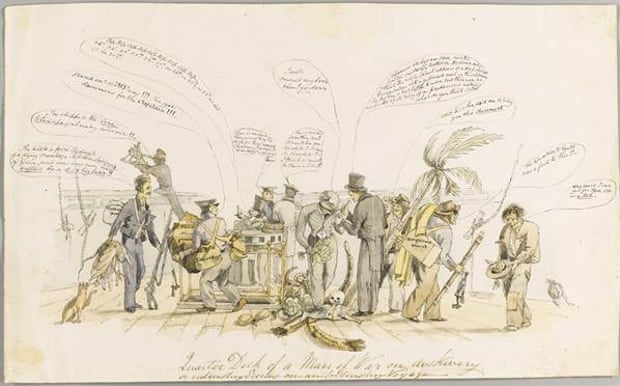
A cartoon of Charles Darwin and the crew of the HMS Beagle – believed to be the only image of the great naturalist on the voyage that inspired his theory of evolution – auctioned by Sotheby’s in December, 2015, for 52,500
The watercolour, painted while the Beagle was anchored off the Patagonian coast in 1832, around September 24, shows fossils and botanical specimens being hauled aboard for examination by Darwin, who commands the centre of the painting in top hat and tails. The event followed Darwin’s trip ashore at Bahia Blanca, Brazil. Painting is by by Augustus Earle, who was hired as shipboard artist by Capt. FitzRoy in October 1831, but had to quit the ship soon after this painting, due to ill health. From The Guardian.
No, Darwin was not racist.
I know many Darwin students, and science students, usually concede that Darwin was “racist by today’s standards,” but better than most of his pre-Victorian and Victorian colleagues. I think that’s an unnecessary and very much inaccurate concession. Darwin simply was not racist.
To come to that conclusion, one needs to read a bunch of Darwin’s writings, and see what he really said. Darwin was bound by English usage mostly in the first half of the 19th century, and that produces confusion among people who assume “savage” is a pejorative term, and not simply the pre-1860 version of “wild” or “aboriginal.”
But beyond that, a look at Darwin’s life should produce an appreciation of the remarkable lack of bias he shows to people of color — though he does demonstrate bias against French, Germans and Turks, and it’s difficult to understand if he’s being sarcastic in those uses.
We discussed this issue way back in 2007, at Dr. P. Z. Myers’s blog, Pharyngula, back when it was a part of a series of science blogs hosted by Seed Magazine, which has gone defunct. P. Z. took an answer I gave in one post, and made a freestanding post out of it.
I was surprised, but happy to bump into the answer recently — because it remains a good summary response. It would have benefited from links, but in 2007 I wasn’t adept at adding links in other blogs (didn’t even have this one), and links were limited, as I recall.
So I’ll add in links below.
Here’s my 2007 answer to the retort, “Darwin was racist,” with no editing, but links added.
Here’s the post from P. Z. Myers, featuring my answer.
Since Ed Darrell made such a comprehensive comment on the question of whether Darwin was as wicked a racist as the illiterate ideologues of Uncommon Descent would like you to believe, I’m just copying his list here.
Remember the famous quarrel between Capt. FitzRoy and Darwin aboard the Beagle? After leaving Brazil, in their mess discussions (remember: Darwin was along to talk to FitzRoy at meals, to keep FitzRoy from going insane as his predecessor had), Darwin noted the inherent injustice of slavery. Darwin argued it was racist and unjust, and therefore unholy. FitzRoy loudly argued slavery was justified, and racism was justified, by the scriptures. It was a nasty argument, and Darwin was banned to mess with the crew with instructions to get off the boat at the next convenient stop. FitzRoy came to his senses after a few days of dining alone. Two things about this episode: First, it shows Darwin as a committed anti-racist; second, it contrasts Darwin’s views with the common, scripture-inspired view of the day, which was racist.
Darwin’s remarks about people of color were remarkably unracist for his day. We should always note his great friend from college days, the African man, [freed slave John Edmonstone,] who taught him taxidermy. We must make note of Darwin’s befriending the Fuegan, Jeremy Jemmy Button [real name, Orundellico], whom the expedition was returning to his home. Non-racist descriptions abound in context, but this is a favorite area for anti-Darwinists to quote mine. Also, point to Voyage of the Beagle, which is available on line. In it Darwin compares the intellect of the Brazilian slaves with Europeans, and notes that the slaves are mentally and tactically as capable as the greatest of the Roman generals. Hard evidence of fairness on Darwin’s part.
Watch for the notorious quote mining of Emma’s remark that Charles was “a bigot.” It’s true, she said it. Emma said Charles was a bigot, but in respect to Darwin’s hatred of spiritualists and seances. Darwin’s brother, Erasmus, was suckered in by spiritualists. Darwin was, indeed, a bigot against such hoaxes. It’s recounted in Desmond and Moore’s biography, but shameless quote miners hope their audience hasn’t read the book and won’t. Down here in Texas, a lot of the quote miners are Baptists. I enjoy asking them if they do not share Darwin’s bigotry against fortune tellers. Smart ones smile, and drop the argument.
One might hope that the “Darwin-was-racist” crap comes around to the old canard that Darwin’s work was the basis of the campaign to kill the natives of Tasmania. That was truly a terrible, racist campaign, and largely successful. Of course, historians note that the war against Tasmanians was begun in 1805, and essentially completed by 1831, when just a handful of Tasmanians remained alive. These dates are significant, of course, because they show the war started four years prior to Darwin’s birth, and it was over when Darwin first encountered Tasmania on his voyage, leaving England in 1831. In fact, Darwin laments the battle. I have often found Darwin critics quoting Darwin’s words exactly, but claiming they were the words of others against Darwin’s stand.
Also, one should be familiar with Darwin’s writing about “civilized” Europeans wiping out “savages.” In the first place, “savage” in that day and in Darwin’s context simply means ‘not living in European-style cities, with tea and the occasional Mozart.’ In the second, and more critical place, Darwin advances the argument noting that (in the case of the Tasmanians, especially), the “savages” are the group that is better fit to the natural environment, and hence superior to the Europeans, evolutionarily. Darwin does not urge these conflicts, but rather, laments them. How ironic that creationist quote miners do not recognize that.
P. Z. closed off:
Isn’t it odd how the creationists are so divorced from reality that they can’t even concede that Darwin was an abolitionist, and are so reduced in their arguments against evolution that they’ve had to resort to the desperate “Darwin beats puppies!” attack?
Sadly, many of the posts in that old home for Pharyngula eroded away as the old Appalachian Mountain range eroded to be smaller than the Rockies. Time passes, even the rocks change.
Darwin’s still not racist. Creationists and other malignant forces revive the false claim, from time to time.
Dear Reader: My apologies. As Cecil might say, we’ve been fighting ignorance since 1974, and it’s taking longer than we thought. My hopes to retire this post have not been realized. Heck, it doesn’t even need much editing from past years. Saints save us, please!
We might pause to reflect, too: Recent years have seen the media rise of actual beheadings. This practice, which now strikes many of us as barbaric, occurs in reality as well as memory and literature; unlike St. Denis, those beheaded do not usually carry on to do anything at all; like St. Denis, they are martyred. Vote well in your local elections, and national elections. Your vote should be directed at preventing anyone’s losing their head, even just figuratively.
Who? He’s the patron saint of Paris (and France, by some accounts), and possessed people. Take a look at this statue, from the “left door” of the Cathedral of Notre Dame in Paris (Cathédrale Notre-Dame de Paris: portail de gauche). He was martyred by beheading, in about 250 C.E.
A later painting of the martyring of St. Denis. Though I can find a couple copies of this painting, neither lists who was the painter, nor where the painting is.
According to the Golden Legend, after his head was chopped off, Denis picked it up and walked two miles, preaching a sermon the entire way.[6] The site where he stopped preaching and actually died was made into a small shrine that developed into the Saint Denis Basilica, which became the burial place for the kings of France. Another account has his corpse being thrown in the Seine, but recovered and buried later that night by his converts.[2]
Clearly, he is the guy to pray to about Donald Trump, Bill Barr, Ben Carson, Rush Limbaugh, Sean Hannity, intelligent design, and the Texas State Board of Education, no? In 2013, we added Ted Cruz, Mike Lee, Louis Gohmert, the entire Tea Party, and the entire GOP crew of the House of Representatives. You catch my drift. In 2018 we added a raft of people: Marsha Blackburn, Ryan Zinke, Sid Miller, Denny Marchant, Jeff Sessions, Sarah Sanders, Mitch McConnell, Lindsey Graham. We’ve left 253 Republicans off for lack of space.
Who would you nominate to pray about for 2020?
Perhaps you can use this factoid to some advantage, enlightenment, and perhaps humor. In Catholic lore, St. Denis is one of the “14 Holy Helpers,” and his aid is sought to help people with headaches, or who have been possessed.
Crazy GOP members who I suspect of having been possessed give me and America a headache. St. Denis seems to be our man. Or saint.
Who else do you know of in this modern, vexatious time, who keeps talking after losing his/her head?
As Rod Stewart sang, just “let your imagination run wild.” Maybe St. Denis is listening.
Another portrayal, in sculpture, of St. Denis. Notice how this one’s face doesn’t really look like the one above? Ouvre du Musée de Cluny, Wikipedia photo by Guillaume Blanchard (Aoineko), June 2001, FinePix 1400Z.
Yes, this is mostly an encore post. I had hoped to have to retire this post someday. I still hope. Perhaps this will be the last year we’ll have so many wackaloons running loose. Pray to St. Denis.
Spread the word; friends don't allow friends to repeat history.
Everybody is weary of the COVID-19 shutdown. Some show their weariness by refusing to mask up, daring other people to call them out and daring the virus to put them down. Others show weariness in their no-nonsense ways of working to keep the virus at bay.
From an anonymous bodega in New York City (I think). Here with some risk of losing our “family-friendly” rating.
Denton composer and mandolinist Steve Horn recorded “Georgia on My Mind” at one of the second-Sunday jazz jams at the Unitarian Universalist Church in Oak Cliff back in March 2018. That’s Steve on mandolin up front, in the hat.
We can’t get back at it soon enough. Lot of room for the bassist here to pick up the game.
“Georgia” – Labyrinth Walk Jazz Jam Session, Kiest Boulevard, Dallas, Texas March 11, 2018
We get a couple of great trumpet/flugelhorns regularly, and usually a couple of good sax players — you’re welcome to bring your horn anytime, please! — but rarely a trombone. Almost any instrument you play jazz on will work.
Come for the fun, stay for the fun!
When will we be back again? Not soon enough.
Another Sunday: Labyrinth Walk Jazz Jam, December 9, 2018
Spread the word; friends don't allow friends to repeat history.
John Adams, by By John Trumbull, 1793. National Portrait Gallery, Smithsonian Institution
“The Second Day of July 1776 will be the most memorable Epocha, in the History of America. . . . It ought to be solemnized with Pomp and Parade, with Shews, Games, Sports, Guns, Bells, Bonfires, and Illuminations from one End of this Continent to the other from this Time forward forever more.” — John Adams to Abigail Adams, July 3, 1776
Surely John Adams knew that July 4 would be Independence Day, didn’t he?
In writing to his wife Abigail on July 3, John Adams committed one of those grand errors even he would laugh at afterward. We’ll forgive him when the fireworks start firing.
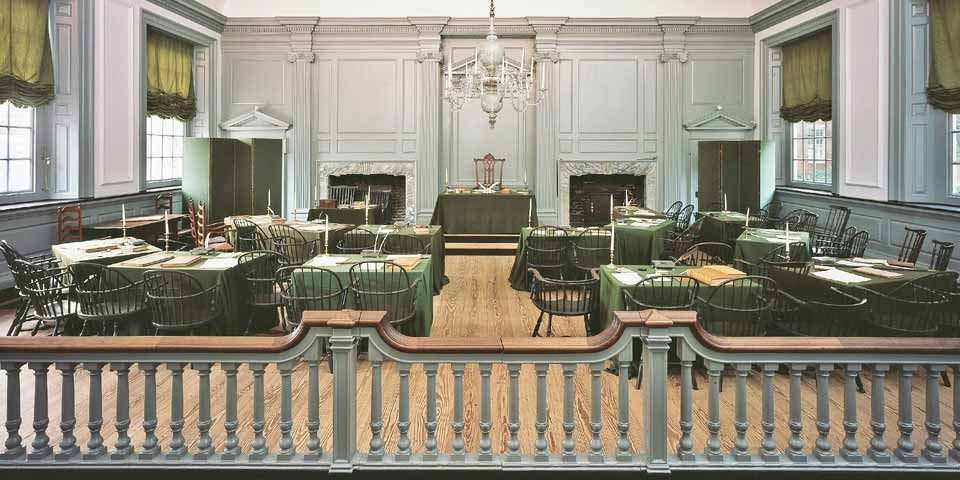
Scene of the crime — Independence Hall in Philadelphia, where the Second Continental congress approved the resolution to declare the colonies independent from Britain – (Photo credit: National Park Service)
Two days later, that same Congress approved the wording of the document Thomas Jefferson had drafted to announce Lee’s resolution to the world.
Today, we celebrate the date of the document Jefferson wrote, and Richard Henry Lee is often a reduced to a footnote, if not erased from history altogether.
Who can predict the future?
(You know, of course, that Adams and Jefferson both died 50 years to the day after the Declaration of Independence, on July 4, 1826. In the 50 intervening years, Adams and Jefferson were comrades in arms and diplomacy in Europe, officers of the new government in America, opposing candidates for the presidency, President and Vice President, ex-President and President, bitter enemies, then long-distance friends writing almost daily about how to make a great new nation. Read David McCullough‘s version of the story, if you can find it.)
The Lee Resolution, passed by the Second Continental Congress on July 2, 1776 – Wikipedia image (Wait a minute: Are those numbers added correctly? What are they?)
Yes, this is an encore post. Defeating ignorance takes patience and perseverance. And of course, this post makes a good one to repeat every year near the 4th of July.
Spread the word; friends don't allow friends to repeat history.
Joe Biden’s campaign is sharing personal stories about Biden — this one was shared originally in September 2019. It’s a way to get to know him, and to show his character (or lack of it).
This one, you should read. It’s the Joe Biden I met first in 1974, and the Biden I know him to be. But I hadn’t heard this story before.
I Know Joe Biden: Rabbi Michael Beals
The story I’m about to share with you about Joe Biden is special — in fact, I’m fairly certain I’m the only living person left who actually witnessed it firsthand.
It was about 16 years ago, and I was a young rabbi, brand-new to Delaware, on my way to lead a shiva minyan — a worship service following a death of a Jewish person. I was from California. Back then, I didn’t know Claymont, Delaware from Scranton, Pennsylvania.
Rabbi Michael Beals and Vice President Joe Biden
A quick bit of background: When someone passes away in the Jewish faith, we observe seven days of mourning, called shiva. We gather a group of ten Jewish adults together — a minyan — to say the Mourners’ Kaddish. It usually happens in a person’s home — somewhere intimate.
In this case, the deceased individual — her name was Mrs. Greenhouse, of blessed memory — had not been a person of means. She had lived in rent-controlled senior housing in a tall high-rise building off of Namaans Road. Her apartment had been too small to fit everyone into, so we conducted our worship service in the building’s communal laundry room, in the basement of the high-rise.
We assembled the ten elders together, and it was in this most humble of places that I began to lead the kaddish. Toward the end of the service, a door at the back of the laundry room opened, and who walks in but Senator Joe Biden, his head lowered, all by himself.
I nearly dropped my prayer book in shock.
Senator Biden stood quietly in the back of the room for the duration of the service.
At the close of the kaddish, I walked over to him and asked the same question that must have been on everyone else’s mind: “Senator Biden — what are you doing here?”
And he said to me: “Listen, back in 1972, when I first ran for Senate, Mrs. Greenhouse gave $18 to my first campaign. Because that’s what she could afford. And every six years, when I’d run for reelection, she’d give another $18. She did it her whole life. I’m here to show my respect and gratitude.”
Now, the number 18 is significant in the Jewish faith — its numbers spell out the Hebrew word chai, as in “to life, to life, l’chayim!” But it’s also a humble amount. Joe Biden knew that. And he respected that.
There were no news outlets at our service that day — no Jewish reporters or important dignitaries. Just a few elderly mourners in a basement laundry room.
Joe Biden didn’t come to that service for political gain. He came to that service because he has character. He came to that service because he’s a mensch.
And if we need anything right now when it comes to the leadership of our country — we need a mensch.
I know this is such a simple, small story. But I tell it to as many people as will listen to me.
Because I think that, in their heart of hearts, when people are trying to think about the decision they’ll make next year — this is the kind of story that matters.
Republican campaign consultants and others who want to save the Republican Party, and America, from Donald Trump, put a fine twist on the old Ronald Reagan campaign ad from 1984, “It’s Morning in America.”
“Mourning in America” came out of the The Lincoln Project, a group of Republicans who find Donald Trump to be unacceptable as a president, including Rick Wilson, the author of Everything Trump Touches Dies.
At their YouTube site, the project say:
Donald Trump’s failed presidency has left the nation weaker, sicker, and teetering on the verge of a new Great Depression.
Trump didn’t create this virus. But his failure to prepare the nation for the pandemic has directly contributed to the growing number of COVID-19 deaths as well as economic devastation.
September 25, 1789, Congress had approved and enrolled the proposals, and sent twelve proposed amendments to the Constitution to the states for ratification. Ten of the twelve amendments were approved, rather quickly, and by 1791 the were attached to the Constitution. These ten we now call the Bill of Rights.
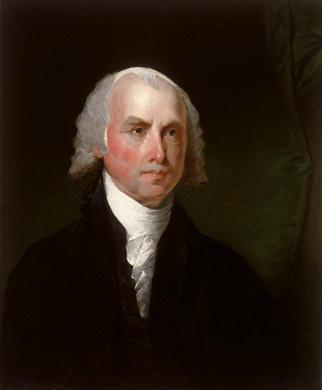
James Madison proposed the first 10 Amendments to the Constitution, and the 27th Amendment; the 203 years it took to ratify the 27th Amendment is the longest legislative process in the history of the U.S., and probably the world.
The two proposals that failed to earn the required approval of three-fourths of the 13 states fell into a special limbo for Constitutional amendments that became clear only in the late 1970s when Congress discussed how long to wait for states to approve the Equal Rights Amendment (this is a much-simplified explanation, I know). Congress put deadlines on the ratification process in the late 20th century, but the first twelve proposals had no deadlines, nor did any other proposal before the Equal Rights Amendment proposal. In the 1980s, Congress passed a law that said any amendments floating around, unapproved, would be considered dead after a date certain. There were six amendments in that category.
Before that date certain passed, more states took a look at one of James Madison’s 1789 proposals. They liked it, and they ratified it — 34 states total.
No law, varying the compensation for the services of the Senators and Representatives, shall take effect, until an election of Representatives shall have intervened.
This is the longest legislative procedure in U.S. history, perhaps the longest ever — it lasted much longer than many nations. By that ratification in 1992, James Madison became the person who proposed both the first, and last amendments to the Constitution.
Madison’s reaching out from the grave 156 years after his death — he died on June 28, 1836 — is one of the greatest legislative coups in history, too.
Yes, this is an encore post. Defeating ignorance takes patience and perseverance.
Spread the word; friends don't allow friends to repeat history.
What happens when Dallas goes home, instead of going out? Produced by The Well Creative Productions Drone Videography – Cash Sirois Edited By – Jason Seely
What did Dallas look like the night of Friday, March 20, 2020? It was the first night of the “shelter in place” protocols in Dallas to try to stop the COVID-19 virus.
I’m a sucker for interesting drone photography. I love a video done to a good piece of music, and even better when it seems the music and the moving pictures take each other in their arms and dance through three or four minutes, putting a smile on our faces.
TheWellDelivers.com (@TheWellDelivers) put this together, with drone photography by Cash Sirois, and music by a band I don’t know, The Bastards of Soul.
And it’s close to perfection.
KERA-TV, our local public station, uses the film in the interstices between the end of a program that doesn’t quite fill its slot, and the next program’s start. I looked for it under KERA’s name, but couldn’t find it. KERA has a couple of other films I really like, including “The Million Dollar Monarch,” and “The Chip that Jack Built,” a joyful honorific to the Jack Kilby who invented the integrated circuit and won a Nobel for it.
But it’s unfindable from KERA’s site, for me. I caught the credits on one of those showings, and found it by looking for Cash Sirois.
(I hope Raul Malo comes back soon, on a night I can see him.)
Last shot from the film by The Well Creative Productions.
A few other television stations have similar films about their cities. These could be a good geography exercise, or maybe part of a project if geography teachers still assign students to report on one state or city.
More likely, it’s just an enjoyable way to see some of the sights, and to get an idea of what it means to record history, to capture history in the making.
Have you seen other films we ought to know about?
Wash your hands. Cover your sneezes and coughs.
More:
The Bastards of Soul are a Dallas-origin band that’s been around about four years, with people who have been around a lot longer than that; read about them in the Dallas Observer
See below, another drone video of Dallas, released the same date the video above was shot; different views, different tone (shot earlier, you can tell by the colors of the buildings)
Nice drone shots of Dallas before the shutdown, from TappChannel4.
Spread the word; friends don't allow friends to repeat history.
Or, until that account is unsuspended by the forces supporting Donald Trump: Follow @FillmoreWhite, the account of the Millard Fillmore White House Library
We've been soaking in the Bathtub for several months, long enough that some of the links we've used have gone to the Great Internet in the Sky.
If you find a dead link, please leave a comment to that post, and tell us what link has expired.
Thanks!
Retired teacher of law, economics, history, AP government, psychology and science. Former speechwriter, press guy and legislative aide in U.S. Senate. Former Department of Education. Former airline real estate, telecom towers, Big 6 (that old!) consultant. Lab and field research in air pollution control.
My blog, Millard Fillmore's Bathtub, is a continuing experiment to test how to use blogs to improve and speed up learning processes for students, perhaps by making some of the courses actually interesting. It is a blog for teachers, to see if we can use blogs. It is for people interested in social studies and social studies education, to see if we can learn to get it right. It's a blog for science fans, to promote good science and good science policy. It's a blog for people interested in good government and how to achieve it.
BS in Mass Communication, University of Utah
Graduate study in Rhetoric and Speech Communication, University of Arizona
JD from the National Law Center, George Washington University


 Posted by Ed Darrell















 Millard Fillmore's Bathtub