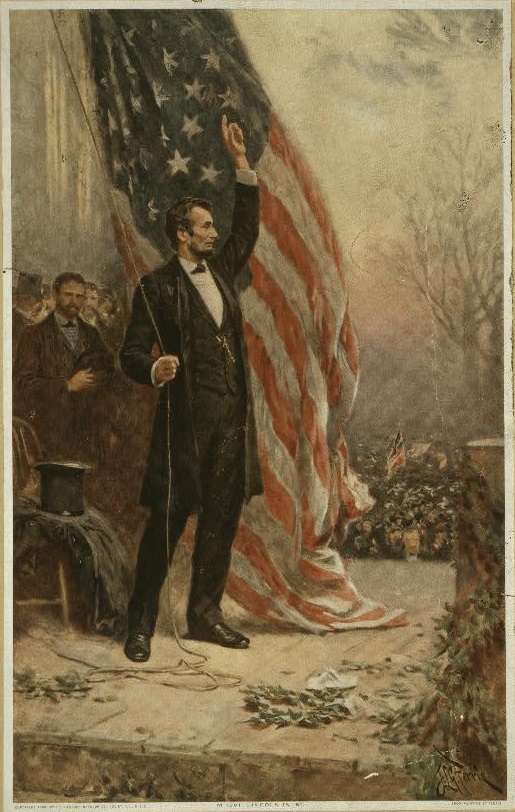
Lincoln at Independence Hall, February 22, 1861, raising a flag in honor of George Washington’s birthday; Library of Congress image via Lincoln’s Cottage
You want to mark your calendar so you remember to put your U.S. flag up on those dates designated by law and tradition, right?
Is the flag flying a bit more easily and briskly, with the new administration in Washington?
Massachusetts statehood, February 6 (6th state, 1788)
Lincoln’s birthday, February 12 (yes, it’s still designated in law as a date to fly the flag)
Oregon statehood, February 14 (33rd state, 1859)
Arizona statehood, February 14 (48th state, 1913)
Washington’s birthday, now designated President’s Day, the third Monday in February, February 15 in 2021 (Washington’s actual birthday is February 22 on the Gregorian calendar; some people fly the flag then, also)
You may fly your flag on state holidays, too — which of those dates do we see in February? Is there a good list? (I don’t have one.)
Though we don’t mark it usually, February 14 is the anniversary of the first recognition of the Stars and Stripes by a foreign government, in 1778. The French fleet recognized the ensign carried by Capt. John Paul Jones, at Quiberon Bay.
February 23 is the anniversary of the raising of the U.S. flag on Iwo Jima, in 1945 — 76 years ago. We should probably watch for proclamations to fly the flag on that date, an anniversary made more important simply because so few survivors of from among the veterans of that war and that fight can be expected to live to see the 80th anniversary. Regardless any official, formal proclamation to fly the flag for the Iwo Jima events, you may always fly your flag.
Image of Lincoln and the flag is in the collection of the Library of Congress, probably more than once; artist is Jean Louis Gerome Ferris, and thought to be circa 1908, in Detroit, Michigan
Yes, some of this is an encore post. Defeating ignorance takes patience and perseverance.
Spread the word; friends don't allow friends to repeat history.
Charles Davis Mitchell (1887 – 1940) penciled and penned this in 1905, showing John Milton Hay, President Theodore Roosevelt, and Speaker of the House of Representatives Joseph G. Cannon. It looks like Hay and Cannon are playing against each other, with Roosevelt just enjoying the game. National Portrait Gallery/Smithsonian image.
It may be quaint today. I have found no description of issues portrayed in the drawing. But it’s a curious collision of now mostly-overlooked history.
NPG lists the drawing by Charles Davis Mitchell as circa 1905. We might presume it to be before July 1, 1905, since that’s the day John Hay died. If 1905, it’s after Roosevelt’s election in November 1904 — whether before or after his March inauguration, we don’t know.
Joe Cannon is a legendary Speaker of the House, after whom the first House Office Building is named (there are three: Cannon, Longworth and Rayburn). Early in Roosevelt’s first term Cannon complained that Hay had not consulted enough with Congress on foreign policy initiatives, but by 1905 that rankle had largely died down, as I read it.
John Hay may be the most interesting figure in the drawing. Hay was personal secretary to President Abraham Lincoln. He had been active in statecraft and politics after Lincoln’s death, serving in diplomatic posts and supporting James Garfield’s campaign, for example — but Garfield did not offer him a cabinet position, and Hay returned to private life and writing the definitive biography of Lincoln with Lincoln’s other secretary and Hay’s colleague, John George Nicolay. After Garfield’s assassination, Hay was much in the political wilderness for a few years. Hay and Nicolay published ten volumes of the history of Abraham Lincoln in 1890.
Hay returned to government as U.S. Ambassador to Britain, and then as Secretary of State in 1898, in the first administration of William McKinley. McKinley was victim of the third assassination of a U.S. president — Hay and Lincoln’s son Robert share an uncomfortable closeness to the three assassinations. When Theodore Roosevelt succeeded to the presidency in 1901 he kept Hay at State. Hay remained there until his death.
What does the illustration attempt to illuminate? Was this meant as a barbed cartoon, or did it illustrate an article on politics of the time? Details from the National Portrait Gallery do not say.
Delicious mystery. Was this image ever published? Does it have greater historical significance on events of 1905? Was either Hay or Cannon a chess player? Mystery.
Spread the word; friends don't allow friends to repeat history.
Martin Luther King, Jr., speaking at microphones, during anti-war demonstration, New York City in 1967 / World Journal Tribune photo by Don Rice. Library of Congress image.
Remember to fly your U.S. flag today in honor of the Rev. Dr. Martin Luther King, Jr.
While King’s birthday is January 15, the law setting up a day to honor King puts the holiday on the third Monday of January every year.
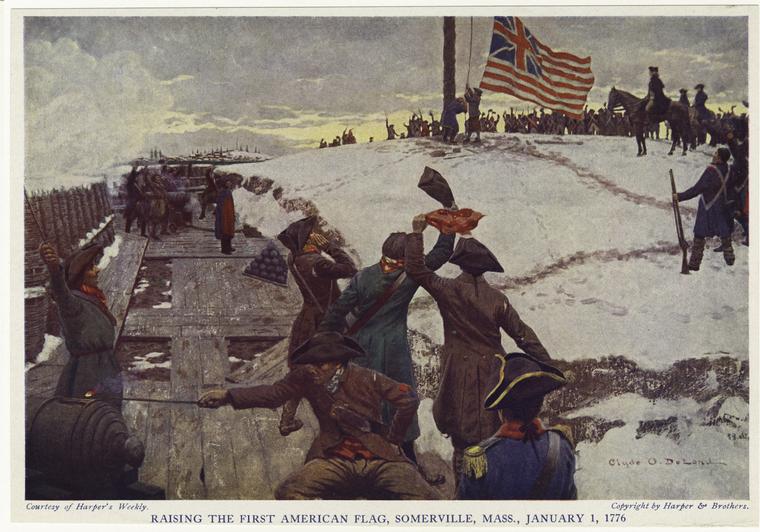
“Raising the first American flag, Somerville, Mass., January 1, 1776.” Harper’s Weekly painting by Clyde Osmer DeLand, 1897. From the digital collections of the New York Public Library; yes, MFB has used this painting before. I like it.
One problem with January’s flag flying dates is that if I snooze a little, you miss a lot. There are four flag-flying dates in the first five days of January: New Year’s Day and statehood days for Georgia, Alaska and Utah. You, Dear Reader, are alert and didn’t let any of those dates pass unmarked if you’re in those states, right?
There are six more dates to go in January 2021, including New Mexico’s statehood today. We’re not halfway done, yet.
In January 2020, the U.S. Flag Code urges citizens to fly flags on these dates, listed chronologically:
New Year’s Day, January 1, a federal holiday
January 2, Georgia Statehood Day
January 3, Alaska Statehood Day
January 4, Utah Statehood Day
January 6, New Mexico Statehood Day
January 9, Connecticut Statehood Day
Martin Luther King’s Birthday, a federal holiday on the third Monday of January; that date is January 18, in 2021; King’s actual birthday is January 15, and you may fly your flag then, too
Inauguration Day, January 20, the year after election years; 2021 will see the inauguration of President Joseph R. Biden (first President named Joe; what took so long?)
January 26, Michigan Statehood Day
January 29, Kansas Statehood Day
You may fly your flag any other day you wish, too; flags should not be flown after sundown unless they are specially lighted, or at one of the few places designated by Congress or Presidential Proclamation for 24-hour flag flying. According to Wikipedia’s listing, those sites include:
Fort McHenry, Baltimore, Maryland (Presidential Proclamation No. 2795, July 2, 1948).
Flag House Square, Albemarle and Pratt Streets, Baltimore, Maryland (Public Law 83-319, approved March 26, 1954).
Lexington Battle Green, Lexington, Massachusetts (Public Law 89-335, approved November 8, 1965).
White House, Washington, D.C. (Presidential Proclamation No. 4000, September 4, 1970).
Washington Monument, Washington, D.C. (Presidential Proclamation No. 4064, July 6, 1971, effective July 4, 1971).
Any port of entry to the United States which is continuously open (Presidential Proclamation No. 413 1, May 5, 1972).
Grounds of the National Memorial Arch in Valley Forge State Park, Valley Forge, Pennsylvania (Public Law 94-53, approved July 4, 1975).
Flag House in 1936, where Mary Pickersgill sewed the garrison-sized, 15-star flag that flew over Fort McHenry at the Battle of Baltimore in 1814; one of the sites where the U.S. flag may be flown 24 hours. The house is at 844 East Pratt & Albemarle Streets (Baltimore, Independent City, Maryland). Cropped image courtesy of the federal HABS—Historic American Buildings Survey of Maryland.
Save
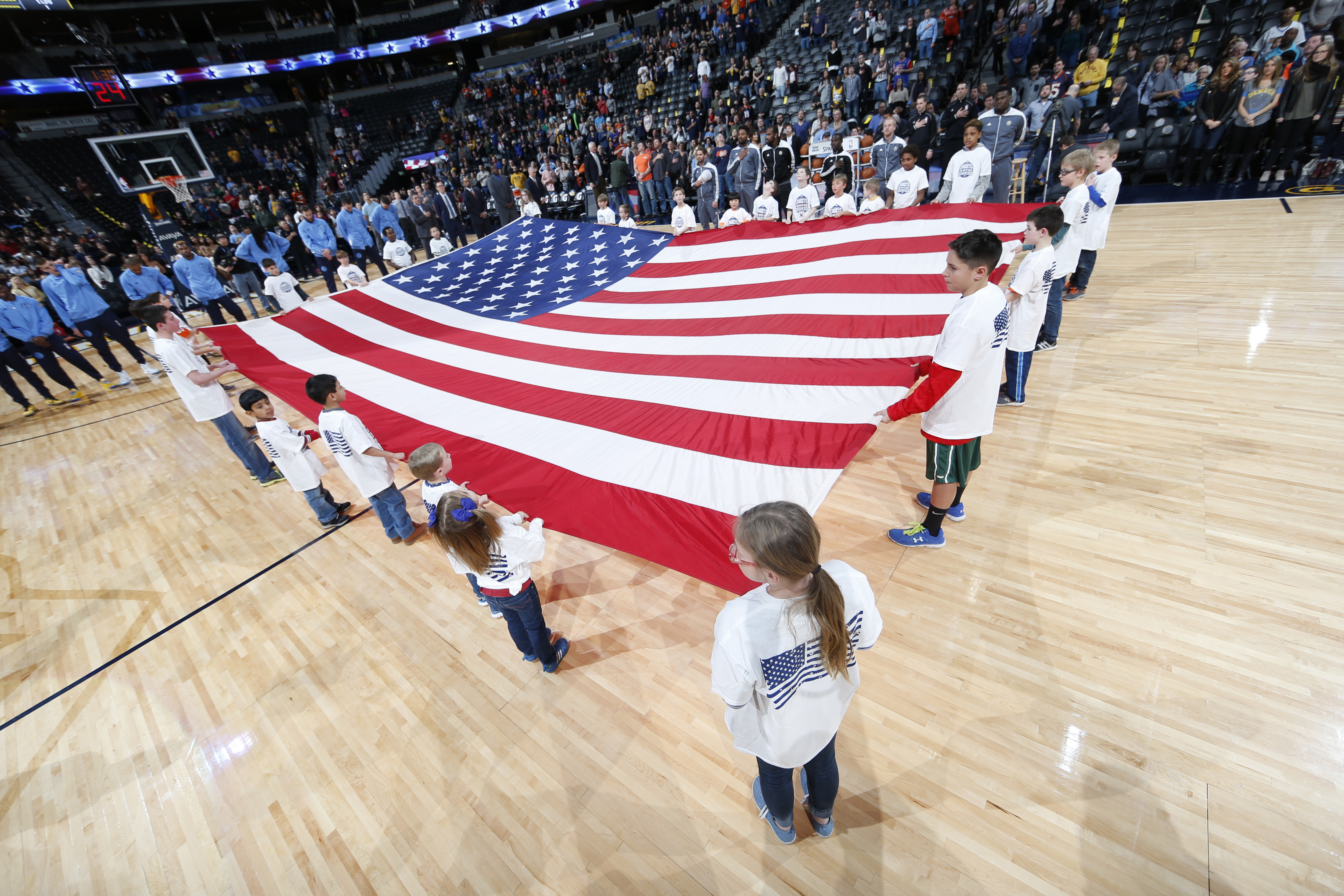
Children unfurl a large flag at a Denver Nuggets/Indiana Pacers NBA basketball game in Denver, January 2016. Colorado Public Radio image.Yes, this is an encore post. Defeating ignorance takes patience and perseverance.
Spread the word; friends don't allow friends to repeat history.
In 1823, the poem “Account of a Visit from St. Nicholas” was published anonymously in the Troy (N.Y.) Sentinel; the verse, more popularly known as “‘Twas the Night Before Christmas,” was later attributed to Clement C. Moore.
Regardless who wrote the poem first published 197 years ago, how did the poem influence America’s view of St. Nicholas, or Santa Claus? And how much of the Santa Claus story really was invented in America?
Thomas Nast invented Santa Claus? Clement C. Moore didn’t write the famous poem that starts out, “‘Twas the night before Christmas, and all through the house . . . ?”
The murky waters of history from Millard Fillmore’s Bathtub soak even our most cherished ideas and traditions.
Isn’t that part of the fun of history?
In January 1863, Thomas Nast portrayed Santa Claus as he delivered gifts to Union troops a few days earlier in Washington, D.C., wearing a blue, star-spangled coat.
Yes, Virginia (and California, too)! Thomas Nast created the image of Santa Claus most of us in the U.S. know today. Perhaps even more significant than his campaign against the graft of Boss Tweed, Nast’s popularization of a fat, jolly elf who delivers good things to people for Christmas makes one of the great stories in commercial illustration. Nast’s cartoons, mostly for the popular news publication Harper’s Weekly, created many of the conventions of modern political cartooning and modeled the way in which an illustrator could campaign for good, with his campaign against the graft of Tammany Hall and Tweed. But Nast’s popular vision of Santa Claus can be said to be the foundation for the modern mercantile flurry around Christmas.
Nast’s drawings probably drew some inspiration from the poem, “Account of a Visit from St. Nicholas,” traditionally attributed to Clement C. Moore, a New York City lawyer, published in 1823. The poem is among the earliest to describe the elf dressed in fur, and magically coming down a chimney to leave toys for children; the poem invented the reindeer-pulled sleigh.
Modern analysis suggests the poem was not the work of Moore, and many critics and historians now attribute it to Major Henry Livingston, Jr. (1748-1828) following sleuthing by Vassar College Prof. Don Foster in 2000. Fortunately for us, we do not need to be partisans in such a query to enjoy the poem (a complete copy of which is below the fold).
The Library of Congress still gives Moore the credit. When disputes arise over who wrote about the night before Christmas, is it any wonder more controversial topics produce bigger and louder disputes among historians?
Moore is thought to have composed the tale, now popularly known as “The Night Before Christmas,” on December 24, 1822, while traveling home from Greenwich Village, where he had bought a turkey for his family’s Christmas dinner.
Inspired by the plump, bearded Dutchman who took him by sleigh on his errand through the snow-covered streets of New York City, Moore penned A Visit from St. Nicholas for the amusement of his six children, with whom he shared the poem that evening. His vision of St. Nicholas draws upon Dutch-American and Norwegian traditions of a magical, gift-giving figure who appears at Christmas time, as well as the German legend of a visitor who enters homes through chimneys.
Again from the Library of Congress, we get information that suggests that Moore was a minor celebrity from a well-known family with historical ties that would make a good “connections” exercise in a high school history class, perhaps (”the link from Aaron Burr’s treason to Santa Claus?”): (read more, below the fold)
Clement Moore was born in 1779 into a prominent New York family. His father, Benjamin Moore, president of Columbia University, in his role as Episcopal Bishop of New York participated in the inauguration of George Washington as the nation’s first president. The elder Moore also administered last rites to Alexander Hamilton after he was mortally wounded in a tragic duel with Aaron Burr.
A graduate of Columbia, Clement Moore was a scholar of Hebrew and a professor of Oriental and Greek literature at the General Theological Seminary in Manhattan. [See comment from Pam Bumsted below for more on Moore.] He is said to have been embarrassed by the light-hearted verse, which was made public without his knowledge in December 1823. Moore did not publish it under his name until 1844.
Tonight, American children will be tucked in under their blankets and quilts and read this beloved poem as a last “sugarplum” before slipping into dreamland. Before they drift off, treat them to a message from Santa, recorded by the Thomas Edison Company in 1922.
But Henry Livingston was no less noble or historic. He hailed from the Livingstons of the Hudson Valley (one of whose farms is now occupied by Camp Rising Sun of the Louis August Jonas Foundation, a place where I spent four amazing summers teaching swimming and lifesaving). Livingston’s biography at the University of Toronto site offers another path for a connections exercise (”What connects the Declaration of Independence, the American invasion of Canada, the famous poem about a visit from St. Nick, and George W. Bush?”):
Henry Livingston Jr. was born in Poughkeepsie, New York, on Oct. 13, 1748. The Livingston family was one of the important colonial and revolutionary families of New York. The Poughkeepsie branch, descended from Gilbert, the youngest son of Robert Livingston, 1st Lord of Livingston Manor, was not as well off as the more well-known branches, descended from sons Robert and Philip. Two other descendants of Gilbert Livingston, President George Walker Herbert Bush and his son, President-Elect George W. Bush, though, have done their share to bring attention to this line. Henry’s brother, Rev. John Henry Livingston, entered Yale at the age of 12, and was able to unite the Dutch and American branches of the Dutch Reformed Church. At the time of his death, Rev. Livingston was president of Rutgers University. Henry’s father and brother Gilbert were involved in New York politics, and Henry’s granduncle was New York’s first Lt. Governor. But the law was the natural home for many of Henry’s family. His brother-in-law, Judge Jonas Platt, was an unsuccessful candidate for governor, as was his daughter Elizabeth’s husband, U.S. Supreme Court Justice Smith Thompson. Henry’s grandson, Sidney Breese, was Chief Justice of the Illinois Supreme Court.
Known for his encyclopedic knowledge and his love of literature, Henry Livingston was a farmer, surveyor and Justice of the Peace, a judicial position dealing with financially limited criminal and civil cases. One of the first New Yorkers to enlist in the Revolutionary Army in 1775, Major Henry Livingston accompanied his cousin’s husband, General Montgomery, in his campaign up the Hudson River to invade Canada, leaving behind his new wife, Sarah Welles, and their week-old baby, on his Poughkeepsie property, Locust Grove. Baby Catherine was the subject of the first poem currently known by Major Livingston. Following this campaign, Livingston was involved in the War as a Commissioner of Sequestration, appropriating lands owned by British loyalists and selling them for the revolutionary cause. It was in the period following Sarah’s early death in 1783, that Major Livingston published most of his poems and prose, anonymously or under the pseudonym of R. Ten years after the death of Sarah, Henry married Jane Patterson, the daughter of a Dutchess County politician and sister of his next-door neighbor. Between both wives, Henry fathered twelve children. He published his good-natured, often occasional verse from 1787 in many journals, including Political Barometer, Poughkeepsie Journal, and New-York Magazine. His most famous poem, “Account of a Visit from St. Nicholas,” was until 2000 thought to have been the work of Clement Clarke Moore (1779-1863), who published it with his collected poems in 1844. Livingston died Feb. 29, 1828.
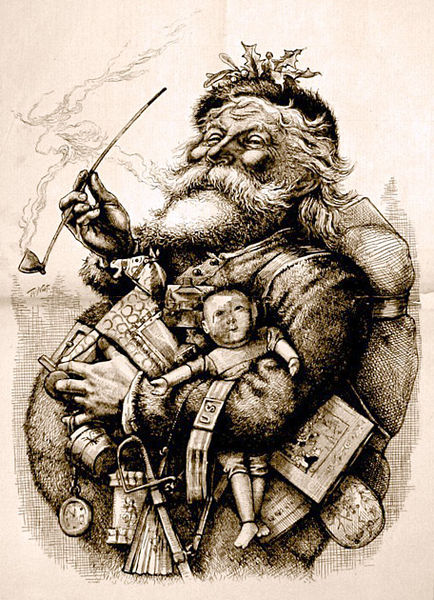
Thomas Nast’s full realization of Santa Claus, “Merry Old Santa Claus,” January 1, 1881. Harper’s Weekly, from Wikimedia.
Our views of Santa Claus owe a great deal also to Coca-Cola advertising campaigns. Coca-Cola first noted Santa’s use of the drink in a 1922 campaign to suggest Coke was a year-round drink (100 years after the publication of Livingston’s poem). The company’s on-line archives gives details:
In 1930, artist Fred Mizen painted a department store Santa in a crowd drinking a bottle of Coke. The ad featured the world’s largest soda fountain, which was located in the department store of Famous Barr Co. in St. Louis, Mo. Mizen’s painting was used in print ads that Christmas season, appearing in The Saturday Evening Post in December 1930.
1936 Coca-Cola Santa cardboard store display
1942 original oil painting – ‘They Remembered Me’
Archie Lee, the D’Arcy Advertising Agency executive working with The Coca-Cola Company, wanted the next campaign to show a wholesome Santa as both realistic and symbolic. In 1931, The Coca-Cola Company commissioned Michigan-born illustrator Haddon Sundblom to develop advertising images using Santa Claus — showing Santa himself, not a man dressed as Santa, as Mizen’s work had portrayed him.
For inspiration, Sundblom turned to Clement Clark Moore’s 1822 poem “A Visit From St. Nicholas” (commonly called “‘Twas the Night Before Christmas”). Moore’s description of St. Nick led to an image of Santa that was warm, friendly, pleasantly plump and human. For the next 33 years, Sundblom painted portraits of Santa that helped to create the modern image of Santa — an interpretation that today lives on in the minds of people of all ages, all over the world.
Santa Claus is a controversial figure. Debates still rage among parents about the wisdom of allowing the elf into the family’s home, and under what conditions. Theologians worry that the celebration of Christmas is diluted by the imagery. Other faiths worry that the secular, cultural impact of Santa Claus damages their own faiths (few other faiths have such a popular figure, and even atheists generally give gifts and participate in Christmas rituals such as putting up a decorated tree).
For over 100 years, Santa Claus has been a popular part of commercial, cultural and religious life in America. Has any other icon endured so long, or so well?
Coca-Cola’s film, “The Legend of Coca-Cola and Santa Claus”:
I wish it were not so. These words of Dickens’s through Scrooge, remain salient, damning and depressing, every day Donald Trump holds the Oval Office. Now Trump’s been impeached, but left in place, and defeated by American voters, but he still sits on his throne, messing up America in every way he can think to do it.
And so our annual post on the lessons we take from “A Christmas Carol.”
Ebenezer Scrooge, up a dark staircase; “Darkness was cheap, and Scrooge liked it.” Illustration by Roberto Innocenti, viaPinterest.
It’s a Quote of the Moment (an encore post for the season, with a bit of context thrown in later), Trump’s platform, and life, edited down to just three words, in green:
Isn’t that the entire GOP platform in three words? “Darkness is cheap.” Substitute “Trump” for “Scrooge,” you’ve got the picture. Three more words than the actual Republican National Platform of 2020, but more accurate.
I think of that line of Dickens’s often when I read of the celebrations of calumny that pass as discourse in Republican politics these days. Although, with the 2008 renewing of Limbaugh’s contract, with the 2020 coming of COVID-19, it may no longer be true that his particular brand of darkness is cheap. With the advent of Donald Trump’s insult politics, offending America’s allies and all American ethnic groups possible, with un-ironic calls to drop nuclear weapons, GOP politics is even darker than ever.
Here is the sentence Dickens put before the quote, to add a little context; Scrooge was climbing a very large, very dark staircase.
Half-a-dozen gas-lamps out of the street wouldn’t have lighted the entry too well, so you may suppose that it was pretty dark with Scrooge’s dip.
Up Scrooge went, not caring a button for that. Darkness is cheap, and Scrooge liked it.
Speaking of darkness, a longer excerpt from a bit later in Dickens’s story, when the Ghost of Christmas Present ushers Scrooge to glimpse what is in the present, but what will be the future if Scrooge does not repent:
‘Forgive me if I am not justified in what I ask,’ said Scrooge, looking intently at the Spirit’s robe, ‘but I see something strange, and not belonging to yourself, protruding from your skirts. Is it a foot or a claw?’
‘It might be a claw, for the flesh there is upon it,’ was the Spirit’s sorrowful reply. ‘Look here.’
From the foldings of its robe, it brought two children; wretched, abject, frightful, hideous, miserable. They knelt down at its feet, and clung upon the outside of its garment.
‘Oh, Man! look here. Look, look, down here!’ exclaimed the Ghost.
They were a boy and girl. Yellow, meagre, ragged, scowling, wolfish; but prostrate, too, in their humility. Where graceful youth should have filled their features out, and touched them with its freshest tints, a stale and shrivelled hand, like that of age, had pinched, and twisted them, and pulled them into shreds. Where angels might have sat enthroned, devils lurked, and glared out menacing. No change, no degradation, no perversion of humanity, in any grade, through all the mysteries of wonderful creation, has monsters half so horrible and dread.
Scrooge started back, appalled. Having them shown to him in this way, he tried to say they were fine children, but the words choked themselves, rather than be parties to a lie of such enormous magnitude.
‘Spirit! are they yours?’ Scrooge could say no more.
‘They are Man’s,’ said the Spirit, looking down upon them. ‘And they cling to me, appealing from their fathers. This boy is Ignorance. This girl is Want. Beware them both, and all of their degree, but most of all beware this boy, for on his brow I see that written which is Doom, unless the writing be erased. Deny it!’ cried the Spirit, stretching out its hand towards the city. ‘Slander those who tell it ye! Admit it for your factious purposes, and make it worse. And bide the end!’
‘Have they no refuge or resource?’ cried Scrooge.
‘Are there no prisons?’ said the Spirit, turning on him for the last time with his own words. ‘Are there no workhouses?’ The bell struck twelve.
Scrooge looked about him for the Ghost, and saw it not. As the last stroke ceased to vibrate, he remembered the prediction of old Jacob Marley, and lifting up his eyes, beheld a solemn Phantom, draped and hooded, coming, like a mist along the ground, towards him.
Think of 2014, 2015, 2016, 2017, 2018, 2019 and 2020, children abused in Central America and in the Middle East, fleeing as best they can, only to die, off the shores of Greece, on the southern deserts of the U.S., or be cast into incarceration after having achieved a nation whose very name promised them refuge, the United States. “Two children; wretched, abject, frightful, hideous, miserable,” Dickens described. Whose children? “Man’s.” Yours, and mine.
Christmas is a festival to celebrate light, what many Christians call “the light of the world?” If so, let us work to stamp out the darkness which the unrepentant Scrooge so dearly loved.
Darkness may be cheap, but it is not good. Light a candle, and run into the darkness, spreading light. We need more light.
Hope you have a merry Christmas in the making for 2020. Let us remember, as Tom and the late Ray Magliozzi always reminded us, the cheapskate pays more in the end, and usually along the way. Is Darkness cheap? Let us then eschew it as too costly for a moral nation, too costly for a moral people.
Is Donald Trump as smart as Ebenezer Scrooge? Is his heart as good as Scrooge’s heart?
If Trump died, who would attend his funeral?
When we die, who will mourn our passing? Which spirit moves us to action?
God bless us, every one. Or gods, or family and friends bless us, as the case may be.
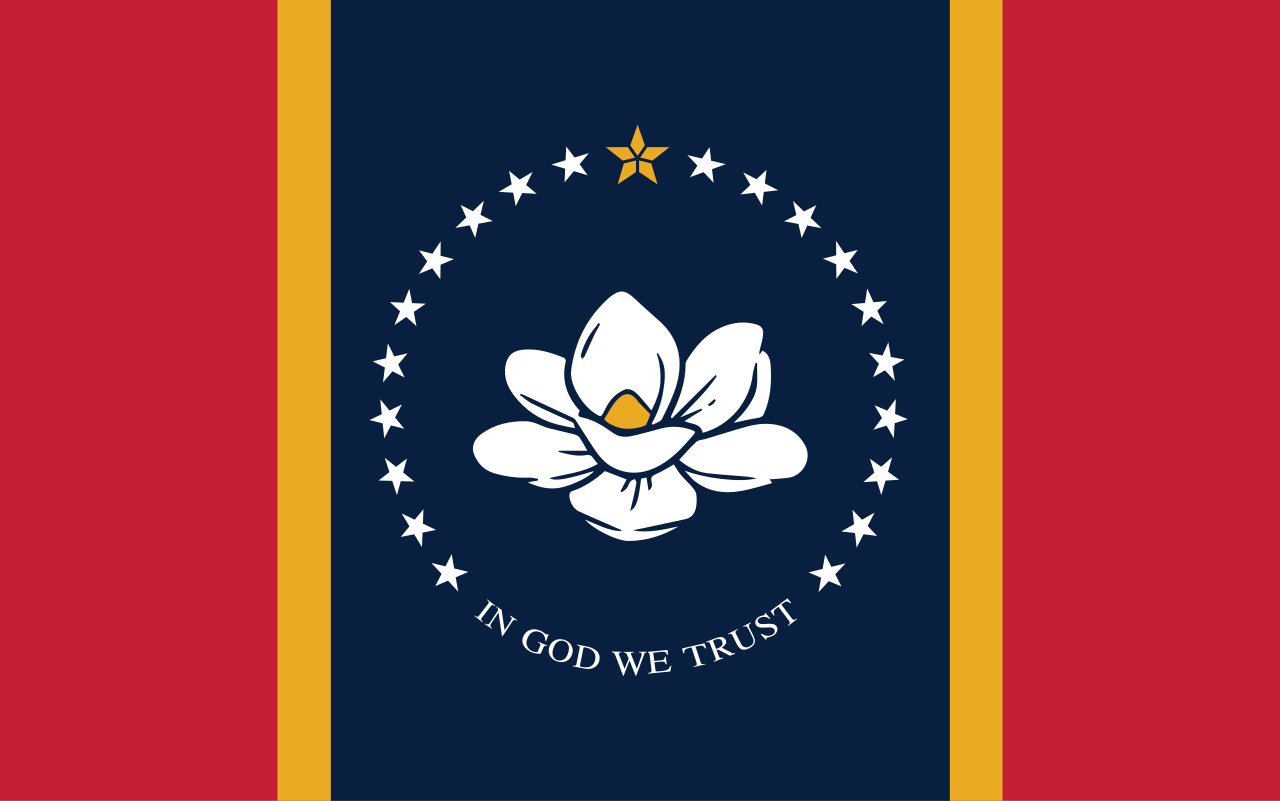
For statehood day this year, Mississippi has a new state flag.
Abandoning vestiges of the old Confederacy, Mississippi voters approved a new flag for the state in November, harkening back to its original flag featuring a magnolia tree. This flag is popularly called the “In God We Trust” flag, carrying the most recent of the “official” mottoes of the U.S. The flag change was prompted by Black Lives Matter protests following the killing of George Floyd
Illinois entered the Union on December 3, 1818. The twenty-first state takes its name from the Illinois Confederation—a group of Algonquian-speaking tribes native to the area. An Algonquian word, “Illinois” means “tribe of superior men.”
Remnants of a much earlier Algonquin civilization thought the most sophisticated prehistoric society north of Mexico, are preserved at the Cahokia Mounds State Historic Site in the southwestern part of the state.
French explorers Louis Jolliet and Jesuit Father Jacques Marquette entered the Illinois region in 1673. Control of the territory passed to Great Britain in 1763. When the United States acquired the land that became Illinois Territory in 1783, most European settlers there were of French descent. In 1788, the Continental Congress received information concerning the inhabitants of the Illinois area. “There are sundry French settlements on the river Mississippi within the tract,” the committee reported:
Near the mouth of the river Kaskaskies, there is a village which appears to have contained near eighty families from the beginning of the late revolution. There are twelve families in a small village at la Prairie duRochers, and near fifty families—the Kahokia village. There are also four or five families at fort Chartres and St. Philips, which is five miles farther up the river. The heads of families in those villages appear each of them to have had a certain quantity of arable land allotted to them, and a proportionate quantity of meadow and of woodland or pasture. The Committee…referred the memorial of George Morgan…respecting a tract of land in the Illinois, June 20, 1788. Documents from the Continental Congress and Constitutional Convention, 1774-1789
Twenty years later, Congress organized the Illinois Territory. Pioneers from Kentucky, Virginia, and Tennessee settled the southern part of the territory, while New Englanders ventured to northern Illinois via the Erie Canal.
Land of Lincoln, the state slogan, pays homage to famous son Abraham Lincoln. Born in Kentucky, Lincoln came to Illinois in 1830. He was instrumental, along with his colleagues in the Illinois legislature, in moving the state capital from Vandalia to Springfield. Settling there in 1837, Lincoln married socially prominent resident Mary Todd, practiced law, and built the political career that brought him the presidency in 1861.
Chicago, a minor trading post at the southwestern tip of Lake Michigan until the 1830s, developed into a railroad hub and industrial center. After the Civil War, industrialization attracted a new wave of immigrants. People from all over the U.S. and the world ventured to Chicago to work in the meat-packing and steel industries. Even the Great Conflagration of 1871 failed to prevent the Windy City from becoming one of the largest urban centers in the country. It remains the third most populous city and metropolitan area in the United States.
Search on Illinois in Map Collections to view a number of small towns in the state. See, for example, an 1880 map of Elgin, an 1869 map of Moline, or an 1869 map of Urbana.
Search on Jolliet or Marquette in France in America both in the interpretive text and collections sections to learn more about these explorers and the settlement of the West.
World Malaria Report 2020 carries bad news. Despite remarkable progress against malaria, despite being on the verge of beating the disease and eradicating it from the planet, governments stopped supporting anti-malaria work.
Malaria is poised to come roaring back to kill millions.
COVID-19 complicates fighting malaria. But the real enemy of the fight against malaria is apathy, neglect and ignorance.
Cover of World Malaria Report 2020, WHO’s annual accounting of the fight to eradicate malaria.
WHO calls for reinvigorated action to fight malaria
Global malaria gains threatened by access gaps, COVID-19 and funding shortfalls
30 November 2020
News release
Reading time: 6 min(1645 words)
The World Health Organization (WHO) is calling on countries and global health partners to step up the fight against malaria, a preventable and treatable disease that continues to claim hundreds of thousands of lives each year. A better targeting of interventions, new tools and increased funding are needed to change the global trajectory of the disease and reach internationally-agreed targets.
According to WHO‘s latest World malaria report, progress against malaria continues to plateau, particularly in high burden countries in Africa. Gaps in access to life-saving tools are undermining global efforts to curb the disease, and the COVID-19 pandemic is expected to set back the fight even further.
“It is time for leaders across Africa – and the world – to rise once again to the challenge of malaria, just as they did when they laid the foundation for the progress made since the beginning of this century,” said WHO Director-General Dr Tedros Adhanom Ghebreyesus. “Through joint action, and a commitment to leaving no one behind, we can achieve our shared vision of a world free of malaria.”
In 2000, African leaders signed the landmark Abuja Declaration pledging to reduce malaria deaths on the continent by 50% over a 10-year period. Robust political commitment, together with innovations in new tools and a steep increase in funding, catalyzed an unprecedented period of success in global malaria control. According to the report, 1.5 billion malaria cases and 7.6 million deaths have been averted since 2000.
A plateau in progress
In 2019, the global tally of malaria cases was 229 million, an annual estimate that has remained virtually unchanged over the last 4 years. The disease claimed some 409 000 lives in 2019 compared to 411 000 in 2018.
As in past years, the African Region shouldered more than 90% of the overall disease burden. Since 2000, the region has reduced its malaria death toll by 44%, from an estimated 680 000 to 384 000 annually. However, progress has slowed in recent years, particularly in countries with a high burden of the disease.
A funding shortfall at both the international and domestic levels poses a significant threat to future gains. In 2019, total funding reached US $3 billion against a global target of $5.6 billion. Funding shortages have led to critical gaps in access to proven malaria control tools.
COVID-19 an added challenge
In 2020, COVID-19 emerged as an additional challenge to the provision of essential health services worldwide. According to the report, most malaria prevention campaigns were able to move forward this year without major delays. Ensuring access to malaria prevention – such as insecticide-treated nets and preventive medicines for children – has supported the COVID-19 response strategy by reducing the number of malaria infections and, in turn, easing the strain on health systems. WHO worked swiftly to provide countries with guidance to adapt their responses and ensure the safe delivery of malaria services during the pandemic.
However, WHO is concerned that even moderate disruptions in access to treatment could lead to a considerable loss of life. The report finds, for example, that a 10% disruption in access to effective antimalarial treatment in sub-Saharan Africa could lead to 19 000 additional deaths. Disruptions of 25% and 50% in the region could result in an additional 46 000 and 100 000 deaths, respectively.
“While Africa has shown the world what can be achieved if we stand together to end malaria as a public health threat, progress has stalled,” said Dr Matshidiso Moeti, WHO Regional Director for Africa. “COVID-19 threatens to further derail our efforts to overcome malaria, particularly treating people with the disease. Despite the devastating impact COVID-19 has had on African economies, international partners and countries need to do more to ensure that the resources are there to expand malaria programmes which are making such a difference in people’s lives.”
WHO response
A key strategy to reignite progress is the “High burden to high impact” (HBHI) response, catalyzed in 2018 by WHO and the RBM Partnership to End Malaria. The response is led by 11 countries – including 10 in sub-Saharan Africa – that account for approximately 70% of the world’s malaria burden.
Over the last 2 years, HBHI countries have been moving away from a “one-size-fits all” approach to malaria control – opting, instead, for tailored responses based on local data and intelligence. A recent analysis from Nigeria, for example, found that through an optimized mix of interventions, the country could avert tens of millions of additional cases and thousands of additional deaths by the year 2023, compared to a business-as-usual approach.
While it is too early to measure the impact of the HBHI approach, the report finds that deaths in the 11 countries were reduced from 263 000 to 226 000 between 2018 and 2019. India continued to make impressive gains, with reductions in cases and deaths of 18% and 20%, respectively, over the last 2 years. There was, however, a slight increase in the total number of cases among HBHI countries, from an estimated 155 million in 2018 to 156 million in 2019.
Meeting global malaria targets
This year’s report highlights key milestones and events that helped shape the global response to the disease in recent decades. Beginning in the 1990s, leaders of malaria-affected countries, scientists and other partners laid the groundwork for a renewed malaria response that contributed to one of the biggest returns on investment in global health.
According to the report, 21 countries eliminated malaria over the last 2 decades; of these, 10 countries were officially certified as malaria-free by WHO. In the face of the ongoing threat of antimalarial drug resistance, the 6 countries of the Greater Mekong subregion continue to make major gains towards their goal of malaria elimination by 2030.
But many countries with a high burden of malaria have been losing ground. According to WHO global projections, the 2020 target for reductions in malaria case incidence will be missed by 37% and the mortality reduction target will be missed by 22%.
Note to editors
WHO’s work on malaria is guided by the Global technical strategy for malaria 2016-2030 (GTS), approved by the World Health Assembly in May 2015. The strategy includes four global targets for 2030, with milestones along the way to track progress. The 2030 targets are: 1) reducing malaria case incidence by at least 90%; 2) reducing malaria mortality rates by at least 90%; 3) eliminating malaria in at least 35 countries; and
4) preventing a resurgence of malaria in all countries that are malaria-free.
Near-term GTS milestones for 2020 include global reductions in malaria case incidence and death rates of at least 40% and the elimination of malaria in at least 10 countries. According to the report, the 2020 milestones for malaria case incidence and mortality rates will be missed:
– Case incidence: WHO projects that, in 2020, there were an estimated 56 malaria cases for every 1000 people at risk of the disease against a GTS target of 35 cases. The GTS milestone will be missed by an estimated 37%.
– Mortality rate: The estimate for globally projected malaria deaths per 100 000 population at risk was 9.8 in 2020 against a GTS target of 7.2 deaths. The milestone will be missed by an estimated 22%.
WHO African Region – Since 2014, the rate of progress in both cases and deaths in the region has slowed, attributed mainly to the stalling of progress in several countries with moderate or high transmission. In 2019, six African countries accounted for 50% of all malaria cases globally: Nigeria (23%), the Democratic Republic of the Congo (11%), United Republic of Tanzania (5%), Niger (4%), Mozambique (4%) and Burkina Faso (4%). In view of recent trends, the African Region will miss the GTS 2020 milestones for case incidence and mortality by 37% and 25%, respectively.
“High burden to high impact” (HBHI) – Launched in November 2018, HBHI builds on the principle that no one should die from a disease that is preventable and treatable. It is led by 11 countries that, together, accounted for approximately 70% of the world’s malaria burden in 2017: Burkina Faso, Cameroon, Democratic Republic of the Congo, Ghana, India, Mali, Mozambique, Niger, Nigeria, Uganda and United Republic of Tanzania. Over the last two years, all 11 HBHI countries have implemented activities across four response elements: 1) political will to reduce the toll of malaria; 2) strategic information to drive impact; 3) better guidance, policies and strategies; and 4) a coordinated national malaria response
Malaria elimination – Between 2000 and 2019, 10 countries received the official WHO certification of malaria elimination: United Arab Emirates (2007), Morocco (2010), Turkmenistan (2010), Armenia (2011), Kyrgyzstan (2016), Sri Lanka (2016), Uzbekistan (2018), Paraguay (2018), Argentina (2019) and Algeria (2019). In 2019, China reported zero indigenous cases of malaria for the third consecutive year; the country recently applied for the official WHO certification of malaria elimination. In 2020, El Salvador became the first country in Central America to apply for the WHO malaria-free certification
In the six countries of the Greater Mekong subregion – Cambodia, China (Yunnan Province), Lao People’s Democratic Republic, Myanmar, Thailand and Viet Nam – the reported number of malaria cases fell by 90% from 2000 to 2019, while P. falciparum (Pf) cases fell by 97% in the same time period. This accelerated decrease in Pf malaria is notable in view of the threat posed by antimalarial drug resistance in the subregion.
A call for innovation – Eliminating malaria in all countries, especially those with a high disease burden, will likely require tools that are not available today. In September 2019, the WHO Director-General issued a “malaria challenge,” calling on the global health community to ramp up investment in the research and development of new malaria-fighting tools and approaches. This message was further reinforced in the April 2020 report of the WHO Strategic advisory group on malaria eradication.
Spread the word; friends don't allow friends to repeat history.
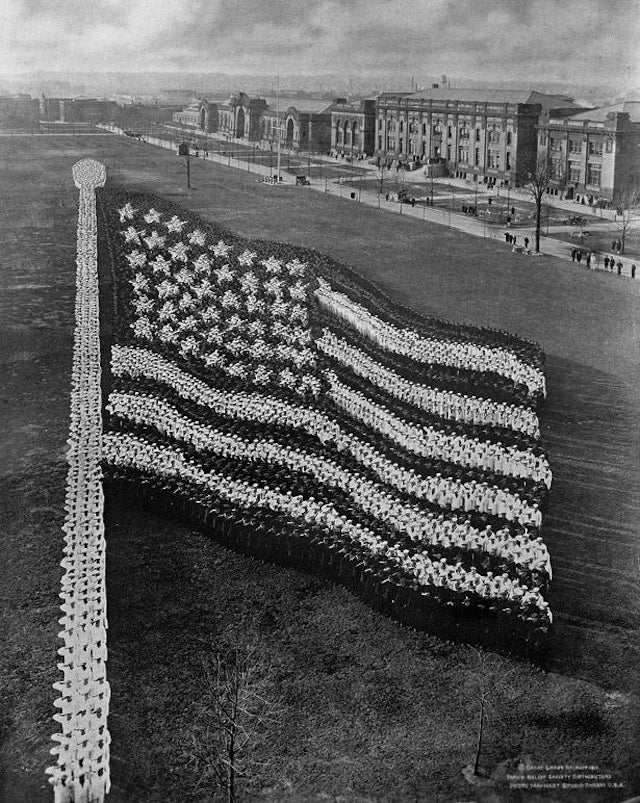
A “living flag” composed of 10,000 sailors, or “Blue Jackets at Salute,” by the Mayhart Studios, December 1917; image probably at the Great Lakes training facility of the Navy. Gawker media image
November offers several flag flying days, especially in years when there is an election.
But December may be the month with the most flag-flying dates, when we include statehood days.
December 25 is Christmas Day, a federal holiday, and one of the score of dates designated in the Flag Code. If you watch your neighborhood closely, you’ll note even some of the most ardent flag wavers miss posting the colors on this day, as they do on Thanksgiving and New Years and Easter.
Other dates?
Nine states attained statehood in December, so people in those states should fly their flags (and you may join them). Included in this group is Delaware, traditionally the “First State,” called that because it was the first former England colony to ratify the U.S. Constitution:
Illinois, December 3 (1818, 21st state)
Delaware, December 7 (1787, 1st state)
Mississippi, December 10 (1817, 20th state)
Indiana, December 11 (1816, 19th state)
Pennsylvania, December 12 (1787, 2nd state)
Alabama, December 14 (1819, 22nd state)
New Jersey, December 18 (1787, 3rd state)
Iowa, December 28 (1846, 29th state)
Texas, December 29 (1845, 28th state)
December 15 is Bill of Rights Day, marking the day in 1791 when the Bill of Rights was declared ratified; but though this event generally gets a presidential proclamation, there is no law or executive action that requires flags to fly on that date, for that occasion. I predict there will be no proclamation from the White House in 2020.
Eleven flag-flying dates in December. Does any other month have as many flag flying opportunities?
Have I missed any December flag-flying dates? 11 events on 10 days (Delaware’s statehood falls on the anniversary of the Pearl Harbor attack).
Here’s a list of the 10 days to fly the flag in December 2020, under national law, in chronological order:
Delaware, December 7 (1787, 1st state) (shared with Pearl Harbor Remembrance Day)
Mississippi, December 10 (1817, 20th state)
Indiana, December 11 (1816, 19th state)
Pennsylvania, December 12 (1787, 2nd state)
Alabama, December 14 (1819, 22nd state)
New Jersey, December 18 (1787, 3rd state)
Christmas Day, December 25
Iowa, December 28 (1846, 29th state)
Texas, December 29 (1845, 28th state)
Fly your flag with respect, for the flag, for the republic it represents, and for all those who sacrificed that it may wave on your residence.
Appropriate to a snowy December. “The Barn on Grayson-New Hope Road. This barn with its old truck and ever-present American flag, is often the subject of photographs and paintings by the locals.” Photo and copyright by Melinda Anderson
Save
Save
Yes, this is an encore post. Defeating ignorance takes patience and perseverance. Plus, I like these photos.
Spread the word; friends don't allow friends to repeat history.
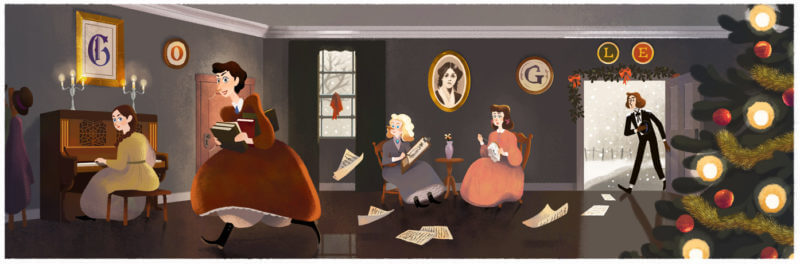
Google Doodle in 2016 for Louisa May Alcott’s birthday on November 29. The Doodle pays homage to the characters of Alcott’s novel, Beth, Jo, Amy and Meg. Designed by doodler Sophie Diao.Via SearchEngineLand.
“Be comforted, dear soul! There is always light behind the clouds.”
November is the most disagreeable month in the whole year, said Margaret, standing at the window one dull afternoon, looking out at the frostbitten garden.
That’s the reason I was born in it, observed Jo pensively, quite unconscious of the blot on her nose.
Spread the word; friends don't allow friends to repeat history.
November 1869, in the first year of the Grant administration — and Nast put aside his own prejudices enough to invite the Irish guy to dinner, along with many others. (Nast tended not to like Catholics, and especially Irish Catholics.)
In a nation whose emotions are raw from a divisive election, a year of protest for the right to live, a year of deadly plague, unwarranted, horrifying assaults on police officers, not to mention daily horrors reported from Venezuela, Central America, East Timor and Indonesian New Guinea, Syria and the Middle East, could there be a better or more timely reminder of what we’re supposed to be doing?
A Millard Fillmore’s Bathtub tradition: Uncle Sam’s Thanksgiving. History teachers should use the image — and if you’re teaching history at home to students working hard to avoid getting ill, you should use it, too.
(Click for a larger image — it’s well worth it.)
Thomas Nast’s “Uncle Sam’s Thanksgiving,” 1869 – Ohio State University’s cartoon collection, and HarpWeek
“Uncle Sam’s Thanksgiving Dinner” marks the highpoint of Nast’s Reconstruction-era idealism. By November 1869 the Fourteenth Amendment, which secures equal rights and citizenship to all Americans, was ratified. Congress had sent the Fifteenth Amendment, which forbade racial discrimination in voting rights, to the states and its ratification appeared certain. Although the Republican Party had absorbed a strong nativist element in the 1850s, its commitment to equality seemed to overshadow lingering nativism, a policy of protecting the interests of indigenous residents against immigrants. Two national symbols, Uncle Sam and Columbia, host all the peoples of the world who have been attracted to the United States by its promise of self-government and democracy. Germans, African Americans, Chinese, Native Americans, Germans, French, Spaniards: “Come one, come all,” Nast cheers at the lower left corner.
One of my Chinese students identified the Oriental woman as Japanese, saying it was “obvious.” Other friends say both are Chinese. Regional differences. The figure at the farthest right is a slightly cleaned-up version of the near-ape portrayal Nast typically gave Irishmen.
If Nast could put aside his biases to celebrate the potential of unbiased immigration to the U.S. and the society that emerges, maybe we can, too.
Hope your Thanksgiving week is good; hope you have good company and good cheer, turkey or not, traveling or not, company or not. Stay safe. Happy Thanksgiving 2020. And of course, remember to fly your flag!
More: Earlier posts from Millard Fillmore’s Bathtub
We fly our flags today, November 11, to honor all veterans, an extension and morphing of Armistice Day, which marked the end of World War I. The Armistice took effect on November 11, 1918.
Veterans Day parade features a nice jumble of flags in Aurora, Illinois, unknown year. Photo from EnjoyAurora.com.
For several reasons including mnemonic, the treaty called for an end to hostilities on the “11th hour of the 11th day of the 11th month” of 1918. Your state’s history standards probably list that phrase somewhere, but the history behind it is what students really find interesting.
The Allied powers signed a ceasefire agreement with Germany at Rethondes, France, at 11:00 a.m. on November 11, 1918, bringing the war later known as World War I to a close.
President Wilson proclaimed the first Armistice Day the following year on November 11, 1919, with the these words: “To us in America, the reflections of Armistice Day will be filled with solemn pride in the heroism of those who died in the country’s service and with gratitude for the victory, both because of the thing from which it has freed us and because of the opportunity it has given America to show her sympathy with peace and justice in the councils of the nations…” Originally, the celebration included parades and public meetings following a two-minute suspension of business at 11:00 a.m.
Between the world wars, November 11 was commemorated as Armistice Day in the United States, Great Britain, and France. After World War II, the holiday was recognized as a day of tribute to veterans of both wars. Beginning in 1954, the United States designated November 11 as Veterans Day to honor veterans of all U.S. wars. British Commonwealth countries now call the holiday Remembrance Day.
Online holdings of the National Archives and Records Administration (NARA) provide rich sources of information on America’s military, and on veteran’s day. NARA leans to original documents a bit more than the Library of Congress. For Veterans Day 2016, NARA featured an historic photo form 1961:
NARA caption: President John F. Kennedy Lays a Wreath at the Tomb of the Unknown Soldier as part of Veterans Day Remembrances, Arlington National Cemetery, Arlington, Virginia, 11/11/1961 Series: Robert Knudsen White House Photographs, 1/20/1961 – 12/19/1963. Collection: White House Photographs, 12/19/1960 – 3/11/1964 (Holdings of the @jfklibrary)
(Well, actually it’s for everyone. But teachers love those kinds of links, especially AP history teachers who need documents for “Document-Based Questions” (DBQs).
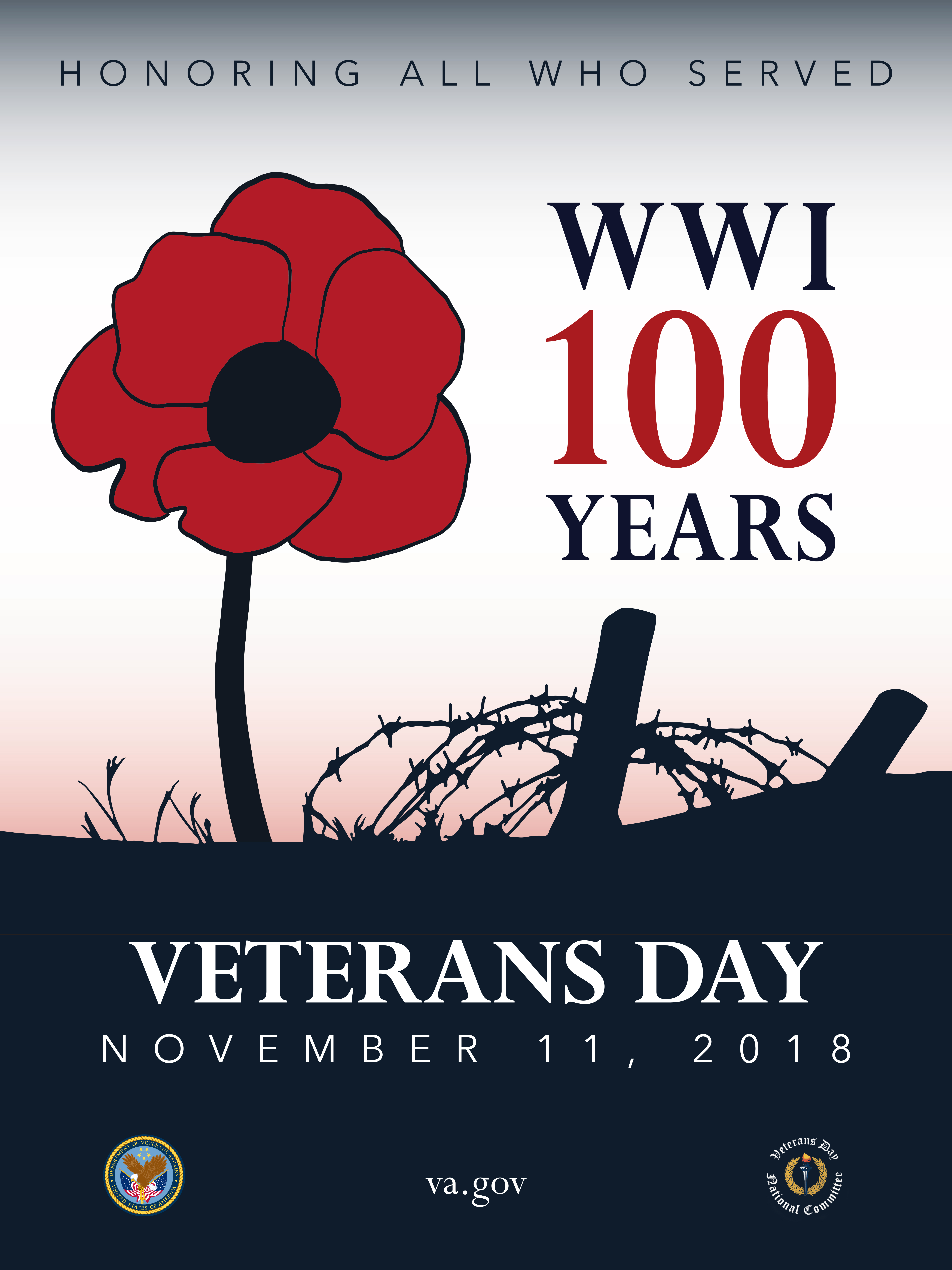
On one page, the Veterans Administration makes it easy for teachers to plan activities; of course, you need to start some of these weeks before the actual day:
The Major, a very large U.S. flag made in honor of Maj. Brent R. Taylor, Mayor of North Ogden, Utah, killed in action in Afghanistan in 2018. The flag flew at the mouth of Coldwater Canyon. The flag is a quarter-acre in size, more than 100 feet on the longest side. North Ogden plans an annual celebration of the U.S. flag in early November. Photo by Ben Dorger, for the Ogden Standard-Examiner newspaper.
2020 is not exactly flying by — but November 3 will probably change our perception of how fast time moves, and how the year moves at all.
Do we even fly our flags during a pandemic? Sure we do.
Eight events spread over seven different days come with urgings to fly the U.S. flag in November: Six states celebrate statehood, Veterans Day falls as always on November 11, and Thanksgiving Day on November 26.
Did I say eight? Elections are dates to fly the flag. 2020 is a presidential election year — in Texas, May and other election dates for counties, cities and school boards were moved to November. (Some thought a pandemic would surely be over by November. Who knew?)
You may fly your flag at home on election day, too. (Yes, flags should be flown at all early polling places, on days of early voting, too — do you know of poll where that did not occur? Tell us in comments.)
Two states, North Dakota and South Dakota, celebrate their statehood on the same date. Washington’s statehood day falls on Veterans Day, November 11 — so there are only seven days covering nine events.
In calendar order for 2019, these are the seven days:
North Dakota statehood day, November 2 (1889, 39th or 40th state)
South Dakota statehood day, November 2 (1889, 39th or 40th state) (shared with North Dakota)
Election day, November 3 (all states; federal offices) — Go vote!
Montana statehood day, November 8 (1889, 41st state)
Veterans Day, November 11
Washington statehood day, November 11 (1889, 42nd state) (shared with Veterans Day)
Oklahoma statehood day, November 16 (1907, 46th state)
North Carolina statehood day, November 21 (1789, 12th state)
Thanksgiving Day, fourth Thursday in November (November 26 in 2020)
Most Americans will concern themselves only with Veterans Day and Thanksgiving Day. Is flying the U.S. flag for statehood day a dying tradition?
Or, until that account is unsuspended by the forces supporting Donald Trump: Follow @FillmoreWhite, the account of the Millard Fillmore White House Library
We've been soaking in the Bathtub for several months, long enough that some of the links we've used have gone to the Great Internet in the Sky.
If you find a dead link, please leave a comment to that post, and tell us what link has expired.
Thanks!
Retired teacher of law, economics, history, AP government, psychology and science. Former speechwriter, press guy and legislative aide in U.S. Senate. Former Department of Education. Former airline real estate, telecom towers, Big 6 (that old!) consultant. Lab and field research in air pollution control.
My blog, Millard Fillmore's Bathtub, is a continuing experiment to test how to use blogs to improve and speed up learning processes for students, perhaps by making some of the courses actually interesting. It is a blog for teachers, to see if we can use blogs. It is for people interested in social studies and social studies education, to see if we can learn to get it right. It's a blog for science fans, to promote good science and good science policy. It's a blog for people interested in good government and how to achieve it.
BS in Mass Communication, University of Utah
Graduate study in Rhetoric and Speech Communication, University of Arizona
JD from the National Law Center, George Washington University


 Posted by Ed Darrell















 Millard Fillmore's Bathtub
