Exact spot – a place to dream

August 28, 2013

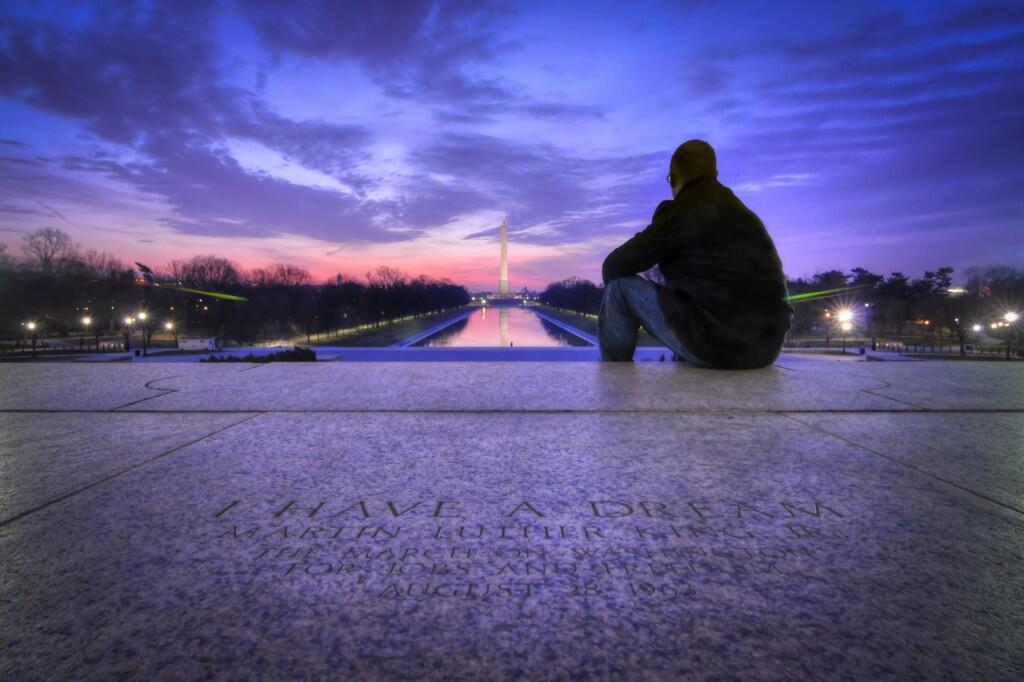
Pic Tweet from the National Park Service: Beautiful photo of the exact spot Dr. King delivered his

Pic Tweet from the National Park Service: Beautiful photo of the exact spot Dr. King delivered his “I Have a Dream speech” 50 years ago today. #MLKdream50 pic.twitter.com/MHwWsY7Hwp

Nice photo from the Lincoln Memorial looking toward the Washington Monument across the length of the Reflecting Pool.

This photo was taken at least several months ago, before the scaffolding went up on the Washington Monument for repairs for damage from the 2011 earthquake.  It’s a winter or fall picture, I’m guessing from the bare trees, and taken early in the morning, as the sun rises in the east over the Capitol and Washington Monument.  That is one of the best times to be at the Lincoln Memorial, in my experience.  The man in the photo has the historic spot very much to himself at that time.

Engraving on the stone says:

I HAVE A DREAM
MARTIN LUTHER KING, JR.
THE MARCH ON WASHINGTON
FOR JOBS AND FREEDOM
AUGUST 28, 1963

More:


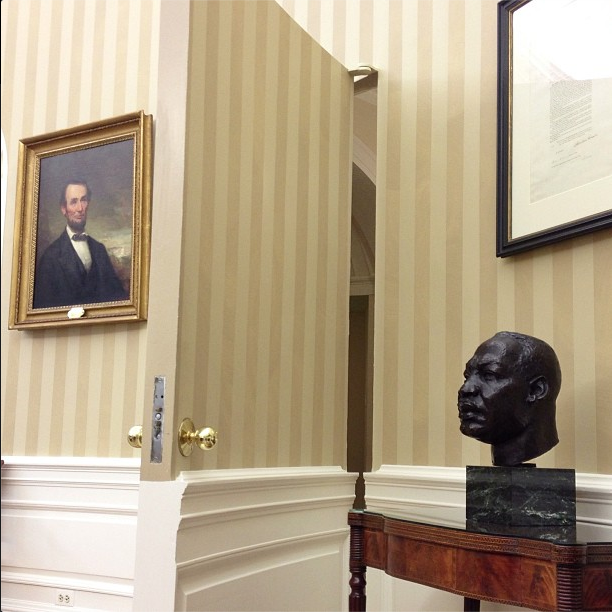
President Lincoln and Rev. Dr. Martin Luther King, Jr., in the Oval Office

August 28, 2013

I remember, just a year ago, when the GOP candidate for president promised to make this photo impossible, replacing King with an Englishman.

150 years later, 50 years later, change gotta come, still.

A better version of the photo:

Painting of Abraham Lincoln, bust of Rev. Dr. Martin Luther King, Jr., together in the Oval Office, White House. (Pete Souza photo?)

Painting of Abraham Lincoln, bust of Rev. Dr. Martin Luther King, Jr., together in the Oval Office, White House. (Pete Souza photo?) Photo published on August 28, 2013, the 50th anniversary of the March on Washington.

Oval office, Martin Luther King, March on Washington, Abraham Lincoln

More:


Top 200 economics blogs, ranked by Onalytica Indexes

August 27, 2013

Borrowing the entire post from Onalytica Blog, for student ease — the top 200 economics blogs (via Mr. Darrell’s Pin Factory, with express permission and a few modifications). Reading a smattering from the top 20 should offer some real-world assistance in understanding any high school economics course.

Read ’em and reap benefits, as the saying goes.  What did you learn just browsing the list?  Economics teachers and especially first-year economics students will want to bookmark this list and keep it handy.

Interesting that the Nobel Prize-winning Paul Krugman ranks so high, doubly interesting that Bruce Bartlett also ranks so high — and a clue, perhaps, to conservatives, that they should pay more attention to real economists.

Logo for Onalytica Indexes

Logo for Onalytica Indexes

(With a wave of the old wire-cutters to Bruce Bartlett, whose own blog is #2 on this list.)

It’s been several months since we published our latest ranking of influential economic blogs. Below is an updated list of the top 200 economic blogs, ordered by their Onalytica Influence index.

An explanation of the methodology can be found in our previous post on influential economic blogs.

We report the same metrics as before: Onalytica Influence Index, Popularity and Over-Influence. Influence index is the impact factor of blogs, similar to the impact factor of academic journals; Popularity measures how well-known a blog is amongst other economic blogs and Over-Influence seeks to capture how influential a blog is compared to how popular it is.

There are quite a few new entries in the list as a results of our growing underlying corpus of economic blogs from which the most influential ones are calculated. Over time, we should expect to see a reduced number of economic blogs entering the top 200 for the first time.

We have recently added some very well-known and influential blogs such as Economix, FT Alphaville and Vox, causing most blogs to go down in ranking. Moreover, there were other shifts in the ranking generated by a change in the quantity and quality of citations that blogs have received. If a blog has gone up it means that it has been cited by more influential blogs and/or has received a higher number of citations since our last ranking.

Rank Change Website I P O-I
1. The Conscience of a Liberal 100.0 100.0 1.2
New Entry ★ 2. Economix 61.7 64.9 1.1
New Entry ★ 3. FT Alphaville 60.8 52.0 1.4
New Entry ★ 4. Vox 57.4 56.5 1.2
2 ↓ 5. Marginal Revolution 53.1 63.4 1.0
2 ↓ 6. Brad Delong 50.8 61.3 1.0
5 ↓ 7. Economist’s View 50.6 62.8 1.0
9 ↑ 8. Zero Hedge 49.0 57.7 1.0
2 ↓ 9. Naked Capitalism 40.4 48.0 1.0
4 ↓ 10. Econbrowser 36.2 42.0 1.0
11. The Big Picture 35.9 42.6 1.0
2 ↓ 12. EconLog 35.9 45.3 0.9
4 ↓ 13. The Money Illusion 30.2 48.0 0.7
9 ↓ 14. Greg Mankiw’s Blog 30.1 36.6 1.0
5 ↑ 15. Economic Policy Institute 28.7 35.7 0.9
3 ↓ 16. Calculated Risk 28.6 25.5 1.3
23 ↑ 17. Next New Deal 26.2 24.0 1.3
New Entry ★ 18. On the Economy 25.1 33.3 0.9
4 ↓ 19. Crooked Timber 24.5 26.4 1.1
6 ↓ 20. Freakonomics 23.4 32.4 0.8
9 ↓ 21. Worthwhile Canadian Initiative 23.3 32.1 0.8
New Entry ★ 22. Tax Policy Blog 22.3 12.3 2.1
1 ↑ 23. The Baseline Scenario 22.0 25.5 1.0
48 ↑ 24. Noahpinion 21.9 42.3 0.6
6 ↓ 25. Cafe Hayek 20.3 26.4 0.9
8 ↓ 26. Interfluidity 19.8 24.3 0.9
11 ↓ 27. Why Nations Fail 19.3 27.0 0.8
New Entry ★ 28. Mish’s Global Economic Trend Analysis 19.3 21.0 1.1
3 ↓ 29. Credit Writedowns 18.7 23.7 0.9
27 ↑ 30. Liberty Street Economics 18.0 21.9 1.0
8 ↓ 31. The Incidental Economist 17.7 22.8 0.9
New Entry ★ 32. LewRockwell.com 17.2 15.9 1.2
New Entry ★ 33. The Grumpy Economist 17.1 18.9 1.0
13 ↓ 34. Angry Bear 16.8 23.7 0.8
New Entry ★ 35. Macro and Other Market Musings 16.3 23.4 0.8
New Entry ★ 36. Not the Treasury View 16.0 17.1 1.1
16 ↑ 37. IMF Direct 15.7 19.5 0.9
New Entry ★ 38. Steve Keens’ Debtwatch 15.7 16.5 1.1
New Entry ★ 39. Stan Collender’s Capital Gains and Games 15.5 11.7 1.5
New Entry ★ 40. Bruegel 15.3 10.8 1.6
7 ↓ 41. The Policy Center 15.2 26.1 0.7
4 ↓ 42. Mainly Macro 15.2 8.4 2.0
New Entry ★ 43. Bill Mitchell – billy blog 14.8 16.5 1.0
16 ↓ 44. The Irish Economy 14.5 9.6 1.7
10 ↑ 45. New Economic Perspectives 14.4 17.1 1.0
New Entry ★ 46. off the charts 14.3 11.1 1.5
New Entry ★ 47. Eschaton 14.1 13.8 1.2
3 ↑ 48. Andrew Gelman 14.0 17.1 0.9
New Entry ★ 49. macroblog 13.9 15.9 1.0
New Entry ★ 50. Steven Landsburg 13.6 15.6 1.0
15 ↓ 51. Stumbling and Mumbling 13.4 20.1 0.8
27 ↓ 52. Overcoming Bias 13.4 21.0 0.7
New Entry ★ 53. Pragmatic Capitalism 13.3 18.9 0.8
7 ↓ 54. The Undercover Economist 13.1 12.3 1.2
New Entry ★ 55. Robert Reich 12.8 15.0 1.0
27 ↓ 56. The Becker-Posner Blog 12.7 9.6 1.5
13 ↓ 57. China Financial Markets 12.5 16.5 0.9
19 ↓ 58. Uneasy Money 11.8 17.1 0.8
New Entry ★ 59. Consider the Evidence 11.6 10.2 1.3
New Entry ★ 60. Bleeding Heart Libertarians 11.6 16.5 0.8
7 ↓ 61. Confessions of a Supply-Side Liberal 11.2 13.5 0.9
69 ↑ 62. Economics One 11.2 16.2 0.8
New Entry ★ 63. the nef blog 11.1 8.4 1.5
6 ↓ 64. The Volokh Conspiracy 11.0 14.7 0.9
30 ↓ 65. Dani Rodrik’s weblog 10.9 12.6 1.0
21 ↓ 66. Organizations and Markets 10.9 10.8 1.1
119 ↑ 67. Conversable Economist 10.5 8.7 1.3
New Entry ★ 68. Euro Intelligence 10.5 14.4 0.8
New Entry ★ 69. The Market Monetarist 10.4 12.6 0.9
40 ↓ 70. A Fistful of Euros 10.2 11.1 1.0
New Entry ★ 71. The Center of the Universe 10.1 9.9 1.2
39 ↓ 72. Keith Hennessey 10.0 8.4 1.3
New Entry ★ 73. Enlightenment Economics 9.9 6.9 1.6
52 ↑ 74. The Street Light 9.8 8.4 1.3
New Entry ★ 75. Robert P. Murphy’s Free Advice 9.5 10.8 1.0
New Entry ★ 76. MacroBusiness 9.4 10.8 1.0
68 ↑ 77. Econospeak 9.4 11.4 0.9
15 ↓ 78. TaxProf Blog 9.3 15.6 0.7
23 ↓ 79. Adam Smith Institute 9.1 16.2 0.6
21 ↓ 80. Donald Marron 9.0 6.9 1.4
New Entry ★ 81. Free Banking 9.0 14.1 0.7
17 ↓ 82. The Reformed Broker 8.9 12.3 0.8
46 ↓ 83. John Kay 8.8 12.9 0.8
New Entry ★ 84. Economic Policy Journal 8.8 10.8 0.9
54 ↓ 85. InfectiousGreed 8.7 9.6 1.0
New Entry ★ 86. Crossing Wall Street 8.7 7.8 1.2
41 ↓ 87. The Oil Drum 8.6 10.2 1.0
46 ↓ 88. Patrick Chovanec 8.5 6.0 1.5
New Entry ★ 89. Coordination Problem 8.4 15.0 0.6
New Entry ★ 90. Cheap Talk 8.3 11.7 0.8
New Entry ★ 91. Michael Hudson 8.3 10.5 0.9
40 ↓ 92. John Quiggin 8.1 11.1 0.8
New Entry ★ 93. Kids Prefer Cheese 8.0 11.1 0.8
New Entry ★ 94. The Market Ticker 8.0 12.9 0.7
New Entry ★ 95. Real-World Economics Review Blog 8.0 12.6 0.7
32 ↓ 96. Daniel W. Drezner 7.9 8.1 1.1
New Entry ★ 97. ToUChstone 7.8 8.7 1.0
20 ↓ 98. Historinhas 7.8 7.2 1.2
New Entry ★ 99. Facts and Other Stubborn Things 7.8 8.1 1.1
42 ↑ 100. Stephen Williamson: New Monetarist Economics 7.8 15.3 0.6
New Entry ★ 101. Credit Slips 7.8 6.3 1.3
New Entry ★ 102. The Bonddad Blog 7.7 11.7 0.8
New Entry ★ 103. The Economic Collapse 7.7 9.3 0.9
New Entry ★ 104. Corey Robin 7.7 11.4 0.8
New Entry ★ 105. Sober Look 7.6 8.4 1.0
56 ↓ 106. Environmental Economics 7.6 7.8 1.1
40 ↑ 107. Bronte Capital 7.6 7.8 1.1
New Entry ★ 108. George Monbiot 7.6 10.2 0.8
New Entry ★ 109. Max Keiser Financial War Reports 7.5 8.1 1.0
New Entry ★ 110. Club Troppo 7.4 13.8 0.6
New Entry ★ 111. Catallaxy Files 7.4 12.3 0.7
New Entry ★ 112. Coppola Comment 7.4 6.6 1.2
New Entry ★ 113. Of Two Minds 7.4 7.8 1.0
39 ↓ 114. ThinkMarkets 7.3 6.0 1.3
New Entry ★ 115. Tax Research UK 7.3 9.3 0.9
New Entry ★ 116. The Beacon Blog 7.3 9.9 0.8
New Entry ★ 117. Unlearning Economics 7.2 10.5 0.8
75 ↓ 118. A Dash of Insight 7.1 3.0 2.4
78 ↓ 119. Chris Blattman 7.0 10.5 0.8
New Entry ★ 120. The Aleph Blog 6.9 10.5 0.7
New Entry ★ 121. Evan Soltas 6.8 8.7 0.9
New Entry ★ 122. UDADISI 6.7 3.0 2.2
26 ↑ 123. The Slack Wire 6.7 5.7 1.3
New Entry ★ 124. Economics for public policy 6.7 9.0 0.8
41 ↑ 125. Supply and Demand (In That Order) 6.7 4.8 1.5
22 ↑ 126. NYU Development Research Insitute 6.6 4.2 1.7
2 ↑ 127. Ludwig von Mises Institute 6.6 9.0 0.8
New Entry ★ 128. OECD Insights 6.6 4.5 1.5
New Entry ★ 129. Mike Norman Economics 6.5 8.7 0.8
54 ↓ 130. The Economic Populist 6.5 8.7 0.8
New Entry ★ 131. MacroMania 6.4 8.7 0.8
65 ↓ 132. TripleCrisis 6.2 7.5 0.9
New Entry ★ 133. Economic Thought 6.2 9.0 0.8
New Entry ★ 134. Jesse’s Cafe Americain 6.2 11.7 0.6
New Entry ★ 135. Yanis Varoufakis 6.1 8.1 0.8
New Entry ★ 136. Political Calculations 6.1 9.6 0.7
New Entry ★ 137. Dan Ariely 6.1 6.0 1.1
New Entry ★ 138. Abnormal Returns 6.0 9.0 0.8
42 ↑ 139. Ideas 5.9 9.0 0.7
New Entry ★ 140. Monetary Freedom 5.9 8.4 0.8
New Entry ★ 141. azizonomics 5.9 6.9 0.9
76 ↓ 142. Tim Worstall 5.9 9.9 0.7
51 ↑ 143. Falkenblog 5.8 9.6 0.7
40 ↑ 144. Rajiv Sethi 5.7 7.5 0.8
76 ↓ 145. Coyote Blog 5.7 8.1 0.8
New Entry ★ 146. International Liberty 5.6 5.4 1.1
59 ↓ 147. CoRE Economics 5.5 7.8 0.8
68 ↓ 148. Knowledge Problem 5.4 8.4 0.7
New Entry ★ 149. I, Cringely 5.3 3.3 1.6
New Entry ★ 150. David Smith 5.3 8.1 0.7
New Entry ★ 151. Sanjeev Sabhlok’s Revolutionary Blog 5.3 6.0 1.0
91 ↓ 152. Division of Labour 5.3 2.7 1.9
New Entry ★ 153. Peter Martin 5.2 3.6 1.5
22 ↓ 154. Neighborhood Effects 5.2 5.1 1.1
New Entry ★ 155. The Epicurean Dealmaker 5.1 7.5 0.8
88 ↓ 156. Economists Do it With Models 5.0 6.3 0.9
New Entry ★ 157. Dr. Ed’s Blog 5.0 5.7 0.9
85 ↓ 158. Growthology 4.9 4.2 1.2
99 ↓ 159. Multiplier Effect 4.9 6.6 0.8
66 ↓ 160. Economics Intelligence 4.9 6.0 0.9
69 ↓ 161. The Capital Spectator 4.9 6.6 0.8
New Entry ★ 162. Offsetting Behaviour 4.8 8.1 0.7
New Entry ★ 163. Antonio Fatas and Ilian Mihov on the Global Economy 4.8 5.4 1.0
New Entry ★ 164. Tom Woods 4.8 6.0 0.9
New Entry ★ 165. owenzidar 4.6 3.6 1.3
10 ↓ 166. Market Design 4.6 5.1 1.0
New Entry ★ 167. Economics of Contempt 4.6 6.9 0.7
New Entry ★ 168. Balance 4.5 2.7 1.6
New Entry ★ 169. Jim Sinclair’s MineSet 4.5 5.1 1.0
26 ↓ 170. Environmental and Urban Economics 4.4 4.5 1.0
New Entry ★ 171. An Economic View of the Environment 4.4 1.8 2.2
New Entry ★ 172. Tax Justice Network 4.4 4.5 1.0
New Entry ★ 173. Mandel on Innovation and Growth 4.4 4.5 1.0
New Entry ★ 174. The Sports Economist 4.4 4.5 1.0
New Entry ★ 175. mathbabe 4.3 6.0 0.8
New Entry ★ 176. Financial Armageddon 4.3 6.6 0.7
107 ↓ 177. Brett Keller 4.3 1.2 2.9
New Entry ★ 178. Social Democracy for the 21st Century: a Post Keynesian Perspective 4.2 8.7 0.5
New Entry ★ 179. Robert Skidelsky 4.2 4.2 1.0
63 ↓ 180. Truth on the Market 4.1 5.4 0.8
81 ↓ 181. Economic Logic 4.1 4.5 1.0
New Entry ★ 182. Moneyness 4.0 6.0 0.7
New Entry ★ 183. Sparse Thoughts of a Gloomy Eurpoean Economist 4.0 3.3 1.2
New Entry ★ 184. Rick Bookstaber 4.0 4.8 0.9
96 ↓ 185. Alpha.Sources.CV 3.9 4.8 0.9
85 ↓ 186. Karl Whelan 3.9 2.4 1.6
17 ↓ 187. Macro Man 3.9 8.4 0.5
New Entry ★ 188. Robert’s Stochastic Thoughts 3.9 2.4 1.5
16 ↓ 189. History Squared 3.9 3.6 1.1
128 ↓ 190. Taking Hayek Seriously 3.8 6.9 0.6
66 ↓ 191. Ralphonomics 3.8 8.4 0.5
New Entry ★ 192. Naked Keynesianism 3.8 8.1 0.5
New Entry ★ 193. International Political Economy at the University of North Carolina 3.8 4.2 0.9
New Entry ★ 194. Middle Class Political Economist 3.7 4.2 0.9
New Entry ★ 195. Ed Dolan’s Econ Blog 3.7 4.2 0.9
111 ↓ 196. Roubini Global Economics 3.7 3.9 1.0
118 ↓ 197. Club for growth 3.7 5.7 0.7
New Entry ★ 198. Adam Smith’s Lost Legacy 3.7 7.2 0.6
New Entry ★ 199. Greed, Green & Grains 3.7 2.1 1.6
New Entry ★ 200. Cassandra Does Tokyo 3.7 5.7 0.7

More:


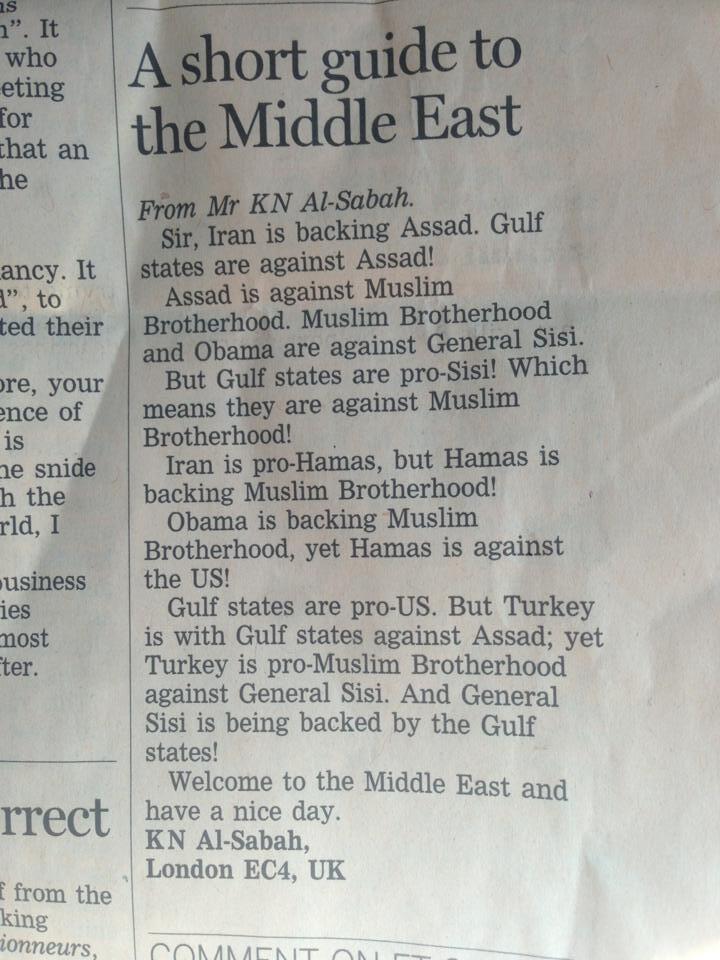
Middle East politics explained, for the novice or anyone else, in six short paragraphs

August 26, 2013

Seven paragraphs, if one counts the cheery close.

Letter to the editor of a London newspaper (trying to track that down), explaining who is who and who is whose enemy, in the Middle East.

Letter to the editor of the Financial Times of London, explaining who is who and who is whose enemy, in the Middle East. August 22, 2013, captured by Randy Prine

A woman named Randy Prine (@RandyPrine) Tweeted this photo, and said:

THIS is why we Voted for an analytical and not ‘shoot from the hip’ McCain or ‘How can I make money’ Romney.

Most of the ObamaH8ers I run into can be stopped on almost all Middle East issues simply by asking them whether the group they rant at, at that moment, is Sunni or Shiite.  For some odd reason, they never know.

Read the rest of this entry »


Her last day of teaching first grade

August 25, 2013

Diane Ravitch gets much better e-mail than I do; Ravitch said (images added here):

This came in my private email:

Woman teaching geometry, from Euclid's Elements.

Woman teaching geometry from Euclid’s Elements. Wikipedia image

As many of you know, I just retired from teaching, having spent most of my career in first grade. Over the last few years, my teaching had become gradually more restricted. Instead of running a center-based day, I was required to run scheduled periods of Fundations, Writing Workshop, Reading Workshop, and (this year) of Envision math. To encourage me to retire, my district had made a financial offer that was difficult to refuse. Almost simultaneously, my daughter had announced that she was pregnant with twins. The decision became easier and easier. As the pressures in New York State increased,  I decided what I wanted to do after retire: support families, fight the tests, tutor children to learn DESPITE the tests. That would mean running workshops for parents about curriculum. But that’s not what I want to write about tonight. I want to tell you about my last few weeks of teaching, and about my last good lesson.  

The district isn’t replacing me next year due to shrinking numbers. Once I announced my retirement, the vultures began to circle – teachers  seeking furniture, leveled books, left over supplies. (All of a sudden, my hoarding had value!) Gradually, my room became emptier and emptier. You’d have thought that my teaching would have suffered, but — I LOVED IT, AND SO DID THE KIDS!!! Painting, gluing, research, math projects; WE ALL RELISHED THE CHANGE! It was a very special time – though teary, for some. I’m not sure why my retiring should result in so many sad children (since I wouldn’t have been their teacher the following year), but there you have it. 

Pamela teaching her children (1743–45)

Joseph Highmore’s illustration of Pamela teaching her children (1743–45); in volume four of Samuel Richardson’s novel, Pamela, Pamela endorses much of Locke’s educational program, while at the same time claiming a valuable new role for mothers: educator.

Driving to school on my last full day, I thought about what I could teach that day in my empty classroom. All I had was art paper, scotch tape, and crayons. The kids had already taken home their markers. I thought about how I could say good-bye. I wanted to help them gain some perspective. I wanted them to know they had each other. (I’d already told them they could email.)  I thought about how our paths had crossed and come together so arbitrarily, but how being together in this class had changed all our lives. And then I knew what I’d do! 

I gave each child one piece of 12″ x18″ paper. I told them that each child was to draw a path across the paper. It could be straight across or curved or jagged – whatever. We agreed that the paths would be about a fist wide, and had to be drawn in purple. The rest of the paper was to be decorated with whatever else they thought might have been on their paths this year. 

Everyone did as I requested after a few false starts. Some of the drawings were quite thoughtful and charming.  I then told the kids that we were now going to connect our paths together. I was having a small get together that night, and I told the children we needed something on the wall. Immediately, some of the kids became excited, and tried to put their papers together. I suggested that the kids get on the floor and connect their paths like a puzzle, assemble their work on the floor, and that we’d move it to the wall later. I’d never done this activity before, and had no idea how it would turn out. Over the course of the next half hour, I kept telling myself: Remember, it’s process over product.  

As the kids worked, I gradually stepped back. The children were making decisions about which paths connected, which looked best together, which should be moved to a different spot. There were no arguments, even though there were differences of opinion. I handed the kids scotch tape dispensers as needed. I mentioned to one little boy that it was great that there were no fights. He said to me, “Well, remember when I invented a game for the playground and then we all had a fight because I wanted to make all the rules? Remember how you explained to me how a true leader doesn’t make all the rules, but helps others to join in? Well – maybe that’s what we’ve all been doing.” 

I was absolutely floored. 

That’s when I knew how much I’d miss teaching. That feeling of molding a group and helping them become better together than singly – that’s amazing.

Empty first grade classroom.  From A Day in First Grade blog.

Empty first grade classroom. From A Day in First Grade blog.


Millard Fillmore’s Bathtub, as poetry

August 25, 2013

Haiku, at that.

Mark Sackler at Millennium Conjectures is making haiku verses from the search terms used on his blog.  Haiku has some firm rules anyway, and this makes the challenge all the greater.

And it produces some interesting stuff, though this one may be just odd:

Existential Stench

I am alone in
Millard Fillmore’s Bathtub blog
with Pepe Le Pou*

(The asterisk notes that this is how the searcher spelled it.)

An unlinked reference — some sort of indication of making it into the bloggynet conscience!

Read more at Mark’s place. (And check out the Savage Chickens cartoon.)

More, maybe only tangentially-related:

Bust of Vice President Millard Fillmore, by Robert Cushing, U.S. Senate Chamber

Does the ghost of Millard Fillmore approve? Bust of Vice President Millard Fillmore, by Robert Cushing, U.S. Senate Chamber


Taxes are “stolen?” Those who don’t know history, shouldn’t pretend to complain about taxes

August 24, 2013

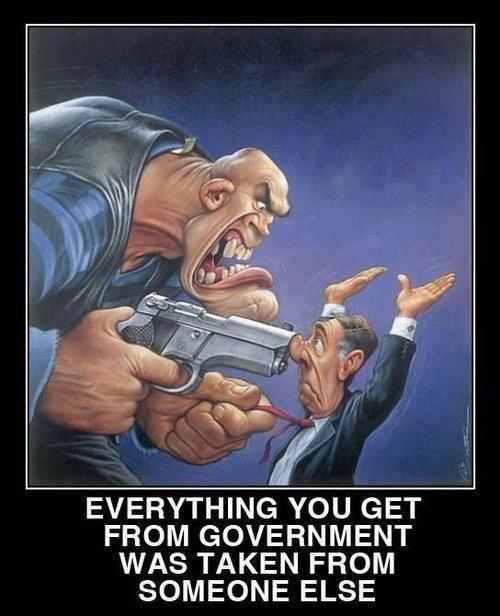
No, taxes are not “stealing.”  Here’s the offending poster I found on Facebook:

Who are the history-illiterates who make these offensive posters? Taxes are not "stolen," at least, not according to patriots like George Washington.

Who are the history-illiterates who make these offensive posters? Taxes are not “stolen,” at least, not according to patriots like George Washington.

I told one guy who posted it that I thought it was a crude misrepresentation of George Washington, there on the left — but that I had always suspected he didn’t like the “founders,” and was grateful to have any doubts I may have had, removed.

He said, “Huh?”

This Prominent Americans series stamp of the U...

Pay your taxes, maybe they’ll put you on a stamp. This Prominent Americans series stamp of the United States from 1968 features Oliver Wendell Holmes. Wikipedia image

One could always refer to that wonderful line from Justice Oliver Wendell Holmes, Jr., about how he liked to pay taxes because “with them I buy civilization.”  But I suspect most tax revolters in the U.S. don’t much like civilization (and they have the guns to prove it).

Instead I simply told the story of George Washington and the Whiskey Rebellion, the first, and mostly-forgotten, case of U.S. tax rebels.  You know the story.

I wrote:

Yeah, in 1794, a bunch of farmers out in western Pennsylvania got ticked off at taxes. They said paying taxes was like the government stealing from them. And, they had their representatives explain to President George Washington, didn’t they fight a war against paying taxes?

Washington, you may recall, was the Commander in Chief of the Continental Army in the great American Revolution against Great Britain. “No taxes without representation” was one of the original war cries.

Washington said, ‘It takes money to run the government, and that money is collected from the people in taxes fairly levied by their elected representatives.’

The farmers weren’t having any of that. They were way out in western Pennsylvania, near the wilderness Fort Pittsburgh. The federal government, what little bit of it there was, was in Philadelphia. ‘How are they going to make us pay taxes?’ the rebel leaders shouted to crowds.

George Washington

A more friendly portrayal of George “Pay Your Taxes or Swing” Washington – Wikipedia image (which bust is this? Library of Congress?)

Washington got a dozen nooses, and a volunteer army of 13,000 Americans, and marched to western Pennsylvania to hang anyone who wouldn’t pay the tax. Oddly, by the time Washington got there with the nooses, the rebels decided maybe it was a good idea to be patriotic about it after all.

So I assumed you just updated the pictures a little. [In the poster] There’s George Washington on the left, with his Smith and Wesson “noose,” telling the big corporate farmer to pay his taxes.I think your portrayal of Washington is a bit crude, but it’s historically accurate, with regard to taxes.

I always suspected you didn’t like George Washington. Now I know for sure you don’t.

You could have looked it up: The Whiskey Rebellion – http://www.pbs.org/wgbh/amex/duel/peopleevents/pande22.html

I don’t much like crude political dysfunction and disinformation from people who don’t know U.S. history, and won’t defend American principles.  Am I being unreasonable?

More:

Gen. Washington, astride his favorite white horse, reviewing his troops at Carlisle, Pennsylvania, before the march to the western part of the state to put down the Whiskey Rebellion. Image from the Department of the Treasury, Alcohol and Tobacco Tax and Trade Bureau.

Gen. Washington, astride his favorite white horse, reviewing his troops at Carlisle, Pennsylvania, before the march to the western part of the state to put down the Whiskey Rebellion. Image from the Department of the Treasury, Alcohol and Tobacco Tax and Trade Bureau. (Just try to find who painted it!)

https://www.nationalguard.mil/Resources/Image-Gallery/Historical-Paintings/Heritage-Series/To-Execute-the-Laws/FileId/319464/

” . . . to execute the laws . . .” a painting by Donna Neary for the National Guard, on the Whiskey Rebellion. National Guard Caption: In September 1791 the western counties of Pennsylvania broke out in rebellion against a federal excise tax on the distillation of whiskey. After local and federal officials were attacked, President Washington and his advisors decided to send troops to pacify the region. It was further decided that militia troops, rather than regulars, would be sent. On August 7, 1794, under the provisions of the newly-enacted militia law, Secretary of War Henry Knox called upon the governors of Virginia, Maryland, New Jersey, and Pennsylvania for 12,950 troops as a test of the President’s power to enforce the law. Numerous problems, both political and logistical, had to be overcome and by October, 1794 the militiamen were on the march. The New Jersey units marched from Trenton to Harrisburg, Pennsylvania. There they were reviewed by their Commander-in Chief, President George Washington, accompanied by Secretary of the Treasury and Revolutionary war veteran Alexander Hamilton. By the time troops reached Pittsburgh, the rebellion had subsided, and western Pennsylvania was quickly pacified. This first use of the Militia Law of 1792 set a precedence for the use of the militia to “execute the laws of the union, (and) suppress insurrections”. New Jersey was the only state to immediately fulfill their levy of troops to the exact number required by the President. This proud tradition of service to state and nation is carried on today by the New Jersey Army and Air National Guard.


Earth on fire? No, just Idaho (and a lot not pictured)

August 23, 2013

Photo and press release from NASA’s Earth Observatory:

Image from the astronauts aboard the International Space Station, acquired August 18, 2013 -- 50 mm lens. Looking to the west, over Idaho.

Image from the astronauts aboard the International Space Station, acquired August 18, 2013 — 50 mm lens. Looking to the west, over Idaho. See photo below for labels of fire sites.

Description of the photo:

Taken with a short lens (50 millimeters), this west-looking image from the International Space Station includes much of forested central Idaho. The oblique image highlights part of the largest single wilderness area in the contiguous United States, the Frank Church–River of No Return Wilderness.

Within this mountainous region (the dark areas are all wooded), several fires produced extensive smoke plumes. The densest smoke appeared to be generated by a combination of the Little Queens and Leggit fires (within the Salmon River Mountains [link added]). This image shows the common pattern of westerly winds carrying smoke in an easterly direction, as seen during the wildfire season of one year ago.

Named fires—most ignited by lightning—had burned 53,000 acres of forest south of the Salmon River by August 20, 2013; the number would be significantly higher if unnamed fires were included. The Gold Pan fire, north of the Salmon River, had burned 27,000 acres. For a sense of scale, Gold Pan lies about 125 miles (200 kilometers) north of the Little Queens fire.

Ten days before this image was taken, fires in central Idaho (near Boise) had been aggravated by southerly winds. Some of those fires began to burn in July, but were quelled and remain under observation for new flare-ups.

In the image above, smoke partly obscures the black lava flows of the Craters of the Moon National Monument [link added] (lower left). The Beaverhead Mountains [link added] mark the eastern boundary of Idaho with Montana.

Astronaut photograph ISS036-E-32853 was acquired on August 18, 2013, with a Nikon D3S digital camera using a 50 millimeter lens, and is provided by the ISS Crew Earth Observations experiment and Image Science & Analysis Laboratory, Johnson Space Center. The image was taken by the Expedition 36 crew. It has been cropped and enhanced to improve contrast, and lens artifacts have been removed. The International Space Station Program supports the laboratory as part of the ISS National Lab to help astronauts take pictures of Earth that will be of the greatest value to scientists and the public, and to make those images freely available on the Internet. Additional images taken by astronauts and cosmonauts can be viewed at the NASA/JSC Gateway to Astronaut Photography of Earth. Caption by M. Justin Wilkinson, Jacobs/JETS at NASA-JSC.

English: Salmon River Mountains, ID

Salmon River Mountains, Idaho, on the ground; notice the steep mountains on-the-ground firefighters must contend with. Wikipedia image

Instrument: ISS – Digital Camera

My older brother Dwight was a firefighter with the Bureau of Land Management in the early 1960s.  There were some huge fires then — but not so many, so large, all at once.  While we don’t have satellite photos to compare from way back then, this is just scary.  Those were scary on the ground, and smaller than these — and fewer.

Notice in the photo below, some of these huge fires are not even big enough to be named.  Wow.

Image from the International Space Station of Idaho fires, with names of larger fires overlayed.  August 23, 2013

Image from the International Space Station of Idaho fires, with names of larger fires overlayed. August 23, 2013

More:

Compare with NASA photo from a month ago; Idaho’s been hammered by fire in 2013:

Photo of Idaho from about July 20, 2013, showing then-active fires in the state -- north at top of photo. Notice Craters of the Moon National Monument, the dark area in the southeast section -- this area is obscured by new fires in the photos above.

Photo of Idaho from about July 20, 2013, showing then-active fires in the state — north at top of photo. Notice Craters of the Moon National Monument, the dark area in the southeast section — this area is obscured by new fires in the photos above. Idaho’s borders are barely visible in a thin, black line.  This photo from NASA/Goddard


Humanitarian crisis in Syria: Refugee kids need food; here’s how you can help

August 23, 2013

Description from YouTube:

Published on Jun 27, 2013

In Syria, a humanitarian crisis has developed as millions flee conflict, facing homelessness, hunger and food shortages. The United Nations World Food Programme is working to provide emergency assistance to 2.5 million hungry people inside Syria and more than one million refugees who have fled to neighboring countries. Needs remain great and the children of Syria are particularly vulnerable. Syrian families need your support today.

At UpWorthy, Megan Kelley complains that this need for food and other aid for refugees has been eclipsed by news coverage of the civil war.  So she urges you to pass on the video, and the pleas for help:

Maybe someday the world will be peaceful and perfect and we won’t need emergency aid. In the meantime, let’s do what we can to help give Syrians one less thing to worry about.

And at 1:57, remember: Providing aid to people in need is an amazing thing to do, but we can’t forget that the real heroes are the ones who face the tragedy and strive against it every day.

More:

WFP caption: A Syrian refugee smiles as she carries food from the World Food Programme (WFP) home to her family. Thanks to @WFP for posting this photo and more on their Twitter page. - See more at: http://blogs.un.org/blog/tag/undp/#sthash.gFwbkl9a.dpuf

WFP caption: A Syrian refugee smiles as she carries food from the World Food Programme (WFP) home to her family. Thanks to @WFP for posting this photo and more on their Twitter page. – See more at: http://blogs.un.org/blog/tag/undp/#sthash.gFwbkl9a.dpuf


Burqas forced on Texas students?

August 23, 2013

Come the CSCOPE critics from the wilds of Texas:

Of course, if you ask DanaSomething, or any other CSCOPE critic, when and where that burqa event took place, she produces no evidence.

For three weeks now I’ve made a practice of asking CSCOPE critics for evidence of the evils of Texas teachers and curriculum planners they claim occur.

Not a single example has checked out.

If you’re familiar with the “burqa” controversy in Lumberton, Texas, you know the facts don’t square with the CSCOPE critics’ shorthand version.

Monday, February 25th, 2013

Lumberton ISD Response to CSCOPE and Promotion of Islam

Recently a picture had surfaced showing five students dressed in burqas (Islamic attire) in a World Geography classroom at Lumberton High School. The lesson that was offered was not a written CSCOPE lesson; however it informed students to the customary culture of the people in the Middle East. The lesson that occurred was presented on February 1, 2013. As part of the curriculum from the World Geography TEKS (as prescribed by the state of Texas), the students are to study the culture (TEKS number 17):

“Culture. The student understands the distribution, patterns, and characteristics of different cultures.” The student is expected to:

(A)  describe and compare patterns of culture such as language, religion, land use, education, and customs that make specific regions of the world distinctive;

(B)  describe major world religions, including animism, Buddhism, Christianity, Hinduism, Islam, Judaism, and Sikhism, and their spatial distribution;

(C)  compare economic, political, or social opportunities in different cultures for women, ethnic and religious minorities, and other underrepresented populations; and

(D)  evaluate the experiences and contributions of diverse groups to multicultural societies.”

The lesson that was offered focused on exposing students to world cultures, religions, customs, and belief systems. A description on the whiteboard behind the students show the splits in religions: Islam (Sunni and Shia), Judaism (Reform, Conservatives, and Orthodox), and Christianity (Catholic, Orthodox, and Protestant). Clothing expresses the individual culture. The lesson is not teaching a specific religion, and the students volunteered to wear the clothing.

The portrait focused only on Middle Eastern attire and the students are wearing variations of this customary attire found in the Middle Eastern culture. This portrait does not reflect the entire aspect of the lesson. The lesson encompassed diversity education so students receive a firm understanding of our world and why people are motivated differently.

Lumberton ISD has purchased the CSCOPE curriculum however; the teachers are not required to teach the lessons that are provided. The school district follows the Year at a Glance, a scope and sequence of the adopted Texas Essential Knowledge and Skills, as well as the Instructional Focus Document which explains the Rationale, Common Misconceptions for students, TEKS, and the Key Academic Vocabulary that supports conceptual development. The district has great teachers and supports the teachers and their individuality in methods of instructional delivery.

Lumberton is a small  town of about 12,000 people (2010 Census) a few miles north of Beaumont.  Lumberton Independent School District (ISD) schools are “recognized” under the old, just-outdated school and district rating system Texas used, suggesting that student achievement was above average.  State test scores tend to show the same. If this is their example, we should note that in addition to characterizing the lesson wrong, getting wrong the facts of students trying on clothes of other cultures, and the fact that this exercise is not at all related to CSCOPE, the students seem to be learning well.

Kudos to Lumberton, and to CSCOPE, right? Not for the Right Wing Crazies.

Remember, when Glenn Back went on national unwatched television to complain about the “Marxist” lesson in economics, when we finally got the slide, it showed clearly that it favored free marketry.

On this burqa thing?  I’m willing to say no kid has ever been “forced” to wear a burqa for any school purpose — though some may have put on a costume for a report (is that bad?).

In short, I find the critics of CSCOPE to be at odds with the facts, making stuff up to yell about.  Almost every single one of the criticisms for how the Texas standards on Islam are taught, involves the fact that Islam is taught about at all.  CSCOPE critics claim “indoctrination” when it’s clear from lesson plans, support materials, texts, state standards, and test results, that students are simply learning about history, geography and culture.

Shame on any politician who acts on such unhinged, false rants.

There’s a “debate” between Texas State Sen. Dan Patrick, R-Bedlam, and the most sane member of the Texas State Board of Education, Thomas Ratliff, set for this Saturday, in Tyler. One wonders how absurd it can get. Will Patrick tell us which Texas school forced kids to wear burqas?  Don’t bet on it.  Will Patrick provide any other evidence of rampant socialism or Marxism in Texas schools?  No, don’t bet on that, either.

More (good and bad information here; caveat emptor:

The world is still safe for fairness.

The world is still safe for fairness.  Joseph McCarthy remains in his grave on the banks of the Fox River in Appleton, Wisconsin; Texas critics of schools and teachers should leave McCarthy’s scurrilous methods and false claims buried, too.


MzTeachuh’s secret to getting to know students (a life hack everyone should know and use)

August 23, 2013

MzTeachuh posted this last year, and Tweeted it this year — it’s good on the first days of school.  Quoting the entire post (links added here):

A Writing Prompt to Really Get To Know Your Students

“Three Things I Want You To Know About Me.”

Jim Abbott of the Yankees, pitching a no-hitter.

I came up with this prompt while teaching high school, but it works with younger kids, too. It gives the students a choice of what to comment on, and allows them to use their own voice to tell it like it feels. You may learn a lot about music, sports, and their dog; but sometimes you will also learn about very serious topics like family crisis or illness. And at times the school can help the families. But you will know the students better, especially if you actually read the essays and comment on them. The kids feel very validated, and more willing to write the remainder of the year no matter what the topic.
Jim Abbott of the Yankees, pitching a no-hitter.

I especially enjoyed when the students shared their dreams for their future. You would be amazed how many major league baseball players (of the future) were in my seventh grade classes. Far be it from me to say otherwise. Who knows, anyway? If Jim Abbott, who had only one hand due to a birth defect, became a major league pitcher, shouldn’t I be like his grown-ups and be filled with

– See more at: http://mzteachuh.blogspot.com/2012/09/a-writing-prompt-to-really-get-to-know.html?spref=tw#sthash.taTaa9nj.dpuf

I told MzTeachuh:

Stealing this in its entirety.

As a reporter, I got a lot of mileage from politicians, or anyone involved in a controversy, asking “what should readers know about [you/this issue] that most of us don’t know now?”

With grownups, it’s quite educational to find people who haven’t thought beyond the shouting.

Open questions are the best; open questions that get kids to write in class are the cream of the best. If not exactly the path to truth, it is clearing the path to knowledge that leads to truth.

More, maybe related stuff:


Not an emerald ash borer — but what is it?

August 21, 2013

Emerald green beetle, looks a lot like a longhorn.  I feared it to be a dreaded emerald ash borer, but it’s not.

Okay.  What is it?  Any body know?

From our Backyard Collection, two weeks ago:

What is this one? Looks like a longhorn beetle, emerald green.

What is this one? Looks like a longhorn beetle, emerald green. Not an emerald ash borer. Anyone know?

It’s too big to be an emerald ash borer.

Our mystery beetle is too big to be an emerald ash borer.

Our mystery beetle is too big to be an emerald ash borer. Brilliant orange underside.

Perhaps a flower longhorn beetle?

Caption from Field and Swamp Animals and their habitats:  Flower longhorn beetle (Encyclops caerulea), Glassmine Gap Trail, Macon County, NC, 5/28/13

Caption from Field and Swamp Animals and their habitats: Flower longhorn beetle (Encyclops caerulea), Glassmine Gap Trail, Macon County, NC, 5/28/13

Where’s Bug Girl when we need her?  (Moving?)  Roused Bear? Beetles in the Bush?

Update, mystery solved:  Ted C. MacRae said (see comments) it’s the bumelia borer (Plinthocoelium suaveolens).  He wrote about it here. So, Kathryn, what are they eating in our backyard? Bumelia lanuginosa is a Texas native; do we have one, or a relative, in the garden?  Dallas-area Dirt Doctor Howard Garrett says they’re mostly harmless in the garden.  (Here’s a closeup, from MacRae’s blog):

Brumelia borer, from Beetles in the Bush.  Photo by Ted C. MacRae

Bumelia borer, Plinthocoelium suaveolens,  from Beetles in the Bush. Photo by Ted C. MacRae


Does a black cat know that it’s black?

August 21, 2013

Looking for the main cat, Luna Lovegood.*  Couldn’t find her.  Cats are like that.  They hide in wonderfully difficult-to-find places, and they resist entreaties to come out, even for dinner.  Luna wasn’t coming when called . . .

In the bedroom, looking around, calling, to no avail . . . 25th call (or thereabouts), a black plastic bag on the bed sorta came alive.  Luna opened her eyes, and outed herself.

Hiding in plain sight: Luna Lovegood remained invisible to me, until she opened her eyes.

Hiding in plain sight: Luna Lovegood remained invisible to me, until she opened her eyes.

Do black cats know that they are black cats?  I think they take advantage of their mono-color camouflage, and that they do it knowingly.

I also think they do it because they think its funny we can’t see them.

Does a black cat know she's a black cat?  Closing her eyes, she disappears.

Does a black cat know she’s a black cat? Closing her eyes, she disappears.

More:

_____________
* We adopted her from the pound, through Pet Medical Center of Duncanville.  As a black cat, she wasn’t much adoptable, and had spent six months waiting for a home.  She was named by the pound, or the vet.  Since she answered to the name, she kept it.


Fly your flag August 21, for Hawaii Statehood

August 21, 2013

A newsboy happily hawks the Honolulu Star-Bulletin with the headline showing the state had achieved statehood, August 21, 1959.  Star-Bulletin photo

13-year-old paperboy Chester Kahapea happily hawks a commemorative edition of the Honolulu Star-Bulletin with the headline showing the state had achieved statehood after the U.S. House of Representatives passed the law authorizing Hawaii as a state. Star-Bulletin photo by Murray Befeler.

Hawaii’s official statehood day is August 21, commemorating the day in 1959 when Hawaii was recognized as a member of the union of the United States of America.  Hawaiians should fly their flags to day in honor of the date (you may, too).

Hawaii formally celebrates the day on the third Friday in August — oops, last Friday, for 2013.  I hope you joined in the festivities (it’s a holiday in Hawaii) — but under the U.S. Flag Code, you may certainly fly your flags on August 21, regardless which day of the week that is.

Specimen copy of the ballot used by Hawaiians in a June 27, 1959, plebiscite to approve conditions of statehood.  Image from Hawaii Magazine, 2009

Specimen copy of the ballot used by Hawaiians in a June 27, 1959, plebiscite to approve conditions of statehood. Image from Hawaii Magazine, 2009

After the U.S. annexed Hawaii in 1898 (in action separate from the Spanish-American War) attempts at getting Hawaii admitted as a state got rolling.  After World War II, with the strategic importance of the islands firmly implanted in Americans’ minds, the project picked up some steam.  Still, it was 14 years after the end of the war that agreements were worked out between the people of Hawaii, the Hawaiian royal family, Congress and the executive branch.  The deal passed into law had to be ratified by a plebiscite among Hawaiian citizens.  The proposition won approval with 94% of votes in favor.

Some native Hawaiian opposition to statehood arose later, and deference to those complaints has muted statehood celebrations in the 21st century.

Other than the tiny handful of loudmouth birthers, most Americans today are happy to have Hawaii as a state, the fifth richest in the U.S. by personal income.  The nation has a lot of good and great beaches, but the idea of catching sun and surf in Hawaii on vacation might be considered an idealized part of the American dream.

Hawaiian and U.S. flags fly from the stern of a boat touring Hawaii. Are these flags displayed properly, under the U.S. flag code?

Hawaiian and U.S. flags fly from the stern of a boat touring Hawaii. Are these flags displayed properly, under the U.S. flag code?

More:

From Prologue, the blog of the National Archives: This petition, rolled onto a wooden spool, was signed by 116,000 supporters of Hawaii statehood and presented to the U.S. Senate on February 26, 1954. (RG 46, Records of the U.S. Senate)

From Prologue, the blog of the National Archives: This petition, rolled onto a wooden spool, was signed by 116,000 supporters of Hawaii statehood and presented to the U.S. Senate on February 26, 1954. (RG 46, Records of the U.S. Senate)

U.S. postage stamp issued in 2009 commemorating the 50th anniversary of Hawaii's admission to the union.

U.S. postage stamp issued in 2009 commemorating the 50th anniversary of Hawaii’s admission to the union.

English: August 21, 1959 7¢ Rose Hawaii Stateh...

Contrast the first class postage price above with the airmail postage price of this stamp issued in 1959 — August 21, 1959 7¢ Rose Hawaii Statehood C55 26432. Wikipedia image


Why is health care so expensive?

August 21, 2013

This comes up in discussions about ObamaCare all the time.

These guys at Vlog have it nailed pretty well.  Don’t know much about ’em, but their facts square:

Vlog brothers wrote:

Published on Aug 20, 2013

In which John discusses the complicated reasons why the United States spends so much more on health care than any other country in the world, and along the way reveals some surprising information, including that Americans spend more of their tax dollars on public health care than people in Canada, the UK, or Australia. Who’s at fault? Insurance companies? Drug companies? Malpractice lawyers? Hospitals? Or is it more complicated than a simple blame game? (Hint: It’s that one.)

For a much more thorough examination of health care expenses in America, I recommend this series at The Incidental Economist: http://theincidentaleconomist.com/wor…
The Commonwealth Fund’s Study of Health Care Prices in the US: http://www.commonwealthfund.org/~/med…
Some of the stats in this video also come from this New York Times story: http://www.nytimes.com/2013/06/02/hea…

This is the first part in what will be a periodic series on health care costs and reforms leading up to the introduction of the Affordable Care Act, aka Obamacare, in 2014.

The other videos should be similarly enlightening, we hope.

Funny.  They don’t complain about ObamaCare so much.

More: