Gun nuts offensive, even in the unconscious subtext

August 14, 2013

Found this on Facebook, a poster designed to be clever:

Facebook poster, from National Gunrights.org

Facebook poster, from National Gunrights.org, featuring guerrilla fighters from the Second Boer War

I like people who use history and historical photographs to inform modern issue debates well.  But I worry sometimes about the subtexts when people use these photos.

For example, who are these guys?  Were they Pinkerton Detectives hired to shoot iron workers at Andrew Carnegie‘s Homestead, Pennsylvania, steel works?  Hatfields, or McCoys?  The deputy sheriffs in Cheyenne, Wyoming, looking out for Butch Cassidy and the Hole in the Wall Gang?  Is it Butch and the gang?  Are these crazed killers, sporting men, officers of the law, or what?

One hopes it’s not a lynch mob from Kansas, or Georgia, or Texas . . .  When the photo’s subjects are unidentified, we might wonder what is the message intended by showing these people; use of the photo implies endorsement, especially absent any disclaimer.  Oh, yeah, it’s quite likely that the person who put the photo up was wholly ignorant of historical context.  But that’s another form of ignorance promotion.  Looking at the list of possibilities I came up with, you can see why I wouldn’t want to promulgate an image that offers endorsement of murderers, thugs, thieves or racists or any combination of that list.

TinEye.com turned up 49 uses across the internet (there may be more, just out of TinEye’s view). Using those links, I’ve learned that the photo is of some unnamed Boer guerrilla fighters in the Second Boer War, circa 1899.  Well, there is this wag claiming the photo may be of George Sydenham Clarke.  He’s in the minority.

Would you want these guys representing your political views?  Any of these guys among those who tried to kill Winston Churchill?  Do they want that in their legacy?

I’m pretty sure I don’t want Boer guerrilla fighters representing my views; they were racist (not that the British were any better), they were crude, and they often tended to let bullets speak for them when words would have worked and been much better for all concerned. 

One might wonder what message the group, NationalGunrights.org, intended.

In the screenplay for the great movie, “Butch Cassidy and the Sundance Kid,” the great William Goldman wrote Butch Cassidy wondering at the collection of hired assassins the railroads sent after him and his gang:  “Who are those guys,” Butch said, several times.

It’s an apt question here.  Who are those guys?  Why would anyone want them representing them?

(And, historically, I wonder whether anyone knows the names of any of these five men; I haven’t found any identification).

More:


Can’t make this stuff up: Utah internet sales magnate wants Constitutional Amendment for . . . religious freedom

August 13, 2013

You know what?  The Stupid doesn’t burn, after all — if it did, this guy would have self-immolated long ago.

Utah Policy Daily is an online-newsletter of public policy stuff in the Beehive State — a very good one.  It’s done by some top Utah political consultants from both parties, and former political writers, colleauges and friends from the University of Utah and the political and culture wars in the state.

Utah Policy Daily carried this story, this morning, which I present in full only because you wouldn’t believe it otherwise:

Constitutional Amendment Would Protect ‘Religious Liberty’

By Bryan Schott

Jonathan Johnson, Executive Vice-President of Overstock.com, is leaping into the political ring with a proposed constitutional amendment to protect religious liberty.

Jonathan Johnson of OverStock.com

Jonathan Johnson of OverStock.com

The Daily Caller reports Johnson wants his proposed amendment to exempt churches from being forced to perform same-sex marriages. Johnson says the amendment wouldn’t interfere with the Supreme Court rulings in favor of same-sex marriage, but it also protects groups opposed to the practice at the same time.

Johnson and some friends hatched an idea for states to pass a constitutional amendment saying: ”A religious organization, religious association, religious society or any person acting in a role connected with such organization, association or society and shall not be required to solemnize, officiate in, or recognize any particular marriage or religious rite of marriage in violation of its constitutional right of conscience or its free exercise of religion.”

(The wording is still being fleshed out, but that’s basically what it will say.)

In some ways, this shouldn’t be controversial. The proposed amendment “doesn’t get in the way of gay marriage,” Johnson notes — “but it [also] doesn’t have gay marriage encroach into areas of religious liberty.”

Read more: Utah Policy – Constitutional Amendment Would Protect Religious Liberty

As I understand it, this amendment would be aimed at preventing the government from ordering preachers to marry people they don’t want to marry.

Maybe Johnson is so much a Mormon (I do not know his faith) that he does not know that this “right” is protected by the First Amendment, and has been practiced by far too many Catholic priests, Baptists ministers, and even Mormon Bishops, over the past 225 years.  Preachers regularly refuse to allow their churches to be used by people for any fool reason whatever, and no preacher is forced to solemnize a marriage.  In short, his proposed amendment is wholly superfluous, already covered by the First Amendment.

Unless his real purpose is to create some new way of bashing homosexuals, as I suspect.  Bigot.

Here’s the scary part:  This guy has created a lobbying group to push for the amendment, and has already raised more than $100,000 to push it.  According to the RWNJournal Daily Caller:

As conservatives work to create a firewall on the issue of religious liberty, don’t be surprised if this effort catches on nationwide. Johnson already has a Utah PAC (First Freedom PAC) and a 501 (c)(4) that he says has “raised low six digits — and we’re not really trying yet,” he says.

How many stupid people, people wholly unaware of the First Amendment, are out there with the checkbooks open willing to be suckered by confidence schemes like this?  Enough to raise “low six digits.”

Hey:  For just $10,000, I’ll come to your home and explain why the First Amendment already gives us religious freedom, and tell you why it shouldn’t be mucked with.  I’ll bring PowerPoints and patriotic music, if you want, and give it all to you in less than an hour — or take a whole day if you want.  I won’t even charge expenses.

Then you can put your remaining money into a group that really works to defend the Constitution, or the First Amendment specifically — and I’ll tell you who they are.

Next thing you know, this guy will “come up” with an idea for an amendment to recognize Jesus.

History and policy ignoramii.  Santayana’s Ghost is grumbling and going back for another cup of coffee.  Has Chris Rodda heard about this yet?  Ed Brayton? (Oh, yeah, Ed’s on it already.  Good.)

One point of light:  My old colleague at the Daily Utah Chronicle, Bob Bernick, wrote a column detailing that Utah politicians generally are not so stupidly right-wing as many in the rest of the nation, “Utah, not as crazy as we could be.”  Maybe some of those not-stupid people will take Mr. Johnson aside and explain the Constitution to him.

Update:  Point of darkness:  Johnson has a law degree from BYU.  Seriously.  I thought U.S. Sen. Mike Lee was an aberration,

More:

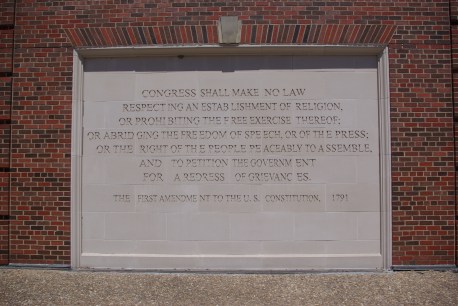
Here in Texas, we have the First Amendment engraved in stone, at Southern Methodist University.

Here in Texas, we have the First Amendment engraved in stone, at Southern Methodist University. Photo by Ed Darrell – use encouraged.
Text of the First Amendment: Amendment:
Congress shall make no law respecting an establishment of religion, or prohibiting the free exercise thereof; or abridging the freedom of speech, or of the press; or the right of the people peaceably to assemble, and to petition the Government for a redress of grievances.


Mountain goat nemeses everywhere!

August 12, 2013

Normally I might just let this beautiful photo slide by without comment.

In this case, I find this particularly frustrating.  See that creature?  That’s the same goat that blocked my trail in Glacier National Park.  I’m sure of it.  I’d recognize those beady eyes and horns anywhere! (See the first story linked to in the “more’ section; maybe this goat stopped in Washington on the way to Alaska.)

He’s probably in Alaska now under the Federal Goat Protection Program.

Harding Icefield Trail @KenaiFjordsNPS. #alaska pic.twitter.com/yozsSLnrcD

Interior US Dept of Interior 6h Caption from the Department of Interior: That’s quite the hike to the top. Harding Icefield Trail @KenaiFjordsNPS. #alaska pic.twitter.com/yozsSLnrcD

He probably thinks he’s safe there at Kenai Fjords National Park.  Ha!  He’s farther away, but that just means I have farther to travel to find him!

I’m taking a longer telephoto, a wide angle, and a first aid kit, next time.  I’ll be prepared!

More:


The climate warmed, and I didn’t speak up, because I was not a cloud . . .

August 12, 2013

Another cartoon on climate change denialism, and the bizarre logic some denialists use — no apologies made to Niemoller at XKCD’s site:

http://xkcd.com/164/

XKCD cartoon, by Randall Munroe

[It appears that the word “denialism” triggers WordPress software to suggest “Fox News” as a topic.]

More:


Signs: Cthulu’s return? Don’t kick jelly fish?

August 12, 2013

Don Knuth at Stanford University collects signs.

Actually he collects photos of signs, especially the diamond-shaped informational-warning signs.

What in the world is this one?

A sign photographed in Australia, in the Knuth Collection.

A sign photographed in Australia, in the Knuth Collection.

Your nominations for captions welcomed in comments.

More, sorta — or maybe, “tangentially related” is a better description:  

Donald Knuth at a reception for the Open Conte...

Donald Knuth at a reception for the Open Content Alliance, hosted by the Internet Archive. Taken October 25, 2005 by Jacob Appelbaum in San Francisco. (Wikipedia image)


Win P. Z. Myers’s book!

August 12, 2013

Go here to ShelfAwareness, enter to win a copy of P. Z. Myers’s book The Happy Atheist.

They’ll subscribe you to their newsletter list.  But it’s a nice newsletter for smart and happy people who like to read (you, that is).  Plus, you may always unsubscribe, later.  If you use that link, I get an entry in the contest, too.  Selfish of me, no doubt.

Cover of The Happy Atheist; click image to go to Amazon.com and read a few pages.

Cover of The Happy Atheist; click image to go to Amazon.com and read a few pages. (I’m sure they’ll let you buy the book there, too.)

Good luck.

Oh, the book?

In this funny and fearless book, PZ Myers takes on the religious fanaticism of our times with all the gleeful disrespect it deserves, skewering the apocalyptic fantasies, magical thinking, hypocrisies, and pseudoscientific theories advanced by religious fundamentalists of all stripes. Forceful and articulate, scathing and funny, The Happy Atheist is finally a reaffirmation of the revelatory power of humor, and the truth-revealing powers of science and reason.

See Greg Laden’s review of the book, here.  It has a surprise ending, Laden said, in comments.

Myers strongly supports good science education — heck, he teaches biology at a state university.  You know him as the poobah at Pharyngula and one of the cofounders of Panda’s Thumb.  He probably gets a small smackeral of income off of each sale.  It’s probably a great read (I haven’t read it yet).

More:


90 years ago: Harding died in San Francisco; Coolidge rose to presidency

August 11, 2013

It’s another one of those mostly-unexplored crevices of history.  90 years ago this August, President Warren G. Harding died in a San Francisco hotel, while on a trip visiting western states.  Harding’s death promoted Calvin Coolidge to the presidency.  They were Republican presidents in one of the hottest stock market eras of all time, during the Roaring ’20s.  Their policies probably helped lead the nation to the financial ruin after the dramatic stock market crash of 1929.

Perhaps its no wonder people would like to forget that fascinating time — but shouldn’t we really give Harding and Coolidge some diligent study?  Consider: Harding and Coolidge would be the last ticket to defeat Franklin Delano Roosevelt for anything; FDR’s reputation rests on his rollback of Harding-Coolidge-Hoover policies.  But in 1920, FDR’s ticket ran on policies more similar to those policies than opposed to them.  Odd how history turns sometimes.

Warren Gamaliel Harding won the election to succeed Woodrow Wilson, some said simply because he looked like a president.  Harding was a little laid back for the times — considering McKinley was assassinated, his successor, the hyper-caffeinated Teddy Roosevelt would die young of a heart attack, obesity nearly took out Teddy’s successor, William H. Taft, and Wilson had suffered a stroke about half-way through his second term.  It was an era when high blood pressure had no particular treatment, and the Type A men who presided over the nation could suffer from all the syndromes high blood pressure can cause.  At the White House website [links added here]:

In 1921, President Warren Harding spoke into a recording apparatus to create a phonographic copy of one of his speeches.  Photo from the Miller Center, University of Virginia

In 1921, President Warren Harding spoke into a recording apparatus to create a phonographic copy of one of his speeches. Photo from the Miller Center, University of Virginia

Before his nomination, Warren G. Harding declared, “America’s present need is not heroics, but healing; not nostrums, but normalcy; not revolution, but restoration; not agitation, but adjustment; not surgery, but serenity; not the dramatic, but the dispassionate; not experiment, but equipoise; not submergence in internationality, but sustainment in triumphant nationality….”

A Democratic leader, William Gibbs McAdoo, called Harding’s speeches “an army of pompous phrases moving across the landscape in search of an idea.” Their very murkiness was effective, since Harding’s pronouncements remained unclear on the League of Nations, in contrast to the impassioned crusade of the Democratic candidates, Governor James M. Cox of Ohio and Franklin D. Roosevelt.

Thirty-one distinguished Republicans had signed a manifesto assuring voters that a vote for Harding was a vote for the League. But Harding interpreted his election as a mandate to stay out of the League of Nations.

Harding took office promising to be a business-friendly president, meaning he supported the big money guys.  Laying out a lesson of history that too many today never learned, Harding led Washington to cut taxes on the upper income levels and bigger businesses, and set up the Roaring ’20s economy that would lead to the financial collapse of the U.S. in 1929, plunging the nation into the Great Depression.  Off the job, he played poker at the White House with bootleg whiskey on the table.  No Treasury “revenuer” would bust the President and his high-rolling friends.

In 1923, Harding’s luck started to run out.  Stories of corruption in his administration began to circulate.  The Miller Center describes what led to his unexpected death:

Death of the President

Shaken by the talk of corruption among the friends he had appointed to office, Warren and Florence Harding began a tour on June 20, 1923 of the West and Alaska. He hoped to get out and meet people, to shake hands and explain his policies. Although suffering from high blood pressure and an enlarged heart, he seemed to enjoy himself—especially in Alaska. On his return journey, he became ill with what was then attributed to a touch of ptomaine (food) poisoning. The presidential train rushed to San Francisco, where his condition worsened. On August 2, he most likely suffered a heart attack in the evening, while his wife was reading to him. He died quietly and instantaneously.

Word quickly spread that Mrs. Harding, the last person to be with him that evening, had poisoned him to prevent him from being brought up on charges of corruption that soon engulfed his administration. A sensationalist book published in 1930 detailed the allegations against her. Her refusal to allow an autopsy of the President only fed the rumors. Harding left the bulk of his estate, valued at $850,000, to his wife.

It was August, after all.  Coolidge retreated from Washington to his home in Vermont.  The Miller Center’s account is a good one:

On August 2, 1923, John Coolidge woke his vacationing son and daughter-in-law at the family home in Plymouth Notch, Vermont, to tell them of President Harding’s death from a heart attack. Coolidge knelt, prayed, and went downstairs. Although the old house had no phone, it was soon abuzz with reporters. At 2:24 a.m., with the newspaper men settled and a copy of the Constitution retrieved, the elder Coolidge, a justice of the peace, administered the oath of office to his son by the light of a kerosene lamp. Soon after, Calvin Coolidge went back to bed as the 30th President of the United States.

Coolidge is the only president to have been sworn in by a close family member.  The “Constitution retrieved”  should be a point of study of presidential aides.  After the assassination of President John Kennedy in Dallas, federal Judge Sarah Hughes got a call to administer the oath of office to Lyndon Johnson before Johnson flew back to Washington.  Hughes said she’d do it, but she needed a copy of the oath.  Apparently not giving adequate thought, this spurred a furious search for a copy of the oath.  After too long, a lawyer in the U.S. attorney’s office recalled the oath is in the Constitution, and a copy in a law book was taken to where Johnson and the presidential entourage awaited aboard Air Force 1 at Love Field.

You never know when you’re going to need to remember history, and know where to retrieve some bit of law.

Coolidge used a calm hand at the tiller during his presidency, continuing what he and others thought to be wise policies to encourage the growth of business.  He’s always struck me as one of the better balanced men in the White House.  Coolidge brought Scouting into the mansion, for his two sons, John, and Calvin, Jr. — he was devoted to his family, and to outdoor recreation (though usually in a coat and tie — the fashion of the time).  John attended Amherst College during his father’s term.

He won his own term of office in 1924, but lost his younger son.  Calvin, Jr., played his brother in tennis, but developed a blister on his foot from the match.  The blister got infected, and the boy developed blood poisoning, which took his life on July 7, 1924.  Although Coolidge, Sr., won the election that fall, after his son’s death he appeared anxious to get out of the White House.  Using the “two-term” precedent as his excuse, and claiming the small part of Harding’s term as his first, Coolidge did not run for re-election in 1928.

Coolidge enjoyed wearing various hats, and did not blanch at posing in clothing created for him, which means we have a rich (though limited) catalog of photographs of Coolidge in strange attire.  Campaign staffs for presidential candidates since at least 1960 have made a study of this, working hard to avoid such photos, failing with some consequences.

President Calvin Coolidge and a 10-gallon hat.  Library of Congress image

President Calvin Coolidge and a 10-gallon hat. Library of Congress image

More:


Remembering Leonidas and the 300 Spartans: died August 11, 480 B.C.

August 11, 2013

300 popped up on some movie channel back in 2008 as I was preparing to teach world history again.  I did not major in history, and my high school history instruction featured no AP courses (Pleasant Grove High, in Utah, didn’t offer such things then; I assume they do now, but I don’t know).

What I knew about Sparta and the stand of the 300 at Thermopylae came from my reading encyclopedias as a child, and culture.  Never had an occasion to write a speech about the events, though had I known the history better, I might have found some opportunity.  Sen. Orrin Hatch would have loved a compare and contrast speech between the stand of the Spartans and his work against the labor law reform bill in 1977 and 1978; more likely, we could have used the simple historical facts that the stand of the 300 at the same place today would be impossible due to poor soil conservation practices of the local farmers, which has created a plain broad enough for a Persian Army to march through with impunity, never fearing drowning in the sea that no longer exists there.  Thermopylae is a grand historical metaphor for a good orator.  The simple facts of history are important, too — Churchill knew Herodotus’s stories well, and considered them when planning military actions in the area in two world wars.

The movie came up from students in the previous year; it offered, perhaps, a hook for an introduction to world history, explaining why we bother to study it at all.

I got a time delay recording to watch it, which I did, mostly.  Interesting stylization.  Cartoonish characterizations, which one should expect from a movie intended as homage to the graphic novel that directly spawned it, more than an instruction about history.  We might doubt that the Persians had trained and armored rhinoceroses in their armament.  Dialogue — well, this is Hollywood.  It would have been in some dialect of Greek, and no Hollywood scriptwriter would have been able to reproduce it.

What about the battle itself.  World history courses in U.S. high schools should pay attention to this battle, I think.

A monument to Leonidas I - Inscription, Molon Lave, which roughly translates to Come and get it!

A monument to Leonidas I – Inscription, “Molon Lave,” which roughly translates to “Come and get it!”

Several sources dated the climax of the battle as August 11, 480 B.C. — 2,493 years ago. (The battle is said to have occurred during the Olympics that year, too.)

World history classes dig through that period of history in the first semester.  Teachers, it’s time to think about how we’re going to facilitate this history this year.  As always, some bright student will wave a hand in the air and ask, “Mr. Darrell!  How do they know what happened if no one survived, and nobody had their Sony videocorder?”

At least one other student in the course of the day will be surprised to discover the movie wasn’t a filmed-on-the-spot documentary.  But apart from that, how do we know the events well enough to pin it down to one day?  And, since the Greeks surely didn’t use the Gregorian calendar, since it wasn’t invented until the 18th century — how do we know the date?

The short answer is “Herodotus.”  The longer answer may resonate better:  This is one dramatic battle in a year-long fight for the history of the world.  The Greeks were understandably and justifiably proud that they had turned back Xerxes’s armies and navy (The Battle of Salamis, a bit after Thermopylae).  So, these events were preserved in poetry, in the chronicles, in song, in sculpture, and in every other medium available to the Greeks.  Your AP English students will probably tell you the movie reminds them of The IliadThere’s an entré for discussion.

Turning points in history:  Had Xerxes succeeded in avenging his father’s, Darius’s, defeats, and subjugated the Greeks, history would be much different.  The culture the Romans built on, the trading patterns from east to west and around the Mediterranean, the technologies, the myths, and the stories of the battles, would be different. (Remember, one of Darius’s defeats was at the Battle of Marathon, from which we get the modern marathon racing event, the traditional close of the modern Olympics.)

How do we know?  How do we know?

How do you handle that question?  (Tell us in comments, please.)

I like this battle for the way it ties together many of the loose threads that vex high school sophomores.  Is history exciting?  It can be, as the Frank Miller graphic novel and and the Zack Snyder movie demonstrate.  How important is accuracy in making the story exciting?  (Do the rhinoceroses improve the story of the courage of the Spartans, or merely offer a good graphical metaphor for the overwhelming forces of the Persians?)  What happens when one nation invades another — who has the advantage?  Is knowledge of geography important — in battle, for example?  The philosopher Santayana notes that those who do not remember history are “condemned” to repeat it.  Xerxes tried to apply the lessons of the history of his father’s failed invasion; was he successful?  Remember this point:  Napoleon failed in his invasion of Russia in 1812; Adolf Hitler assigned his generals to study Napoleon’s failure, for Germany’s invasion of Russia in 1941; so convinced were the Germans that they knew the lessons, they invade Russia on the anniversary of Napoleon’s invasion.  Did it go any better?  George Washington consciously patterned his life on the great Roman warrior and leader, Cincinnatus — especially in turning over rule once the task was done, as Washington did twice.  What if Washington had, instead, patterned his life after Leonidas?  How might the American Revolution have turned out, and how might the United States have developed, had Washington sacrificed himself as Leonidas did?

The story of the Battle of Thermopylea, the bravery and cunning tactics of Leonidas and the 300, the wars between Persia and the Greek City States, form a good foundation for a study of history at any point after.  It is the stuff of great history, and the stuff of great rhetoric.  It could be the stuff of great AP essays and good writing exercises in general.   Damn the Common Core State Standards*, and damn the misguided Texas critics of CSCOPE, this is a topic I wish more world history teachers would spend some good, profitable time on

Resources and commentary on Thermopylae, Leonidas, and the 300:

More:

Livius.org map of the area where the Battle of Thermopylae was fought

Livius.org map of the area where the Battle of Thermopylae was fought. Note that, in purple, the map shows where a plain now exists, which was an ocean the Spartans could use to squeeze the Persian Army, about 25 centuries ago. What a difference 25 centuries can make.

_____________

*  Common Core State Standards in social studies actually would support what I’m asking here, if only they weren’t filtered through state school boards who do not value scholarship, but instead wish history to be a checklist of faux-patriotic bullet points to regurgitate.  Here in Texas, we are not affected by Common Core — but we are affected by meddling in history standards by people whose agenda does not include making history exciting and good.  Common Core standards — technically — do not mention Thermopylae.  However, this is the sort of material, including the original texts of Herodotus, whose study the Common Core standards encourage, especially for analysis of the sort I think Thermopylae invites.  Texas TEKS allow mention of the battle, though the Battle of Thermopylae has been purged from the actual standards; Texas lesson plans frequently suggest “watching a film on the Battle of Thermopylae,” and “Answer questions on the battle; trade and grade.”  Teachers infuse those dull words with life — we hope.  Teachers’ actual practice in the classroom is the saving grace for this important history, in Texas; Texas world history teachers face their own Xerxes.  The Texas Lege recently removed the requirement that students study world history, instead giving them a choice of either world history or world geography.  And so the dumbing down of history by (probably well-meaning, but not well-thinking) legislators continues.


49 years ago: August 7, 1964, Congress passed the Gulf of Tonkin Resolution

August 7, 2013

August 7 is the 43rd anniversary of the Gulf of Tonkin Resolution, the resolution which authorized President Lyndon B. Johnson to move troops into South Vietnam to defend U.S. interests.

Gulf of Tonkin Resolution, passed by Congress on August 7, 1964, as presented to President Lyndon Johnson, and signed by him on August 10. This is the document that authorized U.S. involvement in Vietnam. Image from the National Archives, Our Documents display.

Gulf of Tonkin Resolution, passed by Congress on August 7, 1964, as presented to President Lyndon Johnson, and signed by him on August 10. This is the document that authorized U.S. involvement in Vietnam. Image from the National Archives, Our Documents display.

The resolution passed Congress after what appeared to be attacks on two U.S. Navy ships in the Gulf of Tonkin.  At the time, and now, evidence is weak that such attacks took place.

Quick summary from the National Archives:

On August 4, 1964, President Lyndon Johnson announced that two days earlier, U.S. ships in the Gulf of Tonkin had been attacked by the North Vietnamese. Johnson dispatched U.S. planes against the attackers and asked Congress to pass a resolution to support his actions. The joint resolution “to promote the maintenance of international peace and security in southeast Asia” passed on August 7, with only two Senators (Wayne Morse and Ernest Gruening) dissenting, and became the subject of great political controversy in the course of the undeclared war that followed.

The Tonkin Gulf Resolution stated that “Congress approves and supports the determination of the President, as Commander in Chief, to take all necessary measures to repeal any armed attack against the forces of the United States and to prevent any further aggression.” As a result, President Johnson, and later President Nixon, relied on the resolution as the legal basis for their military policies in Vietnam.

As public resistance to the war heightened, the resolution was repealed by Congress in January 1971.

Santayana’s ghost looks on in wonder.

Map of divided Vietnam, during the Vietnam War. History Place map via Mr. Roache's Place

Map of divided Vietnam, during the Vietnam War. History Place map via Mr. Roache’s Place

Considering its powerful effect on American history, the document is very, very brief.  Here’s the text [links added]:

Eighty-eighth Congress of the United States of America
AT THE SECOND SESSION

Begun and held at the City of Washington on Tuesday, the seventh day of January, one thousand nine hundred and sixty-four

Joint Resolution
To promote the maintenance of international peace and security in southeast Asia.

Whereas naval units of the Communist regime in Vietnam, in violation of the principles of the Charter of the United Nations and of international law, have deliberately and repeatedly attacked United Stated naval vessels lawfully present in international waters, and have thereby created a serious threat to international peace; and

Whereas these attackers are part of deliberate and systematic campaign of aggression that the Communist regime in North Vietnam has been waging against its neighbors and the nations joined with them in the collective defense of their freedom; and

Whereas the United States is assisting the peoples of southeast Asia to protest their freedom and has no territorial, military or political ambitions in that area, but desires only that these people should be left in peace to work out their destinies in their own way: Now, therefore be it

Resolved by the Senate and House of Representatives of the United States of America in Congress assembled, That the Congress approves and supports the determination of the President, as Commander in Chief, to take all necessary measures to repel any armed attack against the forces of the United States and to prevent further aggression.

Map showing ship movements reported during the Gulf of Tonkin Incident, on August 4, 1964; reports that North Vietnamese gunboats attacked and engaged two patrolling U.S. Navy ships pushed Congress to authorize President Johnson to take extensive defensive actions.

Map showing ship movements reported during the Gulf of Tonkin Incident, on August 4, 1964; reports that North Vietnamese gunboats attacked and engaged two patrolling U.S. Navy ships pushed Congress to authorize President Johnson to take extensive defensive actions. (image from Echo Two Seven Tooter, replaced with Wikipedia map 8/2017)

Section 2. The United States regards as vital to its national interest and to world peace the maintenance of international peace and security in southeast Asia. Consonant with the Constitution of the United States and the Charter of the United Nations and in accordance with its obligations under the Southeast Asia Collective Defense Treaty, the United States is, therefore, prepared, as the President determines, to take all necessary steps, including the use of armed force, to assist any member or protocol state of the Southeast Asia Collective Defense Treaty requesting assistance in defense of its freedom.

Section 3. This resolution shall expire when the President shall determine that the peace and security of the area is reasonably assured by international conditions created by action of the United Nations or otherwise, except that it may be terminated earlier by concurrent resolution of the Congress.

[endorsements]

And on that authority, “Congress approves and supports the determination of the President, as Commander in Chief, to take all necessary measures to repel any armed attack against the forces of the United States and to prevent further aggression,” the U.S. spent the next 11 years in all-out warfare in Vietnam, with up to 500,000 military troops in the conflict, and losing the lives of more than 58,000 men and women.

U.S. engagement in Vietnam continued well after the repeal of the Tonkin Gulf Resolution in 1971.  In 1973 a peace treaty was signed between the U.S., North Vietnam and South Vietnam.  The provisions of the treaty did not hold; a final North Vietnamese military push in April 1975 crumpled the South Vietnamese government and army.  The few remaining U.S. forces made an emergency withdrawal as Viet Cong and North Vietnamese troops entered Saigon.  Vietnam was reunited by force, under a communist government.

Attacks on the USS Maddox and USS Turner Joy — if they occurred — took place early on August 4.  President Johnson might be excused for having done nothing on the issue at the time.  That was the same day that the bodies of three civil rights workers were discovered by the FBI, murdered by a pro-segregation mob with clear ties to the local Ku Klux Klan.  Either event, the Gulf of Tonkin, or the Mississippi civil rights murders, could be a major event in any presidency, testing to the utmost the leadership and peace-making abilities of a president.  Johnson dealt with both events at the same time.

Three American civil rights’ workers, James Earl Chaney, Andrew Goodman, and Michael “Mickey” Schwerner, were lynched on the night of June 21–22, 1964 by members of the Mississippi White Knights of the Ku Klux Klan, the Neshoba County‘s Sheriff Office and the Philadelphia Police Department located in Philadelphia, Mississippi. The three had been working on the “Freedom Summer” campaign, attempting to register African Americans to vote.

On a commission from the Dallas Symphony, composer Stephen Stucky composed a piece during the Lyndon Johnson Centennial in 2008; Kathryn and I heard the world premiere of August 4, 1964, on September 18, 2008.  Stucky’s piece (with libretto by Gene Scheer) is the only place I know where anyone has seriously considered the nexus between these two, opposite-side-of-the-world tragedies, and how they set the stage for the rest of the 1960s decade.   The piece has been recorded by the Dallas Symphony.  I highly recommend it.

Here’s a video from the Dallas Symphony on the piece:

More:

Save


Signs of Life: The bowtie on the Paul Simon Highway

August 7, 2013

Driving through Illinois around Chicago — as we had many opportunities to do while younger son James attended Lawrence University in Wisconsin — one can be delighted and amused by the signs marking parts of Interstate 55 as the Paul Simon Freeway.  Simon’s rise up through editorial ranks of small newspapers, to state legislator and U.S. Senator was fueled by his great common sense and very studious habits when it came to history and public policy.

You can’t put all that on a road sign.  But you can put a picture of his bowtie there.  Honestly, we laughed out loud when we saw one for the first time.

I never could find one of the signs where it might be safe to pull off get a good photograph.  Surely someone in Illinois would have one, right?

Just try to find a good picture of these great signs.  I finally found this one on Flickr:

Paul Simon Freeway Bowtie Sign on I-55 near Edwardsville, IL_DSCN9495c  - Flickr photo by Wampa-One

Paul Simon Freeway Bowtie Sign on I-55 near Edwardsville, IL_DSCN9495c – Flickr photo by Wampa-One

Paul Simon, the Illinois politician, was a great guy.  Search for photos of the Tom Landry Highway signs in Texas, you’ll get a boatload of close-up shots.  Come on, Illinois:  Somebody go get a photo of those “Paul Simon Freeway” signs worthy of the man, and post it on the ‘net!

U.S. Sen. Paul Simon, D-Illinois. Biographical Directory of the U.S. Congress

U.S. Sen. Paul Simon, D-Illinois. Biographical Directory of the U.S. Congress


Signs of life: Tufte’s signs that ought to be

August 7, 2013

From Edward Tufte:

Edward Tufte, Road Never Ends, print on canvas, 29 ½

Edward Tufte, Road Never Ends, print on canvas, 29 ½” x 29 ½”, edition of 3

Philosophy on road signs.  Will it catch on?  Has it caught on already?


Wind power fastest growing energy segment?

August 6, 2013

It was a Tweet from the Secretary of Energy, Ernest Moniz, so it must be so:

Wind Technologies Market Report 2012, from the U.S. Department of Energy

Wind Technologies Market Report 2012, from the U.S. Department of Energy

Generally good trends.  Chris Clarke and the Californians defending the deserts think windfarms are blots on the California deserts — and they’re right — but we can find lots of other places to put them in.

Texas showed greatest growth in windpower among the states.  South Dakota, Iowa and Kansas now get more than 20% of their electricity from wind generation.

Work needs to be done to make these bird-friendlier, especially friendlier to raptors. Solvable problems, I think.

What do you think?

More:


August 6: Hiroshima atomic bomb, 68 years ago today

August 6, 2013

A-Bomb Dome in Hiroshima, Japan

A-Bomb Dome in Hiroshima, Japan Wikipedia image

As a Utah Downwinder, I fight depressing ideas every August 6, and August 9.

The first atomic bomb used in war was dropped by my nation on August 6, 1945.  The second, on August 9.  Hiroshima, then Nagasaki, were the targets.

I know the arguments, both ways.  I feel certain my Uncle Leo B. Stewart’s life was saved by the bombs — and the lives of probably two or three million more Americans, and five or ten million Japanese.  And still I am troubled.

I’m troubled that there seems to be so little attention paid to the anniversary in the U.S.  Year by year, it gets tougher to get news out of remembrance ceremonies in Japan.  Here are some Twitter notes on the day.  I may be back with more, later.

http://twitter.com/TimHarford/status/364792998275448835

This comes from a pseudo-Truman, but it’s an accurate reflection of the angst Truman went through; once he made the decision, he did not have doubts that it was the right one.

Fortunately, in 68 years since, no other nuclear device has ever been used in war. May we have a planet that never sees their use in war, again.

More:


Annals of global warming: 2012 hits top 10 hottest years

August 6, 2013

NOAA’s article on the State of the Climate released today:

2012 was one of the 10 warmest years on record globally

The end of weak La Niña, unprecedented Arctic warmth influenced 2012 climate conditions

August 6, 2013

State of the Climate in 2012 - report cover.

The 2012 State of the Climate report is available online.
(Credit: NOAA)

Worldwide, 2012 was among the 10 warmest years on record according to the 2012 State of the Climate report released online today by the American Meteorological Society (AMS). The peer-reviewed report, with scientists from NOAA’s National Climatic Data Center in Asheville, N.C., serving as lead editors, was compiled by 384 scientists from 52 countries (highlights, full report). It provides a detailed update on global climate indicators, notable weather events, and other data collected by environmental monitoring stations and instruments on land, sea, ice, and sky.

“Many of the events that made 2012 such an interesting year are part of the long-term trends we see in a changing and varying climate — carbon levels are climbing, sea levels are rising, Arctic sea ice is melting, and our planet as a whole is becoming a warmer place,” said Acting NOAA Administrator Kathryn D. Sullivan, Ph.D. “This annual report is well-researched, well-respected, and well-used; it is a superb example of the timely, actionable climate information that people need from NOAA to help prepare for extremes in our ever-changing environment.”

Conditions in the Arctic were a major story of 2012, with the region experiencing unprecedented change and breaking several records. Sea ice shrank to its smallest “summer minimum” extent since satellite records began 34 years ago. In addition, more than 97 percent of the Greenland ice sheet showed some form of melt during the summer, four times greater than the 1981–2010 average melt extent.

Temperature in 2012 compared to the 1981-2010 average.

Temperature in 2012 compared to the 1981-2010 average. Credit: NOAA Climate.gov, based on NCDC data. See more.

The report used dozens of climate indicators to track and identify changes and overall trends to the global climate system. These indicators include greenhouse gas concentrations, temperature of the lower and upper atmosphere, cloud cover, sea surface temperature, sea-level rise, ocean salinity, sea ice extent and snow cover. Each indicator includes thousands of measurements from multiple independent datasets.

Highlights:

  • Warm temperature trends continue near Earth’s surface: Four major independent datasets show 2012 was among the 10 warmest years on record, ranking either 8th or 9th, depending upon the dataset used. The United States and Argentina had their warmest year on record.
  • La Niña dissipates into neutral conditions:  A weak La Niña dissipated during spring 2012 and, for the first time in several years, neither El Niño nor La Niña, which can dominate regional weather and climate conditions around the globe, prevailed for the majority of the year.
  • The Arctic continues to warm; sea ice extent reaches record low: The Arctic continued to warm at about twice the rate compared with lower latitudes. Minimum Arctic sea ice extent in September and Northern Hemisphere snow cover extent in June each reached new record lows. Arctic sea ice minimum extent (1.32 million square miles, September 16) was the lowest of the satellite era. This is 18 percent lower than the previous record low extent of 1.61 million square miles that occurred in 2007 and 54 percent lower than the record high minimum ice extent of 2.90 million square miles that occurred in 1980. The temperature of permafrost, or permanently frozen land, reached record-high values in northernmost Alaska. A new melt extent record occurred July 11–12 on the Greenland ice sheet when 97 percent of the ice sheet showed some form of melt, four times greater than the average melt this time of year.
  • Antarctica sea ice extent reaches record high: The Antarctic maximum sea ice extent reached a record high of 7.51 million square miles on September 26. This is 0.5 percent higher than the previous record high extent of 7.47 million square miles that occurred in 2006 and seven percent higher than the record low maximum sea ice extent of 6.96 million square miles that occurred in 1986.
  • Sea surface temperatures increase: Four independent datasets indicate that the globally averaged sea surface temperature for 2012 was among the 11 warmest on record.  After a 30-year period from 1970 to 1999 of rising global sea surface temperatures, the period 2000–2012 exhibited little trend. Part of this difference is linked to the prevalence of La Niña-like conditions during the 21st century, which typically lead to lower global sea surface temperatures.
  • Ocean heat content remains near record levels: Heat content in the upper 2,300 feet, or a little less than one-half mile, of the ocean remained near record high levels in 2012. Overall increases from 2011 to 2012 occurred between depths of 2,300 to 6,600 feet and even in the deep ocean.
  • Sea level reaches record high: Following sharp decreases in global sea level in the first half of 2011 that were linked to the effects of La Niña, sea levels rebounded to reach record highs in 2012. Globally, sea level has been increasing at an average rate of 3.2 ± 0.4 mm per year over the past two decades.
  • Ocean salinity trends continue: Continuing a trend that began in 2004, oceans were saltier than average in areas of high evaporation, including the central tropical North Pacific, and fresher than average in areas of high precipitation, including the north central Indian Ocean, suggesting that precipitation is increasing in already rainy areas and evaporation is intensifying in drier locations.

    Sea ice concentration reached a new record low in mid-September 2012.

    Sea ice concentration reached a new record low in mid-September 2012. Credit: NOAA Climate.gov, based on NSIDC data. See more.

  • Tropical cyclones near average: Global tropical cyclone activity during 2012 was near average, with a total of 84 storms, compared with the 1981–2010 average of 89. Similar to 2010 and 2011, the North Atlantic was the only hurricane basin that experienced above-normal activity.
  • Greenhouse gases climb: Major greenhouse gas concentrations, including carbon dioxide, methane, and nitrous oxide, continued to rise during 2012. Following a slight decline in manmade emissions associated with the global economic downturn, global CO2 emissions from fossil fuel combustion and cement production reached a record high in 2011 of 9.5 ± 0.5 petagrams (1,000,000,000,000,000 grams) of carbon , and a new record of 9.7 ± 0.5 petagrams of carbon  is estimated for 2012. Atmospheric CO2 concentrations increased by 2.1 ppm in 2012, reaching a global average of 392.6 ppm for the year. In spring 2012, for the first time, the atmospheric CO2concentration exceeded 400 ppm at several Arctic observational sites.
  • Cool temperature trends continue in Earth’s lower stratosphere: The average lower stratospheric temperature, about six to ten miles above the Earth’s surface, for 2012 was record to near-record cold, depending on the dataset. Increasing greenhouse gases and decline of stratospheric ozone tend to cool the stratosphere while warming the planet near-surface layers.

The 2012 State of the Climate report is peer-reviewed and published annually as a special supplement to the Bulletin of the American Meteorological Society. This year marks the 23rd edition of the report, which is part of the suite of climate services NOAA provides to government, the business sector, academia, and the public to support informed decision-making. The full report can be viewed online.

NOAA’s mission is to understand and predict changes in the Earth’s environment, from the depths of the ocean to the surface of the sun, and to conserve and manage our coastal and marine resources. Join us on FacebookTwitter and our other social media channels.

More:


Remembering Mermelstein the Hero, a day late

August 6, 2013

It’s a big world.  A lot happens every day.

Over time, significantly historic events tend to pile up on every day of the year.  This is important to remember shortly after the ides of April when students — almost always male — start going on about Hitler’s birthday, Hitler’s suicide, and any other events that may fall on those days.  It’s good to remember coincidence plays a huge role in history, much more than those looking for woo connections will admit.

But I also like to celebrate important events.  Yesterday I posted on Damn the Torpedoes Day, the anniversary of the Battle of Mobile Bay and then-Capt. David Farragut’s famous line.

Doing that, and a dozen other things, I completely overlooked another anniversary that carries a lot of weight with me, and I hope with you, too.  I was reminded this morning when I saw the post from Professor Olsen @ Large, noting the day Mel Mermelstein beat the Holocaust deniers in court, and established in U.S. law the historical fact of the Holocaust.

On this date [August 5], Long Beach, California businessman Melvin Mermelstein struck a powerful blow against bogus history and historical hoaxes. Mel was awarded a judgment in a California court, in a contract case.

In 1980, the Institute for Historical Review (IHR), a Torrance, California organization that claimed that the planned extermination of Jews by the Nazis was a myth, had offered a $50,000 reward for anyone who could prove that the Holocaust actually happened.

*     *     *     *     *

Mermelstein’s lawyer, William John Cox, had a brilliant idea. He petitioned the court to take “judicial notice” of the fact of the Holocaust. The doctrine of judicial notice allows courts to recognize as fact something that is so well established that it doesn’t need to be evidenced when it is introduced in court — such as, 2 + 2 = 4, the freezing point of water is 32 degrees Fahrenheit and 0 degrees Celsius, the Earth orbits the Sun, etc.

In a pre-trial hearing on 9 October 1981, Los Angeles County Superior Court Judge Thomas T. Johnson resolved the most controversial part of the case; the court ruled that the Holocaust had occurred. The judge declared:

Under Evidence Code Section 452(h), this court does take judicial notice of the fact that Jews were gassed to death at the Auschwitz Concentration Camp in Poland during the summer of 1944.

(…)

It just simply is a fact that falls within the definition of Evidence Code Section 452(h). It is not reasonably subject to dispute. And it is capable of immediate and accurate determination by resort to sources of reasonably indisputable accuracy. It is simply a fact.

That ruling meant that, by operation of law, Mermelstein had won the case, obviating the need for a court trial.

Prof. Olsen has much more — go read — and I’ve listed my previous posts on Mel Mermelstein below.

There were two points of law in the case that delighted me.  One was the sweepstakes contract, and the other was the judicial note.  A sweepstakes contract is one where someone makes an offer, “the first one who does X, gets $,” for example.  While it’s a bit obscure, it is a point of contract law that sweepstakes contracts are enforceable in court (common law, as most contract law is).  Willis Carto‘s Holocaust denial group, the Institute for Historical Review (IHR), hadn’t realized that they made a bona fide, potentially legally-binding offer.  Mermelstein did, performed the required task, and demanded payment.  When IHR refused to pay, Mermelstein hauled them into court.

Judicial note is another oddity of law school, that I think is probably used way too seldom to squelch stupid lawsuits.  The rule — again in common law — is that a judge may take note of certain facts so they need not be evidenced and “proven” in court, over and over again.  The sky is blue, most of the time (black at night); boiling water is hot; 2+2=4 — those are the sorts of facts that judges may rule need not be evidenced at every trial where they might play a role.  Mermelstein’s lawyer, William John Cox — another hero, along with Lawrence E. Heller and all of Mermelstein’s lawyers — moved that the court take judicial note of the fact of the Holocaust.  The judge held a hearing, and did.

That meant there was no issue to take to trial in Mermelstein’s suit against IHR.  Where IHR had probably hoped for a chance to trot out their denialists claims, perhaps for broadcast and print media, the issue was now one solely for the judge to rule on the points of law — and on those points, Mermelstein won.  IHR had to pay him.

Plus, it was established in California, that the Holocaust did occur.  As a point of law, Holocause denialists are wrong.

August 5 should be Accurate History Day, too. 

You could combine the lessons of history from David Farragut, Mel Mermelstein, and Davey Crockett, and get a good philosophy.  Davey Crockett said, be sure you’re right, then go ahead.

Get your history right, stand up for human rights, and damn the torpedoes!

I could live with that.

Tree of Testimony from victims of the Holocaust, at the Los Angeles Museum of the Holocaust

Tree of Testimony from victims of the Holocaust, at the Los Angeles Museum of the Holocaust; dozens of interviews of survivors were taped by researchers at the University of Southern California, displayed on these video screens.

More: