Annals of global warming: 2012 hits top 10 hottest years

August 6, 2013

NOAA’s article on the State of the Climate released today:

2012 was one of the 10 warmest years on record globally

The end of weak La Niña, unprecedented Arctic warmth influenced 2012 climate conditions

August 6, 2013

State of the Climate in 2012 - report cover.

The 2012 State of the Climate report is available online.
(Credit: NOAA)

Worldwide, 2012 was among the 10 warmest years on record according to the 2012 State of the Climate report released online today by the American Meteorological Society (AMS). The peer-reviewed report, with scientists from NOAA’s National Climatic Data Center in Asheville, N.C., serving as lead editors, was compiled by 384 scientists from 52 countries (highlights, full report). It provides a detailed update on global climate indicators, notable weather events, and other data collected by environmental monitoring stations and instruments on land, sea, ice, and sky.

“Many of the events that made 2012 such an interesting year are part of the long-term trends we see in a changing and varying climate — carbon levels are climbing, sea levels are rising, Arctic sea ice is melting, and our planet as a whole is becoming a warmer place,” said Acting NOAA Administrator Kathryn D. Sullivan, Ph.D. “This annual report is well-researched, well-respected, and well-used; it is a superb example of the timely, actionable climate information that people need from NOAA to help prepare for extremes in our ever-changing environment.”

Conditions in the Arctic were a major story of 2012, with the region experiencing unprecedented change and breaking several records. Sea ice shrank to its smallest “summer minimum” extent since satellite records began 34 years ago. In addition, more than 97 percent of the Greenland ice sheet showed some form of melt during the summer, four times greater than the 1981–2010 average melt extent.

Temperature in 2012 compared to the 1981-2010 average.

Temperature in 2012 compared to the 1981-2010 average. Credit: NOAA Climate.gov, based on NCDC data. See more.

The report used dozens of climate indicators to track and identify changes and overall trends to the global climate system. These indicators include greenhouse gas concentrations, temperature of the lower and upper atmosphere, cloud cover, sea surface temperature, sea-level rise, ocean salinity, sea ice extent and snow cover. Each indicator includes thousands of measurements from multiple independent datasets.

Highlights:

  • Warm temperature trends continue near Earth’s surface: Four major independent datasets show 2012 was among the 10 warmest years on record, ranking either 8th or 9th, depending upon the dataset used. The United States and Argentina had their warmest year on record.
  • La Niña dissipates into neutral conditions:  A weak La Niña dissipated during spring 2012 and, for the first time in several years, neither El Niño nor La Niña, which can dominate regional weather and climate conditions around the globe, prevailed for the majority of the year.
  • The Arctic continues to warm; sea ice extent reaches record low: The Arctic continued to warm at about twice the rate compared with lower latitudes. Minimum Arctic sea ice extent in September and Northern Hemisphere snow cover extent in June each reached new record lows. Arctic sea ice minimum extent (1.32 million square miles, September 16) was the lowest of the satellite era. This is 18 percent lower than the previous record low extent of 1.61 million square miles that occurred in 2007 and 54 percent lower than the record high minimum ice extent of 2.90 million square miles that occurred in 1980. The temperature of permafrost, or permanently frozen land, reached record-high values in northernmost Alaska. A new melt extent record occurred July 11–12 on the Greenland ice sheet when 97 percent of the ice sheet showed some form of melt, four times greater than the average melt this time of year.
  • Antarctica sea ice extent reaches record high: The Antarctic maximum sea ice extent reached a record high of 7.51 million square miles on September 26. This is 0.5 percent higher than the previous record high extent of 7.47 million square miles that occurred in 2006 and seven percent higher than the record low maximum sea ice extent of 6.96 million square miles that occurred in 1986.
  • Sea surface temperatures increase: Four independent datasets indicate that the globally averaged sea surface temperature for 2012 was among the 11 warmest on record.  After a 30-year period from 1970 to 1999 of rising global sea surface temperatures, the period 2000–2012 exhibited little trend. Part of this difference is linked to the prevalence of La Niña-like conditions during the 21st century, which typically lead to lower global sea surface temperatures.
  • Ocean heat content remains near record levels: Heat content in the upper 2,300 feet, or a little less than one-half mile, of the ocean remained near record high levels in 2012. Overall increases from 2011 to 2012 occurred between depths of 2,300 to 6,600 feet and even in the deep ocean.
  • Sea level reaches record high: Following sharp decreases in global sea level in the first half of 2011 that were linked to the effects of La Niña, sea levels rebounded to reach record highs in 2012. Globally, sea level has been increasing at an average rate of 3.2 ± 0.4 mm per year over the past two decades.
  • Ocean salinity trends continue: Continuing a trend that began in 2004, oceans were saltier than average in areas of high evaporation, including the central tropical North Pacific, and fresher than average in areas of high precipitation, including the north central Indian Ocean, suggesting that precipitation is increasing in already rainy areas and evaporation is intensifying in drier locations.

    Sea ice concentration reached a new record low in mid-September 2012.

    Sea ice concentration reached a new record low in mid-September 2012. Credit: NOAA Climate.gov, based on NSIDC data. See more.

  • Tropical cyclones near average: Global tropical cyclone activity during 2012 was near average, with a total of 84 storms, compared with the 1981–2010 average of 89. Similar to 2010 and 2011, the North Atlantic was the only hurricane basin that experienced above-normal activity.
  • Greenhouse gases climb: Major greenhouse gas concentrations, including carbon dioxide, methane, and nitrous oxide, continued to rise during 2012. Following a slight decline in manmade emissions associated with the global economic downturn, global CO2 emissions from fossil fuel combustion and cement production reached a record high in 2011 of 9.5 ± 0.5 petagrams (1,000,000,000,000,000 grams) of carbon , and a new record of 9.7 ± 0.5 petagrams of carbon  is estimated for 2012. Atmospheric CO2 concentrations increased by 2.1 ppm in 2012, reaching a global average of 392.6 ppm for the year. In spring 2012, for the first time, the atmospheric CO2concentration exceeded 400 ppm at several Arctic observational sites.
  • Cool temperature trends continue in Earth’s lower stratosphere: The average lower stratospheric temperature, about six to ten miles above the Earth’s surface, for 2012 was record to near-record cold, depending on the dataset. Increasing greenhouse gases and decline of stratospheric ozone tend to cool the stratosphere while warming the planet near-surface layers.

The 2012 State of the Climate report is peer-reviewed and published annually as a special supplement to the Bulletin of the American Meteorological Society. This year marks the 23rd edition of the report, which is part of the suite of climate services NOAA provides to government, the business sector, academia, and the public to support informed decision-making. The full report can be viewed online.

NOAA’s mission is to understand and predict changes in the Earth’s environment, from the depths of the ocean to the surface of the sun, and to conserve and manage our coastal and marine resources. Join us on FacebookTwitter and our other social media channels.

More:


Remembering Mermelstein the Hero, a day late

August 6, 2013

It’s a big world.  A lot happens every day.

Over time, significantly historic events tend to pile up on every day of the year.  This is important to remember shortly after the ides of April when students — almost always male — start going on about Hitler’s birthday, Hitler’s suicide, and any other events that may fall on those days.  It’s good to remember coincidence plays a huge role in history, much more than those looking for woo connections will admit.

But I also like to celebrate important events.  Yesterday I posted on Damn the Torpedoes Day, the anniversary of the Battle of Mobile Bay and then-Capt. David Farragut’s famous line.

Doing that, and a dozen other things, I completely overlooked another anniversary that carries a lot of weight with me, and I hope with you, too.  I was reminded this morning when I saw the post from Professor Olsen @ Large, noting the day Mel Mermelstein beat the Holocaust deniers in court, and established in U.S. law the historical fact of the Holocaust.

On this date [August 5], Long Beach, California businessman Melvin Mermelstein struck a powerful blow against bogus history and historical hoaxes. Mel was awarded a judgment in a California court, in a contract case.

In 1980, the Institute for Historical Review (IHR), a Torrance, California organization that claimed that the planned extermination of Jews by the Nazis was a myth, had offered a $50,000 reward for anyone who could prove that the Holocaust actually happened.

*     *     *     *     *

Mermelstein’s lawyer, William John Cox, had a brilliant idea. He petitioned the court to take “judicial notice” of the fact of the Holocaust. The doctrine of judicial notice allows courts to recognize as fact something that is so well established that it doesn’t need to be evidenced when it is introduced in court — such as, 2 + 2 = 4, the freezing point of water is 32 degrees Fahrenheit and 0 degrees Celsius, the Earth orbits the Sun, etc.

In a pre-trial hearing on 9 October 1981, Los Angeles County Superior Court Judge Thomas T. Johnson resolved the most controversial part of the case; the court ruled that the Holocaust had occurred. The judge declared:

Under Evidence Code Section 452(h), this court does take judicial notice of the fact that Jews were gassed to death at the Auschwitz Concentration Camp in Poland during the summer of 1944.

(…)

It just simply is a fact that falls within the definition of Evidence Code Section 452(h). It is not reasonably subject to dispute. And it is capable of immediate and accurate determination by resort to sources of reasonably indisputable accuracy. It is simply a fact.

That ruling meant that, by operation of law, Mermelstein had won the case, obviating the need for a court trial.

Prof. Olsen has much more — go read — and I’ve listed my previous posts on Mel Mermelstein below.

There were two points of law in the case that delighted me.  One was the sweepstakes contract, and the other was the judicial note.  A sweepstakes contract is one where someone makes an offer, “the first one who does X, gets $,” for example.  While it’s a bit obscure, it is a point of contract law that sweepstakes contracts are enforceable in court (common law, as most contract law is).  Willis Carto‘s Holocaust denial group, the Institute for Historical Review (IHR), hadn’t realized that they made a bona fide, potentially legally-binding offer.  Mermelstein did, performed the required task, and demanded payment.  When IHR refused to pay, Mermelstein hauled them into court.

Judicial note is another oddity of law school, that I think is probably used way too seldom to squelch stupid lawsuits.  The rule — again in common law — is that a judge may take note of certain facts so they need not be evidenced and “proven” in court, over and over again.  The sky is blue, most of the time (black at night); boiling water is hot; 2+2=4 — those are the sorts of facts that judges may rule need not be evidenced at every trial where they might play a role.  Mermelstein’s lawyer, William John Cox — another hero, along with Lawrence E. Heller and all of Mermelstein’s lawyers — moved that the court take judicial note of the fact of the Holocaust.  The judge held a hearing, and did.

That meant there was no issue to take to trial in Mermelstein’s suit against IHR.  Where IHR had probably hoped for a chance to trot out their denialists claims, perhaps for broadcast and print media, the issue was now one solely for the judge to rule on the points of law — and on those points, Mermelstein won.  IHR had to pay him.

Plus, it was established in California, that the Holocaust did occur.  As a point of law, Holocause denialists are wrong.

August 5 should be Accurate History Day, too. 

You could combine the lessons of history from David Farragut, Mel Mermelstein, and Davey Crockett, and get a good philosophy.  Davey Crockett said, be sure you’re right, then go ahead.

Get your history right, stand up for human rights, and damn the torpedoes!

I could live with that.

Tree of Testimony from victims of the Holocaust, at the Los Angeles Museum of the Holocaust

Tree of Testimony from victims of the Holocaust, at the Los Angeles Museum of the Holocaust; dozens of interviews of survivors were taped by researchers at the University of Southern California, displayed on these video screens.

More:


Edward Tufte channels Richard Feynman

August 6, 2013

Tufte writes at great length — well, writes and demonstrates — about yellow warning signs.  (Yes, that Edward Tufte.)

In one of his demonstrations, the art comes from the ideas and sayings of Richard Feynman.

Edward Tufte makes art out of Feynman's ideas.

Edward Tufte makes art out of Feynman’s ideas. Sorta. Edward Tufte, Nature Cannot Be Fooled, print on canvas, 78″ x 27 ½”, edition of 3

This guy makes money doing that? What kind of charmed life is that?

More:

Just how fitting is it that Tufte uses the words of Feynman, probably more famous for Feynman diagrams than the work that got him a Nobel?

English: Picture of a Feynman diagram, inscrib...

“Picture of a Feynman diagram, inscribed by Richard P. Feynman to me [who MFB has not identified], in my copy of Volume 3 of his Feynman Lectures on Physics (Quantum Mechanics). Picture taken by self. if you can’t read the symbols, they are \gamma_\mu to \gamma_\mu and 1/q^2 .” Wikipedia image

English: Edward Tufte giving a class and holdi...

Edward Tufte giving a class and holding a scanned copy of a first edition book by Galileo. Wikipedia image


“Damn the torpedoes” Day, Battle of Mobile Bay, August 5, 1864

August 5, 2013

Julius O. Davidson's painting (published by Louis Prang) of the Battle of Mobile Bay, August 5, 1864.

Julius O. Davidson’s painting (published by Louis Prang) of the Battle of Mobile Bay, August 5, 1864.

Especially with the excellent help of Tom Petty, whose 1979 album “Damn the Torpedoes” propelled him to stardom, the phrase “Damn the torpedoes!” remains one of the most used out of history.

Just try to find someone who can tell you who first said it, and what the circumstances were. It’s a sign that history instruction is not what it should be on some matters.

August 5 marks the 149th anniversary of the Battle of Mobile Bay in 1864, when the Union Navy under the command of Admiral David Farragut took Mobile from Confederate forces.

U.S. Heritage Protection Services — a division of the National Park Service — gives a straight up, unemotional description of the fight, which was a key victory for the Union, shutting down much of the Confederacy’s ability to trade with foreign nations and supply its army:

Photograph from circa 1855-1865 of then-Rear Admiral David Glasgow Farragut, the commander of the Union forces at the Battle of Mobile Bay, and the man to who is attributed the famous line,

Photograph from circa 1855-1865 of then-Rear Admiral David Glasgow Farragut, the commander of the Union forces at the Battle of Mobile Bay, and the man to who is attributed the famous line, “Damn the Torpedoes!”

Other Names: Passing of Forts Morgan and Gaines

Location: Mobile County and Baldwin County

Campaign: Operations in Mobile Bay (1864)

Date(s): August 2-23, 1864

Principal Commanders: Adm. David G. Farragut and Maj. Gen. Gordon Granger [US]; Adm. Franklin Buchanan and Brig. Gen. Richard L. Page [CS]

Forces Engaged: Farragut’s Fleet (14 wooden ships and 4 monitors) and U.S. army forces near Mobile [US]; Buchanan’s Flotilla (3 gunboats and an ironclad), Fort Morgan Garrison, Fort Gaines Garrison, and Fort Powell Garrison [CS]

Estimated Casualties: 1,822 (US 322; CS 1,500)

Description: A combined Union force initiated operations to close Mobile Bay to blockade running. Some Union forces landed on Dauphin Island and laid siege to Fort Gaines. On August 5, Farragut’s Union fleet of eighteen ships entered Mobile Bay and received a devastating fire from Forts Gaines and Morgan and other points.  After passing the forts, Farragut forced the Confederate naval forces, under Adm. Franklin Buchanan, to surrender, which effectively closed Mobile Bay. By August 23, Fort Morgan, the last big holdout, fell, shutting down the port. The city, however, remained uncaptured.

Results(s): Union victory

World War I recruiting poster showing Admiral David Farragut lashed to the mast of his ship, and offering the quote for which Farragut is famous.

World War I recruiting poster showing Admiral David Farragut lashed to the mast of his ship, and offering the quote for which Farragut is famous. Image from the collection of the Library of Congress, via Wikipedia

Nota bene:

  • Was Farragut lashed to the rigging? Wikipedia’s listing:An anecdote of the battle that has some dramatic interest has it that Farragut was lashed to the mast during the passage of Fort Morgan. The image it brings to mind is of absolute resolve: if his ship were to be sunk in the battle, he would go down with her. The truth is more prosaic; while he was indeed lashed to the rigging of the mainmast, it was a precautionary move rather than an act of defiance. It came about after the battle had opened and smoke from the guns had clouded the air. In order to get a better view of the action, Farragut climbed into Hartford‘s rigging, and soon was high enough that a fall would certainly incapacitate him and could have killed him. Seeing this, Captain Drayton sent a seaman aloft with a piece of line to secure the admiral. He demurred, saying, “Never mind, I am all right,” but the sailor obeyed his captain’s orders, tying one end of the line to a forward shroud, then around the admiral and to the after shroud.[50]Later, when CSS Tennessee made her unsupported attack on the Federal fleet, Farragut climbed into the mizzen rigging. Still concerned for his safety, Captain Drayton had Flag-Lieutenant J. Crittenden Watson tie him to the rigging again.[51] Thus, the admiral had been tied to the rigging twice in the course of the battle.
  • Did Farragut actually say, “Damn the torpedoes, full speed ahead?  Mobile Bay had been mined by the Confederates, to hold off exactly the sort of Union attack Farragut mounted. Mines, in that time, were known as “torpedoes,” not the underwater-missiles made famous by World War II movies.  Farragut had an iron-clad ship, Tecumseh, under his command leading the attack; legend holds that other ships slowed to allow Tecumseh to cross them and move ahead.  Farragut asked why the attack was slowing, and upon hearing that they feared torpedoes (mines), he later was reputed to have said “Damn the torpedoes,” and urged moving at all speed.  Did he say, “full speed ahead?”  Accounts differ on that, even in legend.  In one version he shouted to the ship Brooklyn, “Go ahead!”  That’s unlikely in the din of sailing, coupled with the din of battle.  Another account has him shouting (vainly) to the Hartford, “Four bells, Captain Drayton.”  Yet another version, that almost makes sense, has him shouting to the Metacomet, which was lashed to the Hartford’s side, “Go ahead, Jouett, full speed.”  The entire quote must be listed as attributed, and the only part most versions agree on is “Damn the torpedoes.”  A World War I recruiting poster probably inscribed the quote into history (see the poster in this post).  Alas, Tecumseh hit a torpedo early in the battle, and sank, killing most of its crew.
  • Political importance:  Coupled with Gen. William Tecumseh Sherman‘s March Across Georgia, and the Fall of Atlanta, the Battle of Mobile Bay gave credence to the idea that the fortunes of the Civil War had turned in the Union’s favor.  This victory probably contributed greatly to the re-election of President Abraham Lincoln against opponents who urged simply ending the war without victory.
  • Mobile Bay was an important port? Mobile Bay stands as a monument to poor soil conservation practices, today.  Maps of the battle show a much larger bay than exists today; since 1864, silting from the river has filled in the bay, making it much less useful, and much less important to shipping.
H. H. Lloyd & Co's 1861 map of Mobile Bay, Alabama

1861 map of Mobile Bay: “H.H. Lloyd & Co’s Campaign Military Charts Showing The Principal Strategic Places Of Interest. Engraved Expressly To Meet A Public Want During The Present War. Compiled From Official Data By Egbert L. Viele, Military and Civil Engineer; and Charles Haskins. Published Under The Auspices Of The American Geographical And Statistical Society. Entered … 1861 by H.H. Lloyd & Co. H.H. Lloyd & Co’s Military Charts. Sixteen Maps On One Sheet.”

LandSat image of Mobile Bay, from NASA, 2003 (via Wikipedia)

LandSat image of Mobile Bay, from NASA, 2003 (via Wikipedia).  The Northern Bay is almost completely silted in by the Mobile River and others.

Whether Admiral David G. Farragut actually said, “Damn the torpedoes!” the phrase remains an often-used quotation to urge action in the face of uncertainty, hopefully, to victory.  Farragut’s forces won the Battle of Mobile Bay on August 5, 1864, a key maritime battle of the Civil War.  Whatever he said, it must have been inspiring.

More:


Unthinking flag desecration

August 1, 2013

Patriot Depot shirt desecrating the U.S. flag.

You can purchase a shirt that displays the flag in violation of the Flag Code. All the outlaws are wearing them these days.

Don’t worry; once we get the Amendment to the Constitution to make flag desecration a crime, these people will go to jail.

But they’ll whine all the while that they didn’t know they were violating the flag code.  That’s the problem:  They don’t know.  They don’t know much about anything.  Calling Dr. Dunning and Dr. Kruger . . .

"Pledge shirt" from the so-called Patriot Depot; putting the flag on shirts like this is a violation of the U.S. Flag Code.

“Pledge shirt” from the so-called Patriot Depot; putting the flag on shirts like this is a violation of the U.S. Flag Code.

Yes, putting the flag on apparel violates the Flag Code, 4 USC Sec. 8, “Respect for the Flag”:

(d) The flag should never be used as wearing apparel, bedding, or drapery. It should never be festooned, drawn back, nor up, in folds, but always allowed to fall free. Bunting of blue, white, and red, always arranged with the blue above, the white in the middle, and the red below, should be used for covering a speaker’s desk, draping the front of the platform, and for decoration in general.

And:

(i) The flag should never be used for advertising purposes in any manner whatsoever. It should not be embroidered on such articles as cushions or handkerchiefs and the like, printed or otherwise impressed on paper napkins or boxes or anything that is designed for temporary use and discard. Advertising signs should not be fastened to a staff or halyard from which the flag is flown.

(j) No part of the flag should ever be used as a costume or athletic uniform. However, a flag patch may be affixed to the uniform of military personnel, firemen, policemen, and members of patriotic organizations. The flag represents a living country and is itself considered a living thing. Therefore, the lapel flag pin being a replica, should be worn on the left lapel near the heart.

God will forgive them, but we owe thanks to God for answering our prayer to make such idiots show themselves by their ignorance, right?

No, I don’t think these people intend to disrespect the flag, and we don’t really need to jail them.  The creation of this shirt is one more indication that those who cloak themselves in the flag generally are not the patriots they claim to be, however, and their respect for the flag and patriotism generally runs no deeper than the thickness of the t-shirt.  A t-shirt patriot is impossible for me to distinguish from a sunshine patriot.  Thomas Paine warned us against them some time ago.

U.S. flag patch displayed legally, and correctly, on the shoulder of a U.S. soldier at Fort Carson.  U.S. Army photo

U.S. flag patch displayed legally, and correctly, on the shoulder of a U.S. soldier at Fort Carson. This display is reversed from those worn on other uniforms, including police, firefighters, and Boy Scouts. U.S. Army photo

More:

Update:

Tea Partiers wear flags in violation of the U.S. Flag Code, AP photo, June 2013

Just stumbled into this photo; it’s an AP photo, but this is fair use. Surely none of these Tea Party functionaries intended to desecrate the flag, did they? AP caption on August 4, 2013: “Associated Press/J. Scott Applewhite, File – FILE – In this June 19, 2013, file photo, Tea Party activists rallying in front of the U.S. Capitol in Washington. The movement’s top strategists concede the tea party is quieter today, by design. It has matured, they said, from a protest movement to a political movement. Large-scale rallies have given way to strategic letter-writing and phone-banking campaigns to push or oppose legislative agendas in Washington and state capitals. (AP Photo/J. Scott Applewhite, File)”


Fly your flags on August 1 in Colorado: Statehood day

August 1, 2013

August 1 is the anniversary of the day in 1876 when Colorado was proclaimed a member of the union, the 38th state in the United States.

U.S. and Colorado flags flutter from the same flagpole.  Denver Library image

U.S. and Colorado flags flutter from the same flagpole. Denver Library image

According to Colorado newspaperman and politician Jerry Koppel, Colorado’s path to statehood started in 1864, in an attempt to get another Republican state to boost Abraham Lincoln’s re-election chances.  Coloradans rejected the proposed constitution in a plebiscite, however, which pushed the effort into the next Lincoln administration — which, sadly, a month into Lincoln’s new term, became the Andrew Johnson administration.

High politics:  Colorado’s path to statehood was not straight.  While Colorado was not frustrated so often nor so long as Utah, proposed laws to bring the state into the union were vetoed twice by President Andrew Johnson.  History from the Andrew Johnson National Historical Site in Greenville, Tennessee:

Colorado Statehood

First Veto:

1. There was such a small population in the area, Johnson felt Colorado would fare better as a territory without the added taxation of statehood.

2. Also due to the small population, Colorado would have only one representative to speak for the people in Congress. (New York, on the other hand, had thirty-one).

3. Johnson felt the citizens of Colorado were not prepared for, and not all wanted, statehood. Johnson wanted to hold a census or an election there first. This would ascertain the number of people in the area, as well as find out what their strongest desire was.

Second veto:

1. Johnson didn’t agree with the Edmunds Amendment which said that Nebraska and Colorado had to give equal suffrage to blacks and whites as a statehood condition. Johnson felt this was unconstitutional because Congress couldn’t regulate a state’s franchise, and the people had not been allowed to vote on it.

2. After holding a census, Johnson felt the population was still too small for statehood.

NOTE: In addition, Johnson did not feel right about adding new states to the Union when the Confederate States had not yet been readmitted to the Union and were still unrepresented.

Congress sustained the veto.

Jerome B. Chaffee. Library of Congress descrip...

Jerome B. Chaffee, one of Colorado’s first U.S. Senators, and the man who earlier pushed through Congress the law admitting Colorado into the Union. Library of Congress description: “Chaffee, Hon. J.B. of Colorado” (Photo credit: Wikipedia)

Colorado Republican and millionaire Jerome Chaffee, serving as the Colorado Territory delegate to Congress, managed to get a statehood bill passed in 1875, in the second term of President Ulysses S Grant; Grant signed the law.   Colorado drafted a state constitution that passed muster, Coloradans approved it, and President Grant declared Colorado the 38th state on July 1, 1876.  Chaffee was elected one of the first U.S. Senators from Colorado by the new state legislature.  In an odd footnote, President Grant’s son, Ulysses S Grant, Jr., married Chaffee’s daughter Fannie in 1881.  In 1875, Chaffee claimed 150,000 people lived in the state, but most historians think that figure was inflated; the 1880 census counted 194,000 people, but some historians doubt that count was accurate.

No doubt there are at least that many people in Colorado today.  Several counties in the northeast corner of the state recently got together to explore the possibility of separating from Colorado to form their own state.  Does the political cauldron in Colorado ever cool?

More:

An American flag hangs in front of a burning structure in the Black Forest, a thickly wooded rural region north of Colorado Springs, Colo. Authorities reported early Saturday that 473 houses had been incinerated.  Air Force photo

One of the more dramatic images from Colorado in recent years, courtesy the U.S. Air Force. Captioned in the Las Vegas Review-Journal, June 15, 2013: An American flag hangs in front of a burning structure in the Black Forest, a thickly wooded rural region north of Colorado Springs, Colo. Authorities reported early Saturday that 473 houses had been incinerated.

PRCA Rodeo in Steamboat Springs, Colorado; photo from SeaSweetie's Pages

PRCA Rodeo in Steamboat Springs, Colorado; photo from SeaSweetie’s Pages


Steens Mountain, sunrise, or sunset?

July 31, 2013

Either someone just spent a very cold night to get a photo, or they’re getting ready to spend a very cold night.

Which is it?

Steens Mountain in #Oregon

US Dept of Interior: If you haven’t seen Steens Mountain in #Oregon, you really should check out this stunning photo from @BLMOregon pic.twitter.com/H2eePMmfsX

Steens Mountain at sunrise is a very popular image for photographers — but very few get a shot from the mountain itself like this one.

Steens Mountain is a large fault-block mountain in the southeastern part of the U.S. state of Oregon. Located in Harney County, it stretches some 50 miles (80 km) long north to south, and rises from alongside the Alvord Desert at elevation of about 4,200 feet (1,300 m) to a summit elevation of 9,733 feet (2,967 m). It is sometimes confused with a mountain range, but is properly a single mountain.

More:

English: The Alvord Desert playa, looking sout...

The Alvord Desert playa, looking southeast from Steens Mountain, southeast Oregon; Wikipedia image


Twitter open thread: Noah’s flood

July 30, 2013

No, the evidence doesn’t point to a Noachic flood.  Evidence contradicts the idea.

Welcome, @crazy_stairz @EdDarrell @paulmc107 @StrangerGirl2 @HomunculusLoikm @LogicBobomb, and anyone else who wants to join in.  Usual rules of civility apply.

Discussing this, and its many cousins:

http://twitter.com/crazy_stairz/status/362325832305348609


Annals of ObamaCare: Restaurant hiring increased since the bill passed

July 30, 2013

Watch the charts, get the facts.  Obamacare is working well.

First, let’s look at the food service industry.  Hoaxsters claim that restaurants are cutting hours of employees and refusing to hire, to avoid the law. Not so.

Growth in restaurant employment and sales since Affordable Care Act was signed into law

Growth in restaurant employment and sales since Affordable Care Act was signed into law

So food service establishments — restaurants — have experienced sales and employment growth as has the rest of the economy during the Obama administration.  What about employees?  Are restaurants cutting back their hours to avoid providing benefits to employees?  Evidence suggests the opposite:  Hours worked per employee are increasing.  Go to the chart:

Average weekly hours worked in restaurants, per employee, since the Affordable Care Act became law

Average weekly hours worked in restaurants, per employee, since the Affordable Care Act became law

These are the official figures from the White House.  More [links added here]:

During the four years since the recession ended in June 2009, 87% of the increase in employment has been due to a rise in the number of workers in full-time jobs. And looking at the period since ACA was signed in March 2010, more than 90% of the rise in employment has been due to workers in full-time jobs. Moreover, the length of the average workweek for private sector production and nonsupervisory employees has returned to its level at the start of the Great Recession.

And while the number of involuntary part-time workers has declined roughly in line with previous recoveries, it spiked up 322,000 in June. However, nearly 30 percent of the June increase was due to federal employees. This suggests that furloughs contributed to the pickup in part-time employment.

These observations strongly suggest that the Affordable Care Act has not constrained growth in hiring or work hours. So what is the ACA doing? It’s slowing the growth rate of health care costs for consumers, creating new incentives for providers to raise the quality of care, and adding new transparency and accountability in the insurance marketplace—all steps that help the economy.

ObamaCare is working — the Affordable Care Act has provided cheaper health care, much broader insurance coverage, better health — and seems to be stimulating industry, too.

More:


Geographic jokes, on the Colorado and Green Rivers?

July 29, 2013

Can the scientist appreciate the beauty of creation as much as the non-scientist religious person?

Can you get the joke in this photo, without a smattering of knowledge of geography, and languages?  Or am I looking at it wrong?

Confluence of the Green and Colorado Rivers, in Canyonlands National Park.  Photo by Jim Collins

Confluence of the Green and Colorado Rivers, in Canyonlands National Park. Photo by Jim Collins, posted on Facebook by Canyonlands National Park

It’s a joke on a planetary scale, if not a cosmic one.

(Hints:  This is a photo looking from the north, I think; “Colorado” means “red” in Spanish.)

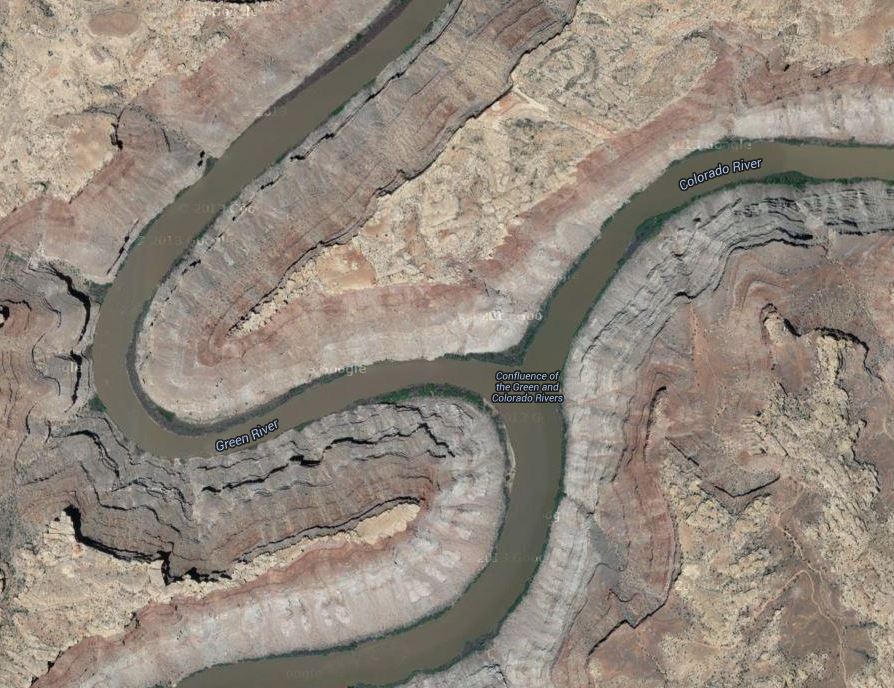
Update: Okay, Mr. Higginbotham convinced me.  We’re looking from the west, and that’s the Colorado coming from the top of the picture, and the Green coming from the bottom left; then the conjoined streams flow away, to the bottom right.  So, in the photo, the Colorado River is, appropriately, red, while the Green River is, fittingly, green

Not a majestic joke by Mother Nature, but a poetic way to remind us of the names of these rivers.

Poetry that might make us smile, too.

(It’s rare that these rivers run such dramatically different colors, especially with the Colorado that red, that far north.)

Google Maps aerial photo of the Confluence of the Green and Colorado Rivers; match the geography with the other photo, and note the labels on this one.  Tip of the old scrub brush to Mr. Higginbotham.

Google Maps aerial photo of the Confluence of the Green and Colorado Rivers; match the geography with the other photo, and note the labels on this one. Rotate this picture 90 degrees to the left, it matches up better.   Tip of the old scrub brush to Mr. J. A. Higginbotham.

More:


Mark Twain in Fort Worth

July 29, 2013

Mark Twain statue, Trinity Park, Fort Worth, Texas Photo by Barbara Schmidt © 2010

Mark Twain statue, Trinity Park, Fort Worth, Texas Photo by Barbara Schmidt © 2010

I’m falling down in my Mark Twain fandom, obviously.  Barbara Schmidt, who keeps the fine site, TwainQuotes (www.twainquotes.com), features this photo of Mark Twain holding an open copy of The Adventures of Huckleberry Finn, on one of the main pages at her site.

I did not know such a statue of Twain existed in Texas, let alone within an hour’s travel from my home.  I’ll have to track it down.

Why is it there?  Twain never set foot in Fort Worth, that I know.

What other great statues hide around Dallas and Fort Worth?

More:

Mark Twain in Fort Worth's Trinity Park, by Amy Moore, at Everything Everywhere

Mark Twain in Fort Worth’s Trinity Park, by Amy Moore, at Everything Everywhere.  The statue was created by Gary Lee Price.


Great obits: Scott E. Entsminger, and six Cleveland Brown pall bearers

July 28, 2013

Published in the Columbus Dispatch, July 7, 2013; highlighting the best part:

Scott E. Entsminger, at Corvette Forum

Scott E. Entsminger. According to Corvette Forum: The family also has requested that “everyone” wear their Browns clothing to Entsminger’s funeral Tuesday. Browns public relations director Zak Gilbert told ESPN.com that as soon as the Browns learned of Entsminger’s death they contacted his widow, Pat, to express their condolences. “She told us that Scott’s favorite player was Lou Groza, so we had a 76 jersey customized with Scott’s last name,” Gilbert said. A representative from the Browns’ front office will personally deliver it to Pat Entsminger at her husband’s memorial service Tuesday afternoon. Image from Corvette Forum

Entsminger — Scott E. Entsminger, 55, of Mansfield, died Thursday, July 4, 2013 at his residence. Born January 8, 1958 in Columbus, Ohio, he was the son of William and Martha (Kirkendall) Entsminger. He retired from General Motors after 32 years of service. He was an accomplished musician, loved playing the guitar and was a member of the Old Fogies Band. A lifelong Cleveland Browns fan and season ticket holder, he also wrote a song each year and sent it to the Cleveland Browns as well as offering other advice on how to run the team. He respectfully requests six Cleveland Browns pall bearers so the Browns can let him down one last time. Scott was a fun loving, kind and caring man who enjoyed gardening and fishing but his greatest enjoyment was spending time with his family. He is survived by his wife of 16 years, Pat Entsminger; a son, Aaron Entsminger of Columbus; a brother, Bill (Kathy) Entsminger of Grove City, Ohio; a sister, Lois Courtright of Galloway, Ohio; a sister-in-law, Carol Ferrall of Georgia; four nieces, Kristi Nunamaker, Allison Courtright, Emily Ferrall and Ashley Ferrall; a nephew, Benny Entsminger; his three dogs, Blackey, Shadow and Jezebel; his step mother, Lil Entsminger; a special aunt, Ginny Entsminger; and several cousins and other dear relatives. In addition to his parents, he was preceded in death by a brother-in-law Harry Courtright. Memorial services will be held at 2 p.m. Tuesday, July 9, 2013 at the Life Celebration Reception Center, 129 South Main Street, Mansfield, Ohio 44902. Friends may call one hour prior to the service, from 1-2 p.m., on Tuesday. The family also encourages everyone to wear their Cleveland Browns clothing to the service in honor of Scott. The family suggests that something be planted in his memory. Online guest registry at www.wappner.com

– See more at: http://www.legacy.com/obituaries/dispatch/obituary.aspx?n=scott-e-entsminger&pid=165695591

More:

Mr. Entsinger's favorite player was Lou Groza, who wore #76 for the old Cleveland Browns.

Mr. Entsminger’s favorite player was Lou Groza, who wore #76 for the old Cleveland Browns.


Happy birthday, Bugs Bunny! 73 today

July 27, 2013

On July 27, 1940, Bugs Bunny burst onto screens across the nation in his first Warner Bros. cartoon, “A Wild Hare.”

Lobby card for "A Wild Hare," Warner Bros, via Wikimedia

Lobby card for “A Wild Hare,” Warner Bros, via Wikimedia

Still wondering who was it said this.  Can you help me pin down the source?

Bugs Bunny is who we hope to be, but Daffy Duck is who we secretly fear we are.

Happy birthday, Bugs!

More: 

The first on-screen appearance of Bugs Bunny, ...

The first appearance of Bugs Bunny as Bugs Bunny — 1940’s “A Wild Hare,” starring Bugs Bunny and Elmer Fudd.
Wikipedia image, from an unrestored version of the cartoon.


Craig Clyde’s “Flowers on Timpanogos”

July 27, 2013

Photo by Craig Clyde, who explained:

Spent the night on the north end of Mount Timpanogos at 10,000 feet, by myself, taking it all in.

Flowers on the north end of Utah's Mt. Timpanogos, about 10,000 feet up. Photo by Craig Clyde.

Flowers on the north end of Utah’s Mt. Timpanogos, about 10,000 feet up. Photo by Craig Clyde.

Photo from July 25, 2013. Flowers include “Blue-pod Lupine, Narrow Goldenrod, Giant Red Paintbrush and Mountain Bluebells.”

Contact him for prints for framing.

Save

Save


July 26: Happy birthday, George Bernard Shaw

July 26, 2013

George Bernard Shaw standing in the snow. (Actually, at Niagara-on-the-Lake, site of an annual Shaw festival) Wikipedia image

George Bernard Shaw standing in the snow. (Actually, at Niagara-on-the-Lake, site of an annual Shaw theater festival) Wikipedia image

Rather like a ghost of a ghost of Shakespeare, George Bernard Shaw occupies one of those uncomfortable seats in history:  Everybody knows the name, few people know anything about him, and though his work shapes our culture, probably fewer can tell you how, or why.

George Bernard Shaw shaking his head while looking at his bust, done by Sigismund de Strobl (Today in Literature)

Caption from Today in Literature: Shaw shaking his head while looking at his bust, done by Sigismund de Strobl (Photo from TinL, too)

Today in Literature sent out a note:

George Bernard Shaw was born in Dublin on this day in 1856 — “fifty years to soon,” according to his calculations, and as if from another planet: “Whether it be that I was born mad or a little too sane, my kingdom was not of this world.”

Shaw portrays his parents as wildly divergent oddballs, their only shared emotion being a feeling of disinterested neutrality towards their offspring: “We as children had to find our own way in a household where there was neither hate nor love.” Mother’s habit of “lavishing indifference” upon him granted Shaw objectivity, and taught him to keep people at arm’s length — close enough to be moved by them, distant enough to be moved only to a quip, a quarrel, or a cause. And Dad was “a model father” because his ruinous enthusiasms for alcohol and tobacco inspired the son to abstain from both.

If, as Shaw claimed, “drink and lunacy were minor specialities” in his clan, then perhaps the spirit of detachment ran in the family too. Shaw seemed to think so: “Fortunately I have a heart of stone,” he wrote in 1939, “else my relations would have broken it long ago.” Biographer Michael Holroyd, concurring that the Shaws were an odd bunch, tells the final years and moments of one madcap uncle this way:

Uncle Barney was an inordinate smoker as well as a drunkard. Frequently drunk by dawn, he lived a largely fuddled life until he was past fifty. Then, relinquishing alcohol and tobacco simultaneously, he passed the next ten years of his life as a teetotaler, playing an obsolete wind instrument called an ophicleide. Towards the end of this period, renouncing the ophicleide* and all its works, he married a lady of great piety, took off his boots and fell completely silent. He was carried off to the family asylum where, “impatient for heaven,” he discovered an absolutely original method of committing suicide … involving as it did an empty carpet bag. However, in the act of placing this bag on his head, Uncle Barney jammed the mechanism of his heart in a paroxysm of laughter, which the merest hint of his suicidal technique never failed to provoke among the Shaws — and the result was that he died a second before he succeeded in killing himself.

Can you name any of Shaw’s works?  Which of them have you read, or seen performed?

What’s your favorite Shaw story?  Which of your favorite Shaw stories are untrue, or hoaxes?

______________

* The ophicleide is not well known today; it’s similar to the sudophone.

More:

George Bernard Shaw in 1899, at 43.

George Bernard Shaw in 1899, at 43. Most photos show Shaw as an old man — he should, perhaps, be remembered more as a young rake. Wikimedia image.  Shaw said, “The liar’s punishment is, not in the least that he is not believed, but that he cannot believe anyone else.” Quintessence of Ibsenism, 1891, “The Two Pioneers.”