Quote of the moment, December 6, 1852: Millard Fillmore explains his legacy; history ignores it

December 6, 2016

For an accidental president, a man who no one expected to take the office; for a guy whose term was marked by his party’s rejection of his policies so much that they did not even entertain the idea he might be the nominee in the next election; for the last Whig president, an obvious dinosaur of a dying political view; for a guy so obscure that a hoax more than a half-century later remains his greatest acknowledged point of reference, Millard Fillmore left the U.S. in good shape.

Should that be his real legacy?

On the anniversary of his final State of the Union message, let us ponder what Millard Fillmore bragged about.

Millard Fillmore for President, campaign poster from 1856 (American Party)

Campaign poster for Millard Fillmore, running for president in 1856 on the American Party ticket. He carried Maryland, which is probably ironic, considering Maryland’s Catholic roots, and the American Party’s anti-Catholic views, views probably not entirely shared by Fillmore; the American Party is more often known as the “Know-Nothings.”  Image from the Library of Congress American Memory files.

These are the last two paragraphs of his final State of the Union message, delivered on paper on December 6, 1852 Perhaps establishing a tradition, he made the message a listing of current zeitgeist, starting out mourning the recent passing of Daniel Webster, and the abatement of epidemics of mosquito-borne plagues in several cities.  He recited activities of the government, including the abolishing of corporal punishment in the Navy and improvements in the Naval Academy; he mentioned U.S. exploration around the world, in the Pacific, in the Amazon River, in Africa, and especially his project to send a fleet to Japan to open trade there.  He noted great opportunities for trade, domestically across an expanded, Atlantic-to-Pacific United States, and in foreign markets reachable through both oceans.

The last two paragraphs would be considered greatly exaggerated had any president in the 20th century delivered them; but from Millard Fillmore, they were not.  He gave credit for these achievements to others, not himself.

In closing this my last annual communication, permit me, fellow-citizens, to congratulate you on the prosperous condition of our beloved country. Abroad its relations with all foreign powers are friendly, its rights are respected, and its high place in the family of nations cheerfully recognized. At home we enjoy an amount of happiness, public and private, which has probably never fallen to the lot of any other people. Besides affording to our own citizens a degree of prosperity of which on so large a scale I know of no other instance, our country is annually affording a refuge and a home to multitudes, altogether without example, from the Old World.

We owe these blessings, under Heaven, to the happy Constitution and Government which were bequeathed to us by our fathers, and which it is our sacred duty to transmit in all their integrity to our children. We must all consider it a great distinction and privilege to have been chosen by the people to bear a part in the administration of such a Government. Called by an unexpected dispensation to its highest trust at a season of embarrassment and alarm, I entered upon its arduous duties with extreme diffidence. I claim only to have discharged them to the best of an humble ability, with a single eye to the public good, and it is with devout gratitude in retiring from office that I leave the country in a state of peace and prosperity.

What president would not have been happy to have been able to claim as much?  Historians often offer back-handed criticism to Fillmore for the Compromise of 1850; in retrospect it did not prevent the Civil War.  In the circumstances of 1850, in the circumstances of Fillmore’s presidential career, should we expect more?  Compared to Buchanan’s presidency and the events accelerating toward war, did Fillmore do so badly?

Compare with modern analogs: Donald Trump appears to be working exactly contrary to those things Fillmore said were beneficial to the U.S., then: Friendly relations with foreign powers, the U.S. recognized as a refuge for persecuted people, and domestic prosperity. Any president since Franklin Roosevelt would have loved to have left such a legacy.

Have we underestimated Millard Fillmore?  Discuss.

More:

Yes, this is mostly an encore post. Fighting ignorance requires patience.

Yes, this is mostly an encore post. Fighting ignorance requires patience.

Save

Save


It’s Martin van Buren’s birthday, December 5

December 5, 2016

Former President Martin van Buren, circa 1855-1888. Matthew Brady photograph (Imperial print of Martin Van Buren. Salted paper print from glass negative. Provenance from W.H. Lowdermilk & Co., Rare Books, 1418 F Street, Washington, DC) Metropolitan Museum image, via Wikimedia

Former President Martin van Buren, circa 1855-1888. Matthew Brady photograph (Imperial print of Martin Van Buren. Salted paper print from glass negative. Provenance from W.H. Lowdermilk & Co., Rare Books, 1418 F Street, Washington, DC) Metropolitan Museum image, via Wikimedia

Martin van Buren was our nation’s 8th president, serving one term, 1837-1841.

This photo is roughly  15 years after van Buren left office, taken in the Washington, D.C., studio of Matthew Brady, whose photography gained fame from his work photographing battle sites during the American Civil War.

Martin van Buren was born December 5, 1872, in Kinderhook, New York. He is the only president to have the first name Martin.


December 2: Happy Guano Day! (Thank you, Millard Fillmore)

December 2, 2016

Why December 2?

(You couldn’t make this stuff up if you were Monty Python.)

English: Millard Fillmore White House portrait

Millard Fillmore’s White House portrait, via Wikipedia

President Millard Fillmore, in the State of the Union Address, December 2, 1850

Peruvian guano has become so desirable an article to the agricultural interest of the United States that it is the duty of the Government to employ all the means properly in its power for the purpose of causing that article to be imported into the country at a reasonable price. Nothing will be omitted on my part toward accomplishing this desirable end. I am persuaded that in removing any restraints on this traffic the Peruvian Government will promote its own best interests, while it will afford a proof of a friendly disposition toward this country, which will be duly appreciated.

Did any other U.S. President spend so much time thinking about guano?  Did any president ever mention it in a State of the Union Address?  The curious case of Millard Fillmore, Seer, just grows.

Guano, or bird poop (and its relative, bat poop), contains phosphorus, which is an essential element for life.  Consequently, it turns out to be a key ingredient in effective agricultural fertilizers.  In international competition for supremacy in farming and farm exports, guano became a key resource to fight over, in the 19th century.

It’s almost safe to say the fights were economic; but guano did play a key role in wars in South America (see Andrew Leonard’s article, noted below).

Fillmore figured out that the substance had great importance, coupled that with the rather esoteric knowledge that sea birds tended to deposit guano in great abundance on certain islands, often unoccupied, and ordered the U.S. Navy to claim islands found to contain guano deposits that were not claimed by other nations.

By the American Civil War, the importance of phosphorus to the production of gun powder became an issue for the armies of the North and South.  Millard Fillmore had set the stage for the North to win an important advantage in gun powder production, just one of many that led to the defeat of the South.

It’s one more thing we should thank Millard Fillmore for doing. Our study of history should inform us that it is, indeed, important for politicians to understand the importance of guano.

Fillmore knew his guano.

Take a moment on December 2 to toast Millard Fillmore’s prescience, on Guano Day!

More:  

Yes, this is mostly an encore post. Fighting ignorance requires patience.

Yes, this is mostly an encore post. Fighting ignorance requires patience.

Save

Save


Rosa Parks Sit Down to Stand Up for Freedom Day, December 1: “Why do you push us around?” Rosa Parks asked the cop. (Anyone know the answer?)

December 1, 2016

Mrs. Rosa Parks asked a question of the policeman who arrested her for refusing to move to the back of the bus on December 1, 1955. In 2016, it is again, and still, a chilling question, to which we have no good answer.

Rosa Parks being fingerprinted, Library of Congress

Mrs. Parks being fingerprinted in Montgomery, Alabama; photo from New York World-Telegram & Sun Collection, Library of Congress

Rosa Parks: “Why do you push us around?”

Officer: “I don’t know but the law is the law and you’re under arrest.”

From Rosa Parks with Gregory J. Reed, Quiet Strength
(Grand Rapids, MI: Zondervan Pub. House, 1994), page 23.

Photo: Mrs. Parks being fingerprinted in Montgomery, Alabama; photo from New York World-Telegram & Sun Collection, Library of Congress

Today in History at the Library of Congress provides the simple facts:

On the evening of December 1, 1955, Rosa Parks, an African American, was arrested for disobeying an Alabama law requiring black passengers to relinquish seats to white passengers when the bus was full. Blacks were also required to sit at the back of the bus. Her arrest sparked a 381-day boycott of the Montgomery bus system and led to a 1956 Supreme Court decision banning segregation on public transportation.

Rosa Parks made a nearly perfect subject for a protest on racism. College-educated, trained in peaceful protest at the famous Highlander Folk School, Parks was known as a peaceful and respected person. The sight of such a proper woman being arrested and jailed would provide a schocking image to most Americans. Americans jolted awake.

Often lost in the retelling of the story are the threads that tie together the events of the civil rights movement through the 1940s, 1950s and 1960s. As noted, Parks was a trained civil rights activist. Such training in peaceful and nonviolent protest provided a moral power to the movement probably unattainable any other way. Parks’ arrest was not planned, however. Parks wrote that as she sat on the bus, she was thinking of the tragedy of Emmet Till, the young African American man from Chicago, brutally murdered in Mississippi early in 1955. She was thinking that someone had to take a stand for civil rights, at about the time the bus driver told her to move to allow a white man to take her seat. To take a stand, she kept her seat.

African Americans in Montgomery organized a boycott of the Montgomery bus system. This was also not unique, but earlier bus boycotts are unremembered. A bus boycott in Baton Rouge, Louisiana, earlier in 1955 did not produce nearly the same results.

The boycott organizers needed a place to meet, a large hall. The biggest building in town with such a room was the Dexter Street Baptist Church. At the first meeting on December 5, it made sense to make the pastor of that church the focal point of the boycott organizing, and so the fresh, young pastor, Rev. Dr. Martin Luther King, Jr., was thrust into civil rights organizing as president, with Ralph Abernathy as program director. They called their group the Montgomery Improvement Association (MIA). When their organizing stretched beyond the city limits of Montgomery, the group became the Southern Christian Leadership Conference.

Litigation on the boycott went all the way to the Supreme Court (Browder v. Gale). The boycotters won. The 381-day boycott was ended on December 21, 1956, with the desegregation of the Montgomery bus system.

Sources for lesson plans and projects:

Yes, this is mostly an encore post. Fighting ignorance requires patience.

Yes, this is mostly an encore post. Fighting ignorance requires patience.

Tip of the old scrub brush to Slacktivist, who gave this post a nice plug.

Save

Save


Down in the River to Pray, with Longhorn Tubas

November 30, 2016

I love low brass.

An Ohio friend alerted my wife to this piece from the University of Texas Tuba/Euphonium Studio:

Nice production of an old folk/gospel tune, “Down in the River to Pray.” (Considerably different from the Allison Krauss “O, Brother Where Art Thou” version, no?)

Did they record this as a recruiting tool? Or just for the beauty of it?

Credits:

The University of Texas Tuba/Euphonium Studio
Charles Villarrubia, Associate Professor Tuba/Euphonium

Euphonium
Alex Avila
Jose Flores
Luke Gall
Eric Gonzales
Fabian Vargas

Tuba
John Flores
Clay Garrett (soloist)
Keith Packman
Danny Trumble
Ben Vasko
T.J. West

Taylor Rudd, Director of Photography
Mario Mattei, Camera Operator
Jacob Ryan Hamilton, Aerial Photography
Joshua Gall, Recording Engineer
Ani Villarrubia, Production Assistant

Follow us on Facebook: https://www.facebook.com/UTTubaEuph/

Tip of the old scrub brush to Donna Hughes and Kathryn Knowles, and their decades-old, interstate friendship.


A toast on Whiskey and Cigar Day 2016: Excelsior! to Mark Twain’s and Winston Churchill’s births (November 30)

November 30, 2016

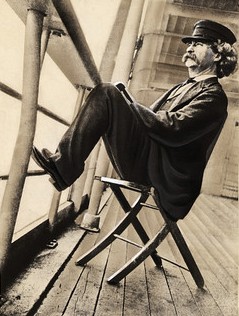
Mark Twain, afloat

Mark Twain aboard a ship, on his way to Hawaii. Young Samuel Clemens apprenticed to be a Mississippi river boat pilot, and held a fascination for water-going vessels his entire life. His pilot years are documented, and analyzed, in Life on the Mississippi.
This photo of Twain remains one of my favorites.

November 30 is the birthday of Mark Twain (1835), and Winston Churchill (1874).

This is the traditional Millard Fillmore’s Bathtub post to remind you. Both Twain and Churchill were lovers of good whiskey, and good cigars. Surely they would have toasted themselves with a drink and a smoke.

Even if we don’t, we can pretend we did.

In 2016, we have the benefit of having had time to digest Twain’s Autobiography, and Volume II; and we have the benefit of scholarship from a great book on Churchill, William Manchester’s and Paul Reid’s The Last Lion: Winston Spencer Churchill: Defender of the Realm, 1940-1965.

We have special need for the wisdom, and wit of each man in a year marked by terrorism and unholy war on educators.

Twain had a comment on the Texas Education Agency and State Board of Education:

In the first place God made idiots. This was for practice. Then He made School Boards.

Following the Equator; Pudd’nhead Wilson‘s New Calendar

The Nobel literature committees were slow. Twain never got a Nobel in Literature; he died in 1910. Churchill did win a Nobel in Literature, in 1953.

The Nobel Prize in Literature 1953 was awarded to Winston Churchill “for his mastery of historical and biographical description as well as for brilliant oratory in defending exalted human values.”

Both men were aficionados of good whiskey and good cigars. Both men suffered from depression in old age.

Both men made a living writing, early in their careers as newspaper correspondents. One waged wars of a kind the other campaigned against. Both were sustained by their hope for the human race, against overwhelming evidence that such hope was sadly misplaced.

churchill-time-cover-man-of-the-year-1941.jpg

Winston S. Churchill, Time Magazine’s Man of the Year for 1941, copyright 1941 by Time Magazine. Churchill’s career was built much on his work as First Lord of the Admiralty, a position he took in 1911.  While he was the goat of the Battle of the Dardanelles (and had to resign as a result), his earlier work to switch Britain’s Navy to oil power from coal, and to use airplanes in combat, kept the British Navy as an important and modern military organization through World War II.

Both endured fantastic failures that would have killed other people, and both rebounded.

Each possessed a great facility with words, and wit, and frequently said or wrote things that people like to remember and repeat again.

Both Churchill and Twain rank near the top of the list of people to whom almost any quote will be attributed, if the quote is witty and the speaker can’t remember or doesn’t know who actually said it.

Surely they said something like any piece of wisdom, at some point in their lives, right?

Both men are worth study. And wouldn’t you really love to have had them over to dinner?

Twain, on prisons versus education:

Every time you stop a school, you will have to build a jail. What you gain at one end you lose at the other. It’s like feeding a dog on his own tail. It won’t fatten the dog.” – Speech, November 23, 1900

Churchill on the evil men and nations do:

“No One Would Do Such Things”

“So now the Admiralty wireless whispers through the ether to the tall masts of ships, and captains pace their decks absorbed in thought. It is nothing. It is less than nothing. It is too foolish, too fantastic to be thought of in the twentieth century. Or is it fire and murder leaping out of the darkness at our throats, torpedoes ripping the bellies of half-awakened ships, a sunrise on a vanished naval supremacy, and an island well-guarded hitherto, at last defenceless? No, it is nothing. No one would do such things. Civilization has climbed above such perils. The interdependence of nations in trade and traffic, the sense of public law, the Hague Convention, Liberal principles, the Labour Party, high finance, Christian charity, common sense have rendered such nightmares impossible. Are you quite sure? It would be a pity to be wrong. Such a mistake could only be made once—once for all.”

—1923, recalling the possibility of war between France and Germany after the Agadir Crisis of 1911, inThe World Crisis,vol. 1, 1911-1914, pp. 48-49. (Obviously, and sadly, Churchill was wrong — twice wrong.)

Yet we continue to make those mistakes, and then to seek out the wisdom of Churchill or Twain to get out of the mess, and to tell us we won’t be in such a mess ever again.

Image of Twain aboard ship, on the Pacific – origin unknown. Image of Winston S. Churchill, Time Magazine’s Man of the Year for 1941, copyright 1941 by Time Magazine.

More on Mark Twain

More on Winston Churchill

Orson Welles, with Dick Cavett, on Churchill, his wit, humor and grace (tip of the old scrub brush to the Churchill Centre):

More, contemporary reports from 2012:

And in 2013:

2014:

Should you fly your flag today?  Congress doesn’t list this dual birthday as an event for flying the U.S. flag.  But you’re welcome to fly the flag any day.  Go ahead, if you want to.

If I get one, it will be the only cigar I’ve had this year. Or this decade.

I will break out the Scotch.

At a very minimum, click on some of the links and read the works of these two great writers. Nothing else today will be so profitable.

Churchill gets attention, even in Texas:

Yes, this is mostly an encore post. Fighting ignorance requires patience.

Yes, this is mostly an encore post. Fighting ignorance requires patience.

Save


Milky Way over the Vermilion Cliffs

November 30, 2016

Oh, there’s a little technical wizardry involved in this one, stitching it together.

But, wow!

White Pocket in the Vermillion Cliffs National Monument, Arizona. Brilliant photography and stitching by Dave Lane Astrohotography, via the U.S. Department of Interior.

White Pocket in the Vermilion Cliffs National Monument, Arizona. Brilliant photography and stitching by Dave Lane Astrophotography, via the U.S. Department of Interior.

A more full description from Interior’s Facebook page:

Located in a remote and unspoiled part of northern Arizona, Vermilion Cliffs National Monument is a geologic treasure. For those who can’t get a permit to places like The Wave, White Pocket is an equally stunning place to explore — day or night. Pictured here, the area’s unusual rock formation is crowned by the Milky Way with Saturn, Mars and the Rho Ophiuchus region all visible. Multi-image photo (42 images stitched together in a 6 x 7 matrix) courtesy of David Lane (Dave Lane Astrophotography).

Dave Lane’s work amazes, doesn’t it?

Tip of the old scrub brush to Kathryn Knowles.

Save


With fondness, wishing it were true in 2016: Remembering “Uncle Sam’s Thanksgiving” by Thomas Nast, 1869

November 24, 2016

November 1869, in the first year of the Grant administration — and Nast put aside his own prejudices enough to invite the Irish guy to dinner, along with many others. (Nast tended not to like Catholics, and especially Irish Catholics.)

In a nation whose emotions are raw from a divisive election, violence from winning and losing the World Series and various other championships, nearly daily violence against people of color and unwarranted, horrifying assaults on police officers, not to mention daily horrors reported from Venezuela, Central America, East Timor and Indonesian New Guinea, Syria and the Middle East, could there be a better or more timely reminder of what we’re supposed to be doing?

A Millard Fillmore’s Bathtub tradition, Uncle Sam’s Thanksgiving.

(Click for a larger image — it’s well worth it.)

Thomas Nast's "Uncle Sam's Thanksgiving," 1869 - Ohio State University's cartoon collection

Thomas Nast’s “Uncle Sam’s Thanksgiving,” 1869 – Ohio State University’s cartoon collection, and HarpWeek

As described at the Ohio State site:

“Uncle Sam’s Thanksgiving Dinner” marks the highpoint of Nast’s Reconstruction-era idealism. By November 1869 the Fourteenth Amendment, which secures equal rights and citizenship to all Americans, was ratified. Congress had sent the Fifteenth Amendment, which forbade racial discrimination in voting rights, to the states and its ratification appeared certain. Although the Republican Party had absorbed a strong nativist element in the 1850s, its commitment to equality seemed to overshadow lingering nativism, a policy of protecting the interests of indigenous residents against immigrants. Two national symbols, Uncle Sam and Columbia, host all the peoples of the world who have been attracted to the United States by its promise of self-government and democracy. Germans, African Americans, Chinese, Native Americans, Germans, French, Spaniards: “Come one, come all,” Nast cheers at the lower left corner.

One of my Chinese students identified the Oriental woman as Japanese, saying it was “obvious.” Other friends say both are Chinese.  Regional differences.  The figure at the farthest right is a slightly cleaned-up version of the near-ape portrayal Nast typically gave Irishmen.

If Nast could put aside his biases to celebrate the potential of unbiased immigration to the U.S. and the society that emerges, maybe we can, too.

Hope your day is good; hope you have good company and good cheer, turkey or not. Happy Thanksgiving 2016.  And of course, remember to fly your flag!

More: Earlier posts from Millard Fillmore’s Bathtub

And in 2013:


Yes, this is mostly an encore post. Fighting ignorance requires patience.

Yes, this is mostly an encore post. Fighting ignorance requires patience. And good Thanksgiving stories need to be refreshed, to bring peace around the dinner table.

Save


Fly your flag on Thanksgiving 2016

November 23, 2016

You’re planning for the big day, the big turkey (or vegan equivalent), you’re wondering how to time everything . . .

Just a reminder to patriots and sunshine patriots that Thanksgiving is one of those days designated in the U.S. Flag Code as a day for citizens to fly Old Glory. Plan to put your flag out early, you won’t have to worry about it all day.

There was a time when people actually sent Thanksgiving cards; few keep up that tradition. Image from Pacific Paratrooper.

There was a time when people actually sent Thanksgiving cards; few keep up that tradition. Image from Pacific Paratrooper.

It’s a great time to recall that the purposes of Thanksgiving usually start with expressing gratitude to and with all of our neighbors, as a means of binding us together as a community, a people, and a nation. And sometimes, an entire world, as cartoonist Joseph Keppler imagined.

Joseph Keppler's

From the Library of Congress collection: Joseph Keppler’s “A Thanksgiving Toast,” Puck magazine, November 30, 1898. “Caption: Puck Gentlemen, your health! I am glad to see from your bea[…]ing faces that you share the high aspirations of our friend, the Czar, for Universal Peace. Here’s to you all! Illus. from Puck, v. 44, no. 1134, (1898 November 30), centerfold.”

(More explanation from the Library of Congress: Print shows Puck standing on a chair at the head of a large dinner table, offering a Thanksgiving toast to those seated around the table, including “England, France, Germany, [Japan?], Russia, Austria, Italy, Turkey, Uncle Sam, Puerto Rico, Hawaii, Brazil, [and] Mexico”. Most of the European countries, as well as Mexico and Brazil, are glaring at their neighbors, with the exception of Russia where Nicholas II attempts to look pious. Turkey appears to be trying to stifle laughter. Uncle Sam seems to be the only one enjoying the toast. Puerto Rico, holding an American flag, and Hawaii are expressionless.)


More:

Save


Annals of Global Warming: 2016 looks to be hottest year ever

November 19, 2016

Chart from Climate Central: The running average of global temperatures throughout 2016 compared to recent years. Each month shows the average of that month's temperature and each month before it

Chart from Climate Central: The running average of global temperatures throughout 2016 compared to recent years. Each month shows the average of that month’s temperature and each month before it

Earth is nearing the end of the the third record-breaking hot year in a row. 2014 was the hottest year ever, but was beaten by 2015. Now 2015’s heat takes second place to 2016’s heat.

2016’s record-breaking heat too fuel in part from an El Nino through the first nine months of the year; with a La Nina weather pattern developing now, there will be some cooling, but the cooling will not be enough to keep 2016 from being the warmest year ever recorded in human history.

Notes on this milestone can be found in several places; Climate Central’s explanation covers it succinctly.

The National Oceanic and Atmospheric Administration released its temperature data through the end of October on Thursday and found that for the year-to-date, the global average temperature is 1.75°F above the 20th century average of 57.4°F. That puts the year 0.18°F ahead of last year, the current hottest year titleholder, with just two months to go.

“It’s likely that we will end up as record warmest,” Jessica Blunden, a climate scientist with NOAA’s National Centers for Environmental Information, said during a press teleconference.

October itself tied as the third warmest in 136 years of record-keeping, coming in at 1.31°F (0.73°C) above the 20th century average of 57.1°F, according to NOAA. (NASA, which uses a different baseline and slightly different methods, put October in second place.)

September was the first month of the year to not be record warm (it came in second place), as temperatures began to cool slightly with the demise of El Niño and the move toward La Niña. It ended a streak of 16 consecutive record-setting months, itself a record.

Maybe more shocking, it’s been 115 years since we had a record cold year, according to Climate Central.

In fact, global temperatures have been above-average for 382 months in a row by NOAA’s reckoning, going all the way back to the Reagan administration. To find a record cold month requires going all the way back to February 1929. The last record-cold year was even further back, in 1911.

382 months. Anyone under the age of 31 has never experienced a single month of temperatures as low as the 20th century average, in their lifetime. A generation has been raised with global warming climate change as the norm. How will that affect voting patterns and public opinion to change government policies?

More:

Caption from Discover Magazine's ImaGeo blog: A map of temperature anomalies during October 2016 shows that the Arctic region was much warmer than the 1951-1980 mean. The United States and North Africa were also particularly warm. The largest area of cooler than average temperatures stretched across Russia. (Source: NASA GISS)

Caption from Discover Magazine’s ImaGeo blog: A map of temperature anomalies during October 2016 shows that the Arctic region was much warmer than the 1951-1980 mean. The United States and North Africa were also particularly warm. The largest area of cooler than average temperatures stretched across Russia. (Source: NASA GISS)


Help! Is this a pipevine swallowtail?

November 18, 2016

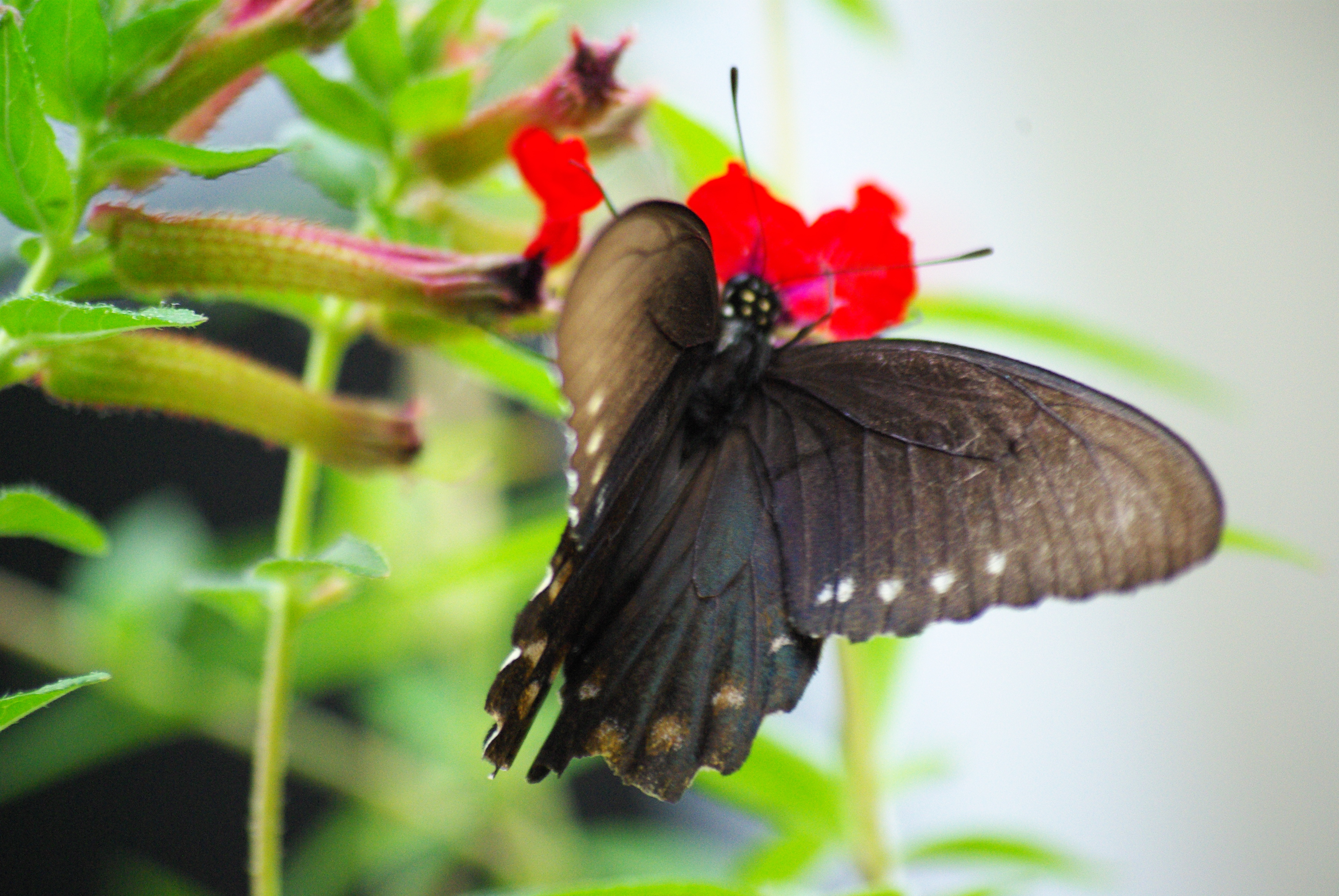
Is this a pipevine swallowtail?

Is this a pipevine swallowtail? This one is tapping the bat-faced cuphea; the pipevine under the holly is undisturbed.

A parade of butterflies this year! A lot of monarchs, in contrast to the past three years; we’ve had some Gulf fritillaries, and various sulfurs. The penta seems to be a major stopping point for hairstreaks and other small butterflies.

We’ve had a few tiger swallowtails.

And this one pictured above. it seems to have the spots of a pipevine swallowtail, but there are no swallowtails!

Did they wear off in migrating?

Are we misidentifying it?

imgp2261

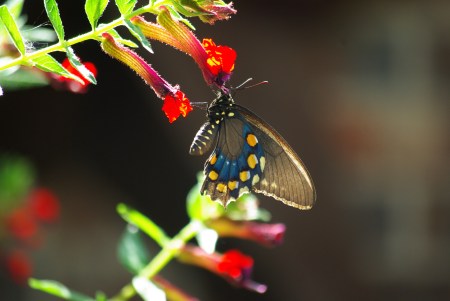
Pipevine swallowtail (?) from the underside, still on the cuphea. Can we erase the question mark? Sunlight emphasizes the blue on the underwing. Photos copyright by Ed Darrell, Creative Commons. Please use, with attribution.

Save


When in doubt, read the instructions, Donald Trump version

November 16, 2016

How is the transition coming?

https://www.pinterest.com/offsite/?token=407-837&url=https%3A%2F%2Fs-media-cache-ak0.pinimg.com%2Foriginals%2F70%2Fd9%2F81%2F70d981e5a3fb2f5e56d6376609902ac2.jpg&pin=355432595576201161

Cartoon by . . . um, can you read that name? Trump and the User’s Manual

Sure, in comments, tell us the instruction manual is the Constitution.

Trump hasn’t read that, either, I wager. In any case, he’s unprepared to put together an administration. Our republic really is in danger. It’s going to take all of us to hold it together, to have any chance of success in the next four years.

In the interim, I don’t recognize the style, and I don’t recognize the signature; can you help discover who is the cartoonist?

Cartoon by Matt Davies, Pulitzer Prize-winning cartoonist for Newsday.

https://twitter.com/MatttDavies/status/797860046017282048

Save


Oklahoma statehood, November 16, 1907; Oklahomans fly your flags today

November 16, 2016

U.S. Flag Code urges citizens of states to fly the U.S. flag on the anniversary of statehood.

President Theodore Roosevelt signed the Oklahoma statehood proclamation on November 16, 1907. Oklahoma became the 46th state, with New Mexico and Arizona to come later to fill out the contiguous 48 states.

Mike Wimmer's 2003 painting of President Theodore Roosevelt's signing of the proclamation that made Oklahoma a member of the union. Oklahoma Arts Council image.

Mike Wimmer’s 2003 painting of President Theodore Roosevelt’s signing of the proclamation that made Oklahoma a member of the union. Oklahoma Arts Council image.

Oklahoma’s pre-history is long, complex and fascinating; the road to statehood is similarly complex and winding, lined with broken promises to Native Americans, tragedy and other drama. Does the state require Oklahoma history be taught in public schools?

Fly your flags today, Sooners!

More: 

Front page of the Daily Oklahoman on November 16, 1907, anticipating President Roosevelt's proclamation to come that morning. Daily Oklahoman image.

Front page of the Daily Oklahoman on November 16, 1907, anticipating President Roosevelt’s proclamation to come that morning. Daily Oklahoman image.


From Jeff R. Bridgman Antiques: 46 star American national flag, made in the period between 1907 and 1912, in small and desirable scale. The 46th state, Oklahoma, joined the Union on November 16th, 1907, during Teddy Roosevelt’s presidency. Roosevelt had many friends in the Oklahoma Territory from his Rough Rider days, and pushed it through to statehood. The 46 star flag became official on July 4th, 1908 and remained so until July 3rd, 1912. Many 46 star flags were made earlier, however, in great anticipation of the future addition of the state, which had previously been appointed to Native Americans.

From Jeff R. Bridgman Antiques: 46 star American national flag, made in the period between 1907 and 1912, in small and desirable scale. The 46th state, Oklahoma, joined the Union on November 16th, 1907, during Teddy Roosevelt’s presidency. Roosevelt had many friends in the Oklahoma Territory from his Rough Rider days, and pushed it through to statehood. The 46 star flag became official on July 4th, 1908 and remained so until July 3rd, 1912. Many 46 star flags were made earlier, however, in great anticipation of the future addition of the state, which had previously been appointed to Native Americans.

Save

Save

Save

Save


On November 14, 1960, Ruby Bridges went to school

November 14, 2016

American Experience reminds us:

On November 14, 1960, 6-year-old Ruby Bridges walked into William J. Frantz Elementary School in New Orleans.

This is an encore post I put up then, happy to have an excuse to repeat historic photos, great art from a great American painter, Norman Rockwell, and remind students of history.

This came on Twitter, back in 2014:

You don’t recognize her there?

How about in Norman Rockwell’s illustration?

The Problem We All Live With,” Norman Rockwell, 1964; oil on canvas, Norman Rockwell Museum, Stockbridge, Massachusetts

Ruby Bridges with President Barack Obama, in 2011:

President Obama and Ruby Bridges viewing Normal Rockwall's painting, "The Problem We All Live With," at the White House in 2011. Photo by Pete Souza, public domain.

President Obama and Ruby Bridges viewing Normal Rockwall’s painting, “The Problem We All Live With,” at the White House in 2011. Photo by Pete Souza, public domain.

Ms. Bridges tells some of her story:

Yes, this is mostly an encore post. Fighting ignorance requires patience.

Yes, this is mostly an encore post. Fighting ignorance requires patience.


Celebrating Veterans Day 2016

November 11, 2016

A teacher asked on Twitter yesterday for sources of information to set up a curriculum for Veterans Day, and I sent a few suggestions (and got thanked!).

Teachers watching through the day probably saw several sources pop up on the internet that they wished they’d had last week, to plan for this week.

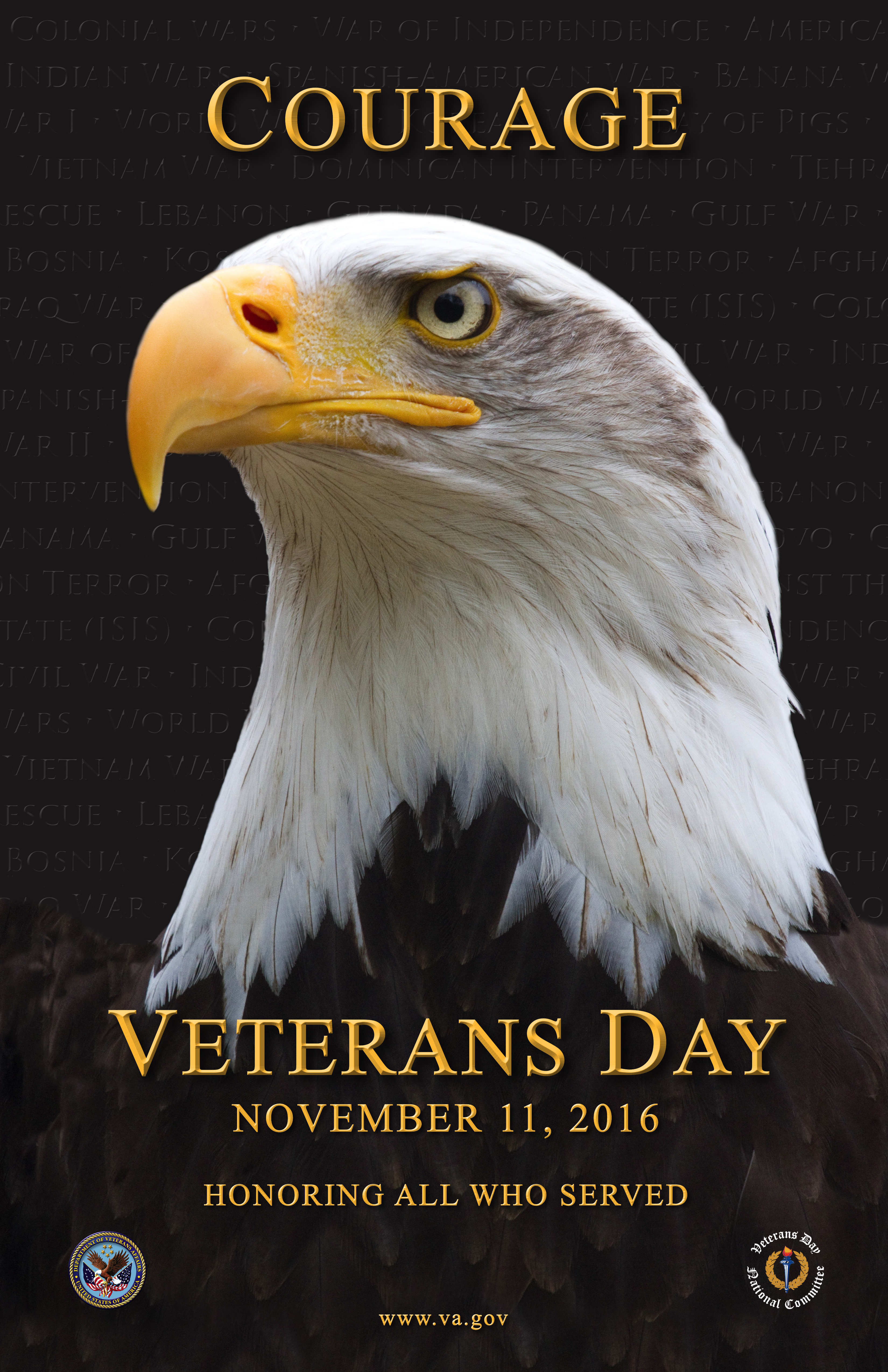
For one, I didn’t post the Veterans Administration’s annual Veterans Day poster, and it’s a very nice one this year:

Veterans Day poster for 2016. Look carefully, you'll see the names of past military engagements in which veterans may have fought, in the background behind the very sharp photo of the head of a bald eagle, our national symbol.

Veterans Day poster for 2016. Look carefully, you’ll see the names of past military engagements in which veterans may have fought, in the background behind the very sharp photo of the head of a bald eagle, our national symbol.

In world history or U.S. history, I usually stop for the day to talk about the origins of Veterans Day in Armistice Day, the day the guns stopped blazing to effectively end fighting in World War I. For several reasons, including mnemonic, the treaty called for an end to hostilities on the “11th hour of the 11th day of the 11th month” of 1918. Your state’s history standards probably has that phrase somewhere, but the history behind it is what students really find interesting.

Original documents and good history can be found at the Library of Congress online collections.

The Allied powers signed a ceasefire agreement with Germany at Rethondes, France, at 11:00 a.m. on November 11, 1918, bringing the war later known as World War I to a close.

President Wilson proclaimed the first Armistice Day the following year on November 11, 1919, with the these words: “To us in America, the reflections of Armistice Day will be filled with solemn pride in the heroism of those who died in the country’s service and with gratitude for the victory, both because of the thing from which it has freed us and because of the opportunity it has given America to show her sympathy with peace and justice in the councils of the nations…” Originally, the celebration included parades and public meetings following a two-minute suspension of business at 11:00 a.m.

Co. E, 102nd U.S.A. Curtiss Studio, photographers, c1917. Panoramic Photographs. Prints & Photographs Division

Between the world wars, November 11 was commemorated as Armistice Day in the United States, Great Britain, and France. After World War II, the holiday was recognized as a day of tribute to veterans of both wars. Beginning in 1954, the United States designated November 11 as Veterans Day to honor veterans of all U.S. wars. British Commonwealth countries now call the holiday Remembrance Day.

Online holdings of the National Archives and Records Administration (NARA) provide rich sources of information on America’s military, and on veteran’s day. NARA leans to original documents a bit more than the Library of Congress. For Veterans Day 2016, NARA featured an historic photo form 1961:

 President John F. Kennedy Lays a Wreath at the Tomb of the Unknown Soldier as part of Veterans Day Remembrances, Arlington National Cemetery, Arlington, Virginia, 11/11/1961 Series: Robert Knudsen White House Photographs, 1/20/1961 - 12/19/1963. Collection: White House Photographs, 12/19/1960 - 3/11/1964 (Holdings of the @jfklibrary)

NARA caption: President John F. Kennedy Lays a Wreath at the Tomb of the Unknown Soldier as part of Veterans Day Remembrances, Arlington National Cemetery, Arlington, Virginia, 11/11/1961 Series: Robert Knudsen White House Photographs, 1/20/1961 – 12/19/1963. Collection: White House Photographs, 12/19/1960 – 3/11/1964 (Holdings of the @jfklibrary)

For teachers, that page also features this:

For Veterans Day, explore the many resources in the National Archives about veterans and military service.

(Well, actually it’s for everyone. But teachers love those kinds of links, especially AP history teachers who need documents for “Document-Based Questions” (DBQs).

On one page, the Veterans Administration makes it easy for teachers to plan activities; of course, you need to start some of these weeks before the actual day:

For Teachers & Students

Hope your Veterans Day 2016 went well (remember to bring in your flag at home!).

Get ready for Veterans Day 2017 — the 11th day of the 11th month.


Save

Save

Save

Save

Save