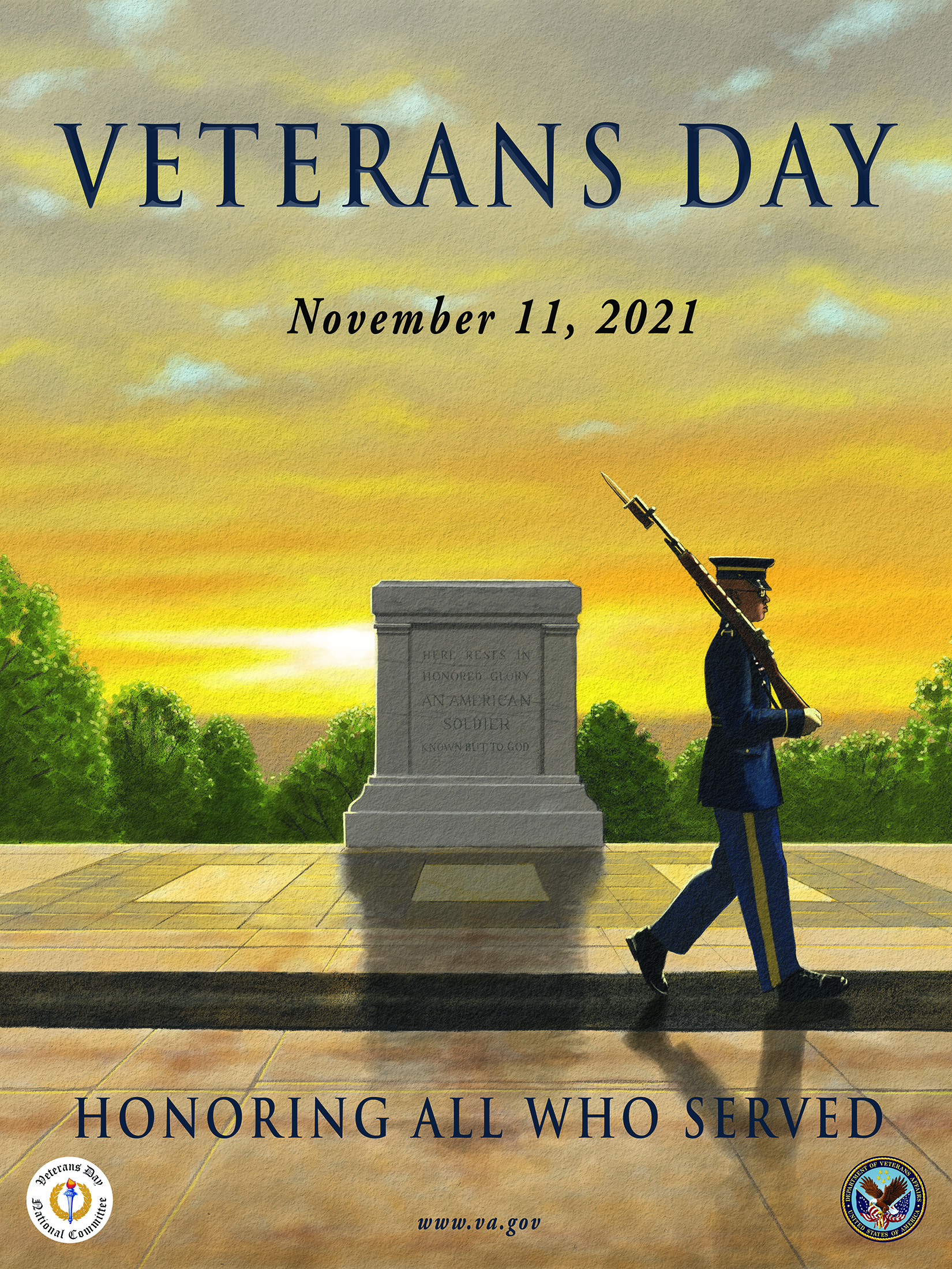
You did remember that New Years Day is the first day to fly U.S. flags in 2022, under the U.S. Flag Code and other laws and regulations, right?
Happy New Year.
You did remember that New Years Day is the first day to fly U.S. flags in 2022, under the U.S. Flag Code and other laws and regulations, right?
Happy New Year.
 4 Comments |
  Fly your flag today, Patriotism, U.S. Flag | Tagged: Fly your flag today, Patriotism, U.S. Flag, U.S. Flag Code |
  Permalink
 Posted by Ed Darrell
Thomas Nast may have done as much as Abraham Lincoln to invent the Republican Party.
Nast’s illustration for Harper’s Weekly for the issue of December 31, 1864, expressed his great desire for an end to the Civil War, and offered a vision of what could happen when arms were put down.

Harper’s Weekly, December 31, 1864. Nast portrayed Lincoln’s hope that the union could be saved. The insets show events that had not yet happened when the illustration was published, including the surrender by Robert E. Lee to U. S. Grant.
We were alerted to the image by a Tweet from White House History; the image above comes via SonoftheSouth.net.
An explanation of the illustration comes from The New York Times Learning page (for teachers — you’re invited):
As the Union military advanced across the South in December 1864, making Confederate defeat seem to be only a matter of time, artist Thomas Nast drew a holiday illustration betokening mercy for the vanquished and sectional reconciliation for the nation. Under the Christmas proclamation of “Peace on Earth and Good Will Toward Men,” President Abraham Lincoln is the gracious host who generously welcomes the Confederates—President Jefferson Davis, General Robert E. Lee, and state governors—in from the cold, and gestures for them to return to their rightful seats at the sumptuous feast of the states. Seated at the table are the governors of the Union states, and on the wall behind them appear portraits of leading Union generals.
Framing the main banquet scene are four circular insets that convey the message that if the Confederacy will lay down its arms, surrender unconditionally, and be contrite, then the Union will be merciful and joyously welcome them back into the fold. Viewing them clockwise from the upper-left, the symbolic figure of Victory, backed by the American Eagle, offers the olive branch of peace to a submissive Confederate soldier; the forgiving father from the biblical parable embraces his wayward son, whose sorrow for his past rebellion prompts the father to honor his son with a celebratory dinner; under the tattered American flag, the ordinary soldiers of the Union and Confederacy reunite happily as friends and brothers after the Confederate arms and battle standards have been laid on the ground; and, General Robert E. Lee, the Confederate commander, bows respectfully and offers his sword in unconditional surrender to General Ulysses S. Grant, the commander of the Union troops. In the lower-center is a scene from a holiday table at which a Northern family drinks a toast to the Union servicemen.
While Nast could be partisan, as in his portrayal of Democrats as mules kicking down a barn, or Republicans as noble elephants, and Nast could be subject to bigotry, as in his frequent jabs at Catholics and his portrayal of Irish immigrants as near-gorillas, much of his work in illustration for Harper’s and other publications offered a vision of a much better America which welcomed everyone — as his later portrayal of “Uncle Sam’s Thanksgiving” in 1869 demonstrated.
We could use more Republicans, and newspapermen, like the hopeful Nast, today (leave the bigotry behind).

Leave a Comment » | 1861-1865, Abraham Lincoln, Civil War, History, Political cartoons, Republican Party, Thomas Nast | Tagged: Abraham Lincoln, Christmas, Civil War, History, Political cartoons, Politics, Thomas Nast | Permalink
Posted by Ed Darrell
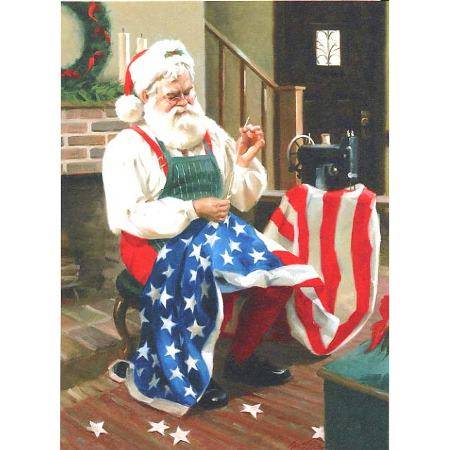
Santa Claus sewing a flag to fly on Christmas Day, according to the U.S. Flag Code. Artist is Tom Browning, “Gift to a nation.”
Christmas Day, December 25, is one of the holidays designated in the U.S. Flag Code for U.S. residents to fly the flag.
No, you don’t take the flag down for mere inclement weather; fly it through rain and snow. Remember to dry your flag before putting it away.
More:

Ron Cogswell captured a flag displayed at Reagan National Airport in Washington, D.C., in December 2015; Creative Commons license
1 Comment | Christmas, Flag etiquette, Fly your flag today | Tagged: Christmas, Flag Code, Flag etiquette, Fly your flag today | Permalink
Posted by Ed Darrell
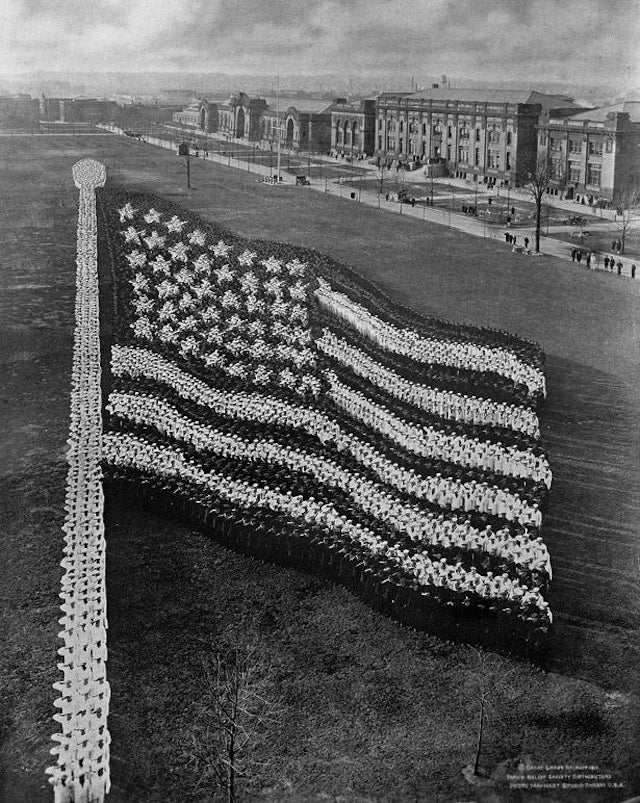
A “living flag” composed of 10,000 sailors, or “Blue Jackets at Salute,” by the Mayhart Studios, December 1917; image probably at the Great Lakes training facility of the Navy. Gawker media image
November offers several flag flying days, especially in years when there is an election.
But December may be the month with the most flag-flying dates, when we include statehood days.
December 7 is Pearl Harbor Remembrance Day. It’s not in the Flag Code, but public law (P.L. 103-308) urges that the president should issue a proclamation asking Americans to fly flags.
December 25 is Christmas Day, a federal holiday, and one of the score of dates designated in the Flag Code. If you watch your neighborhood closely, you’ll note even some of the most ardent flag wavers miss posting the colors on this day, as they do on Thanksgiving and New Years and Easter.
Other dates?
Nine states attained statehood in December! People in those states should fly their flags (and you may join them). Included in this group is Delaware, traditionally the “First State,” called that because it was the first former England colony to ratify the U.S. Constitution:
December 15 is Bill of Rights Day, marking the day in 1791 when the Bill of Rights was declared ratified; but though this event generally gets a presidential proclamation, there is no law or executive action that requires flags to fly on that date, for that occasion.
Eleven flag-flying dates in December. Does any other month have as many flag flying opportunities?
Have I missed any December flag-flying dates? 11 events on 10 days (Delaware’s statehood falls on the anniversary of the Pearl Harbor attack).
Here’s a list of the 10 days to fly the flag in December 2021, under national law, in chronological order:
Fly your flag with respect, for the flag, for the republic it represents, and for all those who sacrificed that it may wave on your residence.

Appropriate to a snowy December. “The Barn on Grayson-New Hope Road [Lawrenceville, Georgia]. This barn with its old truck and ever-present American flag, is often the subject of photographs and paintings by the locals.” Photo and copyright by Melinda Anderson
1 Comment | Flag etiquette, Fly your flag today, History, Patriotism, U.S. Flag | Tagged: December, Flag Code, Flag etiquette, Fly your flag today, History, Patriotism, U.S. Flag | Permalink
Posted by Ed Darrell
You’re planning for the big day, the big turkey (or vegan equivalent), you’re wondering how to time everything . . .
Just a reminder to patriots and sunshine patriots that Thanksgiving is one of those days designated in the U.S. Flag Code as a day for citizens to fly Old Glory. Plan to put your flag out early, you won’t have to worry about it all day.

There was a time when people actually sent Thanksgiving cards; few keep up that tradition. Image from Pacific Paratrooper.
It’s a great time to recall that the purposes of Thanksgiving usually start with expressing gratitude to and with all of our neighbors, as a means of binding us together as a community, a people, and a nation. And sometimes, an entire world, as cartoonist Joseph Keppler imagined. Recognizing that fellowship is not the rule now, as it wasn’t the rule when Keppler called out our hypocrisy then.
To better times to come.

From the Library of Congress collection: Joseph Keppler’s “A Thanksgiving Toast,” Puck magazine, November 30, 1898. “Caption: Puck Gentlemen, your health! I am glad to see from your bea[…]ing faces that you share the high aspirations of our friend, the Czar, for Universal Peace. Here’s to you all! Illus. from Puck, v. 44, no. 1134, (1898 November 30), centerfold.”
(More explanation from the Library of Congress: Print shows Puck standing on a chair at the head of a large dinner table, offering a Thanksgiving toast to those seated around the table, including “England, France, Germany, [Japan?], Russia, Austria, Italy, Turkey, Uncle Sam, Puerto Rico, Hawaii, Brazil, [and] Mexico”. Most of the European countries, as well as Mexico and Brazil, are glaring at their neighbors, with the exception of Russia where Nicholas II attempts to look pious. Turkey appears to be trying to stifle laughter. Uncle Sam seems to be the only one enjoying the toast. Puerto Rico, holding an American flag, and Hawaii are expressionless.)
More:
4 Comments | Flag etiquette, Fly your flag today, Holidays, Thanksgiving | Tagged: Fly your flag today, Patriotism, Thanksgiving | Permalink
Posted by Ed Darrell
Our traditional Thanksgiving post wishing for peace:
November 1869, in the first year of the Grant administration — and Nast put aside his own prejudices enough to invite the Irish guy to dinner, along with many others. (Nast tended not to like Catholics, and especially Irish Catholics.)
In a nation whose emotions are still raw from a divisive election, a year of protest for the right to live, a year of too-long-continued deadly plague, unwarranted, horrifying assaults on police officers, not to mention daily horrors reported from Venezuela, Central America, East Timor and Indonesian New Guinea, Syria, Belarus, Asia and the Middle East, could there be a better or more timely reminder of what we’re supposed to be doing?
A Millard Fillmore’s Bathtub tradition: Uncle Sam’s Thanksgiving. History teachers should use the image — and if you’re teaching history at home to students working hard to avoid getting ill, you should use it, too. If you’re teaching in Texas . . . well, there’s something here to make everyone angry, but anger is allowed under the new history censorship rules, right?
(Click for a larger image — it’s well worth it.)

Thomas Nast’s “Uncle Sam’s Thanksgiving,” 1869 – Ohio State University’s cartoon collection, and HarpWeek
As described at the Ohio State site:
“Uncle Sam’s Thanksgiving Dinner” marks the highpoint of Nast’s Reconstruction-era idealism. By November 1869 the Fourteenth Amendment, which secures equal rights and citizenship to all Americans, was ratified. Congress had sent the Fifteenth Amendment, which forbade racial discrimination in voting rights, to the states and its ratification appeared certain. Although the Republican Party had absorbed a strong nativist element in the 1850s, its commitment to equality seemed to overshadow lingering nativism, a policy of protecting the interests of indigenous residents against immigrants. Two national symbols, Uncle Sam and Columbia, host all the peoples of the world who have been attracted to the United States by its promise of self-government and democracy. Germans, African Americans, Chinese, Native Americans, Germans, French, Spaniards: “Come one, come all,” Nast cheers at the lower left corner.
One of my Chinese students identified the Oriental woman as Japanese, saying it was “obvious.” Other friends say both are Chinese. Regional differences. The figure at the farthest right is a slightly cleaned-up version of the near-ape portrayal Nast typically gave Irishmen.
If Nast could put aside his biases to celebrate the potential of unbiased immigration to the U.S. and the society that emerges, maybe we can, too.
Hope your Thanksgiving week is good; hope you have good company and good cheer, turkey or not, traveling or not, company or not. Stay safe. Happy Thanksgiving 2021. And of course, remember to fly your flag, to show you agree with Nast’s inclusive Thanksgiving.
More: Earlier posts from Millard Fillmore’s Bathtub
And in 2013:

Yes, this is an encore post. Defeating ignorance takes patience and perseverance.
11 Comments | Cartoons, Political cartoons, Thanksgiving, Thomas Nast | Tagged: 1869, History, Immigration, Political cartoons, Thanksgiving, Thomas Nast, Uncle Sam | Permalink
Posted by Ed Darrell
We fly our flags today, November 11, to honor all veterans, an extension and morphing of Armistice Day, which marked the end of World War I. The Armistice took effect on November 11, 1918.
Another very nice Veterans Day poster from the Veterans Administration, for 2021:
2021’s Veterans Day poster from the Veterans Administration features the Tomb of the Unknown Soldier at Arlington National Cemetery.
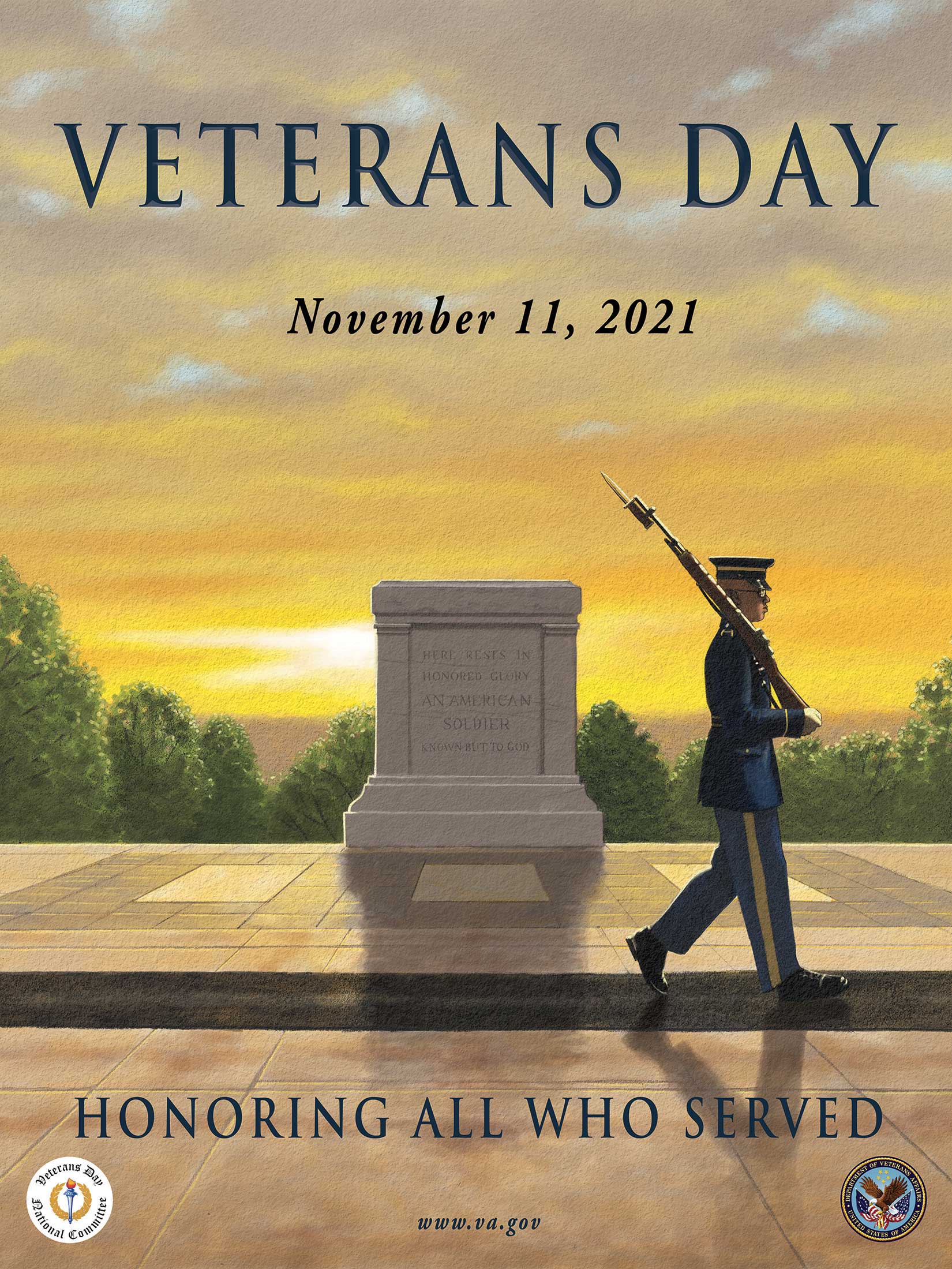
The Tomb of the Unknown Soldier at Arlington National Cemetery is featured in the 2021 poster for Veterans Day from the U.S. Veterans Administration.
In world history or U.S. history, I usually stop for the day to talk about the origins of Veterans Day in Armistice Day, the day the guns stopped blazing to effectively end fighting in World War I.
For several reasons including mnemonic, the treaty called for an end to hostilities on the “11th hour of the 11th day of the 11th month” of 1918. Your state’s history standards probably list that phrase somewhere, but the history behind it is what students really find interesting.
Original documents and good history can be found at the Library of Congress online collections.
The Allied powers signed a ceasefire agreement with Germany at Rethondes, France, at 11:00 a.m. on November 11, 1918, bringing the war later known as World War I to a close.
President Wilson proclaimed the first Armistice Day the following year on November 11, 1919, with the these words: “To us in America, the reflections of Armistice Day will be filled with solemn pride in the heroism of those who died in the country’s service and with gratitude for the victory, both because of the thing from which it has freed us and because of the opportunity it has given America to show her sympathy with peace and justice in the councils of the nations…” Originally, the celebration included parades and public meetings following a two-minute suspension of business at 11:00 a.m.

Between the world wars, November 11 was commemorated as Armistice Day in the United States, Great Britain, and France. After World War II, the holiday was recognized as a day of tribute to veterans of both wars. Beginning in 1954, the United States designated November 11 as Veterans Day to honor veterans of all U.S. wars. British Commonwealth countries now call the holiday Remembrance Day.
Online holdings of the National Archives and Records Administration (NARA) provide rich sources of information on America’s military, and on veteran’s day. NARA leans to original documents a bit more than the Library of Congress. For Veterans Day 2016, NARA featured an historic photo form 1961:

NARA caption: President John F. Kennedy Lays a Wreath at the Tomb of the Unknown Soldier as part of Veterans Day Remembrances, Arlington National Cemetery, Arlington, Virginia, 11/11/1961 Series: Robert Knudsen White House Photographs, 1/20/1961 – 12/19/1963. Collection: White House Photographs, 12/19/1960 – 3/11/1964 (Holdings of the @jfklibrary)
For teachers, that page also features this:
(Well, actually it’s for everyone. But teachers love those kinds of links, especially AP history teachers who need documents for “Document-Based Questions” (DBQs).
On one page, the Veterans Administration makes it easy for teachers to plan activities; of course, you need to start some of these weeks before the actual day:
For Teachers & Students
Hope your Veterans Day 2020 goes well, and remember to fly your flag at home.
Yes, this is an encore post. Defeating ignorance takes patience and perseverance.
Leave a Comment » | 1914-1918, Education, Flag etiquette, History, Lesson plans, Teaching Resources, veterans, veterans day | Tagged: 1914-1918, Education, Flag etiquette, History, Lesson plans, Teaching, Veterans Day | Permalink
Posted by Ed Darrell
Nine events spread over seven different days come with urgings to fly the U.S. flag in November: Six states celebrate statehood, Veterans Day falls always on November 11, and Thanksgiving Day on November 25.

Cub Scouts carry the U.S. flag in the Houston, Texas, Thanksgiving parade. Unknown year; image from Greater Houston Moms
Did I say eight? 2021 is an election year in many states, like Texas; we fly flags at polling places on election day, so that makes nine events. You may fly your flag at home on election day, too.
Two states, North Dakota and South Dakota, celebrate their statehood on the same date, and that’s the date of elections in 2021. Washington’s statehood day falls on Veterans Day, November 11 — so there are only six days covering nine events.
In calendar order for 2021, these are the seven days:
Most Americans will concern themselves only with Veterans Day and Thanksgiving Day. Is flying the U.S. flag for statehood day a dying tradition?
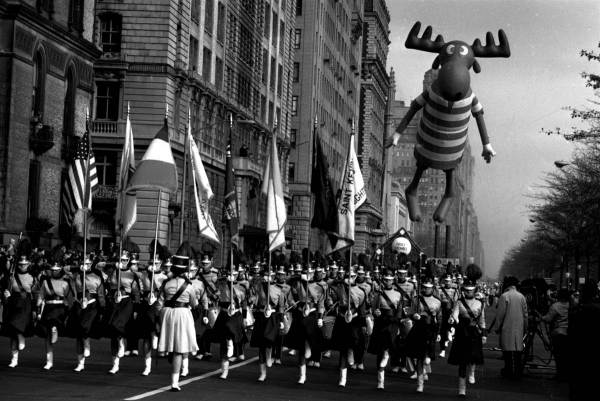
Color guard carries U.S. flag, closely followed Bullwinkle the Moose, in Macy’s Thanksgiving Day Parade, unknown year. HistoryDaily.org image
More:
Yes, this is an encore post. Fighting ignorance takes longer than we hoped.
2 Comments | Flag etiquette, Fly your flag today, History, U.S. Flag | Tagged: Flag etiquette, Fly your flag today, History, U.S. Flag | Permalink
Posted by Ed Darrell
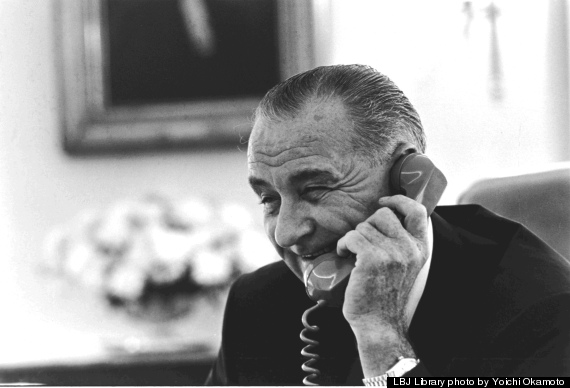
President Lyndon Baines Johnson was born August 27, 1908. One of the most active, ambitious and controversial presidents, he competes with James Madison for the title of “best legislator” among presidents. Today is his 113th birthday.
Several groups in Texas and Washington celebrate LBJ’s birthday each year, an event he always liked to keep festive, partly because he had a huge ego, and partly because he just loved a good time with friends and cake.
More:
4 Comments | History, History of Science, Lyndon B. Johnson, Politics, Presidents | Tagged: History, Lyndon B. Johnson, Politics, Presidents | Permalink
Posted by Ed Darrell

“When you know more than the doctors who’ve spent their entire careers studying infectious diseases, it’s time for a Dunning-Kruger.”
I wish there were a requirement for inventors of internet memes to sign their work. Who gets credit for this whisky advertising mashup?
Now there’s a video ad, from Dr. Rohin Francis.
Tip of the old scrub brush to Nish Gandhi, DO @supreme_doc.
More:
7 Comments | 121 Merit Badge Club, COVID-19, Dunning Kruger Effect, Dunning-Kruger Effect, Humor, medicine, Politics | Tagged: Dunning-Kruger Effect, Humor, medicine, Politics, Science | Permalink
Posted by Ed Darrell
Beleaguered sign makers will tell you, sometimes it’s damnably difficult to make signs make sense to motorists who speed by faster than they should — and sometimes, the story is just too difficult for pictures.
Take this one, posted on Twitter by @Weasel3071:

What does this sign mean? Sign near Bolinas, wherever than is. On Twitter from @Weasel3071.
@Weasel3071 asked reasonably, “What is happening here?”
What do you think, Dear Reader?
Responses cover a lot of territory, and of course the flying cows of “Tornado” and “Monty Python and the Holy Grail” got mentions.
One response appears to come from an actual sign maker, who expresses sign maker frustration.
Other responses hint that some people may be modifying actual cow warning signs, in New Mexico or Nevada.
Not just once, but twice — so you know it must be true.
https://twitter.com/ValkXoe/status/1421302186978512900
What say you, dear reader? Falling cows? Snake eating a cow?
And, shouldn’t it be “.1 mile” instead of “miles?”
Tip of the old scrub brush to @Weasel3071.
2 Comments | Communication, Humor, Signs, Signs of Life, Travel | Tagged: Communication, Humor, Signs, Signs of Life, Travel | Permalink
Posted by Ed Darrell
A running whine on Twitter and Facebook: ‘Can you name anything government ever got right?’
One such occasion was July 20, 1969, when humans first put foot on the Moon.
It’s a day to remember history. Do you remember that day, the first time humans landed on the Moon?
God knows we could use more Americans to have faith in the good intentions of NASA scientists today; we could use more dreams like those NASA gave us then, too.
Southwest Elementary in Burley, Idaho, existed in a world far, far away from the U.S. space program. We watched rocket launches on black and white televisions — the orbital launches were important enough my father let me stay home from school to watch, but when he dropped me off at school, I was in a tiny band of students who actually made it to school. Potato farmers and the merchants who supported them thought the space program was big, big stuff, worth missing school.
By John Glenn’s flight, a three-orbit extravaganza on February 20, 1962, a television would appear in the main vestibule of the school, or in the auditorium, and we’d all watch. There were very few spitballs. Later that year my family moved to Pleasant Grove, Utah.

Moonrise from Apollo 11 prior to Moon landing.
Toward the end of the Gemini series, television news networks stopped providing constant coverage. The launch, the splashdown, a space walk or other mission highlight, but the nation didn’t hold its breath so much for every minute of every mission. Barry McGuire would sing about leaving the planet for four days in space (” . . . but when you return, it’s the same old place.“), then six days, but it was just newspaper headlines.
The Apollo 1 fire grabbed the nation’s attention again. Gus Grissom, one of the three who died, was one of the original space titans; death was always a possibility, but the U.S. program had been so lucky. Apollo’s start with tragedy put it back in the headlines.
The space program and its many successes made Americans hopeful, even in that dark decade when the Vietnam War showed the bloody possibilities of the Cold War. That darkest year of 1968 — see the box below — closed nicely with Apollo 8 orbiting the Moon, and the famous Christmas Eve telecast from the three astronauts, Frank Borman, Jim Lovell, and William A. Anders. The space program kept us hopeful.
By early 1969 many of us looked forward to the flight of Apollo 11 scheduled for July — the space flight that promised to put people on the Moon for the first time in history, the realization of centuries-old dreams.
Then I got my assignment for Scouting for the summer. Out of nearly 50 nights under the stars, one of the days would include the day of the space walk. Not only was it difficult to get televisions into Maple Dell Scout Camp, a good signal would be virtually impossible. I went to bed Sunday night knowing the next day I’d miss the chance of a lifetime, to watch the first moon landing and walk.
Just after midnight my sister Annette woke me up. NASA decided to do the first walk on the Moon shortly after touchdown, at an ungodly hour. I’d be unrested to check Scouts in, but I’d have seen history.
And so it was that I got to watch as on July 20, 1969, Neil Armstrong became the first human to set foot on the Moon: “A small step for a man, a giant leap for mankind,” was what he meant to say in a transmission that was famously garbled (at least he didn’t say anything about jelly doughnuts).

Photo: Astronaut Buzz Aldrin salutes the U.S. flag on the Moon; for a gallery of photos from Apollo 11 from NASA, click here.
NASA provided a video compilation for the 40th anniversary of Apollo 11 in 2009:
2021 marks the 52nd anniversary.
Texas Essential Knowledge and Skills (TEKS) used to list 11 dates for U.S. history as the touchstones kids need to have: 1609, the founding of Jamestown; 1776, the Declaration of Independence; 1787, the Constitutional Convention; 1803, the Louisiana Purchase; 1861-1865, the American Civil War; 1877, the end of Reconstruction; 1898, the Spanish American War; 1914-1918, World War I; 1929, the Stock Market Crash and beginning of the Great Depression; 1941-1945, World War II; 1957, the launching of Sputnik by the Soviets. Most teachers used to add the end of the Cold War, 1991; I usually included Apollo 11 — I think that when space exploration is viewed from a century in the future, manned exploration will be counted greater milestone than orbiting a satellite; my only hesitance on making such a judgment is the utter rejection of such manned exploration after Apollo, which will be posed as a great mystery to future high school students, I think.)
Happy to report the Texas State Board of Education has caught on. TEKS dates now include 1968 and assassination of Rev. Dr. Martin Luther King, Jr., 1969 and Apollo 11, plus the terrorist attacks on the World Trade Center in 2001 and the 2008 election of Barack Obama as president.
* Why 1968 was such a tough year, in roughly chronological order: 1968 produced a series of disasters that would depress the most hopeful of people, including: the Pueblo incident, the B-52 crash in Greenland, the Tet Offensive in Vietnam, the nerve gas leak at the Army’s facility at Dugway, Utah, that killed thousands of sheep, Lyndon Johnson’s pullout from the presidential race with gathering gloom about Vietnam, the Memphis garbage strike, the assassination of Martin Luther King, Jr., riots, the Black Panther shoot-out in Oakland, the Columbia University student takeover, the French student strikes, the tornadoes in Iowa and Arkansas on May 15, the Catonsville 9 vandalism of the Selective Service office, the sinking of the submarine U.S.S. Scorpion with all hands, the shooting of Andy Warhol, the assassination of Robert F. Kennedy, the Buenos Aires soccer riot that killed 74 people, the Glenville shoot-out in Cleveland, the cynicism of the Republicans and the nomination of Richard Nixon and Spiro Agnew, the Warsaw Pact invasion of Czechoslovakia crushing the “Prague Spring” democratic reforms, the Chicago Democratic Convention and the police riot, the brutal election campaign, the Tlatololco massacre of students in Mexico City, Black Power demonstrations by winning U.S. athletes at the Mexico City Olympics, coup d’etat in Panama. Whew!
More, from Millard Fillmore’s Bathtub:
And even more:
Yes, this is an encore post with updates. Defeating ignorance takes patience and perseverance.
2 Comments | 1957, 1968, 1969, Cold War, Heroes, History, Moon, Neil Armstrong, Science, Space exploration, Technology, TEKS | Tagged: Apollo 11, Buzz Aldrin, Gus Grissom, History, John Glenn, NASA, Neil Armstrong, Science | Permalink
Posted by Ed Darrell
The genius behind P. D. Q Bach, and the compoaser of the score to Silent Running, is 86 today. Happy birthday, Peter Schickele!
This is a mostly encore post, of course.

Peter Schickele, born 1935 in Ames, Iowa, and some hope, immortal.
May he live to be a happy, robust, still-composing, still performing 139, at least.
Some people know him as a great disk jockey. Some people know him as the singer of cabaret tunes. Some people know and love him as a composer of music for symphony orchestra, or to accompany Where the Wild Things Are.

Then there are those happy masses who know him for his historical work, recovering the works of Johann Sebastian Bach’s final and most wayward child, P. D. Q. Bach.
One need not be a classical music fan to appreciate much of the humor in Schickele’s work. But if one is familiar with classical music and the tropes of critics and artists, there will be added nuances and fits of laughter.
Shickele has spent his life having a great time in music, and spreading cheer. A life well lived.
Happy birthday!
Tip of the old bathtub-hardened conductor’s baton to Eric Koenig.
Heh. The old “encore post” graphic is really appropriate here.
Yes, this is an encore post. Defeating ignorance takes patience and perseverance.
3 Comments | Art, History, Music, Parody | Tagged: Arts, Eric Koenig, History, Music, P. D. Q. Bach, Parody, Peter Schickele | Permalink
Posted by Ed Darrell

Caption from NASA: The American flag heralded the launch of Apollo 11, the first Lunar landing mission, on July 16, 1969. The massive Saturn V rocket lifted off from NASA’s Kennedy Space Center with astronauts Neil A. Armstrong, Michael Collins, and Edwin “Buzz” Aldrin at 9:32 a.m. EDT. Four days later, on July 20, Armstrong and Aldrin landed on the Moon’s surface while Collins orbited overhead in the Command Module. Armstrong and Aldrin gathered samples of lunar material and deployed scientific experiments that transmitted data about the lunar environment. Image Credit: NASA
[Yes, we’re running late with this post for July. Apologies. You can always check the list of all dates, or last year’s post.]
July 4. Surely everyone knows to fly the flag on Independence Day, the anniversary of the Declaration of Independence.*
In the month of the grand patriotic celebration, what other dates do we fly the U.S. flag? July 4 is the only date designated in the Flag Code for all Americans to fly the flag. Three states joined the union in July, days on which citizens of those states should show the colors, New York, Idaho and Wyoming.
Plus, there is one date many veterans think we should still fly the flag, Korean War Veterans Armistice Day on July 27. Oddly, the law designating that date urges flying the flag only until 2003, the 50th anniversary of the still-standing truce in that war. But the law still exists. What’s a patriot to do?
Patriots may watch to see whether the president issues a proclamation for the date.
Generally we don’t note state holidays or state-designated flag-flying events, such as Utah’s Pioneer Day, July 24, which marks the day in 1847 that the Mormon pioneers in the party of Brigham Young exited what is now Emigration Canyon into the Salt Lake Valley. But it’s a big day in Utah, where I spent a number of years and still have family. And I still have memories, not all pleasant, of that five-mile march for the Days of ’47 Parade, in that wool, long-sleeved uniform and hat, carrying the Sousaphone. Pardon my partisan exception. Utahns will fly their flags on July 24.
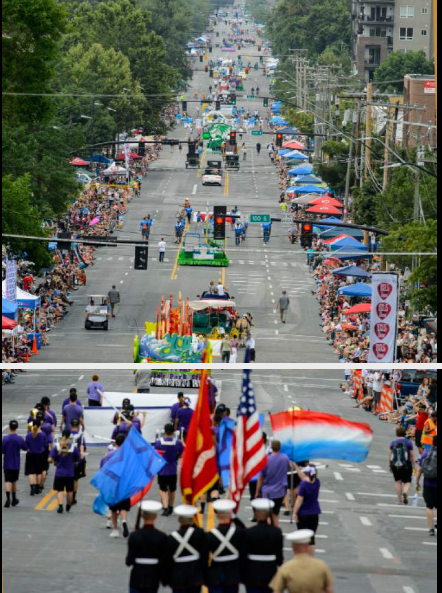
View of part of the route of the Days of ’47 Parade route, along Main Street in Salt Lake City. Photo by Steve Griffin of the Salt Lake Tribute, 2017
July’s flag flying dates, chronologically:
More:
_____________
* July 4? But didn’t John Adams say it should be July 2? And, yes, the staff at Millard Fillmore’s Bathtub sadly noted that, at most July 4 parades, it appears no one salutes the U.S. flag as it passes, as the Flag Code recommends — though there were several people properly saluting the leading flags at the Duncanville Independence Day parade in 2021. MFB’s been fighting flag etiquette ignorance since 2006. It’s taking much, much longer than we wished.
Yes, this is an encore post. Defeating ignorance takes patience and perseverance.
Leave a Comment » | Flag etiquette, Fly your flag today, History, korean war, Utah | Tagged: Days of '47, Flag etiquette, Fly your flag today, History, Korean War, Utah | Permalink
Posted by Ed Darrell

“The Second Day of July 1776 will be the most memorable Epocha, in the History of America. . . . It ought to be solemnized with Pomp and Parade, with Shews, Games, Sports, Guns, Bells, Bonfires, and Illuminations from one End of this Continent to the other from this Time forward forever more.”
— John Adams to Abigail Adams, July 3, 1776
Surely John Adams knew that July 4 would be Independence Day, didn’t he?
In writing to his wife Abigail on July 3, John Adams committed one of those grand errors even he would laugh at afterward. We’ll forgive him when the fireworks start firing.
1776 filled the calendar with dates deserving of remembrance and even celebration. John Adams, delegate from Massachusetts to the Second Continental Congress, wrote home to his wife Abigail that future generations would celebrate July 2, the date the Congress voted to approve Richard Henry Lee’s resolution declaring independence from Britain for 13 of the British colonies in America.
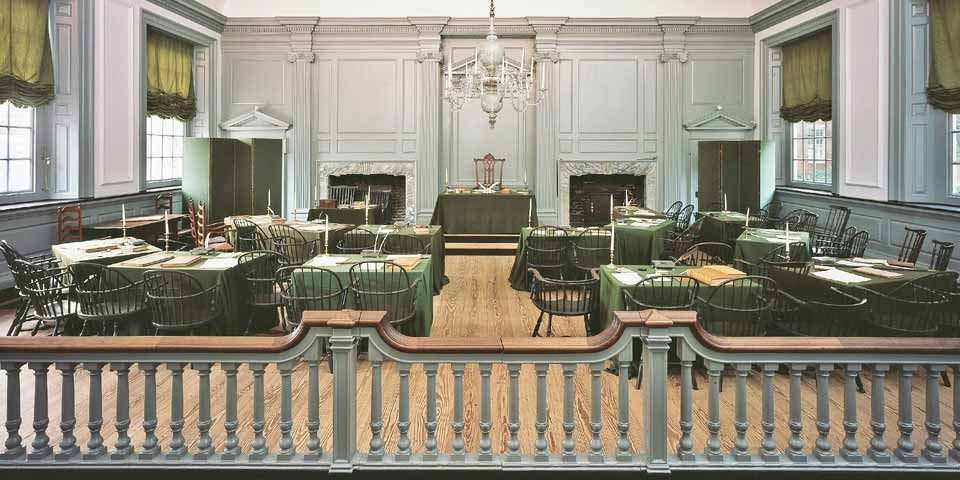
Two days later, that same Congress approved the wording of the document Thomas Jefferson had drafted to announce Lee’s resolution to the world.
Today, we celebrate the date of the document Jefferson wrote, and Richard Henry Lee is often a reduced to a footnote, if not erased from history altogether.
Who can predict the future?
(You know, of course, that Adams and Jefferson both died 50 years to the day after the Declaration of Independence, on July 4, 1826. In the 50 intervening years, Adams and Jefferson were comrades in arms and diplomacy in Europe, officers of the new government in America, opposing candidates for the presidency, President and Vice President, ex-President and President, bitter enemies, then long-distance friends writing almost daily about how to make a great new nation. Read David McCullough‘s version of the story, if you can find it.)
(Yes, this is mostly an encore post. Another history issue that arose in conversations today — I thought everyone knew this.)
More, and Related articles:


Leave a Comment » | 1776, Declaration of Independence, Famous quotes, Historic documents, History, John Adams, July 4 1776, Quotes | Tagged: 1776, Continental Congress, Declaration of Independence, History, John Adams, July 2 1776, July 2nd, July Fourth, Quotes | Permalink
Posted by Ed Darrell


Ed Darrell on Texas's Colorado River


Come on in, the water's fine. Come often: Cleanliness is next to godliness.