Birth of hydrogen phobia: May 6, 1937, the Hindenberg crash

May 6, 2014

May 6, 2014, is the 77th anniversary of the Hindenberg tragedy. Docking at its station in New Jersey, after crossing the Atlantic, a spark ignited the aluminum-based paint on the airship, and the entire craft exploded into flame.

35 people died on the airship, and one on the ground — did you know a few survived? The Associated Press interviewed a man who was 8-years old that day, and a passenger on the airship.

Werner Doehner, an 8-year-old passenger aboard the Hindenburg, saw chairs fall across the dining room door his father had walked through moments before the disaster. He would never see his father alive again.

“Just instantly, the whole place was on fire,” said Doehner, of Parachute, Colo., who is the last surviving passenger. “My mother threw me out the window. She threw my brother out. Then she threw me, but I hit something and bounced back. She caught me and threw me the second time out. My sister was just too heavy for her. My mother jumped out and fractured her pelvis. Regardless of that, she managed to walk.”

Hindenberg on fire

Hindenberg on fire, May 6, 1937.

The disaster erroneously condemned hydrogen in the public’s mind. Despite widespread use of hydrogen gas for cooking and some transportation during World War II (including in the U.S.), use of hydrogen as a fuel beyond that has always faced the hurdle of the “Hindenberg Syndrome,” the fear that the gas would explode.

Is the fear justified?  Fact is that gasoline is much more volatile, more explosive, and generally more dangerous, than hydrogen.  We move, and use, millions of gallons of gasoline in the U.S. every day, worldwide very hour, bound by laws enforcing strict liability, in relative safety.  Most people don’t think about the explosive power of the few gallons of gasoline stored under the rear seat of their car, where the children ride.

What other technologies do we fear irrationally?  What technologies do we irrationally fail to fear so much as we should?

This is mostly an encore post.


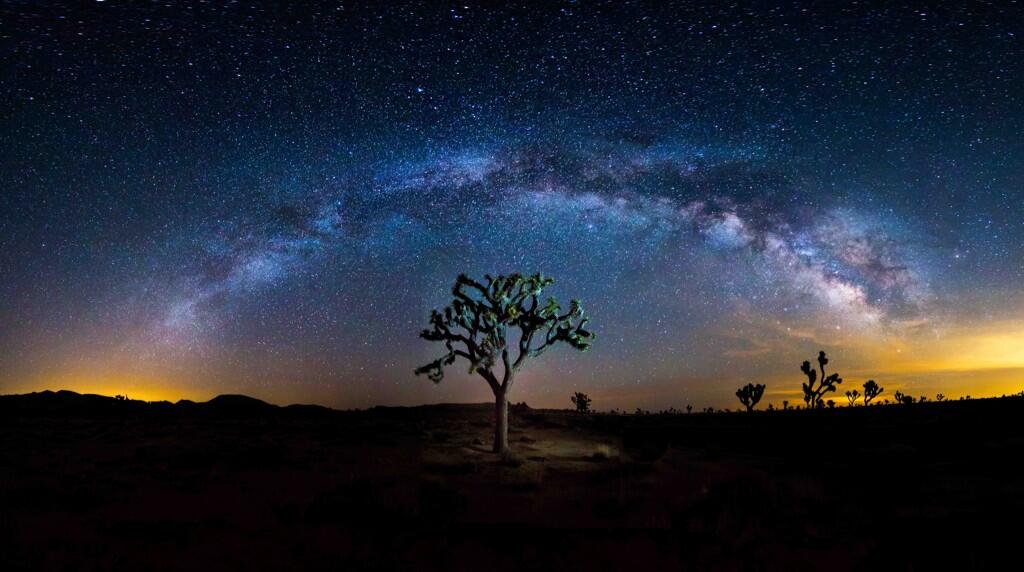
Milky Way from Joshua Tree N.P..

May 5, 2014

From the U.S Department of Interior Twitter feed:  To celebrate being named to the @TIME #Twitter140, here is an amazing photo from @JoshuaTreeNP. pic.twitter.com/F4DS5Xv9vq

From the U.S Department of Interior Twitter feed: To celebrate being named to the @TIME #Twitter140, here is an amazing photo from @JoshuaTreeNP. pic.twitter.com/F4DS5Xv9vq

Milky Way in a long exposure with a light-painted tree in Joshua Tree National Park, California.

More:


Gun nuts twisting the words of President Kennedy

May 4, 2014

Here’s the full text of President Kennedy’s statement on President Franklin D. Roosevelt’s birthday in 1961, urging Americans to join Kennedy in making things better, including enlisting in the military, from the Kennedy Library [links added here]:

January 29, 1961

This year, the celebrations of Roosevelt Day has special significance for Democrats everywhere; for we celebrate not only the triumphs of the past but the opportunities of the future.

Twenty-eight years ago Franklin Roosevelt assumed the leadership of a stricken and demoralized nation. Poverty, distress and economic stagnation blanketed the land. But it was not long before the great creative energies of the New Deal had lifted American from its despair and set us on the path to new heights of prosperity, power and greatness.

Today America is the richest nation in the history of the world. Our power and influence extend around the globe. Yet the challenges and dangers which confront us are even more awesome and difficult than those that face Roosevelt. And we too will need to summon all the energies of our people and the capacities of our leaders if America is to remain a great and free nations — if we are to master the opportunities of the New Frontier.

The dimensions of out problems overwhelm the imagination. At home millions are unemployed and the growth of our economy has come to a virtual halt. Abroad, we are faced with powerful and unrelenting pressure which threaten freedom in every corner of the globe, and with military power so formidable that it menaces the physical survival of our own nation.

To meet these problems will require the efforts not only of our leaders or of the Democratic Party–but the combined efforts of all of our people.; No one has a right to feel that, having entrusted the tasks of government to new leaders in Washington, he can continue to pursue his private comforts unconcerned with American’s challenges and dangers. For, if freedom is to survive and prosper, it will require the sacrifice, the effort and the thoughtful attention of every citizen.

In my own native state of Massachusetts, the battle for American freedom was begun by the thousands of farmers and tradesmen who made up the Minute Men — citizens who were ready to defend their liberty at a moment’s notice. Today we need a nation of minute men; citizens who are not only prepared to take up arms, but citizens who regard the preservation of freedom as a basic purpose of their daily life and who are willing to consciously work and sacrifice for that freedom. The cause of liberty, the cause of American, cannot succeed with any lesser effort.

It is this effort and concern which makes up the New Frontier. And it is this effort and concern which will determine the success or failure not only with Administration, but of our nation itself. [emphasis added]

Source: White House Central Subject Files, Box 111, “FDR”.

Other Information Sources:

“Know your Lawmakers,” Guns Magazine, April 1960.
Letter to President John F. Kennedy from the NRA,” [NRAcentral.com].
“New Minute Men Urged by Kennedy,” The New York Times, 30 January, 1961, pg. 13.
“Kennedy Says U.S. Needs Minute Men,” Los Angeles Times, 30 January, 1961, pg. 4.
“Minutemen’s Soft-Sell Leader: Robert B. DePugh,” The New York Times, 12 November 1961, pg. 76.

It seems to me that Kennedy was not asking yahoos to take up arms against the government, but was instead asking Americans to “ask not what your country can do for you; ask what you can do for your country.”  Specifically in the last paragraph, he noted his call was to join in the New Frontier efforts his administration pushed.
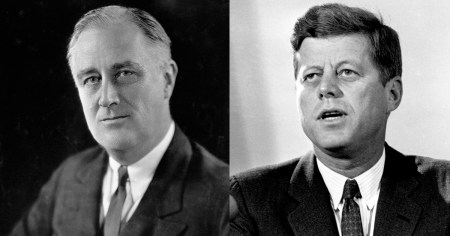
FDR, left, and JFK: Kennedy took the opportunity of Roosevelt's birth anniversary in 1961, January 29, to urge Americans to volunteer to serve the nation, to serve as the Minutemen did, voluntarily, where the nation needs help, and in support of the nation. Image from Ring of Fire Network

FDR, left, and JFK: Kennedy took the opportunity of Roosevelt’s birth anniversary in 1961, January 29, to urge Americans to volunteer to serve the nation, to serve as the Minutemen did, voluntarily, where the nation needs help, and in support of the nation. Image from Ring of Fire Network

If you’re not much a student of history, you may have forgotten about Kennedy’s New Frontier.  As presidents before him, with the Square Deal (Teddy Roosevelt, 1904), the New Deal (FDR, 1933), and the Fair Deal (Truman, 1949), Kennedy sought a shorthand term to apply to much of his program of changes.  In his speech accepting the nomination of the Democratic Party to run for president, he called this a New Frontier.

For I stand tonight facing west on what was once the last frontier. From the lands that stretch three thousand miles behind me, the pioneers of old gave up their safety, their comfort and sometimes their lives to build a new world here in the West. They were not the captives of their own doubts, the prisoners of their own price tags. Their motto was not “every man for himself” –but “all for the common cause.” They were determined to make that new world strong and free, to overcome its hazards and its hardships, to conquer the enemies that threatened from without and within.

Today some would say that those struggles are all over–that all the horizons have been explored–that all the battles have been won– that there is no longer an American frontier.

But I trust that no one in this vast assemblage will agree with those sentiments. For the problems are not all solved and the battles are not all won–and we stand today on the edge of a New Frontier–the frontier of the 1960’s–a frontier of unknown opportunities and perils– a frontier of unfulfilled hopes and threats.
[emphasis added]

Woodrow Wilson’s New Freedom promised our nation a new political and economic framework. Franklin Roosevelt’s New Deal promised security and succor to those in need. But the New Frontier of which I speak is not a set of promises–it is a set of challenges. It sums up not what I intend to offer the American people, but what I intend to ask of them. It appeals to their pride, not to their pocketbook–it holds out the promise of more sacrifice instead of more security.

But I tell you the New Frontier is here, whether we seek it or not. Beyond that frontier are the uncharted areas of science and space, unsolved problems of peace and war, unconquered pockets of ignorance and prejudice, unanswered questions of poverty and surplus. It would be easier to shrink back from that frontier, to look to the safe mediocrity of the past, to be lulled by good intentions and high rhetoric–and those who prefer that course should not cast their votes for me, regardless of party.

But I believe the times demand new invention, innovation, imagination, decision. I am asking each of you to be pioneers on that New Frontier. My call is to the young in heart, regardless of age–to all who respond to the Scriptural call: “Be strong and of a good courage; be not afraid, neither be thou dismayed.”

For courage–not complacency–is our need today–leadership–not salesmanship. And the only valid test of leadership is the ability to lead, and lead vigorously. A tired nation, said David Lloyd George, is a Tory nation–and the United States today cannot afford to be either tired or Tory.

Kennedy famously challenged Americans to stand up for service to the nation in his inaugural speech, and when he founded the Peace Corps, asking Americans to give up two or three years to work, peacefully, in other lands to promote progress there. Kennedy called Americans to share his vision, and to work for change, for a better America.

What were specifics of the New Frontier agenda?   Kennedy pushed a broad range of programs, many turned into laws in his brief term; Kennedy aimed to change America in economics, taxation, labor, education, welfare, civil rights, housing, unemployment, health, equal rights for women, environment, agriculture, crime and defense.   In each of these areas Kennedy sought to build on the legacies of Franklin D. Roosevelt and Harry Truman — in ways that conservatives today become apoplectic just thinking about.

Kennedy pushed for a higher minimum wage with built-in step increases over time not keyed to inflation.  He called for more taxcuts for the poor, coupled with targeted tax incentives to get businesses to spend their cash to create jobs.  Kennedy favored changes in law to give unions greater say in corporate expansion, tougher protection for workers from firing, and he extended collective bargaining to federal workers.  Kennedy called for expansion of federally-funded loans and scholarships for college students, and he started a program to use federal money to put technology into classrooms at the elementary and secondary levels.  Kennedy expanded unemployment and welfare benefits, and got a 20% increase in Social Security benefits.

Kennedy’s New Frontier called for sweeping changes in the way government protects the rights and welfare of all citizens.

Did Kennedy actually call for armed militias to fight government “over-reach” or expansion?

What do you think?  When a proponent of getting guns to protect himself against the U.S. government, by killing agents of the U.S. government (we must imagine), cites a part of Kennedy’s statement from 1961 as supporting arming individual citizens, is he being honest?

Please tell us what you think, in comments. Your opinion counts.

Poster from Americanfirearms.org; the quoate from Kennedy is accurate, but did Kennedy mean what this group wants us to think it means?

Poster from Americanfirearms.org; the quote from Kennedy is accurate, but did Kennedy mean what this group wants us to think it means?

Kennedy appears to have been fond of the image of the Minutemen at Lexington and Concord, trained militia from citizen volunteers, who started the path to American independence from Britain.  He invoked that image earlier, as senator from Massachusetts, in a speech honoring the Polish hero Casimir Pulaski, at a Pulaski Day Dinner in Milwaukee, Wisconsin on October 17, 1959:

We pay tribute to Casimir Pulaski tonight by honoring a great American of Polish descent, Clem Zablocki.  For he has demonstrated, in Washington and Wisconsin, the same courage and conscience, the same zeal for liberty, the same tireless patience and determination to help all who call for help.  He is a great Congressman – not only from Wisconsin – but of the United States . . .

But we also think of Casimir Pulaski tonight because his beloved Poland has once again fallen victim to a foreign power.  The independence for which he fought against the Russians at Czestochowa has been once again suppressed – and once again by the Russians.  Were he alive tonight, the hero of Savannah and Charleston would weep for his homeland – and we, inwardly or outwardly according to our custom, weep with him.

But weeping is not enough.  We know it is not enough.  And yet, while we give vent to our feelings of resentment and outrage, we are also caught up in a feeling of frustration.  What can we do about the situation in the satellites?  How can we help those liberty-loving peoples regain their liberty, without subjecting them to even more cruel repression – or subjecting the world to an even more disastrous war?  How can we let them know their fate is not forgotten – that we have not abandoned them to be – like the Irish of 1647 considered themselves when Owen Roe O’Neill was poisoned – “sheep without a shepherd when the snow shuts out the sky?”

This is the dilemma we face, as both last month and next year the President and Premier Khrushchev are pictured together in the press on both sides of the Iron Curtain.  And this is the dilemma with which this Administration has been confronted, in trying to make good on its tarnished promises of a new “liberation” policy.  For this is no longer an age when minutemen with muskets can make a revolution.  Hungary, we know, is not Cuba – and neither is Poland.  Mr. Khrushchev is not to be overthrown like Mr. Batista.  Brave bands of young men and women may be able to stop a few tanks – but street barricades and home-made hand grenades cannot long stand against a modern army and an atomic air force. [emphasis added]

The facts of the matter are that – no matter how bitter some feelings may be, or how confident some are of a victorious war for liberation – freedom behind the Iron Curtain and world peace are actually inextricably linked.  For if war should ever break out, the control and occupation of Eastern Europe would certainly be even more rigid and repressive than it is today.  That is why, in the days of upheaval in 1956, when Poland could have turned to violent rebellion as Hungary did, Cardinal Wyszynski kept advising his people that the condition of Polish freedom was peace.  Many scoffed – many thought him faint-hearted.  But by following his advice, Poland has now attained at least a measure of national independence and at least a relaxation of Communist rule.  Forced collectivization of the farmers has ceased and most of the collectives were dissolved – religious freedom has been restored in considerable degree – and freedom of speech is returning.

No one says that land of ancient freedom is once more free again.  But if Poland had not accepted this half-way house to freedom, it could have been, as Prime Minister Gomulka warned, wiped off the map of Europe.  If the present emphasis on a thaw in the Cold War should end and tensions rise again, the present good relations between Poland and the United States would undoubtedly cease, the growing contacts between the Polish people and the West would be cut off, and the present degree of freedom of speech and religion in Poland would prove to be short-lived.  On the other hand, if a real thaw develops and Soviet-American relations improve, the prospects for the continuation and perhaps the expansion of this limited degree of Polish freedom are good.  So, in a real sense, the condition for Polish freedom is peace.
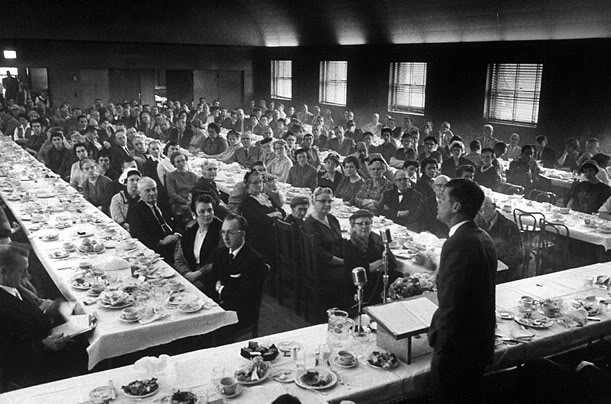
President Kennedy addressing a Wisconsin group during the 1960 presidential campaign.  (Do you have more details?)

President Kennedy addressing a Wisconsin group during the 1960 presidential campaign. (Do you have more details?) Photo by Robert W. Kelley//Time Life Pictures/Getty Images

One does not get the sense that President Kennedy was urging citizens to establish their own arsenals, contrary to the actions of the Minutemen at Lexington and Concord, nor to take up arms against the U.S. government.

Who would suggest that’s what Kennedy meant?  Oh, yeah:  AmericanFirearms.org.

More:

Page one of a speech text then-Sen. John Kennedy delivered regarding why America arms, on March 9, 1960, in Mauston, Wisconsin. JFK Library image

Page one of a speech text then-Sen. John Kennedy delivered regarding why America arms, on March 9, 1960, in Mauston, Wisconsin. JFK Library image


Can America afford to be great anymore? Many say, “no”

May 1, 2014

A friend posted this on Facebook:

“As of today our total national debt is roughly $17 1/2 trillion. Of that number nearly $12 1/2 trillion is publicly owed. Can you even get your mind around it?”

To which I responded:

As a portion of GDP, our national debt was much greater in 1946.

So, the Congress did what it had to do.

Congress borrowed money to educate millions of returning veterans, and to subsidize their homes. The greatest education aid and housing aid programs in history, both in the GI Bill.

Poster honoring the Marshall Plan, to rebuild Europe after World War II -- on borrowed money.

Poster honoring the Marshall Plan, to rebuild Europe after World War II — on borrowed money.

Congress borrowed money to give it away to our allies in World War II, to rebuild their industrial capabilities, on the assumption that an ally with a strong industrial base and good economy is stronger, and can come to our aid if and when we need it.

Congress borrowed money to give it away to our enemies in World War II, to rebuild their industrial capabilities, because a nation with a good economy and health trade tends to stay out of war. Those nations became our allies.

Congress borrowed to build the greatest road system in history, connecting nearly every corner of America — under the pretense that such a road system would allow us to move troops and armaments quickly from coast to coast in event of a defense emergency.

Congress borrowed to finance space exploration, to go to the Moonbecause, you know, it’s hard.

Congress borrowed to build a library in every county in America, and fill it with books — so that if there were ever nuclear war, everybody who survived would be close to the information necessary to rebuild civilization.

Congress borrowed to build the world’s greatest air transportation system, with airports for sport, business and commercial aviation all over the place.

Congress borrowed to build sewer systems and water systems, doubling down on public health service spending, to prevent disease and make health people.

Funny things happened. Our economy boomed. The world economy boomed. Millions of new jobs were created, filled by people who paid whopping taxes. And the debt sorta melted away.
___________

When I hear people complain about our national debt, and how we as Americans must stop spending money, I hear them saying, “We cannot afford to be great anymore. Our time as the world’s leading economy and leading democracy has passed. It will be a lot cheaper for the nation to curl into a national fetal position, and then taxes won’t be so high.”

That’s what I hear the GOP saying, when they urge tax cuts for the rich, while taking away food stamps from the families of our military deployed overseas.  (Can you imagine anything like that happening during World War II? Not even “interned” families of soldiers went hungry.)

In 1946 — and in 1948, 1950, 1952, 1956, 1960, 1962, 1964, 1968, and other election years — there were plenty of Americans who said “we can’t afford the Marshall Plan; we can’t afford foreign aid; we can’t afford to build all these roads; we can’t afford to go to the Moon; we can’t afford to pay for college (or other schooling) for all these veterans/students.”

What would America look like, had leaders listened to those people, and then NOT borrowed the money to build America?  What would the world look like?

I don’t think George Washington spent 8 years at war to curl into the fetal position and give up.

Am I wrong?

The future of an America that is afraid to be great, even if we need to borrow money to do it? (Image from Brogan Knight)

The future of an America that is afraid to be great, even if we need to borrow money to do it? (Image from Brogan Knight)


Insta-Millard: Greenspan explains why and how Fed is accountable

April 30, 2014

A group of people, including a lot of the acolytes of Ron Paul, claim the Federal Reserve Bank system is a renegade organization, unaccountable to anyone.

Alan Greenspan, by the late, very great David Levine

Alan Greenspan, by the late, very great David Levine

Turns out that Ron Paul actually had the guts to ask Fed Chair Alan Greenspan about that.  Greenspan’s answer is worth watching, and hearing.

It was on CSPAN-2, so you probably didn’t see it.  Not the sort of thing Fox likes to run over, and over, and over again, to distraction.

Still looking for  video of Greenspan explaining the annual Fed audits that Ron Paul claims don’t exist . . .

http://twitter.com/StephanieKelton/status/450353383136698368


April 30, 1789: George Washington’s first inauguration as President of the U.S.

April 30, 2014

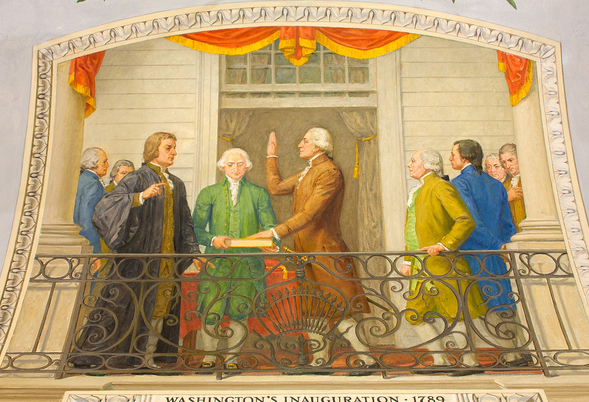
Mural by Allyn Cox in the U.S. Capitol depicts George Washington taking the oath of office in 1789 on the balcony of Federal Hall in New York City. Architect of the Capitol photograph

Mural by Allyn Cox in the U.S. Capitol depicts George Washington taking the oath of office in 1789 on the balcony of Federal Hall in New York City. Architect of the Capitol photograph

Not on March 4, as the Constitution specified, because Congress had not been able to organize itself to count the ballots of the electoral college, but on April 30, 1789, George Washington met with the U.S. Senate on the second floor of a building now called Federal Hall; then to the balcony, where Robert Livingston, Chancellor of the State of New York, administered the oath of office to Washington.  Washington put his left hand on a Bible borrowed from St. John’s Masonic Hall — there were no Bibles to be found in Federal hall where the First Congress was meeting.

That’s how it started.

The Library of Congress Today in History feature links to a wealth of resources for scholars and teachers:

Father of Our Country

George Washington

Detail from Gilbert Stuart’s unfinished portrait of George Washington, from the collections of the Library of Congress.

George Washington [detail],
Gilbert Stuart, artist.
Prints & Photographs Online Catalog

On April 30, 1789, George Washington delivered his first inaugural address to a joint session of Congress, assembled in Federal Hall in the nation’s new capital, New York City. The newly-elected president delivered the speech in a deep, low voice that betrayed what one observer called “manifest embarrassment.” Washington had not sought the office of president and was humbled by the request to serve.

Aside from recommending constitutional amendments to satisfy citizens demanding a Bill of Rights, Washington confined his address to generalities. He closed by asking for a “divine blessing” on the American people and their elected representatives. In delivering his address, Washington went beyond the constitutional requirement to take an oath of office and thus established a precedent that has been followed since by every elected president.

Two weeks before his inauguration, Washington had made an emotional speech to the citizens of his hometown, Alexandria, Virginia. He expressed regret at leaving his Mount Vernon estate where he had retired, and stated: “no earthly consideration, short of a conviction of duty, could have prevailed upon me to depart from my resolution,’never more to take any share in transactions of a public nature.'” The reluctant leader served two terms in office.

To learn more about George Washington, explore the following American Memory resources:

More:


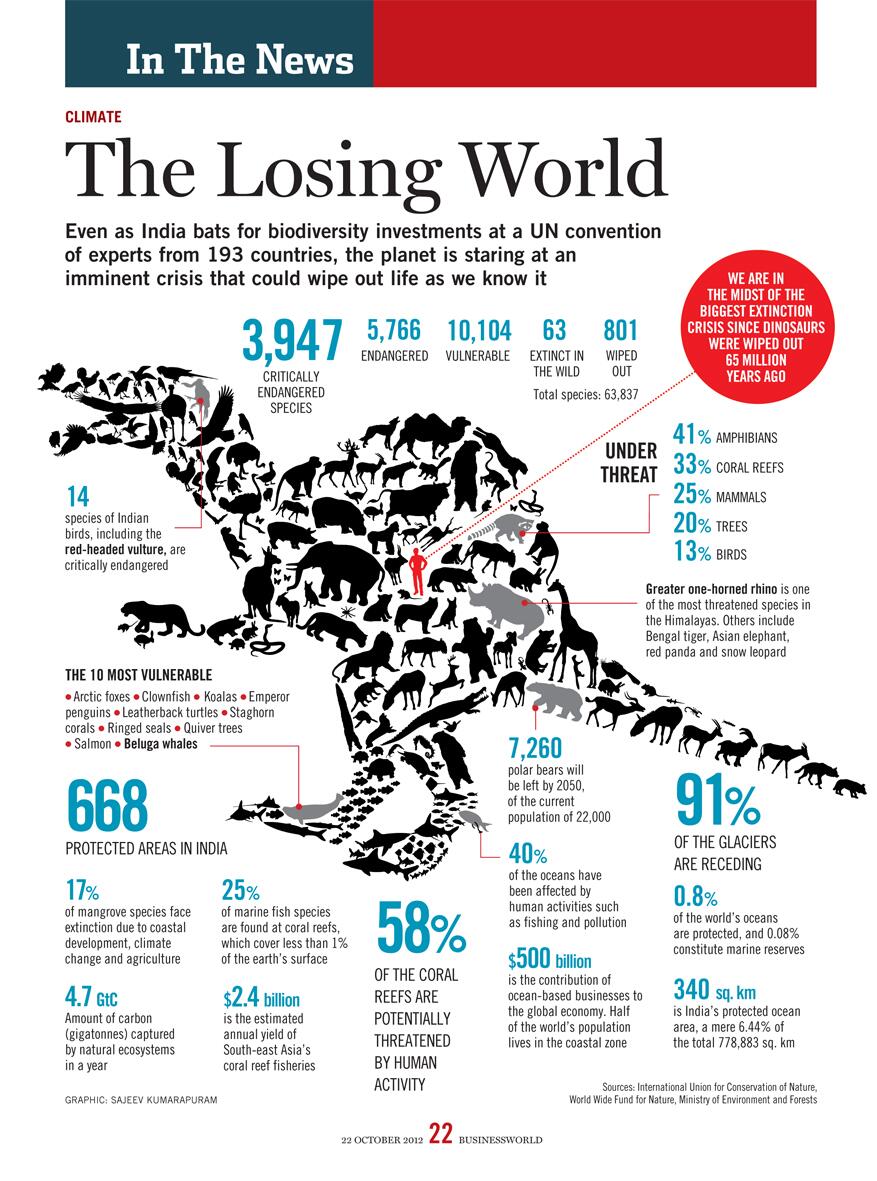
Losing the fight for biodiversity: An infographic

April 28, 2014

BusinessWorld infographic

BusinessWorld infographic

From BusinessWorld, a publication in India:

Even as India bats for biodiversity investments at a UN convention of experts from 193 countries, the planet is staring at an imminent crisis that could wipe out life as we know it.

Compiled by Yashodhara Dasgupta

Click Here To Download Infographic

Sources: International Union for Conservation of Nature,
World Wide Fund for Nature, Ministry of Environment and Forests

Graphic: Sajeev Kumarapuram

(This story was published in Businessworld Issue Dated 22-10-2012)
– See more at: http://www.businessworld.in/news/business/environment/the-losing-world/570570/page-1.html#sthash.mmSk4DDw.dpuf

This would be a good poster for geography, biology, general science and world history courses. Can your drafting class print this out for you in poster format?

When all of the “coal mine canaries” on Earth die out, how much longer have humans left to live on Earth?

What hope have we, with yahoos like this leading us in Congress?

ven as India bats for biodiversity investments at a UN convention of experts from 193 countries, the planet is staring at an imminent crisis that could wipe out life as we know it.Compiled by Yashodhara Dasgupta – See more at: http://www.businessworld.in/news/business/environment/the-losing-world/570570/page-1.html#sthash.mmSk4DDw.dpuf

ven as India bats for biodiversity investments at a UN convention of experts from 193 countries, the planet is staring at an imminent crisis that could wipe out life as we know it.Compiled by Yashodhara Dasgupta

Click Here To Download Infographic


Sources: International Union for Conservation of Nature,

World Wide Fund for Nature, Ministry of Environment and ForestsGraphic: Sajeev Kumarapuram

(This story was published in Businessworld Issue Dated 22-10-2012)

– See more at: http://www.businessworld.in/news/business/environment/the-losing-world/570570/page-1.html#sthash.mmSk4DDw.dpuf

ven as India bats for biodiversity investments at a UN convention of experts from 193 countries, the planet is staring at an imminent crisis that could wipe out life as we know it.Compiled by Yashodhara Dasgupta

Click Here To Download Infographic


Sources: International Union for Conservation of Nature,

World Wide Fund for Nature, Ministry of Environment and ForestsGraphic: Sajeev Kumarapuram

(This story was published in Businessworld Issue Dated 22-10-2012)

– See more at: http://www.businessworld.in/news/business/environment/the-losing-world/570570/page-1.html#sthash.mmSk4DDw.dpuf


Dialogue in the early years of the Dark Ages

April 28, 2014

Poetry on current issues from Devona Wyant.  Wait; is it historic?

(Soldiers involved in the Desert Rock training exercise watching the mushroom cloud from the Dog detonation, Operation Buster-Jangle;  Coporal Alexander McCaughey, U.S. Army Photographic Signal Corps)

(Soldiers involved in the Desert Rock training exercise watching the mushroom cloud from the Dog detonation, Operation Buster-Jangle; Coporal Alexander McCaughey, U.S. Army Photographic Signal Corps) (Illustration added here)

Dialogue in the early years of the Dark Ages

“Old woman, are you awake? Tell my friend here
about the past like you told me. He don’t believe me.”

“What would you like to hear?
About the old forests that stretched for miles?
The wetlands that filtered and gave shelter?
The hundreds of species now lost?
Would you believe we once played outside
without sun block, without protective clothing?
Maybe you want to hear about what it was like
when you could worship as you believed or
not worship at all, without fear, without hiding,
without losing status, without losing your job.
I remember a time when you didn’t need papers
to travel, when you didn’t have your mail read.
I remember when your neighbors didn’t turn
you in if you said you hated a government policy.
I remember when you could gather to protest,
when you could speak out, write letters to the papers.
I remember when there were three classes, not
just the haves and have nots.
I remember when the very poor could
get help if they were very sick or if they were hungry.
I remember when we were considered a beacon of hope,
when we protected those who were oppressed.
I remember when every one could vote and each
vote was counted and mattered.
I even remember when people didn’t live in fear.”

“Are you putting me on Man? She lies! If all those
things were true, why are the old ones the only ones who know?
why isn’t it in the history books?”

“Young man, wait. I’ll be moving on soon or I may just
disappear as so many have. If you never see me again,
remember this at least.
Those who rule, not only make history, they invent it.”

Devona Wyant

Hey, it’s still National Poetry Month.  How are you celebrating? What poems are you reading?

An old woman who tells stories.  Photo by the Library of Congress.

An old woman who tells stories. Photo by the Library of Congress. (Main Reading Room)


Sen. Cruz and Sen. Lee, Tweedle-dum and Tweedle-dee, poke fun at dead tigers

April 28, 2014

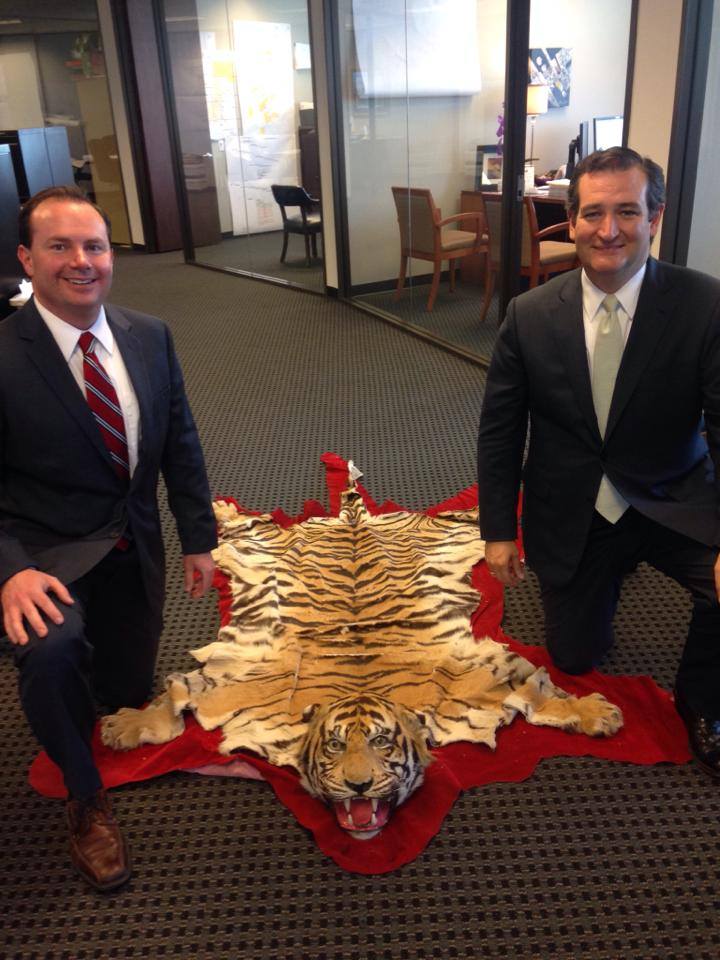
Ted Cruz, demonstrating that he is of the Not Ready For Honorable Service Club, posted this photo on his Facebook page, ridiculing the Endangered Species Act and the plight of tigers everywhere (I’m not a good enough Panthera tigris expert to identify which subspecies* this one is; they are all threatened, and trade in the skins of tigers is proscribed by the US Fish and Wildlife Service and the Convention on International Trade in Endangered Species of Wild Fauna and Flora (CITES)).

Cruz said:  “Did a little shopping for the office with United States Senator Mike Lee in Houston today.

U.S. Sen. Ted Cruz said: "Did a little shopping for the office with United States Senator Mike Lee in Houston today."

U.S. Sen. Ted Cruz said: “Did a little shopping for the office with United States Senator Mike Lee in Houston today.” [This is a replacement copy of the photo, which Sen. Cruz, perhaps wisely, seems to have taken down from his Facebook site. 01/28/2015]

I posted this on Facebook with little comment — it’s just disgusting that public officials would be so cavalier about U.S. law and responsible citizenship like this.  Oddly, someone took offense claiming that we shouldn’t impinge on the First Amendment rights of conservatives.

Shooting threatened and endangered species is not covered by the First Amendment. (YIAAL).

In discussions on my Facebook timeline, I wrote this to those taking offense at criticisms of these two yahoos:

We cannot hope to know the anguish in the hearts of Ted Cruz and Mike Lee that this majestic, endangered, animal was slaughtered.

But we can note that this photo was a genuine lapse in judgment, and we should question whether either of these men is fit to serve you coffee at Dunkin’ Donuts, let alone fit to sit in Congress and wreak destruction in our names.

Our national policy is to protect endangered species. Partly that’s done out of respect for creation and our inability to recreated such magnificent things once they are gone. Partly it is done out of the real understanding that as endangered species go, so go we. We do not know, cannot know, which species are the critical ones that make it possible for us to survive on this planet. We shouldn’t be in the business of experimenting with the wiping out of the human race the penalty paid if we goof.

Protecting endangered species produces huge benefits. Not only did we bring back from the brink of extinction the bald eagle, osprey, peregrine falcon and brown pelican when we banned DDT use on crops, we discovered that we’d endangered several species of bats that, now they’ve recovered from DDT, keep our cities free from disease carrying mosquitoes — much cheaper than even DDT at the acme of its cheapness.

And then there are the other benefits. Digitalis to treat heart disease came from a threatened species in tropical climes. Because we’d protected habitat for the spotted owl, when the National Institutes of Health put out the call for massive amounts of Pacific yew, from which to extract a chemical that had shown promise to cure cancers, we had enough of the trees to answer the call right away — and tamoxifen was tested and found very useful, and is today out there fighting cancers.

So what if these two clowns want to jab at environmentalists? Isn’t that allowed, even when they have to urinate on our national symbols to do it?

Sure, it’s allowed. But people who do that? They’re not qualified to be called leaders. Such a lapse in judgment is enough that, in a just world, they’d be asked to resign immediately.

Martin Luther King, Jr., promised that someday the words of the prophet Amos would come true, and justice will roll like a mighty river.

That day is not today. Today we have Mike Lee and Ted Cruz, proving true the words of the prophet Jagger: “Let’s think of the wavering millions// Who need leaders but get gamblers instead.”

Gambling like that does dishonor to this establishment we call the USA.

_____________

They make Anthony Weiner look chaste and noble.

If you’re on Facebook, perhaps you’d like to join in discussion there; I’d like to have your thoughts here.

More: 

Interesting update: Meanwhile, back in Sane America, which is far away from these two guys, The National Zoo/Smithsonian teamed up with Portugal. The Man to release a very rare piece of music, to raise money to help rescue the Sumatran tiger, of which only 400 remain alive.

The Smithsonian’s National Zoological Park and Conservation Biology Institute teamed with agency DDB New York to put the dwindling tiger population in perspective on Earth Day. They enlisted Portugal. The Man to record an exclusive song, then pressed 400 copies on degradable vinyl, so that with each play the record would diminish until the song disappeared, not unlike the dire situation facing our striped feline friends from Sumatra.

Can you get a copy to listen to?  Though there are only 400 copies, I’ll wager it’s easier to listen to this song than it is to get a straight answer about endangered tigers from the Senate offices of these two senators pictured above.

Update #2: Here’s an infographic that suggests why it’s important to keep tigers alive.  They are canaries in our coal mine we call Earth.  Lee and Cruz appear to be cheering on the destruction of all humanity.

Thanks to Lars for pointing out that all tigers are one species, and the different populations are subspecies.


Arbor Day sunset in Redwood National Park

April 25, 2014

Another stunner from our public lands, from the Department of Interior’s Great American Outdoors Tumblr:

Department of Interior:  Let's end #ArborDay with this great shot from Redwood National Park in #California. pic.twitter.com/SzlkQASYFI

Department of Interior: Let’s end #ArborDay with this great shot from Redwood National Park in #California. pic.twitter.com/SzlkQASYFI

Today is Arbor Day, too?


World Malaria Day 2014 – How can you help beat the disease?

April 25, 2014

Poster from BioMed Central:

Poster from BioMed Central for World Malaria Day 2014

Poster from BioMed Central for World Malaria Day 2014

Time for a big push to smash the disease’s hold on humanity, maybe eradicate it.  Are you in?

No, DDT is not the answer, not even much of AN answer.

How can you help, right now?

  1. Send $10 to Nothing But Nets. Bednets are dramatically more effective than just insecticides, in preventing malaria infections and saving lives.  Your $10 donation will save at least one life.
  2. Write to your Congressional delegation, and urge them to increase funding to the President’s Malaria Initiative. Malaria does well when people in non-malaria regions turn their backs on the problem.  Malaria declines with constant attention to nation-wide and continent-wide programs to prevent the disease, by diminishing habitat for mosquitoes, curing the disease in humans so mosquitoes have no well of disease to draw from, and preventing mosquitoes from biting humans, with window screens, education on when to stay indoors, and bednets.

More:


Hey, Congress! Fix the roads!

April 24, 2014

Just a crazy idea, I know: But do you think Congress could pass a bill to help the states fix potholes in federal highways, make the thousands of decrepit bridges, safe, and put a few thousands of people to work?

Economist wrote:

ONLY the drunk, they say, drive in a straight line in Chicago. The sober zigzag to avoid falling into the city’s axle-breaking potholes. This year the craters, caused by continual freezing and thawing, are worse than ever, and the spring thaw has brought three times the usual number of complaints from citizens.

As winter retreats, holes in roads and budgets are being revealed—especially in midwestern states, which were hit hard by the polar vortex. Those states with money have made emergency appropriations for repairs; those without will have to cut summer programmes. This means not mowing the grass in parks or picking up litter. It also means delaying resurfacing of highways or fixing guard rails, and putting off capital spending.

Looking after America’s roads is a persistent headache. Although $91 billion is spent on them every year, that is nowhere near enough to keep the country’s 4.1m miles (6.6m km) of public roadways in good nick. The Federal Highway Administration estimates that $170 billion in capital investment is needed every year. Last year a report from a civil-engineering group said that 32% of America’s major roads were in poor or mediocre condition. Main roads through cities were in worst shape: almost half the miles travelled over urban interstates in 2013 were a bumpy ride. Ray LaHood, a former transport secretary, thinks the roads are probably in the worst shape they have ever been.

Is it too big a stretch to go back to the hopes in 2009, that we might get a jobs bill to fix this stuff?  Yeah, it’s 2014 — and the roads, and the American people, need a jobs bill more than ever.

Photo from The Atlantic

Photo from The Atlantic

More:


BLM’s statement on Red River management

April 23, 2014

You may have missed the press statement the U.S. Bureau of Land Management issued yesterday, in response to press requests following the release of a letter from Texas Attorney General Greg Abbott.  Here it is.

On the Record

The BLM is categorically not expanding Federal holdings along the Red River.  The 140-acres in question were determined to be public land in 1986 when the U.S. District Court ruled on a case brought by two private landowners, each seeking to adjust boundary lines for their respective properties.  The BLM was not party to any litigation between the landowners.  The 140-acres were at no time held in private ownership.

On Background

During Westward expansion of the country, Texas and Oklahoma disputed their state line, particularly in relationship to where it fell on the Red River.  Once oil and gas was discovered, the dispute was elevated.

In 1923, the Supreme Court made a final determination on the State line and also clarified ownership by private landowners on each side of the river.  Subsequently in 1981 and 1984, Texas and Oklahoma landowners challenged this finding in U.S. District Court as it related to their private property and the changing course of the river.  In both cases, the District Court echoed the Supreme Court determination regarding private boundaries, ruling that the Oklahoma private landowner held property to the center of the river while the Texas landowner’s boundary stopped at the ordinary high water mark.  In 1986, the U.S. District Court established that the 140-acres are public lands.

The BLM is currently in the initial stages of developing options for management of public lands in an area that includes the Red River.  This is a transparent process with several opportunities for public input.

This issue has moved mostly underground, on radical right-wing on-line media, and Facebook and Twitter.

FYI.


A lot of people reading Piketty — the right ones? Enough to matter?

April 23, 2014

An article in the Washington Post calls Thomas Piketty’s book, Capital in the Twenty-first Century, a “runaway best seller.”

Have you read it?

Thomas Piketty - Professor of Economics, Paris School of Economics; photo from The Next Deal

Thomas Piketty – Professor of Economics, Paris School of Economics; photo from The Next Deal

Are you aware of the contents?

Are the right people reading it — especially GOP Members of Congress whose minds need to be changed?  Or, are enough people reading it to make a difference in American politics?

There are presses cranking it out in the United States, India and Britain, and the book is in at least its fourth run. Even though the book was already a hit in its native France, it’s now taking off among English readers around the world, said Donnelly. She expects that sales in China, Hong Kong and Japan will also soon follow.

Piketty, already widely cited for his work on income inequality, has clearly touched a nerve. The book argues that the underlying mechanisms of capitalism tend towards massive inequality. Piketty argues that the era between 1930 and 1975 — often hailed for the way in which wealth was broadly shared — was actually a departure from the norm. That period of economic growth, he says, was the result of unusual circumstances like World War II, a global depression and the government’s actions in the aftermath of those events: strong policies raising taxes and increasing regulation. But now, with many of those policies rolled back, societies are reverting back to extreme inequality.

What do you think, read it or not?

More:


Dark Sky Week, Lyrid meteor shower – get outside!

April 23, 2014

From the Arches National Park Facebook page:  photo of Pine Tree Arch by Andy Porter)

From the Arches National Park Facebook page: photo of Pine Tree Arch and meteoroid by Andy Porter)

A few minutes before 9:00 p.m. Central on Tuesday, I saw a sizable fireball falling north to south, appearing from my vantage on the top of Cedar Hill to be over south Grand Prairie, Texas.  Best meteoroid I’ve seen for a while.

Part of the Lyrid Meteor Shower, perhaps?  The Lyrids coincide with Dark Sky Week this year.  Dark Sky Week’s egalitarian origins should inspire all of us to go outside and look up, no?  The celebration was invented by a high school student, Jennifer Barlow, in 2003.

I want people to be able to see the wonder of the night sky without the effects of light pollution. The universe is our view into our past and our vision into the future . . . I want to help preserve its wonder.” – Jennifer Barlow

The International Dark Sky Association promotes activities worldwide to encourage star-gazing and sky-watching.

Go out tonight, and look up!

More: