2014: STILL, again, Earth Day/Lenin hoax trotted out: Earth Day honors Earth, our majestic home — not Lenin

April 22, 2014

This is mostly an encore post, repeated each year on April 22 — sad that it needs repeating.

You could write it off to pareidolia, once. Like faces in clouds, some people claimed to see a link. The first Earth Day, on April 22, 1970, coincided with Lenin’s birthday. There was no link — Earth Day was scheduled for a spring Wednesday. Now, years later, with almost-annual repeats of the claim from the braying right wing, it’s just a cruel hoax.

No, there’s no link between Earth Day and the birthday of V. I. Lenin:

One surefire way to tell an Earth Day post is done by an Earth Day denialist: They’ll note that the first Earth Day, on April 22, 1970, was an anniversary of the birth of Lenin.

Coincidentally, yes, Lenin was born on April 22 (new style calendar; it was April 10 on the calendar when he was born — one might accurately note that Lenin’s mother always said he was born on April 10).

It’s a hoax. There is no meaning to the first Earth Day’s falling on Lenin’s birthday — Lenin was not prescient enough to plan his birthday to fall in the middle of Earth Week, a hundred years before Earth Week was even planned.

About.com explains why the idea of a link between Earth Day and Lenin is silly:

Does Earth Day Promote Communism?
Earth Day 1970 was initially conceived as a teach-in, modeled on the teach-ins used successfully by Vietnam War protesters to spread their message and generate support on U.S. college campuses. It is generally believed that April 22 was chosen for Earth Day because it was a Wednesday that fell between spring break and final exams—a day when a majority of college students would be able to participate.

U.S. Sen. Gaylord Nelson, the guy who dreamed up the nationwide teach-in that became Earth Day, once tried to put the whole “Earth Day as communist plot” idea into perspective.

“On any given day, a lot of both good and bad people were born,” Nelson said. “A person many consider the world’s first environmentalist, Saint Francis of Assisi, was born on April 22. So was Queen Isabella. More importantly, so was my Aunt Tillie.”

April 22 is also the birthday of J. Sterling Morton, the Nebraska newspaper editor who founded Arbor Day (a national holiday devoted to planting trees) on April 22, 1872, when Lenin was still in diapers. Maybe April 22 was chosen to honor Morton and nobody knew. Maybe environmentalists were trying to send a subliminal message to the national subconscious that would transform people into tree-planting zombies. One birthday “plot” seems just about as likely as the other. What’s the chance that one person in a thousand could tell you when either of these guys were born.

My guess is that only a few really wacko conservatives know that April 22 is Lenin’s birthday (was it ever celebrated in the Soviet Union?). No one else bothers to think about it, or say anything about it, nor especially, to celebrate it.

Gaylord Nelson, Living Green image

Inventor of Earth Day teach-ins, former Wisconsin Governor and U.S. Senator Gaylord Nelson

Wisconsin’s U.S. Sen. Gaylord Nelson, usually recognized as the founder and father of Earth Day, told how and why the organizers came to pick April 22:

Senator Nelson chose the date in order to maximize participation on college campuses for what he conceived as an “environmental teach-in.” He determined the week of April 19–25 was the best bet; it did not fall during exams or spring breaks, did not conflict with religious holidays such as Easter or Passover, and was late enough in spring to have decent weather. More students were likely to be in class, and there would be less competition with other mid-week events—so he chose Wednesday, April 22.

In his own words, Nelson spoke of what he was trying to do:

After President Kennedy’s [conservation] tour, I still hoped for some idea that would thrust the environment into the political mainstream. Six years would pass before the idea that became Earth Day occurred to me while on a conservation speaking tour out West in the summer of 1969. At the time, anti-Vietnam War demonstrations, called “teach-ins,” had spread to college campuses all across the nation. Suddenly, the idea occurred to me – why not organize a huge grassroots protest over what was happening to our environment?

I was satisfied that if we could tap into the environmental concerns of the general public and infuse the student anti-war energy into the environmental cause, we could generate a demonstration that would force this issue onto the political agenda. It was a big gamble, but worth a try.

At a conference in Seattle in September 1969, I announced that in the spring of 1970 there would be a nationwide grassroots demonstration on behalf of the environment and invited everyone to participate. The wire services carried the story from coast to coast. The response was electric. It took off like gangbusters. Telegrams, letters, and telephone inquiries poured in from all across the country. The American people finally had a forum to express its concern about what was happening to the land, rivers, lakes, and air – and they did so with spectacular exuberance. For the next four months, two members of my Senate staff, Linda Billings and John Heritage, managed Earth Day affairs out of my Senate office.

Five months before Earth Day, on Sunday, November 30, 1969, The New York Times carried a lengthy article by Gladwin Hill reporting on the astonishing proliferation of environmental events:

“Rising concern about the environmental crisis is sweeping the nation’s campuses with an intensity that may be on its way to eclipsing student discontent over the war in Vietnam…a national day of observance of environmental problems…is being planned for next spring…when a nationwide environmental ‘teach-in’…coordinated from the office of Senator Gaylord Nelson is planned….”

Nelson, a veteran of the U.S. armed services (Okinawa campaign), flag-waving ex-governor of Wisconsin (Sen. Joe McCarthy’s home state, but also the home of Aldo Leopold and birthplace of John Muir), was working to raise America’s consciousness and conscience about environmental issues.

Lenin on the environment? Think of the Aral Sea disaster, the horrible pollution from Soviet mines and mills, and the dreadful record of the Soviet Union on protecting any resource. Lenin believed in exploiting resources, not conservation.

So, why are all these conservative denialists claiming, against history and politics, that Lenin’s birthday has anything to do with Earth Day?

Can you say “propaganda?”  Can you say “political smear?”

2014 Resources and Good News:

2013 Resources and Good News:

Good information for 2012:

Good information from 2011:

Good information from 2010:

2014’s Wall of Shame:

2013 Wall of Shame:

Wall of Lenin’s Birthday Propaganda Shame from 2012:

Wall of Lenin’s Birthday Propaganda Shame from 2011:

Wall of Lenin’s Birthday Propaganda Shame from 2010:

Spread the word.  Have you found someone spreading the hoax, claiming Earth Day honors Lenin instead?  Give us the link in comments.


April 19, 1775: Battle at Concord Bridge

April 19, 2014

Battle at Concord Bridge, April 19, 1775; National Guard Heritage Painting

Battle at Concord Bridge, April 19, 1775; National Guard Heritage Painting by Dominick D’Andrea.

For a story of the battle, and why the National Guard considers this part of its history, check out this story by Amelia Meyer at the National Guard Educational Foundation.

More:


Darwin’s death, April 19, 1882, and his legacy today

April 19, 2014

This is an encore post.

We shouldn’t pass April 19 — a day marked by significant historic events through the past couple hundred years — without remembering that it is also the anniversary of the death of Darwin.

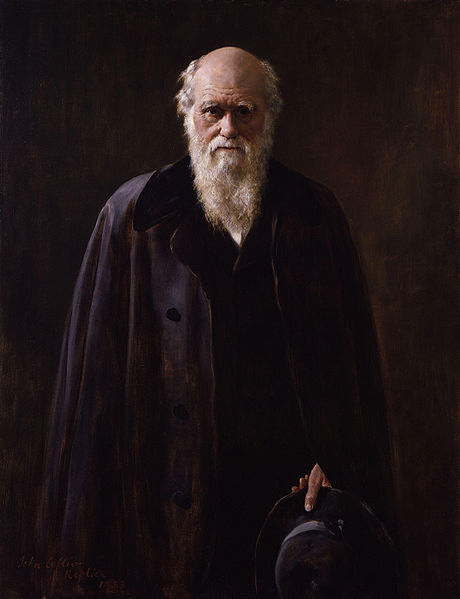
Charles Darwin in 1881, by John Collier

Charles Darwin in 1881, portrait by John Collier; after a Collier painting hanging in the Royal Society

Immortality?  Regardless Darwin’s religious beliefs (I’ll argue he remained Christian, thank you, if you wish to argue), he achieved immortality solely on the strength of his brilliant work in science. Of course he’s best known for being the first to figure out that natural and sexual selection worked as tools to sculpt species over time, a theory whose announcement he shared with Alfred Russel Wallace, who independently arrived at almost exactly the same theory but without the deep evidentiary backup Darwin had amassed.

But had evolution turned out to be a bum theory, Darwin’s other works would have qualified him as one of the greatest scientists of all time, including:

Darwin's theory set out a sequence of coral re...

Darwin’s theory set out a sequence of coral reef formation around an extinct volcanic island, becoming an atoll as the island and ocean floor subsided. Courtesy of the U.S. Geological Survey (Photo credit: Wikipedia)

US Geological Survey graphic demonstrating how coral atolls form on the sinking remains of old volcanic sea mounts, as Darwin described. Wikimedia commons image

  • World’s greatest collector of biological samples:  During his five years’ voyage on HMS Beagle, Darwin collected the largest collection of diverse plant and animal life ever by one person (I believe the record still stands); solely on the strength of his providing actual examples to the British Museum of so much life in so many different ecosystems worldwide, before he was 30 Darwin won election to the Royal Society.  (His election was engineered partly by friends who wanted to make sure he stayed in science, and didn’t follow through on his earlier plan to become a preacher.)
  • Geology puzzle solver:  Coral atolls remained a great geological mystery.  Sampling showed coral foundations well below 50 feet deep, a usual limit for coral growth.  In some cased old, dead coral were hundreds of feet deep.  In the South Pacific, Darwin looked at a number of coral atolls, marvelous “islands” that form almost perfectly circular lagoons.  Inspired partly by Lyell’s new encyclopedic review of  world geology, Darwin realized that the atolls he saw were the peaks of volcanic mounts.  Darwin hypothesized that the volcanoes grew from the ocean floor to the surface, and then the islands were colonized by corals.  The round shape of the volcano gave the atoll its shape.  Then the volcanic mounts eroded back, or sank down, and corals continued to grow on the old foundations.  It was a perfectly workable, natural explanation for a long-standing geologic puzzle.  (See Darwin’s monograph, Structure and Distribution of Coral Reefs.)
  • Patient watcher of flowers:  Another great mystery, this time in biology, concerned how vines twined themselves onto other plants, rocks and structures.  Darwin’s genius in designing experiments shone here:  He put a vine in his study, and watched it.  Over several hours, he observed vine tendrils flailing around, until they latched on to something, and then the circular flailing motion wrapped the tendril around a stick or twig. Simple observation, but no one had ever attempted it before.  (See On the Movements and Habits of Climbing Plants.)
  • Champion of earthworms, and leaf mould:  Darwin suspected the high fertilizer value of “leaf mould” might be related to the action of earthworms.  Again, through well-designed experiments and simple observation, Darwin demonstrated that worms moved and aerated soil, and converted organic matter into even richer fertilizer. (See The Formation of Vegetable Moulds Through the Action of Worms.)
  • Creation of methodological science:  In all of this work, Darwin explained his processes for designing experiments, and controls, and made almost as many notes on how to observe things, as the observations themselves.  Probably more than any other single man, Darwin invented and demonstrated the use of a series of processes we now call “the scientific method.”  He invented modern science.

Any of those accomplishments would have been a career-capping work for a scientist.  Darwin’s mountains of work still form foundations of geology and biology, and are touchstones for genetics.

Born within a few hours of Abraham Lincoln on February 12, 1809, Darwin survived 17 years longer — 17 extremely productive years.  Ill through much of his life with mystery ailments, perhaps Chaga’s Disease, or perhaps some other odd parasite or virus he picked up on his world travels, Darwin succumbed to heart disease on April 19, 1882.

More:


Great benefits to America from having MORE immigrants – 5 key points from the Dallas Fed

April 19, 2014

Did you know?

Interesting fact sheet from the Dallas Branch of the Federal Reserve Bank system.

All material below this point is directly quoted from the .pdf fact sheet; it is here in text format to aid in indexing, and quoting.

Immigration Get the Facts header

An Economic Overview

As U.S. immigration reform moves forward in 2013, a variety of facts and figures continue to be presented around immigrants and their current and potential contributions to the U.S. economy. This fact sheet—the first in our series on immigrants and the economy—provides key data points on why immigrants are vital to the U.S. economy and why comprehensive immigration reform is necessary for future U.S. competitiveness.

Five Reasons
Why the U.S. Economy Needs Immigrants
FACTS

1.  Immigrants are more likely to be entrepreneurial and to start new businesses, which, in turn, create jobs for U.S.-born workers.

  • Immigrants started 28 percent of all new U.S. businesses in 2011, employing 1 in 10 U.S. workers. 1
  • Immigrants represent 18 percent of small business owners in the U.S.—exceeding their share of the overall population (13 percent)—and are more likely than those born in the U.S. to start a small business. Immigrant-owned small businesses employed an estimated 4.7 million people and generated an estimated $776 billion in receipts in 2007. More small business owners are from Mexico than any other country.2
  • Over the past two decades, immigrants made up 30 percent of the growth in small business creation.3
  • Immigrants founded 18 percent of 2010 Fortune 500 companies, creating jobs for 3.6 million people. When including immigrants and their children, the number of Fortune 500 companies with immigrant roots jumps to 40 percent, employing more than 10 million people.4

2.  Both high-skilled and low-skilled immigrant labor creates additional jobs across the U.S. economy.  Immigration FRSB Population box

  • With immigration reform, newly authorized immigrant workers would produce enough new consumer spending to support 750,000 to 900,000 jobs.5
  • Every additional foreign-born student who graduates in science, technology, engineering, or mathematics (STEM) and remains in the U.S. creates an estimated 2.62 American jobs.
  • Every low-skilled, non-agricultural, temporary worker who comes to the U.S. to fill a job that may otherwise be left open creates an average of 4.64 U.S. jobs. 6  These low-skilled jobs are the necessary backbone to support higher-skilled positions.
  • Passage of the DREAM Act would add $329 billion to the U.S. economy and create 1.4 million new jobs by 2030.7

3.  Immigrants boost tax revenue, enlarge the taxpayer base and help to keep down the price of goods.  Immigration FRSB DYK box1

  • On average, immigrants, including the undocumented, pay nearly $1,800 more in taxes than they receive in benefits.8
  • Households headed by undocumented immigrants paid $11.2 billion in state and local taxes in 2010. That included $1.2 billion in personal income taxes, $1.6 billion in property taxes and $8.4 billion in sales taxes.9
  • Immigrants lower the price of products used by highly educated consumers by 0.4 percent of GDP and for less-educated consumers by 0.3 percent.10

4.  As baby boomers retire, immigrants will increasingly be critical for continued economic growth and for ensuring a steady flow of new workers.  Immigration FRSB DYK box2

  • Without immigrants, the U.S. will not have enough new workers to support retirees. Seventy years ago, there were 150 workers for every 20 seniors; 10 years ago, there were 100 workers per 20 seniors.  By 2050, there will be only 56 workers for every 20 seniors. The U.S. needs new taxpayers to help fund Social Security and Medicare and new workers to fill retirees’ positions and provide health care services.11
  • Current levels of immigration will temper the aging of the U.S. population over the next two decades, slowing the increase in the old-age dependency ratio by more than one-quarter.12
  • Nearly 65 percent of Latino immigrants in California who stayed more than 30 years are homeowners, making them a critical pool to buy homes as baby boomers downsize.13

5.  The majority of immigrants in the U.S. today are from Latin America, representing a huge potential economic opportunity due to the region’s burgeoning economic standing.

  • Immigrants are a vital link with their home countries and offer new prospects for the U.S. to capitalize on Latin America’s economic expansion, which saw 3 percent growth in 2012—double the 1.5 percent growth in the United States. In addition, 11 of the 20 U.S. free-trade agreements in force are with Latin American countries. Immigrant-owned small businesses have a unique opportunity to connect to the global marketplace.
  • Over 7 percent of immigrant firms export their goods and services, whereas just over 4 percent of non-immigrant firms export.14
  • Mexico boasts the second largest economy in Latin America and grew at a rate of 4.0 percent in 2012, with a projected 3.5 percent growth in 2013.15  With 29 percent of all immigrants and 58 percent of undocumented immigrants coming from Mexico,16 this demographic represents a human gateway to one of Latin America’s fastest-growing economies.

This fact sheet is a product of the AS/COA Hispanic Integration and Immigration Initiative, which advances the integration of immigrants and promotes positive dialogue around the economic contributions of immigrants and Latinos overall across the United States. It was produced by Jason Marczak, AS/COA Director of Policy, in collaboration with Leani García. For more information, visit AS/COA Online at:  http://www.as-coa.org.  For media inquiries or to speak with an expert on this topic, please contact Adriana LaRotta in our communications office at:   alarotta@as-coa.org

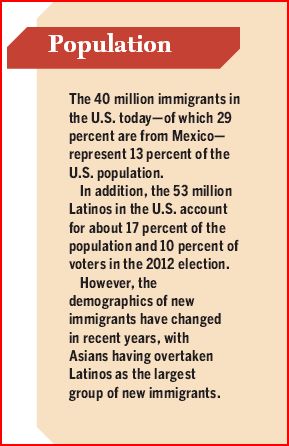
Population:  The 40 million immigrants in the U.S. today—of which 29 percent are from Mexico— represent 13 percent of the U.S. population.

In addition, the 53 million Latinos in the U.S. account for about 17 percent of the population and 10 percent of voters in the 2012 election.

However, the demographics of new immigrants have changed in recent years, with Asians having overtaken Latinos as the largest group of new immigrants.

Did you know?
Google, Procter & Gamble, Kraft, Colgate Palmolive, Pfizer, and eBay are among companies with immigrant founders.

Did you know?
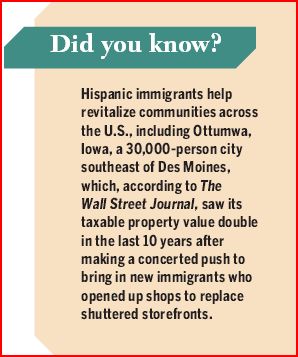
Hispanic immigrants help revitalize communities across the U.S., including Ottumwa, Iowa, a 30,000-person city southeast of Des Moines, which, according to The Wall Street Journal, saw its taxable property value double in the last 10 years after making a concerted push to bring in new immigrants who opened up shops to replace shuttered storefronts.

Endnotes

1.  Robert H. Fairlie, “Open for Business: How Immigrants are Driving Small Business Creation in the United States,” Partnership for a New American Economy, August 2011. http://www.renewoureconomy.org/sites/all/themes/pnae/openforbusiness.pdf

2.  Fiscal Policy Institute, “Immigrant Small Business Owners: A Significant and Growing Part of the Economy,” June 2012. http://fiscalpolicy.org/immigrant-small-business-owners-FPI-20120614.pdf

3.  Ibid.

4.  Partnership for a New American Economy, “The ‘New American’ Fortune 500,” June 2011.  http://www.renewoureconomy.org/sites/all/themes/pnae/img/new-american-fortune-500-june-2011.pdf

5.  Raúl Hinojosa-Ojeda, “Raising the Floor for American Workers: The Economic Benefits of Comprehensive Immigration Reform,” Center for American Progress, January 2010.

6.  Madeline Zavodny, “Immigration and American Jobs,” American Enterprise Institute for Public Policy Research and the Partnership for a New American Economy, December 2011. http://www.renewoureconomy.org/sites/all/themes/pnae/img/NAE_Im-AmerJobs.pdf

7.  Juan Carlos Guzmán and Raúl C. Jara, “The Economic Benefits of Passing the Dream Act,” Center for American Progress and Partnership for a New American Economy, October 2012.  http://www.americanprogress.org/issues/immigration/report/2012/09/30/39567/the-economic-benefits-of-passing-the-dream-act/

8.  James P. Smith & Barry Edmonston, eds., The New Americans: Economic, Demographic, and Fiscal Effects of Immigration (Washington, DC: National Research Council, National Academy of Sciences Press, 1997), 220, 353.

9.  Immigration Policy Center, “Unauthorized Immigrants Pay Taxes, Too,” April 2011.  http://www.immigrationpolicy.org/just-facts/unauthorized-immigrants-pay-taxes-too

10.  Patricia Cortes, “The Effect of Low-Skilled Immigration on US Prices: Evidence from CPI Data,” 381-422.

11.  Immigration Policy Center, “The Future of a Generation: How New Americans Will Help Suppport Retiring Baby Boomers,” February 2012. http://www.immigrationpolicy.org/just-facts/future-generation-how-new-americans-will-help-support-retiring-baby-boomers

12.  Ibid.

13.  Dowell Myers, Immigrants and Boomers: Forging a New Social Contract for America (New York: Russell Sage Foundation, 2007).

14.  Robert H. Fairlie, “Immigrant Entrepreneurs and Small Business Owners, and their Access to Financial Capital,” Small Business Administration, May 2012.

15.  The World Bank, “Mexico Overview,” 2013. http://www.worldbank.org/en/country/mexico/overview

16.  Pew Hispanic Center, “A Nation of Immigrants: A Portrait of the 40 Million, Including 11 Million Unauthorized,” January 2013. http://www.pewhispanic.org/files/2013/01/statistical_portrait_final_jan_29.pdf

More: 


Historian David McCullough: What is the value of education?

April 17, 2014

Historian David McCullough works on his vintage, historic Royal typewriter. Photo by Dorie McCullough Lawson. via Levenger Press.

Historian David McCullough works on his vintage, historic Royal typewriter. Photo by Dorie McCullough Lawson. via Levenger Press.

Branch banks of the Federal Reserve work hard to provide economic education; alas, in the era of state standards requiring “teach to the test,” a lot of this stuff goes unused.

What is the value of education?  The Dallas Branch of the Fed had historian David McCullough in for consultations; they asked him on video, and here’s his response.

“We must be an educated people. We cannot be a productive, original, innovative society if we aren’t educated.”

For more information, visit the Dallas Fed’s website.

6,645


Daytime Moon and jet

April 17, 2014

Passenger jet and Moon.  Photo by Rodger Schmitt, from Lake Powell, Utah.

Passenger jet and Moon. Photo by Rodger Schmitt, from Lake Powell, Utah.

Handheld Nikon.  Nikon stabilizing lens.  Good hands, I’d say.

Third to last time I was out near Lake Powell, I was with Rodger (and about a dozen others) organizing hearings of the President’s Commission on Americans Outdoors.  We flew into Page, Arizona, on an Otter II coming up from Phoenix flying low, looking for elk, and legally buzzing Rainbow Bridge (impressive from the air, too).

We had a luncheon meeting at Wahweap Marina, as I recall; no time for boating.

Then we were off to the South Rim of the Grand Canyon.  There we inspected pine trees 30 feet tall, growing between the ties of the then-abandoned rail lines.  (And did a lot of other stuff.)

Today trains carry tourists to the South Rim on those tracks, the trees gone.  Progress, really.

Rodger carries on in the knowledge that use of the outdoors, especially these public lands, heals souls, and sometimes gives you great photos.

Rodger said I could borrow the photo.  Thanks!


Remembering the worst ever U.S. industrial accident, 1947: 576 dead at Texas City

April 16, 2014

April 16 marks the 67th anniversary of the Texas City Disaster.

It’s a day Texans, and all Americans should note.  It’s an event we need to remember, because every point of the disaster is something we forget at our very great peril.  Thinking such a disaster could not happen again, and failing to train for these same conditions, contributed to the disaster last year in West, Texas.

67 years ago, in the harbor at Texas City, a large cargo ship being loaded with tons of ammonium nitrate caught fire and exploded, setting fire to other nearby ships, one of which exploded, devastating much of the town. In all, 576 people died in Texas City on April 16 and 17, 1947.

View of Texas City from across the bay, in Galveston, April 16, 1947

View of Texas City from Galveston, across the bay, after the explosion of the French ship SS Grandchamp, April 16, 1947. Photo from International Association of Fire Fighters Local 1259

The incident also produced one of the most famous tort cases in U.S. history, Dalehite vs. United States, 346 U.S. 15 (1953). (Here is the Findlaw version, subscription may be required.)

The entire Texas City fire department was wiped out, 28 firefighters in all. The International Association of Fire Fighters, Local 1259 has a website dedicated to the history of the disaster, with a collection of some powerful photographs.

More below the fold. Read the rest of this entry »


Typewriter of the moment: Thomas Merton

April 16, 2014

Thomas Merton's typewriter, at Bellarmine University

Thomas Merton’s typewriter, at Bellarmine University; image from Spiritual Travels blog. Photo by Lori Erickson

One of Thomas Merton’s typewriters sits on display at the Thomas Merton Center at Bellarmine University, in Louisville, Kentucky.

Who? You remember, the guy who wrote The Seven Storey Mountain.

Thomas Merton, O.C.S.O. (January 31, 1915 – December 10, 1968) was an American Catholic writer and mystic. A Trappist monk of the Abbey of Gethsemani, Kentucky, he was a poet, social activist, and student of comparative religion. In 1949, he was ordained to the priesthood and given the name Father Louis.[1][2][3]

Merton wrote more than 70 books, mostly on spirituality, social justice and a quiet pacifism, as well as scores of essays and reviews, including his best-selling autobiography, The Seven Storey Mountain (1948), which sent scores of World War II veterans, students, and even teenagers flocking to monasteries across the US,[4][5] and was also featured in National Reviews list of the 100 best non-fiction books of the century.[6] Merton was a keen proponent of interfaith understanding. He pioneered dialogue with prominent Asian spiritual figures, including the Dalai Lama, the Japanese writer D.T. Suzuki, and the Vietnamese monk Thich Nhat Hanh. Merton has also been the subject of several biographies.

It’s a French typewriter, by Royal, with French characters available for use.

Closeup of Thomas Merton's Royal Typewriter; The Thomas Merton Center

Closeup of Thomas Merton’s Royal typewriter, showing some of the special characters available for French; The Thomas Merton Center


More:  

Another typewriter displayed by the Thomas Merton Center. One of Merton's?

Another typewriter displayed by the Thomas Merton Center. One of Merton’s?


Cross seas: Nature, or design?

April 16, 2014

Here’s just exactly the sort of thing that happens in nature that drives creationists nuts.  How could this happen without God personally working to confuse and/or delight the photographer?  Not to mention the physicist and mathematician.

Photo from the Twitter feed of Science Porn:

Photo from the Twitter feed of Science Porn: “Go home waves you’re drunk. This is called cross sea btw pic.twitter.com/5Cv1UUo8QX”

Where? Somewhere in France, one might gather from the flag on the structure (lighthouse?).

Turns out to be a Wikipedia photo, with this intriguing caption:

Crossing swells, consisting of near-cnoidal wave trains. Photo taken from Phares des Baleines (Whale Lighthouse) at the western point of Île de Ré (Isle of Rhé), France, in the Atlantic Ocean. The interaction of such near-solitons in shallow water may be modeled through the Kadomtsev–Petviashvili equation.

Oh, you remember that one, don’t you?  The Kadomtsev–Petviashvili equation?

At least we confirmed it was taken in France.

They do everything differently in France, don’t they?

Update:Got an e-mail suggestion that I include the equation itself.  You may certainly click to Wikipedia to find it; here’s what it says over there:

In mathematics and physics, the Kadomtsev–Petviashvili equation – or KP equation, named after Boris Borisovich Kadomtsev and Vladimir Iosifovich Petviashvili – is a partial differential equation to describe nonlinearwave motion. The KP equation is usually written as:

\displaystyle \partial_x(\partial_t u+u \partial_x u+\epsilon^2\partial_{xxx}u)+\lambda\partial_{yy}u=0

where \lambda=\pm 1. The above form shows that the KP equation is a generalization to two spatial dimensions, x and y, of the one-dimensional Korteweg–de Vries (KdV) equation. To be physically meaningful, the wave propagation direction has to be not-too-far from the x direction, i.e. with only slow variations of solutions in the y direction.

Like the KdV equation, the KP equation is completely integrable. It can also be solved using the inverse scattering transform much like the nonlinear Schrödinger equation.

Certainly the longest equation ever published at Millard Fillmore’s Bathtub.

Save


Anniversary of Paul Revere’s ride, in the middle of National Poetry Month 2014

April 16, 2014

This is mostly an encore post.  Is there a good reason Paul Revere made his ride in the middle of National Poetry Month

Teachers, I’m posting this a couple of days early.  You may want to get copies of the poems for your U.S. history and literature classes. 

You may want to note that the Boston Marathon is traditionally run on Freedom Day in Massachusetts — the day that commemorates the ride of the patriots’ warning that Gen. Gage’s army was on the move, and of the battles at Lexington and Concord, the next day. 

_____________

April 18 and 19. Do the dates have significance? Paul Revere's ride, from Paul Revere House

Among other things, April 19 is the date of the firing of the “shot heard ’round the world,” the first shots in the American Revolution. On April 19, 1775, American Minutemen stood to protect arsenals they had created at Lexington and Concord, Massachusetts, against seizure by the British Army then occupying Boston.

April is National Poetry Month. What have we done to celebrate poetry?

What have we done to properly acknowledge the key events of April 18 and 19, 1775? Happily, poetry helps us out in history studies. Or it can do.

In contrast to my childhood, when we as students had poems to memorize weekly throughout our curriculum, modern students too often come to my classes seeming wholly unaware that rhyming and rhythm are used for anything other than celebrating materialist, establishment values obtained sub rosa. Poetry, to them, is mostly rhythm, certainly not for polite company, and never for learning.

Poetry has  slipped from our national curriculum, dropped away from our national consciousness.  No national test adequately covers poetry, not in English, not in social studies — certainly not in math or science.

That is one small part of the reason that Aprils in the past two decades turned instead to memorials to violence, and fear that violence will break out again. We have allowed darker ideas to dominate April, and especially the days around April 19.

You and I have failed to properly commemorate the good, I fear. We have a duty to pass along these cultural icons, as touchstones to understanding America.

So, reclaim the high ground. Reclaim the high cultural ground.

Read a poem today. Plan to be sure to have the commemorative reading of “Paul Revere’s Ride” in your classes on April 18 or 19, and “The Concord Hymn” on April 19.

We must work to be sure our heritage of freedom is remembered, lest we condemn our students, our children and grandchildren to having to relearn these lessons of history, as Santayana warned.

Texts of the poems are below the fold, though you may be much better off to use the links and see those sites, the Paul Revere House, and the Minuteman National Historical Park.

Read the rest of this entry »


Insta-Millard: Nevada’s Constitution doesn’t favor Cliven Bundy

April 15, 2014

It’s a relic of the Civil War and Congress’s intention to strengthen the Union when Nevada became a state in 1864, but there it is, in Section 2 of the Nevada Constitution, making a mockery of Cliven Bundy’s claim to owe allegiance to Nevada and its Constitution, but not to the U.S.:

Sec: 2.  Purpose of government; paramount allegiance to United States.  All political power is inherent in the people[.] Government is instituted for the protection, security and benefit of the people; and they have the right to alter or reform the same whenever the public good may require it. But the Paramount Allegiance of every citizen is due to the Federal Government in the exercise of all its Constitutional powers as the same have been or may be defined by the Supreme Court of the United States; and no power exists in the people of this or any other State of the Federal Union to dissolve their connection therewith or perform any act tending to impair[,] subvert, or resist the Supreme Authority of the government of the United States. The Constitution of the United States confers full power on the Federal Government to maintain and Perpetuate its existance [existence], and whensoever any portion of the States, or people thereof attempt to secede from the Federal Union, or forcibly resist the Execution of its laws, the Federal Government may, by warrant of the Constitution, employ armed force in compelling obedience to its Authority.

Sheesh!

Here’s the essay quiz, students:  The standoff between the Bureau of Land Management cowboys — each of whom swore an oath to uphold and defend the Constitution of the U.S., in contrast to Mr. Bundy who claims to owe no allegiance to the U.S. — and the armed mob who threatened to kill those same employees of our U.S. government:  Did Nevadans  (or Idahoans) violate any part of Section 2 of the Nevada Constitution?  Which clauses?

I used to say “the Sagebrush Rebellion is over; sagebrush won.”  Even the sagebrush are losing this one.

From The Atlantic:  Eric Parker, who lives in central Idaho, aims his weapon from a bridge as protesters gather by the Bureau of Land Management's base camp in Bunkerville, Nevada. (Jim Urquhart/Reuters)

From The Atlantic: Eric Parker, who lives in central Idaho, aims his weapon from a bridge as protesters gather by the Bureau of Land Management’s base camp in Bunkerville, Nevada. (Jim Urquhart/Reuters)  (See also Article III, Section 3 of the U.S. Constitution, with regard to Mr. Parker’s actions here.)

More: 


Insta-Millard: Bundy Ranch issue history

April 14, 2014

It’s an oversimplification, but not an oversimplification that leads to inaccuracy.

I say “oversimplification” because President Reagan did not impose grazing fees for the first time, but instead set rates at the time.  U.S. grazing fees grew out of the 1934 Taylor Grazing Act, which included among other noble purposes the saving of unoccupied public lands from erosion, to prevent them from contributing to a national Dust Bowl.  The Bureau of Land Management (BLM) manages about 245 million acres of land in the U.S., highly concentrated in 13 western states (about 86% of Nevada is public lands of one sort or another).  Of those lands, about 155 million acres are open to grazing.  BLM is part of the U.S. Department of Interior.  Reagan’s Executive Order came when the law authorizing grazing fees had expired, and Congress was at an impasse in passing a new one, partly over a Reagan Administration proposal to raise grazing fees to market value, a multiple of fees then (and now) in effect.

Sagebrush Rebellion catches Tea Party Stupid disease, it seems to me.  If the virus hasn’t been cured since 1993, what are the odds Mr. Bundy will sit still for a cure now?

More to come?

More:

Mad City Quanta, a Nebraska on-line comic, on grazing fees issues in 2012.

Mad City Quanta, a Nebraska on-line comic, on grazing fees issues in 2012. To update it, substitute “Bundy” for “Fischer” on the tie of the steer on the left.


Boy Scouts greet Col. Theodore Roosevelt, St. Paul, Minnesota, 1932

April 13, 2014

Interesting photograph.

1932 photograph of U.S. Army Col. Theodore Roosevelt III, being greeted in St. Paul, Minnesota by a group of Boy Scouts.  Minnesota Historical Society collection.

1932 photograph of U.S. Army Col. Theodore Roosevelt III, being greeted in St. Paul, Minnesota by a group of Boy Scouts. Minnesota Historical Society collection.

Found it at the site of the Minnesota Historical Society.

Col. Roosevelt, the son of President Theodore Roosevelt, is nearly center, in civilian clothes.  He would go on to command troops at the Battle of Normandy on D-Day, winning the Medal of Honor, awarded posthumously.  His father would later be awarded the Medal of Honor.  Is this the only father-son MoH duo?

MHS records identify Col. Roosevelt and 13 other people in the photo, mostly the Scouts; alphabetically, they are:  Baker, Curtis; Baker, Robert (brothers?); Haas, Frank; Hagman, R. J.; Jungwirth, Robert A.; Kehne, Clyde; Menz, C. J.; Nyman, David; Polanick, Alexander; Robertson, Donald; Roosevelt, Theodore [III]; Sommers, Charles; Torgerson, Gordon; White, Charles.

It would be interesting to know what the event was in 1932 that brought Roosevelt to St. Paul.  It would be interesting to know what happened to those Scouts.

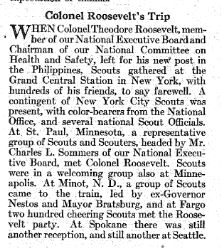
Update: Mr. Higginbotham found an account of Roosevelt’s trip in the April 1932 issue of Boys’ Life (see comments).  Roosevelt was on his way to the Philippines, where he served as Governor-General, a post held earlier by William Howard Taft, Leonard Wood, and Henry L. Stimson, among others.  Roosevelt was a member of the National Board of Boy Scouts of America; Scouts saw him off from New York, and greeted him at stops all the way to Seattle, where he boarded ship for the Philippines.

Account of Col. Theodore Roosevelt III's trip from New York to Seattle, in 1932 -- with Scouts meeting him at almost every stop.  Boys' Life, April 1932, page 58.

Account of Col. Theodore Roosevelt III’s trip from New York to Seattle, in 1932 — with Scouts meeting him at almost every stop. Boys’ Life, April 1932, page 58.


Sky and stars peeking into Antelope Canyon

April 11, 2014

Upper and Lower Antelope Canyon, near Page Arizona, get more visitors annually than just about any other canyon except the Grand Canyon.  They cover only a few miles.

You’re not familiar with Antelope Canyon?  You’ve seen the photos, even if you don’t know the name of the place — it’s a slot canyon, carved as with a wandering knife into the sandstone at the top of the cliffs leading to the Colorado River.

Over at EarthSky, I found a view you haven’t seen before.

Antelope Canyon at night by Sergio Garcia Rill. Stunning contrast of rock painted by light, and stars.  From EarthSky.com.  Visit Sergio’s website and read more about this adventure.

Antelope Canyon at night by Sergio Garcia Rill. Stunning contrast of rock painted by light, and stars. From EarthSky.com. Visit Sergio’s website and read more about this adventure.

Details from EarthSky.com:

Sergio Garcia Rill captured this beautiful image from within Upper Antelope Canyon in Arizona, which is the most visited slot canyon in the United States. A slot canyon is significantly deeper than it is wide. It’s formed by water rushing through rock. Sergio wrote:

During my recent trip to Arizona, I stopped by Page to get a chance at touring the now famous canyons (Upper and Lower Antelope) and I also had a chance to visit Upper Antelope at night.

I couldn’t really get too many shots with the sky (since the openings were very narrow and limited) but I liked this one in particular since I got a chance to set it up and do the light painting myself a couple of chambers behind from where my guide and another participant were working on another shot.

Thank you, Sergio.

Visit Sergio Garcia Rill’s Facebook page.

Click here for info about traveling to Upper and Lower Antelope Canyon.

Readers here may remember Page was the final destination of my late oldest brother, Jerry.  To his credit, he urged me to make a special trip to see Antelope Canyon, because most of the times I visited, it was closed, or impassable.  Alas, I have not yet been to the place.

This is one of the gems of the Diné, the Navajo Nation, and another good reason to get familiar with redrock country.


Last few Texas TAKS Exit Level Social Studies students? Review here

April 11, 2014

Stealing this wholesale from my history class blog:  A few hundred students still need to take the old TAKS Exit Level Social Studies Test, in order to finish their high school diploma requirements.

Isn't the TAKS Test dead?  Not yet -- zombie like, it still prowls the nightmares of older students working to get a Texas diploma.  Test review and practice in this post

Isn’t the TAKS Test dead? Not yet — zombie like, it still prowls the nightmares of older students working to get a Texas diploma. Test review and practice in this post

You can do it; and if you’ve been out of class for a while, or if you just want to boost your score, here’s a review, and a few lines down here is a link to a place to take an on-line practice test which you can get scored.  The practice test questions should be mostly phased out by now, but the topics will remain.

It’s spring, and a young person’s fancy and earnest wishes turn to acing these tests to get a high school diploma.

From Mr. Darrell’s Wayback Machine:

Here’s a generalized, much truncated list of things high school juniors need to know, according to the Texas Essential Knowledge and Skills (TEKS).  This is a list from which the TAKS test questions will be drawn.

Earlier posts provided the definitions of each of these terms and phrases — check those out in your study, too.

We’ll add links to these terms as we find them — you may want to bookmark this post so you can find it again.

You can download a MicroSoft Word version of this study guide, essentially the same as here in a dozen posts, in one file that prints out to about 12 pages; click here to get the printed study guide.

Update 2012:  Go here to link to an on-line, TEA-released TAKS Social Studies Exit Level Test.

Things to Know for the Grade 11 TAKS Social Studies Test

People:

  • Thomas Jefferson
  • George Washington
  • Theodore Roosevelt
  • Woodrow Wilson
  • Clarence Darrow
  • William Jennings Bryan
  • Henry Ford
  • Charles A. Lindbergh
  • Harry Truman
  • George C. Marshall
  • Joseph McCarthy
  • Susan B. Anthony
  • W. E. B. DuBois
  • Martin Luther King, Jr.
  • Rachel Carson
  • Ronald Reagan
  • Thurgood Marshall

Dates:

  • 1776 – Declaration of Independence
  • 1914-1918 – World War I
  • 1929 – Stock Market Crash (beginning of Great Depression)
  • 1941-1945 – World War II (U.S. involvement)
  • 1787 – Constitution written
  • 1861-1865 – Civil War
  • 1898 – Spanish American War, debut of U.S. as a major world power

Primary Sources (mostly documents):

  • Declaration of Independence
  • U.S. Constitution
  • Bill of Rights
  • 13th Amendment
  • 14th Amendment
  • 15th Amendment
  • Wilson’s 14 Points
  • 16th Amendment
  • 17th Amendment
  • 19th Amendment
  • Brown v. Board of Education of Topeka (Supreme Court case from 1954)
  • 24th Amendment
  • 26th Amendment

Events:

  • Magna Carta
  • Bubonic plague
  • Columbian Exchange of food
  • English Bill of Rights (1789)
  • Declaration of Independence (1776)
  • American Revolution
  • Articles of Confederation
  • Philadelphia Convention (1787 – wrote the Constitution)
  • Federalist Papers
  • Bill of Rights
  • Nullification Crisis
  • Civil War (1861-1865, TEKS dates)
  • Thirteenth Amendment
  • Fourteenth Amendment
  • Fifteenth Amendment
  • Spanish-American War (1898, TEKS date)
  • Panama Canal
  • Sixteenth Amendment
  • Seventeenth Amendment
  • World War I
  • Wilson’s Fourteen Points
  • Treaty of Versailles
  • Nineteenth Amendment (Women’s Right To Vote, or Women’s Suffrage)
  • Red Scare
  • Prohibition (of production and sale of alcoholic beverages)
  • (Scopes Trial)
  • Stock Market Crash, October 29, 1929 (TEKS date)
  • Great Depression
  • New Deal (FDR’s program to pull U.S. out of Depression)
  • FDIC (Federal Deposit Insurance Corporation)
  • Social Security Act
  • World War II (1941-1945, TEKS dates)
  • Pearl Harbor, “a day which will live in infamy” (December 7, 1941)
  • Internment of Japanese Americans
  • Battle of Midway
  • Holocaust
  • Normandy Invasion (D-Day)
  • (Hiroshima and Nagasaki) (Atomic bomb targets)
  • Truman Doctrine
  • Marshall Plan
  • NATO (North Atlantic Treaty Organization, established in 1949)
  • GI Bill
  • Korean War
  • McCarthyism
  • Brown v. Board of Education of Topeka
  • Sputnik I (1957; TEKS date)
  • Civil Rights Act of 1964
  • Twenty-fourth Amendment (banned poll taxes, a civil rights issue)
  • Twenty-sixth Amendment (18-years old to vote)
  • Vietnam Conflict
  • (Watergate)
  • (Resignation of President Nixon)

Vocabulary

  • Colonial grievances
  • Unalienable right
  • Free speech
  • Freedom of the press
  • Absolute chronology
  • Relative chronology
  • Demographic patterns
  • Subsistence agriculture
  • Market-oriented agriculture
  • Cottage industries
  • Commercial industries
  • Physical geographic factors
  • Human geographic factors
  • Population growth
  • Technological innovations
  • Telegraph
  • Scientific discoveries
  • Railroads
  • Labor unions
  • Big business
  • Farm issues
  • Minority group
  • Child labor
  • Migration
  • Immigration
  • Unrestricted submarine warfare
  • Prosperity
  • Bank failures
  • Dictatorship
  • Home front
  • Atomic bomb
  • Rationing
  • International trade
  • Political equality

Concepts/Issues:

  • Representative government
  • Revolution
  • Independence
  • Confederation
  • Constitution
  • Limited government
  • Republicanism
  • Checks and balances
  • Federalism
  • Separation of powers
  • Popular sovereignty
  • Individual rights
  • States’ rights
  • Civil war
  • Reconstruction amendments
  • Free enterprise system
  • Spatial diffusion
  • Economic growth
  • Traditional economy
  • Command economy
  • Market economy
  • Industrialization
  • Standard of living
  • Urbanization
  • Expansionism
  • World power
  • Reform
  • (Militarism)
  • (Nationalism)
  • Imperialism
  • Depression
  • Civil rights movement