
Sundown shadows of hoodoos on pinnacles, Bryce Canyon National Park, 2008. Photo by Ed Darrell
Sundown shadows of hoodoos on pinnacles, Bryce Canyon National Park, 2008. Photo by Ed Darrell
 Leave a Comment » |
  Hiking, National Parks, Travel, Utah | Tagged: Bryce Canyon National Park, Hiking, National Parks, Travel, Utah |
  Permalink
 Posted by Ed Darrell
Great, potent question.
What do you think?
And, where did that photo come from?

Protester in West Virginia: “Would we let terrorists poison our water supply, if they said it created jobs?” Photographer unidentified; so is protester.
Keep your eye on West Virginia.
Here’s why: Do you know what factories may lie upstream from your drinking water, and do you know how they are regulated? Is the regulation done well?
More:
7 Comments | Clean Water Act, Environmental protection, Politics, Regulation, Water | Tagged: Clean Water Act, Environmental protection, Politics, Regulation, Water, West Virginia | Permalink
Posted by Ed Darrell

In Texas, voters must register 30 days prior to the election. Primaries for 2014 are on March 4, so today is the LAST DAY TO REGISTER to vote in the primaries in Texas
Registration will be easier than voting for many white women, but that’s the way the GOP legislature likes it.
Today, February 3, 2014, is the deadline to register to vote, to be eligible to vote in Texas’s primary elections, to be held March 4.
Voting is one of the few ways to get the Texas GOP to pay attention to your views.
From VoteTexas.gov:
Register To Vote
To vote in Texas, you must be registered. Simply pick up a voter registration application, fill it out, and mail it at least 30 days before the election date. Get your application here.
You are eligible to register to vote if:
- You are a United States citizen;
- You are a resident of the county where you submit the application;
- You are at least 18 years old on Election Day;
- You are not a convicted felon (you may be eligible to vote if you have completed your sentence, probation, and parole); and
- You have not been declared by a court exercising probate jurisdiction to be either totally mentally incapacitated or partially mentally incapacitated without the right to vote.
Are you already registered?
To confirm your voter registration status, you may select one of three methods to perform a search:
- Your Texas driver’s license number, if you provided it when you applied for voter registration;
- Your Voter Unique Identifier (VUID), which appears on your voter registration certificate;
- Your first and last name.
Leave a Comment » | Citizenship, Voting | Tagged: Citizenship, Register to Vote, Texas, voting | Permalink
Posted by Ed Darrell
Somebody put a video collage of Pete together with Tish Hinojosa‘s cut off of a 1998 Pete Seeger tribute album, “Festival of Flowers,” just in the last few days.
Details:
From “Where Have All the Flowers Gone : The Songs of Pete Seeger” 1998
Tish Hinojosa – vocals
Marvin Dykhuis – gitarra de golpe (mariachi guitar)
Chip Dolan – accordion
Amy Ferris Tiven – violin
Glenn Kawamoto – bass
Paul Pearcy – drums
Tish Hinojosa’s voice constantly stuns me with its clarity; I think my first Tish album purchase is 20 years old now.
We should hear her more often.
http://www.dallasnews.com/opinion/latest-columns/20140122-wendy-davis-is-being-swift-boated.ece
Leave a Comment » | Folk Music, Music, Pete Seeger | Tagged: Festival of Flowers, Folk Music, Music, Pete Seeger, Songs of Pete Seeger, Tish Hinojosa | Permalink
Posted by Ed Darrell

From the Federal News Service, via Washington Post:
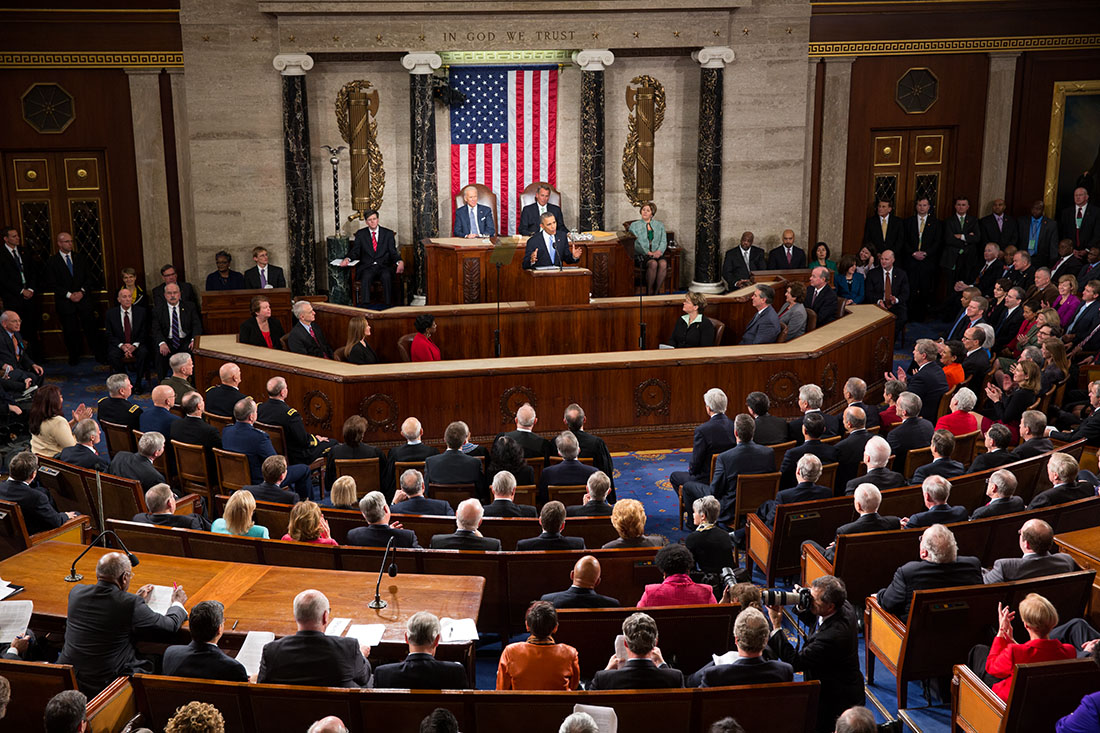
President Obama delivered his 2014 State of the Union address on Jan. 28, 2014, at the U.S. Capitol in Washington. Transcript courtesy of Federal News Service.
PRESIDENT OBAMA: Thank you. (Applause.) Thank you so much. Thank you. Thank you. (Applause.) Thank you so much.
Mr. Speaker, Mr. Vice President, members of Congress, my fellow Americans, today in America, a teacher spent extra time with a student who needed it and did her part to lift America’s graduation rate to its highest levels in more than three decades.
An entrepreneur flipped on the lights in her tech startup and did her part to add to the more than 8 million new jobs our businesses have created over the past four years. (Applause.)
An autoworker fine-tuned some of the best, most fuel-efficient cars in the world and did his part to help America wean itself off foreign oil.
A farmer prepared for the spring after the strongest five-year stretch of farm exports in our history.
A rural doctor gave a young child the first prescription to treat asthma that his mother could afford. (Applause.) A man took the bus home from the graveyard shift, bone-tired but dreaming big dreams for his son. And in tight-knit communities all across America, fathers and mothers will tuck in their kids, put an arm around their spouse, remember fallen comrades and give thanks for being home from a war that after twelve long years is finally coming to an end. (Applause.)
Tonight this chamber speaks with one voice to the people we represent: It is you, our citizens, who make the state of our union strong. (Applause.)
And here are the results of your efforts: the lowest unemployment rate in over five years; a rebounding housing market — (applause) — a manufacturing sector that’s adding jobs for the first time since the 1990s — (applause) — more oil produced — more oil produced at home than we buy from the rest of the world, the first time that’s happened in nearly twenty years — (applause) — our deficits cut by more than half; and for the first time — (applause) — for the first time in over a decade, business leaders around the world have declared that China is no longer the world’s number one place to invest; America is.
(Cheers, applause.) That’s why I believe this can be a breakthrough year for America. After five years of grit and determined effort, the United States is better-positioned for the 21st century than any other nation on Earth.
The question for everyone in this chamber, running through every decision we make this year, is whether we are going to help or hinder this progress. For several years now, this town has been consumed by a rancorous argument over the proper size of the federal government. It’s an important debate — one that dates back to our very founding. But when that debate prevents us from carrying out even the most basic functions of our democracy — when our differences shut down government or threaten the full faith and credit of the United States — then we are not doing right by the American people. (Cheers, applause.)
Now, as president, I’m committed to making Washington work better, and rebuilding the trust of the people who sent us here. And I believe most of you are, too. Last month, thanks to the work of Democrats and Republicans,Congress finally produced a budget that undoes some of last year’s severe cuts to priorities like education. Nobody got everything they wanted, and we can still do more to invest in this country’s future while bringing down our deficit in a balanced way.
But the budget compromise should leave us freer to focus on creating new jobs, not creating new crises.
[Complete Enhanced Video Transcript]
And in the coming months — (applause) — in the coming months, let’s see where else we can make progress together. Let’s make this a year of action. That’s what most Americans want, for all of us in this chamber to focus on their lives, their hopes, their aspirations. And what I believe unites the people of this nation, regardless of race or region or party, young or old, rich or poor, is the simple, profound belief in opportunity for all, the notion that if you work hard and take responsibility, you can get ahead in America. (Applause.)
Now, let’s face it: That belief has suffered some serious blows. Over more than three decades, even before the Great Recession hit, massive shifts in technology and global competition had eliminated a lot of good, middle-class jobs, and weakened the economic foundations that families depend on.
Today, after four years of economic growth, corporate profits and stock prices have rarely been higher, and those at the top have never done better. But average wages have barely budged. Inequality has deepened. Upward mobility has stalled. The cold, hard fact is that even in the midst of recovery, too many Americans are working more than ever just to get by; let alone to get ahead. And too many still aren’t working at all.
So our job is to reverse these trends.
It won’t happen right away, and we won’t agree on everything.
But what I offer tonight is a set of concrete, practical proposals to speed up growth, strengthen the middle class and build new ladders of opportunity into the middle class. Some require congressional action, and I’m eager to work with all of you. But America does not stand still, and neither will I. (Applause.) So wherever and whenever I can take steps without legislation to expand opportunity for more American families, that’s what I’m going to do. (Cheers, applause.)
As usual, our first lady sets a good example. Michelle’s — (applause) — well. (Chuckles.) (Cheers, applause.) Yeah. Michelle’s Let’s Move! partnership with schools, businesses, local leaders has helped bring down childhood obesity rates for the first time in thirty years, and that’s an achievement — (applause) — that will improve lives and reduce health care costs for decades to come. The Joining Forces alliance that Michelle and Jill Biden launched has already encouraged employers to hire or train nearly 400,000 veterans and military spouses. (Applause.)
Taking a page from that playbook, the White House just organized a College Opportunity Summit, where already 150 universities, businesses, nonprofits have made concrete commitments to reduce inequality in access to higher education and to help every hardworking kid go to college and succeed when they get to campus.
And across the country — (applause) — we’re partnering with mayors, governors and state legislatures on issues from homelessness to marriage equality.
The point is, there are millions of Americans outside Washington who are tired of stale political arguments and are moving this country forward. They believe, and I believe, that here in America, our success should depend not on accident of birth but the strength of our work ethic and the scope of our dreams. That’s what drew our forebears here. It’s how the daughter of a factory worker is CEO of America’s largest automaker — (applause) — how the son of a barkeeper is speaker of the House — (cheers, applause) — how the son of a single mom can be president of the greatest nation on Earth. (Cheers, applause.)
Now — (sustained cheers and applause) — opportunity is who we are. And the defining project of our generation must be to restore that promise.
We know where to start. The best measure of opportunity is access to a good job. With the economy picking up speed, companies say they intend to hire more people this year.
And over half of big manufacturers say they’re thinking of insourcing jobs from abroad. (Applause.)
So let’s make that decision easier for more companies. Both Democrats and Republicans have argued that our tax code is riddled with wasteful, complicated loopholes that punish businesses investing here, and reward companies that keep profits abroad. Let’s flip that equation. Let’s work together to close those loopholes, end those incentives to ship jobs overseas, and lower tax rates for businesses that create jobs right here at home. (Cheers, applause.)
Moreover, we can take the money we save from this transition to tax reform to create jobs rebuilding our roads, upgrading our ports, unclogging our commutes — because in today’s global economy, first- class jobs gravitate to first-class infrastructure. We’ll need Congress to protect more than 3 million jobs by finishing transportation and waterways bills this summer. (Cheers, applause.) That can happen.
But — but I’ll act on my own to slash bureaucracy and streamline the permitting process for key projects, so we can get more construction workers on the job as fast as possible. (Applause.)
We also have the chance, right now, to beat other countries in the race for the next wave of high-tech manufacturing jobs. And my administration’s launched two hubs for high-tech manufacturing in Raleigh, North Carolina, and Youngstown, Ohio, where we’ve connected businesses to research universities that can help America lead the world in advanced technologies.
Tonight, I’m announcing we’ll launch six more this year. Bipartisan bills in both houses could double the number of these hubs and the jobs they create. So, get those bills to my desk and put more Americans back to work. (Applause.)
Let’s do more to help the entrepreneurs and small business owners who create most new jobs in America. Over the past five years, my administration has made more loans to small business owners than any other. And when 98 percent of our exporters are small businesses, new trade partnerships with Europe and the Asia-Pacific will help them create even more jobs. We need to work together on tools like bipartisan trade promotion authority to protect our workers, protect our environment and open new markets to new goods stamped “Made in the USA.” (Applause.)
Listen, China and Europe aren’t standing on the sidelines; and neither — neither should we. We know that the nation that goes all-in on innovation today will own the global economy tomorrow. This is an edge America cannot surrender. Federally-funded research helped lead to the ideas and inventions behind Google and smartphones. And that’s why Congress should undo the damage done by last year’s cuts to basic research so we can unleash the next great American discovery. (Cheers, applause.)
There are entire industries to be built based on vaccines that stay ahead of drug-resistant bacteria or paper-thin material that’s stronger than steel. And let’s pass a patent reform bill that allows our businesses to stay focused on innovation, not costly and needless litigation. (Applause.)
Now, one of the biggest factors in bringing more jobs back is our commitment to American energy. The “all the above” energy strategy I announced a few years ago is working, and today America is closer to energy independence than we have been in decades. (Applause.)
One of the reasons why is natural gas. If extracted safely, it’s the bridge fuel that can power our economy with less of the carbon pollution that causes climate change. (Applause.) Businesses plan to invest almost a hundred billion dollars in new factories that use natural gas. I’ll cut red tape to help states get those factories built and put folks to work, and this Congress can help by putting people to work building fueling stations that shift more cars and trucks from foreign oil to American natural gas. (Applause.)
Meanwhile, my administration will keep working with the industry to sustain production and jobs growth while strengthening protection of our air, our water, our communities. And while we’re at it, I’ll use my authority to protect more of our pristine federal lands for future generations. (Applause.)
Now, it’s not just oil and natural gas production that’s booming; we’re becoming a global leader in solar too.
Every four minutes another American home or business goes solar, every panel pounded into place by a worker whose job can’t be outsourced. Let’s continue that progress with a smarter tax policy that stops giving $4 billion a year to fossil fuel industries that don’t need it so we can invest more in fuels of the future that do. (Cheers, applause.)
And even as we’ve increased energy production, we’ve partnered with businesses, builders and local communities to reduce the energy we consume. When we rescued our automakers, for example, we worked with them to set higher fuel efficiency standards for our cars. In the coming months I’ll build on that success by setting new standards for our trucks so we can keep driving down oil imports and what we pay at the pump.
And taken together, our energy policy is creating jobs and leading to a cleaner, safer planet. Over the past eight years the United States has reduced our total carbon pollution more than any other nation on Earth. (Applause.)
But we have to act with more urgency because a changing climate is already harming western communities struggling with drought and coastal cities dealing with floods. That’s why I directed my administration to work with states, utilities and others to set new standards on the amount of carbon pollution our power plants are allowed to dump into the air.
The shift — (applause) — the shift to a cleaner energy economy won’t happen overnight, and it will require some tough choices along the way.
But the debate is settled. Climate change is a fact. (Applause.) And when our children’s children look us in the eye and ask if we did all we could to leave them a safer, more stable world, with new sources of energy, I want us to be able to say yes, we did. (Cheers, applause.)
Finally, if we’re serious about economic growth, it is time to heed the call of business leaders, labor leaders, faith leaders, law enforcement — and fix our broken immigration system. (Cheers, applause.) Republicans and Democrats in the Senate have acted, and I know that members of both parties in the House want to do the same. Independent economists say immigration reform will grow our economy and shrink our deficits by almost $1 trillion in the next two decades. And for good reason: When people come here to fulfill their dreams — to study, invent, contribute to our culture — they make our country a more attractive place for businesses to locate and create jobs for everybody. So let’s get immigration reform done this year. (Cheers, applause.) Let’s get it done. It’s time.
The ideas I’ve outlined so far can speed up growth and create more jobs. But in this rapidly-changing economy, we have to make sure that every American has the skills to fill those jobs.
The good news is, we know how to do it. Two years ago, as the auto industry came roaring back, Andra Rush opened up a manufacturing firm in Detroit. She knew that Ford needed parts for the best-selling truck in America, and she knew how to make those parts. She just needed the workforce. So she dialed up what we call an American Job Center; places where folks can walk in to get the help or training they need to find a new job, or a better job. She was flooded with new workers, and today, Detroit Manufacturing Systems has more than 700 employees. And what Andra and her employees experienced is how it should be for every employer and every job seeker.
So tonight, I’ve asked Vice President Biden to lead an across- the-board reform of America’s training programs to make sure they have one mission: train Americans with the skills employers need, and match them to good jobs that need to be filled right now. (Cheers, applause.) That means more on-the-job training, and more apprenticeships that set a young worker on an upward trajectory for life. It means connecting companies to community colleges that can help design training to fill their specific needs. And if Congress wants to help, you can concentrate funding on proven programs that connect more ready-to-work Americans with ready-to-be-filled jobs.
I’m also convinced we can help Americans return to the workforce faster by reforming unemployment insurance so that it’s more effective in today’s economy. But first, this Congress needs to restore the unemployment insurance you just let expire for 1.6 million people. (Cheers, applause.)
Let me tell you why.
Misty DeMars is a mother of two young boys. She’d been steadily employed since she was a teenager, put herself through college. She’d never collected unemployment benefits, but she’s been paying taxes.
In May, she and her husband used their life savings to buy their first home. A week later, budget cuts claimed the job she loved. Last month, when their unemployment insurance was cut off, she sat down and wrote me a letter, the kind I get every day. “We are the face of the unemployment crisis,” she wrote. “I’m not dependent on the government. Our country depends on people like us who build careers, contribute to society, care about our neighbors. I am confident that in time I will find a job, I will pay my taxes, and we will raise our children in their own home in the community we love. Please give us this chance.”
Congress, give these hardworking, responsible Americans that chance. (Cheers, applause.) Give them that chance. Give them the chance. They need our help right now, but more important, this country needs them in the game. That’s why I’ve been asking CEOs to give more long-term unemployed workers a fair shot at new jobs, a new chance to support their families. And in fact, this week many will come to the White House to make that commitment real.
Tonight I ask every business leader in America to join us and do the same because we are stronger when America fields a full team. (Applause.)
Of course, it’s not enough to train today’s workforce. We also have to prepare tomorrow’s workforce, by guaranteeing every child access to a world-class education. (Applause.)
Estiven Rodriguez couldn’t speak a word of English when he moved to New York City at age 9. But last month, thanks to the support of great teachers and an innovative tutoring program, he led a march of his classmates through a crowd of cheering parents and neighbors from their high school to the post office, where they mailed off their college applications. And this son of a factory worker just found out he’s going to college this fall. (Applause.)
Five years ago we set out to change the odds for all our kids. We worked with lenders to reform student loans, and today more young people are earning college degrees than ever before. Race to the Top, with the help of governors from both parties, has helped states raise expectations and performance. Teachers and principals in schools from Tennessee to Washington, D.C., are making big strides in preparing students with the skills for the new economy — problem solving, critical thinking, science, technology, engineering, math.
Now, some of this change is hard.
It requires everything from more challenging curriculums and more demanding parents to better support for teachers and new ways to measure how well our kids think, not how well they can fill in a bubble on a test. But it is worth it — and it is working.
The problem is we’re still not reaching enough kids, and we’re not reaching them in time, and that has to change.
Research shows that one of the best investments we can make in a child’s life is high-quality early education. (Applause.) Last year, I asked this Congress to help states make high-quality pre-K available to every 4-year-old. And as a parent as well as a president, I repeat that request tonight.
But in the meantime, 30 states have raised pre-k funding on their own. They know we can’t wait. So just as we worked with states to reform our schools, this year we’ll invest in new partnerships with states and communities across the country in a race to the top for our youngest children. And as Congress decides what it’s going to do, I’m going to pull together a coalition of elected officials, business leaders, and philanthropists willing to help more kids access the high-quality pre-K that they need. (Applause.) It is right for America. We need to get this done.
Last year, I also pledged to connect 99 percent of our students to high-speed broadband over the next four years. Tonight I can announce that with the support of the FCC and companies like Apple, Microsoft, Sprint, and Verizon, we’ve got a down payment to start connecting more than 15,000 schools and 20 million students over the next two years, without adding a dime to the deficit. (Cheers, applause.)
We’re working to redesign high schools and partner them with colleges and employers that offer the real-world education and hands-on training that can lead directly to a job and career. We’re shaking up our system of higher education to give parents more information and colleges more incentives to offer better value, so that no middle- class kid is priced out of a college education. We’re offering millions the opportunity to cap their monthly student loan payments to 10 percent of their income, and I want to work with Congress to see how we can help even more Americans who feel trapped by student loan debt. (Applause.)
And I’m reaching out to some of America’s leading foundations and corporations on a new initiative to help more young men of color facing especially tough odds stay on track and reach their full potential.
The bottom line is, Michelle and I want every child to have the same chance this country gave us. But we know our opportunity agenda won’t be complete, and too many young people entering the workforce today will see the American Dream as an empty promise, unless we also do more to make sure our economy honors the dignity of work, and hard work pays off for every single American.
You know, today, women make up about half our workforce, but they still make 77 cents for every dollar a man earns. That is wrong, and in 2014, it’s an embarrassment.
Women deserve equal pay for equal work. (Cheers, applause.)
You know, she deserves to have a baby without sacrificing her job. (Cheers, applause.) A mother deserves a day off to care for a sick child or sick parent without running into hardship. (Applause.) And you know what, a father does too. It is time to do away with workplace policies that belong in a “Mad Men” episode. (Laughter, cheers, applause.) This year let’s all come together, Congress, the White House, businesses from Wall Street to Main Street, to give every woman the opportunity she deserves, because I believe when women succeed, America succeeds. (Cheers, applause.)
Now, women hold a majority of lower-wage jobs, but they’re not the only ones stifled by stagnant wages. Americans understand that some people will earn more money than others, and we don’t resent those who, by virtue of their efforts, achieve incredible success. That’s what America’s all about. But Americans overwhelmingly agree that no one who works full-time should ever have to raise a family in poverty. (Applause.)
In the year since I asked this Congress to raise the minimum wage, five states have passed laws to raise theirs.
Many businesses have done it on their own. Nick Chute is here today with his boss, John Soranno. John’s an owner of Punch Pizza in Minneapolis, and Nick helps make the dough. (Laughter.) Only now he makes more of it. (Laughter.) John just gave his employees a raise to 10 bucks an hour, and that’s a decision that has eased their financial stress and boosted their morale.
Tonight I ask more of America’s business leaders to follow John’s lead. Do what you can to raise your employees’ wages. (Applause.) It’s good for the economy; it’s good for America. (Sustained applause.)
To every mayor, governor, state legislator in America, I say, you don’t have to wait for Congress to act; Americans will support you if you take this on. And as a chief executive, I intend to lead by example. Profitable corporations like Costco see higher wages as the smart way to boost productivity and reduce turnover. We should too. In the coming weeks I will issue an executive order requiring federal contractors to pay their federally-funded employees a fair wage of at least $10.10 an hour because if you cook — (cheers, applause) — our troops’ meals or wash their dishes, you should not have to live in poverty. (Sustained applause.)
Of course, to reach millions more, Congress does need to get on board.
Today the federal minimum wage is worth about twenty percent less than it was when Ronald Reagan first stood here. And Tom Harkin and George Miller have a bill to fix that by lifting the minimum wage to $10.10. It’s easy to remember: 10.10. This will help families. It will give businesses customers with more money to spend. It does not involve any new bureaucratic program. So join the rest of the country. Say yes. Give America a raise. (Cheers, applause.) Give ’em a raise.
There are other steps we can take to help families make ends meet, and few are more effective at reducing inequality and helping families pull themselves up through hard work than the Earned Income Tax Credit. Right now, it helps about half of all parents at some point. Think about that. It helps about half of all parents in America at some point in their lives.
But I agree with Republicans like Senator Rubio that it doesn’t do enough for single workers who don’t have kids. So let’s work together to strengthen the credit, reward work, help more Americans get ahead.
Let’s do more to help Americans save for retirement. Today most workers don’t have a pension. A Social Security check often isn’t enough on its own. And while the stock market has doubled over the last five years, that doesn’t help folks who don’t have 401(k)s. That’s why tomorrow I will direct the Treasury to create a new way for working Americans to start their own retirement savings: MyRA. It’s a — it’s a new savings bond that encourages folks to build a nest egg.
MyRA guarantees a decent return with no risk of losing what you put in. And if this Congress wants to help, work with me to fix an upside-down tax code that gives big tax breaks to help the wealthy save, but does little or nothing for middle-class Americans, offer every American access to an automatic IRA on the job, so they can save at work just like everybody in this chamber can.
And since the most important investment many families make is their home, send me legislation that protects taxpayers from footing the bill for a housing crisis ever again, and keeps the dream of homeownership alive for future generations. (Applause.)
One last point on financial security. For decades, few things exposed hard-working families to economic hardship more than a broken health care system. And in case you haven’t heard, we’re in the process of fixing that. (Scattered laughter, applause.)
Now — a pre-existing condition used to mean that someone like Amanda Shelley, a physician’s assistant and single mom from Arizona, couldn’t get health insurance. But on January 1st, she got covered. (Applause.) On January 3rd, she felt a sharp pain. On January 6th, she had emergency surgery. Just one week earlier, Amanda said, that surgery would’ve meant bankruptcy. That’s what health insurance reform is all about, the peace of mind that if misfortune strikes, you don’t have to lose everything.
Already, because of the Affordable Care Act, more than 3 million Americans under age 26 have gained coverage under their parents’ plans. (Applause.)
More than 9 million Americans have signed up for private health insurance or Medicaid coverage — 9 million. (Applause.)
And here’s another number: zero. Because of this law, no American, none, zero, can ever again be dropped or denied coverage for a pre-existing condition like asthma or back pain or cancer. (Cheers, applause.) No woman can ever be charged more just because she’s a woman. (Cheers, applause.) And we did all this while adding years to Medicare’s finances, keeping Medicare premiums flat and lowering prescription costs for millions of seniors.
Now, I do not expect to convince my Republican friends on the merits of this law. (Laughter.) (Chuckles.) (Laughter.) But I know that the American people are not interested in refighting old battles. So again, if you have specific plans to cut costs, cover more people, increase choice, tell America what you’d do differently. Let’s see if the numbers add up. (Applause.) But let’s not have another 40- something votes to repeal a law that’s already helping millions of Americans like Amanda.
(Cheers, applause.) The first 40 were plenty. We all owe it to the American people to say what we’re for, not just what we’re against.
And if you want to know the real impact this law is having, just talk to Governor Steve Beshear of Kentucky, who’s here tonight. Now, Kentucky’s not the most liberal part of the country. That’s not where I got my highest vote totals. (Laughter.) But he’s like a man possessed when it comes to covering his commonwealth’s families. They’re our neighbors and our friends, he said. They’re people we shop and go to church with — farmers out on the tractor, grocery clerks. They’re people who go to work every morning praying they don’t get sick. No one deserves to live that way.
Steve’s right. That’s why tonight I ask every American who knows someone without health insurance to help them get covered by March 31st. Help them get covered. (Applause.) Moms, get on your kids to sign up. Kids, call your mom and walk her through the application. It’ll give her some peace of mind, and plus, she’ll appreciate hearing from you. (Laughter.)
After all, that — that’s the spirit that has always moved this nation forward.
It’s the spirit of citizenship, the recognition that through hard work and responsibility, we can pursue our individual dreams, but still come together as one American family to make sure the next generation can pursue its dreams as well.
Citizenship means standing up for everyone’s right to vote. (Applause.) Last year, part of the Voting Rights Act was weakened, but conservative Republicans and liberal Democrats are working together to strengthen it. And the bipartisan commission I appointed, chaired by my campaign lawyer and Governor Romney’s campaign lawyer, came together and have offered reforms so that no one has to wait more than a half hour to vote. Let’s support these efforts. It should be the power of our vote, not the size of our bank account, that drives our democracy. (Cheers, applause.)
Citizenship means standing up for the lives that gun violence steals from us each day. I have seen the courage of parents, students, pastors, and police officers all over this country who say “we are not afraid,” and I intend to keep trying, with or without Congress, to help stop more tragedies from visiting innocent Americans in our movie theaters and our shopping malls, or schools like Sandy Hook. (Applause.)
Citizenship demands a sense of common purpose; participation in the hard work of self-government; an obligation to serve to our communities.
And I know this chamber agrees that few Americans give more to their country than our diplomats and the men and women of the United States armed forces. (Extended applause.) Thank you.
Tonight, because of the extraordinary troops and civilians who risk and lay down their lives to keep us free, the United States is more secure. When I took office, nearly 180,000 Americans were serving in Iraq and Afghanistan. Today, all our troops are out of Iraq. More than 60,000 of our troops have already come home from Afghanistan. With Afghan forces now in the lead for their own security, our troops have moved to a support role. Together with our allies, we will complete our mission there by the end of this year, and America’s longest war will finally be over. (Applause.)
After 2014, we will support a unified Afghanistan as it takes responsibility for its own future.
If the Afghan government signs a security agreement that we have negotiated, a small force of Americans could remain in Afghanistan with NATO allies to carry out two narrow missions: training and assisting Afghan forces and counterterrorism operations to pursue any remnants of al-Qaida. For while our relationship with Afghanistan will change, one thing will not: our resolve that terrorists do not launch attacks against our country. (Applause.)
The fact is that danger remains. While we’ve put al-Qaida’s core leadership on a path to defeat, the threat has evolved as al-Qaida affiliates and other extremists take root in different parts of the world. In Yemen, Somalia, Iraq, Mali, we have to keep working with partners to disrupt and disable these networks. In Syria, we’ll support the opposition that rejects the agenda of terrorist networks. Here at home, we’ll keep strengthening our defenses and combat new threats like cyberattacks. And as we reform our defense budget, we have to keep faith with our men and women in uniform and invest in the capabilities they need to succeed in future missions. (Applause.)
We have to remain vigilant.
But I strongly believe our leadership and our security cannot depend on our outstanding military alone. As commander in chief, I have used force when needed to protect the American people, and I will never hesitate to do so as long as I hold this office. But I will not send our troops into harm’s way unless it is truly necessary, nor will I allow our sons and daughters to be mired in open-ended conflicts. We must fight the battles — (applause) — that need to be fought, not those that terrorists prefer from us — large-scale deployments that drain our strength and may ultimately feed extremism.
So even as we actively and aggressively pursue terrorist networks, through more targeted efforts and by building the capacity of our foreign partners, America must move off a permanent war footing. (Applause.) That’s why I’ve imposed prudent limits on the use of drones, for we will not be safer if people abroad believe we strike within their countries without regard for the consequence.
That’s why, working with this Congress, I will reform our surveillance programs because the vital work of our intelligence community depends on public confidence, here and abroad, that privacy of ordinary people is not being violated. (Applause.) And with the Afghan war ending, this needs to be the year Congress lifts the remaining restrictions on detainee transfers and we close the prison at Guantanamo Bay — (applause) — because we counter terrorism not just through intelligence and military action but by remaining true to our constitutional ideals and setting an example for the rest of the world.
You see, in a world of complex threats, our security, our leadership depends on all elements of our power — including strong and principled diplomacy. American diplomacy has rallied more than 50 countries to prevent nuclear materials from falling into the wrong hands, and allowed us to reduce our own reliance on Cold War stockpiles.
American diplomacy, backed by the threat of force, is why Syria’s chemical weapons are being eliminated. (Applause.) And we will continue to work with the international community to usher in the future the Syrian people deserve — a future free of dictatorship, terror and fear.
As we speak, American diplomacy is supporting Israelis and Palestinians as they engage in the difficult but necessary talks to end the conflict there; to achieve dignity and an independent state for Palestinians, and lasting peace and security for the state of Israel — a Jewish state that knows America will always be at their side. (Applause.)
And it is American diplomacy, backed by pressure, that has halted the progress of Iran’s nuclear program — and rolled back parts of that program — for the very first time in a decade. As we gather here tonight, Iran has begun to eliminate its stockpile of higher levels of enriched uranium.
It’s not installing advanced centrifuges. Unprecedented inspections help the world verify every day that Iran is not building a bomb. And with our allies and partners, we’re engaged in negotiations to see if we can peacefully achieve a goal we all share: preventing Iran from obtaining a nuclear weapon. (Applause.)
These negotiations will be difficult; they may not succeed. We are clear-eyed about Iran’s support for terrorist organizations like Hezbollah, which threaten our allies; and we’re clear about the mistrust between our nations, mistrust that cannot be wished away. But these negotiations don’t rely on trust; any long-term deal we agree to must be based on verifiable action that convinces us and the international community that Iran is not building a nuclear bomb. If John F. Kennedy and Ronald Reagan could negotiate with the Soviet Union, then surely a strong and confident America can negotiate with less powerful adversaries today. (Applause.)
The sanctions that we put in place helped make this opportunity possible. But let me be clear: if this Congress sends me a new sanctions bill now that threatens to derail these talks, I will veto it. (Applause.) For the sake of our national security, we must give diplomacy a chance to succeed.
(Applause.) If Iran’s leaders do not seize this opportunity, then I will be the first to call for more sanctions and stand ready to exercise all options to make sure Iran does not build a nuclear weapon. But if Iran’s leaders do seize the chance — and we’ll know soon enough — then Iran could take an important step to rejoin the community of nations, and we will have resolved one of the leading security challenges of our time without the risks of war.
And finally, let’s remember that our leadership is defined not just by our defense against threats but by the enormous opportunities to do good and promote understanding around the globe, to forge greater cooperation, to expand new markets, to free people from fear and want. And no one is better positioned to take advantage of those opportunities than America.
Our alliance with Europe remains the strongest the world has ever known. From Tunisia to Burma, we’re supporting those who are willing to do the hard work of building democracy. In Ukraine, we stand for the principle that all people have the right to express themselves freely and peacefully and to have a say in their country’s future. Across Africa, we’re bringing together businesses and governments to double access to electricity and help end extreme poverty. In the Americas, we’re building new ties of commerce, but we’re also expanding cultural and educational exchanges among young people.
And we will continue to focus on the Asia-Pacific, where we support our allies, shape a future of greater security and prosperity and extend a hand to those devastated by disaster, as we did in the Philippines, when our Marines and civilians rushed to aid those battered by a typhoon, and were greeted with words like, “We will never forget your kindness” and “God bless America.”
We do these things because they help promote our long-term security. And we do them because we believe in the inherent dignity and equality of every human being, regardless of race or religion, creed or sexual orientation. And next week the world will see one expression of that commitment when Team USA marches the red, white and blue into the Olympic stadium and brings home the gold. (Cheers, applause.)
My fellow Americans, no other country in the world does what we do. On every issue, the world turns to us, not simply because of the size of our economy or our military might but because of the ideals we stand for and the burdens we bear to advance them.
No one knows this better than those who serve in uniform. As this time of war draws to a close, a new generation of heroes returns to civilian life. We’ll keep slashing that backlog so our veterans receive the benefits they’ve earned and our wounded warriors receive the health care — including the mental health care — that they need. (Applause.) We’ll keep working to help all our veterans translate their skills and leadership into jobs here at home, and we will all continue to join forces to honor and support our remarkable military families.
Let me tell you about one of those families I’ve come to know.
I first met Cory Remsburg, a proud Army Ranger, at Omaha Beach on the 65th anniversary of D-Day. Along with some of his fellow Rangers, he walked me through the program, the ceremony. He was a strong, impressive young man, had an easy manner. He was sharp as a tack. And we joked around, and took pictures, and I told him to stay in touch.
A few months later, on his 10th deployment, Cory was nearly killed by a massive roadside bomb in Afghanistan. His comrades found him in a canal, face down, underwater, shrapnel in his brain.
For months, he lay in a coma. And the next time I met him, in the hospital, he couldn’t speak; he could barely move. Over the years, he’s endured dozens of surgeries and procedures, hours of grueling rehab every day.
Even now, Cory is still blind in one eye. He still struggles on his left side. But slowly, steadily, with the support of caregivers like his dad Craig, and the community around him, Cory has grown stronger. Day by day, he’s learned to speak again and stand again and walk again, and he’s working toward the day when he can serve his country again.
“My recovery has not been easy,” he says. “Nothing in life that’s worth anything is easy.”
Cory is here tonight. And like the Army he loves, like the America he serves, Sergeant First Class Cory Remsburg never gives up, and he does not quit. (Cheers, applause.) Cory. (Extended cheers and applause.)
My fellow Americans — my fellow Americans, men and women like Cory remind us that America has never come easy. Our freedom, our democracy, has never been easy. Sometimes we stumble; we make mistakes; we get frustrated or discouraged.
But for more than two hundred years, we have put those things aside and placed our collective shoulder to the wheel of progress: to create and build and expand the possibilities of individual achievement; to free other nations from tyranny and fear; to promote justice and fairness and equality under the law, so that the words set to paper by our founders are made real for every citizen.
The America we want for our kids — a rising America where honest work is plentiful and communities are strong; where prosperity is widely shared and opportunity for all lets us go as far as our dreams and toil will take us — none of it is easy. But if we work together; if we summon what is best in us, the way Cory summoned what is best in him, with our feet planted firmly in today but our eyes cast towards tomorrow, I know it’s within our reach.
Believe it.
God bless you, and God bless the United States of America. (Cheers, applause.)
1 Comment | Barack Obama, History, Politics, State of the Union | Tagged: History, Politics, President Obama, State of the Union | Permalink
Posted by Ed Darrell

From the U.S. Department of Interior: Really cool reflection photo from America’s largest national park: @WrangellStENPS in #Alaska. pic.twitter.com/WHUYkgJNTH
Wrangell-St. Elias is our largest National Park? At 20,587 square miles, it’s about 80% as large as West Virginia, and larger than nine other states.
Wrangell–St. Elias National Park and Preserve is a United States national park and national preserve managed by the National Park Service in south central Alaska. The park and preserve was established in 1980 by the Alaska National Interest Lands Conservation Act.[3] This protected area is included in an International Biosphere Reserve and is part of the Kluane/Wrangell-St. Elias/Glacier Bay/Tatshenshini-Alsek UNESCO World Heritage Site. The park and preserve form the largest area managed by the National Park Service in the United States by area with a total of 13,175,799 acres (20,587.19 sq mi; 53,320.57 km2). The park includes a large portion of the Saint Elias Mountains, which include most of the highest peaks in the United States and Canada, yet are within 10 miles (16 km) of tidewater, one of the highest reliefs in the world. Wrangell-St. Elias borders on Canada’s Kluane National Park and Reserve to the east and approaches the U.S. Glacier Bay National Park to the south. The chief distinction between park and preserve lands is that sport hunting is prohibited in the park and permitted in the preserve. In addition, 9,078,675 acres (3,674,009 ha) of the park are designated as the largest single wilderness in the United States.
Wrangell-St. Elias National Monument was initially designated on December 1, 1978 by President Jimmy Carter using the Antiquities Act, pending final legislation to resolve the allotment of public lands in Alaska. Establishment as a national park and preserve followed the passage of the Alaska National Interest Lands Conservation Act in 1980. The park, which is bigger than the nation of Switzerland, has long, extremely cold winters and a short summer season. It supports a variety of large mammals in an environment defined by relative land elevation. Plate tectonics are responsible for the uplift of the mountain ranges that cross the park. The park’s extreme high point is Mount St. Elias at 18,008 feet (5,489 m), the second tallest mountain in both the United States and Canada. The park has been shaped by the competing forces of volcanism and glaciation. Mount Wrangell is an active volcano, one of several volcanoes in the western Wrangell Mountains. In the St. Elias Range Mount Churchill has erupted explosively within the past 2000 years. The park’s glacial features include Malaspina Glacier, the largest piedmont glacier in North America, Hubbard Glacier, the longest tidewater glacier in Alaska, and Nabesna Glacier, the world’s longest valley glacier. The Bagley Icefield covers much of the park’s interior, which includes 60% of the permanently ice-covered terrain in Alaska. At the center of the park, the boomtown of Kennecott exploited one of the world’s richest deposits of copper from 1903 to 1938, exposed by and in part incorporated into Kennicott Glacier. The mine buildings and mills, now abandoned, compose a National Historic Landmark district.
More:
Leave a Comment » | Alaska, National Parks, photography, Travel | Tagged: Alaska, geography, photography, Travel, Wrangell-St. Elias National Park | Permalink
Posted by Ed Darrell
From Twitter today; working to track down more details.
A photo by John C. Olsen, taken in Hastings, Nebraska, perhaps on December 31, 2013:

From Fascinating Pics: One of the rarest weather phenomena, Mammatus Clouds. Photo taken by John C. Olsen in Hastings, NE pic.twitter.com/dlPNaPa25D
Our boys liked clouds from the start. A couple of our early cloud identification books featured mammatus clouds (guess where the name came from); and before each boy was 11, we had seen these clouds here in Texas, often in that treacherous time known as tornado season.
Beautiful clouds, yes, but often scary — well, until you read from the University of Illinois that they tend to follow nasty storms, not precede them.
Mammatus Cloudssagging pouch-like structuresMammatus are pouch-like cloud structures and a rare example of clouds in sinking air.
Sometimes very ominous in appearance, mammatus clouds are harmless and do not mean that a tornado is about to form; a commonly held misconception. In fact, mammatus are usually seen after the worst of a thunderstorm has passed.
As updrafts carry precipitation enriched air to the cloud top, upward momentum is lost and the air begins to spread out horizontally, becoming a part of the anvil cloud. Because of its high concentration of precipitation particles (ice crystals and water droplets), the saturated air is heavier than the surrounding air and sinks back towards the earth.
The temperature of the subsiding air increases as it descends. However, since heat energy is required to melt and evaporate the precipitation particles contained within the sinking air, the warming produced by the sinking motion is quickly used up in the evaporation of precipitation particles. If more energy is required for evaporation than is generated by the subsidence, the sinking air will be cooler than its surroundings and will continue to sink downward.
The subsiding air eventually appears below the cloud base as rounded pouch-like structures called mammatus clouds.
Mammatus are long lived if the sinking air contains large drops and snow crystals since larger particles require greater amounts of energy for evaporation to occur. Over time, the cloud droplets do eventually evaporate and the mammatus dissolve.
Our experience is the clouds look a lot cooler than can be captured on film or in electronic images. Mr. Olsen captured a great image.
Very nice shot
1 Comment | Clouds, Meteorology, Science, Weather | Tagged: Clouds, Hastings, John C. Olsen, Mammatus Clouds, Meteorology, Nebraska, Science, Weather | Permalink
Posted by Ed Darrell
Interesting morning. Is there anyone who does not have a Pete Seeger memory?
The Pete Seeger Appreciation page was set up many months ago — in fact founder Jim Capaldi died last December, with his family carrying it on. A good place to start, maybe.

Classic Pete Seeger photo — from the 1950s? This and more at the Pete Seeger Appreciation Page, at PeteSeeger.net
http://twitter.com/jedsundwall/status/428237009241403392
Read his biography, perhaps?
Learn to play the banjo:
This is the one that made me shed tears:
http://twitter.com/Peter_Seeger/status/428243606491918336
What great tributes have you seen to Pete today? Give us a link in comments, share the good stuff.
4 Comments | Folk Music, History, Pete Seeger | Tagged: Folk Music, History, Pete Seeger | Permalink
Posted by Ed Darrell
It’s a stunning photograph, not for its photgrapher’s skills, nor the artistic nature of the taking. It’s a true snapshot. Five people on a farm in Kentucky, in black and white. Probably the photographer used a Kodak camera made just for snapshots.
Except, it was 1957. The farm is the Highlander School. The five people in the photo include folksinger Pete Seeger, and Rosa Parks, and the Rev. Dr. Martin Luther King, Jr.
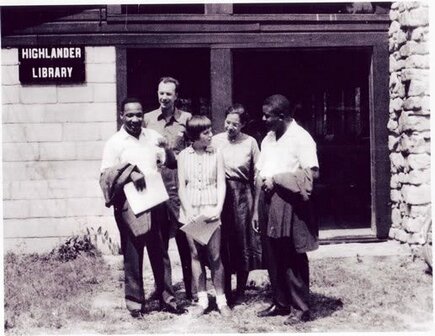
From left, Martin Luther King, Jr., Pete Seeger, Charis Horton, one of the founders of the Highlander School, Rosa Parks, and the Rev. Ralph Abernathy. At a workshop at the Highlander School in Kentucky, circa 1957.
Who was the photographer? Perhaps Myles Horton, the director of the school (and Charis’s husband).
In a sort piece filmed at his home in Beacon, New York, for the Highlander’s 75th Anniversary in 2007, Pete described the time and the occasion.
Don’t you love the cricket singing along with Pete?
More:
1 Comment | 1957, Civil Rights, History, Martin Luther King, Pete Seeger, Red Scare | Tagged: 1957, Civil Rights, Highlander Center, History, Martin Luther King Jr., Pete Seeger, Red Scare, Rosa Parks | Permalink
Posted by Ed Darrell
Just got the news that Pete Seeger died. He was 94.
Such a loss for American music, to American music, and to history and art.

Pete Seeger at the Beacon Sloop Club in Beacon, N.Y., in 2010. Andrew Sullivan for The New York Times
I love the Andrew Sullivan photo the New York Times used — it reminds me of the best way to hear Pete, in the out-of-doors, near the Hudson, in the summer, with a small audience who could be coerced to sing along.
Pete was an alumnus of Camp Rising Sun (of the L. A. Jonas Foundation) near Rhinebeck, New York, from the very early days. In 1974, between concerts at large venues with Arlo Guthrie, and on his way back home to Beacon, Pete stopped and spent a day with us at the camp. He was , as always, wonderfully gracious, other than outward appearances indistinguishable from the 14- and 15-year boys in excitement to be having fun, exploring nature, and then leading us all in songs.
My unfinished master’s thesis was to explore Pete’s use of different rhetorical devices to get his messages across, and make them popular. (One of my everlasting regrets.)
But despite his down-home-everybody-welcome demeanor, Seeger drove great movements, and pushed the arcs of history in wonderful directions throughout his life.
If you would, pull out your collection of Pete Seeger music today, and give it a spin. It will raise your spirits, I guarantee.
What wonderful gifts Pete left us!
So long, Pete, one of the best American citizens we’ll ever know.
Maybe we should just say, “So long! It’s Been Good to Know Ya!”
More:
1 Comment | Citizenship, Folk Music, History, Music, Pete Seeger | Tagged: Citizenship, Folk Music, History, Music, Pete Seeger | Permalink
Posted by Ed Darrell
This one is cropping up all over the internet.
But just try to get a commitment as to its origins. Photographic, or artist’s image?
I wagered the latter. Note general lack of thick clouds, angle of sunlight, etc.

Beautiful Antarctica from space. Photographic image, or artist’s rendering? Who deserves credit for the image?
Then, at Twisted Sifter (shout out to Annette Breedlove; and everyone outside my family will be mystified by that reference) I found this, the full image from NASA. Notice how some selective editing, changing the perspective, makes the image above more fascinating — while stripping out the identifying credits:

Image via Twisted Sifter; NASA image of Antarctica, available at Flickr Commons
Well, that’s a different thing, then.
Twisted Sifter’s explanation of details, excerpt:
Seen above is a view of the Earth on September 21, 2005 with the full Antarctic region visible. The composite image shows the sea ice on September 21, 2005, the date at which the sea ice was at its minimum extent in the northern hemisphere. The colour of the sea ice is derived from the AMSR-E 89 GHz brightness temperature while the extent of the sea ice was determined by the AMSR-E sea ice concentration. Over the continents, the terrain shows the average land cover for September, 2004. The global cloud cover shown was obtained from the original Blue Marble cloud data distributed in 2002. [Source]
Due to the position of Antarctica in relation to our Sun it would not look like this to the naked eye. This is a composite that shows what Antarctica looks like if the entire continent were illuminated.
Click here for the full resolution 8400×8400 pixel TIFF version (63 mb) and click here for the 8400 x 8400 px JPG version.
NASA’s details, from the Flickr file:
NASA on The Commons
Global View of the Arctic and Antarctic on September 21, 2005
Collection: NASA Scientific Visualization Studio Collection
Title: Global View of the Arctic and Antarctic on September 21, 2005
Instrument: Terra/MODIS
Instrument: Aqua/AMSR-E
Description: This image shows a view of the Earth on September 21, 2005 with the full Antarctic region visible.
Abstract: In support of International Polar Year, this matching pair of images showing a global view of the Arctic and Antarctic were generated in poster-size resolution. Both images show the sea ice on September 21, 2005, the date at which the sea ice was at its minimum extent in the northern hemisphere. The color of the sea ice is derived from the AMSR-E 89 GHz brightness temperature while the extent of the sea ice was determined by the AMSR-E sea ice concentration. Over the continents, the terrain shows the average landcover for September, 2004. (See Blue Marble Next Generation) The global cloud cover shown was obtained from the original Blue Marble cloud data distributed in 2002. (See Blue Marble:Clouds) A matching star background is provided for each view. All images include transparency, allowing them to be composited on a background.
Completed: 2007-02-08
Credit: *Please give credit for this visualization to* NASA/Goddard Space Flight Center Scientific Visualization Studio The Blue Marble data is courtesy of Reto Stockli (NASA/GSFC).
Studio: SVS
Animator: Cindy Starr (Lead)
Scientist: Ronald Weaver (University of Colorado)
Data Collected: AMSR-E Sea Ice: 2005-09-21; Blue Marble cloud layer 2002; Blue Marble Next Generation Seasonal Landcover 2004-09
UID: SPD-SCIVS-http://svs .gsfc.nasa.gov/vis/a 000000/a003400/a0034 02/NSIDCimages__SPcl ouds.2158-IMAGE
Original url: svs.gsfc.nasa.gov/vis/a000000/a003400/a003402/index.html
SOURCE: nasaimages.org/luna/servlet/detail/NSVS~3~3~7128~107128
Visit www.nasaimages.org for the most comprehensive compilation of NASA stills, film and video, created in partnership with Internet Archive.
The image, and it’s odyssey and story, are reminders that reality is often better than the made up stuff; and it’s wise to properly attribute stuff you borrow. Is this just a cool image, or an opportunity for teachers to enrich the classroom and an argument for boosting NASA’s budget?
More:
5 Comments | Antarctica, Geography - Physical, Space exploration | Tagged: Anarctica, Art, geography, Hoaxes, photography, Space exploration, Twisted Sifter | Permalink
Posted by Ed Darrell
A friend, who happens to be a Muslim and politically active, sent me this:
Next time one of your RWNJ friends or relatives claims President Obama is a “closet Muslim” who is trying to spread Islamic law throughout the U.S., remind them of this:
In Muslim countries there are certain tendencies. Among them:
- They are anti-abortion.
- They are supportive of the death penalty.
- They are anti-gun control.
- They are anti-separation of church and state.
- They are supportive of teaching religious indoctrination in school.
- They believe women should have less rights than men.
- They oppose “multiculturalism.”
- They believe homosexuality is “evil” and do not allow same-sex marriage.
SO, if President Obama were REALLY trying to spread Islamic law in the U.S., he’d be a REPLUBLICAN!!
Most of the people who complain about Shariah law in the U.S. don’t know what it is, and also don’t know what is in the Republican platforms in the states and national party.
Then, sorta to drill it home, another friend commented:
Please don’t bother me with your bizarre claims that Barack Obama is Muslim. It immediately brands you, in my admittedly jaundiced eye, as one who either cannot tell nonsense from the truth, or one who is intent on spreading mistruths for nefarious, skullduggerous reasons.
[I apologize; the missive that came to me did not bear credit for the photographs; if you know who deserves credit for any or all of them, please tell us in comments.]
Tip of the old scrub brush to Eric and Jim. They know who they are.
26 Comments | Barack Obama, Hoaxes, Politics, Rampant stupidity | Tagged: Barack Obama, Hoaxes, Politics, Rampant stupidity | Permalink
Posted by Ed Darrell
There are those who argue that the the first Boy Scout Troop was organized on January 24, 1908.
History is not so clear on that point, however. There may have been earlier troops organized, but records were unclear, or lost.

From Wikipedia: Front cover of the first part of Scouting for Boys by Robert Baden-Powell, published in January 1908. Illustrations by Baden-Powell himself.
We do know that the the first installment of the serialized Scouting for Boys was published on January 24, 1908. By April of that year all installments were published, and we can say that the first Boy Scout handbook had arrived.
Either way, January 24 holds some historical significance for the Scouting movement.
Do a good turn in honor of the day.
Who was really first? Unfortunately, the records don’t exist to settle that issue.
Scouting, in England, arose from the popular clamor by boys after the 1899 publication of Col. Robert Baden-Powell’s handbook for the scouts he trained for the British Army in southern Africa, Aids to Scouting. Though not written for a youthful audience, the book became a best seller among boys who wished to emulate the adventures of soldiers and rangers in the British Army.
By 1907, Baden-Powell seriously worked to translate his experience and wisdom in a book aimed at boys. In the summer of 1907 he gathered a collection of boys to camp, to try out his ideas for outdoor activities for boys. With aid of the YMCA and other organizations, troops were planned and organized at the end of 1907 and in early 1908; then the program skyrocketed, with 60,000 boy members by the end of 1908.
Which was the “first” troop?
In England, where history and firsts might understandably be taken more seriously for Scouting, a number of groups can make the claims — and it’s almost impossible to choose from among them. Wikipedia explains the claims of each, without much blood (I’ve left in most of the links and footnote links):
The first Scout Troops were formed in the United Kingdom in 1907, and registered in 1908. There are a number of claimants to be the first troop. However, due to poor record keeping when the Scouting Movement started, The Scout Association does not acknowledge any single troop as being the first. The Scout Association maintains a list of all the Scout Troops who claim to have started in 1908.[1]
The Scout Troops with the strongest claims are listed below:
The 1st Glasgow Scout Group in Scotland holds the earliest known registration certificate, dated 26 January 1908, issued by the Scouting Association. The Group was formed from the Glasgow Battalion of the Army Cadet Corps; its Adjutant was Captain Robert E Young. In June 1907, they formed the ‘Cadets’ Winter Recreation Training Club’. The club was a success from the beginning, as ‘Boss’ Young related: “At first we met at my house, signalled up and down the stairs, tied knots around the banisters and always finished with a good tuck-in.” ‘Boss’ Young met B-P during Autumn 1907 who suggested that the Club could experiment with the ideas contained in ‘Scouting for Boys’. On 16 January 1908, the Club was formally disbanded and the First Glasgow Troop of Boy Scouts was registered with Scout HQ in London.[1][2]
The first Scout Troop to receive a visit from Baden-Powell was the Vaux’s Own Scout Troop in Sunderland. This visit was made on 22 February 1908, so it is assumed by The Scout Association “that it had already been in existence for some days at any rate”.[1] This was also the first Scout Troop listed in the Imperial records. The 1st Crystal Palace Patrol (now known as the 2nd Croydon, 1st Crystal Palace) is documented as being in existence on 28 February 1908. The group is still in existence.[3]
In 2007, 1st Henfield Scout Troop was named as the oldest surviving Scout Troop in the world for the centenary of Scouting. They were the hosts of the only place that the centenary flame stopped in England for the night before reaching its goal of Brownsea Island. However, it is not the oldest Scout Troop, as others were set up before Henfield. It is said that the boys that went to Brownsea Island on the first ever scout trip were from Henfield.[4]
The 1st Birkenhead (YMCA) has a claim to be the oldest Scout Troop as it was founded on 24 January 1908 when B P attended a meeting at the YMCA. Documents at the District Headquarters confirm this fact. Baden-Powell at the 1929 Coming of Age Jamboree in Birkenhead said “Here in Birkenhead that I first mooted the idea of Scouting”.
The 1st Croydon Scout Group (Addiscombe) were founded in the latter months of 1907. The Group was officially registered by Imperial Scout Headquarters on 16 June 1908 and can claim to be one of the earliest Groups.
1st Church Kirk, Church near Accrington Lancashire. Formed 1907. Baden Powell formed a link with Accrington during his opening of the Ambulance Drill Hall in 1904.
There is an entry in Baden-Powell’s diary on 4 February 1908 which mentions a Scout Troop in Nottingham.
1st Alsager, Cheshire were formed before 24 February 1908.
A troop from Hampstead was involved in various events in the first half of 1908.
The 1st City Of Aberdeen Scouts existed in 1908. 1st Arbroath Scout Troop (2nd Angus) dates back to June 1908.[5]
The 1st Norwich “Capt. Bower’s Own” Sea Scouts started in January 1908.[6] The group is one of few which has continuously run for 100 years and, remarkably, had just 4 Group Scout Leaders during that time. To celebrate their centenary year, the group published a book entitled, “It Can Be Done: The Hundred Year History of the 1st Norwich Sea Scout Group.” drawing from their extensive archives.[7]
In Poole, Dorset, there are strong claims from 3 current Scout Groups, that all have separate newspaper articles back to 1908 listing Patrols or Troops practicing Scouting. 1st Parkstone has got a registration number back to February 1908 for a Scout Troop. Hamworthy are listed as having a Boat patrol at the Local Church in November 1908 and Broadstone having an Ambulance Scout at the Gathering on Brownsea Island in December 1908.
Wycliffe Scout Group (Gloucestershire) claims to be the oldest continuously active school-based Scout group in the world (active September 2013). It is listed in the Scout Association database with a registration date of 1 February 1909, although the Group celebrated their centenary in 2008, implying that there had been Scouting activity at the school before the Group was registered.
Who was first? The question remains, not yet satisfactorily answered for history.
How would you decide the controversy?

Scouts from several nations around a campfire — photo from EraScouting page [replacing photo from the website of the World Scout Organization]. “Leave this world a little better than you found it” — Lord Baden-Powell, the founder of Scouting. There are over 40 million Scouts in the World Organization of the Scout Movement.
4 Comments | Boy Scouts of America, History | Tagged: Boy Scouts, History, January 24 1908, Robert Baden-Powell, Scouting Movement | Permalink
Posted by Ed Darrell
January 23 is the anniversary of the North Koreans‘ capture of the spy boat, U.S.S. Pueblo, in 1968 — a beginning of a momentous year for bad events. The saga of the Pueblo and its crew, including especially Cmdr. Lloyd Bucher, is of special interest to me because it features a series of some of the grandest, best and most humorously American hoaxes ever perpetrated by imprisoned people against their captors and wardens. This is one of the great Kilroy stories of American history. It should not be forgotten. Especially with the role North Korea plays in contemporary angst, the Pueblo episode should not be forgotten. This is an encore post, with new links added.
1968 brought one chunk of bad news after another to Americans. The year seemed to be one long, increasingly bad disaster. In several ways it was the mark of the times between the feel-good, post-war Eisenhower administration and the feel-good-despite-the-Cold-War Reagan administration. 1968 was depressing.

USN Cmdr. Lloyd M. Bucher (Photo credit: Wikipedia)
What was so bad? Vietnam manifested itself as a quagmire. Just when Washington politicians predicted an end in sight, Vietcong militia launched a nationwide attack in South Vietnam on the Vietnamese New Year holiday, Tet, at the end of January. Civil rights gains stalled, and civil rights leaders came out in opposition to the Vietnam war. President Johnson fared poorly in the New Hampshire primary election, and eventually dropped out of the race for the presidency (claiming he needed to devote time to making peace in Vietnam). Labor troubles roiled throughout the U.S., including a nasty strike by garbage collectors in Memphis. It didn’t help to settle the strike that the sanitation workers were almost 100% African American, the leadership of Memphis was almost 100% white, and race relations in the city were not so good as they might have been – the strike attracted the efforts of the Southern Christian Leadership Conference, and Martin Luther King, Jr. – who was assassinated there in early April. In response, riots broke out in 150 American cities.
More below the fold, including the key confession to “penetration.” Read the rest of this entry »
2 Comments | 1968, Dissent, Elections, Free speech, Freedom - Economic, Freedom - Political, Heroes, History, Hoaxes, Space exploration, Vietnam | Tagged: 1968, Confessions, Elections, freedom, History, Hoaxes, Lloyd Bucher, North Korea, Space exploration, USS Pueblo, Vietnam | Permalink
Posted by Ed Darrell
This one NOT taken by the Hubble Space Telescope, though I suspect a telephoto lens was involved.

“An amazing photo of a full moon over the Lincoln Memorial.” Photo: NASA
Another photo from the Department of Interior’s Great American Outdoors Tumblr site.
It’s a rising Moon, with the photo taken from the west side of the Lincoln Memorial, perhaps from the Virginia side of the Potomac River. The Lincoln Memorial is now part of the National Park Service’s portfolio of properties around our national capital.
Update: Jude Crook points out in comments (below) that this was a NASA Photo of the Day, originally; two federal agencies cooperating in the interest of photographic excellence . . .
Super Perigee Moon
The full moon is seen as it rises near the Lincoln Memorial, Saturday, March 19, 2011, in Washington. The full moon tonight is called a super perigee moon since it is at its closest to Earth in 2011. The last full moon so big and close to Earth occurred in March 1993.
Image Credit: NASA/Bill Ingalls
3 Comments | Geography - Physical, Landmarks, Moon, NASA, National Parks, Travel | Tagged: geography, Landmarks, Lincoln Memorial, NASA, National Parks, Travel, Washington D.C. | Permalink
Posted by Ed Darrell


Ed Darrell on Texas's Colorado River


Come on in, the water's fine. Come often: Cleanliness is next to godliness.


 Millard Fillmore's Bathtub
