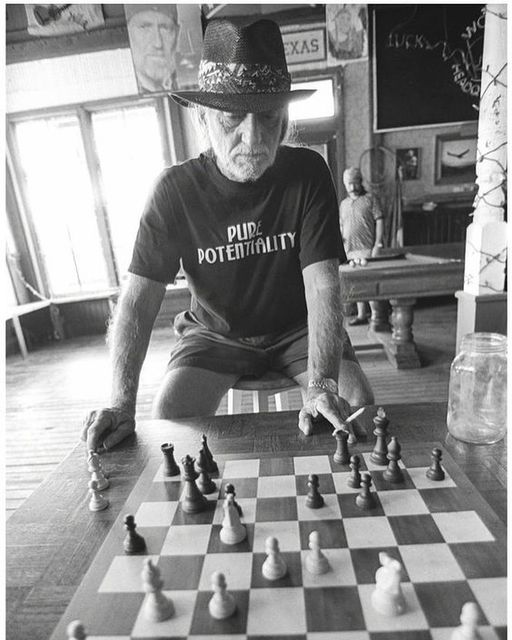
Awesome Scott Newton photo of the awesome man himself. I was sitting across the board from Willie. Lost $100 on that game, haha. Scott has been the official photographer for Austin City Limits TV for 50 years. Check out his work – it’s always great.
Charles Davis Mitchell (1887 – 1940) penciled and penned this in 1905, showing John Milton Hay, President Theodore Roosevelt, and Speaker of the House of Representatives Joseph G. Cannon. It looks like Hay and Cannon are playing against each other, with Roosevelt just enjoying the game. National Portrait Gallery/Smithsonian image.
It may be quaint today. I have found no description of issues portrayed in the drawing. But it’s a curious collision of now mostly-overlooked history.
NPG lists the drawing by Charles Davis Mitchell as circa 1905. We might presume it to be before July 1, 1905, since that’s the day John Hay died. If 1905, it’s after Roosevelt’s election in November 1904 — whether before or after his March inauguration, we don’t know.
Joe Cannon is a legendary Speaker of the House, after whom the first House Office Building is named (there are three: Cannon, Longworth and Rayburn). Early in Roosevelt’s first term Cannon complained that Hay had not consulted enough with Congress on foreign policy initiatives, but by 1905 that rankle had largely died down, as I read it.
John Hay may be the most interesting figure in the drawing. Hay was personal secretary to President Abraham Lincoln. He had been active in statecraft and politics after Lincoln’s death, serving in diplomatic posts and supporting James Garfield’s campaign, for example — but Garfield did not offer him a cabinet position, and Hay returned to private life and writing the definitive biography of Lincoln with Lincoln’s other secretary and Hay’s colleague, John George Nicolay. After Garfield’s assassination, Hay was much in the political wilderness for a few years. Hay and Nicolay published ten volumes of the history of Abraham Lincoln in 1890.
Hay returned to government as U.S. Ambassador to Britain, and then as Secretary of State in 1898, in the first administration of William McKinley. McKinley was victim of the third assassination of a U.S. president — Hay and Lincoln’s son Robert share an uncomfortable closeness to the three assassinations. When Theodore Roosevelt succeeded to the presidency in 1901 he kept Hay at State. Hay remained there until his death.
What does the illustration attempt to illuminate? Was this meant as a barbed cartoon, or did it illustrate an article on politics of the time? Details from the National Portrait Gallery do not say.
Delicious mystery. Was this image ever published? Does it have greater historical significance on events of 1905? Was either Hay or Cannon a chess player? Mystery.
Spread the word; friends don't allow friends to repeat history.
Chess games of the rich and famous. Max Ernst, Nasher Sculpture Center, Dallas.
“The King Playing With the Queen,” Max Ernst, 1944 (cast 1954). Collection of Raymond and Patsy Nasher, Nasher Sculpture Museum, Dallas.
Pattern on the wall is created by the unique louvers in the ceiling, designed to let in natural light, but avoid direct sunlight which might damage the art.
The Nasher describes the work:
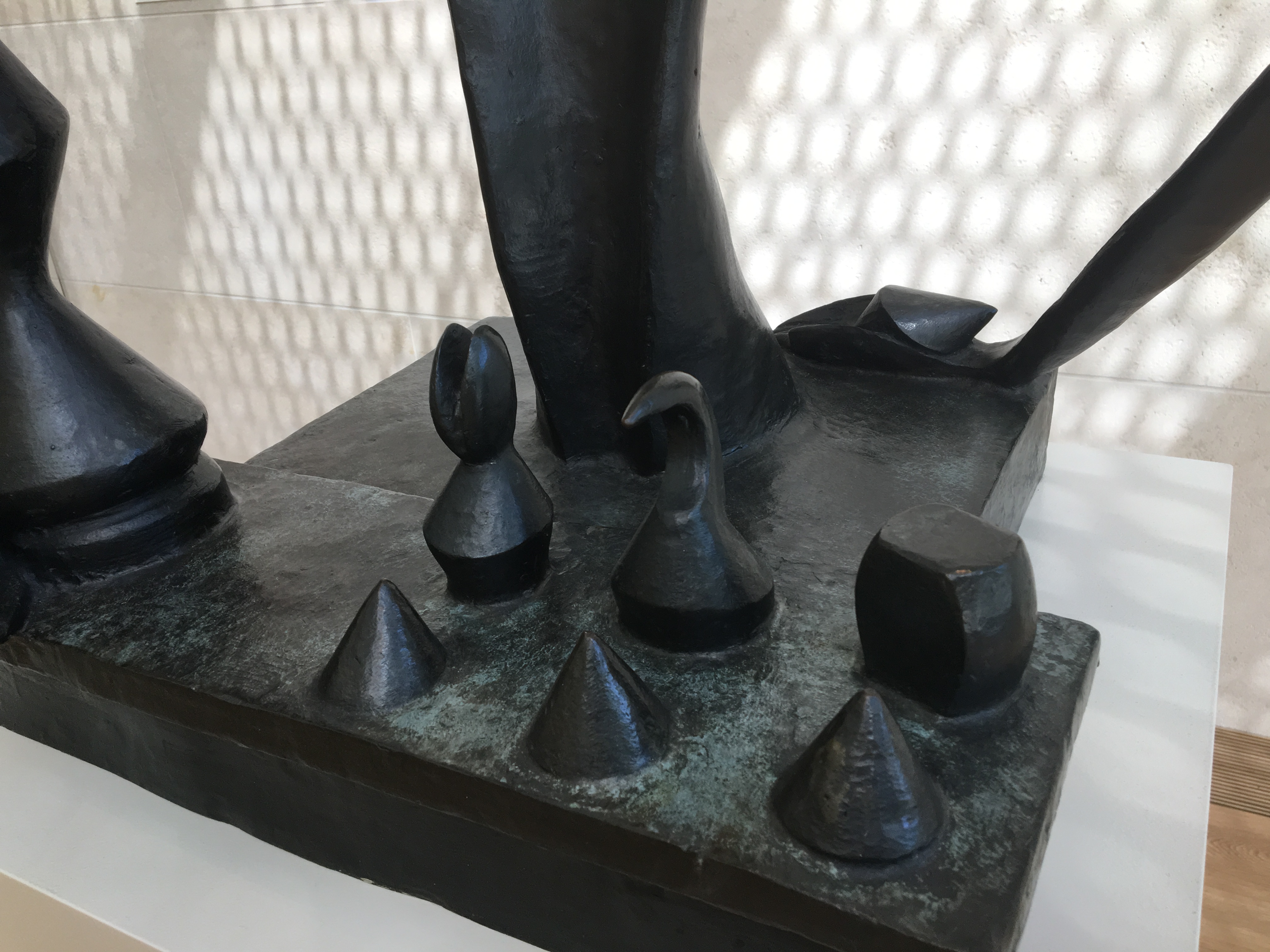
Like many of Ernst’s sculptures from this period, The King Playing with the Queen features an assemblage of diverse forms cast from containers and household objects. In a playful allution to the Surrealist love for the game of chess, a large, horned king rises out of a flat, tabletop arrangement of elements resembling a game board. He is at once the only player and one of the game pieces. This witty evocation of gamesmanship also intones darker themes of sexual manipulation and dominance. The king reaches out to grasp and move the much smaller queen, and at the same time, deceptively conceals another piece behind his back.
Close up of the Ernst work, showing other pieces on the board, and one piece the king conceals behind his back.
Spread the word; friends don't allow friends to repeat history.
Cartoon by the great Leslie Illington, probably in Punch Magazine, 1941. “In 1940 and 1941 Germany and Italy started swallowing up the Balkan countries. Russia frowns.” Image from Pictures from War and History
Spread the word; friends don't allow friends to repeat history.
Chess games used to play a big role in Hollywood movies — behind the scenes, usually. Cast members and crew on films often kept games going in the long down-times required in movie making, while lights were set up, sound issues were worked out, weather conditions changed, or other actors filmed scenes without those at the chess board.
John Wayne may be the most-photographed movie star at chess boards. He loved to play, and he played with anyone good on the sets of many of his films.
Here is a still photo of Wayne and two other actors, on location in France while filming the 1962 film, “The Longest Day.”
John Wayne and two other actors (who are they? Jeffrey Hunter in the middle? Stuart Whitman on the right?) on location for “The Longest Day,” playing chess between scenes. Image from MyFrenchFilmFestival.com
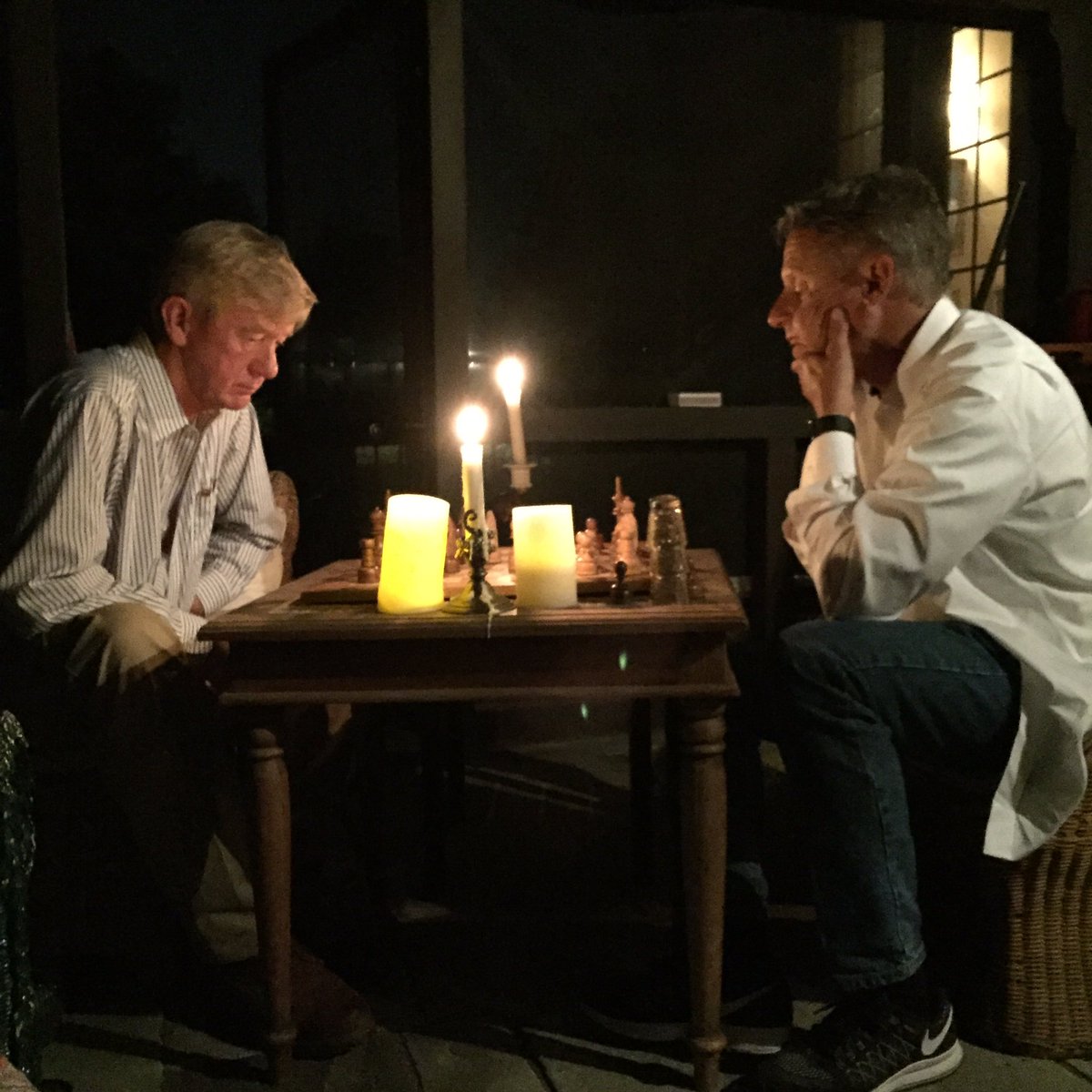
Twitter caption: “What does #TeamGov do after two rallies, a couple dozen interviews, and 4 or 5 hours on the road? #Chess.” Johnson in sneakers on the right. Who’s he playing against?
Nice qualifier for a presidential candidate. It is reputed that some of our better presidents were players of chess, but it’s difficult to find photographic evidence of it, or sketch or drawing evidence for those before 1840.
Save
Spread the word; friends don't allow friends to repeat history.
Cornell Capa (April 10, 1918 – May 23, 2008) was a Hungarian American photographer, member of Magnum Photos, and photo curator, and the younger brother of photo-journalist and war photographer Robert Capa. Graduating from Imre Madách Gymnasium in Budapest, he initially intended to study medicine, but instead joined his brother in Paris to pursue photography. Cornell was an ambitious photo enthusiast who founded the world-known International Center of Photography in New York in 1974[2] with help from Micha Bar-Am after a stint of working for both Life magazine and Magnum Photos.
I wonder who were the two men playing the game? What happened to them?
Another fictional match, perhaps with some wry commentary on the differences between the Orient and the Occident: Sculpture showing Confucius and Einstein engaged in playing chess.
Confucius ponders his next move in a Chinese board game, while Einstein ponders his move in chess, on the same board. Sculpture at the campus of UTAR, a university in Kampar, Malaysia. Image via Harp of Ten Strings.
Interesting sculpture, purely from the imagination of the artist. Confucius and Einstein are separated by 2000 years. Surely someone, somewhere can explain the meaning of the two different games on the same board.
Einstein is known to have played chess, but I have been unable to find any photographs of him engaged in the sport.
Another view of the Malaysian sculpture of Confucius and Einstein playing chess. From Panoramio, photo by wkh0522
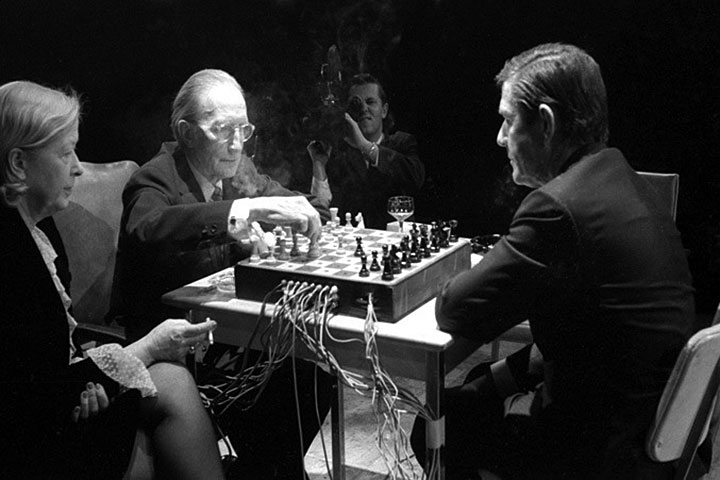
Marcel Duchamp plays white, John Cage plays black, on a chessboard modified to generate tones depending on where the chess pieces are. Toronto, 1968. Teeny Duchamp at far left, cameraman in the background. This was a performance.
Composer John Cage sought him out in Duchamp’s last years, and made a point of meeting with the artist at least once a week. Cage experimented with a chessboard designed to generate music depending on the positions of the chess pieces on the board (hence, the wires). This photo came from a performance at a festival in Toronto in 1968.
“The Chess Players” by Thomas Eakins (1844-1916), 1876; in the Metropolitan Museum of Art. Wikipedia image
One must appreciate Eakins’s great skills, even if one does not love his work — but I love it.
In this 1876 painting, he portrays a game of chess. Was it a real game? “The players are Bertrand Gardel on the left, and George Holmes on the right. The artist’s father, Benjamin Eakins, stands and watches the match.” Some critics claim the painting carries allegory to several levels: “Art historian Akela Reason proposes that the painting is a tribute to a number of the artist’s father-figures: Holmes probably was Eakins’s first art teacher; Gardel was his French teacher; Benjamin Eakins was his literal father; and Jean-Léon Gérôme, his master at the École des Beaux-Arts, is represented by a print of Ave Caesar Morituri te Salutant, over the clock.”
Not a chess game that really happened, but a virtual chess game with the highest stakes ever:
Caption from George Mason collection: In this game Stalin‘s main opponent would be Harry Truman, the board Germany, and the opening gambit would occur in Berlin. Image by Leslie Illington. Source: National Library I of Wales.
Stalin’s pieces include “Eastern Bloc,” and “Berlin Blockade.” Trumans pieces include a knight, “Air Lift,” and a piece looking a lot like Gen. Dwight Eisenhower, “Atlantic Alliance.”
Windom may have been surprised at being called either rich or famous — but he should have been.
William Wiindom, in the orignal “Star Trek” television series
William Windom, an actor whose face and voice most Americans would recognize, died yesterday. I became a fan of his years ago when he starred in a short-lived, quirky and ground-breaking television series, “My World and Welcome to It.” The series was based on the work of humorist and cartoonist James Thurber. Windom played a cartoonist whose drawings occasionally came to life, complicating his troubles with job, women and family. The program ran for one season on NBC, 1969-70, with 26 episodes.
Too few guffaws for network television.
Buried in most notices of Mr. Windom’s death was the information that he was a pretty good chess player.
A few of his games got captured on film.
William Windom, left, playing chess against John Wayne – image from Batgirl at Chess.com. Wayne, known to friends and the chess world as Duke, played chess on almost all of his movie sets, and at least once in a movie role.
Windom’s game against Wayne is undated.
Windom, right, playing Erik Estrada. Image from AnatolyKarpoveChessSchool.com, undated (Is this photo by photographer Irwin Fisk?)
Windom, left, playing chess against Claude Akins. Image from AnatolyKarpovChessSchool.org
Windom playing Adam Baldwin, Los Angeles, 1988 – Anatoly Karpov Chess School image
“My World and Welcome To It,” Christmas show part 1 (hey, this stuff is worth it for the advertising history), part 2 and part 3 (in which Windom’s character gets a visit from a local veterans’ organization concerned that he is flying his flag inappropriately — that is, too much; how times change!)
In this promo for “My World and Welcome To It,” one may get the idea NBC didn’t know what to do with the show, how to market it.
Spread the word; friends don't allow friends to repeat history.
Photo at Chess.com. Caption: This photograph shows an earnest game of chess between Colonel (afterward Major-General) Martin T. McMahon, assistant adjutant-general of the Sixth Corps, Army of the Potomac, and a brother officer, in the spring of 1864 just preceding the Wilderness campaign. Colonel McMahon, who sits near the tent-pole, is evidently studying his move with care. The young officer clasping the tent-pole is one of the colonel’s military aides. Chess was also fashionable in the Confederate army, and it is recorded that General Lee frequently played chess with his aide, Colonel Charles Marshall, on a three-pronged pine stick surmounted by a pine slab upon which the squares had been roughly cut and theblack ones inked in. Napoleon Bonaparte is said to have been another earnest student of chess.
Or, until that account is unsuspended by the forces supporting Donald Trump: Follow @FillmoreWhite, the account of the Millard Fillmore White House Library
We've been soaking in the Bathtub for several months, long enough that some of the links we've used have gone to the Great Internet in the Sky.
If you find a dead link, please leave a comment to that post, and tell us what link has expired.
Thanks!
Retired teacher of law, economics, history, AP government, psychology and science. Former speechwriter, press guy and legislative aide in U.S. Senate. Former Department of Education. Former airline real estate, telecom towers, Big 6 (that old!) consultant. Lab and field research in air pollution control.
My blog, Millard Fillmore's Bathtub, is a continuing experiment to test how to use blogs to improve and speed up learning processes for students, perhaps by making some of the courses actually interesting. It is a blog for teachers, to see if we can use blogs. It is for people interested in social studies and social studies education, to see if we can learn to get it right. It's a blog for science fans, to promote good science and good science policy. It's a blog for people interested in good government and how to achieve it.
BS in Mass Communication, University of Utah
Graduate study in Rhetoric and Speech Communication, University of Arizona
JD from the National Law Center, George Washington University


 Posted by Ed Darrell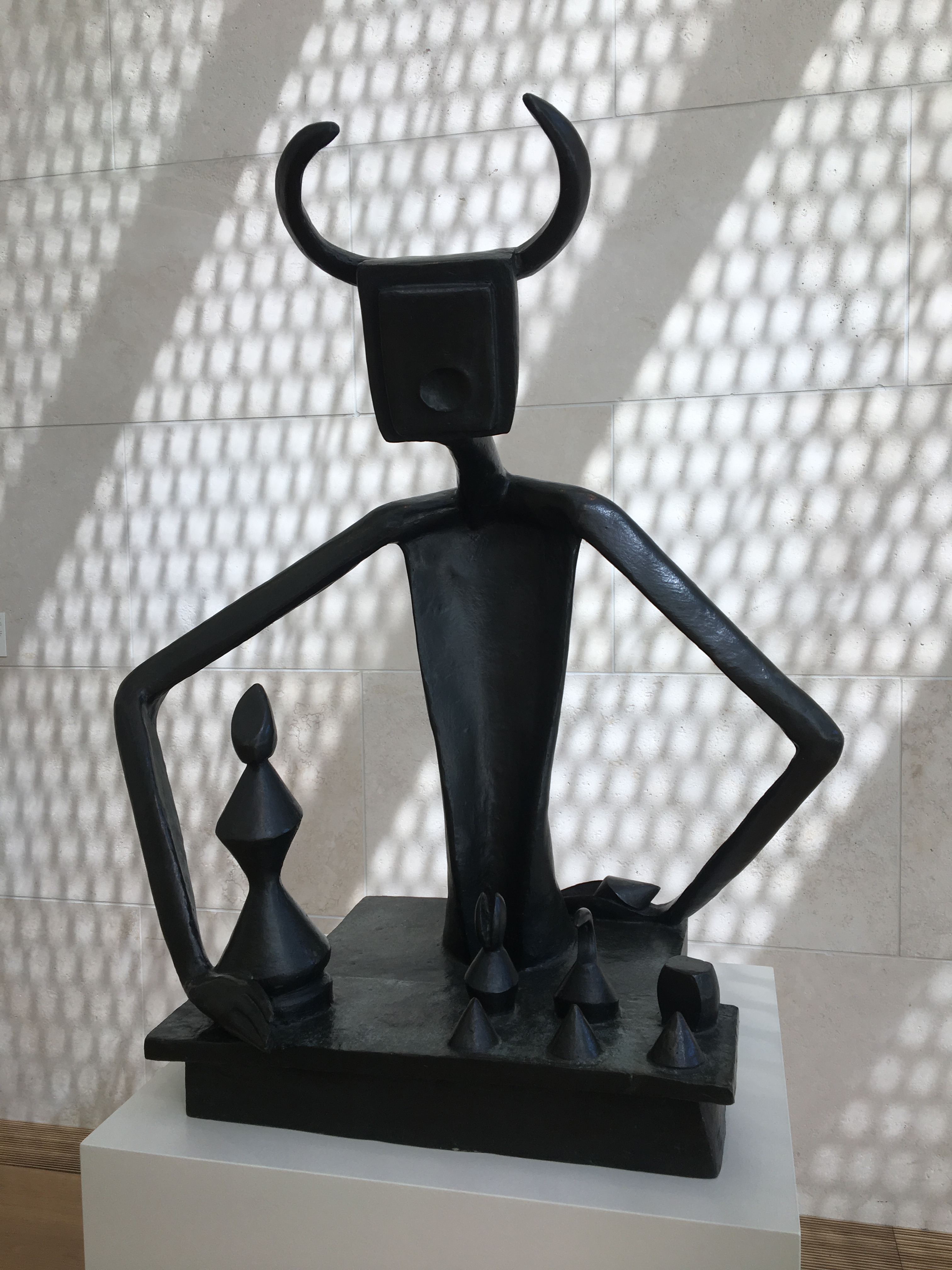









 Millard Fillmore's Bathtub