Poster for World Turtle Day (May 23, 2014)

May 23, 2014

World Turtle Day, Share the Roads!

Nice reminder, featuring an Eastern Box Tortoise (I think). Image from Conscious Companion.

A poster from last year.  Still accurate for World Turtle Day 2014.

Have a great World Turtle Day!  Go do something nice for your neighborhood turtles and tortoises.

Other views:

From there, it’s turtles all the way down!


More:


Insta-Millard: Department of Interior’s quick take on climate change report

May 9, 2014

Department of Interior’s video this week leads with climate change — and in fact, each segment deals with climate change in some way.

Published on May 9, 2014

This week: the White House releases the third annual National Climate Assessment, showing that climate change is already affecting Americans and the U.S. economy; USGS releases a Climate Change Viewer that can track water resource changes at the county, state, and watershed level; Secretary Jewell joins California leaders and first responders as the state braces for another tough wildfire season; the Secretary meets with community leaders and experts to talk about the balance between conservation and smart development; the Secretary announces the approval of a new solar energy project on tribal lands in Nevada, and attends the 69th Departmental Honor Awards Convocation in Washington, DC.


Happy 142nd birthday, Yellowstone National Park!

March 1, 2014

142 years ago today, @YellowstoneNPS became America's first national park. RT to wish them a very happy birthday! pic.twitter.com/drka6iq0Tc

Tweet from the Department of Interior: 142 years ago today, @YellowstoneNPS became America’s first national park. RT to wish them a very happy birthday! pic.twitter.com/drka6iq0Tc

Ken Burns called the National Parks probably the best idea America has had.

Certainly a great idea — really born on this day, 142 years ago, with the designation of Yellowstone National Park.

Yellowstone NP contains the world’s largest collection of geysers. It is the heart of the largest, nearly-intact temperate zone ecosystem on Earth as well, contained in 3,468 square miles (8,983 km²), a laboratory and playground for geologists, geographers, botanists, zoologists, and almost anyone else who loves the nature and the wild.

Only 142 years old?  In the U.S., we have more than 300 units in the National Park System, now, including National Historic Places as well as the best of the wild.  Around the world, how much land has been saved, for the benefit of humanity, by this idea?  Not enough.

What’s your favorite memory of Yellowstone? What’s your favorite feature?

More:

Great Fountain Geyser in Yellowstone, the first U.S. national park, erupts every 9 to 15 hours, shooting water up to 220 feet high.  Photograph by Michael Melford

From National Geographic: Great Fountain Geyser in Yellowstone, the first U.S. national park, erupts every 9 to 15 hours, shooting water up to 220 feet high. Photograph by Michael Melford


New Boy Scout merit badge: Sustainability

July 25, 2013

It’s Eagle required, too — well, Scouts can choose either Environmental Science or Sustainability, but must earn one or the other to earn Eagle rank.

Image of the Sustainability merit badge, from MeritBadge.org

Image of the Sustainability merit badge, from MeritBadge.org

Requirements for the new Sustainability merit badge were released on July 16, concurrent with the 2013 National Scout Jamboree at the Summit.  A lot of people missed the announcement, I’ll wager.

It’s good news.  Conservation and nature-related merit badges have suffered a decline in Scouting, it seems to me.  The conservation series was very much the keystone of a trek to Eagle when I was a Scout, at least as important as the citizenship series.  But I don’t see that emphasis in Scouting today, sadly.

BSA recently created a Mining merit badge, which created some quiet grumbles among conservationists — this new, Eagle-path badge more than makes up for that, I think (though mining is a great topic for Scouts, especially in the western U.S., I think).  This will not set well with the anti-conservation, anti-Agenda 21 crowd and their merry hoaxsters.  But nothing BSA does is removed from political criticism from the right any more (see this odd photo choice for the Sustainability badge notice at the radical right-wing Daily Caller site).

This announcement gives me hope.

More:

Below the fold, the requirements and announcement from Bryan on Scouting, at Scouting Magazine’s site, verbatim and in total.

Read the rest of this entry »


U.S. actions to support Agenda 21: Soil conservation, farm and rural development; no population control, no black helicopters

October 24, 2012

Not sure what Agenda 21 is?  It’s the larger program of the United Nations to pick up where the U.S. Soil Conservation Service left off (SCS is now the U.S. Natural Resources Conservation Service, NRCS).  Erosion control.  Don’t deplete the soils.  Keep water sources clean and flowing.  Use wise plowing practices to prevent another Dust Bowl.  Get Girl Scouts and Boy Scouts and Future Farmers of America and 4-H Clubs to build check dams and plant beneficial trees.

See a quick explanation of Agenda 21 here (courtesy of Grist, here).

Keenan Wynn and a Coke machine, Dr. Strangelove (publicity still?)

Keenan Wynn as Col. Bat Guano, pauses before shooting open a Coke machine to get change to place a call to the President of the United States to save the world, in Stanley Kubrick’s “Dr. Strangelove, Or How I Learned to Stop Worrying and Love the Bomb,” (publicity still?).  Agenda 21 is not like “Dr. Strangelove,” except perhaps in the minds of those poisoned by dramatic over-consumption of Coca-Cola or Monster Cola.

You can’t find that stuff easily on Google, nor Bing, usually.  Instead you’ll find people worrying about black helicopters, the massive, unseen and never-detected UN Army poised to take over U.S. golf courses, and unhinged rants about forced population control, rants worthy of Col. Bat Guano but lacking Kubrick’s and Southern’s and George’s wit or Keenan Wynn‘s sharp delivery.  (Yes, if you hear someone complaining about Agenda 21, you may and perhaps should say, “That’s Bat Guano!”)

Agenda 21 is the umbrella agency under which nations who are members of the UN undertake studies of Earth’s resources, human effects upon those resources, and which makes recommendations about how to save our planet’s resources from depletion.  KyotoRio CopenhagenIPCC.

Agenda 21 is about as milk toast a policy initiative as it is possible to get.  Why all the angst among so-called neo-conservatives and so-called libertarians?  Beats me.  I can only imagine that they have never read any of the documents, know nothing of the issues discussed, and have slept through much of the past 50 years on farm and food production issues.

Should we fear, as Paul Sadler‘s GOP opponent for the Texas U.S. Senate seat does, that Agenda 21 will require Texas to turn over all its golf courses to the UN?  No, we should instead pay attention to what the government has actually done in support of Agenda 21 initiatives — all of which are voluntary under the Agenda 21 program and the UN Charter.  Also, perhaps, we should make sure to vote against anyone who tries to instill fear by misstating what Agenda 21 is, or does, or “requires” (Yeah, you, Ted Cruz — what sort of crazy are you on? and this is why we’re voting for Paul Sadler instead; we need rational people who love Texas more than crazies who speak smack about golf courses and people who golf).

Here’s the White House list of activities to support Agenda 21 in the last four years; can you find the black helicopters and UN takeover of U.S. territory?  No, neither can anyone else:

Policy Initiatives

President Obama’s administration understands that a strong American economy is contingent upon a strong rural economy. Since the creation of the White House Rural Council, the President has made historic investments in rural America designed to drive job growth.  The actions will help ensure the development of a rural economy built to last.  These actions include:

Doubling Small Business Administration (SBA) Investment Funds for Rural Small Businesses
Announced August 2011

The Administration established a rural “carve-out” in the Small Business Investment Company (SBIC) Impact Investment Program that will invest in distressed areas and emerging sectors such as clean energy.  SBA will provide up to a 2:1 match to private capital raised by the fund.  SBA and the U.S. Department of Agriculture (USDA) are committed to partnering to drive $350 million of investment capital through the fund and existing SBICs into rural small businesses over five years, doubling the current rate of investment.

Providing Job Search Information through USDA Field Offices
Announced August 2011

The USDA and Department of Labor (DOL) partnered to offer job training information and better utilize the rural footprint of the USDA field offices across the country to provide them with greater access to job search resources by reducing the driving times and distances for rural customers seeking program information.

Expansion of the National Health Service Corps to Critical Access Hospitals
Announced August 2011

The Department of Health and Human Services (HHS) expanded eligibility for the National Health Service Corps loan repayment program so that Critical Access Hospitals, those with 25 beds or fewer, can recruit new physicians, using student loan repayment incentives.  This program will help hospitals across the country recruit needed staff.  Once a hospital has qualified as a service site, it can then apply for student loan repayment on behalf of its primary care physicians, nurse practitioners, and physician assistants.

Expanding Health Information Technology in Rural Communities
Announced August 2011

USDA and HHS signed an agreement to improve access to capital for rural hospitals and other providers seeking to implement health information technology and expand the health IT workforce in rural communities.

Commercial Aviation Biofuels Partnership
Announced August 2011

The Navy, the Department of Energy, and USDA have joined forces to spur the creation of an advanced biofuels industry that will support commercial aviation, with a pledge of $510 million, over three years, under the Defense Production Act of 1950.

Promoting a Bioeconomy through BioPreferred
Announced February 2012

To support the Administration’s “Blueprint for a Bioeconomy,” the President is utilizing the purchasing power of the Federal government by directing Federal agencies to take additional steps to significantly increase the purchase of biobased products over the next two years, which will create thousands of new rural jobs and drive innovation where biobased products are grown and manufactured. Utilizing the existing BioPreferred program, the Federal government will use its procurement power to increase the purchasing and use of biobased products, promoting rural economic development, creating new jobs, and providing new markets for farm commodities. Biobased products include items like paints, soaps and detergents and are developed from farm grown plants, rather than chemicals or petroleum bases. The biobased products sector marries the two most important economic engines for rural America: agriculture and manufacturing.

Rural Jobs Accelerator
Announced February 2012

The “Rural Jobs Accelerator” will link Federal programs to facilitate job creation and economic development in rural communities by utilizing regional development strategies. The “Rural Jobs Accelerator” will allow multiple agencies to coordinate technical assistance and grant/loan programs so that a consortium of public and private rural entities can have a single access point within the Federal government, allowing for improved access, streamlining of programs, and better leveraging of resources.  USDA and EDA will leverage approximately $14 million in funding, with technical support from Delta Regional Authority, Appalachian Regional Commission, Department of Housing and Urban Development, and the Department of Education.

Development of Rural Health IT Workforce
Announced February 2012

HHS and the DOL signed a memorandum of understanding to link community colleges and technical colleges that support rural communities with available materials and resources to support the training of HIT professionals.  Rural health care providers face challenges in harnessing the benefits of health information technology (HIT) due to limited capital and a workforce that is not trained to work within the expanding field of HIT. Due to lower financial operating margins and limited capital, funds for hiring new staff or training existing staff in HIT implementation and maintenance are often simply not available to rural health care providers.  The Bureau of Labor Statistics estimates that the needed HIT workforce will increase by 20 percent by the year 2016.  A significant part of that growth will come in rural areas, which are served by approximately 2,000 rural hospitals, 3,700 Rural Health Clinics as well as the more than 3,000 Community and Migrant Health Centers that are either located in or serve rural communities.

Timber and National Forest Restoration
Announced  February 2012

USDA’s Forest Service, in conjunction with the White House Rural Council, released a strategy to increase the scale of restoration treatments like forest thinning, reforestation, and other activities to restore and sustain the health of our forests.  In addition to environmental benefits, these activities create jobs in the forest industry which has been hurt significantly by the economic downturn.  The strategy relies on (1) using collaborative approaches to broaden public support for forest restoration; (2) expanding restoration tools like the Collaborative Forest Landscape Restoration Program and stewardship contracting; (3) better targeting budget resources; and (4) streamlining forest planning and analysis without sacrificing quality.

Mortgage Refinancing
Announced February 2012

The Administration announced an initiative to assist rural homeowners refinance their mortgages at lower interest rates through USDA’s Rural Development agency. By reallocating existing funding, at no additional cost to taxpayers, USDA will have almost doubled the amount of funds available to homeowners seeking to lower their mortgage payments or avoid foreclosure.  Under the new allocation, the amount of the $24 billion program dedicated to refinancing will increase from $520 million to $1.1 billion, allowing USDA to meet the growing demand for refinance transactions.

Task Force on Tourism and Competitiveness
Announced January 2012

On January 19, the President signed an Executive Order creating a Task Force charged with developing a National Travel and Tourism Strategy with recommendations for new policies and initiatives to promote domestic and international travel opportunities throughout the United States. The strategy will include recommendations to promote visits to the United States public lands, waters, shores, monuments, and other iconic American destinations, thereby expanding job creation in the United States, as well as tourism opportunities in rural communities. The Task Force is co-chaired by Secretary Salazar and Secretary Bryson, with participation from USDA, other agencies and WH offices.

Advancing Water Quality Conservation across the U.S.
Announced May 2012

The United States Department of Agriculture (USDA) announced the launch of a new National Water Quality Initiative committed to improving one to seven impaired watersheds in every U.S. state and territory. The Initiative is part of the Obama Administration’s White House Rural Council which is working in partnership with farmers, ranchers and forest owners to improve conservation of working lands in rural America. The 157 selected watersheds were identified with assistance from state agencies, key partners, and USDA’s Natural Resources Conservation Service (NRCS) State Technical Committees. NRCS will make available at least $33 million in financial assistance to farmers, ranchers and forest landowners this year to implement conservation practices to help provide cleaner water for their neighbors and communities.

Small Business Administration Investing in Rural Small Businesses
Announced June 2012

The Administration extended more than $400 million in FY 2011 of investments in rural America through the Small Business Investment Company (SBIC) Impact Investment Program, at no cost to taxpayers. Nearly $2 billion in additional funding will be invested by the end of fiscal year 2016. These investments will continue to help finance, grow, expand, and modernize rural small business operations around the country.

MOU to Improve Support in the Colonias
Announced June 2012

The U.S. Department of Agriculture-Rural Development (USDA-RD), Housing and Urban Development, and Department of Treasury’s Community Development Financial Institutions Fund (CDFI) partnered to create the Border Community Capital Initiative. This collaboration is designed to expand access to capital in the U.S/Mexico border region which includes some of the poorest communities in the country. The Memorandum of Understanding (MOU) will provide up to $200,000 to nonprofit and/or tribal financial institutions that serve colonias. This funding will go to increase access to basic necessities such as safe drinking water, adequate sewage systems, and safe, sanitary housing.

U.S Department of Education Investing in Rural Schools
Announced June 2012

Through the national broadband plan, the Obama Administration will leverage the power of technology to overcome distance and increase collaboration to accelerate student achievement in rural schools. The White House Rural Council partnered with the U.S Department of Education to deliver a new online community of practice groups for rural schools. This online tool will create virtual communities of practice for educators to connect to resources, tools, colleagues, experts, and learned activities both within and beyond schools. The Administration is using technology to break down geographic barriers and address rural isolation in education.

Accelerating Broadband Infrastructure Deployment
Announced June 2012

On June 14, 2012 President Obama signed an Executive Order to make broadband construction along Federal roadways and properties up to 90 percent cheaper and more efficient. U.S agencies that manage Federal properties and roads will partner to offer carriers a single approach to leasing Federal assets for broadband deployment. Providing a uniform approach for broadband carriers to build networks will speed the delivery of connectivity to communities, business, and schools in rural America. In order to further expand the nations broadband service, more than 25 cities and 60 national research universities are partnering to form “US Ignite.” US Ignite will create a new wave of services that will extend programmable broadband networks to 100 times the speed of today’s internet. This partnership will improve services to Americans and drive job creation, promote innovation, and create new markets for American business.

Supporting Appalachian Communities
Announced June 2012

Facilitated through the White House Rural Council, the Appalachian Regional Commission (ARC) developed a Livable Communities Initiative. This initiative is a partnership between ARC, the U.S Environmental Protection Agency (EPA), and the U.S Department of Agriculture Rural Development (USDA RD). The initiative provides technical assistance to small rural towns to help them develop and implement strategies for making the communities more livable and competitive. The partnership will focus on expanding transportation choices, supporting thriving and distinctive rural communities by investing in rural town centers, and extending affordable housing opportunities.

There is nothing seriously objectionable in that list of activities.  If you’re an astute, patriotic American, you’ll recognize a lot of actions that strengthen our nation.  Maybe opposition to Agenda 21 is a virus spread by an insect vector — there is no rational explanation for it, certainly.

More:

Highlights from the video, as listed at the White House blog:

Drought Relief: President Obama also toured McIntosh Family Farms in Missouri Valley, Iowa to see drought damage first-hand and offer relief to those being effected. The President announced that the Department of Agriculture will begin to buy up to $170 million worth of pork, chicken, lamb, and catfish. And the President is directing the Department of Defense — which purchased more than 150,000 million pounds of beef and pork in the last year alone — to encourage its vendors to accelerate meat purchases for the military and freeze it for future use.

“Understand this won’t solve the problem. We can’t make it rain,” the President said. “But this will help families like the McIntoshes in states across the country, including here in Iowa. And we’re going to keep doing what we can to help because that’s what we do. We are Americans. We take care of each other.”

To learn more, the Department of Agriculture is collecting resources for farmers, ranchers, and small businesses wrestling with this crisis at USDA.gov/drought. More information still is available at WhiteHouse.gov/drought.

Banner Year for the U.S. Wind Industry: Also this week, the Energy Department and Lawrence Berkeley National Laboratory released a new report highlighting strong growth in America’s wind energy market in 2011 and underscoring the importance of continued policy support and clean energy tax credits to ensure that the U.S. remains a leading producer and manufacturer in this booming global industry.As President Obama has made clear, we need an all-of-the-above approach to American energy and the U.S. wind industry is a critical part of this strategy. In fact, wind energy contributed 32 percent of all new U.S. electric capacity additions last year, representing $14 billion in new investment.

Wall of Shame on Agenda 21; sites that promote the crazies:


What about National Parks as an issue in the 2012 elections?

October 16, 2012

National Parks really are a tiny part of the federal budget.  Consequently, they get overlooked, and that could be bad.

How are your Congress and Senate candidates standing on these issues?

Romney’s “energy plan” calls for opening up the National Parks for oil and gas exploration and drilling, even the Flight 93 Memorial in Pennsylvania  Bet that’s not mentioned by anyone in the debate tonight.

Which one is your favorite unit of the National Park System?  What’s your favorite family story from visiting the parks?  How are you going to vote in November?

Graphic from the National Parks Conservation Association:

Parks in Jeopardy, 2012, NPCA

From the National Parks Conservation Association

More:


Endangered western forests: The Yellowstone

October 10, 2012

Additional CO2 and warmer weather will help plants, the climate change denialists say.  That’s not what we see, however.  Turns out CO2 helps weeds, and warmer weather helps destructive species, more than it helps the stuff we need and want in the wild.

For example, the white-bark pine, Pinus albicaulis:


161

From American Forests:

With increasingly warm winters at high elevations in the West, a predator that has stalked forests for decades has gained the upper hand. It is mountain pine blister rust, an invasive fungus. Combined with mountain pine beetles, which kill hundreds of thousands of trees per year in the Greater Yellowstone Area (GYA), the environmental health of the Rocky Mountains and neighboring regions is in danger. To make matters worse, the species most susceptible to these two threats, the whitebark pine, is also the most vital to ecosystem stability, essential to the survival of more than 190 plant and animal species in Yellowstone alone.

First debuted at SXSW Eco, this video tells the story of our endangered western forests and how American Forests and the Greater Yellowstone Coordinating Committee are working toward their restoration and protection for future generations.

Learn more: http://www.americanforests.org/what-we-do/endangered-western-forests/

More:

Whitebark Pine

Whitebark Pine (Photo credit: Wikipedia)

Whitebark Pine. Français : Tige et cônes de Pi...

Whitebark Pine, cones and needle cluster (Photo credit: Wikipedia)

Whitebark Pine Français : Un cône de Pin à éco...

Whitebark pine’s distinctive, almost-black cone. (Photo: Wikipedia)


Agenda 21: In graphic novel form, so it must be the truth

August 23, 2012

What is Agenda 21?  It’s a program at the United Nations to work on economic development, sustainable development, environmental protection, resource conservation and economic policies.  As with almost all UN programs, Agenda 21 pronouncements are wholly voluntary.

Several international programs create studies and make recommendations to nations — but unless they come from the World Bank or International Monetary Fund along with loans to help nations develop, such recommendations remain mostly academic:  Nations follow them only to the extent that a nation’s policy-making groups (like Congress in the U.S.) are persuaded that the recommended policies benefit the nation.

For reasons unclear to me the wacky wing of the crazy right seized upon Agenda 21 as the symbol of most things evil in the world, especially since we don’t have the Soviet Union to blame stuff on any more.

Grist featured a graphic-novel-style explanation of Agenda 21, so you can follow the issues as they arise at the 2012 Republican Convention:  Agenda 21: Everything you need to know about the secret U.N. plot, in one comic.  Here is the entire post:

Agenda 21: It’s the biggest threat to your freedom, and unless you regularly attend yahoo-filled local planning and zoning meetings, you’ve probably never even heard of it. Until recently, this vast United Nations conspiracy to force us all to live “sustainably” was known only to stalwart defenders of Liberty and Freedom like the John Birch Society. But the underground resistance is about to go mainstream. GOP intellectual it boy Ted Cruz leads the counterstrike, and the Republican Party is even considering a public flambéing of Agenda 21in its official 2012 platform.

Looking to help break the siege of bike paths and high-quality education on our freedoms? Here’s what you’ll need to know.

First panel, Agenda 21 graphic documentary from Grist

Panel 1

Concocted by the U.N. during the 1992 Earth Summit and signed by the 1st President Bush ... in the dark of the night!

Panel 2

A comprehensive plan of extreme environmentalism, social engineering and global political control, Agenda 21 is being covertly pushed into local communities!

Panel 3

If implemented, Agenda 21 would wreak unspeakable havoc on the American way of life!

Panel 4

Imagine what our lives would be like under this Reign Of Terror!

Panel 5

Happily, there is a bright spot in this dark cloud! Shortly after the Earth Summit, the United States forgot Agenda 21 even existed!

Panel 6

This paranoid fantasy has been brought to you by: The Republican National Committee, The Water Fluoridators, The Gub'ment Mind Jockeys, and the evil elves that live in your walls!!!

Panel 7

Tip of the old scrub brush to Grist, and Charles Nesci and especially Greg Hanscom, the cartoonist.  Hanscom is a “senior editor at Grist. He tweets about cities, bikes, transportation, policy, and sustainability at @ghanscom.”

More (not a lot from sane sources on this topic):

More, a sampling from sources without hinges (a small selection):


LCV’s “Flat Earth Five,” targets for election defeat – two named, who are the last three?

July 26, 2012


Naming one of their top five targets per week, the League of Conservation Voters (LCV) will name three more Members of Congress to their “Flat Earth Five,” members who not only vote against LCV positions, but also seem to dwell among flat-Earth believers on science, generally.

First two of the Flat Earth Five:

  1. Rep. Ann Marie Buerkle (N.Y.)
  2. Rep. Dan Benishek (Mich.)

Who will fill the three remaining slots — and will they survive election?


Right or wrong reasons, North Texas governments back into water conservation

April 4, 2012

It’s a win-win situation for North Texas politicians, like Dallas Mayor Mike Rawlings — they can take action that helps mitigate problems of global warming, but they don’t have to say they’re doing it for global warming.

Downtown Dallas in the background with the Tri...

Water supplies will limit future growth for cities like Dallas, if good water policies cannot be made to assure water to critical functions - Downtown Dallas in the background with the Trinity River in the foreground. Taken from the N Hampton Rd bridge. (Photo credit: Wikipedia)

Mayors of several cities announced they will push to keep watering restrictions on, to conserve water, even though their cities’ water supplies got big boosts from massive rainstorms over the past few weeks.

Bruce Tomaso, editor of The Scoop, a blog at The Dallas Morning News, wrote down all the details (comments at that site are worth visiting).

Thanks to last year’s brutal drought, most North Texans have gotten accustomed to watering lawns sparingly.

As lake levels dropped through the dry, hot summer and fall of 2011, emergency conservation measures were enacted throughout the region.

In some cities — Plano, for example — watering was restricted to twice a month. (That restriction was just eased to once a week.)

In others, including Dallas, a less stringent limit of twice a week has been in force.

On Wednesday, Dallas Mayor Mike Rawlings , joined by the mayors of Fort Worth, Arlington , and Irving , will recommend that a twice-a-week limit on watering be made permanent. The mayors plan a 9:30 a.m. news conference at the offices of the North Texas Council of Governments, 616 Six Flags Drive.

“Although recent rains have improved current water supply availability, a twice weekly watering schedule provides predictable expectations to customers for landscape planning and a way for the region to continue to use water resources wisely,” says a joint statement from the four cities.

Bill Hanna of the Fort Worth Star-Telegram writes that says the idea of making the emergency conservation measures permanent was raised a while ago by Fort Worth Mayor Betsy Price, who discussed “a coordinated regional approach” with Rawlings, Arlington Mayor Robert Cluck, and Irving Mayor Beth Van Duyne.

“I think water conservation is probably the most important issue we have in the next three decades,” he quotes Rawlings as saying. “We cannot continue to grow without water, and I want to continue to grow.”

In each of the four municipalities, the City Council would have to approve a measure to implement permanent limitations on lawn watering.

On a related note, the Texas agriculture commissioner unveiled a new water conservation coalition plan Monday in Mesquite.

It’s a good move, even if they do it for the wrong reasons.  Texas lives in a world of trouble with regard to water.  Too many people live in big cities with water supply systems planned and built a half-century ago, for fewer people.  Massive aquifers that offered backup to surface water supplies have been mined out.  In a short phrase, Texas doesn’t have enough water even in a good rain year, and needs to conserve and develop a state-wide policy on how to allocate water, and how to protect water supplies needed for farming, for industry, and for residential use. Global warming threatens each of those resources in disparate ways, all of them bad.

Conservation is a lot cheaper than building more dams and more pipelines, and more environmentally friendly.  Nice to see these guys endorse conservation.

Trinity River in flood and Dallas at night, 9-2010 IMGP5052 - photo by Ed Darrell, Creative Commons License

Texas should not rely on freak floods to mitigate long-term drought; growth of cities like Dallas require better water policy. Photo shows Dallas at night over the Trinity River flooding, September 2010. Photo by Ed Darrell, Creative Commons Copyright

Tip of the old scrub brush to Sara Ann Maxwell.


Dogwood Canyon amble for the blossoms

March 26, 2012

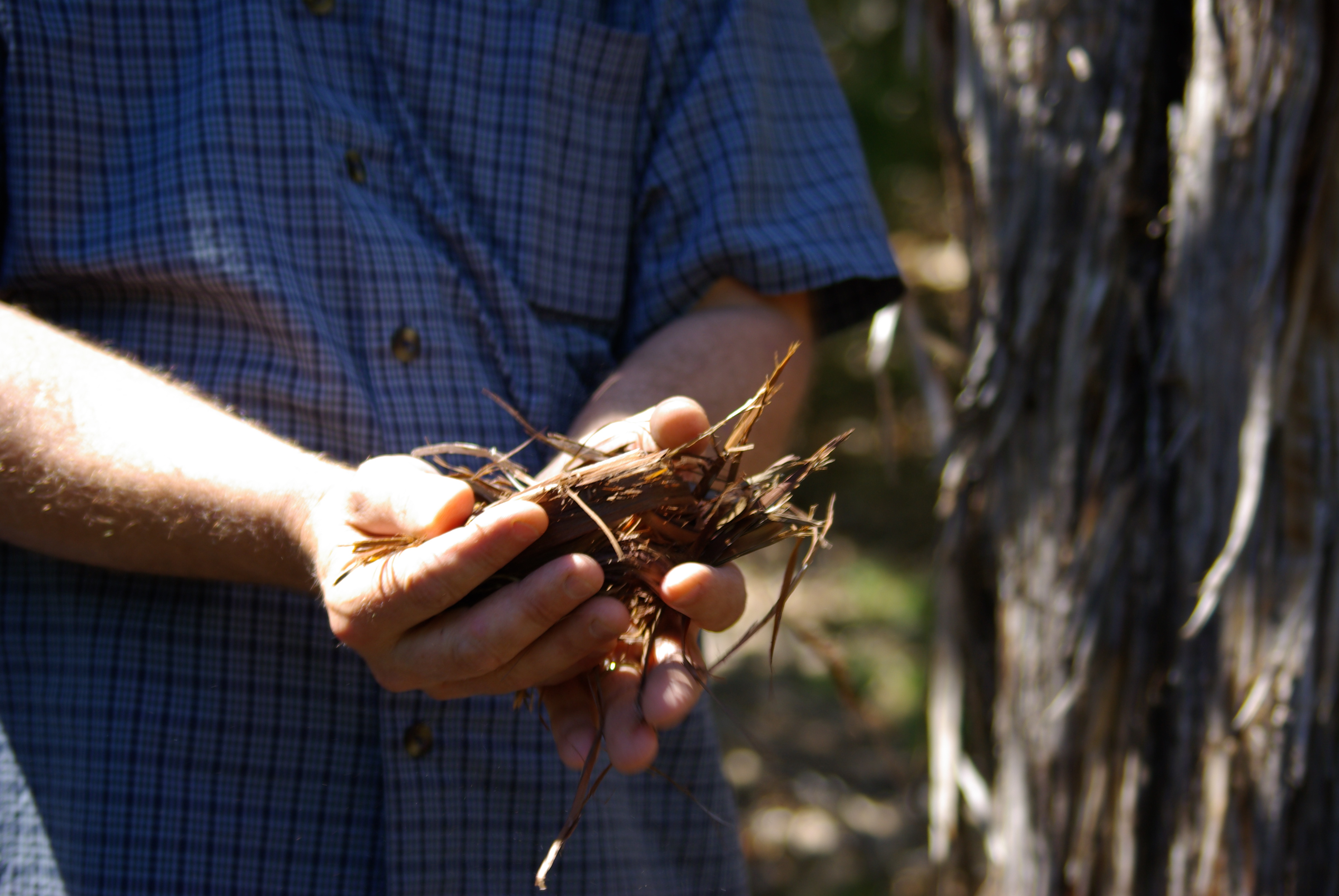
It was billed as a “hike” that might take 2.5 hours, but David Hurt, the grand benefactor of Dogwood Canyon Audubon Center, was the guide — at the two hour mark we had just ambled to the blossoming trees in their still-semi-secret location.  Amble, not a hike.

Great day to be outside.

The voyage is at least half the fun.

Dogwood Canyon's benefactor David Hurt - 03-25-2012 import 672

After more than a year of serious drought, some of North Texas experienced high rainfall in the past three months. Spring-fed streams and seeps on Cedar Hill and across the Escarpment flow well for the moment, lending hope to wild bird breeding.  On some entangled bank . . .

Poison ivy along the trail, Dogwood Canyon Audubon Center - 03-25-2012 import 697 - Photo by Ed Darrell, use permitted with attribution

Poison ivy along the trail. Keep away.

David Hurt demonstrates differences in oaks, 03-25-2012 import 694 - photo by Ed Darrell

Is it eastern red oak, or something else? How to tell?

Dogwood blossom at Dogwood Canyon, Cedar Hill, Texas 03-25-2012 import 737 - Photo by Ed Darrell, use permitted with attribution

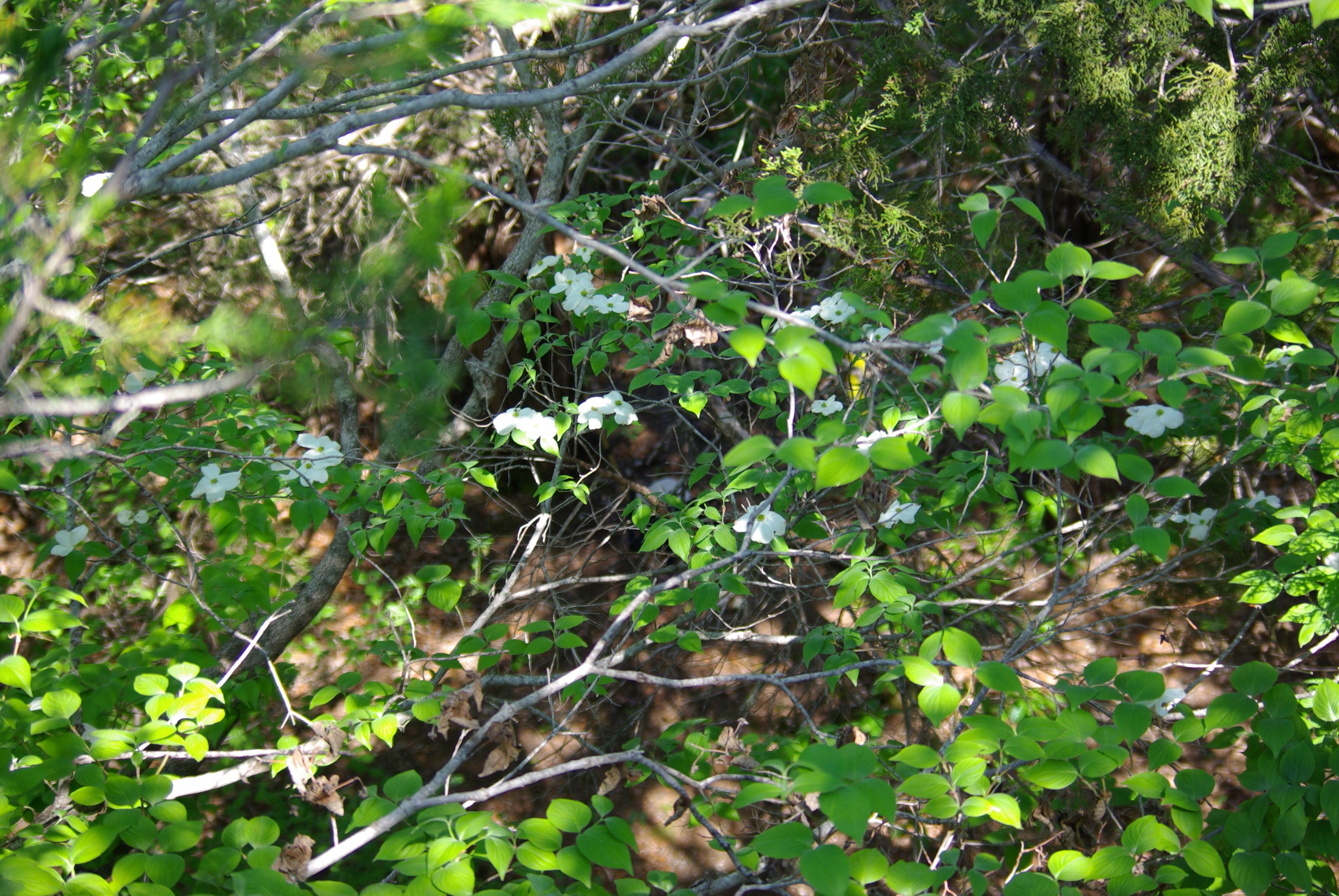
The dogwoods in bloom! An early spring, and lots of water, pushed the trees to leaf out before blossoming started — usually the blossoms come first. The drought last year probably hurts blossoming this year. Blossoms are not yet at their peak.

Dogwood blossoms, Dogwood Canyon Audubon Center 03-25-2012 import 744 - phot by Ed Darrell

Exquisite aroma and beauty from the dogwood blossoms – not the carpet of white we saw in a previous year. Still just the shock of finding these little beauties in Dallas County adds to their splendor. Dogwoods do well in East Texas, where it is wetter and the soil is acid. Here on the escarpment it is generally dry, hotter, and the soil is thin and alkaline. That the blossoms show up at all is a stunning oddity, a stroke of fortune emblematic of the unique place that is Dogwood Canyon.

Guided hikes — the only way to get to see the blossoms — are planned for Wednesday and Saturday this week.  Hikes are limited to 20 people, with two planned for Wednesday, and one for Saturday, March 31.  For reservations call Dogwood Canyon Audubon Center at (469) 526-1980.

Previously in Millard Fillmore’s Bathtub:


Get your Texas Drought Survival Package from Texas Parks & Wildlife

February 20, 2012

We’ve had serious rain in Dallas, but most of the state still resides well in the thrall of drought.  Plus, the rains in Dallas have been unseasonal, which suggests the drought is not done with Dallas yet, either.

Texas Parks & Wildlife has words of advice:

More information from TPWD:

The drought has taken a toll on everything from wildlife to water bills. To help Texans cope, Texas Parks and Wildlife is offering a Drought Survival Kit http://www.texasthestateofwater.org/


Stimulus spending: Texans remember how the CCC helped save the nation

January 20, 2012

New video history piece from the Texas Parks & Wildlife people:

63

Uploaded by on Jan 17, 2012

The Civilian Conservation Corps provided jobs for over 3 million young men during the Great Depression and helped establish the foundation of our nation’s park system. 70 years after the creation of the CCC, Conservation Corps veterans reunite in one of the parks they helped build, sharing stories and rekindling old memories.

A pictorial map showing Texas State Parks with significant work performed by the CCC:

Map of Civilian Conservation Corps Legacy Parks in Texas - TPWD image

Map of Civilian Conservation Corps Legacy Parks in Texas - TPWD image - Click on map for original, larger version


Say what? India only now figures out DDT kills birds?

January 17, 2012

Here’s a troubling thought:  What if India’s use of DDT now is just as destructive as the use of DDT in the U.S. in the 1950s and 1960s?

Why even mention it?  We’ve been reminded here that in the 21st century India is the world’s leading producer of DDT, and that the nation uses more DDT than the rest of the world combined.

Mon Town Baptist Church in the mist, Nagaland, India - Wikipedia image

Mon Town Baptist Church in the mist, Nagaland, India. The people of the state of Nagaland are mostly Christian, and local Baptist groups were among the most politically active groups who worked to put an end to fighting in the area in the early 1960s – Wikipedia image

From my perch in Dallas, Texas, it’s difficult to get a perspective on just how much DDT is used in the nation, and how much of the use is abusive, out of doors, or leading to environmental contamination.

One of the news feeds picked up on this opinion piece from Maneka Gandhi, blogging at the Nagaland PostNagaland is India’s most northeastern province.

Blyth’s Tragopan is the state bird of Nagaland, India's most northeastern province. A member of the pheasant clan, this beautiful bird is threatened by overhunting and DDT, even though it is chiefly a seed eater.

Blyth’s Tragopan is the state bird of Nagaland, India’s most northeastern province. A member of the pheasant clan, this beautiful bird is threatened by overhunting and DDT, even though it is chiefly a seed eater.

Among other troubling issues:  Ms. Gandhi talks about “with the disappearance of the vulture.”  Ecologists should sit up and take note of that; what cleans up the roadside carrion in Nagaland?

Killing birds due to human activity

[Maneka Gandhi]

16 Jan. 2012 11:51 PM IST

Last week I wrote about the strange and mysterious deaths of birds and fish that have taken place. But how many birds are killed every year due to human activity? I am not going to take into account the billion chickens that are killed at the rate of 1000 every minute, the turkeys, emus, ducks, quail that are slaughtered in the millions. I am talking about the birds you do not eat but kill anyway with deliberate malice or carelessness. Why are you ignorant of these? Because bird bodies are rarely found on the roads.

Night roaming scavengers finish them off very quickly. Here’s one estimate of numbers. A 2005 paper by Wallace Erickson, Gregory Johnson, and David Young (“A Summary and Comparison of Bird Mortality from Anthropogenic Causes with an Emphasis on Collisions”) estimates that 500 million-1 billion birds are killed each year in the U.S. alone from human-related causes.

This includes: Collisions with buildings – 550 million (58.2%) Collisions with power lines – 130 million (13.7%) Cats – 100 million (10.6%) Cars, trucks, etc. –80 million (8.5%) Pesticides – 67 million (7.1%) Communication towers – 4.5 million (0.5%) Wind turbines – 28.5 thousand (less than 0.01%) Airplanes –25 thousand (less than 0.01%) Other sources (oil spills, fishing by-catch, etc) – did not estimate I would put the same number in India.

Perhaps decrease the collision with buildings and increase the pesticide hit ones. While large mortality events make the news, the constant attrition, the constant killing has put one in six bird species worldwide in danger of extinction because of the factors listed above plus habitat loss, invasive species, and climate change. I was in Kolkata recently to start a campaign to save sparrows. It consisted of caps, drawings, speeches and the distribution of bird feeders.

I hope it will work but this much I learnt – very few of the children in the school had even seen a sparrow. How many kinds of birds have you seen? Most cities now just have crows and kites and a few parakeets. Looking at this list, can you see a number of ways that people – from municipalities to individuals can work to prevent at least some of these deaths.

Things like making windows and other structures more visible to birds, keeping cats indoors, and minimizing use of pesticides are all crucial to the survival of many species. The deaths are huge and quick but they are preventable if we just tweak our lifestyles. If I told you that you stood at the edge of a cliff and a little step forward would kill you but if you just sidestepped, you could reach safety, would you not?  Often the disappearance of a bird species alters entire human lifestyles, forcing them to change.

With the disappearance of the vulture most villages have had to think of what to do with cow/bullock dead bodies.

The carcass which would have been cleaned up in an hour by the vultures now becomes a threat to human life. No solutions have been found as yet. The Parsis will have to find another way to honour their dead as the towers of silence have no vultures so an entire religion has changed. China lost its sparrows (killed all of them) and then lost its grain because the insects proliferated. It finally had to import sparrows and start rebreeding them.

Today it is losing them again – as we are. Animal mortality is actually a far larger problem than these numbers might suggest. Just one example: in the U.S. there are some 70 million house cats. Each year they kill off hundreds of millions of native birds and more than a billion small mammals such as rabbits, chipmunks, and squirrels. The numbers are staggering. But they tend to go unnoticed, except by ecological researchers.

Most people consider what these cats (which are non-native, invasive pets) are doing to be “natural.” While animals are killed by weather fluctuations, lightning generated fires, the impacts of volcanism, earthquakes or other natural threats, all these hazards pale in comparison to what humans do to them. We have become by far the most significant factor in the deaths of individual animals, or entire species over the past several centuries.

There are many lethal artifacts of civilization. These range from agricultural toxins, to industrial pollution, to lawn care chemicals, to windows and glass buildings (which attract birds to collide with reflections), to predatory pets, to wires to loss of crucial habitats. So many birds have been killed by DDT alone – and it is still being used.

When the Americans finally noticed that their national bird, the Bald Eagle, was disappearing due to DDT, they banned it. We have lost all our birds of prey because DDT does a lot more than just kill insects. It impacts birds of prey to such a degree that it causes their eggs to weaken so that they can’t hatch.

Our consumption of fish is killing all the shore birds. With sonar fish finders and GPS technology, fish harvesters are decimating swordfish, tuna, and a host of other “food species” as our world population swells to 7 billion.

Make a New Year resolution that goes beyond not smoking, drinking and being nice to your mother/daughter in law. Start by making your house less toxic and by eating organic wheat/dal/rice. Plant as many fruit trees as you can so that birds have somewhere to nest. Choose a village and see if you can help them clean up their water body.

More, resources: 


Daily-floggings-will-continue Dept.: Alaska Rep. Don Young melts down, takes it out on famous historian Douglas Brinkley

December 1, 2011

Dr. Douglas Brinkley writes history, and teaches.   In the last decade he’s been one of our premiere historians of conservation and wilderness preservation, especially as started by Theodore Roosevelt.

The issue at the hearing was the Arctic National Wildlife Refuge.

One may get a whiff of “skeptic” desperation at the hearing — Brinkley’s written a book on wilderness protection.  That’s why he was called to testify.

Tip of the old scrub brush to Eli Rabett.  He’s right — it’s tough to improve on the straight dope, the unexpurgated version.  So most of this post is borrowed from the Bunny’s Spartan, laconic post of this same material.

And the Big Bunny is correct that MSNBC’s interview of Brinkley following the hearing is good to see and hear.

More, Resources: