Cicada hawks a month early – another sign of climate change?

July 2, 2009

Well I remember summer camp as a Boy Scout, annually at Maple Dell, a few miles up Payson Canyon, Utah.  Troop 17 camped the week of July 4th, by tradition.  Most other troops avoided that week so families could get together on the holiday — there would be half the usual number of Scouts, and we had a lot more opportunities to hit the rifle range, archery range, rowboats and canoes.  Over four years, we noticed that the annual cicada invasion would usually start near the end of that week, as the Utah heat started its march toward August records.  It was a good week to camp, to avoid the heat and the astounding noise of those insects.

As an Explorer, and junior camp staff member later, I spent entire summers at Maple Dell.  We’d start in early June, when the Payson River still ran icy from the snow runoff, and when our sleeping bags would be coated with frost in the morning.  Cicadas in July said it was warming.  Cicadas in August screamed it was hot — sometimes near 100° F, a dramatic shift from the frost just eight weeks earlier.

In Maryland, one year we lived through the confluence of the 13-year and 17-year locusts, which are related to cicadas. (Bug Girl?  You out there?  Help me out on these details.)  The adults would literally coat trees.  They’d mate and die, and fall to the street, where cars would smush them — driving was more treacherous than driving on ice.  What few predators there were — and the predators seemed awfully few in relation to the billion locusts per acre — would eat their fill, and then ignore the rest of the mob.  The locusts came earlier than the cicadas, as I recall — but still later in the summer.

A post I wrote two years ago has been getting a lot of hits. In late July 2007 I wrote of the return of the cicada hawks, here in Dallas.  Each summer since, about the time the cicada hawks return, people start cruising the web to find out how to get rid of them, mostly (don’t, they’re practically harmless).   As I watched the traffic counts, I noticed that I had posted it on July 20 back in 2007.  I wrote that the wasps had been around for about ten days, then.  Last year I posted a welcome to the wasps on July 8.

Cicada killers at Boisenberry Lane, Dallas

Cicada killer wasps on Boisenberry Lane, Dallas, 2008 - copyright Ed Darrell

I saw my first cicada-killer wasp in 2009 about  June 10.  We didn’t have cicadas, then, that I could find.  The cicadas started buzzing on June 21, the first day of summer.  Our backyard is quite busy with cicada hawks right now, tracking down the cicadas and digging the holes in which to store the cicada zombies.

I hate to crash the denialists’ parties, but it sure seems to me that this cicada season thing is moving up.  The tilt of the Earth is still 23°.  The amount of daylight is the same.  What factors other than climate warming would cause these insects to come earlier each year?  What’s your experience?

More information:


I get e-mail from climate denialists

June 30, 2009

I took issue with JCScuba’s characterizing water conservation as “Nazi.”  First he purged my posts, and then I started getting e-mails.

The last one — at least I hope it’s the last one from this guy — sic:

Obama is a nazi in the making, don’t tell me what I can write on my blog, you polliticially correct asshole, I think you are doing a great deal of projection as you try to psychoalalyze me. I wouldn’t bother to give you the press, and I doubt if I’ve been on your blog just answere one of your inane remarks. So crawl back under your bed with your blanket and suck you thumb, don’t worry about you bed being wet all Lib’s are bed weters.

He’s forgotten he posted here earlier today, and he thinks Obama, on the way  to being a socialist, is also becoming a “nazi.”

Forgive me, but I think he needs to conserve on the stuff he’s mixing with his water.  It’s the high cost of denying green.  Is this just a manifestation of Denialism Disease?  What do you think?


Watt’s Up censors dissents on claims of climate report censorship

June 27, 2009

Want to wager whether this post will ever escape the censors at Watt’s Up?

Anthony Watts is trying to make hay out of the two EPA guys who disagree with EPA’s position on global warming.  In contrast to the Bush administration, EPA is not suppressing agency scientists who argue EPA and the nation need to act on climate change, and Watts and his coterie of followers now claim that clinging to the majority view is “suppression” of the corporate, pro-pollution folks.

Is there suppression?  As I understand it, no one at EPA has been told to shut up.  The White House no longer dictates report conclusions contrary to the scientists at EPA.  In this case, it’s a couple of economists who argue with the science conclusions, so it’s difficult to argue that there is suppression of science.  Their complaint is that their views did not prevail at EPA.

But just to put icing on the issue, the dissenting report of well over 100 pages was published sub-rosa by the Competitive Enterprise Institute (CEI), the crank science, radical, private-enterprise-is-right-facts-be-damned group that is wrong on every other science issue they touch (DDT, for starters).

Early on I wrote to Watts that I am disappointed he’s fallen in with the former (current?) tobacco lobbyists at CEI.  In a second post, I pointed out that CEI is not a science-interested group, as evidenced by their parody of an Apple ad, zinging Al Gore, mainly.  That’s not science work, but pure propaganda (and false to boot).  That got a couple of responses, and this morning I offered the post below.  I think they’ve round-canned my comment.  Dissent is something they regard as sacred only when it suits them.

But tell me, am I wrong?  Is CEI well within bounds to argue that the Clean Energy Act will make the U.S. a totalitarian state?

And, has CEI ever been right about an issue?  Anybody got such evidence?

The post, sent just after 10:00 a.m. CDT:

David Hagan, interesting survey — of course, it covered the Bush administration and the efforts you now support to suppress evidence of global warming and the human contributions to it.  So, now that EPA is going the other way, are you urging a return to suppression of scientists?

Sam [Kazman, CEI]:

But do you really think that Al Gore’s serving on Apple’s board “speaks to his technical acumen”? Could it possibly speak, instead, to his political clout?

In my work with Gore, I’ve noticed that he’s way ahead of almost all other politicians in science.  He was right on air pollution in the ’70s, right on water pollution, right on DDT, right on orphan drugs, right on organ transplantation, and right on saving AARPANET, which is now the internet.  Yes, he’s there because of his technical acumen.  No one at CEI has the science chops of Al Gore — which is a sad testament to both the political acumen and the poor science content at CEI more than anything else, but still a fact.

The point of our video is that political attempts to restrict CO2 emissions may well produce a “1984”-style society. The war on carbon footprints will become very similar to the never-ending war portrayed in Orwell’s novel, with constantly shifting battlefronts and alliances, all resulting in increasing regulation of our lives.

Watts hates it when I call such statements bovine excrement, so let me just say that that statement alone contributes more methane to global warming than a herd of dairy cows.

It’s silly, and in this case insulting to everyone, to pretend these sorts of things are really in the offing.  CEI didn’t exist then, but this is the same sort of unfounded fear mongering we heard when the Clean Air Act was passed.  Perhaps not surprisingly, we’ve discovered that the companies that worked hardest to comply with the provisions of the act also are the more successful, 40 years later, with the possible exceptions of Exxon-Mobil and Chevron.

When we read “1984,” it’s good to recall that among the chief warnings of the book is the call to stick to the facts, to avoid false propaganda, and to beware large corporate interests who tell us they are taking our money for our own benefit.

The Clean Air Act did not result in militant totalitarianism, nor will controls on carbon emissions.

Ironically, there’s a good case to be made that the control on particulate emissions achieved by the Clean Air Act now contributes to global warming, because the particulates no longer offset the greenhouse gases.  No serious person would conclude that the answer is to increase particulate pollution.

Nor would a serious person, looking at the regulatory effects of the Clean Air Act, make such a radical claim as you make here.  Such overblown rhetoric is a danger to serious discussion — note how it’s raised my ire — and a clear indication that CEI is not about science in any shape or form.  Your statement is irresponsible in the highest degree, unsupported by history and current legislation.  Shame on CEI.

Godwin’s law seems entirely inadequate here.  CEI claims the Clean Energy Act — which has yet to pass the Senate, so we don’t really know what it will look like if it gets close to becoming law — will make the U.S. a totalitarian state.  These claims are reckless, irresponsibly alarmist at best.

Why won’t the climate change denialists like Anthony Watts allow discussion about the more radical, more reckless claims?


Clean energy bill needs your help

June 25, 2009

Call your Congressman, the person who represents you in the U.S. House of Representatives, and urge a “yea” vote on the comprehensive clean energy bill.

You can check your representative at several places, or follow the instructions through RePower America, listed below the video from our old friend Al Gore.

Repower America said in an e-mail:

Clean energy bill needs our support

Any moment now, the House will be voting on the boldest attempt to rethink how we produce and use energy in this country. The bill’s passage is not assured. Call your Representative today.

  • Call 877-9-REPOWER (877-9-737-6937) and we’ll connect you to your Representative right after providing you with talking points. (We’re expecting high call volume, and if you are unable to be connected please use our secondary line, 866-590-0971.)
  • When connected to your Representative’s office, just remember to tell them your name, that you’re a voter, and that you live in their district. Then ask them to “vote ‘yes’ on comprehensive clean energy legislation.”

They’d like you to report your contact, here.

What?  You haven’t been following the debate?  Here’s what the pro-pollution, give-all-your-money-to-Canada, Hugo Chavez, and the Saudis group hopesHere’s where the anti-pollution, pro-frog and clean environment people say the proposed act is way too weak as it stands.  Here’s the House Energy and Commerce Committee drafts and discussion of the billConsumer Reports analyzed the bill here (and said it can’t be passed into law fast enough despite its flaws).

Call now.  Pass the word to your friends.  Tell your children to call — their kids deserve better than the path we’re on now.

More information and discussion:


Wool ripped from this blogger’s eyes

June 23, 2009

One of my DDT blog post alerts turned up this one at Butter Side Down, which is as close to perfect in accuracy and conciseness as I have seen lately.

Here’s a question that I was asked this weekend, one which I’ve been asked more than once: how anyone can justify the ban on DDT when millions of people are dying of malaria?

It’s a good question.

Unfortunately, it’s the wrong question. It’s wrong because it’s based on three premises:

  1. DDT has been banned;
  2. In areas where mosquitoes are endemic millions are needlessly suffering and dying from malaria deaths that are preventable if spraying DDT is allowed; and
  3. DDT is a panacea that strikes down mosquitoes without fail.

All three premises are wrong.

If this guy woman can be so wise, why cannot others at least follow him her?


Encore post: Rebutting junk science, “100 things to know about DDT” point #6 (the “500 million saved” or “500 million died” errors)

June 22, 2009

Encore post — originally posted in August 2007.  Another in a continuing series, showing the errors in JunkScience.com’s list of “100 things you should know about DDT.” (No, these are not in order.)  In the summer of 2009, the denialists have trotted this error out again.

Steven Milloy and the ghost of entomologist J. Gordon Edwards listed this as point six in their list of “100 things you should know about DDT “[did Edwards really have anything to do with the list before he died?]:

6. “To only a few chemicals does man owe as great a debt as to DDT… In little more than two decades, DDT has prevented 500 million human deaths, due to malaria, that otherwise would have been inevitable.”

[National Academy of Sciences, Committee on Research in the Life Sciences of the Committee on Science and Public Policy. 1970. The Life Sciences; Recent Progress and Application to Human Affairs; The World of Biological Research; Requirements for the Future.]

In contrast to their citation for the Sweeney hearing record, which leads one away from the actual hearing record, for this citation, the publication actually exists, though it is no longer available in print. It’s available on-line, in an easily searchable format. [I urge you to check these sources out for yourself; I won’t jive you, but you should see for yourself how the critics of Rachel Carson and WHO distort the data — I think you’ll be concerned, if not outraged.] The quote, though troubled by the tell-tale ellipses of the science liar, is accurately stated so far as it goes.

The problems? It’s only part of the story as told in that publication.  The National Academy of Science calls for DDT to be replaced in that book; NAS is NOT calling for a rollback of any ban, nor is NAS defending DDT against the claims of harm. The book documents and agrees with the harms Rachel Carson wrote about eight years earlier.

Sign at the National Academy of Sciences building, Washington, D.C.

Sign at the National Academy of Sciences building, Washington, D.C.

Milloy (and Edwards, he claims), are trying to make a case that the National Academy of Sciences, one of the more reputable and authoritative groups of distinguished scientists in the world, thinks that DDT is just dandy, in contrast to the views of Rachel Carson and environmentalists (who are always cast as stupid and venal in Milloy’s accounts) who asked that DDT use be reduced to save eagles, robins and other songbirds, fish, and other wildlife, and to keep DDT useful against malaria.

First, there is no way that a ban on DDT could have been responsible for 500 million deaths due to malaria.  Calculate it yourself, the mathematics are simply impossible: At about 1 million deaths per year, if we assume DDT could have prevented all of the deaths (which is not so), and had we assumed usage started in 1939 instead of 1946 (a spot of 7 years and 7 million deaths), we would have 69 million deaths prevented by 2008. As best I can determine, the 500 million death figure is a misreading from an early WHO report that noted about 500 million people are annually exposed to malaria, I’m guessing a bit at that conclusion — that’s the nicest way to attribute it to simple error and not malicious lie. It was 500 million exposures to malaria, not 500 million deaths. It’s unfortunate that this erroneous figure found its way into a publication of the NAS — I suppose it’s the proof that anyone can err.

This error, “500 million deaths,” crops up in several publications after it was originally made near the end of the 1960s; honest researchers would get a good copy editor who would do the math and realize that 500 million people would not have died from malaria had there been no control at all, since 1939, when DDT was discovered to have insecticidal properties. Were Milloy and Edwards making a good faith case, I’d excuse it; but Edwards was a scientist and should have known better, Milloy has been spreading this falsehood long enough he could not fail to know better.

But the actual publication from the National Academy of Sciences suggests other issues that JunkScience.com would rather you not know about.

Importantly and specifically, the National Academy of Sciences is calling for broad research 1.) to avoid the problems that DDT presented (problems which Junk Science denies exist), and 2.) to combat the continuing evolution of the insect pests (evolution which Junk Science also denies), and 3.) to provide insecticides that hit specific targets to avoid the collateral damage of harming helpful insects, other animals and especially predators of the harmful insects (more problems that Junk Science pretends do not exist).

Three pages carry references to DDT in the book, The Life Sciences: Recent Progress and Application to Human Affairs — The World of Biological Research Requirements for the Future (National Academy of Sciences, 1970). This was a study of the state of science in several areas, with a survey of places particularly ripe for research considering human needs in the world. It was a sort of road map of where governments and other funders of research should spend their research monies in order to have the greatest beneficial effects.

The book suggests the need for extensive funding for research in biology over the following decade or two, or four. Were Milloy and Edwards correct that DDT was the panacea lifesaver, one might wonder why DDT was included in the book at all except to note a great success that precludes need for further research. That’s not what the book says at all.

Among the chief recommendations, NAS said research had to focus on rapidly biodegradable, closely targeted chemical pesticides to replace the DDT-style, long-lived, broad spectrum pesticides. NAS recognized the environmental dangers of DDT first and foremost in the introduction and statement of key recommendations:

It is imperative that new, degradable insecticides and pesticides with highly specific actions be devised and that their ecological consequences be understood, as it is imperative that the full ecological impact of the existing armamentarium of such agents be evaluated. Classical dose responses, evaluated only in terms of mortality or morbidity statistics, will not suffice; such data also must include an assessment in terms of modern knowledge of cell physiology, metabolism, and cytogenetics. [see page 11 of the book.]

These are exactly the things Milloy and Edwards ignore. This is a warning that simple toxicity tests on humans are not enough — pesticides need to be tested for downstream effects. That is what Rachel Carson called for in Silent Spring, research to understand the full effects of chemicals we use in the wild. This recommendation from NAS fully recognizes that chemicals like DDT, while they may offer significant benefits, can at the same time be significantly dangerous and damaging.

From the general introduction, the NAS authors point to three specific DDT-related issues. In general, the NAS view of DDT can be summarized like this: ‘DDT produced some great benefits fighting harmful insects, but its benefits need to be balanced against its great dangers and great potential for long-term damage. DDT is the poster child for beneficial chemicals that are also hazardous. We need to understand all the dangers as well as some of the benefits, in order to make wise decisions on chemical use. In the interim, where we have gaps in our knowledge, we should be careful.’

By carefully selecting only part of a statement by the NAS in one of the three areas of research, and leaving out all the qualifying statements, Milloy and the late Edwards misrepresent what NAS said. NAS was not calling for greater use of DDT. NAS was not calling for continued use of DDT. NAS was not criticizing any of the bans on DDT usage. NAS was saying we don’t know how great is the danger from DDT, and more study is needed; and use of DDT must be restricted in the interim.

Excerpt 1: Crop research

Increase research in rotating crops, herbicides and pesticides: In a section mentioning the need for alternative treatments, and commending organic methods of farming, on page 182 NAS notes the efficacy of crop rotation, and then talks about the need to have several different tools available to get rid of weeds and insect pests.

Similarly, recognition of the insecticidal properties of DDT in 1939, initially used against insects directly injurious to man, indicated the intelligent application of understanding of insect physiology, entomology, pharmacology, and the arts of the organic chemist could prevent crop destruction by insects. To date, the use of 2,4-D has increased yearly even though it has been replaced in part, and DDT is being withdrawn because of concern for its potentially adverse effects on man, transfer to the general environment, prolonged persistence, destruction of beneficial insects and possibly other wildlife, and stimulation of resistance in the target insects. These are now matters of broad general concern, and it is regrettable that public decisions must be made on the basis of our limited knowledge. But these compounds paved the way for modern agriculture. Without their equivalent, modern intensive agriculture is not possible, and, just as the continual breeding of new crop strains is imperative, so too is a continuing search for effective herbicides and pesticides, optimally with specific effects on offending organisms, degradable in the soil and nontoxic to man and animals. Attainment of these goals will require continuously increasing understanding of plant and insect physiology and life cycles.

Control of undesirable species by biological means is, in many ways, the most attractive possibility for future exploration. The notion is by no means new; attempts at such control began late in the nineteenth century. Indeed, some 650 species of beneficial insects have been deliberately introduced into the United States from overseas, of which perhaps 100 are established. These are now major factors in the control of aphids and a variety of scale insects and mealybugs. More recently, microbes and viruses have been considered for these purposes, a few of which are being used; for example, spores of the bacterium B. thuringiensis are used to control the cabbage looper and the alfalfa caterpillar. Some insects have been utilized for control of weeds — e.g., prickly pear in Australia and the Klamath weed in the western United States — while a combination of the cinnabar moth and the ragwort seed fly is required to keep down the population of the toxic range weed, the tansy ragwort.

There is no ringing endorsement for bringing back DDT, but rather a much more sophisticated understanding demonstrated that a variety of tools, some chemical and some living, need to brought to bear in agriculture and health — coupled with a clear understanding that non-beneficial effects need to be studied and understood, for all attempts to control pests for crops, and threats to humans. This is quite contrary to the general tone of Milloy’s and Edwards’s list, and far beyond the misleading snippet they offer.

Near the end of that first paragraph, the NAS call for pesticides that are pest specific, rapidly degradable once released, and nontoxic to humans and other beneficial creatures, targets and shoots directly at DDT, which is non-specific, long-lived in the soil, and toxic to almost everything.

That’s just the first of the three mentions of DDT.

Excerpt 2: Industrial technologies – Pesticide research

The second mention is in a discussion specific to pesticides. The NAS panel recommends research to find safe, short-lived alternatives that target specific pests. DDT is a long-lived toxin that has broad targets. This is a very long entry, but unlike the JunkScience.com guys, I think accuracy is more than one quote ripped out of context; in context, you see that NAS is not defending DDT as a safe, panacea against malaria.

I quote from the NAS publication at length, below; I want you to see that NAS is not contradicting Rachel Carson in any way; in fact, NAS is paying homage to Carson, adopting her calls to action in research and development, while updating the science which showed, in 1969, that Carson was right more than anyone could have known. Because it’s a long quote, I’ll put it in a different color, not boxing it where the formatting gets out of hand:

___________________________

From: The Life Sciences: Recent Progress and Application to Human Affairs — The World of Biological Research Requirements for the Future (National Academy of Sciences, 1970)

[Beginning on page 213]

Pesticides

As noted earlier, the properties of DDT and 2,4-D inaugurated a new era in management of our living resources and gave rise to a new industry. Each touched off a wave of research that continues to the present, seeking newer compounds that are species-specific, safe, and degradable. For the moment, the use of such compounds is indispensable; until superior means and materials are found, these compounds are essential to the success of our agriculture, while assisting in maintenance of our woodlands and protection of our health. It is the scale of this use, rather than their intrinsic toxicity, that has properly generated public concern over the effects of these chemicals on the public health. In 1966, total production of all pesticides in the U.S. was 1,012,598,000 pounds.

The rapid increase in use occurred because new pesticides have been developed that control hitherto uncontrolled pests, and broader use of pesticides in large-scale agriculture has increased crop yields significantly. Current trends in crop production involving large acreages, greater use of fertilizers, and intensive mechanized cultivation and harvesting offer particularly favorable opportunities for insect pests and would result in large crop losses to these pests unless control measures were applied.

The increased number of new pesticides in part reflects a second generation of pesticides with more appropriate persistence for economic control of specific pests, more complete control of the pest, less hazard for the applicator, or less hazardous residues on the crop. An additional impetus to the development of the pesticides comes from the fact that many insect pests have developed resistance to the older pesticides. The development of pest resistance does not necessarily entail the development of more dangerous pesticides; the new agent need only be chemically different to overcome resistance. The continuing search for new, more nearly ideal pesticides requires the joint effort of research teams composed of organic chemists, biochemists, pharmacologists, physiologists, entomologists, and botanists. The effort is managed much like the development of new drugs, each chemical entity being tested in a “screen” of a variety of insects.

About 73 percent of the total insecticide usage is in agriculture, and about 25 percent is used in urban areas by homeowners, industry, the military, and municipal authorities. The remaining 2 percent is applied to forest lands, grassland pasture, and on salt and fresh water for mosquito control. Over 50 percent of the insecticide used in agriculture is applied to cotton acreage alone.

When insect-control measures are not used in agriculture, insect pests take 10 to 50 percent of the crop, depending on local conditions. Losses of this magnitude are not readily tolerated in the United States in the face of a rapidly increasing population and a concomitant decrease in agricultural acreage. In this sense, the use of pesticides might be deemed essential at this time for the production and protection of an adequate food supply and an adequate supply of staple fiber. While alternative methods of pest control are under investigation and development, they are not yet ready to displace completely the chemical pesticides, and it appears that a pesticide industry will be required for some years to come.

Pesticides have been tremendously effective, but individual pesticides, like sulfa drugs and antibiotics, tend to lose their effectiveness as species resistance to them develops. Hence, there will be a continuing search for new pesticides as long as pesticides are considered to be required for the economy or the public health. This search will require the continuing participation of able biologists. As with drugs, new pesticides, optimally, should be selectively toxic for specific pests, rather than broadly toxic against a wide variety of pests with serious side-effects on nonpest species. Broad-spectrum pesticides affect an essential enzyme or system common to a wide variety of pests. A selective pesticide, on the other hand, either should affect an essential enzyme or system peculiar to a particular pest or should be applied in such a way that only the particular pest gains access to it.

An interesting example of a selective pesticide is the rodenticide norbormide, which is highly toxic for rats, particularly for the Norway rat. By contrast, the acute oral toxicity of norbormide for other species is much lower, the lethal dose for a great variety of birds and mammals, per kilogram of body weight, being more than 100 times greater. The mechanism of the selective toxic action of the norbormide for rats is not yet elucidated.

Achievement of target specificity requires a sophisticated knowledge of the anatomical, physiological, or biochemical peculiarities of the target pest as compared with other pests or vulnerable nonpests; a pesticide may then be developed that takes advantage of these peculiarities. This is obviously not easy to accomplish, and norbormide may prove to be unique for many years. An alternative is the introduction of a systemic pesticide into the host or preferred food of the target pest. Other pests or nonpests would not contact the pesticide unless they shared the same host or food supply. As an example, a suitable pesticide may be applied to the soil and imbibed by the root system of a plant on which the pest feeds. The pest feeding on the plant then receives a toxic dose. The application of attractants or repellents (for nontarget species) would increase the selectivity of the systemic pesticide. The use of systemic pesticides on plants used for food by humans or domestic animals poses an obvious residue problem.

There has been a strong public reaction against the continued use of pesticides on the grounds that such use poses a potential threat to the public health as well as being a hazard to wildlife. Careful investigations have so far failed to establish the magnitude of the threat to the public health; i.e., there are as yet few if any clear-cut instances of humans who have suffered injury clearly related to exposure to pesticides that have been used in the prescribed manner. Report No. 1379 of the 89th Congress (July 21, 1966)* concluded:

The testimony balanced the great benefits of disease control and food production against the risks of acute poisoning to applicators, occasional accidental food contamination and disruption of fish and wildlife. . . . The fact that no significant hazard has been detected to date does not constitute adequate proof that hazards will not be encountered in the future. No final answer is possible now, but we must proceed to get the answer. (Italics ours [NAS]).

Failure to establish such hazard does not mean that it does not exist. There are no living animals, including those in the Antarctic, that do not bear a body burden of DDT. Large fish kills and severe effects on bird populations have been demonstrated. The large-scale use of these agents has been practiced for less than two decades, and use has increased annually until this year (1969). Whereas the anticholinesterase compounds, which have high acute toxicity (and hence are highly hazardous to the applicator), are readily and rapidly degraded in nature, the halogenated hydrocarbons are not. With time, their concentration in the soil and in drainage basins, lakes, ponds and even the oceans must continue to increase, thereby assuring their buildup in plant and animal tissues. Over a sufficient time period, this is potentially disastrous. And should such a period pass without relief, the situation could not be reversed in less than a century. Because of the large economic benefit to the farmer, it is pointless to adjure him to be sparing; unless restrained by law, he will make his judgment in purely personal economics terms. But mankind badly needs the incremental food made possible by use of effective pesticides, and the enormous benefit to public health of greatly reducing the population of insects that are disease vectors is a self-evident boon to humanity. Thus it is imperative that alternative approaches to pest control be developed with all possible dispatch, while we learn to use available pesticides only where they are clearly necessary and desirable and to apply them in the minimal amounts adequate to the purpose.

A recent development in insect-pest control has been the possible use of juvenile hormone. This hormone, normally produced by insects and essential for their progress through the larval stages, must be absent from the insect eggs if the eggs are to undergo normal maturation. If juvenile hormone is applied to the eggs, it can either prevent hatching or result in the birth of immature and sterile offspring. There is evidence to suggest that juvenile hormone is much the same in different species of insects, and analogs have been prepared that are effective in killing many species of insects, both beneficial and destructive. There would, therefore, be great danger of upsetting the ecological balance if juvenile hormone were applied on a large scale.

What is needed, then, is development of chemical modifications of juvenile hormone that would act like juvenile hormone for specific pests but not for other insects. For example, a preparation from balsam fir, which appears to be such an analog, has been identified and is effective against a family of bugs that attack the cotton plant, but not against other species. If it proves possible to synthesize similar analogs specific for other pests, a new type of pesticide may emerge. If this happens, it will be extremely important to explore possible side-effects on other insect species and on warm-blooded animals before introduction of yet a new hazard into the biosphere.

We cannot rest with existing pesticides, both because of evolving resistance to specific compounds and because of the serious long-term threat posed by the halogenated hydrocarbons. While the search for new, reasonably safe pesticides continues, it is imperative that other avenues be explored. It is apparent that this exploration will be effective only if there is, simultaneously, ever-increasing understanding of the metabolism, physiology, and behavior of the unwanted organisms and of their roles in the precious ecosystems in which they and we dwell.

__________________

* U.S. Congress. Senate. Committee on Government Operations. Interagency Environmental Hazards Coordination, Pesticides and Public Policy (Senate Report 1379). Report of the Subcommittee on Reorganization and International Organizations (pursuant to S. R. 27, 88th Cong., as amended and extended by S. R. 288), 89th Cong., 2d sess., Washington, D.C., U.S. Government Printing Office, 1966.

________________________________

Anyone should be able to see from various parts of that excerpt that NAS was not defending DDT as harmless; that instead, NAS was saying that despite its great utility, DDT use needed to be extremely limited, and that substitutes for it needed to be found as quickly as possible — and then, the substitutes need to be researched to make sure they don’t have unintended bad effects, on other species, at other places, at other times.

Excerpt 3: The Great Hazards – Man and his environment

The third excerpt has the money quote — it contains an obvious error of fact, but an error that has been seized upon and trumpeted from one end of the world to the other: The 500 million dead miscalculation. Critics of environmental stewards like to trot this out, sometimes going so far as to accuse Carson and environmentalists of genocide, for the deaths of 500 million people that would have been prevented but for our concerns ‘for a few silly birds.’

I reiterate, the mathematics do not work. If we assumed 5 million deaths to malaria every year for the 20th century, we’d get 500 million deaths. Records indicate total deaths as high as 3 million in some years; since World War II, deaths have averaged about 1 million per year. So, even were it true that DDT bans unnecessarily caused all those deaths (and it’s not true), the total, between 1946 and 2006 would be about 50 million deaths. The “500 million deaths” figure is incorrect by a multiple of 10, at least, in addition to being absolutely in error historically. DDT never offered the realistic hope of eradicating malaria; by 1965, it was already failing where it was applied, and human institutional failures (not environmentalists) prevented its application in places where it might have helped.

The National Academy of Sciences (NAS) discusses hazards from chemistry and biochemistry, in one of its final chapters studying life sciences and their applications to human affairs. NAS authors write about the need to study causes of deaths and how to prevent them (including lung cancer and smoking), and there is discussion on the difficulty of getting clear answers to every question. In a section titled “Man and his environment,” NAS discusses environmental damage: Deforestation, pollution, and animal and plant extinctions. On page 430, there is an example given of supposedly beneficial chemicals turning toxic once released; DDT is the example:

Then NAS discusses DDT:

Large-scale use of pesticides can start a chain in which these substances concentrate in plant an animal tissues and, when ingested, accumulate in the adipose [fat] tissue of the human body. As an illustration of this process, consider the record of Clear Lake, California, where DDD (a breakdown product of DDT) entered the lake at 0.02 part per million (ppm). A year later, its concentration was 10 ppm in the plankton, 900 ppm in fish that eat the plankton, and 2,700 ppm in fish that eat fish that eat plankton. No data are available concerning people who ate such fish.

* * * * *

The effects of these changes in the environment on man himself are not known.

NAS notes that absence of proof of damage should not imply safety, and the article notes that small doses of pollutants, repeated over time, can cause serious health problems.

And then, on page 432, NAS discusses the harmful, latent effects of substances considered to be beneficial — using DDT as the example:

Until reliable evidence thus obtained becomes available, public health measures designed to minimize exposure to such pollutants are patently advisable. But surely a rule of reason should prevail. To only a few chemicals does man owe as great a debt as to DDT. It has contributed to the great increase in agricultural productivity, while sparing countless humanity from a host of diseases, most notably, perhaps, scrub typhus and malaria. Indeed, it is estimated that, in a little more than two decades, DDT has prevented 500 million deaths due to malaria that would otherwise have been inevitable. Abandonment of this valuable insecticide should be undertaken only at such time and in such places as it is evident that the prospective gain to humanity exceeds the consequent losses. At this writing, all available substitutes for DDT are both more expensive per crop-year and decidedly more hazardous to those who manufacture and utilize them in crop treatment or for other, more general purposes.

The health problems engendered by undesirable contaminants of the environment may also be raised by substances that are intentionally ingested. Only large-scale, long-term epidemiological research will reveal whether the contraceptive pills, pain killers, sleeping pills, sweetener, and tranquilizers, now consumed on so great a scale, have any untoward long-range effects on their consumers.* Man has always been exposed to the hazards of his environment and it may well be that he has never been more safe than he is today in the developed nations. Food contamination is probably minimal as compared with that in any previous era, communal water supplies are cleaner, and, despite the smog problem, air is probably less polluted than in the era of soft coal or before central heating systems were the norm. Witness the fact that jungle dwelling natives of South America exhibit a considerably higher incidence of chromosomal aberrations in their somatic cells than does the American population. But modern man also increasingly exposes himself to the chemical products of his own technologies and has both the biological understanding to ascertain the extent of such hazards and the prospect of technological innovation to minimize them where they are demonstrated. To do less would be improvident and derelict.

__________________________

* This sentence was written in June 1969. Revelations of the untoward effects of both steroid contraceptives and cyclamates were made public months later.

__________________________

As presented by the “100 facts about DDT” list, all the qualifiers, warnings, and listed harms of DDT are left off. The numbers cited in the quoted section are in error, and considering that the NAS was calling for research into the harms of DDT, research to replace DDT with chemicals that were short-lived, more carefully targeted by species, and fully researched to avoid the collateral harms DDT caused, it seems dishonest to present that edited quote as an endorsement of DDT. It is no endorsement at all.

And so, it is dishonest to present the quote at all so grossly out of context.

Steven Milloy should strike #6 from his list of “100 things you should know about DDT.”

Save

Save


Recycling = Patriotism

June 14, 2009

Once upon a time it was a patriotic action to recycle things.

Boy Scouts distributed posters urging recycling during World War II - National Scouting Museum via National Archives

Boy Scouts distributed posters urging recycling during World War II - National Scouting Museum via National Archives

Once upon a time the nation’s future hinged on the ability of Americans to conserve resources and energy sources, especially gasoline.  So Americans, from the president to the lowliest boy, united to urge Americans to recycle rubber, metal, rags and paper.  It was the patriotic thing to do.

Make it do or do without - poster encouraging recycling and conservation for World War II

Make it do or do without - poster encouraging recycling and conservation for World War II

Did the recycling make significant contributions to the resources necessary to win the war?  A few argue that the value of the campaigns was uniting people toward a common goal.  But there were some clear connections between recycling of some products and the resources delivered to soldiers at the front that aided their fighting.

In the Pacific, Japan cut off U.S. access to rubber in Indochina.  Rubber from South America and Africa could be intercepted in shipping by German u-boats.  Metal refining from ores required more energy than refining from scrap.  Although the U.S. entered the war as the world’s leading petroleum exporting nation, gasoline and Diesel fuel supplies were precious for airplanes, tanks and other machines directly supporting the troops.

Recycling was patriotic in every possible meaning of the word.

Is it really a news flash?  Recycling is still the patriotic thing to do.

Waster paper made the boxes in which blood plasma was shipped to battlefield hospitals and medics

Waster paper made the boxes in which blood plasma was shipped to battlefield hospitals and medics

So the anti-green drive against recycling, demonstrated by Green Hell, tells us that the campaign against environmental concern, against environmental protection, against Al Gore, and against Rachel Carson, is not in our national interest.

What the hell?  They’re pro-garbage? Who in the world pays for this campaign Milloy runs, Vladimir Putin?  Vlad the Impaler?

Digg: http://digg.com/d1toaH


Bed nets save lives, fighting malaria without DDT

May 25, 2009

Infant in Nigeria sleeps beneath an insecticide-treated bednet that prevents the transmission of malaria, a disease that kills thousands of children in Africa annually.  Nothing But Nets press release

Infant in Nigeria sleeps beneath an insecticide-treated bednet that prevents the transmission of malaria, a disease that kills thousands of children in Africa annually. Nothing But Nets press release

According to Nothing But Nets:

Studies show that use of insecticide-treated bed nets can reduce transmission as much as 90% in areas with high coverage rates. Bed nets prevent malaria transmission by creating a protective barrier against mosquitoes at night, when the vast majority of transmissions occur. The African malaria mosquitoes generally bite late at night or early morning, between 10:00 p.m. and 4:00 a.m. A bed net is usually hung above the center of a bed or sleeping space so that it completely covers the sleeping person. A net treated with insecticide offers about twice the protection of an untreated net and can reduce the number of mosquitoes that enter the house and the overall number of mosquitoes in the area.


Heartland on bedbugs: DDT stupidity, all the way to 11

May 25, 2009

The Heartland Institute is charitably called a “think tank” sometimes.  In their latest screed against science and people who wish to protect the environment, there is no evidence of thinking, however.  It’s all tank.

The headline says it all: “Bedbug Outbreak Hits All 50 States Thanks to DDT Ban.”

With all their reading on bedbugs, they never noticed the many notes that DDT stopped working against bedbugs more than 50 years ago? Who is going to tell them that DDT doesn’t work? Or, is this a talisman, an understanding that none of the solutions proposed by Heartland Institute will work? First they flirt with intelligent design, then they lose their senses altogether.  There’s an omen there.

Remember the scene in “Spinal Tap?” Heartland Institute on bedbugs is stupid, turned up to 11.  Heartland Institute doesn’t allow comments, probably because they can’t stand the laughter.


War on malaria: Wall Street Journal and bloggers side with malaria

May 24, 2009

It’s spring.  Each of the past four years, spring has been the time that the anti-Rachel Carson, anti-environmental protection, anti-environmentalist, pro-DDT groups throttle up their campaigns to impugn Carson and environmentalists, and argue that all we need to do is poison Africa to make the world safe from malaria.

Here’s where Col. Renault joins us from Casablanca to say “Round up the usual suspects.”  It’s spring 2009.  Henry I. Miller of the Hoover Institution could be along any moment to say we need DDT to fight West Nile Virus, though DDT is not the pesticide of choice even among pesticide professionals.

The Wall Street Journal has become a favorite venue for these poison-the-Earthers as it has left rational policy decisions behind, at least in the editorial and op-ed pages. Steven Milloy’s got a book out slandering environmentalists, Green Hell, and a new blog to promote the book.  No doubt someone will trot out Gordon Edwards’ Lyndon-Larouche-tainted claims against Rachel Carson, though none of them check out.

Right on cue:  “Malaria, Politics and DDT – The U.N. bows to the anti-insecticide lobby” from the Wall Street Journal! It appeared in the Saturday edition, May 23.

Sure enough, Green Hell blog picks it up repeating the old canard about how a day without DDT is like a day of genocide. You can’t teach a stupid dog new tricks, you know.  In a post title that drips with calumny, Milloy says “Greens re-boot African genocide.”  They have no case; smears must do the work.

Let’s dissect the WSJ piece, eh?

In 2006, after 25 years and 50 million preventable deaths, the World Health Organization reversed course and endorsed widespread use of the insecticide DDT to combat malaria. So much for that. Earlier this month, the U.N. agency quietly reverted to promoting less effective methods for attacking the disease. The result is a victory for politics over public health, and millions of the world’s poor will suffer as a result.

So much error in so little space!  The error-to-word ratio may be a new land speed record.

Were there 2 million deaths per year from malaria, we could say malaria killed 50 million people in the last 25 years.  But for many, or most of the past 35 years, the death rate has hovered around 1 million, sometimes lower.  That’s still too high for those of us who think malaria should be beaten, but it’s not 2 million a year.  WSJ exaggerates the death figures — what else do they exaggerate?  If they have a case, why do they need to exaggerate?

WHO never abandoned DDT for specific usesThere was no policy for WHO to reverse in 2006.  WHO made it clear that they would continue to use DDT where appropriate, and where local governments would allow.  WSJ, new to the business of caring about Africans afflicted by malaria, doesn’t know the history.

DDT’s effectiveness against malaria-carrying mosquitoes began to wane by 1950.  By the mid-1960s, many populations of mosquitoes had developed resistance and even immunity to DDT.  That was why the World Health Organization (WHO) abandoned its campaign to eradicate malaria.  Overuse of DDT, especially in agriculture, led to rapid evolution of resistance among mosquitoes.  Without a weapon that worked as DDT had worked before resistance, the campaign could not succeed.

The Journal is simply wrong when it says only less-effective methods are left. DDT’s greatly reduced effectiveness is part of the reason; but research over the past five years, in tests run broadly in several African nations, shows that bednets reduce malaria infections by between 50% and 85%.  That is much more effective than DDT in broadcast spraying.

One of the things WSJ fails to mention — maybe they don’t know, there is much demonstration of ignorance in the editorial — is that DDT is not used in broadcast spraying to fight malaria.  Such campaigns proved disastrous because they killed off the predators of mosquitoes more effectively than they killed the mosquitoes, and because they often produced harmful results in other ways.  Along some African rivers, the spraying campaigns killed off a lot of fish local people used for food.  The dangers of DDT have been demonstrated in Africa.

WHO had championed a campaign in the late 1950s and 1960s to eradicate malaria.  The strategy was to use DDT to knock down local mosquito populations for six months or a year, and in that time treat humans infected with the malaria parasites so that, when the mosquitoes came back, there would be no pool of malaria infection among humans from which to draw malaria to spread.

Alas, the overuse of DDT caused mosquitoes to develop resistance before the malaria-fighters could get into the field in some places and get the health care components of the campaign to work.

Because of the worldwide resistance to DDT among insects, DDT cannot be counted on as a panacea against malaria in any case.  While it was never the panacea, never the sole tool to beat the disease, its role has been dramatically reduced by the rise of resistance to the chemical.

The U.N. now plans to advocate for drastic reductions in the use of DDT, which kills or repels the mosquitoes that spread malaria. The aim “is to achieve a 30% cut in the application of DDT worldwide by 2014 and its total phase-out by the early 2020s, if not sooner,” said WHO and the U.N. Environment Program in a statement on May 6.

Citing a five-year pilot program that reduced malaria cases in Mexico and South America by distributing antimalaria chloroquine pills to uninfected people, U.N. officials are ready to push for a “zero DDT world.” Sounds nice, except for the facts. It’s true that chloroquine has proven effective when used therapeutically, as in Brazil. But it’s also true that scientists have questioned the safety of the drug as an oral prophylactic because it is toxic and has been shown to cause heart problems.

Where was the Wall Street Journal when these studies were proposed, when they were run, and when they were reported?  WHO and health care agencies in affected countries carefully worked to find non-DDT solutions to malaria.  All programs to fight malaria require good health care systems, to diagnose malaria in victims, accurately as to the form of parasite affecting the victim, and to treat the disease to restore health to the victim and remove that person from the pool of people from whom mosquitoes can draw new malaria to infect others.  The results are in.  The treatment works.  Now comes WSJ to pose questions that have already been answered?  They are too late, and wrong.

Most malarial deaths occur in sub-Saharan Africa, where chloroquine once worked but started failing in the 1970s as the parasite developed resistance.

Fascinating.  In discussions with the pro-DDTers, resistance of mosquitoes to DDT is generally denied.  But here the WSJ cites similar resistance by the parasite.  Remember, dear reader, that the DDTers are selective in their use of evidence.

Even if the drugs were still effective in Africa, they’re expensive and thus impractical for one of the world’s poorest regions. That’s not an argument against chloroquine, bed nets or other interventions. But it is an argument for continuing to make DDT spraying a key part of any effort to eradicate malaria, which kills about a million people — mainly children — every year. Nearly all of this spraying is done indoors, by the way, to block mosquito nesting at night. It is not sprayed willy-nilly in jungle habitat.

DDT is more expensive than bednets.  DDT is used now only for indoor residual spraying (IRS).  Hut walls are treated with DDT to kill or repel mosquitoes after they have already bitten a victim; this prevents the spread of some parasites, at least in the bodies of the mosquitoes killed.  IRS requires some expensive work, however.  First, analysis of the mosquitoes must be done to be sure DDT is effective; annd second, a professional or highly-trained person must apply the stuff.  DDT applications have to be repeated about every six months.  They cost about $12.00 each time.  IRS may decrease malaria infection by as much as 35% (I’m being liberal).

In contrast, bednets decrease malaria infection by 50% to 85%.  They cost about $10.00 for the expensive ones, and they last five years.  In tests and in practice in Africa over the past five years, bednets have proven to be a necessary and very effective method to fight malaria.  Bednets work without DDT (there are alternative chemicals available for IRS); DDT can’t work without bednets.

There is strong opposition to use of DDT even for IRS, in Uganda, for example, where cotton and tobacco farmers have sued to stop the use.  In other areas, local people still fear fish kills.  DDT is controversial because of local opposition to it, not because of any environmental group’s action.

And the net result is that DDT is not the cheapest nor most effective method to fight malaria.  It is an increasingly expensive, controversial, and decreasingly effective tool.

But here is the bottom line:  Unless malaria is wiped out in human hosts, there will always be mosquitoes ready to spread the disease from one infected human to a dozen uninfected humans.  The key to eliminating malaria is not killing every mosquito on Earth, as quixotic a goal as that may be; the key is to develop methods of curing humans quickly and well and interrupting the life cycle of the parasite.  Drugs are expensive?  DDT cannot substitute for drugs, regardless how cheap it is.

WHO is not saying that DDT shouldn’t be used. But by revoking its stamp of approval, it sends a clear message to donors and afflicted countries that it prefers more politically correct interventions, even if they don’t work as well. In recent years, countries like Uganda, Tanzania and Zambia have started or expanded DDT spraying, often with the help of outside aid groups. But these governments are also eager to remain in the U.N.’s good graces, and donors typically are less interested in funding interventions that WHO discourages.

These campaigns have provided little success against malaria — nothing on the scale of success of bednets.

Oddly, one of the greatest roadblocks to the use of DDT in Africa since 2000 was the Bush administration, which refused to allow any U.S. dollars for the purchase of DDT or treatment.  There are foggy signs the Bush policies eased in 2008.  But again, it may simply be that the opportunity to use DDT is gone.  It’s time to move on to fight malaria, and quit tilting at the DDT windmill.

“Sadly, WHO’s about-face has nothing to do with science or health and everything to do with bending to the will of well-placed environmentalists,” says Roger Bate of Africa Fighting Malaria. “Bed net manufacturers and sellers of less-effective insecticides also don’t benefit when DDT is employed and therefore oppose it, often behind the scenes.”

Roger Bate acts as a shill for malaria over recent years.  Despite the name of his organization, he stands opposed to any effective means of fighting malaria, and he always stands for poisoning Africa.  His claims here are directly contradicted by the results of campaigns run by the Bill and Melinda Gates Foundation, a group which has dedicated its time and an astounding amount of money to beating malaria.  Bill Gates has no axe to grind on the issue — the foundation encourages bednets and medical care, and is relatively silent about DDT.  The Foundation’s work has saved more lives in the past three years than Roger Bate has in more than a decade of promoting DDT.  The Gates Foundation clearly is more credible.

All other serious experts tend to agree with the Gates Foundation path as well.

It’s no coincidence that WHO officials were joined by the head of the U.N. Environment Program to announce the new policy. There’s no evidence that spraying DDT in the amounts necessary to kill dangerous mosquitoes imperils crops, animals or human health. But that didn’t stop green groups like the Pesticide Action Network from urging the public to celebrate World Malaria Day last month by telling “the U.S. to protect children and families from malaria without spraying pesticides like DDT inside people’s homes.”

Pesticide Action Network is probably the only so-called green organization as crazy against DDT as Roger Bate is crazy for DDT.   Ignore what they say.  Pay attention to what’s really going on. (See comments on PAN.)  DDT is dangerous — PAN, for any inaccuracies they may have, are more accurate than the pro-p0ison side.

The National Academy of Sciences did a serious study of DDT in the late 1970s, and in a publication on the future of such chemicals in 1980, NAS said that while DDT was at one time a near-miracle working chemical, it is more dangerous than its benefits justify, and it needs to be eliminated from use.  The entire world has been working to protect people from dangerous man-made chemicals.  The Persistent Organic Pesticides Treaty of 2001 (POPs) calls for an end to use of dangerous chemicals, and singles out a dozen of the most dangerous. DDT is among the dozen most dangerous.  POPs includes a waiver to allow DDT use for fighting disease, so even it does not ban the stuff.  History shows that DDT decreases in effectiveness, and we discover new dangers from the stuff almost every year.  Since we have effective alternatives, and since DDT use has been hamstrung by litigation in Africa and ineffectiveness in the field, now is a great opportunity to end DDT use with very little harmful effect.

“We must take a position based on the science and the data,” said WHO’s malaria chief, Arata Kochi, in 2006. “One of the best tools we have against malaria is indoor residual spraying. Of the dozen or so insecticides WHO has approved as safe for house spraying, the most effective is DDT.” Mr. Kochi was right then, even if other WHO officials are now bowing to pressure to pretend otherwise.

Kochi was right to call for IRS then — and since we now have effective alternatives to DDT to use in IRS, WHO is right again to call for a reduction in DDT use in 2009.  We must take a position based on the science and the data, after all.

DDT is less effective than alternatives, and more expensive.  DDT is a killer once released in the wild.  DDT is unnecessarily controversial where it might do the most good, and therefore even less effective than it might be.  How can the Wall Street Journal come to any different conclusion, if they’re looking at the economics and science?  Who would have suspected political string-pulling at WSJ?

Rachel Carson was right.  47 years after Silent Spring is not too soon to eliminate DDT use.

___________

Here’s one indicator of the silly and bizarre exaggerations pro-DDT people tend to use:  This guy claims DDT had eliminated polio. In an otherwise over-the-top claim that Rachel Carson is a mass murderer — a claim that is false in all respects — the author goes even farther, claiming DDT effectiveness as a pharmaceutical against a disease like polio where there is no record for DDT’s ever having been used.

____________

Even more flight from reality: Climate Change Fraud blog, a site that appears to be a haven for anti-science, reprinted the WSJ editorial and added a bogus history introduction.  And another addition to the Wall of Shame:  Black and Right.


Peregrine falcons — ‘100 things about DDT #77’

December 8, 2007

Another in an occasional series that analyzes “100 Things You Need to Know About DDT,” a junk science publication by former tobacco lobbyist Steven Milloy.

Here’s a note from Audubon a while ago (August 2004) (emphasis added):

Winged Tonic

For those dispirited by the notion that humanity has doomed itself to a lonely, sterile future in a world increasingly bereft of wild creatures, there is no tonic more curative than the peregrine falcon. Today, on cliffs, bridges, and city buildings nationwide, young peregrines are strengthening their wings. Within a few weeks, those wings will propel them at speeds near 250 mph, enabling them to kill birds as large as great blue herons, mostly by impact. City aeries are frequently monitored by TV cameras, and you can watch the progress of the hatchlings on your computer or television. (Do an Internet search to find the monitored aerie nearest you.) Before World War II the peregrine was among the planet’s most successful species, breeding on every continent and many mid-ocean islands, from the Arctic to as far south as Cape Horn. When University of Wisconsin biologist Joseph Hickey surveyed eastern peregrines in 1942, he found 350 breeding pairs. In 1963, after two decades of DDT use, he found none. But in 1972 the Environmental Protection Agency banned DDT, and soon an alliance of federal agencies, conservationists, and private groups was sponsoring captive breeding and the “hacking” of young peregrines into the wild. The recovery goal had been 631 breeding pairs in the United States and Canada. By 1999, when the peregrine was taken off the Endangered Species List, there were at least 1,650.

Compare this with Milloy’s claim #77:

The decline in the U.S. peregrine falcon population occurred long before the DDT years.

[Hickey JJ. 1942. (Only 170 pairs of peregrines in eastern U.S. in 1940) Auk 59:176; Hickey JJ. 1971 Testimony at DDT hearings before EPA hearing examiner. (350 pre- DDT peregrines claimed in eastern U.S., with 28 of the females sterile); and Beebe FL. 1971. The Myth of the Vanishing Peregrine Falcon: A study in manipulation of public and official attitudes. Canadian Raptor Society Publication, 31 pages]

Here are some potential problems:

Eggs of peregrine falcon, crushed by parent due to thin shells caused by DDT. Photo copyright Steve Hopkin, www.ardea.com

Eggs of peregrine falcon, crushed by parent due to thin shells caused by DDT. Photo copyright Steve Hopkin, http://www.ardea.com

1. Milloy offers no real citation to Hickey in 1942. The quote would be impossible to track down. Why is Milloy hiding sources, being so coy?

2. While Milloy doesn’t quote Hickey directly, Milloy’s citation of Hickey implies that Hickey’s work supports Milloy’s point. But when we read what Hickey found, according to Audubon, it contradicts Milloy’s point. If Hickey found only 170 nesting peregrines in 1940, and 350 in 1942, clearly that suggests the peregrines were doing very well, more than doubling their nests in two years. Milloy claims peregrines were on the decline, but from what little we have, it looks like their populations were rocketing up prior to DDT. Hickey developed a great reputation for his work revealing the bad effects of DDT; how is it that Milloy has found the only instant ever recorded where Hickey discovers no harm? I suspect Milloy has doctored the data, and not that he’s made a grand discovery of a missing Hickey manuscript.

3. A general decline of raptors prior to DDT does not refute the evidence that DDT killed embryoes, killed hatchlings before they could fledge, and killed fledglings before they could mature. DDT wasn’t the sole cause of the decline of peregrines, nor eagles, nor brown pelicans, but DDT was the major barrier to their recovery. The history of the war against eagles, for example, is rather well documented, as is the development of the wild lands eagles use as habitat. Eagle populations started to decline at the latest when Europeans started to settle North America. Those pressures have never gone away. But after the eagle was protected from hunting in 1918, and then with a tougher law in 1940, the decline was not ended. After 1950, eagles essentially stopped reproducing. This made recovery impossible, and this was the problem DDT caused. When DDT spraying stopped, peregrine falcon populations started to rise, and so did eagle and brown pelican populations, among others.

I have been unable to find a single study that does not corroborate the claim that DDT and its daughter products were hammering the reproduction of predator birds in North America — nor have I found a single study that says the damage has ended. Where does Milloy find any evidence to support his implied claim that DDT was not responsible? It’s not in the citations he offers.

There may be more on this issue coming. So far, nothing Milloy has said against a DDT ban, or in favor of DDT, has checked out to be truthful from the citations he gives, nor from any other source. There are 109 points in his diatribe; I’ve only researched fewer than 20 in any depth.

Other posts pointing out Milloy’s errors:

Peregrine Falcon

Peregrine falcon – “Mr. Milloy, you wouldn’t tell fibs about what’s killing my babies, would you?”


100 things about DDT: Dissecting #10

November 8, 2007

This is another in an occasional series of posts dissecting the claims made by JunkScience purveyor Steven Milloy’s “100 things you should know about DDT.” What I find in this list is a lot of deception, misleading claims, and general unjustified vitriol. In this post I’m looking at Milloy’s point #10.

Milloy said:

10. Rachel Carson sounded the initial alarm against DDT, but represented the science of DDT erroneously in her 1962 book Silent Spring. Carson wrote “Dr. DeWitt’s now classic experiments [on quail and pheasants] have now established the fact that exposure to DDT, even when doing no observable harm to the birds, may seriously affect reproduction. Quail into whose diet DDT was introduced throughout the breeding season survived and even produced normal numbers of fertile eggs. But few of the eggs hatched.” DeWitt’s 1956 article (in Journal of Agriculture and Food Chemistry) actually yielded a very different conclusion. Quail were fed 200 parts per million of DDT in all of their food throughout the breeding season. DeWitt reports that 80% of their eggs hatched, compared with the “control”” birds which hatched 83.9% of their eggs. Carson also omitted mention of DeWitt’s report that “control” pheasants hatched only 57 percent of their eggs, while those that were fed high levels of DDT in all of their food for an entire year hatched more than 80% of their eggs.

Considering Carson’s careful citing of studies on all sides of the issue, and her use of sources dating back 30 years and more, it would be difficult for her to have “represented the science of DDT erroneously.” Carson got the science right. Milloy doesn’t even get the quote of Carson right, however, deleting her main point, and editing it to set up a straw man argument which misleads unwary readers.

Carson represented the science faithfully. Milloy simply dissembles in his accusation that she got it wrong.

In fact, Carson offered more than 50 pages of citations to studies, virtually everything available on DDT and the other chemicals she wrote about, up to the time of publication. Carson had started working on the issue in 1948, and worked almost solely on the work that became Silent Spring between 1959 and the book’s publication. None of the studies she cited has been retracted. Most of the studies were determined to be accurate in follow-up studies.

I discuss this at some length, below the fold. Read the rest of this entry »


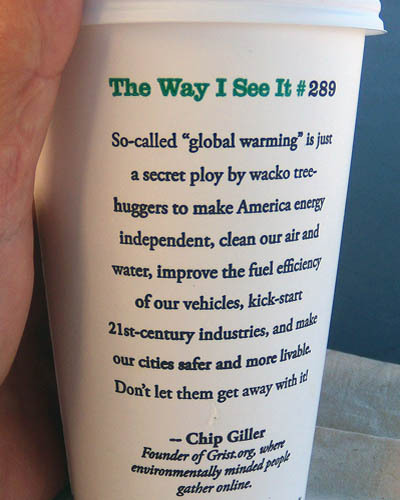
Starbucks controversy: The Way I See It #289 (global warming)

September 17, 2007

Found this on my coffee cup today:

The Way I See It #289

So-called “global warming” is just

a secret ploy by wacko tree-

huggers to make America energy

independent, clean our air and

water, improve the fuel efficiency

of our vehicles, kick-start

21st-century industries, and make

our cities safer and more livable.

Don’t let them get away with it!

Chip Giller
Founder of Grist.org, where
environmentally-minded people
gather online.

Starbucks Coffee Cup, The Way I See It #289

Add to FacebookAdd to NewsvineAdd to DiggAdd to Del.icio.usAdd to StumbleuponAdd to RedditAdd to BlinklistAdd to TwitterAdd to TechnoratiAdd to Furl

Save


Fisking “Junk Science” and “100 things you should know about DDT”: A new project

June 27, 2007

Looking at the odd campaign against the reputation of Rachel Carson, conducted largely by a group of corporate-paid, political scalawags, one will eventually come across a site named JunkScience.com, which has as a motto, “All the junk that’s fit to debunk.”

One might be forgiven if one assumes that the site debunks junk science claims. But that does not appear to be it’s aim at all. On this page, for example, “100 things you should know about DDT,” the site perpetrates or perpetuates dozens of junk science claims against Rachel Carson, against public health, against government and against reason. The site promotes junk science, rather than debunking it!

For example, I had just read a chunk of history reminding me that our first Environmental Protection Agency Administrator, William Ruckelshaus, had been ordered by a federal court to review the pesticide certification for DDT, and had acted against DDT only after two different review panels recommended it be phased out, and states had already started bans of their own. At the time, in 1972, Ruckelshaus faced a heap of criticism for moving so slowly on the issue.

EPA history caption: Rachel Carson's Silent Spring led to banning DDT and other pesticides. [EPA iimage]

EPA history caption: Rachel Carson’s Silent Spring led to banning DDT and other pesticides. [EPA iimage]

How is this action described at JunkScience.com?

You wouldn’t quite recognize the events — and I doubt you could verify other oddities the JunkScience.com site claims:

17. Extensive hearings on DDT before an EPA administrative law judge occurred during 1971-1972. The EPA hearing examiner, Judge Edmund Sweeney, concluded that “DDT is not a carcinogenic hazard to man… DDT is not a mutagenic or teratogenic hazard to man… The use of DDT under the regulations involved here do not have a deleterious effect on freshwater fish, estuarine organisms, wild birds or other wildlife.”

[Sweeney, EM. 1972. EPA Hearing Examiner’s recommendations and findings concerning DDT hearings, April 25, 1972 (40 CFR 164.32, 113 pages). Summarized in Barrons (May 1, 1972) and Oregonian (April 26, 1972)]

18. Overruling the EPA hearing examiner, EPA administrator Ruckelshaus banned DDT in 1972. Ruckelshaus never attended a single hour of the seven months of EPA hearings on DDT. Ruckelshaus’ aides reported he did not even read the transcript of the EPA hearings on DDT.

[Santa Ana Register, April 25, 1972]

19. After reversing the EPA hearing examiner’s decision, Ruckelshaus refused to release materials upon which his ban was based. Ruckelshaus rebuffed USDA efforts to obtain those materials through the Freedom of Information Act, claiming that they were just “internal memos.” Scientists were therefore prevented from refuting the false allegations in the Ruckelshaus’ “Opinion and Order on DDT.”

I propose to Fisk much of the list of 100 claims against Carson (which is really a list over 100 items now), in a serial, spasmodic fashion. I’ll post my findings here, making them generally available to internet searches for information on Rachel Carson and DDT. Below the fold, I’ll start, with these three specious claims listed above.

Read the rest of this entry »