Eye on Yellowstone: Earthquake swarm’s second round

January 10, 2009

More mostly small, less-than-3.0 magnitude earthquakes rumbled the Yellowstone Caldera, with a shift in location.

While not exactly an everyday event, still “not uncommon.”  Scientists are just watching, and they detect no other signs of an imminent eruption.

Here’s the note as of about 5:00 a.m. January 10, Central time, from the Yellowstone Volcano Observatory (YVO):

YELLOWSTONE VOLCANO OBSERVATORY INFORMATION RELEASE
Friday, January 9, 2009 19:44 MST (Saturday, January 10, 2009 02:44 UTC)

YELLOWSTONE VOLCANO (CAVW#1205-01-)
44.43°N 110.67°W, Summit Elevation 9203 ft (2805 m)
Volcano Alert Level: NORMAL
Aviation Color Code: GREEN

Small Earthquake Swarm on 9 January 2009 near northeast corner of Yellowstone Caldera

A currently modest swarm of earthquakes began in the northeast corner of the Yellowstone Caldera, about 10 miles (16 km) NNE of the north end of the Yellowstone Lake swarm that was active in late December and early January. As of 1930 MST, 10 earthquakes had been located by the University of Utah Seismograph Stations, the largest with M= 3.3 and two other events with M >2.0. Located depths are between 2 and 4 km.

Yellowstone Volcano Observatory staff and collaborators are analyzing the data from this and from the earlier Yellowstone Lake swarm and are checking for any changes to the thermal areas located near the epicenters. We will provide further information as it becomes available.

—–
The Yellowstone Volcano Observatory (YVO) is a partnership of the U.S. Geological Survey (USGS), Yellowstone National Park, and University of Utah to strengthen the long-term monitoring of volcanic and earthquake unrest in the Yellowstone National Park region. Yellowstone is the site of the largest and most diverse collection of natural thermal features in the world and the first National Park. YVO is one of the five USGS Volcano Observatories that monitor volcanoes within the United States for science and public safety.

It’s winter in Yellowstone, a great time to go.  It’s the best time to go, my Yellowstone-obsessed brother would say.  A swarm of earthquakes means you’ll have something to talk about at breakfast before taking your camera out to get once-in-a-lifetime shots of nature.

Earthquakes are normal in much of the Rocky Mountains, and in much of the rest of the Intermountain West.  My mother used to enjoy quietly sipping coffee at the stove in her kitchen in Pleasant Grove, Utah, and saying “Oh. We’re having another earthquake.”  She’d watch the power and telephone wires, which formed neat sine waves during quakes.

Experts are watching, and probably sipping their coffee, too.

.”]Image 1. Yellowstone Lake showing location and times of the recent earthquakes from Dec. 27, 2008 (blue) to Jan. 8, 2009 (red). The M 3.0 and greater earthquakes are shown as stars, the smaller earthquakes are shown as circles. During the swarm, the earthquake locations appear to have moved north. For more information on the depths of the earthquakes, see the cross section from X to X below. Click on the image for a full-size version.

See resource lists at earlier MFBathtub posts:


All quiet on the Yellowstone front (almost)

January 6, 2009

Here’s the on-line helicorder view of January 5 — a quiet day at Lake Woebegone Yellowstone.  Click on the image to go to the site and see for yourself (in a larger format, too).

Compare the image below, with the image here, to see the difference a few days makes.

Helicorder data from January 5, 2008, Yellowstone Lake, West Thumb station (YLT)

Helicorder data from January 5, 2008, Yellowstone Lake, West Thumb station (YLT)


Yellowstone earthquake swarm finished?

January 5, 2009

No Few significant quakes recorded at all for January 4, nor so far for January 5 (6:30 a.m. Central) maybe the quakes took a day off in honor of Utah Statehood Day.

Update, January 6, 6:00 a.m. Central: The map now shows 11 quakes magnitude 1 or greater on January 3, 5 on January 4, and one on January 5.  This is significantly less action than the quakes every ten minutes or so when the swarm was at its peak.

Is the swarm done? This is the longest period of no-quake activity in Yellowstone since at least December 27, 2008.

Here’s the USGS data for 11:30 p.m. (Central), January 4:

Update time = Mon Jan 5 5:27:27 UTC 2009

Here are the earthquakes in the Map Centered at 44°N, 110°W area, most recent at the top.
(Some early events may be obscured by later ones.)
Click on the underlined portion of an earthquake record in the list below for more information.

MAG UTC DATE-TIME
y/m/d h:m:s
LAT
deg
LON
deg
DEPTH
km
LOCATION
MAP 2.6 2009/01/03 00:23:22 44.669 -110.163 1.0 43 km ( 26 mi) SSW of Cooke City-Silver Gate, MT
MAP 2.7 2009/01/02 20:33:53 44.553 -110.338 0.9 61 km ( 38 mi) SSW of Cooke City-Silver Gate, MT
MAP 2.2 2009/01/02 20:24:50 44.509 -110.371 0.0 61 km ( 38 mi) ESE of West Yellowstone, MT
MAP 2.7 2009/01/02 20:23:57 44.556 -110.357 1.3 60 km ( 38 mi) SSE of Gardiner, MT

So there was only one quake on January 3, and none on January 4.

Swarms are “not uncommon,” but caldera supereruptions are extremely rare.

Time Magazine tracked down the head of the Yellowstone Volcano Observatory (YVO), Jake Lowenstern:

Jake Lowenstern, Ph.D., YVO’s chief scientist, who also is part of the USGS Volcano Hazards Team, told TIME that a supervolcano event does not appear to be imminent. “We don’t think the amount of magma exists that would create one of these large eruptions of the past,” he said. “It is still possible to have a volcanic eruption comparable to other volcanoes. But we would expect to see more and larger quakes, deformation and precursory explosions out of the lake. We don’t believe that anything strange is happening right now.” Last summer YVO installed new instrumentation in boreholes 500 to 600 ft. deep to better detect ground deformation.  Says Lowenstern: “We have a lot more ability to look at all the data now.” (See an interactive graphic depicting how scientists monitor volcanoes.)

Plan your vacation to Yellowstone now. Transportation will be cheaper (you can fly to Jackson Hole), and if there is any effect of the earthquake swarm, it would be to reduce tourist reservations at local hotels.

Now is the time to book your visit.


November 7 – big day in history

November 7, 2008

Lots of anniversaries today:

1805 The Lewis and Clark Expedition arrived at the Pacific Ocean.
1874 The first cartoon depicting the elephant as the symbol of the Republican Party was printed in Harper’s Weekly. [Thomas Nast was the artist.]Thomas Nast carton that first used an elephant for Republican Party, Harpers Weekly, Nov. 7, 1874
1916 Republican Jeannette Rankin of Montana became the first woman elected to the U.S. House of Representatives.
1917 The Bolsheviks overthrew the Russian government in St. Petersburg.
1940 Only four months after its completion, the Tacoma Narrows Bridge in Washington state, the third longest suspension bridge in the world at the time, collapsed. No one was injured.

Video of the Tacoma Narrows Bridge disaster:

_______________

Update:  Blue Ollie has more information on the bridge collapse — and is generally worth a visit.


Disaster in Yellowstone Park: 20 years after the fires, it’s healing

September 17, 2008

High school students weren’t alive when Yellowstone burned in 1988. Do you remember?

NASA infrared satellite photograph of Yellowstone fires in 1988

NASA infrared satellite photograph of Yellowstone fires in 1988

It was a conflagration that made hell look like good picnicking. 1988 was a particularly dry summer, and hot. Lightning and human carelessness ignited fires across western North America. Five huge fires raged out of control, and burned huge swaths out of forests in Yellowstone National Park that probably hadn’t seen fire in 80 years, maybe longer.

The Salt Lake Tribune featured several stories about the fires and Yellowstone’s recovery today, “Yellowstone: Back from the ashes,” how wildland firefighting changed, a great chart on fire succession stages, and another chart on the effects of the fire on larger animals in the Yellowstone system.

Old Faithfull erupts against background of smoke from 1988 fires - NPS photo by Deanna Marie Dulen

Old Faithfull erupts against background of smoke from 1988 fires - NPS photo by Deanna Marie Dulen

The 1988 fires made history in several ways; it was the first time so many fires had burned simultaneously. Ultimately some of the fires merged into even greater conflagrations. The fires forced the shutdown of tourism and other activities in the Park. Inadequacies in fire fighting equipment, staffing and policies were highlighted and displayed in newspapers and on television for weeks, forcing changes in policies by cities, states and the federal government.

Some good came out of the fires. Much undergrowth and dead wood had choked off plant diversity in some places in the Park. The fires opened new meadows and offered opportunities for some species to expand their ranges.

Scientifically, a lot of information came out of the fires. The mystery of when aspen would seed out was solved — new aspen seedlings appeared in areas where the fires had sterilized the ground with extremely high temperatures that seemed to trigger the seeds to germinate.

Our visits in 1989 offered a lot of opportunities to look at very bleak landscapes.

Yellowstone National Park in 1989, a year after the big fires - Copyright 1989 and 2008, Ed Darrell

Yellowstone National Park in 1989, a year after the big fires - Copyright 1989 and 2008, Ed Darrell

Recover of the forested areas began rather quickly, but will take time to cover over all the scars of the fires.

Other resources:


Disaster at Arches National Park

August 10, 2008

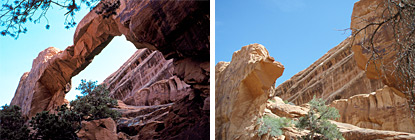
Wall Arch, 12th largest, one of the better-known and most-seen natural arches in Arches National Park, Utah, collapsed.

Wall Arch, before and after collapse - National Park Service photos

Wall Arch, before and after collapse – National Park Service photos

“Not being a geologist, I can’t get very technical but it just went kaboom,” [Arches NP] Chief Ranger Denny Ziemann said. “The middle of the arch just collapsed under its own weight. It just happens.”

Wall Arch, located along the popular Devils Garden Trail, was 71 feet tallwide and 33 1/2 feet widetall, ranking it 12th in size among the known arches inside the park. Lewis T. McKinney first reported and named Wall Arch in 1948.

No one reported observing the arch collapse and there were no visitor injuries, the National Park Service said.

Read the report from the Salt Lake Tribune.

Some tourist on Sunday, August 3, or Monday, August 4, got the last photograph of Wall Arch still standing. Was it you? Were you close? Give us a shout in the comments if so.

Other resources:

x

Other blogs and later reports:


Grand Canyon airline collision, June 30, 1956

June 30, 2008

[2008] Today’s the 52nd anniversary of a horrendous accident in the air over the Grand Canyon. Two airliners collided, and 128 people died.

In 1956 there was no national radar system. When commercial flights left airports, often the only contact they had with any form of air traffic control was when the pilots radioed in for weather information, or for landing instructions. Especially there was no system to avoid collisions. As this 2006 story in the Deseret News (Salt Lake City) relates, the modern air traffic control system was spurred mightily by this tragedy.

About 9 a.m. Saturday, June 30, [1956], the TWA flight bound for Kansas City, Mo., and the United flight bound for Chicago left Los Angeles International Airport within three minutes of each other. The TWA flight, carrying 70 people, filed a flight plan to cruise at 19,000 feet. The United flight, with 58 people on board, planned to cruise at 21,000 feet.

About 20 minutes into the flight, TWA pilot Capt. Jack Gandy requested permission to climb to 21,000 feet. An air traffic controller in Salt Lake City turned down Gandy’s request. Then Gandy asked to fly “1,000 on top,” meaning at least a thousand feet above the clouds, which that morning were billowing as high as 30,000 feet. That request was granted.

By the time both planes were over the Grand Canyon, the pilots were flying in and out of the clouds, on visual flight rules and off their prescribed flight plans, apparently typical in those days as pilots veered off course to play tour guide.

No one knows exactly what happened.

It was the last big accident before instigation of the “black box,” so investigators had to piece together details from debris on the ground.

They decided that the left wing and propeller of the United plane hit the center fin of the TWA’s tail and cut through the fuselage, sending Flight 2 nose-first into the canyon, two miles south of the juncture of the Colorado and Little Colorado rivers. The United DC- 7, which had lost most of its left wing, began spiraling down. Capt. Robert Shirley radioed Salt Lake City a garbled message that controllers understood only after they slowed down the recording: “Salt Lake, ah, 718 . . . we are going in.” Flight 718 smashed into a cliff on Chuar Butte.

The accident plays a key role in a Tony Hillerman mystery, Skeleton Man — Hillerman writes about two Navajo Nation policemen.

I’m thinking of the crash today for two reasons. I’m off for a tour of canyons, including both rims of the Grand Canyon, in the next two weeks. The last time I was there was 1986, with the President’s Commission on Americans Outdoors. We flew in on a Twin Otter, coming up from Phoenix, over the Roosevelt Dam, up over the Mogollon Rim, over the Glen Canyon Recreation area and stopping it Page. From Page to Grand Canyon, we took full advantage of the huge windows in the Otter — seeing first hand the sights that the controversial tourist flights were designed to reveal. Safety was a key concern, and we talked about it constantly with the pilots.

A few weeks later, on June 18, 1986, that DeHavilland Twin Otter collided with a Bell Jet Ranger helicopter over the Canyon. 25 people died in that crash.

I have flown over the Canyon a dozen times since then — no longer will airliners dip down to give passengers a better view, not least because airliners cruise tens of thousands of feet higher now than they did then. I think of those airplane accidents every time I see the Canyon.

We’re driving in. We’ll spend a day and a half on the South Rim, and another couple of nights on the North Rim. We’re taking our time on the ground. But if we had time, and we could afford it, I’d love to get up in an airplane or helicopter to see the Canyon from the air again.


Not Bobby Jindal: The Parable of the Idiot Candidate

June 16, 2008

Bobby Jindal’s experience at exorcisms and rejection of the Catholic Church’s position on teaching creationism are getting some attention. He is young and makes an appearance of governmental competence (though, New Orleans is still a mess and he’s had several months to start making things happen that aren’t happening). But on science issues, the man is without sense, without reason.

In response to a post at Pharyngula, someone commented:

No, no no…. we WANT McCain to pick Jindal.

Because Jindal claims to have performed an exorcism.

http://www.time-blog.com/swampland/2008/06/jindals_exorcism.html

PleaseohpleaseohpleaseohPLEASE pick Jindal!!!!!!

Let me tell you a story. This looks like a parable, and after a fashion, it is.  It is also history.  You can look it up.  Call it a parable from Santayana’s Ghost.

Once upon a time, back in the Cretaceous (okay, 1976), when Utah was still split among Democrats and Republicans, especially for national offices like senator and representative, there was a great congressman in Utah’s first district (which you might call the “cursed First,” because it has had its share of misfortunes, like Enid Greene, and Douglas Stringfellow; except that at the time, it was the 2nd. No, I’m not about to explain). Rep. Alan Howe was a smart, well-connected Democrat, and a very good first-term Congressman. He’d won election in 1974 when Wayne Owens vacated the seat to run for the U.S. Senate unsuccessfully against Jake Garn.* In 1976, Howe was considered unbeatable.

Howe’s brother was president of the Utah State Senate. Howe was a friend of outgoing Gov. Calvin Rampton. As a former director of the Four Corners Commission, he had a good bead on water, energy, agricultural, industrial and environmental issues in the entire state. He was rising rapidly up the ladder in Democratic leadership. Republicans who might have made a run looked at Howe’s war chest of campaign contributions, his record and sterling reputation, and sat out the race.

At that time the state’s parties held their conventions in June. Under Utah’s system, all candidates for an office would appeal to the delegates of the state convention, and if one candidate got 50% plus 1 of the delegates to vote for her or him, there would be no primary. If no candidate got a majority, the top two would face off in a primary in September, and the winner would go to the general election in November.

Utah’s Republicans had five people file for the office, all of them unknowns, all of them considered appropriate to fill the ballot out for a losing election. The five were so undistinguished, and so undistinguishable, that the race was close between all of them. An insurance salesman named Dan Marriott (no relation to the J. W. Marriotts) scraped enough delegate votes to stand against a proctologist in the primary election. Both candidates were unfamiliar with national politics and national issues. It would be one gaffe after another up to the primary.

But that’s not the story. I was a part-time reporter for KUTV, helping Lucky Severson (later of NBC) and a great documentary unit in coverage of all things political in the state. Since there was no great race on the Democratic side, I got the short straw and a good chance to cover the local Democratic convention. It was uneventful enough I didn’t even get a stand-up out of it.

Alan Howe’s campaign was loaded with people I knew from college. They invited me to a post-convention party which was, unfortunately, a fund-raiser. Consulting with the assignment desk, we figured that since the invitation came as a comp ticket, and not as an invitation to cover the thing, it was a freebie that was unacceptable under the station’s gift policies. I could go on my own, we determined, but I’d have to pay for the ticket myself. I didn’t have the change.

So I didn’t get even a stand-up. And I didn’t get to go to the party with the Congressman.

About 2:00 a.m. the assignment desk called, asking hopefully whether I’d gone to the fundraiser after all. When I said “no,” the guy yelled “Damn!”

“Look,” I said. “We discussed this — it’s against the station’s policies.”

“Yeah, but a good story isn’t. We just got a tip from the County Jail that Howe was picked up for soliciting a prostitute.”

Utah, then, was much more provincial than it is now. Still, there are few places outside of Louisiana where soliciting sex for hire is not a death knell in an election campaign.

Alan Howe had just handed his congressional seat to a Republican to be named later.

Dan Marriott and the proctologist, J. Preston Hughes fought a gaffe-filled campaign all the way to the primary. Hughes avoided using all the great campaign slogans a proctologist could use fairly and accurately, indicating a great lack of a sense of humor (“Send Hughes to Washington — he’s made a career out of cutting up a–holes to make life better!”) Marriott beat Hughes, 56,000 votes to 25,500 votes roughly.

The campaign for the general election was a groaner. Utah Democrats tried to get Howe to resign the election, but he refused, even after he was convicted. Howe refused to debate Marriott, appearing to hope that Marriott wouldn’t get any publicity. A Democrat ran a write-in campaign, further sapping Howe’s hopes.

Television debates were set up, but Howe refused to appear. These turned into painful interviews of Dan Marriott, who had no real good ideas about what he was getting into, it appeared. In one public television “debate,” open to voters to call in questions, when the host, Rod Decker then of the Deseret News went to the phones, not even crickets chirped. Decker ended up asking questions himself, though he hadn’t prepared to do that. In one exchange seared into my memory, Decker asked Marriott what committees he might like to be on in Congress, since it was all but absolutely certain he’d win the election and be able to stay out of the way of speeding buses and trains. Marriott explained that he’d been on a few committees in his local PTA, and they didn’t seem to get anything done, so he hoped he wouldn’t get any committee assignments.

Utah, so dependent on largesse from the Interior Committees and Agriculture Committees, issued a collective groan.

Utah got stuck with a candidate no one wanted, and had to send him to the House of Representatives.

Do not ever — EVER! — hope the other party will nominate an idiot against your candidate. Even the good candidates are idiot enough to blow an election. But sure as the other side nominates an idiot that even other idiots can see unable to do the job, something will happen to push that nominated idiot into the position.

There is a good history of surprise office-holders rising to the occasion. Teddy Roosevelt was nominated for the Vice Presidency largely to get him out of New York politics, where his mere presence threatened to clean up some of the corruption. New Yorkers thought he’d never recover from serving as Vice President. You know the rest of the story, of course, how President William McKinley showed up in Buffalo to shake hands, how Leon Czolgosz got in line and shot McKinley fatally.

Dan Marriott with large rubber gloves

Even Utah got lucky. Dan Marriott had enough sense to learn a bit about Congress. He lucked into a seat on the House Interior Committee, and in a Democratic Congress, with everyone ignoring him, he sneaked through a bill to clean up radioactive mill tailings in Salt Lake County. Managing to avoid major embarrassments, he went on to serve four terms. Utah swatted him down when he stood for election as governor in 1984.

Photo at left: Dan Marriott, on right, with large rubber gloves. Dan Marriott Photograph Collection at the J. Willard Marriott Library, University of Utah.

Events can intervene. Good candidates get tripped up — think Ed Muskie defending his wife’s honor in New Hampshire, but with a few tears, before tears were acceptable. Think all those Republicans who avoided the nastiness of the campaign against Nixon in 1968, since Robert Kennedy would easily outdistance Nixon. Sen. Paul Wellstone was a lock in a close race in Minnesota in 2002, until an airplane crash changed the race — as happened to Mel Carnahan in Missouri in 2000, and to Dick Obenshain in Virginia in 1978. Or think of former Speaker of the House Tom Foley of Washington, who simply lost his seat when an unexpected change of mind of the voters of Washington got him, in 1994, when the Newt Gingrich Contract On America was executed.

Every vote counts, until it’s dismissed or uncounted. Every race is important. Pray that each party puts up the best available people, and that the best of them win.

Remember: Do not ever — EVER! — hope the other party will nominate an idiot against your candidate. Even the good candidates are idiot enough to blow an election. But sure as the other side nominates an idiot that even other idiots can see is unable to do the job, something will happen to push that nominated idiot into the position.

________

* Shortly after his election in 1974 I interviewed Jake Garn with a panel for KUED-TV. I asked Garn what he would bring to the Senate, a good, softball question. He went on at length about his viewpoint as a former mayor, noting that no one else in the Senate had that experience. I named five or six former mayors in the Senate, and I asked him what was the difference. “I won’t become federalized like they did,” he said. I thought of that quote often as he orbited the Earth. Glad he didn’t fall victim to the siren song of federalization.


Worst ever U.S. industrial accident, 1947: 576 dead

April 14, 2007

April 16 marks the 60th anniversary of the Texas City Disaster. A large cargo ship being loaded with tons of ammonium nitrate caught fire and exploded, setting fire to other nearby ships, one of which exploded, and devastating much of the town. In all, 576 people died in Texas City on April 16 and 17, 1947.

View of Texas City from across the bay, in Galveston, April 16, 1947

View of Texas City from Galveston, across the bay, after the explosion of the French ship SS Grandcamp, April 16, 1947. Photo from International Association of Fire Fighters Local 1259

The incident also produced one of the most famous tort cases in U.S. history, Dalehite vs. United States, 346 U.S. 15 (1953). (Here is the Findlaw version, subscription required.)

The entire Texas City fire department was wiped out, 28 firefighters in all. The International Association of Fire Fighters, Local 1259 has a website dedicated to the history of the disaster, with a collection of some powerful photographs.

More below the fold. Read the rest of this entry »