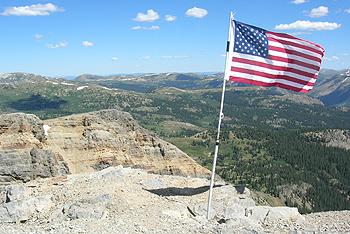
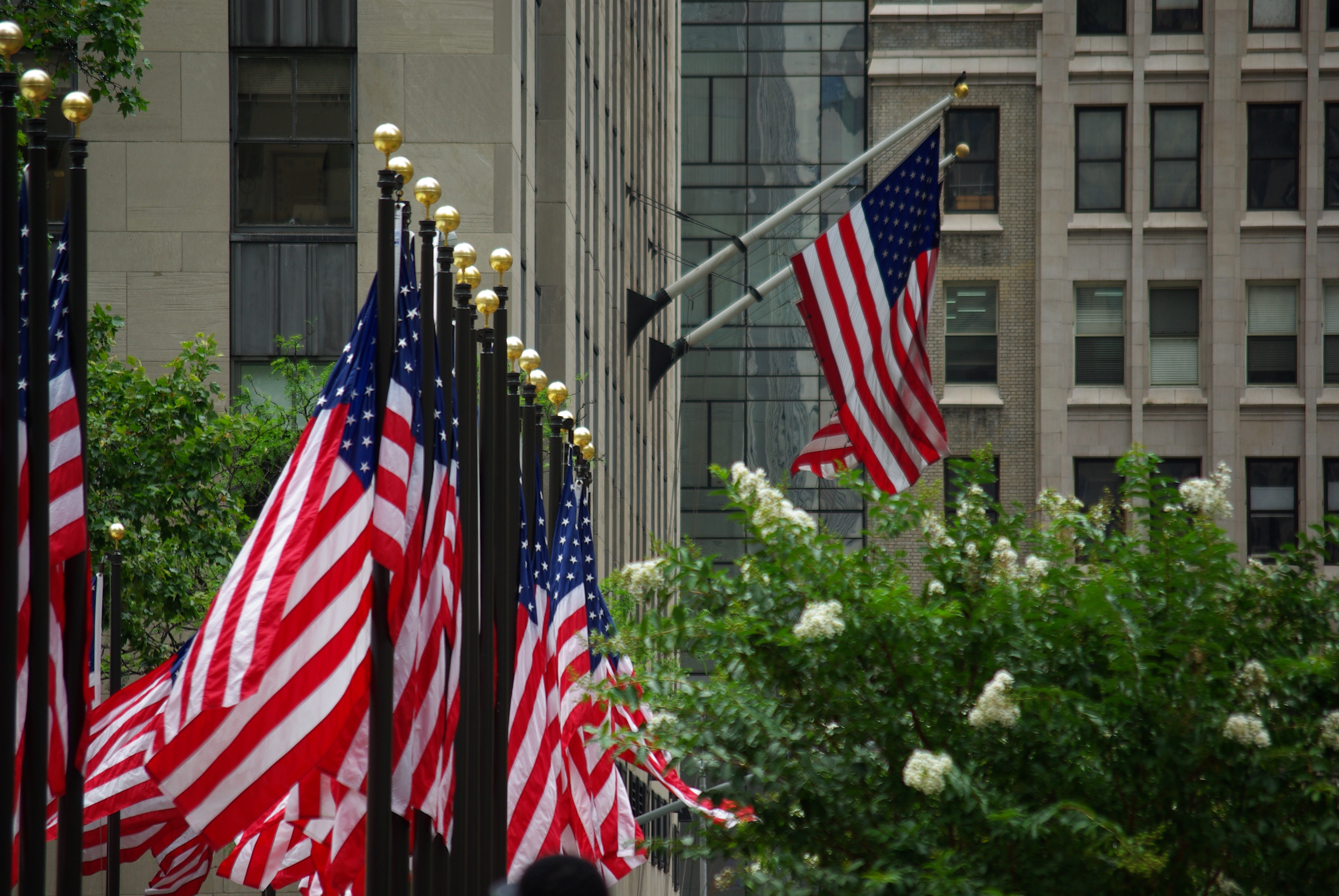
Iowans, fly your flags today for statehood, December 28, 1846

December 28, 2017

The 2004 commemorative Iowa quarter-dollar pays homage to Iowa's great artist son, Grant Wood, and the prairie school house, with a motto for Iowa,

The 2004 commemorative Iowa quarter-dollar pays homage to Iowa’s great artist son, Grant Wood, and the prairie school house, with a motto for Iowa, “Foundation in Education.” Wood’s painting is “Arbor Day,” showing students and a teacher planting a tree outside a one-room schoolhouse. Image from the Littleton Coin Company.

Iowans fly their flags today in celebration of the anniversary of Iowa statehood.  Iowa’s admission to the Union came on December 28, 1846; Iowa is the 29th state admitted.

The Flag Code, 4 USC §6 (d), notes that the U.S. flag may be flown on “the birthdays of States (date of admission),” in addition to the other score of dates specifically written into law.

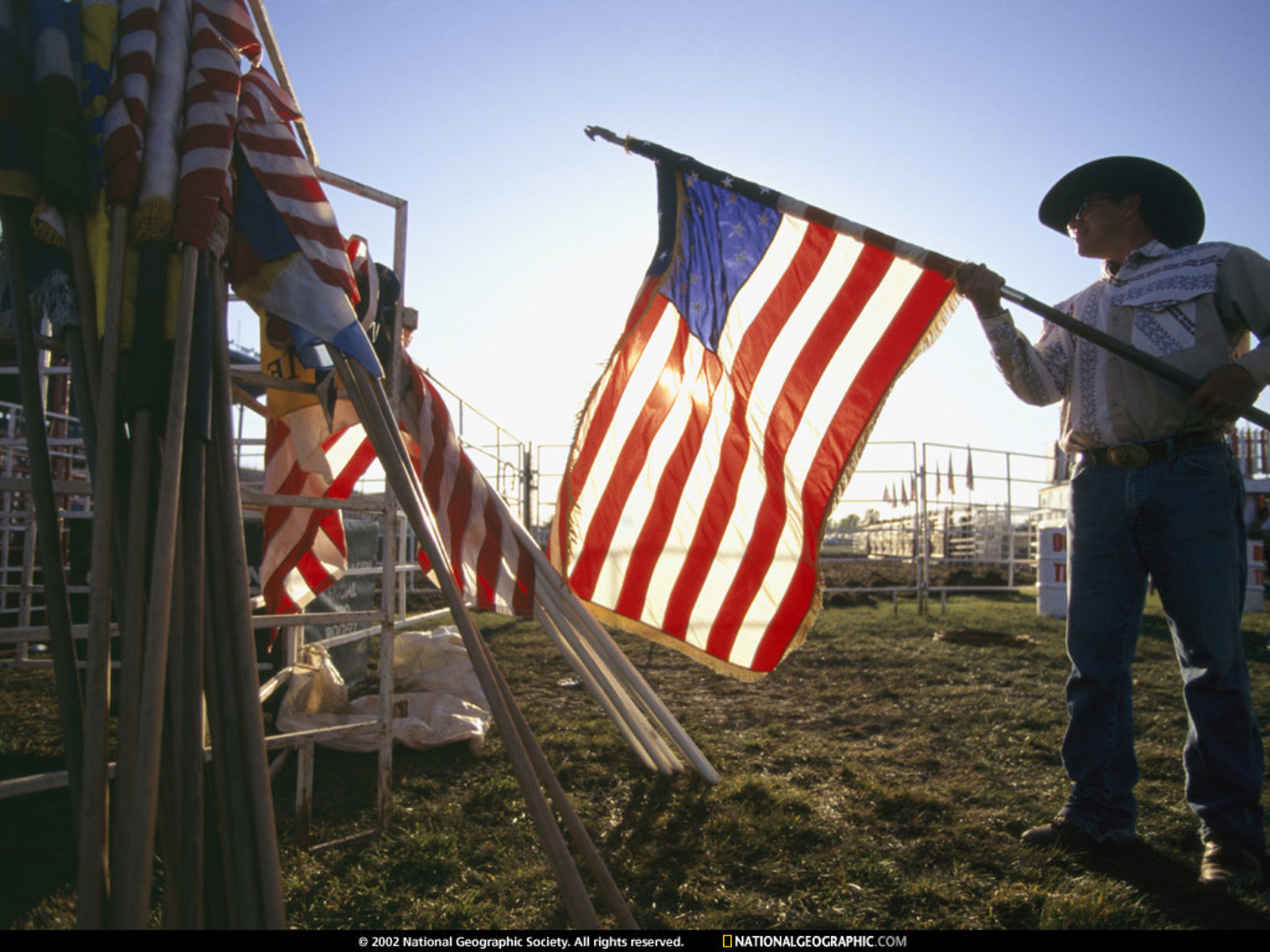
American Flag, Spencer, Iowa, 1996 – caption from the National Geographic Society: A man rolls up U.S. flags at the end of the Clay County Fair in Spencer, Iowa. “Although the population of Spencer is only about 12,000, the fair draws some 300,000 visitors. Once a year, rising from the endless flatness of the Iowa countryside, a crowd forms—to stroll, to hear big country music acts like the Statler Brothers, to sell a grand champion boar, to buy a new silo.” (Photographed on assignment for, but not published in, “County Fairs,” October 1997, National Geographic magazine) Photograph by Randy Olson; copyright National Geographic Society

American Flag, Spencer, Iowa, 1996 – caption from the National Geographic Society: A man rolls up U.S. flags at the end of the Clay County Fair in Spencer, Iowa. “Although the population of Spencer is only about 12,000, the fair draws some 300,000 visitors. Once a year, rising from the endless flatness of the Iowa countryside, a crowd forms—to stroll, to hear big country music acts like the Statler Brothers, to sell a grand champion boar, to buy a new silo.” (Photographed on assignment for, but not published in, “County Fairs,” October 1997, National Geographic magazine) Photograph by Randy Olson; copyright National Geographic Society. Just a great photo.

More:


December 7, 2017: Fly flags for Pearl Harbor Remembrance, and for Delaware statehood — and at half staff

December 7, 2017

From Dayton Daily News: Jeff Duford, curator for the National Museum of the U.S. Air Force, with a flag that flew on the U.S.S. St. Louis in Hawaii during the attack on Pearl Harbor on Dec. 7, 1941. The same flag flew aboard the U.S.S. Iowa in Tokyo Bay on September 16, 1944, as Japan signed instruments of surrender aboard the U.S.S. Missouri.

From Dayton Daily News: Jeff Duford, curator for the National Museum of the U.S. Air Force, with a flag that flew on the U.S.S. St. Louis in Hawaii during the attack on Pearl Harbor on Dec. 7, 1941. The same flag flew aboard the U.S.S. Iowa in Tokyo Bay on September 16, 1944, as Japan signed instruments of surrender aboard the U.S.S. Missouri. [This flag was displayed for one day at the museum, on Pearl Harbor Remembrance Day 2016.]

December 7 is a two-fer flag-flying day.

By public law, December 7 is Pearl Harbor Remembrance Day, and Americans fly the U.S. flag in memory of those who lost their lives at Pearl Harbor on December 7, 1941. U.S. flags should be flown at half-staff.

As for Delaware, under the U.S. Flag Code, residents of the relevant state should fly their U.S. flag on the date the state joined the union.

In 1787 Delaware quickly and promptly elected delegates to the former colony’s convention to ratify the Constitution proposed at the Philadelphia convention just over three months earlier. The ratification of the Constitution won opposition from strong factions in almost every state. Pols anticipated tough fights in New York, Virginia, and other states with large populations. They also expected other states would wait to see what the bigger states did.

Delaware didn’t wait.  On December 7 Delaware became the first of the former British colonies to ratify the Constitution. Perhaps by doing so, it guaranteed other states would act more favorably on ratification.

Because Delaware was first, it is traditionally granted first position in certain ceremonies, such as the parades honoring newly-inaugurated presidents. Delaware’s nickname is “The First State.”

In Delaware and the rest of the nation, fly your flags on December 7, 2016. If you can, fly your flag at half-staff to honor the dead at Pearl Harbor; if you have a flag on a pole that cannot be adjusted, just fly the flag normally.

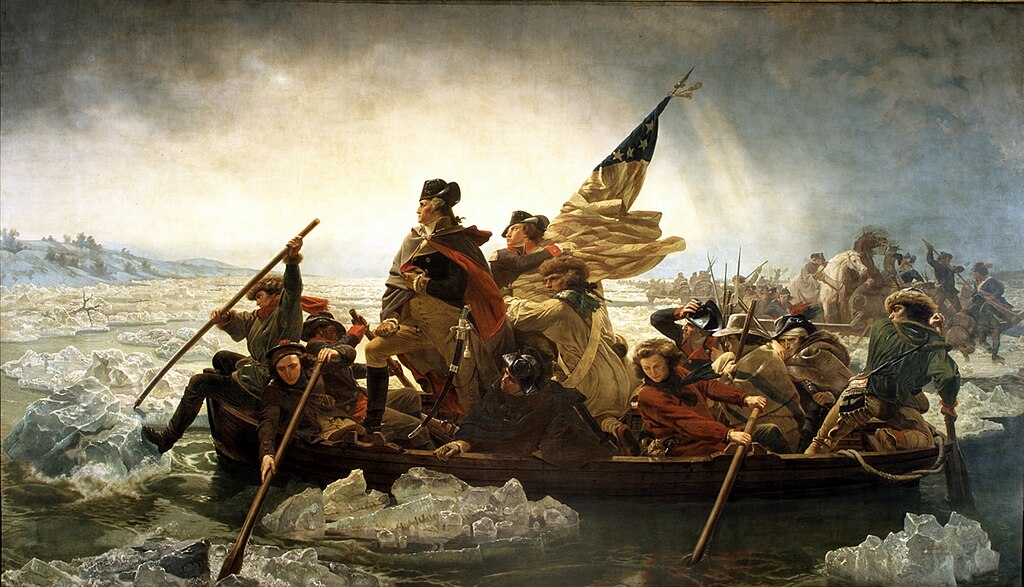
The most famous portrayal of a U.S. flag flying in Delaware is in the painting by Emanuel Leutze (American, 1816–1868).

The most famous portrayal of a U.S. flag flying in Delaware is in the painting by Emanuel Leutze (American, 1816–1868). “Washington Crossing the Delaware,” 1851. The Metropolitan Museum of Art, New York, Gift of John Stewart Kennedy, 1897 (97.34) Among other problems with this portrayal: The flag depicted had not been designated on the date of the crossing, Christmas 1776.

Yes, this is mostly an encore post. Fighting ignorance requires patience.

Yes, this is mostly an encore post. Fighting ignorance requires patience.


Oklahoma statehood, November 16, 1907; Oklahomans fly your flags today

November 16, 2017

U.S. Flag Code urges citizens of states to fly the U.S. flag on the anniversary of statehood.

We almost let the whole day slip away without reminding you: President Theodore Roosevelt signed the Oklahoma statehood proclamation on November 16, 1907. Oklahoma became the 46th state, with New Mexico and Arizona to come later to fill out the contiguous 48 states.

Mike Wimmer's 2003 painting of President Theodore Roosevelt's signing of the proclamation that made Oklahoma a member of the union. Oklahoma Arts Council image.

Mike Wimmer’s 2003 painting of President Theodore Roosevelt’s signing of the proclamation that made Oklahoma a member of the union. Oklahoma Arts Council image.

Oklahoma’s pre-history is long, complex and fascinating; the road to statehood is similarly complex and winding, lined with broken promises to Native Americans, tragedy and other drama. Does the state require Oklahoma history be taught in public schools?

And so we hope, you flew your flags today, Sooners!

Did anyone actually fly their flag? Does anyone other than Oklahoma newspapers even care any more?

More: 

Front page of the Daily Oklahoman on November 16, 1907, anticipating President Roosevelt's proclamation to come that morning. Daily Oklahoman image.

Front page of the Daily Oklahoman on November 16, 1907, anticipating President Roosevelt’s proclamation to come that morning. Daily Oklahoman image.

46-star flag used after Oklahoma became the 46th state in 1907. This flag remained in use for four years. RareFlags.com image

46-star flag used after Oklahoma became the 46th state in 1907. This flag remained in use for four years. RareFlags.com image

Yes, this is mostly an encore post. Fighting ignorance requires patience.

Yes, this is mostly an encore post. Fighting ignorance requires patience.

Save

Save

Save

Save


2017 North Dakota and South Dakota statehood days – fly your flags

November 2, 2017

North Dakota's commemorative quarter depicts the American bison, perhaps the quintessential prairie symbol.

North Dakota’s commemorative quarter depicts the American bison, perhaps the quintessential prairie symbol.

South Dakota's commemorative quarter interestingly focuses on human alterations to the area -- the carved presidential busts on Mt. Rushmore, wheat introduced by immigrant farmers, and the Chinese pheasant, an exotic species introduced for hunting.

South Dakota’s commemorative quarter interestingly focuses on human alterations to the area — the carved presidential busts on Mt. Rushmore, wheat introduced by immigrant farmers, and the Chinese pheasant, an exotic species introduced for hunting.

Residents of North Dakota and South Dakota should fly their U.S. flags today in honor of their states’ being admitted to the union, on November 2, 1889.

Most sites note simply that both states were admitted on the same day; some sites, especially those that lean toward North Dakota, claim that state is Number 39, because President Harrison signed their papers first, after shuffling to avoid playing favorites.

Does anyone really care?

How much do you really know about the Dakotas?

Dakotans, fly your flags today in honor of statehood.

More:

Yes, this is mostly an encore post. Fighting ignorance requires patience.

Yes, this is mostly an encore post. Fighting ignorance requires patience. And, confess: Do you remember this post from last year?

Save

Save


November 2017 flag-flying dates

October 28, 2017

A giant American flag is unfurled at Wrigley Field before World Series Game 3, October 28, 2016 (Cubs won the Series, remember?) Will 2017's World Series push into November for the first time? Wikimedia Commons image

A giant American flag is unfurled at Wrigley Field before World Series Game 3, October 28, 2016 (Cubs won the Series, remember?) Will 2017’s World Series push into November for the first time? Wikimedia Commons image

Nine events spread over seven different days come with urgings to fly the U.S. flag in November: Six states celebrate statehood, Veterans Day falls as always on November 11, and Thanksgiving Day on November 23.

Did I say eight? 2017 is an election year in many states, like Texas; we fly flags at polling places on election day, so that makes nine events. You may fly your flag at home on election day, too.

Two states, North Dakota and South Dakota, celebrate their statehood on the same date. Washington’s statehood day falls on Veterans Day, November 11 — so there are only seven days covering eight events.

In calendar order for 2017, these are the seven days:

  • North Dakota statehood day, November 2 (1889, 39th or 40th state)
  • South Dakota statehood day, November 2 (1889, 39th or 40th state) (shared with North Dakota)
  • Election day, November 7 (several states)
  • Montana statehood day, November 8 (1889, 41st state)
  • Veterans Day, November 11
  • Washington statehood day, November 11 (1889, 42nd state) (shared with Veterans Day)
  • Oklahoma statehood day, November 16 (1907, 46th state)
  • North Carolina statehood day, November 21 (1789, 12th state)
  • Thanksgiving Day, fourth Thursday in November (November 24 in 2016)

Most Americans will concern themselves only with Veterans Day and Thanksgiving Day. Is flying the U.S. flag for statehood day a dying tradition?

More:

This is an encore post.

Yes, this is an encore post. Fighting ignorance takes longer than we hoped.


Fly your flag for Navy Day, October 27, 2017

October 27, 2017

NORFOLK – Sailors assigned to USS Gerald R. Ford (CVN 78) lower the ensign as the ship shifts colors from the fantail to the mast in preparation to get underway. (U.S. Navy file photo and caption)

NORFOLK – Sailors assigned to USS Gerald R. Ford (CVN 78) lower the ensign as the ship shifts colors from the fantail to the mast in preparation to get underway. (U.S. Navy file photo and caption)

A reminder to fly your U.S. flags today in honor of the U.S. Navy.

We celebrate Navy Day each year on October 27, one of the score of dates designated in the U.S. Flag Code to fly Old Glory. Navy Day honors everyone who serves or served in the U.S. Navy.

Navy Day may be eclipsed by Armed Forces Day, Memorial Day and Veterans Day in modern life, but it’s still in the law and the Navy still notes it.

So should we.

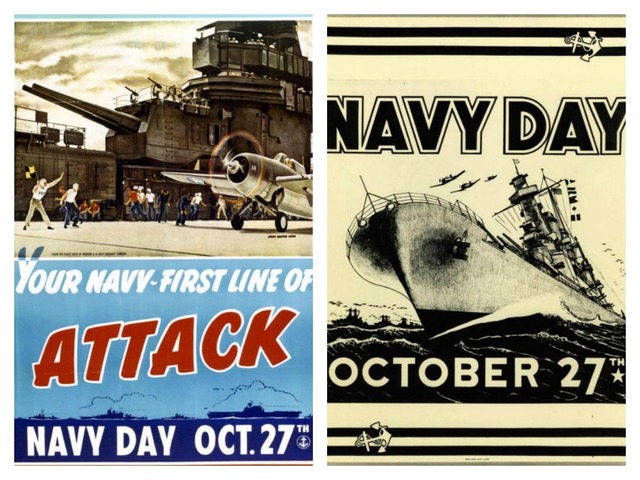
You get an idea of the celebrations from some of the old Navy Day posters. (If you can put a year on posters undesignated, please tell us in comments; if you know of a poster not shown here, please give a link in comments.)

Navy Day poster, after World War I

Navy Day poster, after World War I


This may have been used as a Navy Day poster after the death of Theodore Roosevelt, a former, popular Secretary of the Navy. Crasch McDuff blog

This may have been used as a Navy Day poster after the death of Theodore Roosevelt, a former, popular Secretary of the Navy. Crash MacDuff blog


Navy Day poster, post World War I, pre-World War II

Navy Day poster, post World War I, pre-World War II

Navy Day poster, 1931; Crash MacDuff blog

Navy Day poster, 1931; Crash MacDuff blog


Navy Day poster, early 1940s

Navy Day poster, early 1940s, featuring the battleship USS New Jersey.
Illustration by Matt Murphey


Navy Day poster, 1940s

Navy Day poster, 1940s


Two more 1940s Navy Day posters

Two more 1940s Navy Day posters


Navy Day poster, 1944

Navy Day poster, 1944


Billboard showing art similar to the poster, Navy Day 1944

Billboard showing art similar to the poster, Navy Day 1944. History 101 image


Navy Day Poster, 1945

Navy Day Poster, 1945


Navy Day Poster from after World War II (?)

Navy Day Poster from after World War II (?)


Navy Day poster, 1947, Crash MacDuff blog

Navy Day poster, 1947, Crash MacDuff blog. “Issued September 1947. Courtesy of the Naval Historical Foundation. NHHC Photograph Collection, NH 78860.”


Yes, this is mostly an encore post. Fighting ignorance requires patience.

Yes, this is mostly an encore post. Fighting ignorance requires patience.


Save


9/11/2017 – Fly your flag today, honor the victims and heroes

September 11, 2017

Rose honoring a victim at the 9/11 Memorial, Manhattan, New York City. (Photo by Ed Darrell)

Rose honoring a victim at the 9/11 Memorial, Manhattan, New York City. (Photo by Ed Darrell)

Fly your U.S. flag today to honor the victims and heroes of the September 11, 2001, attacks on the U.S. The day is designated in U.S. law as National Patriot Day (36 USC § 144).

U.S. flag flies in front of construction restoring the sites of the World Trade Center in New York City (bus station opened a few weeks later).

U.S. flag flies in front of construction restoring the sites of the World Trade Center in New York City (bus station opened a few weeks later).

More:


Labor Day 2017: Fly the flag to honor American labor

September 4, 2017

Small U.S. flag flies at the grave of John Morris, the first worker killed in the battle outside of the Homestead Works Steel Mill in 1892. Photo by Alex Popichak / 90.5 WESA

Small U.S. flag flies at the grave of John Morris, the first worker killed in the battle outside of the Homestead Works Steel Mill in 1892. Photo by Alex Popichak / 90.5 WESA

Fly your U.S. flags today in honor of Labor Day, to honor American labor.

In Lawrence, Massachusetts, in 1912, flag-waving union organizers are confronted by armed state troops trying to quell union protests. Library of Congress photo.

In Lawrence, Massachusetts, in 1912, flag-waving union organizers and textile workers confronted by armed state troops trying to quell union protests. Library of Congress photo.

More:


Save


Colorado Day 2017! Coloradans fly the flag for statehood

August 1, 2017

U.S. flag on American Flag Mountain, near Taylor Park, Colorado. Photo from Hobo Jeepers.

U.S. flag on American Flag Mountain, near Taylor Park, Colorado. Photo from Hobo Jeepers.

August 1 is Colorado’s statehood day. Unlike many other states, Colorado actually celebrates the day.

More accurately, people of Colorado celebrate the day. It seems most Colorado residents are happy to be there, and take any excuse to celebrate their good fortune.

#ColoradoDay even trended on Twitter for time today.

Under the provisions of the U.S. Flag Code, residents of a state are invited to fly the U.S. flag on their state’s day of statehood. Colorado came into the Union on August 1, at the declaration of President U. S. Grant, in 1876. People of Colorado tend to favor Colorado’s flag for most displays, on Colorado Day.

How are others celebrating? Free admission to Colorado State Parks, for one.


https://twitter.com/CaseyJPorter/status/892488499911426049


https://twitter.com/VegucationMama/status/892485902995304448


https://twitter.com/dwphotosco/status/892483447649779712


https://twitter.com/elieze_garner/status/892477389015527428


https://twitter.com/BriandaQuinones/status/892473969760141312

https://twitter.com/railfan4christ/status/892472012655927296

Well, yes, every other state has a statehood day, but don’t look for this effusive outpouring of state pride for many others, including Texas.

https://twitter.com/Jimbofoxman/status/892467827269140481

https://twitter.com/walkershow/status/892467003415552005


Save

Save

Save

Save


July 26, 2017, New York flies U.S. flags for statehood

July 26, 2017

Flags fly in July at Rockefeller Center, New York City. Photo by Ed Darrell; please use, with attribution.

Flags fly in July 2016 at Rockefeller Center, New York City. Photo by Ed Darrell; please use, with attribution.

New York became a state, historians say, on July 26, 1788, when the Constitution Ratification Convention for the colony approved the U.S. Constitution. Technically the nation did not yet exist, but in flag circles, we use the ratification date as the statehood day for the 18 original states.

Following the guide of the U.S. Flag Code, New Yorkers fly their U.S. flags today in honor of New York’s statehood.

More: 

  • Next date to fly Old Glory: July 27 (tomorrow!) for Korean War Veterans Armistice Day.

Save

Save

Save


July 2017: What dates do we fly the flag?

July 13, 2017

Caption from the Kansas Historical Society:

Caption from the Kansas Historical Society: “This is an illustration showing President Abraham Lincoln hoisting the American flag with thirty-four stars upon Independence Hall, Philadelphia, February 22, 1861. Copied from Harper’s Weekly, March 9, 1861.” Engraving by Frederick De Bourg Richards

July 4. Surely everyone knows to fly the flag on Independence Day, the anniversary of the Declaration of Independence.*

In the month of the grand patriotic celebration, what other dates do we fly the U.S. flag? July 4 is the only date designated in the Flag Code for all Americans to fly the flag.  Three states joined the union in July, days on which citizens of those states should show the colors, New York, Idaho and Wyoming.

Plus, there is one date many veterans think we should still fly the flag, Korean War Veterans Armistice Day on July 27.  Oddly, the law designating that date urges flying the flag only until 2003, the 50th anniversary of the still-standing truce in that war.  But the law still exists.  What’s a patriot to do?

Patriots may watch to see whether the president issues a proclamation for the date.

From Pinterest:

From Pinterest: “Riders in the patriotic horse group Americanas from Rexburg, Idaho, participate in the 163rd annual Days of ‘47 KSL 5 Parade Tuesday July 24, 2012 [in Salt Lake City, Utah]. (Chris Detrick | The Salt Lake Tribune)”

Generally we don’t note state holidays or state-designated flag-flying events, such as Utah’s Pioneer Day, July 24, which marks the day in 1847 that the Mormon pioneers in the party of Brigham Young exited what is now Emigration Canyon into the Salt Lake Valley. But it’s a big day in Utah, where I spent a number of years and still have family. And I still have memories, not all pleasant, of that five-mile march for the Days of ’47 Parade, in that wool, long-sleeved uniform and hat, carrying the Sousaphone. Pardon my partisan exception. Utahns will fly their flags on July 24.

  • Idaho statehood, July 3 (1890, 43rd state)
  • Independence Day, July 4
  • Wyoming statehood, July 10 (1890, 44th state)
  • New York statehood, July 26 (1788, 11th state)
  • National Korean War Veterans Armistice Day, July 27 (flags fly at half-staff, if you are continuing the commemoration which was designated in law only until 2003)

More:

_____________

* July 4? But didn’t John Adams say it should be July 2?  And, yes, the staff at Millard Fillmore’s Bathtub sadly noted that, at the Georgetown, Texas, July 4 parade in 2011 pictured at top, it appears no one saluted the U.S. flag as it passed, as the Flag Code recommends. MFB’s been fighting flag etiquette ignorance since 2006. It’s taking much, much longer than we wished.

Image of the entire cover of the March 9, 1861, Harper's Magazine,

Image of the entire cover of the March 9, 1861, Harper’s Weekly, “A Journal of Civilization.” From a sale at Amazon.com

Yes, this post is a bit late this year.

Yes, this is mostly an encore post. Fighting ignorance requires patience.

Yes, this is mostly an encore post. Fighting ignorance requires patience.

Save


June 20, 2017: Fly the flag for West Virginia Statehood, and remembering Muhammad Ali

June 20, 2017

Homemade West Virginia Statehood U.S. flag with 35 stars. Image from RareFlags.com

Homemade West Virginia Statehood U.S. flag with 35 stars. Image from RareFlags.com

On June 20, 1863, West Virginia joined the fractured union as the 35th state.

Yes, that was during the Civil War.  Yes, West Virginia had been the northwestern counties of Virginia.  No, I’m not sure of the history of how Congress decided Virginia had consented to be divided.

In any case, per the guidelines in the U.S. Flag Code, West Virginians should fly the U.S. flag today in honor of their statehood, 154 years ago.  West Virginia no doubt has lots of celebrations, reenactments, and general festive events planned.

West Virginia's State Capitol in Charleston, West Virginia, on December 11, 2011

West Virginia’s State Capitol in Charleston, West Virginia, on December 11, 2011 — built in 1931. From O Palsson’s Flickr collection: “As I was traveling through Charleston, the capital of West Virgina, during blue hour (my favorite time of day) a couple of days after Thanksgiving, I happened upon this beautiful sight of the State Capitol Building reflected in the Kanawha River flowing by in total stillness, so I just had to stop and capture the scene. I didn’t have a tripod handy, so this is not a long-exposure nightshot, just a regular hand-held shot accomplished by bumping up the ISO as much as I dared to get correct exposure at acceptable shutter speed (ended up being 1/40 sec) and doing my best to keep the camera steady.”

Sunday I had a visit with a fellow who was born in western Virginia, went to school at Virginia Tech, and knew the New River geography (which was how we got into the conversation). He said the New River emptied into a river whose name he could never pronounce. Took a few minutes to realize he meant the Kanawha River, shown in the photo above. Pronouncing the river, and the county correctly is an interesting exercise. We once thought about living along the Kanawha, and I appreciated the frustration of our Virginia friend.

It’s usually pronounced in two syllables, ka-NAH; when locals have more time for a slower-paced conversation, it may become ka-NAH-uh — but they’ll look at you funny if they hear a “w” in your pronunciation. (Your mileage may vary; tell about it in comments.)

Kathryn and I have a few fond memories of Charleston on the banks of the Kanawha River.  Then-West Virginia Attorney General Charlie Brown was one of the few with enough wisdom to offer me a job, when I graduated from the National Law Center at George Washington University as an older student.  Brown promised to clean up West Virginia politics, and he had a lively, very young crew of attorneys fighting coal companies, oil companies, loggers, shady real estate people, and corrupt city, county and state officials.  One fellow in the office complained that he’d “had to argue eight cases” at the State Supreme Court that year, in his first year out of law school.

But the corrupt officials knew what they were doing.  Brown could only offer $25,000 a year, and in Charleston it was unlikely we’d be able to find any work for Kathryn.  Tough to attract crime fighters at less-than crime-fighting rates. It would have been a more than 75% cut in income.  We made a trip there to mull it over, baby on the way (pre-digital photographs buried in the archives).  Brown got a special dispensation to offer me $5,000 more.

Great tour of the Capitol, great interviews with the office lawyers.  Kathryn and I sat for a long while in the deserted West Virginia Supreme Court (sort of tucked into an attic of the Capitol) discussing how in the world we could afford to move the Charleston and take on the work.  We drove around the city, looking at houses for sale and rent; we gazed at the Kanawha River and discussed the future for the city.

We went to dinner in a tiny restaurant touted as Charleston’s finest, which was a long way from good eateries in D.C.  We discussed with our host the cultural pickings in Charleston.  We could give up the symphony but get back to fishing and practice fly fishing . . .

A few tables over, the maitre ‘d brought in a few extra chairs, and then seated Muhammad Ali and his party.  Our waiter asked that we not make a scene.

I don’t remember for what charitable purpose Ali was in Charleston, but the event was over and his hosts took him out to the good restaurant in Charleston, too.

Ali was a slower, sedate and gentle version of the fiery fighter he’d been.  Parkinson’s disease already had him in its grip.  His voice, soft as it could be at times, was still strong enough to carry across a table.  There was a young boy with the group, under five years old.  Ali had lost steps, but not spirit.  He produced a couple of balls from a pocket and proceeded to dazzle the kid with sleight-of-hand magic tricks.  He picked one of the balls from behind the kid’s ear, and the kid giggled wonderfully.  Balls appeared here, disappeared there — I remember thinking how much easier those tricks could be with hands that big; but Ali also had difficulty dealing with a knife and fork.  Working magic tricks pulled years away from Ali, and he seemed much younger, much more deft than he really was.  The little boy laughed and giggled through the meal.  It was a happy affair.

Our dinners finished about the same time.  As we got up, Ali looked over at us and said, “You wonder why I spend so much time with children?  They are the future.”

I turned down the offer from West Virginia.  A job I’d hoped for at American Airlines fell through, but a position opened up at the Office of Educational Research and Improvement (OERI) at Bill Bennett’s Department of Education.  A year or so later I saw small item in the Washington Post that Charlie Brown had been indicted on some charge.  Coal companies still have a lot of clout in West Virginia.

This is an anniversary day for Ali, too:  June 20, 1967, Muhammad Ali was convicted in Houston, Texas, of evading the draft.  That conviction was overturned by the U.S. Supreme Court.

Fly those flags in West Virginia.

More:

Yes, this is mostly an encore post. Fighting ignorance requires patience.

Yes, this is mostly an encore post. Fighting ignorance requires patience.

Save

Save

Save

Save


Celebrating Flag Day

June 14, 2017

NASA History office (@NASAHistory) Tweeted this out: Happy #FlagDay! Apollo 15 Commander Dave Scott salutes the American flag at the Hadley-Apennine landing site on the Moon, 1971.

You’ve got your flag flying for Flag Day, right?

Flag Day is one of the least holiday-ish commemorative days on the U.S. calendar.  I doubt anyone gets the day off. There are a few scheduled events, maybe a flag-raising, or a fly over.

Most of us go to work, we note a few more flags flying. That’s it.

Some newspapers and other news outlets take the opportunity to tell us flag history, or flag etiquette. Mostly Flag Day is a day for people say hurray for the flag!

That’s not bad.

What are other people doing and saying (beyond the other tragedies of the day)?

One of my favorite pictures from Mount Vernon, George Washington’s home. The flag is on a temporary pole — the view from the cupola is fantastic, but few ever get to see it.

https://twitter.com/ColoradoGirl2A/status/874946741157732353

How do you provide real, courtroom-worthy evidence that the Moon landings by Apollo really happened, that they were not hoaxes? You show the prints on the Moon. You show the flag that is still there:

https://twitter.com/selectknowledge/status/875182617871740928

https://twitter.com/EdDarrell/status/874909610305630208

Oh, that NASA History post:

Save

Save

Save

Save

Save

Save

Save


Flag Day 2017 – Fly your flag June 14!

June 14, 2017

Flag Day cartoon by Clifford Berryman (Washington Post?); June 14, 1918

Flag Day cartoon by Clifford Berryman (Washington Post?); June 14, 1918

Our traditional Flag Day post.

Of course, you’re ready to fly your Stars and Stripes on Tuesday, June 14, right?

You may fly your flag the entire week, Sunday through Saturday, designated Flag Week by law. But please remember to get the flag out on June 14 at least.

Flag Day 2014 celebrates the U.S. flag, now over 200 years since the night (in September) the British invaded Baltimore — the Battle of Baltimore, and the Battle of Baltimore Harbor, during the War of 1812.  On that night, Georgetown, D.C., lawyer Francis Scott Key negotiated the release of a physician the British captured during their raid on Washington, D.C.  But British officers didn’t want Key to be able to reveal what he might have learned about their next target, Baltimore.  So they put Key on a boat to watch as they invaded Baltimore, trying to capture the fort that guarded the harbor, Fort McHenry.

Yes, THAT battle.  Key saw the flag at the fort flying, under extreme bombardment, at sunset.  The bombardment continued through night.  At dawn, on September 14, 1814, Key saw that the massive flag at Fort McHenry still flew, meaning the British invasion failed.

He was inspired to write poem, “The Defense of Fort McHenry.”  You know the opening line:

“O! Say can you see by the dawn’s early light, what so proudly we hailed at the twilight’s last gleaming?”

History by Zim has a more detailed account — and this photo, noted as probably the first photograph of that same flag.

From History by Zim:

From History by Zim: “This is the first known photograph of the American flag taken on June 21, 1873 by George Henry Preble. The flag was flown over Fort McHenry in Baltimore, Maryland during an infamous battle between the British and the United States during the War of 1812. Photo Credit: National Star-Spangled Banner Centennial, Baltimore, Maryland, September 6 to 13, 1914.”

Flag Day, June 14th, marks the anniversary of the resolution passed by the Second Continental Congress in 1777, adopting the Stars and Stripes as the national flag.

Fly your flag today. This is one of the score of dates upon which Congress suggests we fly our U.S. flags.

The first presidential declaration of Flag Day was 1916, by President Woodrow Wilson. Wilson won re-election the following November with his pledge to keep America out of World War I, but by April of 1917 he would ask for a declaration of war after Germany resumed torpedoing of U.S. ships. The photo shows an America dedicated to peace but closer to war than anyone imagined. Because the suffragettes supported Wilson so strongly, he returned the favor, supporting an amendment to the Constitution to grant women a Constitutional right to vote. The amendment passed Congress with Wilson’s support and was ratified by the states.

The flags of 1916 should have carried 48 stars. New Mexico and Arizona were the 47th and 48th states, Arizona joining the union in 1913. No new states would be added until Alaska and Hawaii in 1959. That 46-year period marked the longest time the U.S. had gone without adding states, until today. No new states have been added since Hawaii, more than 57 years ago. (U.S. history students: Have ever heard of an essay, “Manifest destiny fulfilled?”)

150 employees of the National Geographic Society marched in that parade in 1916, and as the proud CEO of any organization, Society founder Gilbert H. Grosvenor wanted a photo of his organization’s contribution to the parade. Notice that Grosvenor himself is the photographer.

I wonder if Woodrow Wilson took any photos that day, and where they might be hidden.

History of Flag Day from a larger perspective, from the Library of Congress:

Since 1916, when President Woodrow Wilson issued a presidential proclamation establishing a national Flag Day on June 14, Americans have commemorated the adoption of the Stars and Stripes by celebrating June 14 as Flag Day. Prior to 1916, many localities and a few states had been celebrating the day for years. Congressional legislation designating that date as the national Flag Day was signed into law by President Harry Truman in 1949; the legislation also called upon the president to issue a flag day proclamation every year.

According to legend, in 1776, George Washington commissioned Philadelphia seamstress Betsy Ross to create a flag for the new nation. Scholars debate this legend, but agree that Mrs. Ross most likely knew Washington and sewed flags. To date, there have been twenty-seven official versions of the flag, but the arrangement of the stars varied according to the flag-makers’ preferences until 1912 when President Taft standardized the then-new flag’s forty-eight stars into six rows of eight. The forty-nine-star flag (1959-60), as well as the fifty-star flag, also have standardized star patterns. The current version of the flag dates to July 4, 1960, after Hawaii became the fiftieth state on August 21, 1959.

Fly your flag with pride today.

Elmhurst Flag Day 1939, DuPage County Centennial - Posters From the WPA

Elmhurst flag day, June 18, 1939, Du Page County centennial / Beauparlant.
Chicago, Ill.: WPA Federal Art Project, 1939.
By the People, For the People: Posters from the WPA, 1936-1943

This is an encore post, from June 14, 2009, and other previous Flag Days.

More, and Other Voices:

Save


On what dates should we fly the flag in June 2017?

June 5, 2017

Flags at Post Office building, Pennsylvania Ave., Washington, D.C. on Flag Day, 1913. Now commonly referred to as the Old Post Office Building, this is the lobby of the Trump Hotel, 104 years later. Library of Congress image, from the National Photo Company Collection.

Flags at Post Office building, Pennsylvania Ave., Washington, D.C. on Flag Day, 1913. Now commonly referred to as the Old Post Office Building, this is the lobby of the Trump Hotel, 104 years later. 1913 was long before the U.S. Flag Code went into law; how many Library of Congress image, from the National Photo Company Collection.

June holds only two days designated for flying the U.S. flag out of the specific days mentioned in the U.S. Flag Code, and six statehood days, when residents of those states should fly their flags.  Plus, there is National Flag Week.

Two Flag Code-designated days:

  • Flag Day, June 14
  • Fathers Day, third Sunday in June (June 18 in 2017)

Several states celebrate statehood. New Hampshire, Virginia, Arkansas, Kentucky, Tennessee and West Virginia celebrate statehood; Kentucky and Tennessee share the same date.

  • Kentucky, June 1 (1792, 15th state)
  • Tennessee, June 1 (1796, 16th state)
  • Arkansas, June 15 (1836, 25th state)
  • West Virginia, June 20 (1863, 35th state)
  • New Hampshire, June 21 (1788, 9th state), and
  • Virginia, June 25 (1788, 10th state)

Additionally, Congress passed a resolution designating the week in which June 14th falls as National Flag Week, and urging that citizens fly the flag each day of that week.  In 2016 that would the week of June 12, which falls on Sunday, through June 18.

Flag-flying days for June, listed chronologically:

  1. Kentucky and Tennessee statehood, June 1
  2. Flag Day, June 14; National Flag week, June 11 to 17
  3. Arkansas statehood, June 15 (duplicating a day in National Flag Week)
  4. Fathers Day, June 18
  5. West Virginia statehood, June 20
  6. New Hampshire statehood, June 21
  7. Virginia statehood, June 25

Any resident may fly the flag any day of the year, under the etiquette provided in the Flag Code.

Tip of the old scrub brush to Mike’s Blog Rounds at Crooks and Liars — thanks for the plug!

National Archives caption: This illustration entitled, “Flag Day - 1900”, by cartoonist Clifford Berryman, which appeared in the Washington Post on June 14, 1900, depicts the growth of American influence in the world as the European powers watch in the background as new century is ushered in.

National Archives caption: This illustration entitled, “Flag Day – 1900”, by cartoonist Clifford Berryman, which appeared in the Washington Post on June 14, 1900, depicts the growth of American influence in the world as the European powers watch in the background as new century is ushered in.

Save