Tsunami warnings for Hawaii: How science really works

February 27, 2010

As I write this it’s more than five hours away.

Earthquake map from USGS, showing location of the Chile quake 2-27-2010

Earthquake map from USGS, showing location of the Chile quake 2-27-2010 - click on map to go to interactive version at USGS site

A horrible, devastating earthquake hit Chile last night, on the west coast of South America.  Scientists at the Pacific Tsunami Warning Center fear it may have triggered a tsunami that will hit Hawaii today (an AP story says at 5:19 p.m. Eastern; that’s 4:19 p.m. Central, and just after 11:00 a.m. in Honolulu, Hawaii, Hawaiian-Aleutian Standard Time (HAST).

HONOLULU (Reuters) – Hawaii prepared to start evacuations ahead of a tsunami generated by a massive earthquake in Chile, a civil defense official on the U.S. island said on Saturday.

It planned to sound civil defense sirens across the island state at 6 a.m. local time (11 a.m. EST) after the Pacific Tsunami Warning Center said a tsunami was generated that could cause damage along the coasts of all the Hawaiian islands,

“Get off the shore line. We are closing all the beaches and telling people to drive out of the area,” said John Cummings, Oahu Civil Defense spokesman.

Buses will patrol beaches and take people to parks in a voluntary process expected to last five hours.

More than an hour before sirens were due to sound lines of cars snaked for blocks from gas stations in Honolulu.

“Urgent action should be taken to protect lives and property,” the Warning Center said in a bulletin. “All shores are at risk no matter which direction they face.”

*  *  *  *  *  *  *  *

The warning follows a huge earthquake in Chile that killed at least 82 people and triggered tsunamis up and down the coast of the earthquake-prone country.

The center estimates the first tsunami, which is a series of several waves in succession, will hit Hawaii at 11:19 a.m. Hawaii time (4:19 p.m. EST) in the town of Hilo on the Big Island of Hawaii, with waves in Honolulu at 11:52 a.m.

Sardina said the Hawaiian islands could expect waves of six feet (two meters) in some places. Other estimates have been higher but he could not confirm those were likely.

Plate tectonics at work — the Pacific plate pushing underneath South America.  The epicenter was 22 miles deep.  We get a glimpse into how geologists and others work with a report from the Times of London:

Several big aftershocks later hit the south-central region, including ones measuring 6.9, 6.2 and 5.6.

The earthquake was caused by the floor of the Pacific being pushed below South American land mass.

This sudden jerking of the sea-floor displaced water and triggered a tsunami, which is now crossing the ocean at a speed of a jet plane.

The Pacific Tsunami Warning Center issued a warning for Chile and Peru, and a less-urgent tsunami watch for Ecuador, Colombia, Panama, Costa Rica and Antarctica.

A spokesman said: “Sea level readings indicate a tsunami was generated.

Will a potential disaster in human lives be averted?

Isn’t this exactly how science is supposed to work?  Will the anti-science yahoos ignore the warnings?

Woo notice: Our dogs were restless last night.  I had to get up twice to let them out just to bark with the rest of the dogs in the neighborhood, who all seemed to be going nuts at once.  Looking at the news stories, it was just a bit before the big quake hit Chile.  It doesn’t make sense to me that dogs so far away from the epicenter would be affected that way.

Resources:

Hawaii map and threat map from the Pacific Tsunami Warning Center - 2-27-2010

Hawaii map and threat map from the Pacific Tsunami Warning Center, February 27, 2010. Click on image for current information.


Wattsupgate: Denialists claim all knowledge is wrong

January 31, 2010

It really is that bad.  Climate science denialists now attack any information simply for not being what they want it to be.  Lysenko’s Ghost smiles broadly.

Anthony Watts is just the most prominent of the bloggers making hoax charges of error and worse in the fourth report from the Intergovernmental Panel on Climate Change (IPCC), because of a footnote that cites a rock climbing magazine.

Here’s the trouble for Watts:  There is no indication that the citation is in error in any way.  Watts’s move is more fitting of King George III’s campaign against Ben Franklin’s lightning rods, the prosecution of John Peter Zenger, the pre-World War II campaign against Einstein’s work because he was born a Jew, or the hoary old Red Channels campaign against Texas history told by John Henry Faulk.  It’s as bad as the Texas State Board of Education’s attack on Brown Bear, Brown Bear, What Do You See? Watts’ and others’ complaint is simply that Climbing magazine’s story on the worldwide retreat of glaciers suitable for climbing is not published in a juried science journal.

In other words, they indict the science, not because it’s wrong — they have no evidence to counter it — but because it’s too American Patriot correct Jewish left Texan mistakenly thought to be political well-known, too accessible, (small “d”) democratically-reported.

And of course, any comment that points that out at Watts’s blog goes into long-term “moderation,” keeping it from the light of day in the best tradition of the Crown’s defense of Gov. Cosby’s misadministration of New York (see “John Peter Zenger”).  Watts said in a quote that should have been attributed to the Daily Telegraph:

The IPCC’s remit is to provide an authoritative assessment of scientific evidence on climate change.

In its most recent report, it stated that observed reductions in mountain ice in the Andes, Alps and Africa was being caused by global warming, citing two papers as the source of the information.

However, it can be revealed that one of the sources quoted was a feature article published in a popular magazine for climbers which was based on anecdotal evidence from mountaineers about the changes they were witnessing on the mountainsides around them.

The other was a dissertation written by a geography student, studying for the equivalent of a master’s degree, at the University of Berne in Switzerland that quoted interviews with mountain guides in the Alps.

The revelations, uncovered by The Sunday Telegraph, have raised fresh questions about the quality of the information contained in the report, which was published in 2007.

It comes after officials for the panel were forced earlier this month to retract inaccurate claims in the IPCC’s report about the melting of Himalayan glaciers.

By those standards, Watts’s own readers should eschew his blog — it’s not peer reviewed science by any stretch, and Watts isn’t an established authority in climate science (he’s not even working for an advanced degree).  Consistency isn’t a virtue or concern among climate change denialists.  Watt’s entire modus operandi is much more anecdotal than the story in Climbing, which was written by a physicist/climber who studies climate change in the world’s mountains.

And did you notice?  They’re whining about research done by a scientist in pursuit of a degree, complaining about the second citation.  That’s the exaclty kind of research that they claim the magazine article is not.  Their complaint is, it appears, that a scientist in pursuit of education is not the right “kind” of person to do climate research. It’s the chilling sort of bigotry that we spent so much time in the 20th century fighting against.  In the 21st century, though, it appears one can still get away with demonizing knowledge, education and research, part of the campaign to indict “elitism,” the same sort of elitism aspired to by America’s founders.  Too much of the criticism against scientists involved in documenting global warming is the cheap bigotry the critics claim to find in science, falsely claimed in my view.

Topsy-turvy.

And the glaciers?  Yeah, the evidence tends to show they are in trouble.  Those Himalayan glaciers?  The IPCC report was accurate in everything except the speed at which the glaciers decline — they should be with us for another three centuries, not just 50 years, if we can reduce warming back to 1990s levels (oddly, denialists rarely deal with the facts of accelerating warming, preferring to point to a local snowstorm as a rebuttal of all knowledge about climate).

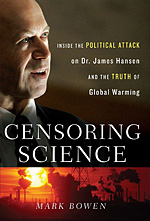
Oh, and the research?  The author of the story in Climbing magazine is Mark Bowen.  Dr. Bowen’s Ph.D. is in physics from MIT. He’s a climber, and he researches climate change on the world’s highest mountains.  His 2005 book, Thin Ice, focused tightly on what we can learn about climate from the world’s highest mountains.   Bowen is the expert Anthony Watts would like to be.

Cover of Mark Bowen's book defending climate science, "Censoring Science."

Cover of Mark Bowen’s book defending climate science, “Censoring Science.”

Bowen’s newest book:  Censoring Science:  Inside the political attack on James Hansen and the truth of global warming. Watts doesn’t want anyone to read that book.  It is easy to imagine Watt’s s attack is, he hopes, pre-emptive, against Bowen’s book.

I’ll wager Watts hasn’t read the article in Climbing, and didn’t know who Bowen was when he launched his attack, though.  The denials of bias coming out of the denialists’ camp will be interesting to watch.

Let the denialists roll out the rope far enough, they’ll inevitably hang themselves.

More:

Do something for freedom: Spread the news

Add to FacebookAdd to NewsvineAdd to DiggAdd to Del.icio.usAdd to StumbleuponAdd to RedditAdd to BlinklistAdd to TwitterAdd to TechnoratiAdd to Furl


Geography education vs. geography learning

January 29, 2010

Angst over the state of education never goes away:

Much more important is the way we seem to have turned away from the very idea of education that sustains a healthy, vibrant liberal democracy.  As I write this I am conscious of how unfashionable it sounds. However, there has been a steady erosion of the notion that education can and should fuel our individual ability to think critically about the world as we find it – which requires knowledge and understanding of how the world has come to be. We are swamped with a language of targets, skills and 21st century ‘learning to learn’, but have forgotten what it is that distinguishes learning (a word that now seems to carry huge weight and always deemed a good thing in itself, when clearly it is not) from education.  All worthwhile education is, in the end self-education, based on the student’s curiosity, their need to know and readiness to rise to the challenge of finding out. Indeed, offering challenge to young people is one way to motivate them – so different from today’s orthodoxy which says we should make learning accessible, bite-sized and achievable by all.

These guys write from England, however, and they write from the vantage point of teaching geography and having just published their book on how better to teach geography.

See their take on what geography teachers should be teaching about Haiti right now.


Yellowstone earthquake swarm, 2010

January 25, 2010

Stop me if you’ve heard this one:

Earthquake swarm hits the area of the Yellowstone Caldera, around Yellowstone Park; wackoes start predicting the End of the World As We Know It, at least for West Yellowstone, Montana, and Jackson Hole, Wyoming.  Unless they are Bobby Jindal, and they predict that the quakes didn’t even happen.

Oh, yeah — that was the series of earthquake swarms in late 2008 and early 2009, right?

Not exactly.  It’s happened again.

Yellowstone Volcano Observatory logo
YELLOWSTONE VOLCANO OBSERVATORY INFORMATION STATEMENT
Thursday, January 21, 2010 2:26 PM MST (Thursday, January 21, 2010 2126 UTC)

Yellowstone Volcano
44°25’48” N 110°40’12” W, Summit Elevation 9203 ft (2805 m)
Current Volcano Alert Level: NORMAL
Current Aviation Color Code: GREEN

The earthquake swarm on the northwest edge of Yellowstone Caldera that began on January 17, 2010 continues.

PRESS RELEASE FROM YVO PARTNER UNIVERSITY OF UTAH SEISMOGRAPH STATIONS

Released: January 21, 2010 2:00PM MST

This release is a continuation of information updates building upon our two previous press releases on the ongoing earthquake swarm on the west side of Yellowstone National Park. The University of Utah Seismograph Stations reports that a pair of earthquakes of magnitude 3.7 and 3.8 occurred in the evening of January 20, 2010 in Yellowstone National Park.

The first event of magnitude 3.7 occurred at 11:01 PM and was shortly followed by a magnitude 3.8 event at 11:16 PM. Both shocks were located around 9 miles to the southeast of West Yellowstone, MT and about 10 miles to the northwest of Old Faithful, WY. Both events were felt throughout the park and in surrounding communities in Wyoming, Montana, and Idaho.

These two earthquakes are part of an ongoing swarm in Yellowstone National Park that began January 17, 2010 (1:00 PM MST). The largest earthquake in the swarm as of 12 PM, January 21, 2010, was a magnitude 3.8. There have been 901 located earthquakes in the swarm of magnitude 0.5 to 3.8. This includes 8 events of magnitude larger than 3, with 68 events of magnitude 2 to 3, and 825 events of magnitude less than 2. There have been multiple personal reports of ground shaking from observations inside the Park and in surrounding areas for some of the larger events (for felt reports, please visit http://earthquake.usgs.gov/eqcenter/dyfi/). Earthquake swarms are relatively common in Yellowstone.

The swarm earthquakes are likely the result of slip on pre-existing faults rather than underground movement of magma. Currently there is no indication of premonitory volcanic or hydrothermal activity, but ongoing observations and analyses will continue to evaluate these different sources.

Seismic information on the earthquake can be viewed at the University of Utah Seismograph Stations: http://www.seis.utah.edu/.

Seismograph recordings from stations of the Yellowstone seismograph network can be viewed online at: http://quake.utah.edu/helicorder/yell_webi.htm.

Anyone who has felt earthquakes in the swarm are encouraged to fill out a form on the USGS Community Felt reports web site: http://earthquake.usgs.gov/eqcenter/dyfi/.

This press release was prepared by the Yellowstone Volcano Observatory partners of the U.S. Geological Survey, the University of Utah, and the National Park Service: http://volcanoes.usgs.gov/yvo/

The Yellowstone Volcano Observatory (YVO) is a partnership of the U.S. Geological Survey (USGS), Yellowstone National Park, and University of Utah to strengthen the long-term monitoring of volcanic and earthquake unrest in the Yellowstone National Park region. Yellowstone is the site of the largest and most diverse collection of natural thermal features in the world and the first National Park. YVO is one of the five USGS Volcano Observatories that monitor volcanoes within the United States for science and public safety.

CONTACT INFORMATION:
Peter Cervelli, Acting Scientist-in-Charge, USGS

pcervelli@usgs.gov (650) 329-5188


The Yellowstone Volcano Observatory (YVO) was created as a partnership among the U.S. Geological Survey (USGS), Yellowstone National Park, and University of Utah to strengthen the long-term monitoring of volcanic and earthquake unrest in the Yellowstone National Park region. Yellowstone is the site of the largest and most diverse collection of natural thermal features in the world and the first National Park. YVO is one of the five USGS Volcano Observatories that monitor volcanoes within the United States for science and public safety.

Here’s the map as of Sunday night, January 24, 9:10 p.m. MST (where the observatory is located); while this map may update here, you may want to click over to the observatory for more information (click on the map):

Yellowstone National Park Special Map, showing earthquakes in last week.

Yellowstone National Park Special Map, showing earthquakes in last week.

Eruptions has a short post on the swarmVolcanism, which covers volcanoes better than Sherwin-Williams covers the world, has a short post, probably appropriate to the newsworthiness.  Stoichiometry mentions them.  Not much to say yet, right?  Yellowstone Insider doesn’t seem too alarmed.

In mass media, The Billings (Montana) Gazette notes that these quakes are probably just shifting rocks, and not volcanic activity.  The headline in the Bozeman (Montana) Daily Chronicle captures the news:  “Earthquake Swarm Suggests Just Another Day in Yellowstone.”

Meanwhile, Scott Bowen at True/Slant sounds just a little alarmistRalph Maughan sets the right tone:  “No, it doesn’t mean the end is near.”  The tinfoil hat concessions probably won’t make nearly the money they did a year ago.

Outside of the Yellowstone and Intermountain areas, students will probably ask about 2012.  Tell them the Mayans didn’t know anything about Old Faithful.

Resources:

Shake a little news to the rest of the world:

Add to FacebookAdd to NewsvineAdd to DiggAdd to Del.icio.usAdd to StumbleuponAdd to RedditAdd to BlinklistAdd to TwitterAdd to TechnoratiAdd to Furl


Annals of Global Warming: Bering Strait, choke point and butterfly effect

January 17, 2010

From the National Science Foundation, we get more stuff that students in high school ought to learn, stuff which would give the conservatives on the Texas State Board of Education full-fledged conniptions, stuff that just doesn’t fit into Texas’s Teach-To-The-Test™ education standards.

Reading the press release brings home two points to me.  First, for the sake of Texas social studies standards, this story tells the physical effects of “choke points.”  The Bering Strait limited human migration to populate the America’s, meeting the definition of choke point favored by Texas Essential Knowledge and Skills (TEKS), and this story sheds light on that issue.  But it also points out that choke points affect more than just humans.  This was a key finding of the President’s Commission on Americans Outdoors that led to a recommendation that we create green corridors favorable for animal migration.  In the Bering Strait, it’s migration of ice and cold and warm water that get choked off — and that, too, affects human history.  Second, this may enlighten students to the butterfly effect noted in the science we call chaos, where a small physical perturbation in one area can have enormous consequences later, and far away, in the dynamic systems that keep our planet alive.  (Yeah, the Bering Strait is bigger than a butterfly.  I know.)

Press Release 10-003

Global Ice Age Climate Patterns Influenced by Bering Strait

Small geographic feature has large impacts on climate

Ice pouring through the Bering Strait, from the Arctic to Pacific Ocean - NASA photo via NSF

Ice is shown choking the Bering Strait in recent times; the ice moves from the strait south to the Bering Sea. Credit: NASA

January 10, 2010

In a vivid example of how a small geographic feature may have far-reaching impacts on climate, new research shows that water levels in the Bering Strait helped drive global climate patterns during ice age episodes dating back more than 100,000 years.

The international study, led by scientists at the National Center for Atmospheric Research (NCAR) in Boulder, Colo., found that the repeated opening and closing of the narrow strait due to fluctuating sea levels affected currents that transported heat and salinity in the Atlantic and Pacific Oceans.

As a result, summer temperatures in parts of North America and Greenland oscillated between comparatively warm and cold phases, causing ice sheets to alternate between expansion and retreat and affecting sea levels worldwide.

While the findings do not directly bear on current global warming, according to Steve Nelson, National Science Foundation (NSF) program director for NCAR, they highlight the complexity of Earth’s climate system and the fact that seemingly insignificant changes can lead to dramatic tipping points for climate patterns, especially in and around the Arctic.

“The global climate is sensitive to impacts that may seem minor,” says NCAR scientist Aixue Hu, the project’s lead scientist. “Even small processes, if they are in the right location, can amplify changes in climate around the world.”

The research results are published this week in the journal Nature Geoscience.

Funded by NSF and the U.S. Department of Energy, the scientists used the latest generation of supercomputers to study past climate at a level of detail that would have been impossible just a few years ago.

Hu and his colleagues set out to solve a key mystery of the last glacial period: Why, starting about 116,000 years ago, did northern ice sheets repeatedly advance and retreat for about the next 70,000 years? The enormous ice sheets held so much water that sea levels rose and dropped by as much as about 100 feet (30 meters) during these intervals.

In other cases, scientists have associated such major oscillations in climate with fluctuations in Earth’s orbit around the Sun. But in the time period the research team looked at, the orbital pattern did not correspond with the geologic movement of the ice sheets and associated sea level changes.

The researchers considered an alternative possibility: that changes in the Bering Strait, the main gateway in the Northern Hemisphere between the Atlantic and Pacific Oceans, might have affected ocean currents across much of the globe.

Although small–the strait is currently about 50 miles (80 kilometers) wide between Russia and the westernmost islands of Alaska–it allows water to circulate from the relatively fresh north Pacific to the saltier north Atlantic via the Arctic Ocean. This flow is instrumental to regulating the strength of a current known as the meridional overturning circulation, a key driver of heat from the tropics to the poles.

Using the NCAR-based Community Climate System Model, a powerful computer tool for studying worldwide climate, the researchers compared the responses of ice age climate to conditions in the Bering Strait.

They ran the model on new supercomputers at NCAR and the Department of Energy’s Oak Ridge National Laboratory, enabling them to focus on smaller-scale geographic features that, until recently, could not be captured in long-term simulations of global climate.

The simulations accounted for the changes in sea level, revealing a recurring pattern–each time playing out over several thousand years–in which the reopening and closing of the strait had a far-reaching impact on ocean currents and ice sheets.

As the climate cooled because of changes in Earth’s orbit, northern ice sheets expanded. This caused sea levels to drop worldwide, forming a land bridge from Asia to North America and nearly closing the Bering Strait.

With the flow of comparatively fresh water from the Pacific to the Atlantic choked off, the Atlantic grew more saline. The saltier and heavier water led to an intensification of the Atlantic’s meridional overturning circulation, a current of rising and sinking water that, like a conveyor belt, pumps warmer water northward from the tropics.

This circulation warmed Greenland and parts of North America by about 3 degrees Fahrenheit (1.5 degrees Celsius)–enough to reverse the advance of ice sheets in those regions and reduce their height by almost 400 feet (112 meters) every thousand years. Although the Pacific cooled by an equivalent amount, it did not have vast ice sheets that could be affected by the change in climate.

Over thousands of years, the Greenland and North American ice sheets melted enough to raise sea levels and reopen the Bering Strait.

The new inflow of fresher water from the Pacific weakened the meridional overturning circulation, allowing North America and Greenland to cool over time. The ice sheets resumed their advance, sea levels dropped, the Bering Strait again mostly closed, and the entire cycle was repeated.

The combination of the ocean circulation and the size of the ice sheets–which exerted a cooling effect by reflecting sunlight back into space–affected climate throughout the world.

The computer simulations showed that North America and Eurasia warmed significantly during the times when the Bering Strait was open, with the tropical and subtropical Indian and Pacific Oceans, as well as Antarctica, warming slightly.

The pattern was finally broken about 34,000 years ago, the point in Earth’s 95,000-year orbital cycle at which the planet was so far from the Sun at certain times of year that the ice sheets continued to grow even when the Bering Strait closed.

When the orbital cycle brought Earth closer to the Sun in the northern winter, the ice sheets retreated sufficiently about 10,000 years ago to reopen the strait. This helped lead to a relatively stable climate, nurturing the rise of civilization.

“This kind of study is critical for teasing out the nuances of our climate system,” says NCAR scientist Gerald Meehl, a co-author of the paper. “If we can improve our understanding of the forces that affected climate in the past, we can better anticipate how our climate may change in the future.”

In addition to NCAR, the study team included researchers from the National Center for Scientific Research (CNRS) in France, University of Colorado in Boulder, Catholic University of Louvain in Belgium, Australian National University and Harvard University.

-NSF-
Download the high-resolution JPG version of the image [of ice flowing through the Bering Strait, above]. (1.4 MB)

Bering Strait, NASA photo via National Science Foundation

The Bering Strait separates the U.S. and Russia by only 90 kilometers. Credit: NASA

Download the high-resolution JPG version of the image. (570 KB)

Currents move warm and cold water across the Arctic Ocean - UCAR map

Altered currents once produced ocean warming (right, dark red) that melted ice sheets. Credit: UCAR

Download the high-resolution JPG version of the image. (680 KB)

Media Contacts
Cheryl Dybas, NSF (703) 292-7734 cdybas@nsf.gov
David Hosansky, NCAR/UCAR (303) 497-8611 hosansky@ucar.edu

The National Science Foundation (NSF) is an independent federal agency that supports fundamental research and education across all fields of science and engineering. In fiscal year (FY) 2009, its budget is $9.5 billion, which includes $3.0 billion provided through the American Recovery and Reinvestment Act. NSF funds reach all 50 states through grants to over 1,900 universities and institutions. Each year, NSF receives about 44,400 competitive requests for funding, and makes over 11,500 new funding awards. NSF also awards over $400 million in professional and service contracts yearly.

Get News Updates by Email

Useful NSF Web Sites:
NSF Home Page: http://www.nsf.gov
NSF News: http://www.nsf.gov/news/
For the News Media: http://www.nsf.gov/news/newsroom.jsp
Science and Engineering Statistics: http://www.nsf.gov/statistics/
Awards Searches: http://www.nsf.gov/awardsearch/

Bookmark those sites, teachers.

More:


Texas social studies standards: Beware the ides of January

January 15, 2010

News reports in Texas this morning said that several of the right-wing, gut-education-standards changes proposed to social studies standards had failed in voting on Thursday, January 14.  But, much more was to be done, and the SBOE adjourned early last night to continue voting today.

In a pattern familiar to education advocates in Texas, board member Don McLeroy (R-Pluto) today proposed a long series of amendments, apparently off-the-cuff, but probably written up in earlier strategy sessions.  These last-minute amendments tend to pass having missed any serious scrutiny.

Will he be able to ruin Texas education for the next decade?  I cannot follow the live webcasts; Steve Schafersman is working to stop the amendments, rather than merely blog about them.  We probably won’t know the extent of the damage for weeks.  McLeroy cherishes his role as a Port-au-Prince-style earthquake to Texas education. (Pure coincidence, I’m sure — Ed Brayton summarizes McLeroy’s politics today.)

Watch that space, and other news sources.  I may provide updates here, as I can get information.


Social studies train wreck at Texas State Board of Education: Live! A Nation at Risk

January 13, 2010

Steve Schafersman will live blog the hearings on social studies standards before the Texas State Board of Education (SBOE) today, at Evo-Sphere.  Schafersman is president of Texas Citizens for Science, and a long-time activist for better education in Texas on all topics.

Rapid updates or live-blogging should be available at the blog of the Texas Freedom Network, TFN Insider.

It’s Item #6 on the SBOE agenda, with a title that tips off the trouble:

Item #6 — Public Hearing Regarding Proposed Revisions to 19 TAC Chapter 113, Texas Essential Knowledge and Skills for Social Studies, and Chapter 118, Texas Essential Knowledge and Skills for Economics with Emphasis on the Free Enterprise System and Its Benefits.

Schafersman e-mailed an introduction to the meeting:

Some say the Social Studies public testimony by the religious right, liberals, etc., then the SBOE debate, motions to amend, votes, etc. is a bigger circus than adopting the science standards. Judge for yourself. You can watch the entire circus, carnival, and sideshow on the webcast video at http://www.texasadm in.com/cgi- bin/tea.cgi

This is Texas democracy in action, when sullen and tight-lipped State Board members listen to public testifiers for 3 minutes each and profoundly ignore them since they already know what they are going to do. But I, at least, feel better after speaking so I don’t later feel responsible for the crappy amendments, changes, and policies that come out of this horrible Board because I did nothing. The proposed Social Studies standards written by the panels composed of teachers and professors are excellent (when have I heard this before), but the SBOE can’t wait to shamelessly impose their own Religious Right agenda on them.

You’ll recall that SBOE has at every possible turn disregarded the advice of famous and serious historians, respected free-market-advocating economists, geographers and educators on these standards.  Economists, for example, want Texas kids to learn about “capitalism,” since that’s what it’s called by economists and policy makers, and colleges.  SBOE thinks “capitalism” sounds too subversive, and wishes instead to require Texas kids to learn about “free enterprise” instead.

‘A rose by any other name’ you think, until you start thinking of how Texas kids do on standardized tests, college admission exams, and the punchline on the joke, about Texas kids being told not to study capitalism.  No siree, no capitalism in the fictional home of J. R. Ewing, never mind the real-life capitalists like T. Boone Pickens or H. Ross Perot (Jr. and Sr.).

In Dallas, the city prepares to name a street after Cesar Chavez, the great Hispanic union organizer and advocate for working Americans.  In Austin, SBOE works to strike all mentions of Chavez, because they dislike the politics of heroes of our ethnic minorities (soon to be a majority in Texas).  In Washington historians and policy-makers follow the legacy of Thurgood Marshall, the great civil rights attorney and first African-American to sit on the U.S. Supreme Court.  In Austin, SBOE thinks Marshall should be left out of history books.  Many of us suspect he’s anathema to the white right-wing in Austin:  A smart, successful and noble man of color.

Mel and Norma Gabler died years ago, but their history lingers in the halls of education policy in Austin.  It’s Shakespearean.

This is a massive battle.  David Barton worked for 30 years to gut history standards nationally to teach a history of America that never was, and as the official religionist appointee of the right-wing SBOE members, he stands on the brink of accomplishing much of the revisionism he’s advocated.  See the Texas Tribune story on the issue, “Hijacking History.”

Generally we shouldn’t negotiate with terrorists, Ronald Reagan said.  At the SBOE, we’ve put the terrorists in charge of history and economic curricula — if not the terrorist themselves, at least the terrorists’ camels’ noses.  Texas’s process has earned flashing red-light, claxon-sounding repeating of the words of Ronald Reagan’s Commission on Excellence in Education:  If a foreign nation did this to us, we’d consider it an act of war [excerpt below the fold].

Make no mistake about it.  SBOE’s goal is to roll back any of the reforms left from Reagan’s Commission’s work.  Our nation is more at risk from foreign competition than ever before.  SBOE plans to give away a bit more of our future to China, this week.

Our saving grace is the general incompetence of SBOE members to make significant reform in Texas’s wounded schools, reeling from unworkable and damaging requirements under the No Child Left Behind Act and a testing program that severely limits what can be taught in any social studies course other than those bastions of learning left in International Baccalaureate programs and Advanced Placement courses (estimates are that between 5% and 10% of Texas high school students can take one of those good courses).  Whatever silliness, craziness or lies SBOE orders to  be taught, it can’t be taught and tested well.  Inertia preventing change works to save America in this case.

In business, most CEOs at least appreciate the value of having good front-line employees who are the ones who really deliver the service or product and produce the profit of the enterprise (even if they don’t treat those employees so well as the employees deserve).  Education may be the last bastion of flogging the horse that should be pulling the cart instead.  In this case, having well-trained teachers in the classroom is the last hope for Texas, Texas parents and Texas students — and Texas’s economic future and future in liberty.  Teachers are the last defense of freedom in Texas.  Today SBOE will make another assault on the ramparts that protect the teachers in their work.

When will the French fleet arrive to lend aid?  Will it arrive at all?  And if it arrives, will Texas kids know better than to shoot at the ships?

Carol Haynes, who claims to have a doctorate in some discipline, told the board how to rewrite the standards to completely change the history of the civil rights movement in their last hearing on the topic.  According to Haynes, apparently, Dr. Martin Luther King, Jr., was opposed to civil rights and Barry Goldwater was in favor — the Board didn’t offer to correct her revisionism, but instead asked her to go beyond her three minutes in fawning acceptance. This appears to be SBOE’s approval of various Other Universe hypotheses offered by Star Trek, allowing any damned thing at all to be taught as history (except the right stuff).  Haynes is scheduled to testify again (#128), probably very late at night, but perhaps in time for the 10:00 p.m. Texas television news broadcasts.  Oy.

Excerpt from the Report of the Commission on Excellence in Education, A Nation at Risk, below the fold.

ae_summer2015mehta_opener-1100x736

Cover of A Nation at Risk: The Imperative for Educational Reform, the 1983 report that started the education reform mess. AFT graphic.

Stand up for your nation, it’s children and future; sound the alarm:

Add to FacebookAdd to NewsvineAdd to DiggAdd to Del.icio.usAdd to StumbleuponAdd to RedditAdd to BlinklistAdd to TwitterAdd to TechnoratiAdd to Furl


Read the rest of this entry »


Schafersman’s testimony on social studies standards, to Texas SBOE

January 13, 2010

Dr. Steve Schafersman will testify on proposed new standards for social studies in Texas public schools, at a hearing before the Texas State Board of Education (SBOE) scheduled for today, January 13, 2009.

Schafersman is president of Texas Citizens for Science and its driving force.  He’ll also live blog much of the hearing at his blog, Evo-Sphere.  You should probably watch TFN Insider, the blog of the Texas Freedom Network, too.

Schafersman’s testimony was released in advance, and reprinted below.

Public Testimony of
Steven D. Schafersman

Texas State Board of Education Public Hearing
Austin
, Texas; Wednesday, 2009 January 13

I am grateful for the opportunity to address you about Social Studies standards for which I am testifying as a private citizen. Tomorrow you will begin your work to adopt the new Social Studies TEKS. I closely read and evaluated the proposed Grade 8 Social Studies, High School U. S. History, U. S. Government, World History, and World Geography standards and found them to be quite satisfactory. The standards were extremely comprehensive, balanced, fair-minded, and honest. The members of the panels who wrote them did an outstanding job and I was very impressed by their knowledge and professionalism. I urge that you adopt these Social Studies standards without change.

My experience with this Board leads me to suspect that some of you don’t want to adopt these excellent standards–written by social studies curriculum experts and teachers–without change. After all, these standards were written by experts and some of you feel obliged to stand up to the experts. Some of you may want to change some of the standards to correspond to your own political and religious beliefs, such as the mistaken notions that the United States is a Christian nation, that we do not have a secular government, or that separation of church and state is a myth. Some of you may want to add more unnecessary information about Christian documents or Christian history in America. If some of you do wish to make such changes, I request that you restrain yourselves. Please resist the temptation to engage in the same behavior some of you exhibited last year when you perverted the Science standards and embarrassed the citizens of Texas by engaging in pseudoscientific anti-intellectual behavior. While the Texas State Board of Education has a long and proud history of anti-intellectualism, the economic conditions today demand that we stop that practice and return to professionalism and respect for academic achievement so that our children have a future in which they will use their minds to make a living in intellectual pursuits and not their limbs in a service economy.

During the adoption of the science standards, some Board members amended the Biology and Earth and Space Science standards by engaging in fast talking, omitting pertinent information about what was being changed, offering bogus “compromises” that were not really fair compromises, and referring to “experts” who were in fact pseudoscientists and not real experts at all. I hope to not witness the same behavior tomorrow but I am pessimistic. Two pseudo-historians, David Barton and Peter Marshall, were appointed as “experts” and there is plenty of evidence available that demonstrates that these two gentlemen are preachers and polemicists for their radical agendas, not legitimate history experts.

I urge the rational and conservative Board members–whom I hope still make up a majority of this Board–to resist proposed radical amendments that attempt to insert bogus histories of American exceptionalism, America’s presumed Christian heritage as the source of our liberties and Constitutional principles, and other historical myths perpetrated by the American Religious Right. I urge you to vote No to such radical amendments, not Abstain or your radical opponents will gain the same advantage that they enjoyed during the amendment process for the Science standards, where they were delighted when some of you abstained or did not vote since that made it easier for them to obtain majorities which allowed them to win several amendments that made changes detrimental to science education. Unlike last year, when you were prevented from consulting your legitimate Science experts during debate, please consult your genuine Social Studies experts, Texas Professors Kracht, Hodges, and de la Teja. Please try to avoid the same mistakes with the Social Studies adoption process that occurred with the Science standards adoption, so no one will be able to accuse you of being anti-intellectual.


Trouble at Texas Board of Education: Social studies

January 11, 2010

Here is a news rundown of stories on the Texas State Board of Education, who have been planning for a year now to mess up social studies standards for Texas public schools, this week.

Get on your horse and warn Texans:  The Idiots are coming to get your good schoolbooks:

Add to FacebookAdd to NewsvineAdd to DiggAdd to Del.icio.usAdd to StumbleuponAdd to RedditAdd to BlinklistAdd to TwitterAdd to TechnoratiAdd to Furl


Annals of Global Warming: Black soot and glaciers in Tibet

January 5, 2010

Another in a series on the history of global warming; this comes from the Earth Observatory at NASA (visit that site — the image is more stunning, larger):

tibet_geos5_2009269

Black Soot and the Survival of Tibetan Glaciers

Posted December 15, 2009
Black Soot and the Survival of Tibetan Glaciers

Color bar for Black Soot and the Survival of Tibetan Glaciers
download large image (677 KB, JPEG) acquired September 26, 2009
download large animation image (9 MB, M4V) acquired August 1, 2009 – November 9, 2009

On the Tibetan Plateau, temperatures are rising and glaciers are melting faster than climate scientists would expect based on global warming alone. A recent study of ice cores from five Tibetan glaciers by NASA and Chinese scientists confirmed the likely culprit: rapid increases in black soot concentrations since the 1990s, mostly from air pollution sources over Asia, especially the Indian subcontinent. Soot-darkened snow and glaciers absorb sunlight, which hastens melting, adding to the impact of global warming.

NASA climate scientists combine satellite and ground-based observations of soot and other particles in the air with weather and air chemistry models to study how the atmosphere moves pollution from one place to another. This image is from a computer simulation of the spread of black soot (“black carbon” to climate scientists) over the Tibetan Plateau from August through November 2009. It shows black carbon aerosol optical thickness on September 26, 2009. (Aerosol optical thickness is scale that describes how much pollution was in the air based on how much of the incoming sunlight the particles absorbed.) Places where the air was thick with soot are white, while lower concentrations are transparent purple.

The highest concentrations of black soot are in the right-hand side of the image, over the densely populated coastal plain of China. But high concentrations occur over India, as well, and the black soot spreads across the southern arc of the Tibetan Plateau, which is defined by the towering peaks of the Himalaya Mountains. (Note: Topography has been exaggerated to highlight features that influence air movement). The animation shows how the black carbon pollution from India often circulates at high concentrations for several days against the base of the Himalaya, periodically “sloshing” over the rim of the mountains and spilling northward over the plateau, before being carried away over the Bay of Bengal or the Arabian Sea.

Writing about the implications of the study for the Goddard Institute for Space Studies Website, NASA climate scientist and study co-author James Hansen said, “[C]ontinued, ‘business-as-usual’ emissions of greenhouse gases and black soot will result in the loss of most Himalayan glaciers this century, with devastating effects on fresh water supplies in dry seasons. The black soot arises especially from diesel engines, coal use without effective scrubbers, and biomass burning, including cook stoves. Reduction of black soot via cleaner energies would have other benefits for human health and agricultural productivity. However, survival of the glaciers also requires halting global warming, which depends upon stabilizing and reducing greenhouse gases, especially carbon dioxide.”

NASA image by Gregory Shirah, Goddard Scientific Visualization Studio, based on model simulations from the Goddard Earth Observing System Model, Version 5 (GEOS-5). Caption by Rebecca Lindsey.


Geography quiz: In space, who will accept your teeming masses?

December 3, 2009

Lady Liberty from space, European Space Agency photo

What is this famous landmark?

This could be an interesting geography or history bell ringer.  What are these famous sites pictured above?

Answer below the fold.

Read the rest of this entry »


The unbearable lightness of Palin groupies

November 24, 2009

I’m not sure what to make of this.  No amount of dopeslapping or head:desk banging is going to help these people get a clue.

And while I haven’t read Sarah Palin’s book, I’ll wager they won’t get a clue there, either.  Listening to the interviews one wonders whether they would be able to read Palin’s book.  Most of the kids who work hard to fail my classes look like geniuses next to these people.

And then a horrifying thought bubbles up:  Dear God, these people might actually vote!  They probably view Jay Leno’s “Jaywalking” sequences with astonished looks and great confusion.  They can’t tell what’s wrong with the answers, and they miss the humor.

I found this piece at Canadian Cynic (from whom I stole the headline) — he confessed he could only stand just under two minutes of this torture.

For Palin groupies, here are a couple of issues to consider while watching this video:

  1. While it’s done by New Left Media, it’s astonishing that anyone could find so many babbling idiots at one gathering, anywhere in America.  This was Ohio?   Yeah, Columbus; I know people in Columbus.  I fear for their lives, now.
  2. Palin has never made any particular defense of the First Amendment, nor of any of the five freedoms it enumerates.  When people say she stands for “freedom to speak,” or “freedom of religion,” they are making stuff up.
  3. “Realness” is not a policy.
  4. Tax cutting isn’t generally a great policy when people aren’t making enough to pay any taxes at all.  Tax cutting contributed to our current mess.
  5. Socialism is not “giving away money.”
  6. Obama’s two books do not portray Marxism in a good light.  They don’t mention Marxism as a potential path for any American, anywhere.
  7. “Czar” is a shorter word for a headline than “Administrator of the Environmental Protection Agency,” or “Special Assistant to the President for Energy Policy.”  People who are called “czars” by headline writers do not have any special powers beyond being right when they speak to the president (among many other advisors).  The real power is held by agency heads, like the Secretary of Defense, and the Secretary of Treasury.  The President’s Cabinet is not a wooden device in which he keeps his dinnerware.
  8. One may always question motives, but on the issue of Obama’s “liking” the military, consider:  He’s appointed many former military people to important positions, including U.S. Ambassador to Afghanistan, Lt. Gen. Karl Eikenberry, to get good advice from people who know the military well; Obama is the only president since Johnson, maybe since Lincoln, to go meet victims of war as their caskets come back to their families; Obama is the only sitting president ever to visit the graves of victims of a current conflict at Arlington National CemeteryThe lives and welfare of our men and women in uniform has been a singular focus of this president.
  9. Talk of martial law?  Not from Obama.  Not in the administration.  Not in any agency.  Not in Congress.  Only in wingnut dens.
  10. Illegal aliens cannot be naturalized under current law.  No illegal aliens are being naturalized.  When found, they are being deported.
  11. Obama is an American citizen; even the courts are getting testy about that, tossing the crazy lawsuits out with harsh comments for people who are so gullibly dumb.
  12. It’s 700 miles from Sarah Palin’s home to the nearest point in Russia.  “Seeing Russia from the backyard” is a figure of speech, and not accurate in any way.
  13. The Governor of Alaska is not the first defense against any attack from a foreign nation on the U.S., coming through Alaska.  The U.S. Air Force has jurisdiction, and still patrols that area, along with satellite and radar surveillance.  In an attack, the official role of the Governor of Alaska is to duck and stay out of the way.
  14. The Governor of Alaska has no special security clearance that no other governor has.  I’m not sure that any governor has a security clearance as governor.
  15. People for the Ethical Treatment of Animals (PETA) is not a player in the protection of polar bears, nor any other animal on listed as threatened or endangered.
  16. No proposal is before Congress to change current law on “partial birth” abortion.  Since there is a law on the topic, it would take a new law, passed by Congress, to change current law.  Obama can’t touch it without Congressional action.  (This is basic civics, you know?)
  17. Are you afraid of what’s happening in America?  After you listen to these yahoos, you may have cause to fear what would happen if their views were to carry an election.

Are people still lining up for lobotomies?  Do they directly from the operating table to a Sarah Palin book signing?

We can hope New Left Media edited out all the cogent, intelligent remarks.  I have this nagging fear that they didn’t have to edit at all.

Add to FacebookAdd to NewsvineAdd to DiggAdd to Del.icio.usAdd to StumbleuponAdd to RedditAdd to BlinklistAdd to TwitterAdd to TechnoratiAdd to Furl


Geography Awareness Week, November 15-21

November 6, 2009

Geography Awareness week is sneaking up — November 15-21.

Got your special lesson plans ready, teachers?


Surely we’ve found everything by now

November 4, 2009

Well, no, we haven’t.  Nice little post by a photographer urging people to go look to see what they can find, with a brilliantly concise set of arguments about big things discovered just in the past few years.

Nice photos, too — go see.


Definition of “urbanization”: Glowing Cities Under a Nighttime Sky on Flickr – Photo Sharing

October 2, 2009

Pleasant to watch, this time-lapse composition highlights the light pollution aspect of increasing urbanization across the United States.  The photographer, a Dutch architect, notes that each streak of light represents a city, as he flies across the American Midwest to touchdown in San Francisco (SFO).  It’s a visual definition of urbanization, isn’t it?

On my night time flight back to SF from Amsterdam, I noticed that the lights from cities were making the clouds glow. Really spectacular and ethereal – it was really seeing the impact of urban environments from a different perspective. Each glow or squiggle represents one town or city!

Luckily the flight was half empty, so I was able to set up an improvised stabilizer mound made up of my bags, pillows, and blankets for my camera to sit on.

We were around the midwest at the beginning of the clip, and there were fewer cities once we hit the rockies. the bridge at the end is the san mateo bridge.

Technique: 1600iso; beginning – 1 (30sec) exposure / 45secs; end – 1 (4sec) exposure / 10 secs; total elapsed time: around 3 hours?

Equipment used: Nikon D300 (interval shooting mode), Tokina 12-24mm.

Music: Bloc Party – Signs

Stunning, beautiful and troubling at the same time.

Vodpod videos no longer available.

more about “Definition of “urbanization”: Glowin…“, posted with vodpod

Can you use this in your classroom?

Tip of the old scrub brush to One Man’s Blog.

Share the light with your friends:

Add to FacebookAdd to NewsvineAdd to DiggAdd to Del.icio.usAdd to StumbleuponAdd to RedditAdd to BlinklistAdd to TwitterAdd to TechnoratiAdd to Furl