Yellowstone earthquake swarm, 2010

January 25, 2010

Stop me if you’ve heard this one:

Earthquake swarm hits the area of the Yellowstone Caldera, around Yellowstone Park; wackoes start predicting the End of the World As We Know It, at least for West Yellowstone, Montana, and Jackson Hole, Wyoming.  Unless they are Bobby Jindal, and they predict that the quakes didn’t even happen.

Oh, yeah — that was the series of earthquake swarms in late 2008 and early 2009, right?

Not exactly.  It’s happened again.

Yellowstone Volcano Observatory logo
YELLOWSTONE VOLCANO OBSERVATORY INFORMATION STATEMENT
Thursday, January 21, 2010 2:26 PM MST (Thursday, January 21, 2010 2126 UTC)

Yellowstone Volcano
44°25’48” N 110°40’12” W, Summit Elevation 9203 ft (2805 m)
Current Volcano Alert Level: NORMAL
Current Aviation Color Code: GREEN

The earthquake swarm on the northwest edge of Yellowstone Caldera that began on January 17, 2010 continues.

PRESS RELEASE FROM YVO PARTNER UNIVERSITY OF UTAH SEISMOGRAPH STATIONS

Released: January 21, 2010 2:00PM MST

This release is a continuation of information updates building upon our two previous press releases on the ongoing earthquake swarm on the west side of Yellowstone National Park. The University of Utah Seismograph Stations reports that a pair of earthquakes of magnitude 3.7 and 3.8 occurred in the evening of January 20, 2010 in Yellowstone National Park.

The first event of magnitude 3.7 occurred at 11:01 PM and was shortly followed by a magnitude 3.8 event at 11:16 PM. Both shocks were located around 9 miles to the southeast of West Yellowstone, MT and about 10 miles to the northwest of Old Faithful, WY. Both events were felt throughout the park and in surrounding communities in Wyoming, Montana, and Idaho.

These two earthquakes are part of an ongoing swarm in Yellowstone National Park that began January 17, 2010 (1:00 PM MST). The largest earthquake in the swarm as of 12 PM, January 21, 2010, was a magnitude 3.8. There have been 901 located earthquakes in the swarm of magnitude 0.5 to 3.8. This includes 8 events of magnitude larger than 3, with 68 events of magnitude 2 to 3, and 825 events of magnitude less than 2. There have been multiple personal reports of ground shaking from observations inside the Park and in surrounding areas for some of the larger events (for felt reports, please visit http://earthquake.usgs.gov/eqcenter/dyfi/). Earthquake swarms are relatively common in Yellowstone.

The swarm earthquakes are likely the result of slip on pre-existing faults rather than underground movement of magma. Currently there is no indication of premonitory volcanic or hydrothermal activity, but ongoing observations and analyses will continue to evaluate these different sources.

Seismic information on the earthquake can be viewed at the University of Utah Seismograph Stations: http://www.seis.utah.edu/.

Seismograph recordings from stations of the Yellowstone seismograph network can be viewed online at: http://quake.utah.edu/helicorder/yell_webi.htm.

Anyone who has felt earthquakes in the swarm are encouraged to fill out a form on the USGS Community Felt reports web site: http://earthquake.usgs.gov/eqcenter/dyfi/.

This press release was prepared by the Yellowstone Volcano Observatory partners of the U.S. Geological Survey, the University of Utah, and the National Park Service: http://volcanoes.usgs.gov/yvo/

The Yellowstone Volcano Observatory (YVO) is a partnership of the U.S. Geological Survey (USGS), Yellowstone National Park, and University of Utah to strengthen the long-term monitoring of volcanic and earthquake unrest in the Yellowstone National Park region. Yellowstone is the site of the largest and most diverse collection of natural thermal features in the world and the first National Park. YVO is one of the five USGS Volcano Observatories that monitor volcanoes within the United States for science and public safety.

CONTACT INFORMATION:
Peter Cervelli, Acting Scientist-in-Charge, USGS

pcervelli@usgs.gov (650) 329-5188


The Yellowstone Volcano Observatory (YVO) was created as a partnership among the U.S. Geological Survey (USGS), Yellowstone National Park, and University of Utah to strengthen the long-term monitoring of volcanic and earthquake unrest in the Yellowstone National Park region. Yellowstone is the site of the largest and most diverse collection of natural thermal features in the world and the first National Park. YVO is one of the five USGS Volcano Observatories that monitor volcanoes within the United States for science and public safety.

Here’s the map as of Sunday night, January 24, 9:10 p.m. MST (where the observatory is located); while this map may update here, you may want to click over to the observatory for more information (click on the map):

Yellowstone National Park Special Map, showing earthquakes in last week.

Yellowstone National Park Special Map, showing earthquakes in last week.

Eruptions has a short post on the swarmVolcanism, which covers volcanoes better than Sherwin-Williams covers the world, has a short post, probably appropriate to the newsworthiness.  Stoichiometry mentions them.  Not much to say yet, right?  Yellowstone Insider doesn’t seem too alarmed.

In mass media, The Billings (Montana) Gazette notes that these quakes are probably just shifting rocks, and not volcanic activity.  The headline in the Bozeman (Montana) Daily Chronicle captures the news:  “Earthquake Swarm Suggests Just Another Day in Yellowstone.”

Meanwhile, Scott Bowen at True/Slant sounds just a little alarmistRalph Maughan sets the right tone:  “No, it doesn’t mean the end is near.”  The tinfoil hat concessions probably won’t make nearly the money they did a year ago.

Outside of the Yellowstone and Intermountain areas, students will probably ask about 2012.  Tell them the Mayans didn’t know anything about Old Faithful.

Resources:

Shake a little news to the rest of the world:

Add to FacebookAdd to NewsvineAdd to DiggAdd to Del.icio.usAdd to StumbleuponAdd to RedditAdd to BlinklistAdd to TwitterAdd to TechnoratiAdd to Furl


News flash: Texas has a second natural lake!

July 20, 2009

Years ago, in Virginia, I had learned that Virginia had only one natural lake, the Great Dismal Swamp.  Accompanying that chunk of information in that lecture was that Texas had only two natural lakes.

But upon arriving in Texas, I could find reference to only one natural lake, Caddo, and it had ceased being fully natural when its maintenance fell to a dam.

What happened to Texas’s second natural lake?

A Google search right now on “Texas +’natural lake'” produces ten listings on the first page, all of them pointing to the fact that Texas has just one natural lake.  Here are the first five:

I have found a second natural lake in Texas. It’s not a new discovery at all — it’s just a case of people not having the facts, and overlooking how to find the truth.  It’s especially difficult when the lake hides itself.

Our testing coordinator at Molina High School, Brad Wachsmann, spins yarns that belie his youth.  In the middle of one yarn last year, corroborated by other yarns, he mentioned that he has family in Big Lake, Texas; and he described visiting and having relatives urge people to run out and see the lake since it’s rebirth in torrential rains.

“A second natural lake in Texas?” I asked.  Wachsmann knew the drill.  Yes, Big Lake is a natural lake in Texas, and yes, people forget about it.

Texas teachers, listen to your testing coordinators, okay?

All of this came to mind reading the Austin American-Statesman, still a bastion of great journalism despite problems in the newspaper industry.  On Monday, July 7, the paper ran a story and an editorial about the clean up of the oil industry refuse that killed the shoreline of part of the lake; the springs that once fed the lake have mostly gone dry, but that’s likely due to agricultural water mining.

It’s a story of boom and bust, environmental degradation for profit, and eventual recovery we hope.

Looking at the landscape that surrounds the Reagan County seat, you wonder whether the name Big Lake was somebody’s idea of joke. It’s dry and dusty, where the flora sprouts reluctantly and lives precariously.

Yet, the West Texas town of Big Lake got its name from a natural lake that was fed by springs that have long since gone dry. While the area may not fit everyone’s definition of photogenic, it has its own brand of charm – charm that could be enhanced if the damage done to the fragile ecosystem by salt spills were reversed or even minimized.

As the American-Statesman’s Ralph K.M. Haurwitz reported in Monday’s editions, the University of Texas and Texas A&M systems have benefited from the $4.4 billion in royalty payments and mineral income produced by its West Texas acreage since Santa Rita No. 1 well came in on May 28, 1923.

The salt water byproduct of oil and natural gas production, however, contaminated 11 square miles near Big Lake, killing most everything that grows. The lack of vegetation allows wind and water erosion.

Hey, it gets better.  This is real Texas history, real American history — you can’t make this stuff up.  Haurwitz’s article talks about the heritage of Texas education.   Remember that old story about setting aside certain sections of townships to help fund education in lands on the American frontier?  Texas wasn’t a public lands state as farther west, but it still reserved sections of land for the benefit of education.

Rose petals blessed by a priest?  I’ll wager the priest didn’t make the trip to the top of the derrick.  Haurwitz wrote:

BIG LAKE — Investors appealed to the patron saint of impossible causes when oil drilling began on University of Texas System land in 1921. It didn’t hurt.

Santa Rita No. 1 blew in on May 28, 1923, after rose petals blessed by a priest were scattered from the top of the derrick at the behest of some Catholic women in New York who had purchased shares in the Texon Oil and Land Co., which drilled that first well.

Since then, the UT System’s 2.1 million acres in West Texas have produced $4.4 billion in royalty payments and other mineral income for the Permanent University Fund, an endowment that supports the UT and Texas A&M University systems.

But this long-running bonanza for higher education exacted a price from the remote, semiarid landscape where it all began. Millions of barrels of salt water, a byproduct of oil and natural gas production, contaminated 11 square miles, or more than 7,000 acres, killing virtually all vegetation and leaving the land vulnerable to wind and water erosion. Hundreds of mesquite stumps with three feet of exposed roots testify to the dramatic loss of topsoil.

Texas, and Big Lake - from BigLakeTx.com

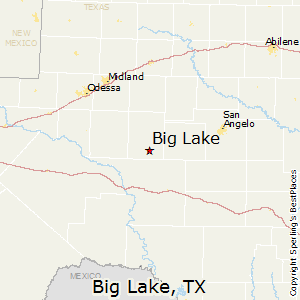
Where in Texas is Big Lake?

The town of Big Lake is just north of the lake itself, on State Highway 137 running north and south, and U.S. Highway 67 running east and west, approximately 65 miles west of San Angelo.   Big Lake sits about 10 miles north of Interstate 10, and about 75 miles south of Interstate 20.  Big Lake calls itself “the gateway to the Permian Basin.”

Big Lake is the home of Reagan County High School.  Jim Morris was baseball coach for the Reagan High Owls when his team persuaded him to try out for a major league baseball team.  His story was chronicled, with some artistic license, in the Disney movie “Rookie.”

Land managers are working to stop erosion on the often-dry shores of Big Lake using any trick they can find.  One trick:  Plant salt grass.

Salt grass?  Along Texas’s Gulf Coast, there are a few species of grass that, while not halophytes, are at least salt tolerant.  Salt grass.  This grass made it profitable to graze cattle on what would otherwise have been unproductive land in the Texas cattle boom.  This role in Texas history is memorialized in the Salt Grass Steakhouse chain, now found in five states.

And if planting salt grass works to control erosion, it will help clean up a large part of Texas other natural lake, Big Lake.

Big Lake’s being wet or dry is a whim of local climate.  You could say that half of all of Texas’s natural lakes are now dry as a result of continued warming; you could say that two good gully-washers or toad-stranglers could restore water to half of Texas’s natural lakes.

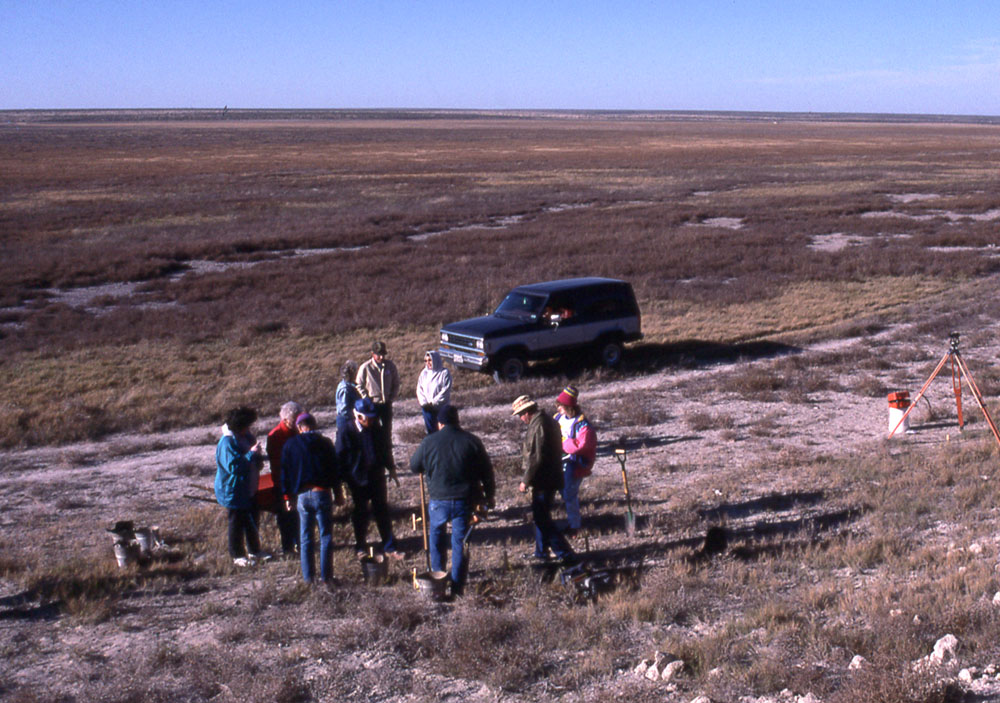
Big Lake Playa, from NightOwl Bakery and Roastery in Big Lake, Texas

Field crew meeting at the outset of the 1992 excavations at the Big Lake Bison Kill site. The dry bed of Big Lake stretches for miles in the background. Big Lake is an intermittent saline lake or playa, an uncommon landform on the Edwards Plateau. Photo by Larry Riemenschneider, Concho Valley Archeological Society.

More details about Big Lake and prehistory, below the fold.

Read the rest of this entry »


Bathtub reading on a warm June Sunday

June 7, 2009

I thought everybody does serious reading in the bathtub, no?

The Boneyard at Davis-Monthan Air Force Base near Tucson, Arizona; the Pima Air & Space Museum now offers bus tours of the 309th Maintenance and Regeneration Groups collection of scrapped and very historic airplanes

The Boneyard at Davis-Monthan Air Force Base near Tucson, Arizona; the Pima Air & Space Museum now offers bus tours of the 309th Maintenance and Regeneration Group's collection of scrapped and very historic airplanes

Can’t soak all day.


Teacher workshops at the Texas Natural Science Center – Earth science, paleontology

April 7, 2009

Hurry, teachers, get your workshops before the State Board of Education declares science workshops to be illegal:

FREE upcoming teacher training workshops at the Texas Natural Science Center — sign up now!
Change Over Time workshop — 2 sessions (1 for elementary; 1 for middle school) on Saturday, May 2, 2009.
Enjoy inquiry-based, hands-on activities using the Change Over Time kit containing TEKS-based geological science instructional materials for grades K-8!  This workshop is designed to help students master Earth Science concepts tested on the TAKS (Grade 5 and/or Grade 8). Conducted in conjunction with Sargent-Welch, Science Kit, and Ward’s.  For information and registration, visit http://www.utexas.edu/tmm/education/profdev/cot/index.html

Texas: Past, Present and Future — 4 one-day workshops: June 30, July 14, July 22, and July 30.
Learn more about geology, paleontology and Texas biodiversity!  Participating teachers will explore how animals are adapted to varying environments, investigate how paleontologists use fundamental principles to recreate what life was like in Texas’ past, and learn how to integrate these concepts into the classroom. Workshop participants will receive curriculum guides and be able to check out a Texas Fish and Mammals Loaner Kit for use in their classrooms. For information and registration, visit http://www.utexas.edu/tmm/education/profdev/txppf/index.html


Well, Texas! How do you like your culture war!

March 30, 2009

Historical Item:  William Randolph Hearst’s newspaper in New York favored war with Spain in 1898 — the Spanish-American War.  When the war got underway, on the top of the newspaper’s first page, in the corners (the “ears”), Hearst printed, “America!  How do you like your war!”

Creationism lost on the votes that had been planned for weeks, on issues members of the State Board of Education were informed about.  But creationists on the board proposed a series of amendments to several different curricula, and some really bad science was written in to standards for Texas school kids to learn.  Climate change got an official “tsk-tsk, ain’t happenin'” from SBOE.  And while Wilson and Penzias won a Nobel Prize for stumbling on the evidence that confirmed it, Big Bang is now theory non grata in Texas science books.   Using Board Member Barbara Cargill’s claims, Texas teachers now should teach kids that the universe is a big thing who tells big lies about her age.

Phil Plait wrote at Bad Astronomy:  “Texas:  Yup.  Doomed.”

A surefire way to tell that the changes were bad:  The Discovery Institute’s lead chickens  crow victory over secularism, science and “smart people.”  Well, no, they aren’t quite that bold.   See here, here, here and hereDisco Tute even slammed the so-conservative-Ronald-Reagan-found-it-dull Dallas Morning News for covering the news nearly accurately.  Even more snark here. Discovery Institute’s multi-million-dollar budget to buy good public relations for anti-science appears to have dropped a bundle in Austin; while it might appear that DI had more people in Austin than there are members of the Texas SBOE . . . no, wait, maybe they did.

SBOE rejected the advice of America’s best and greatest scientists.  If it was good science backed by good scientists and urged by the nation’s best educators, SBOE rejected it.  If it was a crank science idea designed to frustrate teaching science, it passed.  As the Texas Freedom Network so aptly put it, while SBOE closed the door on “strengths and weaknesses” language that favors creationism, they then opened every window in the house.

Read ’em, and tell us in comments if you find any reason for hope, or any reason the state legislature shouldn’t abolish this board altogether.  (What others should we add to the list?)


Alaska volcano blows smoke on Bobby Jindal

March 24, 2009

Joni Mitchell sang it, she’d seen “some hot, hot blazes come down to smoke and ash.”  Certainly Bobby Jindal’s criticism of President Barack Obama’s budget message to Congress was no love affair, but as the Toronto, Canada Globe and Mail noted, the eruption of Redoubt Volcano in Alaska made Bobby Jindal’s objection to volcano monitoring look particularly reckless.  Redoubt sent smoke and ash all over Jindal’s complaint.

This is the Globe and Mail story, really:

Alaska volcano blows smoke on Bobby Jindal

The eruption of Mount Redoubt deflates the Republican Party’s rising star

Globe and Mail Update

A month after Louisiana Governor Bobby Jindal chided the Democrats for funding “something called volcano monitoring,” the eruption of a volcano in Alaska is spewing ash 15 kilometres into the air.

Alaska’s Mount Redoubt, which has erupted five times since Sunday, is likely among the sites to benefit from the U.S. stimulus package, with the money going toward monitoring volcanoes, repairing facilities and mapping.

In his official Republican response to President Barack Obama’s speech to the nation last month, Mr. Jindal called volcano monitoring an unnecessary frill in the government’s stimulus package.

“While some of the projects in the bill make sense, their legislation is larded with wasteful spending and includes $300-million to buy new cars for the government, $8-billion for high speed rail projects, such as a magnetic levitation line from Las Vegas to Disneyland, and $140-million for something called volcano monitoring,” Governor Jindal said. “Instead of monitoring volcanoes, what Congress should be monitoring is the eruption of spending in Washington, D.C.”

But judging by the events of the past couple of days, perhaps it’s prudent for the government to spend money monitoring volcanoes.

Mount Redoubt’s first eruption occurred at 10:38 p.m. Sunday and the fifth ended at 5 a.m. yesterday, according to the Alaska Volcano Observatory. The volcano, roughly 160 kilometres southwest of Anchorage, sent an ash plume more than 15 kilometres into the air as it erupted for the first time in nearly 20 years. Residents of Anchorage were spared from falling ash, but fine grey dust was falling yesterday morning on small communities north of the city.

The observatory was warned in late January that an eruption could occur. Increased activity prompted scientists to raise the alert level on Sunday. Flights in the vicinity of the volcano were cancelled because of the ash.

Asked in a conference call yesterday whether stimulus money is necessary for volcano monitoring, John Power, a geophysicist with the U.S. Geological Survey, declined comment.

Governor Jindal’s office did not return calls and e-mails seeking comment.

The issue could prove a wedge in two years, when Republicans are deciding on their nominee. Governor Jindal has been tabbed by some as a young academic from a diverse background who could be the party’s answer to Mr. Obama, while Alaska Governor Sarah Palin, who failed in a vice-presidential bid last year, has refused to rule out a shot at the top of the 2012 ticket.

Governor Jindal’s attack on volcano monitoring was met with criticism from politicians, bloggers and some scientists. Democratic Senator Mark Begich of Alaska wrote in an open letter: “Volcano monitoring is a matter of life and death in Alaska. The science of volcano monitoring and the money needed to fund it is incredibly important in our state.”

The senator’s spokeswoman, Julie Hasquet, said Monday that the eruption of Mount Redoubt over the past few days and its potential to cause damage in the state illustrate that this is “very serious for Alaskans, and we don’t appreciate it when folks use it as a laugh line or a sound bite.”

With a report from Associated Press

Alaskas Redoubt  Volcano erupted in 1990 - National Geographic photo

Alaska's Redoubt Volcano erupted in 1990 - National Geographic photo

Tip of the old scrub brush to Sara Ann.


When on Earth, Google as the Earthlings do

March 7, 2009

I’m probably way behind the curve, but this looks to me as if it could be developed into a classroom exercise of some sort.

At Geevor Tin Mine Museum’s Weblog, I stumbled onto Whenonge #7 — When on Google Earth #7 (archaeology edition).

These wacky archaeologists!  They get a Google Earth image of some dig, post it, and challenge people to identify the dig and the time in history the site was actually occupied.  The first to identify the site accurately gets to host the next round.

Hey, take a look at these things.  They would make great slides for a presentation, but they’re also just cool.

Mystery image for When on Google Earth #7 (archaeology)

Mystery image for When on Google Earth #7 (archaeology)

Like so much in archaeology, this game comes to us from our methodological cousins in geology. Shawn Graham adopted their game, and modified it for our use at whenonge #1. Chuck Jones had the first correct answer, and then hosted whenonge #2. The mysterious and elusive PDD got #2 right but never claimed his prize, so Chuck struck back with whenonge #2.1. Paul Zimmerman got the correct answer to #2.1 and hosted whenonge # 3. Heather Baker got the correct answer to #3 and hosted whenonge # 4, and Jason Ur won and hosted of whenonge # 5 . Dan Diffendale won that,  #6 was hosted on whenonge #6 and i won this! so here we are… be the first to correctly identify the site above and its major period of occupation in the comments below and you can host your own!

What’s that?  There’s a geology version, too?  Good heavens!  The geologists are past #150!

WoGE #124 - Where on Google Earth #124; I dont know where this is, but it looks cool.

WoGE #124 - Where on Google Earth #124; I don't know where this is, but it looks cool.

It’s the sort of geeky game that airline real estate lawyers could play with airports, football geeks could play with collegiate football stadia, or baseball geeks with Major League Baseball parks.  Hiking, camping and wilderness geeks could do a National Parks and National Monuments version, with real aficianadoes including trails in National Wilderness Areas from the National Forest Service and Bureau of Land Management.

Why not a simple geography version?  Cities with more than 2 million population; national capital cities, state capital cities; Civil War battlefields; famous battlefields; volcanoes; 7 Wonders of the World.

Maybe someone in the Irving, Texas, ISD can get their geography kids to use their computers and put up a website devoted to some of these issues.


Bobby Jindal: Dumb about rocks

February 27, 2009

I couldn’t believe it either.

Remember all the flap about a flurry of earthquakes in the Yellowstone Caldera over the Christmas holidays?  Volcano monitoring is critical to safety in California, Oregon, Washington, Montana, Idaho, Wyoming and Alaska — not to mention Hawaii’s special circumstances — and to all neighboring states or those within downwind striking distance of a volcanic event.

A volcanic field now in southern Idaho erupted a few millions of years ago, spreading ash that killed creatures as far away as Nebraska.  “Neighboring state” covers a lot of territory.

So, Bobby Jindal, in his response to the Obama budget proposal speech, said the U.S. should get out of the volcano monitoring business.  It was not clear whether there were no rocks in his head, but neither was there knowledge about rocks where it should be in his head.

Green Gabbro, a real geologist, couldn’t believe it either.

  1. DID HE SERIOUSLY JUST SAY THE GOVERNMENT SHOULD NOT BE MONITORING VOLCANOES??!?!!!????@#$@!

Ignoring for the sake of argument the value of the basic science that always results from the data collected during routine monitoring – ignoring the general function of increased spending as an economic stimulus to the nation’s earth scientists, instrument manufacturers, etc., – even ignoring all that, volcano monitoring is still a very sensible investment in national security. A $1.5 million investment in monitoring at Pinatubo (near a U.S. air force base) earned a greater than 300-fold return when the volcano erupted explosively in 1991: hundreds of millions of dollars worth of property (mostly airplanes) was saved, as were thousands of lives. That 30,000% figure comes before you attempt to put a value on human life.

But then, Sarah Palin is in one of those areas where a failure to monitor volcanoes might lead to huge disaster.  It’s an unusual way to knock out a political rival, and not certain, but were Sarah Palin to disappear into a volcanic cloud, Bobby Jindal’s path to the Republican nomination for president might be less cluttered.  He’s a Rhodes Scholar — surely he can’t be that stupid about volcanoes, so the evil alternative, that he hopes to get rid of Palin, is the only thing that makes sense, isn’t it?

Is there no one in the Republican Party who will stand up for science and reason?

Resources:


You felt it coming: Hoaxers jump on Yellowstone quake news

January 11, 2009

Oh, yeah, we expected a few religious nuts to claim it was the end times when an interesting, but so far harmless swarm of small earthquakes hit the Yellowstone Caldera again.

But who expected such nuttiness?

Legal action is being taken against a Web site operator who has misrepresented the U.S. Geological Survey in a warning that the area around Yellowstone National Park should be evacuated out of concern that the park’s supervolcano could erupt.

“We started to take action as soon as we found out about it,” said Jessica Robertson of the USGS, adding that the agency was notified on Friday.

The issue has been referred to the USGS’s solicitor’s office which is pursuing charges of impersonating a federal official as well as violation of the agency’s trademark.

“The main issue we have is we don’t want people to believe it’s coming from us,” Robertson said.  [From the Billings (Montana) Gazette]

It’s a hoax, but a very pernicious hoax.  In a world where people believe in all sorts of things that do not happen and take actions that hurt themselves and others as a result, hoaxing is not a good game to play.

(Update, evening of January 11, 2009:  Here’s the site complained about; it appears he’s removed material that would make the site look like a USGS site.)

Was this guy under a belief that what he said was correct?

The issue highlights Nash’s concerns about where people get their news.

“There is a legitimate place to get this information; this is not it,” Nash said of the Web site [ Al Nash, the Yellowstone National Park’s chief of public affairs]. “The Yellowstone Volcano Observatory is out there. You can find it. It is run by three really bright geologists. There’s really good monitoring in the park. Our offices would be the secondary place to go for information.”

Robertson said this isn’t the first time USGS has been falsely used in such claims. She said in June a YouTube video used the agency’s logo to lend legitimacy to a claim about the end of the world.

Earthquakes are very interesting.  The Yellowstone is fascinating.  These are good reasons to study the facts and events of nature.  Hoaxes like this one, urging people to panic, play on the wealth of ignorance about science and nature, and scientists.

The only firm defense is good education and good information.

Resources:

  • From the Billings Gazette’s sidebar on good information:
    Latest quake info
    “According to the latest information from the Yellowstone Volcano Observatory, about 900 earthquakes occurred between Dec. 26 and Jan. 8 in the Yellowstone Lake area.
    “Five hundred of the earthquakes (including all greater than magnitude 2.0) have been reviewed by seismologists. There were 111 earthquakes with magnitudes greater than 2.0 and 18 earthquakes greater than 3.0. About 400 smaller earthquakes have yet to be reviewed.
    “The largest earthquake during the swarm was a magnitude 3.9 on Dec. 28. One of the analyses seismologists use to talk about earthquakes and swarms is the cumulative seismic moment, which is a measure of the earthquake energy. The cumulative moment (the energy from all the analyzed earthquakes in the swarm) for the Yellowstone Lake Swarm is equal to the energy of a single magnitude 4.5 earthquake.
    “Earthquakes with magnitudes less than 3.4 are generally not felt by people unless they are very shallow and you are standing very close to the epicenter. For perspective, earthquakes of magnitude 3.4 to 4.5 are often felt and there were multiple reports of felt earthquakes during this swarm. A magnitude 5 or greater is generally required to produce damage to buildings or other structures.
    “For more information, log onto the observatory’s Web site at: http://volcanoes.usgs.gov/yvo/
  • Powell (Wyoming) Tribune blog, with an e-mail interview with the hoax perpetrator — note the nonchalance with which Chris Sanders, who appears to be the perpetrator, acknowledges his pirating of the USGS log, claims connections to soon-to-be-President Obama, and otherwise suggests he’s the smartest scientist even touching geology in the U.S.
  • Good, solid reporting on the seismology, from the Salt Lake Tribune
  • Bozeman (Montana) Daily Chronicle coverage of the hoax
  • Finding Dulcinea blog
  • Associated Press story of January 9, 2009
  • Also see other posts here at Millard Fillmore’s Bathtub on the Yellowstone Caldera:  Not likely to blow, first post with best links, “swarm finished?” and all Yellowstone posts

Acknowledgement to High Boldtage.


Eye on Yellowstone: Earthquake swarm’s second round

January 10, 2009

More mostly small, less-than-3.0 magnitude earthquakes rumbled the Yellowstone Caldera, with a shift in location.

While not exactly an everyday event, still “not uncommon.”  Scientists are just watching, and they detect no other signs of an imminent eruption.

Here’s the note as of about 5:00 a.m. January 10, Central time, from the Yellowstone Volcano Observatory (YVO):

YELLOWSTONE VOLCANO OBSERVATORY INFORMATION RELEASE
Friday, January 9, 2009 19:44 MST (Saturday, January 10, 2009 02:44 UTC)

YELLOWSTONE VOLCANO (CAVW#1205-01-)
44.43°N 110.67°W, Summit Elevation 9203 ft (2805 m)
Volcano Alert Level: NORMAL
Aviation Color Code: GREEN

Small Earthquake Swarm on 9 January 2009 near northeast corner of Yellowstone Caldera

A currently modest swarm of earthquakes began in the northeast corner of the Yellowstone Caldera, about 10 miles (16 km) NNE of the north end of the Yellowstone Lake swarm that was active in late December and early January. As of 1930 MST, 10 earthquakes had been located by the University of Utah Seismograph Stations, the largest with M= 3.3 and two other events with M >2.0. Located depths are between 2 and 4 km.

Yellowstone Volcano Observatory staff and collaborators are analyzing the data from this and from the earlier Yellowstone Lake swarm and are checking for any changes to the thermal areas located near the epicenters. We will provide further information as it becomes available.

—–
The Yellowstone Volcano Observatory (YVO) is a partnership of the U.S. Geological Survey (USGS), Yellowstone National Park, and University of Utah to strengthen the long-term monitoring of volcanic and earthquake unrest in the Yellowstone National Park region. Yellowstone is the site of the largest and most diverse collection of natural thermal features in the world and the first National Park. YVO is one of the five USGS Volcano Observatories that monitor volcanoes within the United States for science and public safety.

It’s winter in Yellowstone, a great time to go.  It’s the best time to go, my Yellowstone-obsessed brother would say.  A swarm of earthquakes means you’ll have something to talk about at breakfast before taking your camera out to get once-in-a-lifetime shots of nature.

Earthquakes are normal in much of the Rocky Mountains, and in much of the rest of the Intermountain West.  My mother used to enjoy quietly sipping coffee at the stove in her kitchen in Pleasant Grove, Utah, and saying “Oh. We’re having another earthquake.”  She’d watch the power and telephone wires, which formed neat sine waves during quakes.

Experts are watching, and probably sipping their coffee, too.

.”]Image 1. Yellowstone Lake showing location and times of the recent earthquakes from Dec. 27, 2008 (blue) to Jan. 8, 2009 (red). The M 3.0 and greater earthquakes are shown as stars, the smaller earthquakes are shown as circles. During the swarm, the earthquake locations appear to have moved north. For more information on the depths of the earthquakes, see the cross section from X to X below. Click on the image for a full-size version.

See resource lists at earlier MFBathtub posts:


All quiet on the Yellowstone front (almost)

January 6, 2009

Here’s the on-line helicorder view of January 5 — a quiet day at Lake Woebegone Yellowstone.  Click on the image to go to the site and see for yourself (in a larger format, too).

Compare the image below, with the image here, to see the difference a few days makes.

Helicorder data from January 5, 2008, Yellowstone Lake, West Thumb station (YLT)

Helicorder data from January 5, 2008, Yellowstone Lake, West Thumb station (YLT)


Yellowstone earthquake swarm finished?

January 5, 2009

No Few significant quakes recorded at all for January 4, nor so far for January 5 (6:30 a.m. Central) maybe the quakes took a day off in honor of Utah Statehood Day.

Update, January 6, 6:00 a.m. Central: The map now shows 11 quakes magnitude 1 or greater on January 3, 5 on January 4, and one on January 5.  This is significantly less action than the quakes every ten minutes or so when the swarm was at its peak.

Is the swarm done? This is the longest period of no-quake activity in Yellowstone since at least December 27, 2008.

Here’s the USGS data for 11:30 p.m. (Central), January 4:

Update time = Mon Jan 5 5:27:27 UTC 2009

Here are the earthquakes in the Map Centered at 44°N, 110°W area, most recent at the top.
(Some early events may be obscured by later ones.)
Click on the underlined portion of an earthquake record in the list below for more information.

MAG UTC DATE-TIME
y/m/d h:m:s
LAT
deg
LON
deg
DEPTH
km
LOCATION
MAP 2.6 2009/01/03 00:23:22 44.669 -110.163 1.0 43 km ( 26 mi) SSW of Cooke City-Silver Gate, MT
MAP 2.7 2009/01/02 20:33:53 44.553 -110.338 0.9 61 km ( 38 mi) SSW of Cooke City-Silver Gate, MT
MAP 2.2 2009/01/02 20:24:50 44.509 -110.371 0.0 61 km ( 38 mi) ESE of West Yellowstone, MT
MAP 2.7 2009/01/02 20:23:57 44.556 -110.357 1.3 60 km ( 38 mi) SSE of Gardiner, MT

So there was only one quake on January 3, and none on January 4.

Swarms are “not uncommon,” but caldera supereruptions are extremely rare.

Time Magazine tracked down the head of the Yellowstone Volcano Observatory (YVO), Jake Lowenstern:

Jake Lowenstern, Ph.D., YVO’s chief scientist, who also is part of the USGS Volcano Hazards Team, told TIME that a supervolcano event does not appear to be imminent. “We don’t think the amount of magma exists that would create one of these large eruptions of the past,” he said. “It is still possible to have a volcanic eruption comparable to other volcanoes. But we would expect to see more and larger quakes, deformation and precursory explosions out of the lake. We don’t believe that anything strange is happening right now.” Last summer YVO installed new instrumentation in boreholes 500 to 600 ft. deep to better detect ground deformation.  Says Lowenstern: “We have a lot more ability to look at all the data now.” (See an interactive graphic depicting how scientists monitor volcanoes.)

Plan your vacation to Yellowstone now. Transportation will be cheaper (you can fly to Jackson Hole), and if there is any effect of the earthquake swarm, it would be to reduce tourist reservations at local hotels.

Now is the time to book your visit.


Yellowstone ready to blow? Not likely

December 31, 2008

Every science nut is, and quite a few fear mongers are following the story of the swarm of small earthquakes miles beneath the waters of Yellowstone Lake.

They know Yellowstone is in the middle of a supervolcano, and they can’t help but wonder whether the Yellowstone Caldera is ready to blow.

Even Cecil Adams at the Straight Dope wonders in the headline whether Yellowston is ready blow, in what must be one of the best-timed, prepared-in-advance columns in any newspaper in the world in 2008.  (My skiepticism for Cecil Adams’ stuff increased mightily when I noticed he had gotten much wrong on Rachel Carson’s claims about DDT and birds, but I digress.)

So is Yellowstone going to blow?

Not likely.  According to me. (I’m a lawyer and teacher — what authority does my prediction have?)

Serious scientists are being more careful.  I asked Relu Burlacu at the University of Utah Seismograph Station, the group that is the front line in the monitoring of Yellowstone, whether this is The Big One.

“The short answer is,” he said, “we don’t know.”

57 quakes, at least, have been recorded for December 31 so far (15:05 UTC).  Since Saturday, there have been more than 300 quakes (conservative estimate).  Because the quakes are so tightly packed, geographically, but from depths covering several miles underground, some amateurs suggest the quakes suggest magma or water moving up a pipe toward the surface.

The professionals I spoke with today are very circumspect about saying what is going on, stopping far short of making predictions about what will happen.  Most telling, they’re taking tonight and tomorrow off, New Year’s Eve and New Year’s Day.  Oh, someone will be on hand to make sure the machines are working, and if there’s a truly significant event, there will be alerts.  But the current swarm is not something that alarms the monitoring people, nor is it something they have not seen before.

Mr. Berlacu explained — patiently, I must add — that so far, there has been just monitoring.  With so many events, one of the problems is determining when one event ends, and the next begins.  There is a great deal of work to be done pinpointing locations of temblors, triangulating from several different recording stations.

“This is not uncommon,” Berlacu said.  He noted that 1985 had a swarm of quakes that continued for nearly three months, with the swarm just tapering off.

Charts from the earthquake monitoring station on Yellowstone Lake, showing raw data recording by the University of Utah Seismograph Stations, Earthquake Information Center, for December 31, 2008.  These data must be correlated and corroborated with data from other stations in the area to determine locations of geological events, depths, duration, start and end, before complete analysis can be done.

Charts from the earthquake monitoring station on Yellowstone Lake, showing raw data recording by the University of Utah Seismograph Stations, Earthquake Information Center, for December 31, 2008. These data must be correlated and corroborated with data from other stations in the area to determine locations of geological events, depths, duration, start and end, before complete analysis can be done.

Reality is that the scientists who study Yellowstone’s vulcanism expect eruptions in the future. But they expect smaller eruptions, not the massive supervolcano disaster usually portrayed over the last five or ten years.  Yes, a massive eruption is possible.  Yes, it could be an enormous disaster.

In a video explaining the geology of the Yellowstone caldera, Yellowstone National Park Geologist Hank Heasler explains there are three things geologists think will presage a large volcanic event in the caldera:

  1. An increase in earthquakes, or a swarm of earthquakes, plus
  2. Significantly increased ground deformation, such as a rise of several feet or several meters, plus
  3. Increased thermal activity in the thermal features of the Park.

The current swarm lacks the second two features.  Even so, experts note that all three conditions might be met, without any major eruption.

No, it’s not likely to happen in our lifetimes. Read this entertaining piece by Jake Lowenstern in Geotimes, from June 2005. Lowenstern is the director of the Yellowstone Volcanic Observatory (YVO):

Of course, the Yellowstone caldera is a volcano, and it almost certainly will erupt again someday. It’s possible, though unlikely, that future eruptions could reach the magnitude of Yellowstone’s three largest explosive eruptions, 2.1 million, 1.3 million and 640,000 years ago. Smaller eruptions, however, are far more likely, and no eruption seems imminent on the timescale that most people truly care about — their lifetime or perhaps even the next few hundred or thousands of year

Small eruptions do not make for the grand drama desired by television executives and producers.

Instead, the technicians monitor what happens; conclusions, the explanation for what happened, will have to wait for later analysis.

Resources:


News from the Yellowstone Caldera: Earthquakes

December 29, 2008

Yellowstone Lake, site of swarm of earthquakes, December 27-30, 2008

Yellowstone Lake, site of swarm of earthquakes, December 27-30, 2008

Yellowstone National Park holds more than 70% of the world’s geysers, and rumbles with earthquakes and eruptions all the time.  It is, after all, rather in the middle of the great Yellowstone Caldera, a supervolcano that probably will erupt with astounding destruction someday.

Massive, super eruptions in the caldera occur about every 600,000 years (take THAT Don McLeroy!).  The last eruption was about 640,000 years ago, which means that we may be a bit overdue for the sort of eruption that would make the destruction of Krakatoa look like a firecracker compared to a nuclear bomb.

So, of course, some people worried a bit with the cluster of earthquakes under Yellowstone Lake in the past two days. A swarm is a better description, perhaps — 250 little quakes, all under 3.5 on the Richter Scale.

It is unusual in the number, but they are all small.

Watch that space!

(See update for December 31, here: ‘Yellowstone not likely to blow’)

USGS Regional map for earthquakes, Yellowstone Region

USGS Regional map for earthquakes, Yellowstone Region

According to the USGS system, at the time of this post, earthquakes are occurring frequently around Yellowstone, with about 35 in the past 24 hours (I copied the chart to preserve the historical data; click on the link to get more current data):

MAG UTC DATE-TIME
y/m/d h:m:s
LAT
deg
LON
deg
DEPTH
km
LOCATION
MAP 2.4 2008/12/30 00:36:39 44.510 -110.384 0.2 60 km ( 37 mi) ESE of West Yellowstone, MT
MAP 2.4 2008/12/29 21:25:15 44.525 -110.360 2.0 61 km ( 38 mi) ESE of West Yellowstone, MT
MAP 1.6 2008/12/29 21:18:51 44.521 -110.362 2.2 61 km ( 38 mi) ESE of West Yellowstone, MT
MAP 1.8 2008/12/29 21:18:36 44.522 -110.359 2.1 61 km ( 38 mi) ESE of West Yellowstone, MT
MAP 2.9 2008/12/29 20:38:25 44.514 -110.381 2.1 60 km ( 37 mi) ESE of West Yellowstone, MT
MAP 2.3 2008/12/29 20:38:04 44.511 -110.385 2.3 60 km ( 37 mi) ESE of West Yellowstone, MT
MAP 1.0 2008/12/29 20:26:29 44.520 -110.355 2.2 62 km ( 38 mi) ESE of West Yellowstone, MT
MAP 1.9 2008/12/29 20:14:26 44.498 -110.364 2.3 62 km ( 38 mi) ESE of West Yellowstone, MT
MAP 1.4 2008/12/29 20:13:31 44.508 -110.359 2.2 62 km ( 38 mi) ESE of West Yellowstone, MT
MAP 2.2 2008/12/29 19:56:46 44.522 -110.365 1.2 61 km ( 38 mi) ESE of West Yellowstone, MT
MAP 1.2 2008/12/29 19:53:50 44.511 -110.377 2.2 60 km ( 37 mi) ESE of West Yellowstone, MT
MAP 1.1 2008/12/29 19:46:13 44.515 -110.386 2.4 59 km ( 37 mi) ESE of West Yellowstone, MT
MAP 1.7 2008/12/29 19:44:50 44.525 -110.373 0.0 60 km ( 37 mi) ESE of West Yellowstone, MT
MAP 1.7 2008/12/29 19:40:27 44.511 -110.379 2.5 60 km ( 37 mi) ESE of West Yellowstone, MT
MAP 2.4 2008/12/29 19:37:07 44.502 -110.366 1.8 61 km ( 38 mi) ESE of West Yellowstone, MT
MAP 1.2 2008/12/29 19:36:08 44.521 -110.385 2.0 59 km ( 37 mi) ESE of West Yellowstone, MT
MAP 1.7 2008/12/29 19:35:27 44.511 -110.385 2.4 60 km ( 37 mi) ESE of West Yellowstone, MT
MAP 2.9 2008/12/29 19:29:38 44.513 -110.381 0.5 60 km ( 37 mi) ESE of West Yellowstone, MT
MAP 2.5 2008/12/29 19:28:55 44.515 -110.381 0.0 60 km ( 37 mi) ESE of West Yellowstone, MT
MAP 1.8 2008/12/29 19:26:21 44.519 -110.370 2.0 60 km ( 38 mi) ESE of West Yellowstone, MT
MAP 1.5 2008/12/29 19:24:43 44.520 -110.342 2.3 63 km ( 39 mi) ESE of West Yellowstone, MT
MAP 3.3 2008/12/29 19:14:49 44.521 -110.369 1.8 60 km ( 38 mi) ESE of West Yellowstone, MT
MAP 1.2 2008/12/29 18:47:45 44.523 -110.371 2.1 60 km ( 37 mi) ESE of West Yellowstone, MT
MAP 1.4 2008/12/29 18:40:00 44.533 -110.359 4.8 61 km ( 38 mi) ESE of West Yellowstone, MT
MAP 1.1 2008/12/29 16:32:12 44.494 -110.360 2.4 62 km ( 39 mi) ESE of West Yellowstone, MT
MAP 1.6 2008/12/29 16:31:55 44.491 -110.360 2.3 62 km ( 39 mi) ESE of West Yellowstone, MT
MAP 1.2 2008/12/29 16:15:28 44.480 -110.363 2.3 62 km ( 39 mi) ESE of West Yellowstone, MT
MAP 1.5 2008/12/29 14:58:37 44.486 -110.354 1.3 63 km ( 39 mi) ESE of West Yellowstone, MT
MAP 1.7 2008/12/29 10:25:18 44.523 -110.371 2.4 60 km ( 37 mi) ESE of West Yellowstone, MT
MAP 1.8 2008/12/29 09:14:04 44.527 -110.376 0.3 60 km ( 37 mi) ESE of West Yellowstone, MT
MAP 2.4 2008/12/29 08:57:55 44.527 -110.378 0.5 60 km ( 37 mi) ESE of West Yellowstone, MT
MAP 2.4 2008/12/29 08:28:24 44.527 -110.382 0.4 59 km ( 37 mi) ESE of West Yellowstone, MT
MAP 2.0 2008/12/29 05:30:35 44.517 -110.372 1.0 60 km ( 37 mi) ESE of West Yellowstone, MT
MAP 2.3 2008/12/29 05:30:04 44.477 -110.349 6.5 63 km ( 39 mi) ESE of West Yellowstone, MT
MAP 1.7 2008/12/29 05:29:23 44.489 -110.354 4.2 63 km ( 39 mi) ESE of West Yellowstone, MT
MAP 2.4 2008/12/29 05:23:36 44.516 -110.361 6.4 61 km ( 38 mi) ESE of West Yellowstone, MT
MAP 1.9 2008/12/29 04:29:18 44.522 -110.385 1.0 59 km ( 37 mi) ESE of West Yellowstone, MT
MAP 2.8 2008/12/29 04:25:53 44.514 -110.370 0.1 61 km ( 38 mi) ESE of West Yellowstone, MT
MAP 2.6 2008/12/28 23:57:56 44.521 -110.371 1.4 60 km ( 37 mi) ESE of West Yellowstone, MT
MAP 2.0 2008/12/28 23:08:25 44.491 -110.390 1.7 60 km ( 37 mi) ESE of West Yellowstone, MT
MAP 3.1 2008/12/28 19:55:17 44.511 -110.353 0.7 62 km ( 39 mi) ESE of West Yellowstone, MT
MAP 3.0 2008/12/28 19:32:15 44.511 -110.356 2.7 62 km ( 38 mi) ESE of West Yellowstone, MT
MAP 2.8 2008/12/28 15:37:40 44.514 -110.359 0.0 61 km ( 38 mi) ESE of West Yellowstone, MT
MAP 2.2 2008/12/28 09:25:14 44.508 -110.364 1.9 61 km ( 38 mi) ESE of West Yellowstone, MT
MAP 3.2 2008/12/28 09:23:57 44.511 -110.361 0.4 61 km ( 38 mi) ESE of West Yellowstone, MT
MAP 1.9 2008/12/28 07:16:13 44.513 -110.374 2.0 60 km ( 37 mi) ESE of West Yellowstone, MT
MAP 2.5 2008/12/28 07:15:18 44.495 -110.359 0.0 62 km ( 39 mi) ESE of West Yellowstone, MT
MAP 2.5 2008/12/28 06:37:41 44.492 -110.356 2.6 62 km ( 39 mi) ESE of West Yellowstone, MT
MAP 2.0 2008/12/28 06:37:20 44.497 -110.379 2.1 60 km ( 38 mi) ESE of West Yellowstone, MT
MAP 1.9 2008/12/28 05:28:49 44.498 -110.383 2.3 60 km ( 37 mi) ESE of West Yellowstone, MT
MAP 1.9 2008/12/28 05:28:05 44.485 -110.371 2.5 61 km ( 38 mi) ESE of West Yellowstone, MT
MAP 1.8 2008/12/28 05:26:14 44.484 -110.359 2.0 62 km ( 39 mi) ESE of West Yellowstone, MT
MAP 1.2 2008/12/28 05:26:03 44.470 -110.355 5.2 63 km ( 39 mi) ESE of West Yellowstone, MT
MAP 1.3 2008/12/28 05:24:39 44.489 -110.359 4.1 62 km ( 39 mi) ESE of West Yellowstone, MT
MAP 2.8 2008/12/28 05:23:54 44.489 -110.354 2.5 63 km ( 39 mi) ESE of West Yellowstone, MT
MAP 1.9 2008/12/28 05:21:16 44.480 -110.344 4.0 64 km ( 40 mi) ESE of West Yellowstone, MT
MAP 1.7 2008/12/28 05:20:10 44.494 -110.379 2.4 61 km ( 38 mi) ESE of West Yellowstone, MT
MAP 1.6 2008/12/28 05:19:11 44.492 -110.372 2.2 61 km ( 38 mi) ESE of West Yellowstone, MT
MAP 3.9 2008/12/28 05:15:56 44.502 -110.366 0.3 61 km ( 38 mi) ESE of West Yellowstone, MT
MAP 2.6 2008/12/28 00:08:50 44.493 -110.354 0.4 63 km ( 39 mi) ESE of West Yellowstone, MT
MAP 3.3 2008/12/27 22:30:03 44.498 -110.358 4.3 62 km ( 39 mi) ESE of West Yellowstone, MT
MAP 1.5 2008/12/27 22:28:53 44.500 -110.368 2.1 61 km ( 38 mi) ESE of West Yellowstone, MT
MAP 1.8 2008/12/27 22:27:36 44.499 -110.367 2.5 61 km ( 38 mi) ESE of West Yellowstone, MT
MAP 1.0 2008/12/27 21:28:06 44.500 -110.362 3.5 62 km ( 38 mi) ESE of West Yellowstone, MT
MAP 1.6 2008/12/27 21:22:08 44.495 -110.372 2.6 61 km ( 38 mi) ESE of West Yellowstone, MT
MAP 2.1 2008/12/27 21:08:49 44.496 -110.370 2.0 61 km ( 38 mi) ESE of West Yellowstone, MT
MAP 3.2 2008/12/27 20:26:27 44.505 -110.364 2.4 61 km ( 38 mi) ESE of West Yellowstone, MT
MAP 3.5 2008/12/27 20:17:33 44.488 -110.357 4.1 62 km ( 39 mi) ESE of West Yellowstone, MT
MAP 2.3 2008/12/27 18:56:35 44.484 -110.367 0.5 62 km ( 38 mi) ESE of West Yellowstone, MT
MAP 3.0 2008/12/27 18:23:07 44.495 -110.364 2.8 62 km ( 38 mi) ESE of West Yellowstone, MT
MAP 2.0 2008/12/27 18:21:36 44.493 -110.362 7.2 62 km ( 38 mi) ESE of West Yellowstone, MT
MAP 1.2 2008/12/27 17:01:46 44.484 -110.373 2.4 61 km ( 38 mi) ESE of West Yellowstone, MT
MAP 2.7 2008/12/27 17:01:07 44.490 -110.366 1.2 62 km ( 38 mi) ESE of West Yellowstone, MT
MAP 2.6 2008/12/27 16:30:54 44.498 -110.362 2.5 62 km ( 38 mi) ESE of West Yellowstone, MT

At the site of the Deseret News (published in Salt Lake City), one commenter noted he is from Texas, a commented he was safely out of the way.  One might do well to remember that volcanic activity in the Yellowstone often affects life well outside the area.  Ashfall Beds State Historical Park in Nebraska, for example, marks a prehistoric waterhole where dozens of mammals died from ash from a volcano that erupted 10 million to 12 million years ago — a volcano in Idaho, south of the Yellowstone Caldera, and considerably smaller.

While danger is probably slight right now, and this swarm most likely does not presage anything of great note, one should not forget the power of volcanic eruptions from supervolcanoes, like the Yellowstone Caldera.

Update, December 30, 2:20 p.m. Central:

Resources:

Great photo for the heck of it:

Aerial view of Grand Prismatic Spring, Wikimedia photo (all text in caption from Wikimedia); Hot Springs, Midway & Lower Geyser Basin, Yellowstone National Park. The spring is approximately 250 by 300 feet (75 by 91 m) in size.  This photo shows steam rising from hot and sterile deep azure blue water (owing to the light absorbing overtone of an OH stretch which is shifted to 698 nm by hydrogen bonding [1]) in the center surrounded by huge mats of brilliant orange algae and bacteria. The color of which is due to the ratio of chlorophyll to carotenoid molecules produced by the organisms. During summertime the chlorophyll content of the organisms is low and thus the mats appear orange, red, or yellow. However during the winter, the mats are usually dark green, because sunlight is more scarce and the microbes produce more chlorophyll to compensate, thereby masking the carotenoid colors.

(Caption from Wikimedia) Aerial view of Grand Prismatic Spring; Hot Springs, Midway & Lower Geyser Basin, Yellowstone National Park. The spring is approximately 250 by 300 feet (75 by 91 m) in size. This photo shows steam rising from hot and sterile deep azure blue water (owing to the light absorbing overtone of an OH stretch which is shifted to 698 nm by hydrogen bonding) in the center surrounded by huge mats of brilliant orange algae and bacteria. The color of which is due to the ratio of chlorophyll to carotenoid molecules produced by the organisms. During summertime the chlorophyll content of the organisms is low and thus the mats appear orange, red, or yellow. However during the winter, the mats are usually dark green, because sunlight is more scarce and the microbes produce more chlorophyll to compensate, thereby masking the carotenoid colors.


Creationism vs. Christianity

December 20, 2008

Several weeks ago I responded to a lengthy thread at Unreasonable FaithThe original post was Garry Trudeau’s “Doonesbury” cartoon of the guy in a doctor’s office, just diagnosed with an infection.  The physician asks the guy if he’s a creationist, explaining that if he is, the doc will treat him with old antibiotics in honor of his belief that evolution of bacteria doesn’t occur. [Time passes: You may find the Doonesbury cartoon here, at Nature.com, in an article discussing issues with creationism.]

Point being, of course, that evolution occurs in the real world.  Creationists rarely exhibit the faith of their claims when their life, or just nagging pain, is on the line.  They’ll choose the evolution-based medical treatment almost every time.  There are no creationists in the cancer or infectious disease wards.

At one point I responded to a comment loaded with typical creationist error.  It was a long post.  It covered some ground that I’ve not written about on this blog.  And partly because it took some time to assemble, I’m reposting my comments here.  Of course, without the Trudeau cartoon, it won’t get nearly the comments here.

I’ll add links here when I get a chance, which I lacked the time to do earlier.  See my post, below the fold.

Read the rest of this entry »