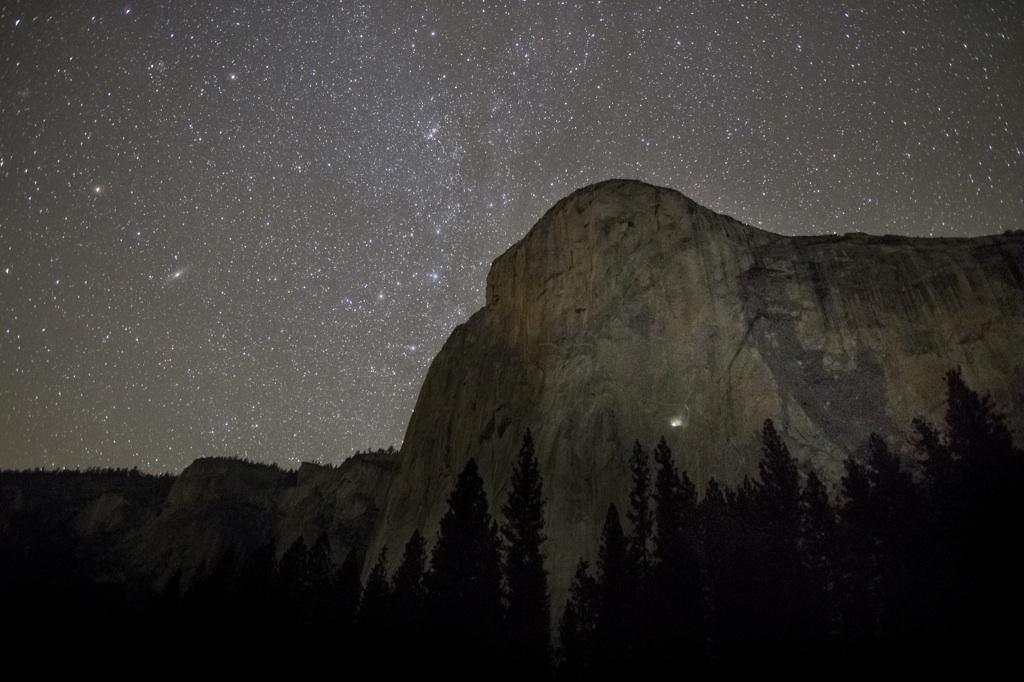
NBC News correspondent Hallie Jackson posted this photo on her Twitter feed, a shot from NBC photographer Scot Kilian:
@HallieJackson: Incredible shot from NBC’s Scott Kilian: that tiny dot of light on side of #DawnWall is where the climbers slept.
It’s a long exposure, enough that the stars brighten the black sky, but not quite so much that the stars become streaks on the photo. Long enough that the lights used by Tommy Caldwell and Kevin Jorgeson register on the CMOS (I’m assuming no film here).
Incredibly, their tents are pitched upon the rock, where mountain goats and cliff-dwelling birds fear to tread. It’s very much a vertical sheet of almost smooth rock.
And it’s a great photo. In these particularly troubled times, any light shining on human cooperation to achieve great things becomes a beacon.
Clearly I need to intern with Shawn Reeder. His piece on Yosemite shows the natural objects of beauty in their best lights, over and over: “Yosemite Range of Light.”
The two-year project, Yosemite Range of Light, uses nearly 7,000 high-resolution still photos to create an inspiring vision of light and granite, capturing rolling cloud formations and the rainbow-lit waterfalls of Yosemite.
Reeder first came to Yosemite after winning a local waiter contest where he grew up in Maryland. First prize was a trip to Napa Valley wine-country, but the 18-year-old convinced the prize committee to offer a change of venue. Choosing Yosemite as his destination instead, he brought along his best friend, who happened to have a camera. . . .
“I came out for a week and I did my first backpacking trip ever. We hiked to the top of Half Dome via the cables, which was an incredible experience. We hiked the whole South-Rim Trail from Glacier Point to Tunnel View. It to
Panorama of view of Yosemite Valley including Half Dome and Diving Board as seen from Glacier Point in Yosemite National Park. (Photo credit: Wikipedia)
Spread the word; friends don't allow friends to repeat history.
One of what should be an occasional series of posts on American iconic places, natural features, sights to see, etc. For studies of U.S. history and U.S. geography, each of these posts covers subjects an educated American should know. What is the value of these icons? Individually and collectively, our preservation of them may do nothing at all for the defense of our nation. But individually and collectively, they help make our nation worth defending.
This is a less-than-10-minute video you can insert into class as a bell ringer, or at the end of a class, or as part of a study of geologic formations, or in any of a number of other ways. Yosemite Nature Notes provides glorious pictures and good information about Yosemite National Park — this video explains the modern incarnation of Half Dome, an enormous chunk of granite that captures the imagination of every living, breathing soul who ever sees it.
Potential questions for class discussion:
Have you put climbing Half Dome on your bucket list yet? Why not?
Is it really wilderness when so many people go there?
How should the National Park Service, and the Forest Service and Bureau of Land Management, manage these spectacular, completely unique features, both to preserve their wild nature, and allow people to visit them?
What are the federalism issues involved in protecting Half Dome, or any grand feature, like the Great Smokey Mountains, Great Dismal Swamp, Big Bend, Yellowstone Falls, or Lincoln Memorial?
Or, until that account is unsuspended by the forces supporting Donald Trump: Follow @FillmoreWhite, the account of the Millard Fillmore White House Library
We've been soaking in the Bathtub for several months, long enough that some of the links we've used have gone to the Great Internet in the Sky.
If you find a dead link, please leave a comment to that post, and tell us what link has expired.
Thanks!
Retired teacher of law, economics, history, AP government, psychology and science. Former speechwriter, press guy and legislative aide in U.S. Senate. Former Department of Education. Former airline real estate, telecom towers, Big 6 (that old!) consultant. Lab and field research in air pollution control.
My blog, Millard Fillmore's Bathtub, is a continuing experiment to test how to use blogs to improve and speed up learning processes for students, perhaps by making some of the courses actually interesting. It is a blog for teachers, to see if we can use blogs. It is for people interested in social studies and social studies education, to see if we can learn to get it right. It's a blog for science fans, to promote good science and good science policy. It's a blog for people interested in good government and how to achieve it.
BS in Mass Communication, University of Utah
Graduate study in Rhetoric and Speech Communication, University of Arizona
JD from the National Law Center, George Washington University


 Posted by Ed Darrell





 Millard Fillmore's Bathtub