Soldiers’ Memorial Day, 1870

May 25, 2009

Cover to Soldiers Memorial Day, sheet music from 1870 - Library of Congress image from Duke University Library Special Collections (http://scriptorium.lib.duke.edu/sheetmusic/a/a22/a2221/)

Cover to "Soldiers' Memorial Day," sheet music from 1870 - Library of Congress image from Duke University Library Special Collections (http://scriptorium.lib.duke.edu/sheetmusic/a/a22/a2221/)

From the Library of Congress description:

Soldier’s memorial day. 1870

Perkins, W. O. (William Oscar), 1831-1902

OTHER TITLES
First line: When flow’ry summer is at hand
Chorus: Gentle birds above are sweetly singing

CREATED/PUBLISHED
Boston, Massachusetts, Oliver Ditson & Co., 1870


May 22, 1906: Patent to Wright Bros. for “flying machine”

May 23, 2009

In a drawer in a file box in the U.S. Patent Office in Washington, D.C., is a study in black ink on white paper, lines that resemble those images most of us have of the first Wright Bros. flyer, usually dubbed “Kittyhawk” after the place it first took to the air.

Drawing 1 from patent granted to Orville Wright for a flying machine

Drawing 1 from patent granted to Orville Wright for a flying machine

The patent was issued on May 22, 1906, to Orville Wright, Patent No. 821393, for a “flying machine.”

It makes more sense if you turn the drawing on its side.

Wright Bros. flying machine, from patent drawing

Wright Bros. flying machine, from patent drawing

Why did it take three years to get the patent issued?

Below the fold, the rest of the patent.

Read the rest of this entry »


Vintage film on Japanese internment during World War II

May 20, 2009

[Google Video version is not showing or playing for reasons I don’t know; fortunately the National Archives (NARA) has uploaded a version to YouTube]

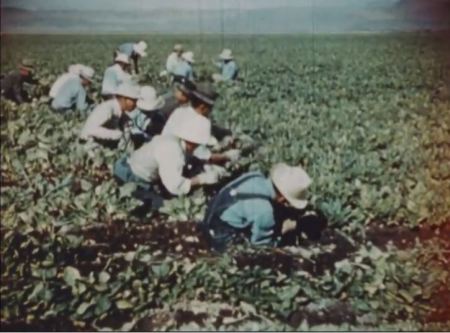
“A Challenge to Democracy,” by the War Relocation Board.  This film defends the relocation of 100,000 Japanese Americans during World War II.

Japanese-descended American citizens harvesting crops they grew during internment during World War II. Screen capture from "Challege to Democracy."

Japanese-descended American citizens harvesting crops they grew during internment during World War II. Screen capture from “Challege to Democracy.”

“These people are not under suspicion,” the narrator says.  “They are not prisoners, they are not internees.  They are merely dislocated people, the unwounded casualties of war.”

According to the Internet Archive, the film is a 1944 production.  That site has the film available for download in several formats.  The film is collected in the Prelinger Archives.  On my computer, some of the Internet Archive versions offer  better quality than the Google Video version above.

I originally found the film at a school site in Washington, Mr. Talmadge’s Wikispace site, apparently for his classes in the history of the State of Washington.  That site has a very useful series of links to good sites on the internet for information about the Japanese internment.  There are several other topics noted there, too, including the Chinese Exclusion Act, the Whitman Massacre in Oregon, and the Nez Perce Retreat.  I’d love to see Mr. Talmadge’s plan for the year.

What do your students do to display their work on the internet?


Desperation in AGW denial ranks?

May 17, 2009

One might hope it is a sign of desperation, and not just one more ratcheting up on the dishonesty scale.

Anthony Watts has a post that looks at Boston Harbor, a post borrowed from a sleepy blog called Climate Sanity, by Tom Moriarty.  Watts, a leader among denialists, notes the warnings about sea level rising, and then offers maps of Boston as evidence everyone is safe.

The maps show the shoreline expanding around the peninsula where the main part of Boston sits.

Consequently, the authors claim, rising sea levels won’t do damage anyone should worry about.

Changes in Boston Harbor, from the denialist blog Climate Sanity

Changes in Boston Harbor, animation from the denialist blog Climate Sanity

It’s an odd sort of claim.  Anyone with any knowledge of the growth of harbor cities will look at the maps and notice the extension of lands from fill. Watts and Moriarty do not specifically claim that ocean levels have no effect, though some reading the headlines alone may get that idea.  They argue that humans will respond to negate the bad effects of climate change. 

That’s not what the maps show at all. The maps show that, in the absence of wetlands protection, people will use fill to expand commercial opportunities at a busy harbor.  That is true whether the fill requires the destruction of local landmarks, or whether the fill arrives accidentally from other major natural events.

The climate change denialists’ claims make an argument based in deception.  Harbor areas are always better fortified against sea and weather changes than other areas.  Boston Harbor is a comparatively small area, when contrasted with the Atlantic coastline of North America.

Do they know they’re just pulling our leg?  Or is this one more sign of the desperation denialists get over the realization the facts are against them?

At root the argument fails, and fails offensively: Watts and company argue that climate change and rising sea levels are not a problem, if we have enough concrete and fill to expand land close to the water and harden seawalls.  We also would need a lot of commercial development to make it cost effective to fill in the threatened lands.  That sort of development will involve only a very small area of any nation’s coastline.

Of course, that sort of hardening of sites is exactly what the wetlands protection under Section 404 of the Clean Water Act aimed to slow or stop, and it is part of the cause of trouble in the Mississippi Delta and other places unhardened, where the effects of hardening ports are pushed.

Watts also fails to account for the more serious immediate issues:  It’s not permanent inundation that we need to worry about with ports, but rather, the effects of stronger storms with higher sea levels.  The U.S. Environmental Protection Agency has been on that issue for years.  Boston Harbor is an example of a place that we need to protect from effects of climate change, at great expense, in order to preserve the filling done in the past and the development on that filled-in land that once was sea.

For examples, consult the white paper from EPA in July 2008, “Planning for Climate Change Impacts at U.S. Ports.  From the very first lines, you can begin to see why the denialists’s claims don’t wash:

Over the coming decades, climate change is likely to cause sea levels to rise, lake levels to drop, more frequent and severe storms, and increases in extreme high temperatures. These effects can have mild to severe impacts on port infrastructure and operations, depending on their geographical setting and design. Ports are critical to the trade and transportation networks of the United States. Specifically, ports handle 78% of all U.S. foreign trade by weight and 44% by value.1 The United States’ ports also represent billions of dollars in capital improvements and new investments. While the risk that climate change poses to ports is unclear, what is clear is that ports need to better understand climate change, how it may impact them, and what they can do to ensure reliable services for their customers.

Stakes are too high for analysis so shallow as simple map overlays.  In reality many factors mean that ports and harbors are threatened from many different problems arising from climate change.  The EPA white paper lists specifics.

Changes in water level:

The most immediate concern related to rising sea levels is the need to raise the level of infrastructure to prevent flooding. Ports will need to consider anticipated sea levels when building new infrastructure. In cases where current infrastructure may not be high enough for its useful lifespan, ports will need to increase infrastructure heights.

Higher sea levels may threaten ports’ environmental mitigation projects. Also, many ports have contaminated or potentially contaminated industrial land on their premises.17 Higher water levels may require new containment methods to prevent leeching of contaminants.

Many climate models predict that climate change will cause water levels to drop in the Great Lakes and the Mississippi River Basin, which would make shipping there more difficult. When lake levels decreased from 1997-2001, ships in the Great Lakes were forced to carry less cargo. Future decreases in water level would again require cargo restrictions or perhaps the redesign of vessels. Either one would increase the cost of shipping on interior waterways. Decreased depths could be mitigated by increased dredging, but at a financial and environmental cost.

Storm events and precipitation:

Globally, extreme precipitation events are expected to become more frequent, and severe storms are expected to become more intense. Stronger wave action and higher storm surges, especially when coupled with higher sea levels, are the primary threat to ports. These impacts can damage bridges, wharfs, and piers, terminal buildings, ships, and cargo. Harbor infrastructure may need to be raised or reinforced to withstand these impacts.

In addition to contributing to storm surge, wind can also have its own damaging impacts. High winds particularly threaten unreinforced terminal structures. For example, Hurricane Katrina tore roofs and doors off warehouses at the Port of New Orleans. One possible response to these threats is to change design standards for terminals, cranes, lighting systems, and other infrastructure to incorporate the risk of stronger storms.

Higher temperatures:

Higher incidences of extreme high temperatures could also affect some auxiliary port infrastructure. For example, paved surfaces may deteriorate more quickly in hotter conditions. Cranes and warehouses made of metal may require design changes to withstand higher temperatures. Higher temperatures may also require more energy for cooling of goods stored at ports.

Higher temperatures could impact the human and natural environments associated with ports as well. Many employees at ports work primarily outdoors. Operational changes may be required to protect workers from extreme heat. Warmer temperatures may also increase the risk of transferring invasive species from region to region on cargo vessels.

For ports in northern states, including Alaska, higher temperatures could provide some benefits. Operating conditions may improve as ice accumulation on port infrastructure decreases. Shipping seasons would lengthen as more ports and waterways become ice free for more of the year. These effects could increase volume and reduce costs for northern shipping.

Indirect impacts, including insurance:

Ports are also likely to face changes in insurance coverage and possible higher insurance premiums because of climate change. The insurance industry is one of the leading commercial sectors expressing concern about and exploring adaptive responses to climate change. Several large companies that provide business insurance services are incorporating risk from climate change into insurance offerings. Strategies include shifting a greater share of risk onto customers and providing technical support and pricing incentives for customers to reduce their exposure to climate-related risks.

Denialist arguments frequently come with unintended irony.  Part of Boston Harbor was filled in by a the New England hurricane of 1938.  Castle Island, one of the areas the animation highlights as being filled out, ostensibly by humans, is connected to the mainland now as a testament, a warning of the potential for nature to change the place quickly, contrary to the plans of humans.  One day in 1938 a hurricane converted the place from an island to a peninsula.  Is this really the best the denialists have to persuade us that we shouldn’t be concerned about the power of nature now?

Climate warming is real.  The effects of warming are real and quite problematic already.  Filling in wetlands around busy harbors, even just to raise elevation, is not a viable solution to the problems, regardless their cause.

Resources:


Kerouac played fantasy baseball – four decades early

May 17, 2009

Who knew?

Three of Jack Kerouac’s fantasy baseball team cards, circa 1953-56. New York Public Library, Berg Collection, Jack Kerouac Archive

Three of Jack Kerouac’s fantasy baseball team cards, circa 1953-56. New York Public Library, Berg Collection, Jack Kerouac Archive

Kerouac fans, and anyone who participates in a rotisserie league sport, and anyone who just wants a moment of merriment, should read this New York Times story:

Almost all his life Jack Kerouac had a hobby that even close friends and fellow Beats like Allen Ginsberg and William S. Burroughs never knew about. He obsessively played a fantasy baseball game of his own invention, charting the exploits of made-up players like Wino Love, Warby Pepper, Heinie Twiett, Phegus Cody and Zagg Parker, who toiled on imaginary teams named either for cars (the Pittsburgh Plymouths and New York Chevvies, for example) or for colors (the Boston Grays and Cincinnati Blacks).

At least one more book Kerouac had inside, unwritten.  Now we just see the outline of what could have been a superb, and funny, work of fiction, in a book by New York Public Library curator Isaac Gewirtz.  The Kerouac items are in the Berg Collection at the Library.

No historian could make this stuff up.


Cartoons: Bill Mauldin on DDT

May 16, 2009

Bill Mauldin rose to fame drawing cartoons from the fronts during World War II, first as a soldier, and then as the cartoonist for Stars and Stripes.  He won the Pulitzer Prize for cartooning in 1945.  After the war he continued to be a major force in American culture, eventually cartooning for the St. Louis Post-Dispatch and quickly winning a second Pulitzer, and then with the Chicago Sun-Times, with drawings syndicated to other newspapers around the world.

In 1962 Mauldin turned his pen to DDT and the controversy created in part by Rachel Carson’s best-selling book Silent Spring.

CREDIT: Mauldin, Bill, artist. Another such victory and I am undone Copyright 1962, Field Enterprises, Inc. Prints and Photographs Division of the Library of Congress.

CREDIT: Mauldin, Bill, artist. “Another such victory and I am undone” Copyright 1962, Field Enterprises, Inc. Prints and Photographs Division of the Library of Congress.


History: May 15, 1963, President’s council vindicates Rachel Carson, warns of pesticide dangers

May 15, 2009

President John F. Kennedy’s Science Advisory Council (PSAC) studied Rachel Carson’s best-selling book, Silent Spring, checking it for scientific accuracy.  Kennedy read the book himself, but sought expert advice before doing anything.  Meanwhile, DDT manufacturers bankrolled an extensive public relations campaign claiming DDT was safe, and suggesting Carson was less than a careful writer and scientist.

On May 15, 1963, PSAC reported:  Carson was right. Pesticides were being misused, even abused, and some pesticides like DDT presented significant threats to the environment.  “The Use of Pesticides” recommended increased government scrutiny of the safety and efficacy of pesticides, and vindicated Carson’s reporting of science findings.

Library of Congress described the event and its import in America’s Library, “Meet Amazing Americans”:

The Consequences of Silent Spring

Reading Carson’s book changed many people’s ideas about the environment and inspired some to take action. People wrote to their representatives in congress and asked them to do something about the misuse of pesticides. When several senators created a committee to research environmental dangers, they asked Carson to speak to them about pesticides. Carson recommended that the government regulate and reduce pesticide use, and that it ban the most toxic pesticides. She said that a citizen of the United States had the right “to be secure in his own home against the intrusion of poisons applied by other persons.”

President Kennedy understood the importance of Carson’s book. He asked his Science Advisory Committee to research Carson’s claims in Silent Spring. In 1963 the Committee released a report called “The Uses of Pesticides.” It supported Silent Spring. Environmental activists continued to push the government to regulate pesticides. Changes in federal law in 1964 required companies to prove that something did not cause harm before they could sell it. In 1972, activists pushed for and won a ban on DDT, the pesticide that started Carson’s research for Silent Spring. And in 1970 the Environmental Protection Agency (EPA) was created “in response to the growing public demand for cleaner water, air and land.” Who knows what the world would be like today if Rachel Carson had not written Silent Spring?

 
Some radicals argue that Rachel Carson’s legacy is tarnished, that she was in error about DDT, and somehow that translates into many deaths as a result of malaria, as if DDT worked against malaria parasites themselves.  With such a strong propaganda campaign of disinformation plaguing us today, we do well to pause and remember that Carson’s work was subjected to intense, careful scrutiny by scientists from the start.  Carson’s reporting was accurate, and her legacy of environmental protection and saving lives should be celebrated.

Teaching Resource: Role play simulation, “Advisory Committee on Pesticides 1963,” (see especially the list of historic and scientific resources available for study and for the simulation, from Douglas Allchin).

Rachel Carson in the ocean in Florida, 1955 - photo, R. G. Schmidt, USFWS

Rachel Carson in the ocean in Florida, 1955 – photo, R. G. Schmidt, USFWS

Updates, January 2013:

More, from 2013:

Save


History: May 15, 1953 and the mysteries of life’s beginnings

May 15, 2009

May 15, 1953, saw the publication in Science of Stanley Miller’s dramatic experiment showing that essential chemicals of life rise spontaneously.

The late Prof. Stanley Miller.  ISSOL photo

The late Prof. Stanley Miller. ISSOL photo

As usual, the real history is better and much more serendipitous than anyone could imagine in a fictional account; here’s an account from the International Astrobiology Society (ISSOL), from their 2003 celebration of the 50th anniversary of Miller’s paper’s publication:

The University of Chicago Chemistry Department seminars were held on Mondays in Kent Hall, an old building where the floors creaked and there was a smell of dust and mildew. Only the most distinguished scientists were invited to speak at this seminar, many had Nobel prizes or were to receive one, and the list included Franck, Urey, Calvin, Seaborg, Eigen, Libby and Taube.

But this day was different because a second year graduate student, Stanley Lloyd Miller, was speaking, and the room was full because the word had spread that something important was to be presented. In addition to the famous scientists and less famous but equally high-powered scientists was an undergraduate, Carl Sagan attending his first chemistry seminar. The topic was the synthesis of important biological compounds, using conditions thought to have existed on the primitive Earth.

Miller reported that by sending repeated electric sparks through a sealed flask containing a mixture of methane, ammonia, hydrogen, and water vapor, he had made some of the amino acids found in proteins. Perhaps, he suggested, this was how organic compounds were made on the ancient Earth before life existed.

While Miller was confident of his results, the rows of famous faces in his audience were, to say the least, intimidating. He was bombarded with questions. Were the analyses done correctly? Could there have been contamination? After the event, Miller thought that the questions had been constructive, but since the results were hard to believe, they had simply wanted to ensure that he had not made some mistake. However, Carl Sagan thought that Miller’s inquisitors seemed to be picky and did not appreciate the significance of the experiment. Even the relevance of Miller’s results to the origin of life were questioned. When someone asked Miller how he could really be sure this kind of process actually took place on the primitive Earth, Nobel Laureate Harold Urey, Miller’s research advisor, immediately interrupted, replying, “If God did not do it this way, then he missed a good bet.” The seminar ended amid the laughter, and the attendees filed out with some making complimentary remarks to Miller. Miller changed clothes, went back to the lab and started a paper chromatography run.

The events leading up to this dramatic seminar began two years earlier in October, 1951 when Urey presented the Chemistry Department seminar on the origin of the Solar system. In addition to the usual high powered scientists, the audience had contained the then first year graduate student, Stanley Miller.

Read “Prebiotic Soup—Revisiting the Miller Experiment” by Jeffrey Bada and Antonio Lazcano published in Science300 (2003) 745-726 in full text or as a PDF.

This is an abridged version of the Stanley Miller’s 70th Birthday published in Origins of Life and Evolution of the Biosphere 30: 107-112, 2000 by Jeffrey Bada and Antonio Lazcano and The Spark of Life – Darwin and the Primeval Soup by Christopher Wills and Jeffrey Bada, Perseus Books, 2000.

More than 50 years ago scientists demonstrated that basic chemicals of life, thought previously by some to be too complex to arise naturally, could occur in nature spontaneously. Much of the misunderstanding and crank science behind creationism is devoted to hiding these facts.

Lift a glass to Stanley Miller and his experiment today, a toast to learning, a toast to the truth.

More Resources:


True, but did Einstein say it?

May 6, 2009

Poster by Ricardo Levins Morales. Updated March 2015 - click image to purchase a copy of the poster from Mr. Morales.

Poster by Ricardo Levins Morales. Updated March 2015 – click image to purchase a copy of the poster from Mr. Morales.

Nice poster, great thought — you can’t measure everything about a student with a test, nor with a battery of tests.  Texas testing in core areas finished up last week, Advanced Placement and International Baccalaureate testing runs this week.

Not everything that can be counted, counts, and not everything that counts can be counted.
– Albert Einstein

I especially thought of this quote one day last week while reading the questions to a kid with Downs syndrome who, as best I could measure from just watching reactions working problems, has a great flair for mathematics, and again when I discovered a geographic genius in the special education group.  (My classes say universally the tests were easy — and for some reason I find that terrifying.)

Did Einstein say it? I found the poster at Learning is More Than a Score; it can be purchased from the Northland Poster Collective.  Neither suggests where we might verify that Albert actually said it, though Bob Murphy at More Than a Score said he understands it may have been on the wall in Einstein’s office.  The artist is Ricardo Levins Morales (see more at Ricardo Levins Morales Galleries).

Readers, can you help?  Did Einstein say that?  When and where?

Update March 2015:  Quote Investigator urges that we attribute the quote to William Bruce Cameron, in a 1963 book.


Cinco de Mayo explained

May 5, 2009

You thought Cinco de Mayo was Independence Day for Mexico?

No, it’s not.

History.com has a nice explanation, with a nice little video.

Perhaps the U.S. should celebrate the day, too, at least in those states who were not in the old Confederacy.  On May 5, 1862, Mexicans under the command of 33 year old Commander General Ignacio Zaragoza Seguín stopped the quick advance of superior French forces trying to invade Mexico to take it over, at the Battle of Puebla.  While France did eventually defeat Mexican forces (after getting 30,000 men in reinforcements), the spirit of May 5 inspired Mexicans to continue to fight for freedom.  And ultimately, Mexican forces overpowered and captured the French forces and Emperor Maximilian, who was executed.

Thus ended a great hope for the Confederacy, that French-supported Mexican Army would lend aid to the Confederates in their struggle to secede from the Union.

It is one of the great what-ifs of history:  What if France had kept Mexico, and what if French-led Mexican forces backed up the Confederate Army?

One thing is rather sure:  Had that happened, and had the Confederacy been successful, we wouldn’t be celbrating Cinco de Mayo in Texas today.

Also in Texas, on May 5, 2009, AP Spanish tests.  Good luck, kids!

Battle of Puebla, Wikimedia (artist?)

Battle of Puebla, Wikimedia (artist?)

Mexican Independence Day is September 16.


Great images of art, for world history and geography

April 20, 2009

About 75,000 images, most very high quality, for classroom use.  Images are sorted into categories that should align with all state standards and any textbook series — at the California State Universities, World Images Kiosk.  There are a lot of images from ancient cultures, a lot of images from pre-Renaissance times, and a rich panorama of other images.

For example, Jasper Johns’ 1961 pop art map of the United States . . .

JOHNS Jasper | Map. | 1961 | American | Pop Art | | North America. | | ©Jasper Johns ; Kathleen Cohen

JOHNS Jasper | Map. | 1961 | American | Pop Art | | North America. | | ©Jasper Johns ; Kathleen Cohen


Polluted waters near your home, 6-legged frogs, and you

April 19, 2009

It was a reference to the “environmental movement” in government and politics — seniors take the class in Texas.  “What does that mean?”

We have maybe ten minutes in the block to stray.  No time for discovery learning to get this point across in government.

“The movement, the grass-roots political organizing to express concern for clean air, clean water, preservation of green space, preservation of endangered species, protection from toxic chemicals and poisons.  Things really took off after Rachel Carson’s book, Silent Spring. ”

“That’s a funny title.  What’s it about?”  I pause.  It’s dangerous territory to ask what high school kids don’t know these days.

“Is there anyone here who does not know about DDT and its role in threatening our national symbol, the bald eagle?”

Every hand went up.

How can children get to their senior year and not know about Rachel Carson, DDT, or “environmentalism?”

Comes Frontline on PBS this week.  Government and politics teachers, your students should watch and report.

FRONTLINE
http://www.pbs.org/frontline/

This Week: “Poisoned Waters” (120 minutes),
April 21st at 9pm on PBS (Check local listings)

———————-

For years, Pulitzer Prize-winning journalist Hedrick Smith has reported from the corridors of power in Washington, on Wall Street, and overseas.  But these days, he’s worried about something that he’s found much closer to home — something mysterious that’s appeared in waters that he knows well:  frogs with six legs, male amphibians with ovaries, “dead zones” where nothing can live or grow.

What’s causing the trouble? Smith suspects the answers might lie close to home as well.

This Tuesday night, in a special two-hour FRONTLINE broadcast –“Poisoned Waters”– Smith takes a hard look at a new wave of pollution that’s imperiling the nation’s waterways, focusing on two of our most iconic:  the Chesapeake Bay and Puget Sound.  He also examines three decades of environmental regulation that are failing to meet this new threat, and have yet to clean up the ongoing mess of PCBs, the staggering waste from factory farms, and the fall-out from unchecked suburban sprawl.

“The environment has slipped off our radar screen because it’s not a hot crisis like the financial meltdown, war, or terrorism,” Smith says.  “But pollution is a ticking time bomb. It’s a chronic cancer that is slowly eating away the natural resources that are vital to our very lives.”

Among the most worrisome of the new contaminants are “endocrine disruptors,” chemical compounds found in common household products that mimic hormones in the human body and cause freakish mutations in frogs and amphibians.

“There are five million people being exposed to endocrine disruptors just in the Mid-Atlantic region,” a doctor at the Johns Hopkins School of Public Health tells Smith.  “And yet we don’t know precisely how many of them are going to develop premature breast cancer, going to have problems with reproduction, going to have all kinds of congenital anomalies of the male genitalia that are happening at a broad low level so that they don’t raise the alarm in the general public.”

Can new models of “smart growth” and regulation reverse decades of damage?  Are the most real and lasting changes likely to come from the top down, given an already overstretched Obama administration?  Or will the greatest reasons for hope come from the bottom up, through the action of a growing number of grassroots groups trying to effect environmental change?

Join us for the broadcast this Tuesday night.  Online, you can watch “Poisoned Waters” again, find out how safe your drinking water is,  and  learn how you can get involved.

Ken Dornstein
Senior Editor

————————

Funding for FRONTLINE is provided through the support  of PBS viewers. Major funding for FRONTLINE is provided by The John D. and Catherine T. MacArthur Foundation. Additional funding is provided by the Park Foundation. Major funding for Poisoned Waters is provided by The Seattle Foundation, The Russell Family Foundation, The Wallace Genetic Foundation, The Morris and Gwendolyn Cafritz Foundation, The Keith Campbell Foundation for the Environment, The Merrill Family Foundation, The Abell Foundation, The Bullitt Foundation, the Park Foundation, and The Rauch Foundation.  Additional funding is provided by The Town Creek Foundation, The Clayton Baker Trust, The Lockhart Vaughan Foundation, The Curtis and Edith Munson Foundation, The Chesapeake Bay Trust, Louisa and Robert Duemling, Robert and Phyllis Hennigson, Robert Lundeen, The Eugene and Agnes E. Meyer Foundation, The Prince Charitable Trusts, Ron and Kathy McDowell, Valerie and Bill Anders, Bruce and Marty Coffey, The Foundation for Puget Sound, Janet Ketcham, Win Rhodes, The Robert C. and Nani S. Warren Foundation, Jim and Kathy Youngren, Vinton and Amelia Sommerville and Laura Lundgren.

————————

FRONTLINE is a registered trademark of the WGBH Educational Foundation.

See a preview, and read more, here.  Another preview below.  You can watch the entire program online after April 21.


Paul Revere’s ride, and the shot ‘heard ’round the world’

April 18, 2009

This is the anniversary of Paul Revere’s ride, which means tomorrow is the anniversary of the battles at Lexington and Concord, Massachusetts, that signaled the beginning of real hostilities of the American Revolution.

Details on the poems here and here — go get them and read them to your children.

The National Guard traces its beginnings to these events (see a description here — scroll down to April 18).

Shot heard round the world - Dominick D'Andrea, National Guard Heritage Gallery

Dominick D'Andrea painting from the National Guard Heritage Series. National Guard caption: At dawn on April 19, 1775, as 700 elite British soldiers marched toward Concord, they fought a brief skirmish with militiamen on Lexington Green, leaving eight colonists dead and nine wounded. The King’s troops marched on, arriving at Concord two hours later. While some troops searched the town for stores of gunpowder and arms, three companies guarded the “North Bridge.” As the British were marching toward Concord, word spread of the fight at Lexington. Alarm bells rang calling out the militia and Minute Men across Middlesex County. Among the units to muster was Colonel James Barrett’s Middlesex County Regiment of Minute Men. Once in formation the regiment moved onto a hill within 500 yards of where the British stood watch at North Bridge. Colonel Barrett, needing to organize additional militia companies, left his command to Major John Buttrick. When smoke appeared in the sky above Concord the Americans wrongly believed the British were burning the town. In response Buttrick decided to move his men toward the town. As the Americans advanced the British pickets fell back across the bridge. The last British unit to cross, the Light Company of the 4th (King’s Own) Foot, stopped to tear up some of the planks to delay the militia advance. Leading the American column was Captain Isaac Davis’s Company of Minute Men from Acton. As they got within 50 yards of the bridge Buttrick shouted at the British to stop tearing up the planks. Suddenly three British shots were fired, killing Davis and another man instantly and wounding a third. Buttrick shouted “Fire! For God’s sake Fire!” and the Minute Men unloosed a ragged but heavy volley. Four out of eight British officers were hit along with seven enlisted men, two of whom died. The British immediately fell back toward the town where they linked up with other Royal troops. Buttrick moved his men across the bridge as the British column began marching back down the road toward Boston. Militiamen gathered along their path and soon began firing from behind trees and stone walls, inflicting an ever-increasing number of casualties. When the exhausted British troops reached Lexington, scene of the fight earlier that morning, they were met by a relief force sent to accompany them back to Boston. However, the Americans did not stop their attacks, inflicting additional losses on the British column before it reached Boston. In total the British suffered almost 300 dead, wounded or missing. Within days an army of nearly 20,000 militiamen from all over New England surrounded the city, effectively putting it under siege. In 1875, on the 100th anniversary of the action at Concord, Daniel Chester French’s Minuteman statue, the symbol of today’s National Guard, was dedicated. As part of the ceremony, Ralph Waldo Emerson’s poem The Concord Hymn was read honoring the men who “fired the shot heard round the world” which began the Revolutionary War. Today’s National Guard is the direct descendent of those militia and Minute Men who stood their ground to protect their homes and freedoms.

National Guardsmen from the U.S. stand under arms around the world today, defending freedom and America’s towns, cities, farms, orchards, forests and wilderness.   Find a Guardsman today (including women), and thank them for their service.


No, Texas cannot secede; no, Texas can’t split itself

April 18, 2009

Rick Perry put his foot into something during one of the Astro-turf “tea parties” on April 15.  Someone asked him about whether Texas should secede from the United States, as a protest against high taxes, or something.

The answer to the question is “No, secession is not legal.  Did you sleep through all of your U.S. history courses?  Remember the Civil War?”

Alas, Perry didn’t say that.

Instead, Perry said it’s not in the offing this week, but ‘Washington had better watch out.’

He qualified his statement by saying the U.S. is a “great union,” but he said Texans are thinking about seceding, and he trotted out a hoary old Texas tale that Texas had reserved that right in the treaty that ceded Texas lands to the U.S. in the switch from being an independent republic after winning independence from Mexico, to statehood in the U.S.

So, rational people want to know:  Does Perry know what he’s talking about?

No, he doesn’t.  Bud Kennedy, columnist for the Fort Worth Star-Telegram (still one of America’s great newspapers despite the efforts of its corporate owners to whittle it down), noted the error and checked with Gov. Perry’s history instructors at Texas A&M and his old high school, both of which said that Perry didn’t get the tale from them.  (Score one for Texas history teachers; rethink the idea about letting people run for state office without having to pass the high school exit history exam.)

A&M professor Walter L. Buenger is a fifth-generation Texan and author of a textbook on Texas’ last secession attempt. (The federal occupation lasted eight years after the Civil War.)

“It was a mistake then, and it’s an even bigger mistake now,” Buenger said by phone from College Station, where he has taught almost since Perry was an Aggie yell leader.

“And you can put this in the paper: To even bring it up shows a profound lack of patriotism,” Buenger said.

The 1845 joint merger agreement with Congress didn’t give Texas an option clause. The idea of leaving “was settled long ago,” he said.

“This is simple rabble-rousing and political posturing,” he said. “That’s all it is.  . . .  Our governor is now identifying himself with the far-right lunatic fringe.”

Three false beliefs about Texas history keep bubbling up, and need to be debunked every time.  The first is that Texas had a right to secede; the second is that Texas can divide itself into five states; and the third is that the Texas flag gets special rights over all other state flags in the nation.

Under Abraham Lincoln’s view the Union is almost sacred, and once a state joins it, the union expands to welcome that state, but never can the state get out.  Lincoln’s view prevailed in the Civil War, and in re-admittance of the 11 Confederate states after the war.

The second idea also died with Texas’s readmission.  The original enabling act (not treaty) said Texas could be divided, but under the Constitution’s powers delegated to Congress on statehood, the admission of Texas probably vitiated that clause.  In any case, the readmission legislation left it out.  Texas will remain the Lone Star State, and not become a Five Star Federation. (We dealt with this issue in an earlier post you probably should click over to see.)

Texas’s flag also gets no special treatment.  I cannot count the number of times I’ve heard Texans explain to Boy Scouts that the Texas flag — and only the Texas flag — may fly at the same level as the U.S. flag on adjacent flag poles.  Under the flag code, any flag may fly at the same level; the requirement is that the U.S. flag be on its own right.

Gov. Perry is behind Sen. Kay Bailey Hutchison in polling of a head-to-head contest between the two to see who will be the Republican nominee for governor in 2010 — Hutchison is gunning to unseat Perry.  He was trying to throw some red meat to far-right conservative partisans who, he hopes, will stick by him in that primary election.

Alas, he came off throwing out half-baked ideas instead.  It’s going to be a long, nasty election campaign.

_____________

Update: A commenter named Bill Brock (the Bill Brock?) found the New York Times article from 1921 detailing John Nance Garner’s proposal to split Texas into five.  Nice find!

Another update: How much fuss should be made over the occasional wild hare move for some state to secede?  Probably not much.  A few years ago Alaska actually got a referendum on the ballot to study secession.  The drive to secede got nowhere, of course.  I was tracking it at the time to see whether anyone cared.  To the best of my knowledge, the New York Times never mentioned the controversy in Alaska, and the Washington Post gave it barely three paragraphs at the bottom of an inside page.


Four Stone Hearth #64 at Quiche Moraine

April 12, 2009

Do you have to know geology to get the title of that blog?

Four Stone Hearth 64 is hosted by Quiche Moraine.  Lots of good stuff.  F’rinstance:

With a few hours, an ambitious teacher could get 20 or 30 good bell-ringers out of FSH.  Bell ringers based on real research — what a concept.

A modern version of an ancient hearth - State Cooking Pot of Utah, the Dutch oven - photo by Jason Slemons

A modern version of an ancient hearth - State Cooking Pot of Utah, the Dutch oven - photo by Jason Slemons