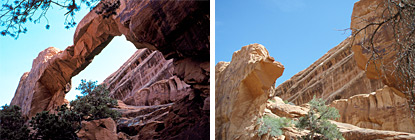
Disaster at Arches National Park

August 10, 2008

Wall Arch, 12th largest, one of the better-known and most-seen natural arches in Arches National Park, Utah, collapsed.

Wall Arch, before and after collapse - National Park Service photos

Wall Arch, before and after collapse – National Park Service photos

“Not being a geologist, I can’t get very technical but it just went kaboom,” [Arches NP] Chief Ranger Denny Ziemann said. “The middle of the arch just collapsed under its own weight. It just happens.”

Wall Arch, located along the popular Devils Garden Trail, was 71 feet tallwide and 33 1/2 feet widetall, ranking it 12th in size among the known arches inside the park. Lewis T. McKinney first reported and named Wall Arch in 1948.

No one reported observing the arch collapse and there were no visitor injuries, the National Park Service said.

Read the report from the Salt Lake Tribune.

Some tourist on Sunday, August 3, or Monday, August 4, got the last photograph of Wall Arch still standing. Was it you? Were you close? Give us a shout in the comments if so.

Other resources:

x

Other blogs and later reports:


63rd anniversary: Hiroshima, August 6; Nagasaki, August 9

August 9, 2008

63 years ago, U.S. military action brought a quick close to hostilities without an invasion of Japan, with the detonation of two atomic bombs, one over Hiroshima on August 6, 1945, and one over Nagasaki on August 9.

Daily Yomiuri Online carried a description of memorial events in Hiroshima today, from Yomiuri Shimbun:

NAGASAKI–The Nagasaki municipal government held a ceremony Saturday marking the 63rd anniversary of the atomic bombing of the city, at which participants called for the abolition of all nuclear weapons.

A total of 5,650 A-bomb survivors, representatives of victims’ families from around the nation and Nagasaki citizens participated in the ceremony. Prime Minister Yasuo Fukuda also attended the ceremony, which was held in Nagasaki Peace Park near ground zero.

Nagasaki Mayor Tomihisa Taue read out the Nagasaki Peace Declaration, which urges the worldwide abolition of nuclear weapons.

“Human beings have no future unless nuclear weapons are eliminated. We shall clearly say no to nuclear weapons,” Taue said.

The ceremony started at 10:40 a.m. Three books listing the names of 3,058 people confirmed to have died as a result of the bombing in the past year were placed inside a memorial box in front of the Peace Statue.

The total number of books listing the names of the deceased is 147, and the number of names is 145,984.

Representatives of surviving victims, bereaved families, the prime minister and Hiroshima Mayor Tadatoshi Akiba placed flowers at the site.

At 11:02 a.m., the time the atomic bomb struck, ceremony participants offered a silent prayer. At the same time, local high school students rang the Bells of Nagasaki.

In the peace declaration, Taue read from an academic paper written by four people, including a former U.S. secretary of state, which promoted a new policy for developing nuclear weapons. The proposal encouraged countries to ratify the Comprehensive Test Ban Treaty. The mayor said world nuclear powers “should sincerely fulfill their responsibility of nuclear disarmament,” and urged the government to pass the three nonnuclear principles into law.

This year also marks the 100th anniversary of the birth of Takashi Nagai, a medical doctor who helped rescue of victims after the bombing.

The mayor referenced one of the doctor’s remarks, saying: “There are no winners or losers in a war. There is only destruction.”

Shigeko Mori, 72, representing survivors of the bombing, read out an oath for peace that said Japan should promote its Constitution and the three nonnuclear principles to the rest of the world to prevent nuclear proliferation.

Fukuda gave a speech, saying, “Japan should play a responsible role in the international community as a nation cooperating for peace.”

(Aug. 10, 2008)

Other information:

Other related posts at Millard Fillmore’s Bathtub:


No one believes it. Is it so?

August 9, 2008

One of the great mysteries of history is how an entire nation of people can follow a leader into tragedy — a stupid war, economic morass, cultural suicide, genocide, or other tragedy — without appearing to notice they were going against their national values, against reason, against morality.

I wonder if part of the answer can be found by studying the way our brains perceive things, in particular, the way our brains force us to see things that are not so.

Some things are just so unbelievable, our brains tell us we’re seeing something different, something more believable. Here are two examples, the Charlie Chaplin mask illusion, and the Einstein mask illusion.

Chaplin — you know it’s concave, but the nose sticks out every time:

Einstein — is Big Brother really watching you? What do your eyes say?

Here’s a nasty little kicker: Even when most people know that it’s an illusion, they can’t perceive the illusion-in-action; as Paul Simon wrote, “Still a man sees what he wants to see and he disregards the rest.” See Stephen Fry’s discussion about the illusion from BBC2:

Historical applications

  • CIA chief William Colby was involved in Operation Phoenix during the Vietnam War. When investigations revealed that the operation involved torture, many people refused to believe the U.S. would be involved in torture (good!). And even after he admitted to Congressional committees that he had personally authorized the torture, people had difficulty believing it. David Wise wrote an article about Operation Phoenix for the New York Times Magazine, July 1, 1973: “Not one of Colby’s friends or neighbors, or even his critics on the Hill, would, in their wildest imagination, conceive of Bill Colby attaching electric wires to a man’s genitals and personally turning the crank. “Not Bill Colby… He’s a Princeton man.'”
  • “[T]he Russians are finished. They have nothing left to throw against us,” a confident Adolf Hitler told Gen. Franz Halder in July 1941. Russia mired down the German army, making the phrase “the Eastern Front” a dreaded death sentence in German commands. In the end, it was the Soviet Army that first got to Berlin, and captured Hitler’s command bunker where der Führer had committed suicide a short time before. Adding to the historic irony, twice over: First, Stalin refused to believe his intelligence service reports that the Nazis were massing on the border of Russia, just two years after the Molotov-Ribbentrop Pact, which pledged neither nation would invade the other. Second, Hitler’s generals had studied Napoleon’s invasion of Russia in 1812, working to avoid all the mistakes Napoleon made. So sure were the Nazis of their superiority to Napoleon in every way, they invaded Russia on the anniversary of Napoleon’s invasion, June 22, 1941. Great shades of Santayana’s Ghost!
  • Bush administration historians will wonder why Bush was able to do what he did, in the Iraq war and other situations foreign and domestic, with even members of his own party who saw him close up believing he’d do something different. See this story by Ron Susskind, “Faith, Certainty and the Presidency of George Bush,” New York Times Magazine, October 17, 2004.
  • The Gulf of Tonkin Resolution, based on an incident in the Gulf of Tonkin near Vietnam.  (See also documents from the National Security Agency archives.)
  • Weapons of Mass Destruction in Iraq.

Richard Feynman discussed at length how scientists know their experimental results are accurate, and how to keep science honest. He pointed out that most of the time, errors creep in at the start, and some people just refuse to believe they exist. It is easiest to fool ourselves, Feynman said — and so a good scientist understands that, and protects against self-deception. If only other disciplines could adopt that philosophy, strategy and tactics!

Faith can get us through troubled times, but often gets us into troubled times in the first place.

Do you have other examples of self-delusion by illusionary means?

Tip of the old scrub brush to Vous Pensez.


Oops! How many stripes on the U.S. flag?

August 7, 2008

School kids and people seeking naturalization as citizens of the U.S. should be able to tell you there are 13 stripes on the U.S. flag, one for each of the original 13 colonies. The top stripe is red, and the bottom stripe is red.

Oops. The U.S. Postal Service printed a stamp that features what looks like a flag with a 14th stripe.

Representations of the general usage, first class postal stamps issued by the U.S. Postal Service in April 2008 -- and, is that a 14th stripe on the flag in the lower right?

Representations of the general usage, first class postal stamps issued by the U.S. Postal Service in April 2008 -- and, is that a 14th stripe on the flag in the lower right? The four original, correct paintings were done by Laura Stutzman of Mountain Lake Park, Maryland.

A philatelist blogger, Stamps of Distinction, noted the error in a post earlier this week. The Postal Service acknowledged a problem with the stamp, but said what looks like a seventh white stripe at the bottom of the flag is really just a light patch added to the stamp to give contrast with the last red stripe.

The error appears on the fourth of a four-stamp plate known as the “Flags 24/7 stamps.” The flag is portrayed flying at four different times of the day, sunrise, noon, sunset, and night. The night portrayal carries the last-minute art revision that looks like a 14th stripe, on the bottom of the flag.

Errors in stamps drive up collectors’ prices — USPS says it has no plans to change the stamp now, so it won’t become a rarity.

Stamps of Distinction explains the intricacies of U.S. flag design, stamp traditions, and more specifics. You would do well to visit that site and check the full post.

Please note that flags flown after sunset should be specially lighted to be flown; the U.S. flag code suggests flags should be retired at sunset, otherwise, except at a few locations where the flag may be flown 24 hours a day, by law. USPS said:

For more than 200 years, the American flag has been the symbol of our nation’s source of pride and inspiration for millions of citizens. In May of 1776, Betsy Ross reported that she sewed the first American flag.

Federal law stipulates many aspects of flag etiquette. In 1942, a code of flag etiquette was established. The code states in part that the American flag should be displayed from sunrise to sunset every day, weather permitting, but especially on days of national importance like Memorial Day, Independence Day, Labor Day, and Veterans Day. Also, federal law requires that “when a patriotic effect is desired,” the flag can be flown through the night if properly lit. Although compliance is voluntary, public observation of the code’s measures is widespread throughout the nation.

Teachers, can you use this for a warm-up/bell ringer exercise on flag history?

Resources:


Thought of the moment: Environmental movement most diverse

August 6, 2008

Environmentalism is the most politically diverse movement in history. Here in the Kingsnorth climate camp, I have met anarchists, communists, socialists, liberals, conservatives and, mostly, pragmatists. I remember sitting in a campaign meeting during the Newbury bypass protests and marvelling at the weirdness of our coalition. In the front row sat the local squirearchy: brigadiers in tweeds and enormous moustaches, titled women in twin sets and headscarves. In the middle were local burghers of all shapes and sizes. At the back sat the scuzziest collection of grunge-skunks I have ever laid eyes on. The audience disagreed about every other subject under the sun – if someone had asked us to decide what day of the week it was, the meeting would had descended into fisticuffs – but everyone there recognised that our quality of life depends on the quality of our surroundings.

The environment is inseparable from social justice. Climate change, for example, is primarily about food and water. It threatens the fresh water supplies required to support human life. As continental interiors dry out and the glaciers feeding many of the rivers used for irrigation disappear, climate change presents the greatest of all threats to the future prospects of the poor. The rich will survive for a few decades at least, as they can use their money to insulate themselves from the effects. The poor are being hammered already.

British ecologist, journalist and activist, George Monbiot (Wikimedia image)

British ecologist, journalist and activist, George Monbiot (Wikimedia image)


Millard Fillmore’s place in the blogosphere

August 6, 2008

American President’s Blog has 14 posts indexed to Millard Fillmore, as of today. That’s among the fewest listings of all the presidents (but more than Abigail Adams!).

Millard Fillmore, from Clipart, Etc.

Millard Fillmore, from Clipart, Etc.

Fillmore lost out on the “hardest name to spell” poll, but he won “most obscure president.”

The blog has a nice summary of sources on Fillmore, but nothing about the bathtub! I get e-mail often from people looking for information about Fillmore — usually junior high and younger kids, the ones who didn’t pick a more famous president quickly when the teacher said “Now choose a president to do a report on.” In reality, there just isn’t a lot available, on the internet, or in print. (I’ve collected a few sources here.)

Fillmore, perhaps more than any other president, put Japan where it is today. Matthew C. Perry usually gets the credit for opening Japan, most historians focusing on the drama of Commodore Perry’s visit rather than the action of the president who sent him there.

Fillmore’s place in history: He’s fallen into one of the cracks.

At least the American President’s Blog didn’t get sucked in by the bathtub hoax.

Image from Clipart, Etc., part of Florida’s Educational Technology Clearing House


Fred Flintstone waded here: Hoaxsters ready to teach creationism to Texas kids

August 5, 2008

Creationists in Texas claim to have found a stone with footprints of a human and a dinosaur.

No, I’m not kidding.

Hoax

Hoax “dinosaur and human footprints” claimed to be found in the Paluxy River near Glen Rose, Texas.

Could you make this stuff up? Well, yeah, I guess some people think you could. Somebody did make this stuff up.

According to a report in the too-gullible Mineral Wells Index, long-time hoaxster and faux doctorate Carl Baugh’s Creation Evidence Museum announced the rock was found just outside Dinosaur Valley State Park. The area has been the site of more than one creationist hoax since 1960, and was an area rife with hoax dinosaur prints dating back to the 1930s. (See these notes on the warning signs of science hoaxes and history hoaxes.)

The estimated 140-pound stone was recovered in July 2000 from the bank of a creek that feeds the Paluxy River near Glen Rose, Texas, located about 53 miles south of Fort Worth. The find was made just outside Dinosaur Valley State Park, a popular destination for tourists known for its well-preserved dinosaur tracks and other fossils.

The limestone contains two distinct prints – one of a human footprint and one belonging to a dinosaur. The significance of the cement-hard fossil is that it shows the dinosaur print partially over and intersecting the human print.

In other words, the stone’s impressions indicate that the human stepped first, the dinosaur second. If proven genuine, the artifact would provide evidence that man and dinosaur roamed the Earth at the same time, according to those associated with the find and with its safekeeping. It could potentially toss out the window many commonly held scientific theories on evolution and the history of the world.

Except, as you can see, Dear Reader and Viewer, it’s a hoax. No dinosaur has a footprint exactly resembling the print of Fred Flintstone’s pet Dino, as the rock shows; nor do human footprints left in mud look like the print shown.

Dear God, save us from such tom-foolery, please.

To the newspaper’s credit, they consulted with an expert who knows better. The expert gave a conservative, scientific answer, however, when the rock deserved a chorus of derisive hoots:

However, Dr. Phillip Murry, a vertebrate paleontology instructor in the Geoscience department of Tarleton State University at Stephenville, Texas, stated in his response to an interview request: “There has never been a proven association of dinosaur (prints) with human footprints.”

The longtime amateur archeologist who found the fossil thinks that statement is now proven untrue.

“It is unbelievable, that’s what it is,” Alvis Delk, 72, said of what could be not only the find of a lifetime, but of mankind.

Delk is a current Stephenville and former Mineral Wells resident (1950-69) who said he found the rock eight years ago while on a hunt with a friend, James Bishop, also of Stephenville, and friend and current fiancee Elizabeth Harris.

Yes, it’s unbelievable.

For comparison, real hominid footprints look much different — the print below was left in a thin-layer of volcanic ash about 4 million years ago, 61 million years after dinosaurs went extinct, according to timelines corroborated by geologists, paleontologists, astronomers, nuclear physicists and biologists:

Print of a hominid, found at Laetoli, Africa; image from Stanford University

Print of a hominid, found at Laetoli, Tanzania, Africa; image from Stanford University. Photo: J. Reader/SPL

With luck, serious scientists will get a chance to analyze the prints soon, and note that they are hoaxes. If history is any guide, however, Baugh and his comrades will keep the rock from scientific analysis, claiming that scientists refuse to analyze it.

The rock is approximately 30 inches by 24 inches. The human footprint, with a deep big toe impression, measures 11 inches in length. Baugh said the theropod track was made by an Acrocanthosaurus. Baugh said this particular track was likely made by a juvenile Acrocanthosaurus, one he said was probably about 20 feet long, stood about 8 feet tall and walked stooped over, weighing a few tons.

Its tracks common in the Glen Rose area, the Acrocanthosaurus is a dinosaur that many experts believe existed primarily in North America during the mid-Cretaceous Period, approximately 125 million to 100 million years ago.

Baugh said Delk’s discovery casts doubts on that theory. Baugh said he believes both sets of prints were made “within minutes, or no more than hours of each other” about 4,500 years ago, around the time of Noah’s Flood. He said the clay-like material that the human and dinosaur stepped in soon hardened, becoming thick, dense limestone common in North Texas.

He said the human print matches seven others found in the same area, stating the museum has performed excavations since 1982 in the area Baugh has dubbed the “Alvis Delk Cretaceous Footprint” discovery.

This “find” comes as the State Board of Education begins rewriting science standards for Texas schools. The chairman of the SBOE is a committed creationist who publicly says he hopes to get creationism into the standards and textbooks in Texas, miseducating Texas students that creationism has a scientific basis.

Delk’s own daughter, Kristi Delk, is a geology major at Tarleton State University in Stephenville and holds different beliefs from her dad about the creation of Earth and the origins of man.

She said she wants to see data from more tests before jumping to any conclusions.

“I haven’t come to terms with it,” she said. “I am skeptical, actually.”

Listen to your daughter, Mr. Delk.

In a story Texas educators hope to keep completely unrelated to the foot prints hoax, Mineral Wells area schools showed gains in academic achievement on the Texas state test program.

Additional resources:

________________________

Gary Hurd at Stones and Bones, who Is a bit of an expert in this stuff, calls “fake.

Here is how to fake a patina that will look like this fake fossil: Brush the surface with vinegar, and then sprinkle with baking powder followed by baking soda, and let dry. Repeat until you are happy with the results. This is not the only way, or even the best way. But it is simple, and will fool the average fool. Especially easy if they want to be fooled.

So, having spent a little bit more time on the photo of this fake, I feel that I understand a bit more about how it was produced. A legitimate dinosaur track was found and removed. Incompetent, unprofessional “Cleaning” damaged it. An parital overprint, or simple erosion depression was “improved” by adding “toes.” The faked surfaces were smothed over with a simple kitchen concoction to make a “patina.” Artifact fabricators next bury the fake for a year or two, or they smear it with fertilizer and leave it exposed. This helps weather the object and obscure tool marks.

Did you find this post useful, or entertaining? Vote to share it with others — click the “Digg” button above; list it on Reddit or other services, if you have memberships there. Link to this post from your own blog. Help spread the word this hoax is coming.

Help stamp out hoaxes; run with the word:

Add to FacebookAdd to NewsvineAdd to DiggAdd to Del.icio.usAdd to StumbleuponAdd to RedditAdd to BlinklistAdd to TwitterAdd to TechnoratiAdd to Furl

Save

Save


On economics, pay attention to Santayana, and Greenberg

August 5, 2008

George Santayana is best known as a historian. He’s famous for his observation on the importance of studying history to understand it, and getting it right: “Those who cannot remember the past are condemned to repeat it.”  (See citation in right column of the blog.)

Steve Greenberg is a historian cartoonist whose work is published in the Ventura County (California) Star. He offers a Santayana-esque analysis of economics positions of presidential candidates.

Steve Greenberg, published in the Ventura County Star

Steve Greenberg, published in the Ventura County Star

Click on the thumbnail for a larger version.

Steve Greenberg, Ventura County Star, via Cagle Comics

Steve Greenberg, Ventura County Star, via Cagle Comics

Greenberg has compressed into 33 words and 5 images a rather complex argument in this year’s presidential campaign.

Is Greenberg right? Do you see why Boss Tweed feared Thomas Nast’s cartoons more than he feared the reporters and editorial writers?

This election campaign we may be able to get the best analysis and commentary from cartoonists. Same as always. Teachers: Are you stockpiling cartoons for use through the year in government, economics, and history?

Other resources:

Note to Cagle cartoons: I think I’m in fair use bounds on this. In any case, I wish you would create an option for bloggers, and an option for teachers who may reuse cartoons year after year. I’ve tried to contact you to secure rights for cartoons in the past, and I don’t get responses. Complain away in comments if you have a complaint, but let us know how we can expose cartoonists to broader audiences and use these materials in our classrooms for less than our entire teacher salary.


Irony: Celebrate Solzhenitsyn, not his ideas

August 5, 2008

In the old, old movie, from the H. G. Wells story, “Things to Come,” the forces of scientific good (led by Raymond Massey) use a gas to knock out warring parties, to stop the shooting, and to give the good guys a chance to disarm disputants and set things right.

1936 movie poster for Things to Come - WikiMedia image

1936 movie poster for "Things to Come" - WikiMedia image

That was fictional. The “Gas of Peace” doesn’t exist.

The sniping will continue about P. Z. Myers’ complaint that some Catholics grossly over reacted when they threatened death to a fellow who didn’t swallow his wafer at communion, and then kept the wafer (not a hostage — the wafer has been returned), and a lot of the sniping will come from Rod Dreher at the Dallas Morning News.

Did anyone else note the irony of Dreher’s comments commending the ideas of the late Alexander Solzhenitsyn, who campaigned his entire life against authoritative oppression of freedom and enforcement of ideas against all good and common sense, while at the same time railing against Myers’ similar campaign?

Santayana’s Ghost needs to do more active haunting. We can’t excuse tyranny from a church, nor tyranny from any government in the United States of America, either. Freedom typically works better when the freedom to offend is greater than the privilege of being free from being offended. Why doesn’t Dreher see that?

More resources:


World’s oldest joke, about flatulence

August 3, 2008

Oh, the life of the globe-trotting, Indiana Jones-style archaeologist!

Millard Fillmore’s Bathtub brought you the world’s oldest animation.

MFB brought you the world’s oldest playable musical instrument.

And now, with a tip from Dr. Bumsted at Grassroots Science, the world’s oldest joke. It’s a one-liner about flatulence.

Academics have compiled a list of the most ancient gags and the oldest, harking back to 1900BC, is a Sumerian proverb from what is now southern Iraq.

“Something which has never occurred since time immemorial; a young woman did not fart in her husband’s lap,” goes the joke.

Perhaps it loses something in the translation from Sumerian. (The oldest animation comes in at 5,200 years, the oldest joke at about 3,900 years — cartoons lacked punch lines for more than 1,000 years?)

“Jokes have varied over the years, with some taking the question and answer format while others are witty proverbs or riddles,” said Dr Paul McDonald, who led the study by academics at the University of Wolverhampton.

“What they all share, however, is a willingness to deal with taboos and a degree of rebellion.”

My students complain my jokes are too dry as it is. Should I try to work these into the presentations?

As today, world leaders make good foils for ancient humour, particularly Egyptian pharaohs, as shown by this 1600BC joke:

“How do you entertain a bored pharaoh? Sail a boatload of young women dressed only in fishing nets down the Nile – and urge the pharaoh to go fishing.”

One Roman jape dating back to the 1st Century BC details the Emperor Augustus touring his realm and coming across a man who bears a striking resemblance to himself.

Intrigued, he asks the man: “Was your mother at one time in service at the palace?”

The man replies: “No your highness, but my father was.”

Full press release on the World’s Ten Oldest Jokes, from the University of Wolverhampton and the full list of the jokes from Dave TV, below the fold.

Read the rest of this entry »


40th anniversary: Nuclear Non-Proliferation Treaty (and DBQ)

August 1, 2008

President Lyndon B. Johnson looks on as U.S. Secretary of State Dean Rusk prepares to join foreign ministers from more than 50 other nations in signing the Nuclear Nonproliferation Treaty, July 1, 1968.  Photo courtesy the LBJ Library, Austin, Texas.

President Lyndon B. Johnson looks on as U.S. Secretary of State Dean Rusk prepares to join foreign ministers from more than 50 other nations in signing the Nuclear Nonproliferation Treaty, July 1, 1968. Photo from the LBJ Presidential Library, Austin, Texas, via the Nuclear Archive.

Another missed anniversary — but a found archive of original documents on a key issue of our time which has flared up into worldwide controversy in the past year: On July 1, 1968, nations that had nuclear weapons and nations capable of making such weapons — more than 50 nations total — joined in the Nuclear Nonproliferation Treaty (NPT) designed to discourage anyone else from getting “the bomb.” In the past 40 years, few other arms treaties, or any treaties, have worked so well, reducing by two-thirds the potential growth of “the Nuclear Club.”

The National Security Archives at George Washington University (one of my alma maters) assembled a solid history as a press release, featuring links to 34 documents important to the NNPT. For AP world history and U.S. history, and pre-AP courses, and maybe for AP government, these documents form an almost ready-made Documents-Based Question (DBQ).

The Scout Report explains it well:

13. The Nuclear Vault: 40th Anniversary of the Nuclear Nonproliferation
Treaty http://www.gwu.edu/~nsarchiv/nukevault/ebb253/index.htm

Signed into law on July 1, 1968, the historic Nuclear Nonproliferation Treaty (NPT) was a major step towards creating a world that had the potential to be a bit safer from the threat of nuclear annihilation. This particular collection of documents related to the NPT was brought together through the diligence of staff members at the Archive’s Nuclear Documentation Project and released to the public in July 2008. The site starts off with a narrative essay which describes the backdrop to the signing of the NPT in 1968, along with offering a bit of additional context about the international political climate at the time. The site’s real gems are the 34 documents which include State Department cables, internal planning documents, and other items that reveal the nature of the political machinations involved with this process. [KMG]

Nuclear Archive does a good job itself — eminently readable, suitable for high school and maybe junior high:

Near the end of the protracted negotiations that produced the historic Nuclear Nonproliferation Treaty (NPT) 40 years ago, U.S. government officials warned that countries could legally reach “nuclear pregnancy” under the Treaty and then withdraw and quickly acquire nukes, according to declassified U.S. government documents published on the Web today by the National Security Archive (www.nsarchive.org).

The documents detail the well-known resistance to the NPT from countries like India (“China at her back, and Pakistan lurking on the sidelines”) but also from more unusual objectors such as Australia (concerned that the Western Pacific security situation might worsen) and Italy (unhappy about the “second-class status” of non-nuclear states). The documents suggest that the current crisis in the NPT system has deep historical roots, but also that current headlines overlook the long-term achievements of the NPT regime.

During the mid-1960s, prior to the NPT, U.S. intelligence had warned that as many as 15 countries had incentives to become nuclear weapons states but after the Treaty was signed, only five additional countries have developed such weapons (Israel, India, Pakistan, South Africa, and North Korea, while South Africa has renounced them). How much of an impact the Treaty had on keeping the numbers low can be debated, but the non-nuclear standard that it set remains a central goal of the world community to this date.

This is a fantastic source for student projects, for reports, for teachers putting together presentations, for students to read on the Cold War, on 1968, on nuclear weapons, on the Johnson administration, on foreign affairs and how treaties work and are negotiated.

Powerful stuff. Go see.

Tip of the old scrub brush to Dr. Bumsted at Grassroots Research for pointing me to this site.


Encore post: Jefferson on religious freedom, “infidels of every denomination”

July 31, 2008

Jefferson on religious freedom

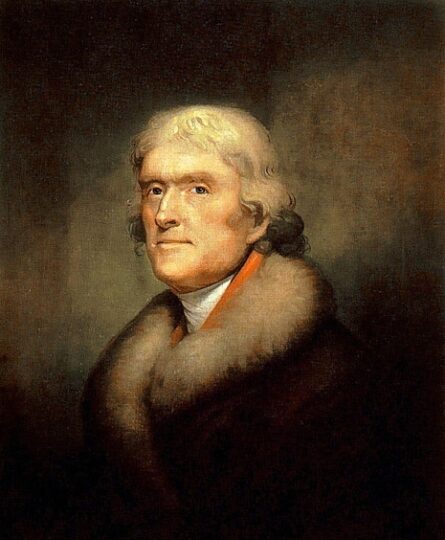
Thomas Jefferson, by Rembrandt Peale

Thomas Jefferson

August 1, 2006

 *

In his Autobiography Jefferson recounted the 1786 passage of the law he proposed in 1779 to secure religious freedom in Virginia, the Statute for Religious Freedom:

The bill for establishing religious freedom, the principles of which had, to a certain degree, been enacted before, I had drawn in all the latitude of reason and right. It still met with opposition; but, with some mutilations in the preamble, it was finally passed; and a singular proposition proved that its protection of opinion was meant to be universal. Where the preamble declares, that coercion is a departure from the plan of the holy author of our religion, an amendment was proposed, by inserting the word “Jesus Christ,” so that it should read, “a departure from the plan of Jesus Christ, the holy author of our religion;” the insertion was rejected by a great majority, in proof that they meant to comprehend, within the mantle of its protection, the Jew and the Gentile, the Christian and the Mahometan, the Hindoo, and the Infidel of every denomination.

Life and Selected Writings of Thomas Jefferson, Modern Library 1993 edition, pp. 45 and 46.

* Image is a photo of detail from a painting of Jefferson by Rembrandt Peale, courtesy of the New York Historical Society by way of the Library of Congress.

[Encore post from August 1, 2006]

An encore post; fighting ignorance takes repetition.

Save

Save


Uganda and malaria, from the inside

July 30, 2008

This is probably as close to we can come to know what’s going on inside Uganda, especially with regard to malaria and efforts to fight it there.  Go see Mars and Aesculapius, “World Malaria Day.

As you can see, simply pumping DDT into the countryside is unlikely to solve the problems.


Happy conception, NASA! 50 years

July 29, 2008

Happy 50th birthday, NASA!

President Eisenhower signing the National Aeronautics and Space Act - U.S. Naval Photographic Center

President Eisenhower signing the National Aeronautics and Space Act – U.S. Naval Photographic Center

The National Aeronautics and Space Administration was created by legislation signed into law by President Dwight D. Eisenhower on July 29, 1958, the National Aeronautics and Space Act. The agency was formally inaugurated on October 1, 1958 — NASA dates its birth from that day.

But, what the heck! There’s enough cool history for two celebrations every year!

Teachers might take this opportunity to stock up on photos and information for bell-ringer quizzes and other presentations on October 1, 2008, when NASA celebrates the 50th anniversary of NASA’s opening its doors, and school is actually in session.

Photos from NASA on the 47th birthday, in 2005

Photos from NASA on the 47th birthday, in 2005 Image Details:
First row, from left:
A 1931 photo shows the original hangar at NASA’s predecessor, the National Advisory Committee for Aeronautics (NACA). The first American satellite in orbit, Explorer 1, launches in January 1958. The “Original Seven” Mercury astronauts were selected in 1959. The experimental Echo project used large metallic balloons to bounce signals from one point on Earth to another.Second row, from left:
The X-15 hypersonic research aircraft flew for nearly 10 years, from June 1959 to October 1968. Apollo 11 astronauts left the first bootprints on the moon in July 1969. Jupiter’s Great Red Spot, seen from one of the twin Voyager spacecraft that launched in 1977. NASA satellites helped create the “blue marble,” a detailed image of Earth.

Third row, from left:
Columbia launches on the first shuttle mission in April 1981. Image of the Eagle Nebula from the Hubble Space Telescope. The Mars rover Opportunity looks back at its tracks on the red planet. The international space station is humanity’s first permanent orbital outpost.

Fourth row, from left:
The Cassini spacecraft has been sending back images of Saturn, it’s rings and moons since July 2004. Discovery returns the space shuttle fleet to flight in July 2005. NASA satellites help scientists and forecasters watch powerful hurricanes. Artist’s concept of NASA’s next spaceship, the crew exploration vehicle, docked with a lander in lunar orbit.

Photo credit: NASA

Congress created a civilian agency to honcho space exploration as part of the body of reform actions after the Soviet Union beat the U.S. with orbiting an artificial satellite, in 1957.

Google has another of its arty Google Logos in honor of the day:

NASA has its own logo for the 50th anniversary:

NASA’s 50th anniversary logo


Exciting times dept.: New inflation control – no paper to print money

July 29, 2008

This year is an exciting time to be teaching history, government or civics, or economics. So many events in national politics and in the world expose the workings of government, politics and history, that teachers should have smoking scissors by the time they finish the morning newspaper.

From Agence France Presse - A Zimbabwean $50 million note in April, not enough to buy a banana

Image from The Guardian/EPA - A Zimbabwean $50 million note in April, not enough to buy a banana; worth less than $0.01 US now

Zimbabwe’s unbelievable inflation rates are textbook cases for economics and government teachers, aren’t they? Inflation has been running more than 1 million percent for some time. Reports I saw a few days ago said inflation is now at something like 2 million percent — in a story about a new currency being printed there, the Zimbabwean $100 billion note.

Authorities last week released a new $100 billion bank note. By Sunday it was not enough even to buy a scarce loaf of bread in what has become one of the world’s most expensive — and impoverished — countries.

Is that a cruel enough example to get the attention of high school economics students?

But the story has gotten even more bizarre. Even with a government making absolutely no effort to control inflation, supply and demand can put a crunch on affairs.

Zimbabwe has run out of paper upon which to print the money to pay government workers.

So the elaborate work by the despotic Robert Mugabe to keep his hold on the reins of power, the carefully planned murders of opposition political workers, the threats of violence if the vote didn’t go his way — all of that may come crashing down. Mugabe can’t print money to pay the thugs to terrorize the people. The thugs may turn on Mugabe.

The government is reported to have run out of paper to print money and is believed to be panicking over how to pay salaries for civil servants, especially soldiers and police who are the backbone of the Mugabe dictatorship. From AllAfrica.com, a report from SW Radio Africa:

Giesecke & Devrient, the European company that was providing the paper, was last month pressured to cut supplies by the German government, after protests were threatened. In addition, a company that provides the software licences for the design and printing of the banknotes, is reported to be considering withdrawing their contract.

The military has helped run the country for some years now and the Mugabe regime needs to sustain military and police operations in order to maintain political control. There is much consensus among observers that Mugabe’s recent decision to sign the Memorandum of Agreement with the two MDC formations was clearly based on increased economic pressure. One English pound this week is trading at Z$1.3 trillion.

Earlier in the week, Mugabe was out of the country trying to negotiate a power-sharing agreement with his opposition, Morgan Tsvangarai. What power will be left to share?

The software for the notes, which is supplied by a Hungarian-Austrian company called Jura JSP, is reportedly very technical. The UK Guardian newspaper quoted a ‘knowledgeable source’ at the Zimbabwe government’s Fidelity Printers, who said the software issue was a major problem and had created an air of panic. “They are in a panic because without the software they can’t print anything,” the source added.

Helmoed-Romer Heitman, the South Africa correspondent for Jane’s Defence Weekly (a global military security publication) said the situation faced by the regime is quite typical of many African countries that are falling apart. He said the result tends to be at least violent demonstrations, if not a mutiny by the military.

“Given the current situation in Zimbabwe, I am inclined to think that a lot of the military, certainly middle ranking officers and some seniors, are not all that enamoured of the party that is running the show”, said Heitman.

Oh, and that 2 million percent inflation?

With experts estimating that the inflation rate is currently at 15 million per cent, and pressure on those doing business with the Mugabe regime increasing, the economy has proved to be the straw that finally broke the camel’s back.

Today comes word that the government plans to revalue Zimbabwean money, lopping a few zeroes off, to make it sound more rational.

Observations: First, these are great examples to use in classes, stark contrasts of inflation out of control. Second, Mugabe is riding a tiger, finally, after holding power for several decades. He should study the words of Winston Churchill. Churchill wrote, in While England Slept:

“Dictators ride to and fro upon tigers which they dare not dismount. And the tigers are getting hungry.”

If you read this blog regularly, you may wonder with me, is there a malaria problem in Zimbabwe? If so, how will the wackoes blame all of this on Rachel Carson?

Resources: