Happy 217th birthday, Millard Fillmore! Mo Rocca’s profile, from our archives to yours

January 7, 2017

Millard Fillmore as a younger man? Several sites claim this is a painting of Fillmore, but as with much about our mysterious 13th president, it's difficult to confirm, partly because images of Fillmore really are rather rare.

Millard Fillmore as a younger man? Several sites claim this is a painting of Fillmore, but as with much about our mysterious 13th president, it’s difficult to confirm, partly because images of Fillmore really are rather rare.

Our 13th president, Millard Fillmore, was born January 7, 1800. He’s 217 years old today, though he’s been dead most of that time.

After commemorating Fillmore’s birthday each year for the past several years, I’m running out of ideas to write about him that seem novel, at least to me. [No doubt you’ve noted this is roughly the same post as last year.]  Several years I’ve called the University of Buffalo to try to get copies of the remarks officials make at Fillmore’s gravesite, but those remarks rarely come through — so we don’t get enlightenment from them.

Reality? Few people remember anything about Fillmore even after we feature it here. For Fillmore’s 217th, let’s review what little we really know about him, with some encore posts.

Raconteur Mo Rocca profiled Fillmore for CBS’s Sunday Morning, a while back. That may be as good a place as any to review the highlights of Fillmore’s life, and meaning and place in U.S. history.

Most historians give Fillmore bad marks as a president, despite his having opened Japan for trade, and despite his having procured a steady supply of bird poop for U.S. industry.

I get this eerie feeling Fillmore would fit right in today in the GOP presidential scraps, and would be a serious challenge to fellow New Yorker Donald Trump. Do you agree?

You may view Mo Rocca’s “profile” of President Millard Fillmore for CBS Sunday Morning, on YouTube:

“CBS Sunday Morning” correspondent Mo Rocca, far left, poses with Kathy Frost, curator of the Millard Fillmore Presidential Site, and Robert Lowell Goller, town historian and director of the Aurora Historical Society, during his recent visit to East Aurora. Photo by Robert Lowell Goller

East Aurora Advertiser caption: CBS Visits East Aurora “CBS Sunday Morning” correspondent Mo Rocca, far left, poses with Kathy Frost, curator of the Millard Fillmore Presidential Site, and Robert Lowell Goller, town historian and director of the Aurora Historical Society, during his recent visit to East Aurora. Photo by Robert Lowell Goller

CBS broadcast this piece on February 16, 2014.

 974

More:

Yes, this is mostly an encore post. Fighting ignorance requires patience.

Yes, this is mostly an encore post. Fighting ignorance requires patience. Overcoming Mencken’s hoax requires an army, too.

Save


Utah flies U.S. flags on January 4 for statehood: 121 years in 2017 – old enough to drink

January 4, 2017

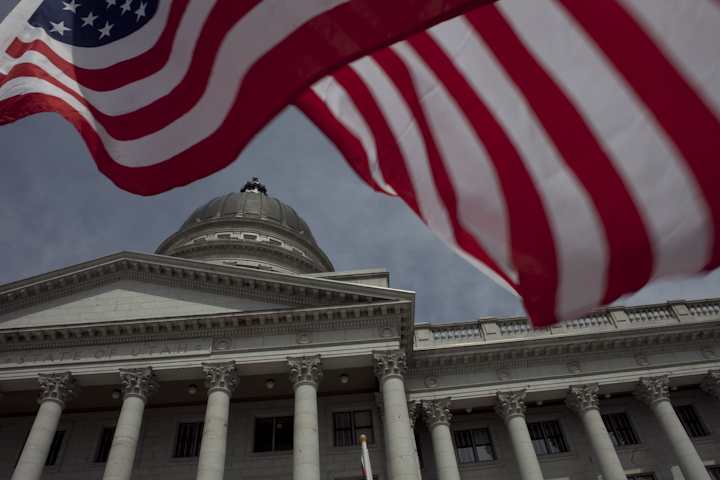
U.S. flag flying in front of the Utah State Capitol. Utah State Capitol image.

U.S. flag flying in front of the Utah State Capitol. Utah State Capitol image.

U.S. flags fly in Utah today in honor of Utah statehood. It’s also the day that new, elected state officers take their oaths and take their offices. Utah is 121 years in the union — as a state, it’s old enough to drink, though you may have difficulty finding a drink there among the teetotaling Mormons.

Utah joined the Union on January 4, 1896.  It had been a 49-year slog to statehood for Deseret, the Mormon settlement in the Desert.  The size had been pared down, so it would not be the biggest state, incorporating parts of what is now Nevada, Arizona, Oregon, Idaho, Colorado and New Mexico.  New capitals had been tried and cast aside (Fillmore, Utah).  Democratic Party rule was broken when LDS church authorities went door-to-door, calling every other family to the Republican Party, and party parity.  The Mormon Church abandoned polygamy, and adopted a state constitution that gave the vote to women.

Finally, Utah became the 45th state.

You may fly your U.S. flag today for Utah statehood, especially if you’re in Utah.

Happy birthday, Utah!  121 years old today.

Big dance in Fillmore to celebrate, Saturday:

Next federal flag-flying date: January 6, in honor of New Mexico’s statehood.

More:

One of my favorite Utah photos: U.S. flag at the south end of Mount Timpanogos; photo from Orem, Utah, by Bob Walker.

One of my favorite Utah photos: U.S. flag at the south end of Mount Timpanogos; photo from Orem, Utah, by Bob Walker.

Yes, this is mostly an encore post. Fighting ignorance requires patience.

Yes, this is mostly an encore post. Fighting ignorance requires patience.

Save

Save


58 years ago, January 3, 1959: Welcome, Alaska, and the 49-star flag

January 3, 2017

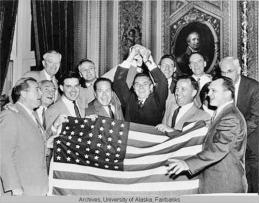
Alaska Territorial Gov. Bob Bartlett in center, with the 49-star flag (Bartlett was one of Alaska's first U.S. senators).

Alaska Territorial Gov. Bob Bartlett in center, with the 49-star flag (Bartlett was one of Alaska’s first U.S. senators).

The great service at the New York Times site, the Learning Network, notes the 1959 Dwight Eisenhower proclamation of Alaska as the 49th state, and the unveiling of the 49-star flag:

On Jan. 3, 1959, President Dwight Eisenhower signed a proclamation admitting Alaska to the Union as the 49th state. The New York Times noted that the signing included the unveiling of the new 49-star American flag.

The land that became Alaska came into U.S. possession in 1867, when William Seward, secretary of state under President Andrew Johnson, negotiated a deal to buy the 586,000-square-mile area from Russia for $7.2 million, less than 2 cents per acre. Seward’s decision was ridiculed in the American press, who saw no potential in the vast, inhospitable and sparsely populated area.

For decades after its purchase, Alaska was derided as “Seward’s folly” or “Seward’s icebox.” This opinion changed in 1896 with the discovery of gold in the neighboring Yukon Territory, which spurred tens of thousands of people to head to Alaska in search of gold. The gold rush also brought about a boom in mining, fishing and trapping.

Though the first statehood bill had been presented to Congress in 1916, there was little desire in either Alaska or Washington for Alaskan statehood until after World War II. During the war, the U.S. established multiple military bases to resist Japan’s attacks on Alaska’s Aleutian Islands and prevent a potential invasion of the mainland. The military activity, along with the completion of a major highway from Montana, led to a large population growth.

In 1946, Alaskans voted in favor of statehood in a referendum and Alaskan delegates began to lobby Congress for statehood. After years of debate, Congress voted in June 1958 to admit Alaska.

Eight months after Alaska’s admission, on Aug. 21, 1957 [should be 1959, no?], Hawaii became the 50th state. The 49-star remained in place until the following July 4, when it was replaced by the now-familiar 50-star flag.

49-star flags were produced only until August 1959, so there are few of them around.  I love this photo of the unveiling of the flag with President Eisenhower:

President Eisenhower and Quartermaster General MG Andrew T. McNamara, with 49-star flag - image from QM foundation

“Quartermaster General MG Andrew T. McNamara and President Eisenhower examine new 49 star flag” – image and caption from the Quartermaster Foundation. Photo by Bob Schutz, Associated Press (Who are the other two people?  The guy on the right looks to me a bit like is Pennsylvania’s Sen. Hugh Scott.)

It had been about 47 years since the previous state admission (Arizona); people became aware that no law set what the flag should look like.  President Eisenhower issued a directive.

How did the nation survive for 170 years without firm, decisive and conclusive orders on what the U.S. flag should look like?  Isn’t it a great story that we went so long without law setting the requirements?

Alaska's state flag design came from 13-year old Benny Benson.

Alaska’s state flag design came from 13-year old Benny Benson. Benny Benson holding the Alaska flag at the Jesse Lee Home, Seward, Alaska. ASL-P01-1921, Alaska State Library-Historical Collections.


Alaska’s state flag came from the imagination of a 13-year-old Aleut, Benny Benson, winning a contest to design the state’s flag.  Alaska’s flag stands out in any display of U.S. state flags.

Alaska's flag as it was approved by the state legislature, and still flies today. Image from the Ninilchik Natives Association, Inc (NNAI).

Alaska’s flag as it was approved by the state legislature, and still flies today. Image from the Ninilchik Natives Association, Inc (NNAI).


Yes, this is mostly an encore post. Fighting ignorance requires patience.

Yes, this is mostly an encore post. Fighting ignorance requires patience.

Save

Save

Save

Save

Save


Will you fly your U.S. flags in January 2017?

January 3, 2017

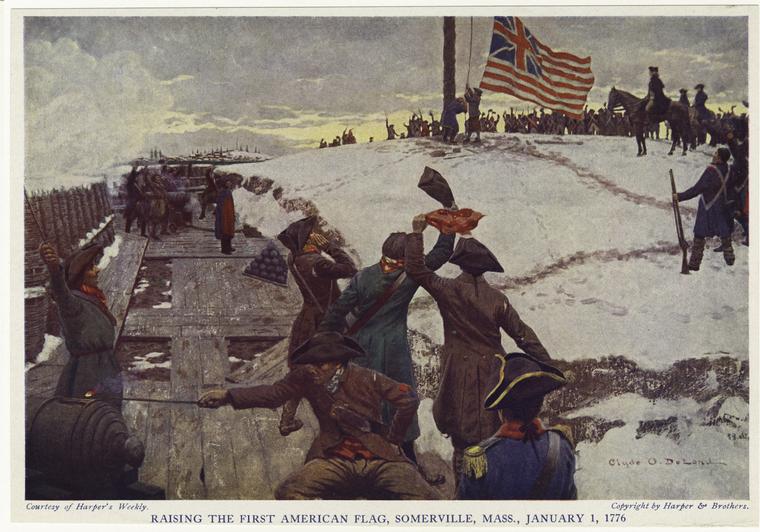
“Raising the first American flag, Somerville, Mass., January 1, 1776.” Harper’s Weekly painting by Clyde Osmer DeLand, 1897. From the digital collections of the New York Public Library

January is loaded with flag flying dates, when we add in statehood days, dates those states are invited to fly their U.S. flags.

In January 2017, the U.S. Flag Code urges citizens to fly flags on these dates, listed chronologically:

  • New Year’s Day, January 1, a federal holiday
  • January 2, Georgia Statehood Day
  • January 3, Alaska Statehood Day
  • January 4, Utah Statehood Day
  • January 6, New Mexico Statehood Day
  • January 9, Connecticut Statehood Day
  • Martin Luther King’s Birthday, a federal holiday on the third Monday of January; that date is January 16, in 2017; King’s actual birthday is January 15, and you may fly your flag then, too
  • Inauguration Day, January 20, the year after election years, as 2017 is
  • January 26, Michigan Statehood Day
  • January 29, Kansas Statehood Day

You may fly your flag any other day you wish, too; flags should not be flown after sundown unless they are specially lighted, or at one of the few places designated by Congress or Presidential Proclamation for 24-hour flag flying.  According to Wikipedia’s listing, those sites include:

  • Fort McHenry, Baltimore, Maryland (Presidential Proclamation No. 2795, July 2, 1948).
  • Flag House Square, Albemarle and Pratt Streets, Baltimore, Maryland (Public Law 83-319, approved March 26, 1954).
  • Marine Corps War Memorial (Iwo Jima Memorial), Arlington, Virginia (Presidential Proclamation No. 3418, June 12, 1961).
  • Lexington Battle Green, Lexington, Massachusetts (Public Law 89-335, approved November 8, 1965).
  • White House, Washington, D.C. (Presidential Proclamation No. 4000, September 4, 1970).
  • Washington Monument, Washington, D.C. (Presidential Proclamation No. 4064, July 6, 1971, effective July 4, 1971).
  • Any port of entry to the United States which is continuously open (Presidential Proclamation No. 413 1, May 5, 1972).
  • Grounds of the National Memorial Arch in Valley Forge State Park, Valley Forge, Pennsylvania (Public Law 94-53, approved July 4, 1975).
Flag House in 1936, 844 East Pratt & Albemarle Streets (Baltimore, Independent City, Maryland) (cropped). Image courtesy of the federal HABS—Historic American Buildings Survey of Maryland.

Flag House in 1936, where Mary Pickersgill sewed the garrison-sized, 15-star flag that flew over Fort McHenry at the Battle of Baltimore in 1814; one of the sites where the U.S. flag may be flown 24 hours. The house is at 844 East Pratt & Albemarle Streets (Baltimore, Independent City, Maryland). Cropped image courtesy of the federal HABS—Historic American Buildings Survey of Maryland.

Yes, this is mostly an encore post. Fighting ignorance requires patience.

Yes, this is mostly an encore post. Fighting ignorance requires patience.

Save


December 30, 2016, Hubble Day! Look to the stars for our future

December 30, 2016

[Today is actually the day!  You may fly your flag if you choose.  This is the traditional Millard Fillmore’s Bathtub Hubble Day post.]

Lift a glass of champagne today in tribute to Edwin Hubble and his great discovery. Not sure what to call it — Hubble Day, Looking Up Day, Endless Possibilities Day — whatever, this is the anniversary of Edwin Hubble’s announcement that he had discovered the universe is much, much larger than anyone had imagined, containing far more stars than anyone had dared guess.

It’s a big universe out there.

Ultraviolet image of the Andromeda Galaxy. Wired caption: Photo: Edwin Hubble’s 1920s observations of Andromeda (whose ultraviolet spectrum is rendered here) expanded our notions of the size and nature of a universe that is itself expanding. Galaxy Evolution Explorer image courtesy NASA.

Ultraviolet image of the Andromeda Galaxy. Wired caption: “Photo: Edwin Hubble’s 1920s observations of Andromeda (whose ultraviolet spectrum is rendered here) expanded our notions of the size and nature of a universe that is itself expanding. Galaxy Evolution Explorer image courtesy NASA.”

So, today is a good day to celebrate the universe in all it’s glory – December 30.

On December 30, 1924, Edwin Hubble announced he’d discovered other galaxies in distant space. Though it may not have been so clear at the time, it meant that, as a galaxy, we are not alone in the universe (whether we are alone as intelligent life is a separate question). It also meant that the universe is much, much bigger than most people had dared to imagine.

92 years ago today.

I keep trying to get people to celebrate.

In 2008 for Hubble Day, Wired picked up on the story (with a gracious link to 2007’s post here at the Bathtub). Wired includes several links to even more information, a good source of information. See Wired’s 2009 post here.

Hubble was the guy who showed us the universe is not only bigger than we imagined, it’s probably much bigger and much more fantastic than we can imagine. (See J. B. S. Haldane’s “queerer” quote.) Hubble is the guy who opened our imaginations to the vastness of all creation.

Hubble’s work would have been impossible without the earlier work of one of the great, unsung women of science, Henrietta Leavitt, as Wired explained:

He trained the powerful new 100-inch telescope at Mount Wilson in Southern California on spiral nebulae. These fuzzy patches of light in the sky were generally thought to be clouds of gas or dust within our galaxy, which was presumed to include everything in the universe except the Magellanic Clouds. Some nebulae seemed to contain a few stars, but nothing like the multitudes of the Milky Way.

Hubble not only found a number of stars in Andromeda, he found Cepheid variable stars. These stars vary from bright to dim, and a very smart Harvard computationist named Henrietta Leavitt had discovered in 1912 that you could measure distance with them. Given the brightness of the star and its period — the length of time it takes to go from bright to dim and back again — you could determine how far away it is.

Hubble used Leavitt’s formula to calculate that Andromeda was approximately 860,000 light years away. That’s more than eight times the distance to the farthest stars in the Milky Way. This conclusively proved that the nebulae are separate star systems and that our galaxy is not the universe.

How does one celebrate Hubble Day? Here are some suggestions:

  • Easier than Christmas cards: Send a thank-you note to your junior high school science teacher, or whoever it was who inspired your interest in science. Mrs. Hedburg, Mrs. Andrews, Elizabeth K. Driggs, Herbert Gilbert, Mr. Willis, and Stephen McNeal, thank you.
  • Rearrange your Christmas/Hanukkah/KWANZAA lights in the shape of the Andromeda Galaxy — or in the shape of any of the great photos from the Hubble Telescope (Andromeda Galaxy pictured above; Hubble images here)

    A few of the images from the Hubble Telescope

    A few of the images from the Hubble Telescope

  • Go visit your local science museum; take your kids along – borrow somebody else’s kids if you have to (take them along, too); in Dallas, you can visit the Perot Museum of Nature and Science — it’s a doozy.
  • Spend two hours in your local library, just looking through the books on astronomy and the universe
  • Write a letter to your senators and congressman; tell them space exploration takes a minuscule portion of our federal budget, but it makes us dream big; tell them we need to dream big, and so they’d better make sure NASA is funded well.  While you’re at it, put in a plug for funding Big Bird and the rest of public broadcasting, too.  Science education in this nation more and more becomes the science shows on NPR and PBS, watched by kids who learned to read and think by watching Big Bird.
  • Anybody got a good recipe for a cocktail called “The Hubble?” “The Andromeda?” Put it in the comments, please.  “The Hubble” should have bubbles in it, don’t you think?  What was it the good monk said?  He was working to make great wine, but goofed somewhere, and charged the wine with another dose of yeast.  When he uncorked the very first bottle of what would come to be called champagne, Benedictine Monk Dom Pierre Perignon said “I am drinking stars!”  Except, he said it in French.  In any case, a Hubble cocktail should have bubbles, some of Perignon’s stars.

The encore post, from 2007:

December 30, 1924, Edwin Hubble announced the results of his observations of distant objects in space.

PBS

Edwin Hubble, long before the Surgeon General’s 1964 report on smoking made taboo photos of people smoking pipes.

In 1924, he announced the discovery of a Cepheid, or variable star, in the Andromeda Nebulae. Since the work of Henrietta Leavitt had made it possible to calculate the distance to Cepheids, he calculated that this Cepheid was much further away than anyone had thought and that therefore the nebulae was not a gaseous cloud inside our galaxy, like so many nebulae, but in fact, a galaxy of stars just like the Milky Way. Only much further away. Until now, people believed that the only thing existing outside the Milky Way were the Magellanic Clouds. The Universe was much bigger than had been previously presumed.

Later Hubble noted that the universe demonstrates a “red-shift phenomenon.” The universe is expanding. This led to the idea of an initial expansion event, and the theory eventually known as Big Bang.

Hubble’s life offered several surprises, and firsts:

  • Hubble was a tall, elegant, athletic, man who at age 30 had an undergraduate degree in astronomy and mathematics, a legal degree as a Rhodes scholar, followed by a PhD in astronomy. He was an attorney in Kentucky (joined its bar in 1913), and had served in WWI, rising to the rank of major. He was bored with law and decided to go back to his studies in astronomy.
  • In 1919 he began to work at Mt. Wilson Observatory in California, where he would work for the rest of his life. . . .
  • Hubble wanted to classify the galaxies according to their content, distance, shape, and brightness patterns, and in his observations he made another momentous discovery: By observing redshifts in the light wavelengths emitted by the galaxies, he saw that galaxies were moving away from each other at a rate constant to the distance between them (Hubble’s Law). The further away they were, the faster they receded. This led to the calculation of the point where the expansion began, and confirmation of the big bang theory. Hubble calculated it to be about 2 billion years ago, but more recent estimates have revised that to 20 billion years ago.
  • An active anti-fascist, Hubble wanted to joined the armed forces again during World War II, but was convinced he could contribute more as a scientist on the homefront. When the 200-inch telescope was completed on Mt. Palomar, Hubble was given the honor of first use. He died in 1953.

“Equipped with his five senses, man explores the universe around him and calls the adventure Science.”

That news on December 30, 1924, didn’t make the first page of the New York Times. The Times carried a small note on February 25, 1925, that Hubble won a $1,000 prize from the American Academy for the Advancement of Science.

(Does anyone have a suitable citation for that video? Where did it come from? Who produced it? Is there more somewhere?)

Happy Hubble Day! Look up!

Resources:

Hubble Space Telescope - NASA image

Hubble Space Telescope, working homage to Edwin Hubble – NASA image

Even More Resources:

Andromeda as we can see it today. Wikimedia image: The Andromeda Galaxy is a spiral galaxy approximately 2.5 million light-years away in the constellation Andromeda. The image also shows Messier Objects 32 and 110, as well as NGC 206 (a bright star cloud in the Andromeda Galaxy) and the star Nu Andromedae. This image was taken using a hydrogen-alpha filter.

Andromeda as we can see it today. Wikimedia image: The Andromeda Galaxy is a spiral galaxy approximately 2.5 million light-years away in the constellation Andromeda. The image also shows Messier Objects 32 and 110, as well as NGC 206 (a bright star cloud in the Andromeda Galaxy) and the star Nu Andromedae. This image was taken using a hydrogen-alpha filter.

Yes, this is mostly an encore post. Fighting ignorance requires patience.

Yes, this is mostly an encore post. Fighting ignorance requires patience.


Texans fly U.S. flags today in honor of Texas statehood

December 29, 2016

First class postage stamp showing U.S. and Texas flags together, issued for the Texas Statehood Centennial, in 1945. Yes, first class postage was three cents. Wikipedia image.

First class postage stamp showing U.S. and Texas flags together, issued for the Texas Statehood Centennial, in 1945. Yes, first class postage was three cents. Wikipedia image.

Congress approved Texas’s petition to join the union on December 29, 1845. Texas joined the United States of America 171 years ago today.

KWTX Channel 10 News described the process in 1845:

On December 29, 1845—171 years ago today—the U.S. Congress voted to annex Texas, eight years after statehood was first proposed. In June 1845 the Texas Congress voted in favor of annexation and on July 4, 1845, a convention of elected delegates followed suit. A popular vote in October ratified the document, which the U.S. Congress accepted on December 29, 1845, making Texas the 28th state. Texas President Anson Jones handed over control of the new state government to Gov. James Pinckney Henderson on February 19, 1846.

Engraving of Texas President Anson Jones lowering the flag of the Republic of Texas, to be replaced with the flag of the United States, on December 29, 1845, after Congress accepted the annexation of Texas into the Union. Texas State Library image.

Engraving of Texas President Anson Jones lowering the flag of the Republic of Texas, to be replaced with the flag of the United States, on December 29, 1845, after Congress accepted the annexation of Texas into the Union. Texas State Library image.

More:


Iowa entered the union on December 28, 1846; fly your flags, Hawkeyes!

December 28, 2016

Iowans may fly their flags today in celebration of the anniversary of Iowa statehood.  Iowa’s admission to the Union came on December 28, 1846; Iowa was the 29th state admitted.

“Millions of acres. Iowa and Nebraska. Land for sale on 10 years credit by the Burlington & Missouri River R. R. Co. at 6 per ct interest and low prices.” Poster advertising land in Iowa, circa 1872, from the Burlington & Missouri River Railroad Co. – Library of Congress Printed Ephemera Collection; Portfolio 134, Folder 13; via Wikipedia

The Flag Code, 4 USC §6 (d), notes that the U.S. flag may be flown on “the birthdays of States (date of admission),” in addition to the other score of dates specifically written into law.

Stars and Stripes were impossible to miss at University of Iowa's Kinnick Stadium in November 2014. Photos by Tim Schoon.

Sometimes we excuse parts of the Flag Code if the display otherwise stirs great patriotism. Stars and Stripes were impossible to miss at University of Iowa’s Kinnick Stadium in November 2014. Photos by Tim Schoon.

More:

Yes, this is mostly an encore post. Fighting ignorance requires patience.

Yes, this is mostly an encore post. Fighting ignorance requires patience.

Save

Save


George Washington: No military junta, no king; an example we can all follow

December 23, 2016

This is a mostly encore post, emphasizing George Washington’s astounding ability to draw from history just exactly the right lesson, and then set the example that makes history.

Washington, though having never attended college, was an inveterate reader, and a sharp student of history.  Early he read the story of the great Roman, Cincinnatus, who made the Roman Republic great with his refusal to lust for power.  Cincinnatus twice was named Dictator, and both times resigned the commission rather than personally profit as others did — after saving Rome both times, of course.

In his own life, Washington also twice cast off the mantle of top leader, once when he resigned his commission as Commander in Chief of the Continental Army when so many assumed he would just keep on, and add the title of “King of America;” and the second time when, as president, he stepped aside and retired, leaving the leadership of the nation up to the Constitutional processes that had never before been tried successfully in any nation.

Washington’s resignation from the army command came on December 23, 1783 — such an important anniversary usually gets lost in preparations for Christmas, so I’ll post it a bit early.  In your holiday toasts, lift a glass to George Washington, who gave us civilian rule, an end to monarchy, and an example of responsible leadership making way for peaceful succession.

In 2007, I wrote:

On December 23, 1783, Commander of the Continental Army, Gen. George Washington resigned his commission, to the Continental Congress sitting in Annapolis, Maryland. Washington modeled his actions on the life of Roman general and patriot Cincinnatus. (See especially this site, the Society of the Cincinnati)

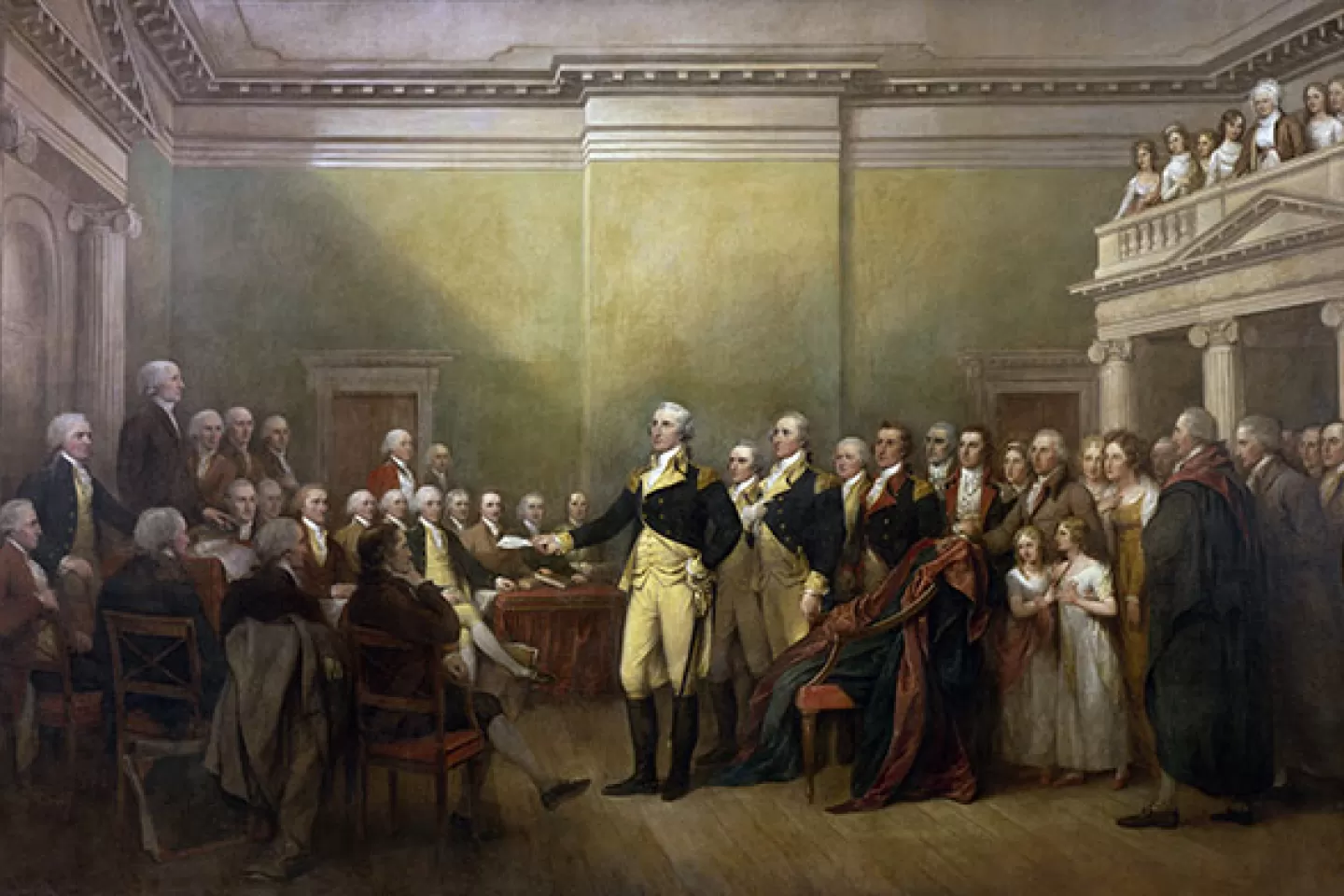
John Trumbull painting of Washington resigning his commission

John Trumbull’s painting of Washington resigning his commission; one of eight great paintings hanging in the Rotunda of the U.S. Capitol

Washington had been thought to be in a position to take over the government and declare himself king, if he chose. Instead, at some cost to himself he personally put down a rebellion of the officers of the army who proposed a coup d’etat against the Continental Congress, angered that they had not been paid. Washington quietly asked that the men act honorably and not sully the great victory they had won against Britain. Then Washington reviewed the army, wrapped up affairs, journeyed to Annapolis to resign, and returned to his farm and holdings at Mount Vernon, Virginia.

Because Washington could have turned into a tyrant, it is reported that King George III of England, upon hearing the news of Washington’s resignation, refused to believe it. If the report were true, George is reported to have said, Washington was the greatest man who ever lived.

Washington’s resignation set precedent: Civilian government controlled the military; Americans served, then went back to their private lives and private business; Americans would act nobly, sometimes when least expected.

From the Library of Congress American Memory site, “Today in History”:

George Washington resigned his commission as commander-in-chief of the Continental Army on December 23, 1783, in the senate chamber of the Maryland State House in Annapolis, where the Continental Congress was then meeting.

Although the British had recognized American independence with the signing of the Treaty of Paris on September 3, British troops did not evacuate New York until December 4. After the last British ships left the harbor, Washington bid an emotional farewell to his officers and set out for Annapolis. On the journey south he was met with throngs of well-wishers paying him tribute for his role in the nation’s military victory over Great Britain.

Washington left Annapolis at dawn on December 24 and set out for Mount Vernon, his plantation on the Potomac River in Virginia. He arrived home before nightfall on Christmas Eve, a private citizen for the first time in almost nine years.

The Maryland State Capitol in Annapolis.

The Maryland State Capitol in Annapolis.

Maryland State House, Annapolis, Maryland
William Henry Jackson, photographer, circa 1892.
Touring Turn-of-the-Century America, 1880-1920

When Washington visited The Maryland State House in 1783, the structure was incomplete and suffered from a leaking roof. By 1786, when representatives from Maryland and Virginia meeting at the State House rallied support for the movement to remedy defects in the Articles of Confederation, construction of a new dome had begun. Today, the building begun in 1772 is the oldest state house still in legislative use.

Located at the mouth of the Severn River on the Chesapeake Bay, Annapolis was settled in 1649 by Puritans who moved there from Virginia. The town was known in the seventeenth century as Town of Proctor’s, Town at the Severn, and Anne Arundel Town before it was named for Queen Anne in 1695. It is home to the U.S. Naval Academy and to St. John’s College, founded in 1696.

This is an encore post.

Yes, this is an encore post. Defeating ignorance takes patience and perseverance.

Save


Flags in New Jersey flying for statehood, December 18

December 18, 2016

New Jersey's Capitol in Trenton, by Vagabond Voyage. Many complain it's difficult to get a good, nice looking photo of this building due to development around it. This photo is alleged to be one of the better photos possible.
New Jersey’s Capitol in Trenton, by Vagabond Voyage. Many complain it’s difficult to get a good, nice looking photo of this building due to development around it. This photo is alleged to be one of the better photos possible.

December 18 is New Jersey Statehood Day.

U.S. Flag Code encourages residents of each state to fly the U.S. flag on their state’s anniversary of statehood. New Jersey won consideration as the Third State, on December 18, 1787, by being the third colony to ratify the U.S. Constitution. Technically the U.S. did not come into existence until six more states ratified, but among the first 13 states, statehood dates are calculated traditionally as the day the colony ratified.

Does anyone in New Jersey celebrate it?

New Jersey's state flag. Just try to find photos of the U.S. flag and New Jersey flag flying together.
New Jersey’s state flag. Just try to find photos of the U.S. flag and New Jersey flag flying together.
New Jersey's Capitol Building and surroundings in Trenton, from across the Delaware River. U.S. flag can be seen flying at the Capitol. Wikipedia image.
New Jersey’s Capitol Building and surroundings in Trenton, from across the Delaware River. U.S. flag can be seen flying at the Capitol. Wikipedia image.

More:

  • Next Fly Your Flag dates: December 28 in Iowa, for Iowa statehood; December 29 in Texas, for Texas statehood.

Save


Ashes to ashes, airplanes to spread them, Damon Runyon and silver bells; Wrights flew on December 17, on December 18 an airplane spread Damon Runyon’s ashes (not the same year)

December 18, 2016

Spent a day with my aging father-in-law last week. Conversation is difficult, but memories always flow. We watched the movie version of “Guys and Dolls,” with Sinatra and Brando, and Stubby Kaye’s get-up-and-sing version of “Sit Down! You’re Rockin’ the Boat.”

He was happy to see the thing again, though in the first few minutes he said he didn’t think he’d ever seen the film. My fondness for the piece, and for Damon Runyon’s stories, goes back (too many) decades to a production of the play by the Utah Valley Opera Society. They hired our high school drama director, David Larson, to direct. On a lark I auditioned, telling them I couldn’t really sing or dance, and ended up with a lot of lines in a couple of supporting roles, and singing and dancing both in the chorus.

When my father-in-law joined in the movie chorus of “Fugue for Tinhorns,” I knew we had a good couple of hours. We laughed, watched, reminisced, and sang along.

Damon Runyon could tell stories, true stories about real people. Sometimes the names were changed to protect the innocent, or the guilty; sometimes the real names were more entertaining than the fictional names Runyon invented.

Some time ago I stumbled across the story of Runyon’s son, Damon Runyon, Jr., using an early airplane to spread the playwright’s ashes. It’s a story Runyon would have appreciated. It’s appropriate for the day after the anniversary of the Wrights’ first flight; December 18 is the anniversary of the event.

On December 17, Orville and Wilbur Wright got their heavier-than-air flying contraption to actually fly with motor driving it along.

First flight of the Wright Flyer I, December 1...

First flight of the Wright Flyer I, December 17, 1903, Orville piloting, Wilbur running at wingtip. Photo from Wikipedia

On December 18, Damon Runyon, Jr., got Eddie Rickenbacker to fly over Broadway to scatter the ashes of his father, Damon Runyon.

First Lieutenant E. V. [Eddie] Rickenbacker, 9...

First Lieutenant E. V. [Eddie] Rickenbacker, 94th Aero Squadron, American ace, standing up in his Spad plane. Near Rembercourt, France. Photo from Wikipedia. This photo dates near World War I; Rickenbacker remained a hero for a couple of decades. In 1946, he flew a DC-3 over New York City, and illegally scattered the ashes of raconteur Damon Runyon over his beloved Broadwary.

Not exactly the next day. 43 years and one day apart.  The Wrights first flew in 1903; Runyon died in 1946.

Today in Literature, for December 18:

On this day in 1946 Damon Runyon’s ashes were scattered over Broadway by his son, in a plane flown by Eddie Rickenbacker. Runyon was born in Manhattan, Kansas; he arrived at the bigger apple at the age of thirty, to be a sportswriter and to try out at Mindy’s and the Stork Club and any betting window available his crap-shoot worldview: “All of life is six to five against.” Broadway became his special beat, and in story collections like Guys and Dolls he developed the colorful characters — Harry the Horse, the Lemon Drop Kid, Last Card Louie — and the gangster patois that would swept America throughout the thirties and forties.

A lot of history packed in there.  Runyon’s early reportorial career included a lot of that history — he wrote the lead story for United Press on the inauguration of Franklin Roosevelt, for one example.  Runyon found a uniquely American vein of literary ore on Broadway in New York City, and in the ne’er-do-wells, swells, tarts and reformers who flocked to the City that Never Sleeps to seek fame, or fortune, or swindle that fortune from someone else.

As a reporter and essayist, he smoked a lot.  Throat cancer robbed him, first of his voice, then his life at 56.

Runyon’s ashes were spread illegally over Broadway, from a DC-3 piloted by Rickenbacker. Runyon would have liked that.

You couldn’t make this stuff up.

Factoids of history:

  • Twenty movies got crafted from Runyon stories, including “The Lemon Drop Kid” — in two versions, 1934 and 1951. Appropriate to the Christmas season, the 1951 version introduced the song, “Silver Bells” composed by Jay Livingston and Ray Evans. (Great explanation of the movie, and song, here.)
  • Runyon got fame first as a sports writer.  He was inducted into the writer’s wing of the Baseball Hall of Fame in 1967.
  • According to Wikipedia, Jerry Lewis and others owe a great debt to Damon Runyon:  “The first ever telethon was hosted by Milton Berle in 1949 to raise funds for the Damon Runyon Cancer Research Foundation.”
  • One might salivate over the varied fare offered in the theaters of Broadway in 1946, Runyon’s final year, “Annie, Get Your Gun” through Shakespeare, and everything in between and on either side
  • Runyon and H. L. Mencken both covered the trial of Bruno Hauptmann, the accused (then convicted) kidnapper of Charles Lindbergh’s baby son
  • Yes, of course, “Guys and Dolls.” Frank Loesser created it, but not of whole cloth, but from the stories of Damon Runyon; it is a masterpiece, perhaps in several realms.  In homage to Runyon, Adam Gopnik wrote:

    Just as Chandler fans must be grateful for Bogart, Runyon fans have to be perpetually happy that the pure idea of Runyon, almost independent of his actual writings, produced the best of all New York musicals: Frank Loesser’s “Guys and Dolls,” which made its début in 1950 and is just now reopening on Broadway in a lavish and energetic new production. But then “Guys and Dolls” is so good that it can triumph over amateur players and high-school longueurs and could probably be a hit put on by a company of trained dolphins in checked suits with a chorus of girl penguins.

    Your author here, Dear Reader, was once one of those trained dolphins. It was magnificent.

“Silver Bells,” from “The Lemon Drop Kid,” with William Frawley, Virginia Maxwell and Bob Hope (1951 version):

More:

A view of New York City in 1946:

Thomas Hart Benton (1889–1975)

Thomas Hart Benton (1889–1975) “The Artist’s Show, Washington Square,” painted in 1946

Times Square, showing part of Broadway, in November 1946, from the magnificent archives of Life Magazine:

Brownout Time Square.November 1946.© Time Inc.Herbert Gehr - See more at: http://kcmeesha.com/2011/11/29/old-photos-times-square-through-the-years/#sthash.ru9W0F9h.dpuf

Brownout Time Square.November 1946.© Time Inc.Herbert Gehr – See more at: http://kcmeesha.com/2011/11/29/old-photos-times-square-through-the-years/#sthash.ru9W0F9h.dpuf

Yes, this is mostly an encore post. Fighting ignorance requires patience.

Yes, this is mostly an encore post. Fighting ignorance requires patience.

Save

Save


Beethoven’s birthday and baptism, and accident on the way to the concert hall

December 18, 2016

Beethoven takes an unplanned swim in his rush to the concert hall in Google's Doodle honoring the composer's 245th year. Image from Google, via Washington Post

Beethoven takes an unplanned swim in his rush to the concert hall in Google’s Doodle honoring the composer’s 245th year, 2015. Image from Google, via Washington Post.

Maybe we should say “happy baptism.” The infant Ludwig von Beethoven was baptized on December 17, 1770; he was born the previous day, perhaps (some historians disagree). In 2016, Beethoven is 246. No longer alive, of course.

But the point is, Google honored Beethoven with an interactive Google Doodle in 2015, one of the best they’ve ever done. The Doodle features the composer finishing scores and heading to the concert hall — with a series of mishaps along the way that scatter his musical scores and leaves them torn up, speared and generally out of order.

Then you, Dear Reader, get a chance to re-arrange the score in order. When you do that, it plays. Finally Beethoven gets to the concert hall.

It’s a great learning device, really. Can Google do this for history? Can we figure out a way to create these for use in our classrooms?

Here is the intro to the piece (I’m not skilled enough to embed the entire quiz). Click to Google for the entire piece, with the quizzes.

Now that you’ve finished the quizzes, relax for 42 minutes with Beethoven’s Symphony No. 6, The Pastorale, performed by the Bremen symphonie, directed by Paavo Jarvi.

Information:

Beethoven: Symphony No.6 in F, “Pastorale”, Op.68
Deutsche Kammerphilharmonie Bremen
Paavo Jarvi, dir.

Yes, this is mostly an encore post. Fighting ignorance requires patience.

Yes, this is mostly an encore post. Fighting ignorance requires patience. Just teaching history requires patience.

Save

Save


December 17, history written in the wind and engraved in stone

December 17, 2016

Ten feet in altitude, 120 feet traveled, 12 seconds long. That was the first flight in a heavier-than-air machine achieved by Orville and Wilbur Wright of Dayton, Ohio, at Kittyhawk, North Carolina, on December 17, 1903.

Few witnesses observed the flight.  Though the brothers Wright fully understood the potential of the machine they had created, even they waited before revealing to their supporters, and then the world, what they had accomplished.

Critics complain others achieved flight in a heavier-than-air machine before the Wrights. There are stories of flights in Texas, Connecticut, and France. If anyone achieved flight before the Wrights, the Wrights did a much better job of recording their achievement, and promoting it afterward. In the end, the Wrights left a legacy of flight research conducted in classic science, with careful records, a lot of experiments and observations, and publication of results.

We honor the Wrights.

From the Library of Congress:

On the morning of December 17, 1903, Wilbur and Orville Wright took turns piloting and monitoring their flying machine in Kill Devil Hills, North Carolina. Orville piloted the first flight that lasted just twelve seconds. On the fourth and final flight of the day, Wilbur traveled 852 feet, remaining airborne for 57 seconds. That morning the brothers became the first people to demonstrate sustained flight of a heavier-than-air machine under the complete control of the pilot.

No lost luggage, no coffee, no tea, no meal in a basket, either.  No ATC (Air Traffic Control) delays.  Neither brother endured a TSA screening.

Resources on the Wright Brothers’ first flight:

(I almost always forget the big dates until the end of the day.  This is mostly an encore post.)

Yes, this is mostly an encore post. Fighting ignorance requires patience.

Again, this is mostly an encore post. Fighting ignorance requires patience.

Save


Millard Fillmore’s letter to Abraham Lincoln, December 16, 1861: The Trent Affair

December 16, 2016

First page of Millard Fillmore's letter to Abraham Lincoln on the Trent Affair, sent December 16, 1861, 155 years ago today. Library of Congress image.

First page of Millard Fillmore’s letter to Abraham Lincoln on the Trent Affair, sent December 16, 1861, 155 years ago today. Library of Congress image.

Sometimes ex-presidents get the bug to offer advice to the person holding the office at the time.

Most of the time they let the urge pass.

But on December 16, 1861, former President Millard Fillmore shot off a letter to Abraham Lincoln, 7 months into the Civil War, warning Lincoln that a breach of relationships with Britain was to be avoided. Britain complained when U.S. warships stopped a British ship and arrested two Confederate diplomats.

It’s known as the Trent Affair, after the name of the British ship that was stopped.

It’s an example of a foreign nation interfering in domestic affairs of the U.S. Do we ever face such circumstances in the 21st century? Do we expect different results today?

Fillmore’s letter, in transcript:

Abraham Lincoln Papers at the Library of Congress. Transcribed and Annotated by the Lincoln Studies Center, Knox College. Galesburg, Illinois.

Millard Fillmore to Abraham Lincoln, Monday, December 16, 1861 (Trent Affair)

From Millard Fillmore to Abraham Lincoln, December 16, 1861

Buffalo, Dec. 16. 1861.

Sir,

I have never, under any circumstances, presumed to offer any advice, as to men or measures, to those who have succeeded me in the administration of the Government; and I beg of you to consider the few crude suggestions which I am now about to make, as mere hints from one who will feel no mortification, personally, if they should be wholly disregarded.

I can in some measure appreciate the difficulties with which the administration of the Government is now embarrassed by this unholy rebellion; for I heard the muttering thunder, and viewed the gathering storm at a distance in 1850; and while I approve most cordially of the firm stand which you have taken in support of the constitution, as it is, against insane abolitionism on one side and rebellious secessionism on the other, and hope and trust that you will remain firm; yet, it was not to speak of this that I took up my pen, but of a new danger which threatens more immediately our Northern frontier, but in its consequences, most fatally, the whole country. You of course must anticipate that I refer to a threatened rupture with England;1 for if we are so unfortunate as to be involved in a war with her at this time, the last hope of restoring the Union will vanish, and we shall be overwhelmed with the double calamities of civil and foreign war at the same time, which will utterly exhaust our resources, and may practically change the form of our government and compel us in the end to submit to a dishonorable peace.

I perceive that the telegram of this morning announces the fact from semi-official sources that, the law officers of Great Britain have given it as their opinion that the arrest of Messrs. Mason & Slidell and forcibly taking them from the Trent, a British merchant or transport vessel, was not justified by the law of nations; and that the British Cabinet were united in sending a despatch to Lord Lyon,2 protesting against the act, and demanding satisfaction by the restoration of the prisoners and a suitable apology for the insult to the British Flag. I still cherish the hope, however, that this statement may be greatly exagerated– But suppose it be true– What then? It may be said that one of two things must happen– Either, this Government must submit to the demand thus made upon it by Great Britain, or take the hazards of a war at a most inconvenient time to settle a point of international law by resort to arms. This alternative should be avoided it it can be with honor, and I venture to suggest that it may be, by urging in a firm but conciliatory argument in reply to the demand of Great Britain, our views of the Belligerent right to arrest these men, but conclude by saying that although we feel assured that we are right, yet if Great Britain after weighing our argument still adheres to the opinion that we are wrong, then as this is a purely legal question, where no insult was intended to the flag of Great Britain, nor any intention to invade her rights, and as the point in dispute is one of international law in which all maritime nations are interested, we propose to submit it to one of the crowned heads of Europe for arbitrament, agreeing to abide its award. It seems to me that Great Britain can not refuse so fair a proposition. But if she does, and insists on an unconditional compliance with her demand or war, all Christendom will then hold her responsible for the consequences.

I trust you will pardon these suggestions, which are made on the spur of the moment, without consultation with, or the knowledge of, any one; and may remain in confidence between us if you prefer that they should.

I am with sincere respect &

great haste, Truly yours

Millard Fillmore

[Note 1 On November 8, 1861 Captain Charles Wilkes of the U. S. S. San Jacinto intercepted the Trent, a British ship, and arrested James Mason and John Slidell who were on their way to Europe as representatives of the Confederacy. This violation of Britain’s neutrality nearly led to a war with the United States.]

[Note 2 Lord Lyons was the British minister to the United States.]

Could students today translate that letter, written in cursive? Maybe, for the sake of knowing history, we need to teach students how to read cursive, if not write it. Is it possible to teach reading without the writing?

Page 2, Millard Fillmore to Abraham Lincoln, on the Trent Affair. Library of Congress image.

Page 2, Millard Fillmore to Abraham Lincoln, on the Trent Affair. Library of Congress image.


Page 3 of Fillmore letter to Lincoln. Library of Congress image.

Page 3 of Fillmore letter to Lincoln. Library of Congress image.


Page 4 of Fillmore's letter to Lincoln. Library of Congress image.

Page 4 of Fillmore’s letter to Lincoln. Library of Congress image.


Page 6, the last page of Millard Fillmore's letter to Abraham Lincoln about the Trent Affair. Library of Congress image.

Page 5, the last page of Millard Fillmore’s letter to Abraham Lincoln about the Trent Affair. Page 6 shows only the author and topic.  Library of Congress image.

Save

Save


Fact sheet for World Malaria Report 2016

December 16, 2016

A woman shows the mosquito net that protects her and her family from malaria transmission, in India. India remains the world's top DDT user, but is switching to nets in an effort to bring malaria rates down and set up malaria eradication before the end of DDT in 2020. WHO image.

A woman shows the mosquito net that protects her and her family from malaria transmission, in India. India remains the world’s top DDT user, but is switching to nets in an effort to bring malaria rates down and set up malaria eradication before the end of DDT in 2020. WHO image.

World Health Organization publishes an annual World Malaria Report, with the year appended to the title. It summarizes the state of the fight against malaria worldwide, recording progress and setbacks.

In the tally of progress we get a clear indication of what is needed to continue or increase that progress, with the ultimate goal of controlling malaria to the point it poses no great economic risk, or health risk, to any nation, or better that human malaria is eradicated.

World Malaria Report 2016 is 184 pages, shorter than some previous reports but packed with figures and history, some of which requires greater background to understand completely.

For example, the 2016 publication notes that about 412,000 people died from malaria in 2016. This is a shocking figure. Most of the news coverage of the report mentions this death toll in the first paragraph.

It’s too many deaths. But it’s a more than 50% reduction in deaths from 1990s rates, and it’s a more than 90% reduction from the annual death tolls that shocked the world to concerted action after World War II. Most estimates are that about 5 million people a year died from malaria through the 1950s, and into the 1960s.

WHO concentrates on the malaria fight, and plays down the political aspects to encourage international cooperation to help fight the disease. But there are political statements made, if one has the background to understand them. There remains controversy over the use of DDT, with many people yelling far and wide that if ‘bans on DDT were removed’ then malaria would quickly become an eradicated disease. This position ignores the facts, that there were still 5 million people dying each year during peak DDT use; that death tolls plunged after the U.S. banned DDT use on crops; that the U.S. ban covered only crop use, and that DDT use against disease has never been banned anywhere in the world; and that DDT use continued long after the U.S. banned DDT, around the world. DDT use never stopped.

Taken together, we would understand that the 90% reduction in malaria deaths from peak DDT use years, was accomplished mostly without DDT, and that therefore DDT is not a panacea.

World Malaria Report 2016 also tallies the slow demise of DDT. Mosquito resistance to pesticides, especially DDT, is a major problem in the fight against the disease. But more DDT can’t fix that problem now that every mosquito on Earth carries alleles that make them resistant and wholly immune to the stuff. DDT will probably never be a panacea, even were its manufacture not scheduled to stop very soon.

History, and a complete assessment of the science and current conditions in the frontlines of the malaria fight, can help us put these things in perspective.

So far, only the Los Angeles Times in the U.S. provided any in-depth reporting on World Malaria Report 2016. We hope other media will take up the challenge to inform. They will find WHO’s Fact Sheet useful.

With that warning in mind, it’s good to look at the broad outlines of the report, which WHO has packaged into a fact sheet for our convenience.

Fact Sheet: World Malaria Report 2016

13 December 2016

The World Malaria Report, published annually by WHO, tracks progress and trends in malaria control and elimination across the globe. It is developed by WHO in collaboration with ministries of health and a broad range of partners. The 2016 report draws on data from 91 countries and areas with ongoing malaria transmission.

Global progress and disease burden (2010–2015)

According to the report, there were 212 million new cases of malaria worldwide in 2015 (range 148–304 million). The WHO African Region accounted for most global cases of malaria (90%), followed by the South-East Asia Region (7%) and the Eastern Mediterranean Region (2%).

In 2015, there were an estimated 429 000 malaria deaths (range 235 000–639 000) worldwide. Most of these deaths occurred in the African Region (92%), followed by the South-East Asia Region (6%) and the Eastern Mediterranean Region (2%).

Between 2010 and 2015, malaria incidence rates (new malaria cases) fell by 21% globally and in the African Region. During this same period, malaria mortality rates fell by an estimated 29% globally and by 31% in the African Region.

Between 2010 and 2015, malaria incidence rates (new malaria cases) fell by 21% globally and in the African Region. During this same period, malaria mortality rates fell by an estimated 29% globally and by 31% in the African Region.

Other regions have achieved impressive reductions in their malaria burden. Since 2010, the malaria mortality rate declined by 58% in the Western Pacific Region, by 46% in the South-East Asia Region, by 37% in the Region of the Americas and by 6% in the Eastern Mediterranean Region. In 2015, the European Region was malaria-free: all 53 countries in the region reported at least 1 year of zero locally-acquired cases of malaria.

Children under 5 are particularly susceptible to malaria illness, infection and death. In 2015, malaria killed an estimated 303 000 under-fives globally, including 292 000 in the African Region. Between 2010 and 2015, the malaria mortality rate among children under 5 fell by an estimated 35%. Nevertheless, malaria remains a major killer of under-fives, claiming the life of 1 child every 2 minutes.

Trends in the scale-up of malaria interventions

Vector control is the main way to prevent and reduce malaria transmission. Two forms of vector control are effective in a wide range of circumstances: insecticide-treated mosquito nets (ITNs) and indoor residual spraying (IRS).

ITNs are the cornerstone of malaria prevention efforts, particularly in sub-Saharan Africa. Over the last 5 years, the use of treated nets in the region has increased significantly: in 2015, an estimated 53% of the population at risk slept under a treated net compared to 30% in 2010.

Indoor residual spraying of insecticides (IRS) is used by national malaria programmes in targeted areas. In 2015, 106 million people globally were protected by IRS, including 49 million people in Africa. The proportion of the population at risk of malaria protected by IRS declined from a peak of 5.7% globally in 2010 to 3.1% in 2015.

Diagnostics

WHO recommends diagnostic testing for all people with suspected malaria before treatment is administered. Rapid diagnostic testing (RDTs), introduced widely over the past decade, has made it easier to swiftly distinguish between malarial and non-malarial fevers, enabling timely and appropriate treatment.

New data presented in the report show that, in 2015, approximately half (51%) of children with a fever who sought care at a public health facility in 22 African countries received a malaria diagnostic test compared to 29% in 2010. Sales of RDTs reported by manufacturers rose from 88 million globally in 2010 to 320 million in 2013, but fell to 270 million in 2015.

Treatment

Artemisinin-based combination therapies (ACTs) are highly effective against P. falciparum, the most prevalent and lethal malaria parasite affecting humans. Globally, the number of ACT treatment courses procured from manufacturers increased from 187 million in 2010 to a peak of 393 million in 2013, but subsequently fell to 311 million in 2015.

Prevention in pregnancy

Malaria infection in pregnancy carries substantial risks for the mother, her fetus and the newborn child. In Africa, the proportion of women who receive intermittent preventive treatment in pregnancy (IPTp) for malaria has been increasing over time, but coverage levels remain below national targets.

IPTp is given to pregnant women at scheduled antenatal care visits after the first trimester. It can prevent maternal death, anaemia and low birth weight, a major cause of infant mortality. Between 2010 and 2015, there was a five-fold increase in the delivery of 3 or more doses of IPTp in 20 of the 36 countries that have adopted WHO’s IPTp policy – from 6% coverage in 2010 to 31% coverage in 2015.

Insecticide and drug resistance

In many countries, progress in malaria control is threatened by the rapid development and spread of antimalarial drug resistance. To date, parasite resistance to artemisinin – the core compound of the best available antimalarial medicines – has been detected in 5 countries of the Greater Mekong subregion.

Mosquito resistance to insecticides is another growing concern. Since 2010, 60 of the 73 countries that monitor insecticide resistance have reported mosquito resistance to at least 1 insecticide class used in nets and indoor spraying; of these, 50 reported resistance to 2 or more insecticide classes.

Progress towards global targets

To address remaining challenges, WHO has developed the Global Technical Strategy for Malaria 2016-2030 (GTS). The Strategy was adopted by the World Health Assembly in May 2015. It provides a technical framework for all endemic countries as they work towards malaria control and elimination.

This Strategy sets ambitious but attainable goals for 2030, with milestones along the way to track progress. The milestones for 2020 include:

  • Reducing malaria case incidence by at least 40%;
  • Reducing malaria mortality rates by at least 40%;
  • Eliminating malaria in at least 10 countries;
  • Preventing a resurgence of malaria in all countries that are malaria-free.

Progress towards the GTS country elimination milestone is on track: In 2015, 10 countries and areas reported fewer than 150 locally-acquired cases of malaria. A further 9 countries reported between 150 and 1000 cases.

However, progress towards other GTS targets must be accelerated. Less than half (40) of the 91 malaria-endemic countries are on track to meet the GTS milestone of a 40% reduction in malaria case incidence by 2020. Progress has been particularly slow in countries with a high malaria burden.

Forty-nine countries are on track to achieve the milestone of a 40% reduction in malaria mortality; this figure includes 10 countries that reported zero malaria deaths in 2015.

Funding trends

In 2015, malaria funding totalled US$ 2.9 billion, representing only 45% of the GTS funding milestone for 2020. Governments of malaria-endemic countries provided 32% of total funding. The United States of America and the United Kingdom are the largest international funders of malaria control and elimination programmes, contributing 35% and 16% of total funding, respectively. If the 2020 targets of the GTS are to be achieved, total funding must increase substantially.

More:

Save

Save


December 14, Alabama flies the flag for statehood

December 14, 2016

U.S. and Alabama flags share a pole at the Alabama Capitol Building in Montgomery. USFlagStore.com image.

U.S. and Alabama flags share a pole at the Alabama Capitol Building in Montgomery. USFlagStore.com image.

Alabama joined the union on December 14, 1819, the 22nd state.

Under provisions of the U.S. Flag Code, residents of a state are encouraged to fly the U.S. flag on their respective statehood day.

Does Alabama commemorate its own statehood?

More: 


U.S. and Alabama flags flying together. Liberty Flagpoles image.

U.S. and Alabama flags flying together. Liberty Flagpoles image.

Save

Save