L Banks: Artist’s version of the world’s oldest animation

May 3, 2013

L. Banks illustrated a publication about an ancient bowl found at the Burnt City, in what is now Iran.

L. Banks illustrated a publication about an ancient bowl found at the Burnt City, in what is now Iran.

It’s a nice rendering of . . . gee, what is that?

If you remember correctly, it’s a goat.  It’s a goat.

More specifically, it’s the goat depicted on “the world’s oldest animation,” a bowl more than 5,000 years old that some researchers think may have been the earliest attempt to depict animals in motion.

I wrote about the bowl back in 2008.  I learned of it from Kris Hirst at About.com, and I thought it was interesting.  “Animation” in the headline, at spring break, and tens of thousands of kids took a look at the little .gif animation from photos of the bowl.  The post took about ten minutes to compose, and it remains the single most popular post ever at Millard Fillmore’s Bathtub (even more popular than the posts about the imaginary Texas chainsaw massacre).

So I stumbled on Banks’s drawing.  Illustration is often high art — the image above is identified as an educational image.  Children’s book?  Don’t know.

Banks has some other very nice illustrations on display, on completely different subjects.  You should go see.

What was that bowl maker trying to show with the goat and tree on that bowl?  Did s/he dream that people would be making images inspired by the bowl, 52 centuries later?

World's oldest animation; bowl from the Burnt City

An animated .gif made from photographic images of a bowl found at the Burnt City, and dated at 5,200 years.


Where have all the flowers gone? A bunch to Pete Seeger on his 94th birthday today

May 3, 2013

Pete Seeger was born on May 3, 1919.  He turns 94 today.

Pete is an alumnus of the Louis August Jonas Foundation‘s Camp Rising Sun, a little nugget that appealed to me when I signed up as a counselor at the Rhinebeck campus in 19#&.  Pete and Arlo Guthrie teamed up for a series of concerts at East Coast venues that summer, including Wolftrap, Saratoga, Tanglewood and others.  Pete lives just down the river from Rhinebeck, near Beacon — but driving home from one of those venues was just a bit too far.  Pete stopped off at his childhood haunts and spent a day with us.

I hoped to invite him to Salt Lake City.  Pete said he might make such a trip, but it was unlikely — and impressed me with his reasoning and dedication to principle.  He explained that he was sticking closer to home as he approached 65, because there was work to do there.  He said he’d attended a local school board or PTA meeting to voice an opinion on some issue in Beacon.  One of the local newspapers complained he was “an outside agitator.”  That stung, he said — he’d been a resident in the town for more than 30 years.

Instead of complaining, though, he started thinking.  He said he’s traveled the world and worked for causes for other people in other towns; and he said he realized that one’s life’s work might be dedicated to making life better where one lives.  So he’d decided to campaign to clean up his local river, the Hudson . . . you’ve heard of the Sloop Clearwater?

Pete’s dedication to making things better, with local action where one may make a huge difference, stuck with me, and it should stick with all of us.

Last month I was doodling around Twitter, and discovered Pete had signed up for a Twitter account — years ago.  He tweets regularly.

He’s an encouragement to all of us.  He boasts that there is no group he has ever refused to sing for, and in his typical humility, he claims that he can get any group to join, so they do all the heavy lifting.  During the pre-inaugural festivities for President Obama’s first inauguration I was happy to see Bruce Springsteen singing some of Pete’s work — highly appropriate for any president’s inauguration — and I thought it would be more fitting only if Pete was singing himself.  Then Springsteen brought Pete out on stage to close out.

Pete keeps up a schedule of concerts, most for causes.  He sails with the Clearwater, campaigning for clean water on the Hudson River (much accomplished) and community efforts to change things for the better.  As you will see below, he pulls his own when raising the sails.    He cuts his own wood to heat the house he built.

Considering his age, 94, we might wonder why he keeps going, doing so much all the time.

Why does he keep on going?  He might be telling us, from this 2012 recording.

More:  

English: This graphic was used for the cover o...

Cover of Pete Seeger’s single release (same photo on an album). The banjo features Pete’s traditional “This machine surrounds hate and forces it to surrender,” a twist on a sticker famously seen on his old friend Woody Guthrie’s guitar. Wikipedia image

Some material in this post is recycled from an earlier post.

Save


Grosbeak!

May 1, 2013

Our goldfinches left several weeks ago.  The cedar waxwings came through in at least three big waves, starting in February (and the last just over a week ago).  House finches moulted, and the breeding males have bright red heads. Migrating robins left us by the end of January, but a lot more residents stayed with us.

We have at least one, and maybe three cardinal families.  A black-capped chickadee family stuck around.  Haven’t seen a titmouse in a month, but I think they’re still in the neighborhood.  The black-chinned hummingbird family is back, and maybe a few other hummers.  The resident blue jays and white-winged doves duke it out every day.  Carolina wren stayed, and may have already fledged; but there are too many wrens for one family — is that a Bewick’s wren?

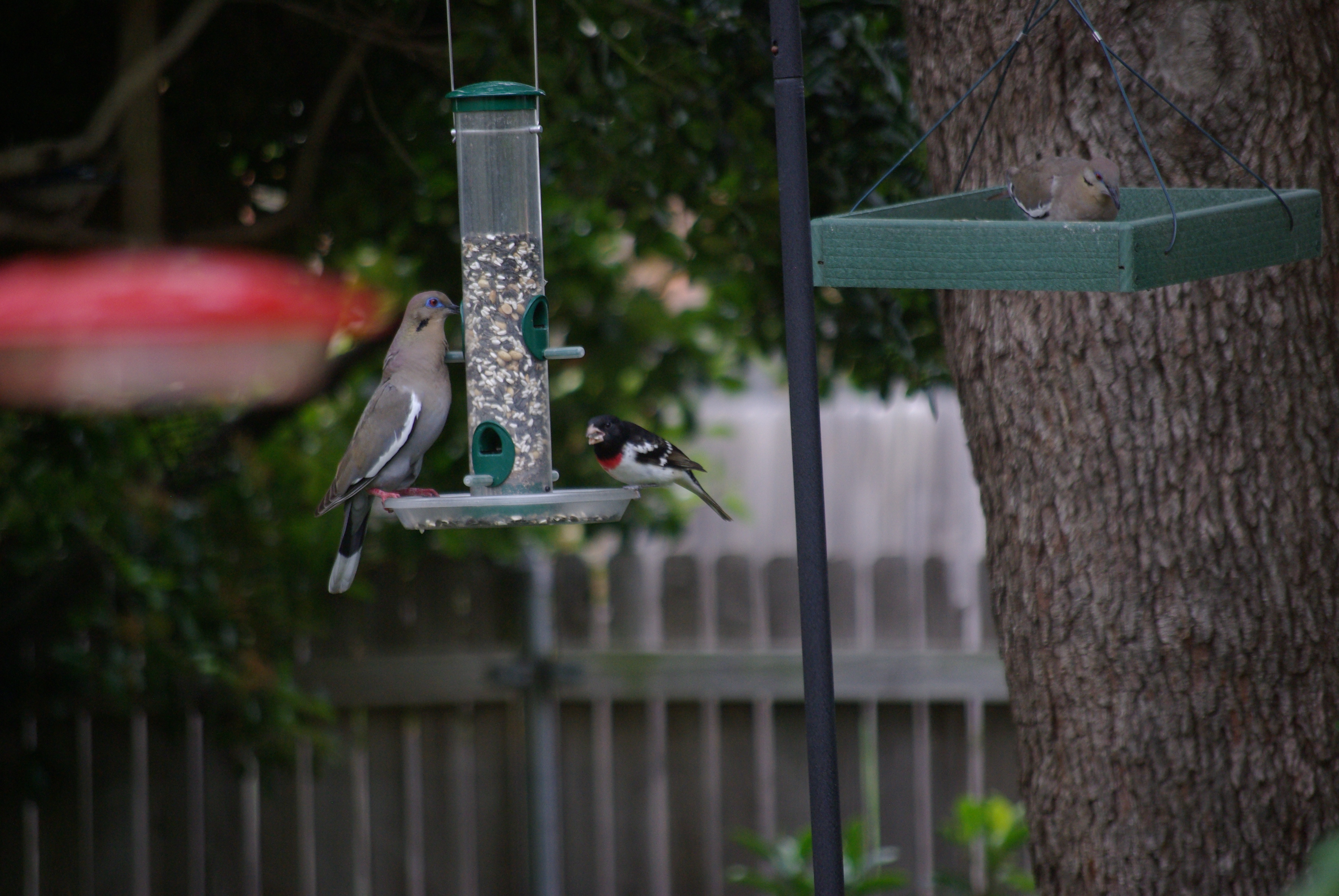
What’s THAT?

White winged dove and rose-breasted grosbeaki

White-winged dove, left, can’t scare away the rose-breasted grosbeak from the songbird feeder. Photo by Ed Darrell

IMGP4861

Look closer. Photo by Ed Darrell

It’s a rose-breasted grosbeak, Pheucticus ludovicianus.  It seems late for migrating birds, but only because so many migratory species migrate earlier these days.

Haunts of the rose-breasted grosbeak, from Cornell University's ornithological laboratory.

Haunts of the rose-breasted grosbeak, from Cornell University’s ornithological laboratory.

Would love to have a grosbeak family, but the Cornell ornithologists say this is fly-through territory.  Maybe that explains why it won’t scare by the white-winged dove, Zenaida asiatica.  Dallas is the western edge of the grosbeaks’ migratory path, but the eastern edge of the dove’s territory.  They probably don’t see much of each other.

We don’t even advertise clean restrooms.

More:


Meanwhile, back at the rice paddy, global warming holds families hostage . . .

May 1, 2013

See this United Nations Development Program ten-minute video that, to the wise and concerned, lays out the stakes of delaying action against human-caused climate change.

Without enough funding, NGOs work to help farmers getting hammered in the Southern Philippines, and other places.

In the Southern Philippines, farmers’ lives and the weather are intimately interwoven, but something is changing, now that the rains in Agusan del Norte are too heavy, the sun shines too fiercely. Now there’s hope for poor farmers with the community-based approach monitoring and Weather Index-Based Insurance packages, to warn people when heavy weather is on the way.

Though, I do weary of the astonishing abuse of acronyms in this work-of-the-angels. “WIBI?”

Incidentally, though the phrase doesn’t appear anywhere in this material, this is exactly the sort of work carried on by the UN’s Agenda 21 project.  Doesn’t look subversive to me.

Tip of the old scrub brush to the UNDP and ILO Tweet:

More:

Map of the Philippines with Agusan del Norte h...

Map of the Philippines with Agusan del Norte highlighted. Wikipedia image


Free land! May 20, 1862, the Homestead Act

April 30, 2013

A family off to find and settle their homestead, 1886. Photo from the National Archives

A family off to find and settle their homestead, 1886. Photo from the National Archives

History and demographics of the United States were forever changed when the Homestead Act became law early in the administration of President Abraham Lincoln, on May 20, 1862.

The bill that became the Homestead Act, H.R. 125, in the 37th Congress, 1862. Image from the U.S. National Archives

The bill that became the Homestead Act, H.R. 125, in the 37th Congress, 1862. Image from the U.S. National Archives

Here’s the history from the National Archives:

The notion that the United States government should give free land titles to settlers to encourage westward expansion became popular in the 1850s. During that time the U.S. House of Representatives passed numerous homestead bills but southern opposition in the Senate prevented enactment. In 1860, during the 36th Congress, the Senate narrowly passed a homestead act but President James Buchanan vetoed it and the Senate failed its override attempt.

When the 37th Congress convened for its brief summer session in 1861, now without members from seceded states, it was preoccupied with Civil War-related legislation. The House took up briefly the homestead issue in December but postponed further consideration of it until the following February. The House finally passed the Homestead Act on February 28, 1862 by the large margin of 107 to 16. The act worked its way through the Senate until May 6, 1862 when it passed easily by a vote of 33 to 7. After a few minor changes in conference committee—which both houses agreed to without controversy—Congress sent the final legislation to President Abraham Lincoln who signed the act into law on May 20, 1862.

The Homestead Act encouraged western migration by providing settlers with 160 acres of land in exchange for a nominal filing fee. Among its provisions was a five-year requirement of continuous residence before receiving the title to the land and the settlers had to be, or in the process of becoming, U.S. citizens. Through 1986, when the last claim was made in Alaska, the Homestead Act distributed 270 million acres of land in the United States making it arguably one of the most far-reaching pieces of legislation in American history.

More:


April 30 – Fly flags for Louisiana Statehood

April 30, 2013

U.S. and Louisiana flags both should fly in Louisiana today.  Photo by Jack and Joann

U.S. and Louisiana flags both should fly in Louisiana today. Photo by Jack and Joann

Flags out in Louisiana today?  Under the U.S. Flag code, Louisianans (and anyone else so inclined) should fly their U.S. flags on April 30 in honor of Louisiana’s statehood, achieved on April 30, 1812.

On April 30, 1812, the United States admitted Louisiana as the 18th state into the Union. Louisiana was the first state to have a majority Catholic French- and Spanish-speaking population, reflecting its origins as a colony under France from 1699-1763 and Spain from 1763-1803. Following the Louisiana Purchase in 1803, Louisiana’s road to statehood was not all smooth. Federal law required citizens of a newly admitted territory to apply to congress for statehood, and the admission of the Orleans Territory as the 18th state followed years of lobbying efforts by prominent citizens—both American and Creole (French-speaking Catholics). Men such as French-born congressman Julien Poydras and American attorney Edward Livingston sought the greater political rights that statehood bestowed and convinced Territorial Governor William C.C. Claiborne that the Orleans Territory qualified for statehood. Finally in 1811, Democratic President James Madison signed the bill allowing the people of Louisiana to form a state constitution. Following the state constitutional convention in New Orleans where 43 American and Creole leaders convened, on April 14, 1812, President Madison signed the bill approving statehood. The bill designated April 30, 1812, as the day of formal admission.

Seriously, where would the U.S. be without the stories of Huey Long, and without Tobasco Sauce?

More:

Map of the states and territories of the Unite...

Map of the states and territories of the United States as it was from April 1812 to May 1812. On April 30 1812, most of Orleans Territory was admitted as the state of Louisiana. On May 12 1812, the federal government assigned its annexed land of West Florida to Mississippi Territory. (Photo credit: Wikipedia)

From the U.S. National Archives: Joint Credentials for the State of Louisiana's First Senators, September 3, 1812

From the U.S. National Archives: Joint Credentials for the State of Louisiana’s First Senators, September 3, 1812 On September 3, 1812 Louisiana’s legislature elected Jean Noel Destréhan and Allan Bowie Magruder to serve as the new state’s first U.S. Senators. Destréhan resigned before being seated and was replaced by Thomas Posey. RG 46, Records of the U.S. Senate


Fly your flag April 28: Maryland statehood day

April 28, 2013

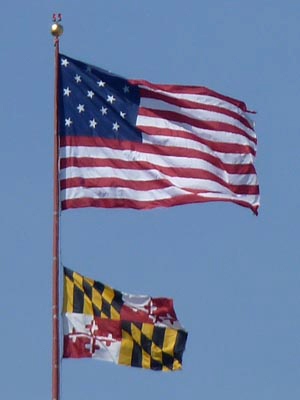
U.S. and Maryland flags flown together. Photo from the Maryland Secretary of State's office.

U.S. and Maryland flags flown together. Photo from the Maryland Secretary of State’s office.

Maryland’s convention to ratify the Constitution voted approval on April 28, 1788, the sixth of the former British colonies to ratify.

April 28 is considered Maryland’s statehood date.  According to the suggestions for proper times to fly the U.S. flag, Marylanders should fly their flags on April 28.

It’s only my opinion, but I think there is no grander display of a state and U.S. flag than with Maryland’s.  Maryland’s flag is a unique design in the state flags, and it features colors not common to state flags.  Our displays of both flags at our Maryland home often drew comments from passers-by (we lived on the street leading to the town’s Metro stop, so there was a lot of foot traffic.

Maryland’s flag features the two family crests of George Calvert, the First Lord Baltimore.  In Maryland law it’s described:

The Maryland flag is divided into four quarters. The first and fourth quarters consist of six vertical bars alternately yellow (representing gold) and black with a diagonal band on which the colors are reversed. The yellow and black quarters represent the family arms of the first proprietor of Maryland, George Calvert, first Lord Baltimore. The second and third quarters consist of a quartered field of red and white (representing silver) bearing a Greek cross with arms terminating in trefoils. The colors in the second and third quarters alternate, with red on the white ground and white on the red. The red and white quarters display the arms of Lord Baltimore’s maternal family, the Crosslands.

The flag was officially adopted only in 1904.  Maryland also has a detailed, but not too lengthy set of instructions on proper display and other care of the state flag.

Historic 15-star/15-stripe U.S. flag, and Maryland flag, in Baltimore

From the W&M Blogs: “American and Maryland flags flying high over downtown Baltimore. Just why does the American flag have 15 stars and stripes? Think about Baltimore’s Fort McHenry and Francis Scott Key.”

Baltimore Harbor is home to Fort McHenry, the fort whose siege inspired Georgetown lawyer Francis Scott Key to write a poem about the U.S. flag, which became our national anthem.  Partly due to this history, U.S. flags in Maryland often are the historic, 15-star/15-stripe flag that inspired Key.

More:

Maryland flag on the cover of a Justice League of America comic book.

Maryland flag on the cover of a Justice League of America comic book.

Save


Resources for World Malaria Day 2013

April 25, 2013

Not a word about condemning Rachel Carson.  No plea to use DDT to try to poison Africa or Asia to health.  That’s a great start.

More:

Mother and son under a protective bednet, the most efficient method to prevent malaria.  Columbia University MVSim image

Mother and son under a protective bednet, the most efficient method to prevent malaria. Columbia University MVSim image


National Infant Immunization Week, April 20-27, 2013

April 23, 2013

National Infant Immunization Week:  Find out about the power to protect with immunizations on http://www.vaccines.gov/

This week is National Infant Immunization Week designated by the U.S. Centers for Disease Control (CDC).  Vaccinations worked miracles in extending human lifespans, and in making childhood much safer from disease, for those children who get vaccinated.

Information following comes directly from the CDC:

Protect Your Baby with Immunization

Photo: A mother and childImmunization is one of the best ways parents can protect their infants from 14 serious childhood diseases before age two. Check to see if your baby is up to date on immunizations.

It is important for children to be fully immunized. Diseases that can be prevented with vaccines can be very serious – even deadly – especially for infants and young children. For example, children younger than 2 years old are at the highest risk for serious pneumococcal disease like pneumonia, blood infection (sepsis), and meningitis. Before the pneumococcal vaccine was used routinely, an estimated 17,000 cases of severe types of pneumococcal infection, like meningitis, occurred each year.

Immunization. Power to Protect.

Immunizations have helped to greatly improve the health of children in the United States. Most parents today have never seen first-hand the devastating consequences that vaccine-preventable diseases have on a family or community. While most of these diseases are not common in the United States, they persist around the world. It is important that we continue to protect our children with vaccines because outbreaks of vaccine-preventable diseases can and do occasionally occur in this country.

For example, in 2010, there were 27,550 people reported to have “whooping cough” (pertussis) in the United States. Twenty-seven deaths were reported – 25 of these were in children younger than 1 year old. In 2011, 222 people were reported to have measles in the United States – that’s more than any year since 1996. Measles is brought into the United States by unvaccinated U.S. residents and foreign visitors who get infected when they are in other countries. Measles is still common in many parts of the world, including Europe, Asia, the Pacific, and Africa. In fact, in France alone, more than 15,000 people were reported to have measles in 2011. Measles spreads easily, and it can be serious, causing hospitalization and even death. Young children are at highest risk for serious complications from measles.

Vaccinating your baby according to the recommended immunization schedule gives him or her the best protection against 14 serious childhood illnesses – like measles and whooping cough – before he is two years old. The recommended schedule is designed to protect infants and children early in life, when they are most vulnerable and before they are exposed to potentially life-threatening diseases.

Vaccine Information for ParentsVisit CDC’s vaccine website for parents.

The Diseases Vaccines Prevent

The recommended immunization schedule for babies includes vaccination protection against all of the following diseases:

Vaccinate On Time, Every Time

Even though the United States experiences outbreaks of some vaccine-preventable diseases, the spread of disease usually slows or stops because of immunization. If we stopped vaccinating, even the few cases we have in this country could very quickly become tens or hundreds of thousands of cases. Fortunately, most parents choose to vaccinate their children and immunization rates in this country are at or near record high levels. In fact, less than 1% of children do not receive any vaccines. However, some children have not received all of their vaccines and therefore are not fully immunized. It’s important that children receive all doses of the vaccines according to the recommended immunization schedule. Not receiving all doses of a vaccine leaves a child vulnerable to catching serious diseases.

That’s why it’s important to make sure that your child is up to date on his or her immunizations. Call your pediatrician to find out if your child is due for any vaccinations. Or, you can use this online tool to enter your child’s current record and quickly see if any doses have been skipped or missed. It is important to your child’s health to be up to date on immunizations.

Paying for Immunization

Photo: A babyMost health insurance plans cover the cost of vaccinations, but you should check with your insurance provider before going to the doctor. If you don’t have health insurance, or if your insurance does not cover vaccinations, the Vaccines for Children (VFC) program may be able to help with the cost.

The VFC program helps families of eligible children who might not otherwise have access to immunization. The program provides vaccinations at no cost. Children younger than 19 years of age are eligible for VFC vaccines if they are:

  • Medicaid-eligible
  • Uninsured
  • American Indian or Alaska Native,
  • Underinsured and vaccinated in Federally Qualified Health Centers or Rural Health Clinics.

Parents of uninsured or underinsured children who receive vaccines at no cost through the VFC Program should check with their health care providers about possible administration fees that might apply. These fees help providers cover the costs of giving the vaccines, including storing the vaccines and paying staff members to give vaccines to patients. However, VFC vaccines cannot be denied to an eligible child if a family can’t afford the fee.

Have Questions about Immunization?

  • Talk with your child’s health care professional, contact your local or state health department, or call the CDC at 800-CDC-INFO (800-232-4636).
  • Visit CDC’s vaccine website for parents

More Information

CDC works 24/7 saving lives and protecting people from health threats to have a more secure nation. A US federal agency, CDC helps make the healthy choice the easy choice by putting science and prevention into action. CDC works to help people live longer, healthier and more productive lives.

Last syndicated: April 19, 2013
This content is brought to you by: Centers for Disease Control and Prevention (CDC)

More:


Remembering Lindheimer’s muhly grass from last year’s garden

April 23, 2013

It’s spring.  The grasses are sprouting.

Texas is a good place for grasses.

Lindheimer's muhly grass, in the afternoon sun

Lindheimer’s muhly grass, Dallas, Texas, January 2013. Photo by Ed Darrell; horticultural adventures by Kathryn Knowles

Spring sunlight is spectacular on the new flowers; winter sunlight, in the afternoon, shows a different kind of spectacular.

Lindheimer’s muhly grass, Muhlenbergia lindheimeri, shows beauty from soon after it sprouts until long after it’s gone dormant.  A garden is a year-around project, and joy.

History lives in those grasses, too.  You can find some at the Native Plant Society of Texas’s website, and its description of Lindheimer’s muhly.

This seems pretty dumb now, but many years ago when I first heard about so many grasses called “muley,” I was puzzled about that name. I’d heard of muley cattle such as polled Herefords, but not hornless grass! Needless to say, as soon as I looked up Lindheimer muhly, I could see it is in a genus named after a Mr. Muhlenberg.

Gotthilf Hunrich Ernst Muhlenberg lived from 1753 to 1815. He was born into a prominent Pennsylvania family, and his father and brothers were influential patriots during the Revolutionary War. Because of his family’s involvement in the Revolution, Muhlenberg was on the British hit list.

While he was hiding out in a rural area away from Philadelphia during the Revolution, Muhlenberg became interested in botany. Through his extensive collections, Muhlenberg made major contributions to botany, and many plants have been named in his honor. For example, among our local flora are several species of muhly grass (Muhlenbergia) and Chinquapin oak (Quercus muhlenbergii).

Lindheimer muhly was named in honor of Ferdinand Lindheimer, the “Father of Texas Botany.” Many other plants native to the Texas Hill Country also bear the name “Lindheimer” or “Lindheimer’s.” Most of these plants were first collected by Lindheimer, who settled on the banks of the Comal River in New Braunfels in 1845.

Another entry in the Blackland Prairie Almanac, perhaps.

More:


Once again, the Earth Day/Lenin hoax trotted out: Earth Day honors Earth, our majestic home — not Lenin (2013 version)

April 22, 2013

This is mostly an encore post, repeated each year on April 22 — sad that it needs repeating.

You could write it off to pareidolia, once. Like faces in clouds, some people claimed to see a link. The first Earth Day, on April 22, 1970, coincided with Lenin’s birthday. There was no link — Earth Day was scheduled for a spring Wednesday. Now, years later, with almost-annual repeats of the claim from the braying right wing, it’s just a cruel hoax.

No, there’s no link between Earth Day and the birthday of V. I. Lenin:

One surefire way to tell an Earth Day post is done by an Earth Day denialist: They’ll note that the first Earth Day, on April 22, 1970, was an anniversary of the birth of Lenin.

Coincidentally, yes, Lenin was born on April 22 (new style calendar; it was April 10 on the calendar when he was born — but that’s a digression for another day).

It’s a hoax. There is no meaning to the first Earth Day’s falling on Lenin’s birthday — Lenin was not prescient enough to plan his birthday to fall in the middle of Earth Week, a hundred years before Earth Week was even planned.

About.com explains why the idea of a link between Earth Day and Lenin is silly:

Does Earth Day Promote Communism?
Earth Day 1970 was initially conceived as a teach-in, modeled on the teach-ins used successfully by Vietnam War protesters to spread their message and generate support on U.S. college campuses. It is generally believed that April 22 was chosen for Earth Day because it was a Wednesday that fell between spring break and final exams—a day when a majority of college students would be able to participate.

U.S. Sen. Gaylord Nelson, the guy who dreamed up the nationwide teach-in that became Earth Day, once tried to put the whole “Earth Day as communist plot” idea into perspective.

“On any given day, a lot of both good and bad people were born,” Nelson said. “A person many consider the world’s first environmentalist, Saint Francis of Assisi, was born on April 22. So was Queen Isabella. More importantly, so was my Aunt Tillie.”

April 22 is also the birthday of J. Sterling Morton, the Nebraska newspaper editor who founded Arbor Day (a national holiday devoted to planting trees) on April 22, 1872, when Lenin was still in diapers. Maybe April 22 was chosen to honor Morton and nobody knew. Maybe environmentalists were trying to send a subliminal message to the national subconscious that would transform people into tree-planting zombies. One birthday “plot” seems just about as likely as the other. What’s the chance that one person in a thousand could tell you when either of these guys were born.

My guess is that only a few really wacko conservatives know that April 22 is Lenin’s birthday (was it ever celebrated in the Soviet Union?). No one else bothers to think about it, or say anything about it, nor especially, to celebrate it.

Gaylord Nelson, Living Green image

Inventor of Earth Day teach-ins, former Wisconsin Governor and U.S. Senator Gaylord Nelson

Wisconsin’s U.S. Sen. Gaylord Nelson, usually recognized as the founder and father of Earth Day, told how and why the organizers came to pick April 22:

Senator Nelson chose the date in order to maximize participation on college campuses for what he conceived as an “environmental teach-in.” He determined the week of April 19–25 was the best bet; it did not fall during exams or spring breaks, did not conflict with religious holidays such as Easter or Passover, and was late enough in spring to have decent weather. More students were likely to be in class, and there would be less competition with other mid-week events—so he chose Wednesday, April 22.

In his own words, Nelson spoke of what he was trying to do:

After President Kennedy’s [conservation] tour, I still hoped for some idea that would thrust the environment into the political mainstream. Six years would pass before the idea that became Earth Day occurred to me while on a conservation speaking tour out West in the summer of 1969. At the time, anti-Vietnam War demonstrations, called “teach-ins,” had spread to college campuses all across the nation. Suddenly, the idea occurred to me – why not organize a huge grassroots protest over what was happening to our environment?

I was satisfied that if we could tap into the environmental concerns of the general public and infuse the student anti-war energy into the environmental cause, we could generate a demonstration that would force this issue onto the political agenda. It was a big gamble, but worth a try.

At a conference in Seattle in September 1969, I announced that in the spring of 1970 there would be a nationwide grassroots demonstration on behalf of the environment and invited everyone to participate. The wire services carried the story from coast to coast. The response was electric. It took off like gangbusters. Telegrams, letters, and telephone inquiries poured in from all across the country. The American people finally had a forum to express its concern about what was happening to the land, rivers, lakes, and air – and they did so with spectacular exuberance. For the next four months, two members of my Senate staff, Linda Billings and John Heritage, managed Earth Day affairs out of my Senate office.

Five months before Earth Day, on Sunday, November 30, 1969, The New York Times carried a lengthy article by Gladwin Hill reporting on the astonishing proliferation of environmental events:

“Rising concern about the environmental crisis is sweeping the nation’s campuses with an intensity that may be on its way to eclipsing student discontent over the war in Vietnam…a national day of observance of environmental problems…is being planned for next spring…when a nationwide environmental ‘teach-in’…coordinated from the office of Senator Gaylord Nelson is planned….”

Nelson, a veteran of the U.S. armed services (Okinawa campaign), flag-waving ex-governor of Wisconsin (Sen. Joe McCarthy’s home state, but also the home of Aldo Leopold and birthplace of John Muir), was working to raise America’s consciousness and conscience about environmental issues.

Lenin on the environment? Think of the Aral Sea disaster, the horrible pollution from Soviet mines and mills, and the dreadful record of the Soviet Union on protecting any resource. Lenin believed in exploiting resources, not conservation.

So, why are all these conservative denialists claiming, against history and politics, that Lenin’s birthday has anything to do with Earth Day?

Can you say “propaganda?”  Can you say “political smear?”

2013 Resources and Good News:

Good information for 2012:

Good information from 2011:

Good information from 2010:

2013 Wall of Shame:

Wall of Lenin’s Birthday Propaganda Shame from 2012:

Wall of Lenin’s Birthday Propaganda Shame from 2011:

Wall of Lenin’s Birthday Propaganda Shame from 2010:

Spread the word.  Have you found someone spreading the hoax, claiming Earth Day honors Lenin instead?  Give us the link in comments.


Rachel Carson/DDT hoaxing from the Ayn Rand Institute

April 21, 2013

Welcome, refugees and truth-seekers from WUWT:  If this site seems a little unusual to you, you should know that at Millard Fillmore’s Bathtub we try to stick to science, and we don’t censor opposing opinions.  Genuinely interested in the DDT/Malaria issue?  See this collection.

______________

A couple of physicists get together in a podcast from the Ayn Rand Institute, Poke in Your Eye to Eye, and demonstrate that they don’t know biology well, they know less about history, but they don’t hesitate to tell whoppers about Rachel Carson and the value of DDT“Silent Spring 50 Years Later [a special Earth Day podcast].

English: An image of the main entrance of Rach...

A better indication of the legacy of Rachel Carson: Schools across America named after the woman, to inspire children to explore science, and to read and write. Here, the main entrance of Rachel Carson Middle School in Herndon, Virginia. (Photo: Wikipedia)

Earth Day must be coming up.  The usual suspects trot out their usual disinformation and hoax campaigns — and it will continue through Earth Day on April 22, International Malaria Day on April 25, through Rachel Carson’s birthday, and probably all summer.

Mencken warned us that hoaxes, once out of the bottle, can’t be put back.  Twain (and others) remind us that whopping falsehoods travel around the world “while truth is getting its boots on.”  Amanda Maxham, who is listed as an astrophysicist at the Rand site, interviewed physicist Keith Lockitch — and they repeat almost all the hoary old false fables invented by Gordon Edwards and Steven Milloy about malaria, DDT, and Rachel Carson.

A few of the errors committed by the polemicists at the Ayn Rand Institute:

  • ‘DDT doesn’t breed mosquitoes more resistant to the stuff, but instead weakens the population through reducing diversity.’  Absolutely wrong.  Turns out the new alleles mosquitoes pick up that makes them resistant and immune to DDT, are ALSO the alleles that make mosquitoes resistant to the whole class of chemicals, and thereby foul up efforts to develop new pesticides.

    Tanzania - Removing DDT

    Cleaning up DDT in Africa: 40 tons of 50 year old DDT were found in Menzel Bourguiba Hospital, Tanzania – FAO photo

  • ‘Rachel Carson didn’t account for the value of DDT in eradicating malaria.’  They start out claiming DDT ended malaria in the U.S. (it didn’t; CDC had won the fight will just mop up operations left, by 1939; DDT wasn’t even available for another seven years), and run through the false claim that DDT alone had almost eradicated malaria from Sri Lanka, but listening to Rachel Carson, the nation stopped spraying and malaria roared back (the nation stopped ALL of its malaria fighting efforts due to costs and civil war; when the fight was taken up again, DDT was not useful; largely without DDT, Sri Lanka has once again nearly wiped out malaria).
  • ‘Because of a lack of DDT use, malaria continues to ravage the world killing a million people a year.’  Actually, malaria is at the lowest level in human history, killing less than a million a year, with great progress being made against the disease using the methods Rachel Carson urged in 1962.  Had we listened to Carson earlier, we could have saved a few million more lives, and perhaps have eradicated malaria already.  Also, it’s important to remember that DDT was never banned in Africa nor Asia; the ban on use of DDT on cotton crops in the U.S. did not cause any increase in malaria anywhere; since the ban on DDT use in the U.S. malaria has constantly declined in incidence and deaths.
  • ‘DDT is very effective because it’s ALSO repellent to mosquitoes, after it ceases to kill them.’  So in the end, they urge the use of a poisonous-to-wildlife, mildly carcinogenic substance, because it repels mosquitoes?  Bednets are more effective, cheaper, not-poisonous to wildlife, and they aren’t even suspected of causing cancer.

Rachel Carson’s life is a model for budding scientists, aspiring journalists, and teachers of ethics.  That so many people spend so much time making up false claims against her, in favor of a deadly toxin, and against science, tells us much more about the subrosa intentions of the claim fakers than about Rachel Carson.

Want the facts about Rachel Carson?  Try William Souder’s marvelous biography from last year, On a Farther Shore.  Want facts on DDT?  Try EPA’s official DDT history online (or look at some of the posts here at Millard Fillmore’s Bathtub). Want the facts about malaria?  Check with the world’s longest running, most ambitious malaria fighting campaign operated by the good people at the World Health Organization, Roll Back Malaria,  or see Sonia Shah’s underappreciated history, The FeverHow malaria has ruled mankind for 500,000 years.

More:

Roll Back Malaria, World Malaria Day logo for 2013

Roll Back Malaria, World Malaria Day logo for 2013

Wall of Shame (hoax spreaders to watch out for this week):


4 million

April 21, 2013

About noon today Central Time, Millard Fillmore’s Bathtub recorded its 4 millionth visit.

Thank you, Dear Reader.

Bring on the confetti and champagne.  Well, champagne, anyway.  Save the confetti money and send it instead to Nothing But Nets to fight malaria.

More notes on “4 million”:


Another great speech of the 21st century: Kiwi MP Williamson on the effects of gay marriage

April 20, 2013

Two great legislative speeches in about two months!  (Here’s the other one, from Colorado State Sen. Mike Johnston.)

Maurice Williamson

Maurice Williamson (Photo credit: nznationalparty)

My faith in humanity’s ability to invent rhetoric to cause us to rise to an occasion is in danger of being restored.

Here’s New Zealand Member of Parliament Maurice Williamson, National-Pakuranga, making a case for a national law recognizing gay marriage (on April 17, 2013, I think):

The bill to recognize marriage between homosexual partners passed, 77-44.

New Zealand’s National Party is described as “center-right,” or like a U.S. Republican.  Can you imagine any member of the GOP in the U.S. House or the U.S. Senate having both the guts and the wit to make this speech?

Pakuranga is also leading the polls as the most humorous name for a political district, potentially displacing Cleveland for the first time.  It’s a Maori word, actually, with a beautiful definition, from Maori lore:  “Battle of the Sunlight.”

Tip of the old scrub brush to correspondent Devona Wyant, for finding the thing and sending a link.

More:


April 20, Glow Day (Marie and Pierre Curie)

April 20, 2013

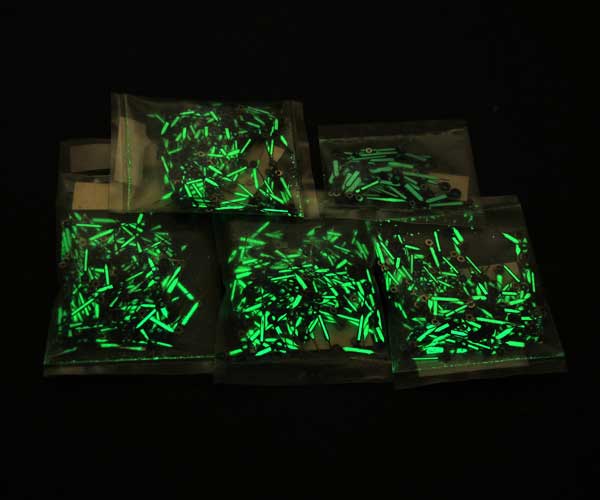
Radium watch hands; Nobel Foundatin image
Caption from the Nobel.org site: “Radium hands from 1940-1950’s watches. (Photo licensed under Creative Commons, author: Mauswiesel, November 2011)”  The glowing watches to which these hands were attached sometimes caused problems; people who painted the radium on to the hands and the dial suffered a high degree of radiation-related diseases.  Modern watches that glow typically do not use radium.

On April 20, 1902, Marie and Pierre Curie succeeded in isolating a chunk of the element radium, one of the earliest radioactive elements studied.

For this work they shared the Nobel Prize in Physics in 1903, with Henri Becquerel.

Pierre died in 1906, run over by a horse-drawn carriage. Marie won a second Nobel, in Chemistry, in 1911. Marie died in 1934 of aplastic anemia, a disease probably caused by her having received so much radiation over the course of her career.

More: