You know those mudflaps with Yosemite Sam holding two six-shooters, and the caption “Back Off!?”
Shouldn’t this truck have those mudflaps? Or would that be redundant?
Tip of the old scrub brush to Dave Taylor and George Takei.
You know those mudflaps with Yosemite Sam holding two six-shooters, and the caption “Back Off!?”
Shouldn’t this truck have those mudflaps? Or would that be redundant?
Tip of the old scrub brush to Dave Taylor and George Takei.
Posting this on Facebook, a fellow named Todd Wilbur said it’s a “private post.”
Not sure if this rises to a sign of intelligent life in the universe.
(If you’ve got details, put ’em in comments. Thank you.)
More:
A few of us, a vanishing few, remember when Canada changed its flag in 1965.
Canada’s flag in 1965, featuring the British Union Jack. This design dates from 1957, following several earlier, similar designs. Wikipedia image.
Change the flag? What a concept!
We probably forget that the U.S. flag, while recognizable since 1789, changed quite a bit between then and now, mostly in stars, but also in stripes.
Here’s what Canada settled on in 1965, after a surprisingly bitter debate that ran for months in 1964:
Wikipedia: The National Flag of Canada,[1] also known as the Maple Leaf and l’Unifolié (French for “the one-leafed”), is a flag consisting of a red field with a white square at its centre, in the middle of which is featured a stylized, 11-pointed, red maple leaf. Adopted in 1965 to replace the Union Flag, it is the first ever specified by statute law for use as the country’s national flag. The Canadian Red Ensign had been unofficially used since the 1890s and was approved by a 1945 Order in Council for use “wherever place or occasion may make it desirable to fly a distinctive Canadian flag”
New Zealand to hold flag referendum in 2016 bbc.in/100nrwS http://t.co/s4iv8jzUGo—
BBC News Australia (@BBCNewsAus) October 29, 2014
At the BBC site, a few more details:
New Zealand is to hold a binding referendum in 2016 on whether to change the national flag.
The announcement by Prime Minister John Key of the referendum came after his government last month won a third term in a general election.
A panel of “respected New Zealanders” will lead the public discussion on potential designs for a new flag.
Mr Key has previously said he would like to see a new flag featuring a silver fern, on a black background.
That would be similar to the banner already used by many New Zealand teams such as the All Blacks national rugby union team.
“I believe that this is the right time for New Zealanders to consider changing the [flag’s] design to one that better reflects our status as a modern, independent nation,” Mr Key said.

Photo illustrating the BBC story, showing the silver fern flag of the New Zealand All Blacks football club — Getty Images
A fern leaf. Hey, that’s rather like Canada’s switch from the mostly-red flag with a Union Jack to a maple leaf. Canada’s been happy with that flag for more than 50 years, now. Right?
Wait. Canadian Prime Minister Harper wants to change the maple leaf now?
OTTAWA — Prime Minister Stephen Harper surprised media this morning by unveiling a “new-look” Canadian flag in red, white, and blue that “just by fluke” matches the colours of the Conservative Party’s logo.
“I was doodling with my magic markers a while back and it just came to me out of the blue. Our flag needs some blue!” said Harper sporting a lapel pin with his proposed new flag design.
“Frankly, the boring old flag doesn’t reflect my new Canada…we needed something with more energy, something gutsier to better reflect my world leadership role.”
Harper’s doodle, cleaned up a bit:

A new flag for Canada, with blue added in? Stephen Harper’s proposed new flag. And what a lovely shade of blue it is . . . why does it make us suspicious?
When a CBC reporter pointed out that Harper’s new flag colours are identical to the Conservative Party logo the PM said he was surprised by the question and hadn’t really noticed the similarity.
“Wow…I guess if you squint at our new flag you could maybe see some loose, loose likeness to my party’s logo colours. But my new design really captures the new Canada…bold and not to be messed with.”
“Proud Canadians will rally behind this new flag as a patriotic symbol of what Canada has become.”
Liberal Party leader Justin Trudeau reacted immediately telling the Ottawa Citizen, “I, like most Canadians, must now question the very sanity of Mr. Harper. Has he gone nuts? That’s a real and pressing question. Has Mr. Harper’s ego finally won the sweaty arm-wrestling match that goes on in his brain.”
“The NDP has been calling loudly for increased spending on mental health care and Mr. Harper just proved the need,” said opposition leader Tom Mulcair.
[Well, no, not really. Notice that the source of the Canadian flag proposal is The Lapine, Canada’s most successful on-line satirical news site — the Onion of the Frozen North. Yes, I got suckered in, until I read the entire article; if it makes you shake your head, be suspicious, even if it doesn’t trigger your Hemingway™ Shit Detector. New Zealand is serious, though.]
Flag wars ahead! Social studies teachers, you should tee this up so your students can enjoy the popcorn.
Good thing the U.S. had Betsy Ross around to tell the rebels what the flag would be, eh?*
More, and resources:

One proposal for a new flag for New Zealand, incorporating the silver fern, but keeping red, white and blue colors. Here the new design is pictured with its designer, Kyle Lockwood. Image from Silver Fern Flag.
* If you can’t find several errors in that sentence, you’re not trying, or you need very remedial history.
Why December 2?
(You couldn’t make this stuff up if you were Monty Python.)
President Millard Fillmore, in the State of the Union Address, December 2, 1850
Peruvian guano has become so desirable an article to the agricultural interest of the United States that it is the duty of the Government to employ all the means properly in its power for the purpose of causing that article to be imported into the country at a reasonable price. Nothing will be omitted on my part toward accomplishing this desirable end. I am persuaded that in removing any restraints on this traffic the Peruvian Government will promote its own best interests, while it will afford a proof of a friendly disposition toward this country, which will be duly appreciated.
Did any other U.S. President spend so much time thinking about guano? Did any president ever mention it in a State of the Union Address? The curious case of Millard Fillmore, Seer, just grows.
Guano, or bird poop (and its relative, bat poop), contains phosphorus, which is an essential element for life. Consequently, it turns out to be a key ingredient in effective agricultural fertilizers. In international competition for supremacy in farming and farm exports, guano became a key resource to fight over, in the 19th century.
It’s almost safe to say the fights were economic; but guano did play a key role in wars in South America (see Andrew Leonard’s article, noted below).
Fillmore figured out that the substance had great importance, coupled that with the rather esoteric knowledge that sea birds tended to deposit guano in great abundance on certain islands, often unoccupied, and ordered the U.S. Navy to claim islands found to contain guano deposits that were not claimed by other nations.
By the American Civil War, the importance of phosphorus to the production of gun powder became an issue for the armies of the North and South. Millard Fillmore had set the stage for the North to win an important advantage in gun powder production, just one of many that led to the defeat of the South.
It’s one more thing we should thank Millard Fillmore for doing. Our study of history should inform us that it is, indeed, important for politicians to understand the importance of guano.
Fillmore knew his guano.
Take a moment on December 2 to toast Millard Fillmore’s prescience, on Guano Day!
More:
Humor in signage, especially with the kitty on top!
Where does this photo come from?
I’m not certain, but I think it’s from South Africa. It showed up in Memebase from “unknown.” A couple of links I found for other photos of similar signs showed they were in South Africa.
Anyone know for sure?
October 9 is the Feast Day of St. Denis.
Who? He’s the patron saint of Paris (and France, by some accounts), and possessed people. Take a look at this statue, from the “left door” of the Cathedral of Notre Dame in Paris (Cathédrale Notre-Dame de Paris: portail de gauche). He was martyred by beheading, in about 250 C.E.

St. Denis greets vistors to the Cathedral of Notre Dame, Paris (Cathédrale Notre-Dame de Paris: portail de gauche)
Our trusty friend Wikipedia explains:
According to the Golden Legend, after his head was chopped off, Denis picked it up and walked two miles, preaching a sermon the entire way.[6] The site where he stopped preaching and actually died was made into a small shrine that developed into the Saint Denis Basilica, which became the burial place for the kings of France. Another account has his corpse being thrown in the Seine, but recovered and buried later that night by his converts.[2]
Clearly, he is the guy to pray to about Michelle Bachmann, Rush Limbaugh, Todd Akin, Paul Ryan, intelligent design, and the Texas State Board of Education, no? In 2013, you can add Ted Cruz, Mike Lee, Louis Gohmert, the entire Tea Party, and the entire GOP crew of the House of Representatives. You catch my drift.
Perhaps you can use this factoid to some advantage, enlightenment, and perhaps humor. In Catholic lore, St. Denis is one of the “14 Holy Helpers,” and his aid is sought to help people with headaches, or who have been possessed.
Crazy GOP members who I suspect of having been possessed give me and America a headache. St. Denis seems to be our man.
Who else do you know of in this modern, vexatious time, who keeps talking after losing his/her head?
As Rod Stewart sang, just “let your imagination run wild.” Maybe St. Denis is listening.
More:
Another portrayal, in sculpture, of St. Denis. Notice how this one’s face doesn’t really look like the one above? Ouvre du Musée de Cluny, Wikipedia photo by Guillaume Blanchard (Aoineko), June 2001, FinePix 1400Z.
Yes, this is mostly an encore post. I had hoped to have to retire this post someday. I still hope. Perhaps this will be the last year we’ll have so many wackaloons running loose. Pray to St. Denis.
Frans de Waal posted this on Facebook a while back.
Wouldn’t it be great to be able to join the crows in vulture surfing? Doesn’t that look like fun?
You’ll not convince me easily that the crows don’t know what they’re doing, and don’t have loads of fun doing it.

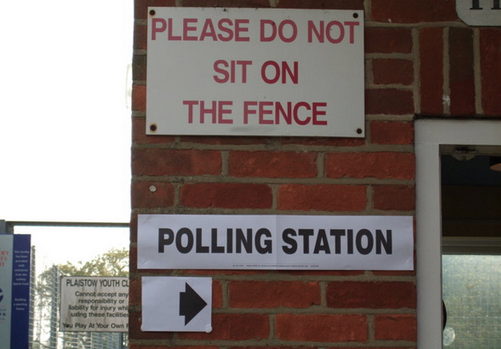
Polling station, in unnamed location in Scotland (?) posted on Twitter during the referendum on Scotland independence, but around since at least April 2014. From @standrewsradio
“Please do not sit on the fence.”
It would work in Texas elections this year, too. 97% of eligible Scot voters registered to vote; as I write this, it looks like about 90% of those people voted in the election.
Ain’t democracy grand?
“Vote: It’s what citizens do.”
Update: Seems to be at the Plaistow Youth Center, in England.
From BBC:

BBC caption: After four weeks of campaigning the polls are closed, we now await the result of the general election. Quentin Gadd spotted these signs at a polling station, he says, “Is this proof positive that the organisers of the Plaistow Youth Centre are taking a stand against those who choose to abstain?”
The photo may be from 2010, from this site, which identifies the photo location further, with a different photo: “Sign at the polling station in Plaistow, West Sussex, on Local Council Polling Day.”
From the voting festivities in Scotland today, a very graphic demonstration of why one should never, never, never drink and play bagpipes.

From Twitter, Wall Street Journal’s account: Photos: Scotland votes in independence referendum | http://on.wsj.com/1ubZMTH
In every other way, this vote should be closely watched. Two nations pushed together by force of arms hundreds of years ago, discussing whether and how to split up. No guns. No tanks. Lots of discussion, lots of fun, lots of ballots. 97% of eligible voters registered to vote, and indications are at least 90% of them turned out.
Can you imagine what would happen in U.S. elections if 90% of registered voters showed up at the polls, instead of 40%, or 30%? Can you imagine if 97% of U.S. eligible voters bothered to register, instead of the less-than-50% we have now?
You bagpipes would flame, too.

Logos for great scientists; from Twitter, https://twitter.com/aneyeofsky/status/495615741912416257/photo/1
These are quite creative. I wonder who invented them?
Other possibilities?
Maybe:
It was spotted in Utah, of course (note the mountains in the background).
Yeah, we had that family living next door to us for a while.
Look closely, it appears not to be a claim for a polygamous family . . . oy. Surely, it is a joke.

Maybe it’s a kindergarten teacher who thinks all students are her kids, or his kids. Maybe the driver just wants to start conversation, or convulsions of laughter.

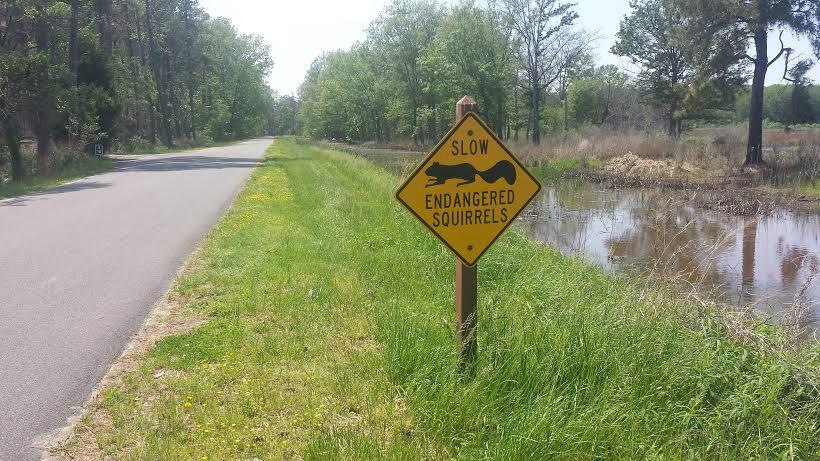
From jbendery (Jennifer Bendery) — I learned today that there are endangered squirrels, and apparently they have ginormous tails. (h/t @kate_sheppard) pic.twitter.com/Uu4QxiDa5M
A lot of punchlines possible, e.g., ‘if the squirrels weren’t slow, maybe they wouldn’t be endangered.’
Still a rather unique sign, no?
I wonder where it is? This sign marks habitat in the Blackwater National Wildlife Refuge in Maryland for the Delmarva fox squirrel.
Update: Well, maybe not wholly unique; World Wildlife Fund has this one — again, without a note about location.
No, we’re not joking.
May 11 is the anniversary of the birth of Richard Feynman (born 1918, died 1988).
In 2014, his birthday falls on Sunday, Mothers Day. Mothers Day is one of the designated-by-law days to fly the U.S. flag — so fly your flag! You can tell your mother it’s for her — but it’s also for Richard Feynman.
Why Feynman Day? To celebrate invention, physics, interesting characters, and that essential, American quality of je ne sais quoi.
In addition to his winning the Nobel Prize for Quantum Electrodynamics (QED), Feynman popularized the critique of science and other enterprises with what we now call Cargo Cult science, or education, or whatever, where people follow the dance steps, but without the rhythm and music.
Those two things alone would make him a remarkable man. But, like a product offered for $19.95 as a good buy in a 2:00 a.m. infomercial, with Feynman, there’s more. With Feynman, there is always more.
I got alerted to Feynman in the first days of the old Quality Paperback Book Club, when they featured his new memoir, Surely You’re Joking, Mr. Feynman! QPBC was hot on the book, and with a title like that, how could I resist? When I got the book a week or so later, I read it within two days, while attending law school and working full time. I remember Feynman.
Norton published the book — and their description, alone, should make you want to read it:
A New York Times bestseller—the outrageous exploits of one of this century’s greatest scientific minds and a legendary American original.
In this phenomenal national bestseller, the Nobel Prize-winning physicist Richard P. Feynman recounts in his inimitable voice his adventures trading ideas on atomic physics with Einstein and Bohr and ideas on gambling with Nick the Greek, painting a naked female toreador, accompanying a ballet on his bongo drums and much else of an eyebrow-raising and hilarious nature.
All true, and that’s not even the half of the outrageousness, all done with great good humor, about a life lived in great good humor through what should have been a memorable age, but often was just terrifying.
I think sometimes that Feynman’s calm, alone, borne of that great good humor and insatiable curiosity, may have gotten us through the birth of the atomic age and the Cold War.
Feynman was a giant, and we don’t revere him enough. Consider:
A special postal cancel was authorized by the USPS (United States Postal Service) to honor the 80th birthday of Richard Feynman. This cancel was used in Lake Worth, Florida. For this special day the post office was renamed “Feynman Station.”
![]()
The Feynman Diagram used for the postal cancel on this envelope depicts what is known as a “bubble process.” It shows a high energy particle, for example, a cosmic ray (a) from a distant supernova, which emits a high energy photon, for example, a gamma ray (b). The photon, in turn, creates a particle (c) and an anti-particle (d) that exists for a brief moment and then recombines.
As Feynman liked to point out, an anti-particle is the same thing as a particle with negative energy traveling backward in time (which is why the arrow at (d) points backwards, i.e. to the left). So you could say the photon created only one particle that, at first, traveled forward in time (the bottom semi-circle) and then reversed and went back in time (the top semi-circle) and annihilated itself! By inventing diagrams like this, Richard Feynman made it much easier to understand what is going on in the interactions between sub-atomic particles without getting lost in tremendous amounts of tedious math
There’s more — a lot more. Feynman outlined our current generation of computer memory devices — in 1959. No, he didn’t patent the idea. He did patent an idea for a nuclear-powered spacecraft. Another delightful story.

Feynman was featured in print and broadcast ads for Apple — not one, but two (did anyone else get that honor from Apple?). “Think Different.” This is one of Apple Computer’s most successful advertising campaigns. The theme of the campaign is one that celebrates figures in history who changed the world by thinking differently. Richard Feynman was among the chosen figures.
Feynman served on the board that approved science books for the California school system — his stories of that work will shock some, but it will make others shake their heads as they recognize the current crop of cargo-cultists and political bullies who dominate textbook approval processes, knowing nothing at all about what they are doing, or why.
No, I didn’t forget his brilliant work on the commission that studied the Challenger disaster, for NASA. There’s so much stuff to glorify!
In history, Feynman should be remembered much as we remember Thomas Jefferson, as a renaissance man in his time, a man who put great intellect to great work for his nation and all humanity.

The second Apple ad featuring Richard Feynman. An excerpt from Apple Computer’s campaign commercial: “Here’s to the crazy ones, the misfits, the rebels, the troublemakers, the round pegs in the square holes, the ones who see things differently. They’re not fond of rules and they have no respect for the status quo. You can quote them, disagree with them, glorify or vilify them… about the only thing you can’t do is ignore them, because they change things, they push the human race forward; and while some may see them as the crazy ones, we see genius, because the people who are crazy enough to think they can change the world are the ones who do.”
The sages say we shouldn’t have regrets, but I do have one. When the Challenger Commission was meeting in Washington, D.C., I was working on another commission up the street. I knew Feynman was ill, but our work was important, and we’d heard his disease was in remission. I didn’t goof off a day and go to any of the hearings to see him, to get an autograph, to meet the man. I though I’d have other opportunities to do that. Now I regret not having met him in person.
In print, and in film, I know him well. In our family, reading Feynman is something everybody does. Feynman’s memoir was one of the last books I read to our son, Kenny, as he was growing up, and growing into reading on his own. Even reading about Feynman, together, was an adventure. Our son, James, took us into the real physics of Feynman, and though I struggle with it more than James, we still read Feynman, for humor, and physics.
What would be appropriate ways to mark Feynman’s birth? At some future date, I hope we’ll have public readings of his books, showings of the documentaries about him, recreations of his lectures, perhaps. And then everyone can get in a circle, beating drums and singing about getting some orange juice, before sending postcards to our friends in Tuva.
Richard Feynman, we still need you, and miss you dearly.

Tuva’s capital is the delightfully-named Kyzyl. From this map, can you figure out where Tuva is, or how to get there — without Google, or Bing?
There will always be “More” about Richard Feynman, if we’re lucky:
Much of this is an encore post.
Found on Twitter:

Deep thoughts on Twitter, about children, childhood, recess and play. https://twitter.com/IntThings/status/464766923201576960
Maybe there’s a John Waters movie in the story.
From Metrotimes, the alternative weekly paper in Detroit:
Jerry Vile strikes again. The artist (and volunteers) stuck about 100 plastic lawn flamingos painted to look like vultures — one can imagine Vile lovingly glueing on the feathers — on the front lawn of the Detroit Institute of Arts. A banner was also erected, reading “Happy Bankruptcy: You’re Getting Flocked! Vultures by the Scads, LLC.”
It’s Vile’s latest prank that targets Detroit’s bankruptcy and the threat of selling the DIA’s artwork to appease “creditor vultures.” Within the past year the artist has put out an ad for Detroit’s liquidation in Metro Times, rolled out an oversized can of Crisco in front of the Joe Louis fist, and placed price tags on public art throughout the city.
The only statement the artist has made so far about the vultures is a post on his Facebook page that says, “Sssssshhhhhhhh. Can’t wait to get a look at Beal’s face when he pulls up to work tomorrow.”
Negotiations are ongoing in regard to an $816 million so-called “grand bargain” — funded by numerous foundations, the state, and the DIA itself — that would spin the DIA into a new nonprofit and prevent the sale of any city-owned art. Meanwhile, Lansing is setting up a board that could oversee Detroit’s pensions and finances for 20 years, and also potentially appropriate $194.8 million from the state’s rainy day fund toward Detroit’s bankruptcy.