The article the British Chiropractic Association hopes you will not read

July 31, 2009

Science-based Medicine carried this article yesterday, and several other blogs have joined in.  Below is the article Simon Singh wrote for which he is being sued for libel by the professional association for British chiropractors.  It’s a good cause, so I’ll stretch it another little while.

Science-based Medicine introduced the article with this:

Last year Simon Singh wrote a piece for the Guardian that was critical of the modern practice of chiropractic. The core of his complaint was that chiropractors provide services and make claims that are not adequately backed by evidence – they are not evidence-based practitioners. In response to his criticism the British Chiropractic Association (BCA) sued Simon personally for libel. They refused offers to publish a rebuttal to his criticism, or to provide the evidence Simon said was lacking. After they were further criticized for this, the BCA eventually produced an anemic list of studies purported to support the questionable treatments, but really just demonstrating the truth of Simon’s criticism (as I discuss at length here).

In England suing for libel is an effective strategy for silencing critics. The burden of proof is on the one accused (guilty until proven innnocent) and the costs are ruinous. Simon has persisted, however, at great personal expense.

This is an issue of vital importance to science-based medicine. A very necessary feature of science is public debate and criticism – absolute transparency.This is also not an isolated incident. Some in the alternative medicine community are attempting to assert that criticism is unprofessional, and they have used accusations of both unprofessionalism and libel as a method of silencing criticism of their claims and practices. This has happened to David Colquhoun and Ben Goldacre, and others less prominent but who have communicated to me directly attempts at silencing their criticism.

This behavior is intolerable and is itself unprofessional, an assault on academic freedom and free speech, and anathema to science as science is dependent upon open and vigorous critical debate.

What those who will attempt to silence their critics through this type of bullying must understand is that such attempts will only result in the magnification of the criticism by several orders of magnitude. That is why we are reproducing Simon Singh’s original article (with a couple of minor alterations) on this site and many others. Enjoy.

Here it is:

Beware the spinal trap

Some practitioners claim it is a cure-all but research suggests chiropractic therapy can be lethal

Simon Singh
The Guardian, Original version published Saturday April 19 2008
Edited version published July 29, 2009

You might be surprised to know that the founder of chiropractic therapy, Daniel David Palmer, wrote that “99% of all diseases are caused by displaced vertebrae”. In the 1860s, Palmer began to develop his theory that the spine was involved in almost every illness because the spinal cord connects the brain to the rest of the body. Therefore any misalignment could cause a problem in distant parts of the body.

In fact, Palmer’s first chiropractic intervention supposedly cured a man who had been profoundly deaf for 17 years. His second treatment was equally strange, because he claimed that he treated a patient with heart trouble by correcting a displaced vertebra.

You might think that modern chiropractors restrict themselves to treating back problems, but in fact some still possess quite wacky ideas. The fundamentalists argue that they can cure anything, including helping treat children with colic, sleeping and feeding problems, frequent ear infections, asthma and prolonged crying – even though there is not a jot of evidence.

I can confidently label these assertions as utter nonsense because I have co-authored a book about alternative medicine with the world’s first professor of complementary medicine, Edzard Ernst. He learned chiropractic techniques himself and used them as a doctor. This is when he began to see the need for some critical evaluation. Among other projects, he examined the evidence from 70 trials exploring the benefits of chiropractic therapy in conditions unrelated to the back. He found no evidence to suggest that chiropractors could treat any such conditions.

But what about chiropractic in the context of treating back problems? Manipulating the spine can cure some problems, but results are mixed. To be fair, conventional approaches, such as physiotherapy, also struggle to treat back problems with any consistency. Nevertheless, conventional therapy is still preferable because of the serious dangers associated with chiropractic.

In 2001, a systematic review of five studies revealed that roughly half of all chiropractic patients experience temporary adverse effects, such as pain, numbness, stiffness, dizziness and headaches. These are relatively minor effects, but the frequency is very high, and this has to be weighed against the limited benefit offered by chiropractors.

More worryingly, the hallmark technique of the chiropractor, known as high-velocity, low-amplitude thrust, carries much more significant risks. This involves pushing joints beyond their natural range of motion by applying a short, sharp force. Although this is a safe procedure for most patients, others can suffer dislocations and fractures.

Worse still, manipulation of the neck can damage the vertebral arteries, which supply blood to the brain. So-called vertebral dissection can ultimately cut off the blood supply, which in turn can lead to a stroke and even death. Because there is usually a delay between the vertebral dissection and the blockage of blood to the brain, the link between chiropractic and strokes went unnoticed for many years. Recently, however, it has been possible to identify cases where spinal manipulation has certainly been the cause of vertebral dissection.

Laurie Mathiason was a 20-year-old Canadian waitress who visited a chiropractor 21 times between 1997 and 1998 to relieve her low-back pain. On her penultimate visit she complained of stiffness in her neck. That evening she began dropping plates at the restaurant, so she returned to the chiropractor. As the chiropractor manipulated her neck, Mathiason began to cry, her eyes started to roll, she foamed at the mouth and her body began to convulse. She was rushed to hospital, slipped into a coma and died three days later. At the inquest, the coroner declared: “Laurie died of a ruptured vertebral artery, which occurred in association with a chiropractic manipulation of the neck.”

This case is not unique. In Canada alone there have been several other women who have died after receiving chiropractic therapy, and Edzard Ernst has identified about 700 cases of serious complications among the medical literature. This should be a major concern for health officials, particularly as under-reporting will mean that the actual number of cases is much higher.

If spinal manipulation were a drug with such serious adverse effects and so little demonstrable benefit, then it would almost certainly have been taken off the market.


Simon Singh is a science writer in London and the co-author, with Edzard Ernst, of Trick or Treatment? Alternative Medicine on Trial. This is an edited version of an article published in The Guardian for which Singh is being personally sued for libel by the British Chiropractic Association.

Other venues:

Related material:


Media bias, Palin vs. Obama

July 13, 2009

You saw the photo?  The one where Obama and Sarkozy are, um, “admiring” the rear end of a 17-year old girl?  Shame on Obama, right?

I’ll wager that all the radical right-wing blogs that feature the still photo won’t bother to check out the video.  Palin’s woes are nothing compared to Obama’s.

Of course, Obama ain’t whinin’ and he ain’t quittin’.

Cassie at Political Teen shows her reportorial chops; go see the video there.


Bathtub reading on a warm June Sunday

June 7, 2009

I thought everybody does serious reading in the bathtub, no?

The Boneyard at Davis-Monthan Air Force Base near Tucson, Arizona; the Pima Air & Space Museum now offers bus tours of the 309th Maintenance and Regeneration Groups collection of scrapped and very historic airplanes

The Boneyard at Davis-Monthan Air Force Base near Tucson, Arizona; the Pima Air & Space Museum now offers bus tours of the 309th Maintenance and Regeneration Group's collection of scrapped and very historic airplanes

Can’t soak all day.


Ida, our only Darwinius masillae: Are we a lemur’s nephews and neices?

May 22, 2009

She’s being called Ida (EE-duh, to the Brits, EYE-duh to Bob Wills fans).  How could you miss all the hype about her unveiling this week?

Science fans complain that the hype might be over done.  Creationists appear a bit panicked by the developments.

Ida herself?  She’s beautiful.  Here’s an interview with Michael Novacek from the American Museum of Natural History in New York, carried on the public television news program World Focus.

Here’s a collection of British television stories on Ida, including David Attenborough’s animation of the reconstruction of her skeleton — some great graphics:

See also:


Swine flu shuts down prisons: Let the prisoners out?

May 3, 2009

This headline from the Sacramento Bee sure caught my eye:

Swine flu case shuts down visits at all 33 state prisons

Of course, I read it too fast, and skipped over the word “visits.”  I had to click on the story to see whether they were going to tell the prisoners to stay at home for a week, like the Fort Worth, Texas, school district did.   I suppose, after a fashion, that was exactly the message.

At the Officer of the Receiver for California Prison Health Care Services, spokesman Luis Patino said Sunday that an inmate in Centinela State Prison in Imperial County was diagnosed as probable for the H1N1 virus, or swine flu.

“The inmate and his cellmate have been isolated, Patino said. “They remain at the prison.”

Whew!

Ticket sales for movies are way up in those areas where the schools are shut down — good news for the opening weekend of X-Men Origins:  Wolverine.

Maybe we’d be better off if the kids remained in school, as well as keeping the convicts in the prisons.

Is the panic over swine flu too much? If we go back to the week ending March 21, 2009, we find that there were already more than 22,000 cases of influenza in the U.S., with 35 pediatric deaths.  Has the swine flu added to either the rates of infection or the rates of death?  If the dramatic steps, the event cancellations and school closings, are appropriate for the swine flu, shouldn’t they have been appropriate for the other flu viruses, too?

Do we really need to close schools?  What do you think — tell us in comments.

See the CDC’s report on swine flu at their site:    H1N1 (Swine Flu)

Other resources:


Great cartoons: The Economist

April 26, 2009

Best, wisest and most cynical cartoon of the week, on the cover of the current North American edition of The Economist:

Cover, The Economist, North American edition, April 25-May 1, 2009

Cover, The Economist, North American edition, April 25-May 1, 2009; illustration by Jon Berkeley

For a week at least, you can get the story behind the cover for free, here.

THE rays are diffuse, but the specks of light are unmistakable. Share prices are up sharply. Even after slipping early this week, two-thirds of the 42 stockmarkets that The Economist tracks have risen in the past six weeks by more than 20%. Different economic indicators from different parts of the world have brightened. China’s economy is picking up. The slump in global manufacturing seems to be easing. Property markets in America and Britain are showing signs of life, as mortgage rates fall and homes become more affordable. Confidence is growing. A widely tracked index of investor sentiment in Germany has turned positive for the first time in almost two years.

*  *  *  *  *  *  *  *  *

But, welcome as it is, optimism contains two traps, one obvious, the other more subtle. The obvious trap is that confidence proves misplaced—that the glimmers of hope are misinterpreted as the beginnings of a strong recovery when all they really show is that the rate of decline is slowing. The subtler trap, particularly for politicians, is that confidence and better news create ruinous complacency. Optimism is one thing, but hubris that the world economy is returning to normal could hinder recovery and block policies to protect against a further plunge into the depths.

The cover almost says it all, doesn’t it?  Week in and week out, The Economist has great covers, a phase of newsstand-oriented journalism that I hope never goes away, regardless the medium.


Typewriter of the moment: Australian journalist Ron Boland, OBE

December 27, 2008

1930s era typewriter that accompanied Australian journalist Ron Boland through his journalistic career - State Library of South Australia (on loan from Jasin Boland)

1930s era typewriter that accompanied Australian journalist Ron Boland through his journalistic career, a Remington Portable - State Library of South Australia (on loan from Jasin Boland)

Ron Boland played an important role in the expansion and maturation of Australian newspaper journalism in the 20th century — in the era before Rupert Murdoch, mostly – though Boland worked for Murdoch and could be said to have created the style that made Murdoch rich — in an era when newspapers still set the pace of the Information Age.  He retired in 1977, the year Altair was a top computer name, the year RadioShack almost got the TRS-80 to market, the year Jobs and Wozniak started work on the Apple II (before Macintosh).

For nearly 50 years, this typewriter was the peak of technology, for a world class journalist.

Boland’s life and timeline could make for some interesting projects or study assignments — see Boland’s campaign for topless swimming on Australia’s beaches.  Topless swimming for men.

Boland’s work is probably mostly invisible to American students, but it should provide some good enrichment for students of world history.

The case for Australian journalist Ron Bolands Remington Portable typewriter, testifying to the globe trotting done by the typewriter, and Boland.  State Library of South Australia

The case for Australian journalist Ron Boland's Remington Portable typewriter, testifying to the globe trotting done by the typewriter, and Boland. State Library of South Australia

Resources

Read the rest of this entry »


Happy birthday, Walter Cronkite (a bit late)

November 12, 2008

Missed this one.  But contrary to what most of my journalism profs said, I think news is news so long as people don’t know it.

Walter Cronkite - undated photo via Mediabistro

Walter Cronkite - undated photo via Mediabistro

Walter Cronkite turned 92 on election day, November 4.

Astounding.  He’s still active in news, though heaven knows CBS doesn’t use him as they should (where was he on election night?).

I’ve been interested to see the prominence he gets, now, in history accounts of the Vietnam war.  At the same time, it’s painful that we have students whose parents didn’t grow up with Cronkite on the air.  They’re a generation removed from knowing what they missed.

My one brief Cronkite story:  Late one afternoon I was preparing for a hearing at the Senate Labor Committee for the next morning, preparations that had been slowed by a fair deal of breaking news around Reagan’s Labor Secretary Raymond Donovan, whose potential links to crime organizations had been hidden from the committee during his nomination hearings (Donovan was acquitted of wrongdoing in a later trial).  Chaos might be the best way to describe the events, especially in the news area.   A lot of misinformation was passed around, about what were the position and concerns of Labor Committee Chairman, Sen. Orrin Hatch (my boss), what was the position of the White House, what was the evidence and what wasn’t the evidence on Donovan, etc.

I turned on the television to catch Cronkite’s broadcast.  About five minutes in, the phone rang.  It was Rita Braver, then a CBS producer, and she really gave me the third degree about some minor point on the Donovan story — a minor point, but one that had been reported incorrectly by others (I forget now what the issue was).  I had known Braver, chiefly on the phone, for some time.  I found her extremely careful with the facts, which was comfortable considering where she sat in CBS’s ranks; the stuff she worked on was on the evening news regularly.  We talked for a few minutes, and then rather abruptly she yelled “Hang on!”  and put me on hold.  The newscast I was watching went to a commercial break, and as sometimes happened, the camera pulled away, and Cronkite on the air reached for the telephone on his desk.  The commercial came on simultaneously with the voice on the phone:  “This is Walter Cronkite.  Mr. Darrell, I have a question about this report I’m holding.  I think Rita has spoken with you about it.”  We talked about the issue for just about a minute, he thanked me.  As the show came out of the break, Cronkite read the news about Ray Donovan that day, with Hatch’s views.  He got it right, of course.

Do most people realize how intensely most news operations work to get even the small stuff right?

It was really odd watching Cronkite reach for the phone, and then hear him on my phone.

Other Cronkite news:


Found: Last photo of Ernie Pyle

February 4, 2008

A reporter named Richard Pyle — no relation, he notes — writing for the Associated Press reports that a photograph of Ernie Pyle has surfaced, showing him dead, after he was hit by a Japanese machine gun bullet while reporting on U.S. troops, on the island of Ie Shima, on April 18, 1945.

Photos here, at the Dallas Morning News site. Story here.

Especially in black and white, the photo is not so macabre as to shock. Pyle looks peaceful, asleep, as Richard Pyle wrote. The value is historical. It’s a reminder that reporters, too, put themselves in harm’s way, to inform Americans about the world, providing the information our democratic republic needs to function well.

Remember to vote in your state’s primary elections this year. Deserve their heroism.

Earlier notes on Ernie Pyle:

Read the rest of this entry »


Whales, and understanding evolution

December 27, 2007

Partly because Kenneth Miller in his recent Dallas appearance made such a big deal about his “aha!” moment with whale evolution and the charts in Carl Zimmer’s stuff, and partly because of several conversations I’ve had, including in blog comments and e-mail, whale evolution is on my mind. (Must write about what Miller said, soon.)

To the chagrin of Dr. McLeroy and all other anti-science creationists, whale evolution offers some outstanding evidence of evolution, and the stories about whale evolution offer great chances to students of the science to understand what’s going on.

Carl Zimmer at the Loom has a great, short post answering questions he’s gotten about the recent publication of the discovery of another whale ancestor that both offers information about evolution, and also shows how such knowledge fits into the puzzles that need to solve about the diversity of life. The new find, indohyus, is dated at about 47 million years ago (MYA), about the same time as whale ancestor ambulocetus. How can two ancestors be contemporaries? some people asked.

Chart showing key events in whale evolution, and in which genera

Of course, this is a scientific hypothesis that needs to be tested. And the way to test it is to find more species like Indohyus. If paleontologists are lucky, they’ll be able to draw more branches at the base of the whale tree. And if the current hypothesis is right, a lot of the species belonging to those deep lineages will be a lot like Indohyus. They may turn out to have lived before the oldest whales, or they may have lived millions of years later. But that’s not the heart of the matter. What matters is kinship.

In the annals of misleading science reporting, this may be pretty small potatoes. But mistaking relatives for ancestors does lead to confusion, and it gets in the way of appreciating some very elegant research. And, of course, some people pretend that the fact that relatives are not direct ancestors means that evolution is false. So it’s worth getting right–not just for whales, but for humans, flowers, or any other organism.

Zimmer is the calm, collected end of evolution advocates. Never any heated language, no heated exchanges with Discovery Institute stalking horses — just the science, in lay terms. Always.

And good illustrations. Are those drawings of indohyus out of Carl Buell‘s studio?


Accuracy: A good bias (DDT again)

August 4, 2007

Jay Ambrose retired from editing newspapers, and now writes commentary for the Scripps News chain of papers. Because of his experience in editing, I was suprised to see his commentary from last week which takes broad, inaccurate swipes at environmental groups (here from the Evansville, Indiana, Courier & Press).

Ambrose is victim of the “DDT and Rachel Carson bad” hoax.

His column addresses bias in reporting, bias against Christians, which he claims he sees in reporting on issues of stem cell research, and bias “in favor” of environmentalists, which has resulted in a foolish reduction in the use of DDT. I don’t comment here on the stem cell controversy, though Ambrose’s cartoonish presentation of how federally-funded research works invites someone to correct its errors.

Relevant excerpts of Ambrose’s column appear below the fold, with my reply (which I have posted to the Scripps News editorial section, and in an earlier version, to the on-line version of the Evansville paper).

Read the rest of this entry »


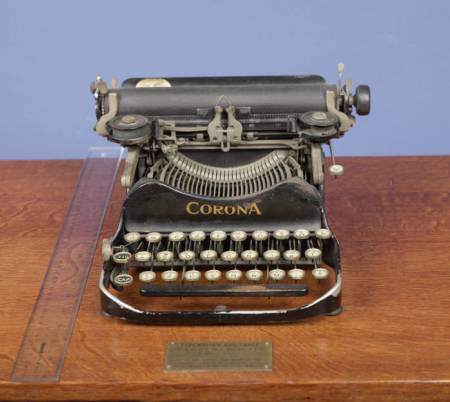
Mencken’s typewriter

January 10, 2007

Mencken's Corona Typewriter, Enoch Pratt Library

Mencken's Corona Typewriter, at the Mencken Room in the Enoch Pratt Library, Baltimore, Maryland

The typewriter that belonged to H. L. Mencken. Photo by the Enoch Pratt Free Library, Baltimore, Maryland. [Update, April 15, 2007: The photo has moved, and is restricted by copyright; you may follow the links to view the original photo of the typewriter, at the site of the Enoch Pratt Free Library. E.D.]

Was this the machine upon which Mencken composed the Millard Fillmore/Bathtub hoax?  Perhaps.  It was used prior to 1930.


Millard Fillmore’s Bathtub?

July 3, 2006

History is a study of what happened and why. Often, high school and college studies of history are ruined by rote memorization of a long list of dates with a couple of words describing an event. That is not history. Often, studies of history are ruined through unreliable sources.

H. L. Mencken, the famous newspaper columnist from Baltimore, wrote a column published December 28, 1917, about the history of the bathtub, specifically that it was rare in the U.S., and how President Millard Fillmore introduced it to the White House, thereby making bathtubs and bathing popular. The column was brilliant, and it was a complete fabrication, a hoax. Within two years, however, Mencken’s column had found its way to reference books, encyclopedias, and bad history books. Here is Mencken’s original column: “A Neglected Anniversary.”  [3/19/2009 – that link is dead; see Mencken’s column here.]  You can read a history of the hoax and its spread at this site, Millard Fillmore’s Bathtub.

It’s a great story, about a do-nothing president, the press, and errors of history. To know the story, dates are unimportant. No one cares what years Fillmore was actually in office, no one cares exactly when Mencken’s column was published. Knowing lists of dates has never stopped a bad historian from reciting the erroneous claim that Millard Fillmore introduced the concept of bathing in a bathtub to the White House.

But now you know better.

This site is dedicated to knowing history, especially U.S. history, better.

Thank you for visiting. Noodle around, see what articles are here, leave some comments if you care to. Especially, if you find errors, leave a note of correction.