May 23 is World Turtle Day

May 23, 2013

English: Turtles. Français : Tortoises. Deutsc...

English: Turtles. Français : Tortoises. Deutsch: Schildkröten. Griechische Schildkröte (Testudo graeca). ¼. Klappschildkröte (Cinosternum pensylvanicum). ¼. Sumpfschildkröte (Cistudo lutaria). ¼. Matamata (Chelys fimbriata). 1/16. Großkopfschildkröte (Platysternum megalocephalurn). ¼. Lederschildkröte (Dermatochelys coriacea). 1/20. Karettschildkröte (Chelone imbricata). 1/20. (Photo credit: Wikipedia)

Just found out.  Never heard of it before — and I’m rather a turtle & tortoise kind of guy, so you’d think I’d know that.

May 23 is World Turtle Day.  In fact, this is the 13th World Turtle Day.

No grand pronouncements from Congress, probably — American Tortoise Rescue picked a day, and that was that.

American Tortoise Rescue (ATR) is sponsoring its 13th annual World Turtle Day 2013 on May 23rd.  The day was created as an annual observance to help people celebrate and protect turtles and tortoises and their disappearing habitats around the world.  Susan Tellem and Marshall Thompson, founders of ATR, advocate humane treatment of all animals, including reptiles.  Since 1990, ATR has placed about 3,000 tortoises and turtles in caring homes.  ATR assists law enforcement when undersize or endangered turtles are confiscated and provides helpful information and referrals to persons with sick, neglected or abandoned turtles.

“World Turtle Day was started to increase respect and knowledge for the world’s oldest creatures.  These gentle animals have been around for about 200 million years, yet they are rapidly disappearing as a result of the exotic food industry, habitat destruction, global warming and the cruel pet trade,” says Tellem. “We are seeing smaller turtles coming into the rescue meaning that older adults are disappearing from the wild thanks to the pet trade, and the breeding stock is drastically reduced.  It is a very sad time for turtles and tortoises of the world.”  (See slide show here http://www.slideshare.net/tellem/where-have-all-the-turtles-gone.)

Turtles, Tortoises, and Terrapins are reptiles...

Turtles, Tortoises, and Terrapins are reptiles of the Order Testudines (all living turtles belong to the crown group Chelonia), most of whose body is shielded by a special bony or cartilagenous shell developed from their ribs. (Photo credit: Wikipedia)

Tellem says, “We are thrilled to learn that organizations throughout the world now are observing World Turtle Day, including those in India, Australia, the UK and many other countries.”  Tellem notes that biologists and other experts predict the complete disappearance of these reptiles within the next 50 years.  She recommends that adults and children do a few small things that can help to save turtles and tortoises for the next generation:

  • Never buy a turtle or tortoise from a pet shop as it increases demand from the wild.
  • Never remove turtles or tortoises from the wild unless they are sick or injured.
  • If a tortoise is crossing a busy street, pick it up and send it in the same direction it was going – if you try to make it go back, it will turn right around again.
  • Write letters to legislators asking them to keep sensitive habitat preserved or closed to off road vehicles, and to prevent off shore drilling that can lead to more endangered sea turtle deaths.
  • Report cruelty or illegal sales of turtles and tortoises to your local animal control shelter.
  • Report the sale of any turtle or tortoise of any kind less than four inches.  This is illegal throughout the U.S.

“Our ultimate goal is to stop the illegal trade in turtles and tortoises around the world.  Our first priority here in the U.S. is to stop pet stores and reptile shows from selling illegal hatchling tortoises and turtles,” says Thompson.  “We also need to educate people who are unfamiliar with their proper care about the real risk of contracting salmonella from turtles.  Schools and county fairs are no place for turtles. Wash your hands thoroughly every time you touch a turtle or its water, and do not bring turtles into homes where children are under the age of 12.”

For answers to questions and other information send e-mail to info@tortoise.com; on Twitter @tortoiserescue; “Like” American Tortoise Rescue at www.Facebook.com/AmericanTortoiseRescue; and join World Turtle Day on www.Facebook.com/WorldTurtleDay.

Here’s to you Freddie, the Western Box Tortoise from Idaho, and Truck, the desert tortoise from Southern Utah, the friends of my youth.  And all you others.

Red-eared sliders, turtles at Texas Discovery Gardens - photo by Ed Darrell

Red-eared sliders cluster together to catch the sun on a spring day at Texas Discovery Gardens at Fair Park in Dallas. Photo by Ed Darrell, 2010

More:


Grosbeak!

May 1, 2013

Our goldfinches left several weeks ago.  The cedar waxwings came through in at least three big waves, starting in February (and the last just over a week ago).  House finches moulted, and the breeding males have bright red heads. Migrating robins left us by the end of January, but a lot more residents stayed with us.

We have at least one, and maybe three cardinal families.  A black-capped chickadee family stuck around.  Haven’t seen a titmouse in a month, but I think they’re still in the neighborhood.  The black-chinned hummingbird family is back, and maybe a few other hummers.  The resident blue jays and white-winged doves duke it out every day.  Carolina wren stayed, and may have already fledged; but there are too many wrens for one family — is that a Bewick’s wren?

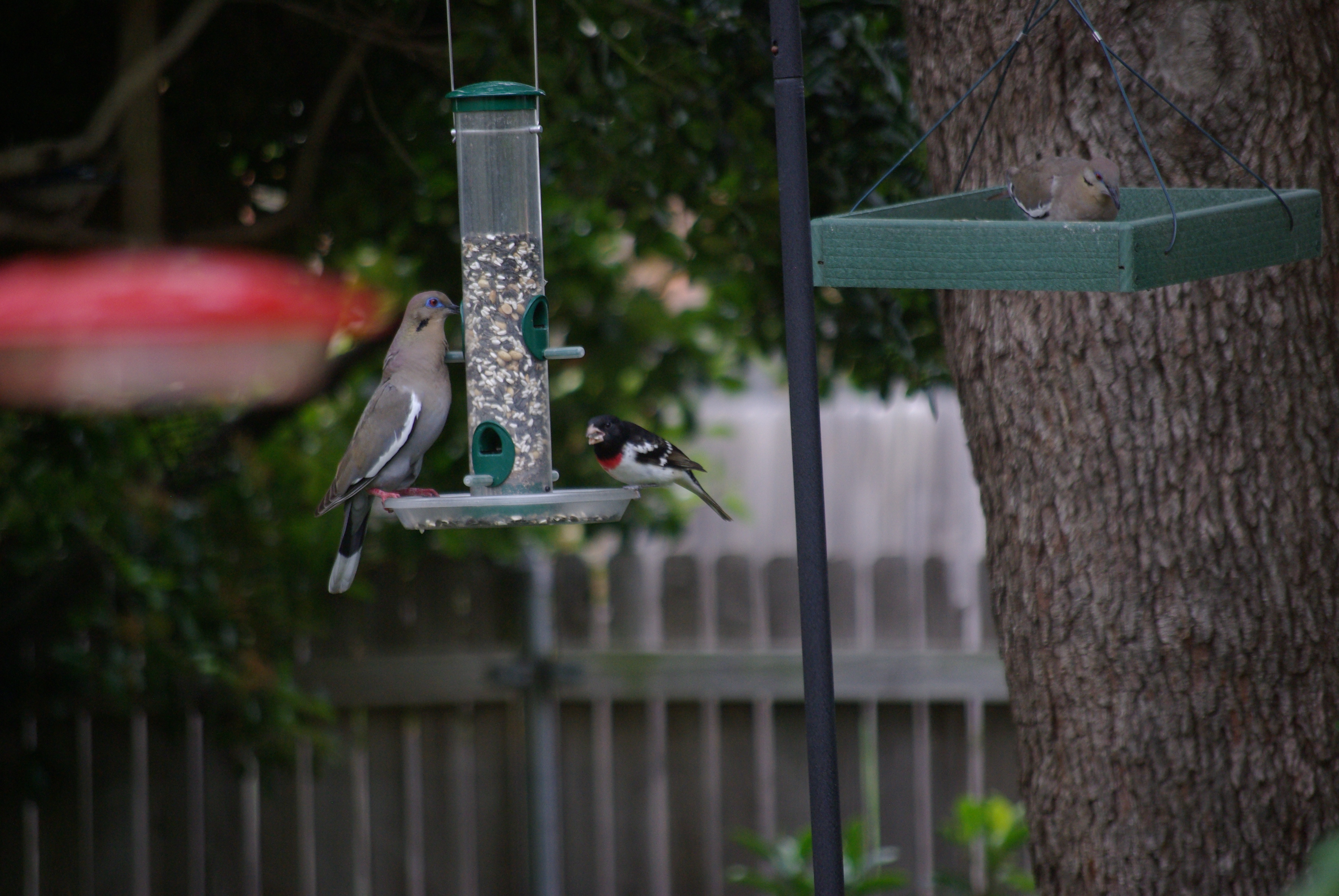
What’s THAT?

White winged dove and rose-breasted grosbeaki

White-winged dove, left, can’t scare away the rose-breasted grosbeak from the songbird feeder. Photo by Ed Darrell

IMGP4861

Look closer. Photo by Ed Darrell

It’s a rose-breasted grosbeak, Pheucticus ludovicianus.  It seems late for migrating birds, but only because so many migratory species migrate earlier these days.

Haunts of the rose-breasted grosbeak, from Cornell University's ornithological laboratory.

Haunts of the rose-breasted grosbeak, from Cornell University’s ornithological laboratory.

Would love to have a grosbeak family, but the Cornell ornithologists say this is fly-through territory.  Maybe that explains why it won’t scare by the white-winged dove, Zenaida asiatica.  Dallas is the western edge of the grosbeaks’ migratory path, but the eastern edge of the dove’s territory.  They probably don’t see much of each other.

We don’t even advertise clean restrooms.

More:


War between frogs and dragonflies: Frog fail!

April 2, 2013

Which do you think eats more destructive insects, a frog or a dragonfly?

In the war between frogs and dragonflies, for which do we cheer?

Browbeat said:

You should read Natalie Angier’s entire piece about dragonflies from yesterday’s New York Times, of course. But first, you should watch the video above, by Andrew Mountcastle, which accompanies the piece. You should watch it again and again and again.

More:


More Aurora borealis, and Iceland

March 22, 2013

More Iceland than Aurora.  Not necessarily bad.  Great timelapse photos.

You have my permission to turn down the music volume.

Filmmaker Anna Possberg wrote:

Iceland has become a popular destination since the singer Björk made her island famous by her songs. Yet few people know Iceland during wintertime. And I am sure that they miss a beautiful part of the island: the snow covered rocks, the magic arctic light and especially the phantastic aurora borealis dancing in the sky. The days spent at the Jokülsarlon glacial lake were one of the most beautiful and peaceful Christmas time I remember.

English: Jökulsárlón, a glacial lake in Icelan...

Jökulsárlón, a glacial lake in Iceland. To the right, the mouth of the glacier Vatnajökull. Wikipedia photo

More:


Fireworks for James Madison’s birthday! Aurora borealis in Alaska, March 16, 2013

March 22, 2013

Fireworks for James Madison’s birthday?

Loren Holmes photo of Aurora borealis over Eureka, Alaska, March 16, 2013

Loren Holmes photograph straight up of Aurora borealis over Eureka, Alaska, on March 13, 2013. AlaskaDispatch.com

I love fireworks.  Kathryn and I have been known to drive a couple hundred miles to see a good show.  Fireworks in honor of the guy who gave us the Constitution and the First Amendment (and much more), seems a great idea to me.

But no one did it . . .

Sometimes the Sun, Moon, stars and planets conspire.

Here’s one of the best, most inspiring five minutes you’ll spend this week. Look what the Sun sent us, filmed in time-lapse glory above Eureka, Alaska, on March 16, 2013, the anniversary of James Madison’s birthday; from AlaskaDispatch.com:

A timelapse of the Aurora Borealis, Northern Lights, over Eureka, Alaska on March 16, 2013. Taken with a Canon 5D Mark III and 24mm f/1.4 and 70-200 f/2.8 lenses. Compiled from 3800 images, with exposures between 2 seconds and 30 seconds.

Loren Holmes, the photographer, provides a more poetic description of the lights he filmed, and more scientific, too, at AlaskaDispatch.com.

AlaskaDispatch.com provided a slide show of Holmes’s better photos, too.

Tip of the old scrub brush to Dr. M. P. Bumsted.

More:


Waiting for Comet Godot

March 14, 2013

Comet Pan-STARRS?

I just can’t see it.

The past two evenings, when it was supposed to be visible, we couldn’t find it.  Maddeningly, others have great photos of the thing.

Here’s a photo of where it was supposed to be the evening of March 12.  Nice sliver of a Moon.

A view to the west over south Grand Prairie, Texas, showing the sliver of the new Moon, but a no-show Comet Pan-STARRS, March 12, 2013.  Photo by Ed, Kathryn and Peanut.

A view to the west over south Grand Prairie, Texas, showing the sliver of the new Moon, but a no-show Comet Pan-STARRS, March 12, 2013. Photo by Ed, Kathryn and Peanut.

We watched for over an hour, from just after the Sun’s winking out in a blaze of orange (Texas dust and DFW smog).  We were shooting without a tripod, and so it was difficult to capture just how thin was the line of the Moon for a long time.  It was not a clear crescent, with mountains of the Moon providing jagged lines that glistened like a crystal glass necklace.  Longer exposures revealed the comet to other observers in other places, but not to us.  Perched as we were right on the edge of the Austin Chalk Escarpment, we were joined by a dozen or so others who hoped to see the comet, or who were just putting their BMX bikes away.

A more detailed, and grainy, shot of the Moon (with no comet):

New Moon over Grand Prairie Texas, looking for Comet Pan-STARRS, photo by Ed Darrell

Eventually the Moon stated its presence, but still no Comet Pan-STARRS, on March 12, 2013. Looking west over Grand Prairie, Texas.  (Yeah, probably would have been a much better photo if not handheld.)

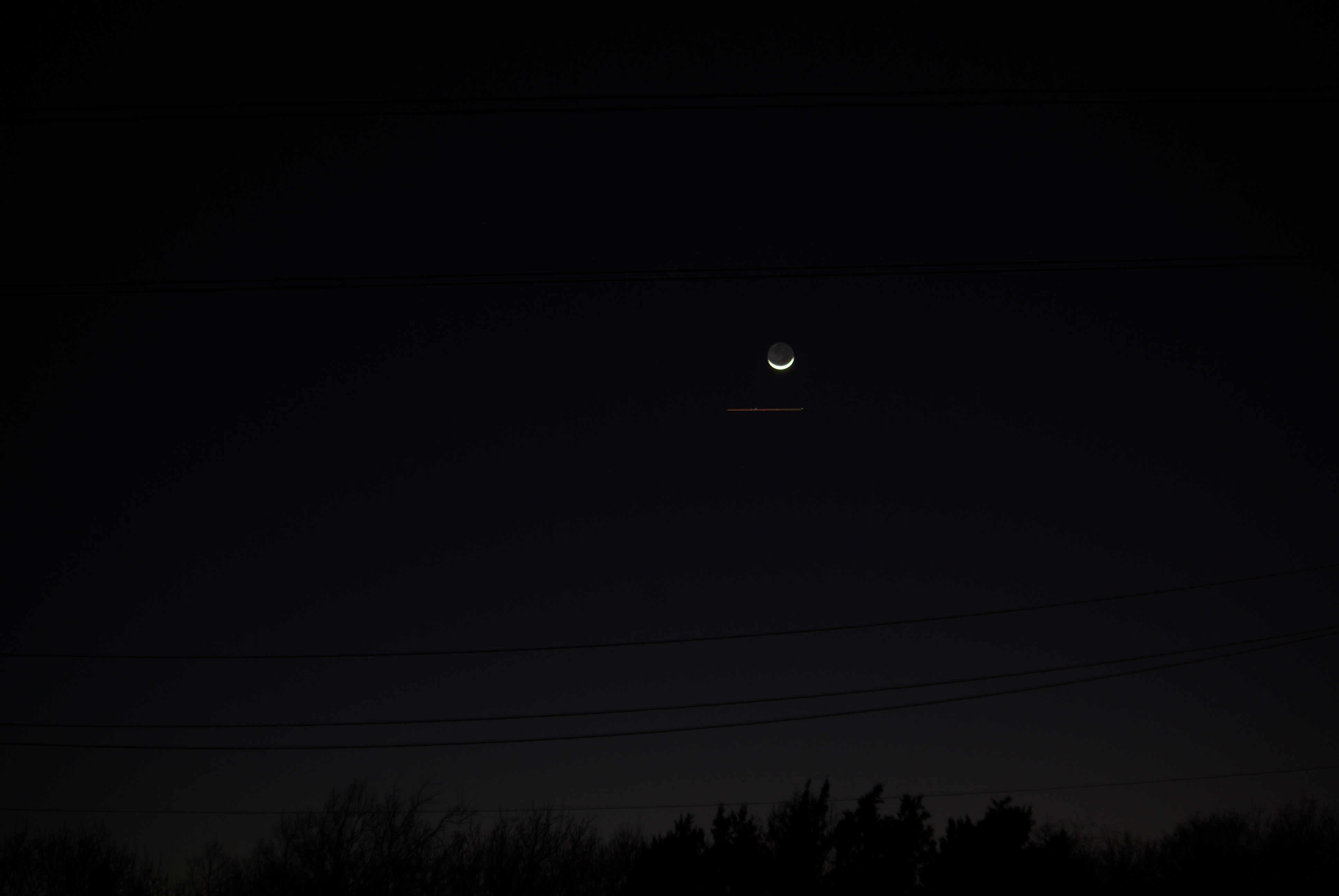
Here’s a photo of where it was supposed to be last night, the evening of March 13.

Moon over Grand Prairie, no comet, 3-13-2013

On March 13, Comet Pan -STARRS rode directly underneath the Moon; it’s invisible in this longer exposure, though you can see the streaking lights of a jetliner flying out of DFW International Airport under the Moon.

It’s like waiting for Godot.  Waiting for Comet Godot.

Quoting from SamuellBeckett.net:
ESTRAGON: 
People are bloody ignorant apes.  He rises painfully, goes limping to extreme left, halts, gazes into distance off with his hand screening his eyes, turns, goes to extreme right, gazes into distance. Vladimir watches him, then goes and picks up the boot, peers into it, drops it hastily.
VLADIMIR:  Pah!He spits. Estragon moves to center, halts with his back to auditorium.
ESTRAGON:  Charming spot. (He turns, advances to front, halts facing auditorium.)
Inspiring prospects. (He turns to Vladimir.)
Let’s go.
VLADIMIR:  We can’t.
ESTRAGON:  Why not?
VLADIMIR:  We’re waiting for Godot.
ESTRAGON:  (despairingly). Ah! (Pause.) You’re sure it was here?
VLADIMIR:  What?
ESTRAGON:  That we were to wait.
VLADIMIR:  He said by the tree. (They look at the tree.) Do you see any others?
ESTRAGON:  What is it?
VLADIMIR:  I don’t know. A willow.
ESTRAGON:  Where are the leaves?
VLADIMIR:

It must be dead.


More:

Brian Klimowski's photo of Comet Pan-STARRS, March 12, 2013

Other photographers found Comet Pan-STARRS. This photo comes via SpaceWeather.com. ” Brian Klimowski sends this picture from the countryside near Flagstaff, Arizona . . . ‘Beautiful show this evening!’ says Klimowski. ‘I took the photo from an altitude of about 9500 feet in the San Francisco Peaks near Flagstaff. A 1-second exposure with my Canon digital camera easily revealed the comet.'” Photo details: Canon 7D, 125 mm, 1s @ F/5.6. ISO 1250


Brilliant film: A Forest Year, from Motionkicker

March 14, 2013

Cousin Amanda Holland called my attention to this on Facebook.  Time lapse photography and a forest — heavenly to me.

More details from Motionkicker,  Samuel Orr:

help support my new time-lapse project at kickstarter!
kickstarter.com/projects/motionkicker/new-york-year

A Forest Year was made from 40,000 still images taken from my front window over 15 months, and were blended into the film.

Find out more about how it was made at motionkicker.com

Special thanks to Johnny_RIpper for letting me use his music.
soundcloud.com/johnny_ripper

Tip of the old scrub brush to Amanda Holland and the National Forest Foundation.

More:


Backyard birds: Goldfinch at the feeder

March 12, 2013

No, he’s not particularly gold — but this is winter, and if he’s going to get his breeding plumage, it will come in a couple of weeks.

We’ve had Niger thistle seed feeders out for years; this year one goldfinch (Spinus tristis) finally started to visit.  We’ve had as many as four at a time — but they’re probably headed north soon.

Here’s a shot of our first guest, from a couple of weeks ago.

Goldfinch at the feeder

A goldfinch male, checking out the feeder before bringing in his buddies — we hope.

If you’re north of Dallas, and you see this guy at your feeder this summer, tell him “hello” from us.

The non-breeding plumage isn’t so flashy as the bright yellow of the breeding males.  Some of the finches settle in to a beautiful, smooth olive-drab livery for much of the winter.  Close up, they look like good pen-ink-drawings by a master artist.

More:


Sounds of the Yellowstone in winter will haunt you, lovingly

February 14, 2013

This is a heckuva research project: What is the sound ecosystem of the Yellowstone?

Film from Yellowstone National Park:

The film was produced by Emily Narrow for NPS, with financial assistance from the Yellowstone Association.

From NPS:

Published on Jul 13, 2012

Many people come to Yellowstone to see the fantastic landscapes. Wise visitors also come to experience the amazing soundscapes. This video provides some insight into the value of natural sounds in wild places and how the park is monitoring those sounds as well as the sounds created by humans.

Nothing matches the sound of a western river, to my mind.  I love the sound of the tumbling waters, and it was on one of those roaring creeks that we scattered the ashes of my Yellowstone-loving oldest brother Jerry Jones.

Poster for Yellowstone National Park, Wyoming/...

Classic, vintage poster for Yellowstone National Park, Wyoming/Montana, USA (Photo credit: Wikipedia)

Other sounds will captivate you.  The rush and gush of the geysers, and the gurgle and plop of heated pools rivets you for a while.  Once you hear the chuff of an interested grizzly bear, you don’t forget it.  And while it can be scary if you’re relatively alone on the trail, the howl of the wolf tells you about the wilderness in a way no other sound ever can.  The honks of the geese, the trumpets of the swans, the grunts of the bison, the scolding of the many different squirrels and chipmunks, the slap of a trout jumping out of the river — these are all worth making the trip.

After you go, these sounds will lovingly haunt your life.  You’ll smile when you remember them.

I hope you can go soon.  (I hope I can go, soon.)

Sad note:  Only 1,553 people have watched this video since last July.  Can you spread the word a bit?

More:


Backyard birds: A convention of white-winged doves

February 8, 2013

The white dove was a short-lived interlude; the white-winged doves seem to be with us constantly.

One family in 2011; two families in 2012 — and our yard isn’t that big.

A very early version of the birds who visited, befriended, and plagued Snoopy — this drawing, while faithful to Shultz’s work, was done by another artist.

Earlier this week I looked out, and it looked like the early “Peanuts” comic strip when Snoopy opened his dog house to a group of pigeon-like birds for their poker game.  The birds took advantage of Snoopy’s largesse, and nearly over-ran him.  (Woodstock was a product of that flock of birds, the last remaining vestige by Charles Shultz‘s death.)

At least they didn’t drink our beer and try to make off with the Picasso.

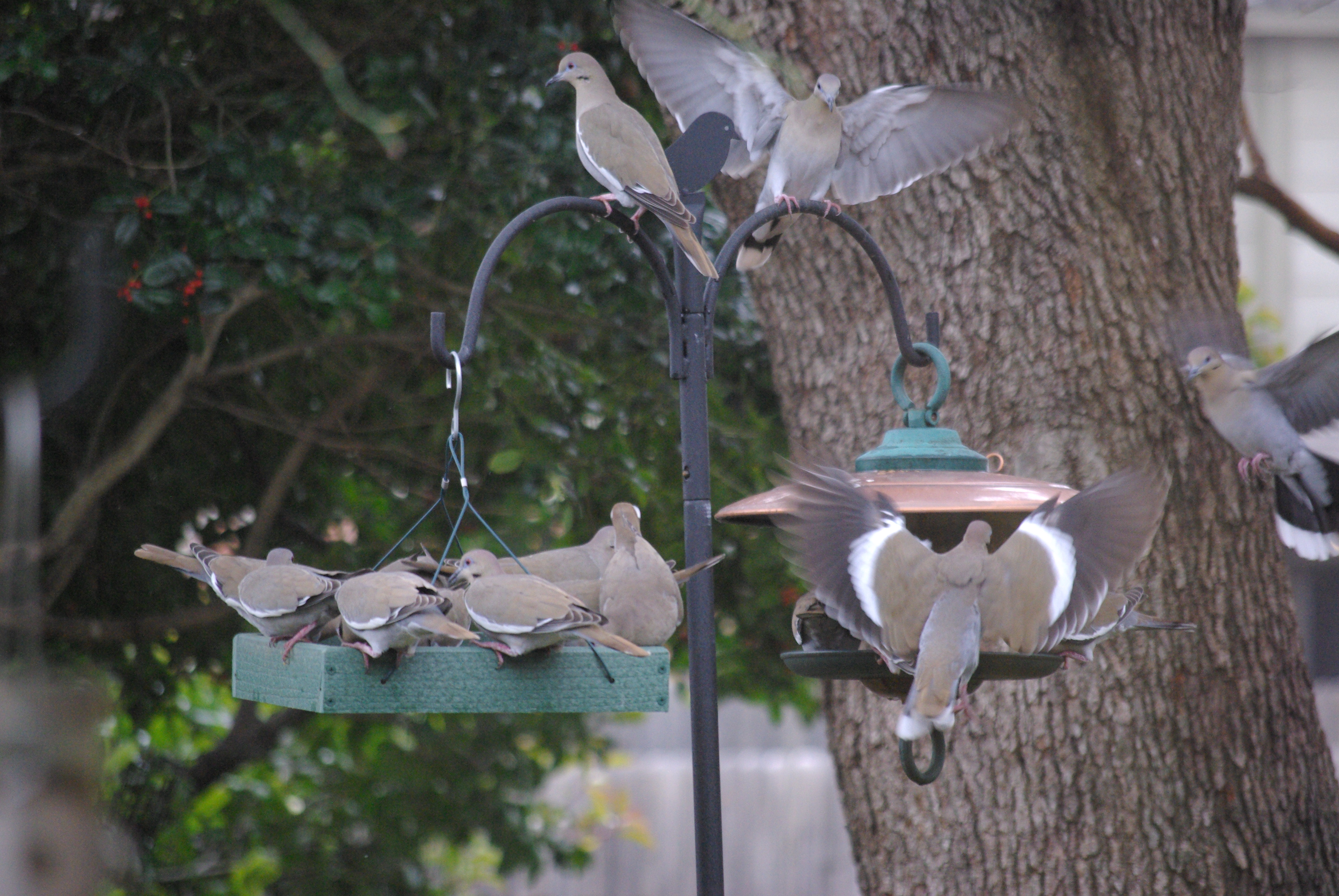
White-winged doves are really too big for any of our feeders -- but what are you going to tell a rampaging herd of them?  Photos by Ed Darrell - use encouraged with attribution.

White-winged doves are really too big for any of our feeders — but what are you going to tell a rampaging herd of them? Photos by Ed Darrell – use encouraged with attribution.

White-winged doves crowding at the bird feeders

Enough doves to frighten Alfred Hitchcock — Two of these birds is too many for either side of this feeding station. How many do you see here?

White winged doves jostle for position at the feeder.

Not enough room for all, and so they jostle and push each other off the feeders. See the display of the white stripe on the wings of one of our subjects here, from which the species gets its name.

Blue jays enforce the “too-long-or-too-many-at-the-feeder” rules here, but they can be distracted by peanuts put out by neighbors.  In any case, they were absent when we needed them.

We used to have mourning doves, but at some point in the last five years this bunch pushed them out.  We may be the only ones on the block who noticed.  (Yes, it’s “mourning” dove; Duncanville’s having misspelled it on “Morning Dove Lane” is their error.)

More:


Eagles! We reduced DDT, and the eagles recovered

January 28, 2013

Love this photo, from the great folks at Yellowstone National Park:

Chris Daniel photo of a bald eagle in Yellowstone National Park, in the snow

From the Yellowstone NP Facebook site: An adult bald eagle perched along the Firehole River on New Year’s Day, near a trumpeter swan that it had either killed or was scavenging. Adult bald eagles usually remain in or near their nest territory throughout winter provided they have access to sufficient prey. Photo courtesy of Chris Daniel. (kd)

It’s a reminder of progress we’ve made in environmental protection.

While bald eagles may not have been the most endangered animal protected under the Endangered Species Act, or any other law, they became the most famous.  In the late 18th century Congress voted to designate the bald eagle as our national symbol.  At the time, the continent was still lousy with the creatures.  But from the arrival of Europeans after 1492, eagles had been hunted mercilessly.  By the early 20th century it was clear the animal was bound for extinction, like the great auk and other species (see here for technical information on the auk).

Ben Franklin complained the eagle was a dirty carrion eater, in a smart and funny polemic favoring the American turkey as the national bird.  Franklin couldn’t know how hunting and in-breeding would suck the nobility out of even wild turkeys over the next 200 years, until species protection laws and hunters pushed governments to invigorate stocks of wild turkeys again.  Compared to the eagle’s troubles, though, the turkey’s genetic torpor and limited habitat was almost nothing.

Americans tried to save the eagle.  After 1890, and during the run on great bird feathers that excited the fashion world and led to the senseless slaughter of millions of America’s most spectacular birds, we passed a federal law against hunting and shooting eagles for sport or no reason.  It was a toothless law, and the decline of eagle populations begun in the early 16th century continued unabated. Migratory bird treaties, providing more legal heft to bird protection, didn’t help the eagles either — not enough of them crossed borders, at least not that hunters and law enforcement could see.  The Bald Eagle Protection Act of 1940, kicking into action in 1941, provided teeth to eagle hunting restrictions, and hunters stopped shooting them so much.  Between 1940 and 1950, eagle populations stabilized, with a good bunch in Alaska, and a few nesting pairs spread from Oregon to Maine, Lake of the Woods to Florida Everglades.  There were so few eagles, and they were spread so far apart, that most Americans could not see one without major effort and travel.

Bird watchers noticed trouble in the 1950s.  Young eagles stopped showing up for the Audubon Christmas bird count, and at the Hawk Mountain migration counts.  Adults went through the motions, migrating, hunting, building nests, laying eggs for all anyone knew, and hatching young that had been seen, sometimes, to fledge — but then the young birds died.  Between leaving the nest, and returning to mate up and breed, the young birds simply disappeared.

Research showed deeper trouble.  On careful observation the birds were seen to be frustrated in hatching and raising chicks.  Sometimes the eggs wouldn’t hatch.  If they did hatch, the chicks died.  The few who lived to fly out, died soon after.

Rachel Carson called attention to the trouble in her 1962 claxon call on pesticide and chemical pollution, Silent Spring (50 years ago in 2012).

Doctor Science at Obsidian Wings wrote a paean to seeing bald eagles in the wild, with a brief and kind mention of this blog. You should go read it there.

Protecting birds?  The Steve Milloys, CEIs, AEIs, Heritage Foundations, CATO Institutes and other dens of smug cynicism and bad citizenship have it all wrong.  It’s not about power for environmentalists.  It’s nothing so cheap or mean.  Heck.  Often it’s not even about protecting the birds so much.

It’s about protecting our own dreams, and places we have to inspire those dreams.  Frederick Jackson Turner postulated that there is something mystical and magical in a frontier that helped form the American character and make us hard-working, smart, and noble.  He was right, of course.  Those frontiers are not simply frontiers of settlement in the wilderness anymore.  We have to work to find them, to declare Alaska the “Last Frontier,” or government reform and Cold War enterprise as the “New Frontier.”  But we still need frontiers.

Eagles still soar there.  Wherever eagles soar, in fact, we find those frontiers, those places to dream and inspire.  The Endangered Species Act isn’t about saving animals and plants.  It’s about saving our own souls.

More:


Montreal baby experiences terror of being ‘lifted up by eagle’s wings’ (hoax?)

December 19, 2012

East Coast son Kenny sent this video, noting his reaction was the same as the guy in the film; an encounter with a golden eagle in a Montreal park:

You can take the eagle out of the wild, but you can’t take the wild out of the eagle.

Looks mostly like a golden eagle to me — anyone want to make the case it’s a different bird?

What’s going on in Montreal, I wonder, that would make a golden eagle think a human baby might make a good meal?  (No, I don’t think the bird was trying to give the kid a thrill.)

Other reports of similar incidents around Montreal?

Update:  WHAT?  IT’S FAKED? Thoughtful reader Luisa in comments refers us to Chris Clarke’s Original Blog™ Coyote Crossing, which updates from expert birder Kenn Kauffman who says, as I wondered, it’s not a golden eagle, and other things look hoaxed. (While you’re looking around, check out Luisa’s Crow and Raven; bird photos that will make you jealous.)  You’d think an incident like that would have made it to the newspapers and television stations in Montreal, but I’ve found nothing — have you?)

Update, December 19, 2012:  Now the CBC covers the tale,  noting that it is most likely a hoax.  The film’s maker or YouTube poster has not defended it that I can find.  Watch carefully — the “baby” doesn’t move during the time it’s on the ground, through the bird’s plucking it up and dropping it.  There’s plenty of time to swap a dummy out with a real kid in the stroller while the camera is pointed away.  CBC found a Montreal ornithologist who claims it looks more like an osprey than an eagle.  I’ll buy that.

More:


Geminid meteor shower, December 13, 2012

December 12, 2012

StarDate lists December 13 as probably the best night for the year’s last meteor shower, the Geminids.

Dennis Mammana photo of Geminid meteoroid near Orion

Astrophotographer Dennis Mammana caught a Geminid fireball streaking near the stars of Orion. (what year?) CREDIT: ©Dennis Mammana/dennismammana.com

Are you up for it?  Or, do you plan to stay up for it?  Space.com said this one is likely to be better than the Leonids of last month:

If you were disappointed with the meager showing put on by this year’s Leonid Meteor Shower, don’t fret.  What potentially will be the best meteor display of the year is just around the corner, scheduled to reach its peak on Thursday night, Dec. 13: the Geminid Meteors.

The Geminids get their name from the constellation of Gemini, the Twins.  On the night of this shower’s maximum the meteors will appear to emanate from a spot in the sky near the bright star Castor in Gemini.

The Geminid Meteors are usually the most satisfying of all the annual showers, even surpassing the famous Perseids of August. Studies of past displays show that this shower has a reputation for being rich both in slow, bright, graceful meteors and fireballs as well as faint meteors, with relatively fewer objects of medium brightness. Geminids typically encounter Earth at 22 miles per second (35 kilometers per second), roughly half the speed of a Leonid meteor. Many appear yellowish in hue. Some even appear to travel jagged or divided paths.

EarthSky.org said the show starts as soon as Gemini rises — soon after sunset in the nothern middle latitudes.  Look east to the constellation Gemini, toward the star Castor. (I’m using my iPhone NightSky app; wish I had my old Android and Google Sky.)  Get a coat.  Get your binoculars, your tripod and camera (you’ll want time exposures, yes?).  Maybe take some gloves, and a Thermos of hot chocolate.  Out of the city, out where the sky is dark.  The Moon is in a new phase, and shouldn’t be visible when the meteor watching is hot.

Send us your pictures. (Here are instructions from Patch.com on how to photograph this shower.)  Good luck!

Babak Tafreshi, photo of 2009 Geminid meteor

Babak Tafreshi’s photo of a Geminid meteoroid in 2009. Note position of Orion, on the right.

More:


Watching the Leonid meteor shower 2012

November 17, 2012

Faithful stargazers may already have spotted a few shooting stars from this year’s Leonid shower.  Best estimates are that the peak will come the night of Saturday, November 17.

Meteor from 2009 Leonid shower, Wikimedia Commons

A meteor streaks across the sky during the 2009 Leonid meteor shower. (Navicore / Wikimedia Commons via Los Angeles Times)

Ready?

One of our best sources on viewing meteors is the StarDate website.  Their advice for tonight:

The next meteor shower is the Leonids on the night of November 17

The best viewing for this year’s Leonid meteor shower will be several hours before dawn on November 17. The shower should produce perhaps a dozen or so “shooting stars” per hour. The best view comes in the wee hours of the morning, as your part of Earth turns most directly into the meteor stream.

*     *     *     *     *

What is a meteor shower?

A meteor shower is a spike in the number of meteors or “shooting stars” that streak through the night sky.

Most meteor showers are spawned by comets. As a comet orbits the Sun it sheds an icy, dusty debris stream along its orbit. If Earth travels through this stream, we will see a meteor shower. Although the meteors can appear anywhere in the sky, if you trace their paths, the meteors in each shower appear to “rain” into the sky from the same region.

Meteor showers are named for the constellation that coincides with this region in the sky, a spot known as the radiant. For instance, the radiant for the Leonid meteor shower is in the constellation Leo. The Perseid meteor shower is so named because meteors appear to fall from a point in the constellation Perseus.

What are shooting stars?

“Shooting stars” and “falling stars” are both names that describe meteors — streaks of light across the night sky caused by small bits of interplanetary rock and debris called meteoroids vaporizing high in Earth’s upper atmosphere. Traveling at tens of thousands of miles an hour, meteoroids quickly ignite from the searing friction with the atmosphere, 30 to 80 miles above the ground. Almost all are destroyed in this process; the rare few that survive and hit the ground are known as meteorites.

When a meteor appears, it seems to “shoot” quickly across the sky, and its small size and intense brightness might make you think it is a star. If you’re lucky enough to spot a meteorite (a meteor that makes it all the way to the ground), and see where it hits, it’s easy to think you just saw a star “fall.”

How can I best view a meteor shower?

Get away from the glow of city lights and toward the constellation from which the meteors will appear to radiate.

For example, drive north to view the Leonids. Driving south may lead you to darker skies, but the glow will dominate the northern horizon, where Leo rises. Perseid meteors will appear to “rain” into the atmosphere from the constellation Perseus, which rises in the northeast around 11 p.m. in mid-August.

After you’ve escaped the city glow, find a dark, secluded spot where oncoming car headlights will not periodically ruin your sensitive night vision. Look for state or city parks or other safe, dark sites.

Once you have settled at your observing spot, lie back or position yourself so the horizon appears at the edge of your peripheral vision, with the stars and sky filling your field of view. Meteors will instantly grab your attention as they streak by.

How do I know the sky is dark enough to see meteors?

If you can see each star of the Little Dipper, your eyes have “dark adapted,” and your chosen site is probably dark enough. Under these conditions, you will see plenty of meteors.

What should I pack for meteor watching?

Treat meteor watching like you would the 4th of July fireworks. Pack comfortable chairs, bug spray, food and drinks, blankets, plus a red-filtered flashlight for reading maps and charts without ruining your night vision. Binoculars are not necessary. Your eyes will do just fine.

StarDate offers a wealth of resources on meteor showers, and clips from their radio programming on specific events.

Here’s a map of where to look in the sky (also from StarDate, though that’s not where I found it!):

Starmap, where to look for Leonids, StarDate via NBC

Where should you look for Leonid meteors? Orient this map, and look to the east – courtesy of StarDate via NBC

Next up:  The Geminids shower, about December 13, 2012.

More:


Utah’s Mount Timpanogos, no PhotoShop needed

November 16, 2012

Here’s a good demonstration of why you don’t need PhotoShop, but a decent camera and a steady hand instead.

Utah's Mt. Timpanogos in snow, by Craig Clyde, 2012

Utah’s Mt. Timpanogos in snow, by Craig Clyde, 2012 (rights probably reserved).  Click for larger version.

Craig Clyde took this photo of Utah Valley‘s Mt. Timpanogos, probably from Saratoga Springs, on the west side of Utah Lake, after one of the first snows of 2012.  (This area had a few farm fields when I grew up there.)  It’s a great photo for several reasons.

It’s a formerly unusual view, there being so few people on the west side of the lake until recent development.  It pictures all of Timpanogos, with American Fork Canyon on the left, Mahogany Mountain, Big Baldy, and Provo Canyon on the right.  It’s an afternoon shot, you can tell from the angle of the sun (the mountain runs on a north-south axis), and the darkness on the lower mountains may be caused by the Sun’s setting behind the mountain range on the west side of  the lake.  Timpanogos in white, in the afternoon sunshine, is one of the greatest images of a mountain you’ll ever see.

Tip of the old scrub brush to Craig Clyde.  Mr. Clyde and I attended high school together — haven’t seen him in more than 30 years; not sure, but I don’t think he’s the same Craig Clyde in the movie business.

More: